Archive

Yearly Archives: 2020

The aim of this project is to investigate if, and to what extent do ‘tropical modernist’ structures modify or mitigate climatic conditions to create more ‘comfortable’ interiors. 

Most of these structures were designed to be passively cooled and as such have a permeable façade composed of concrete screens or louvres to facilitate cross ventilation air-flow, and to create shade. A good example is the Children’s Library in Accra, designed by Nickson and Borys in 1957.

Mainly built during the 1930s-70s, these buildings are now at an age when they require refurbishment and rehabilitation – although this is mainly superficial and does not involve structural correction. There are various options pursued, many involving the installation of air-conditioning units. For the AC to be effective it ideally requires a sealed interior volume, rendering the existing permeable façade unsuitable. 

Standard Chartered Bank: as built and passively cooled
Standard Chartered Bank: refurbished, clad in glazed panels and reliant on AC

One solution being increasingly used in Ghana is to externally clad the façades with a glazed screen, as seen on the Standard Chartered Bank on Accra’s High Street. 

The glazing cuts out street and traffic noise and reduces dust infiltration, as well as enabling the interior to be mechanically cooled. But in terms of energy usage (consumption of AC and in the fabrication of the glazed units) it is far from ideal. Furthermore, there is the financial cost of cooling what is now effectively a greenhouse in a hot and humid climate. Architecturally the building has also been dramatically altered. It is now a bland non-descript block, and lacks the patterns, shading effects, and references to the floors behind the façade. I’m not suggesting that this example is a prestigious heritage monument, but rather using it to illustrate what is becoming an increasingly common approach to refurbishment. Fortunately, in this case glazing can be easily removed and the older structure has been preserved inside.

Our project has several objectives, including to:

  1. Recognise and promote the significance of these 20thC modernist structures.
  2. Determine if the passive cooling approach does create sufficiently comfortable interiors.
  3. Investigate what conditions are comfortable for the occupants of these buildings.
  4. Investigate alternatives to AC that provide low cost and low energy comfortable interiors without detrimentally impacting upon the architectural quality.

To test both inland and coastal conditions we’ve selected a case study at KNUST in Kumasi, and another at the University of Ghana, Accra.  Both buildings are university libraries, and as such have a large number of daily visitors that we can consult. The library at KNUST was designed as a louvred screen wall, fully adjustable from the interior, and also has a later brutalist extension with a twin façade arrangement and partially air-conditioned interior. 

KNUST Library: a facade of adjustable louvres

At Accra, the Balme Library takes a more colonial/traditional approach with a series of courtyards, loggias and high ceilings. Some of the rooms have been retro-fitted with air-conditioning, whilst at the same time naturally ventilated. Both libraries are large institutional buildings and have the potential to consume large amounts of energy should they be refurbished with full AC and cooled to ASHRAE recommendations. Furthermore, it is important for the health and education of the staff and students that these buildings are comfortable places to spend time in, and to study. 

Balme Library at University of Ghana

In each building we’ve installed a number of Hobo data-loggers that record the temperature and humidity at regular intervals. Whilst this data allows us to determine whether the internal temperature/humidity is different to the external condition, it does not tell us if the conditions are comfortable to the inhabitants. To establish this, we’ve consulted the library users and staff to enquire how comfortable they feel in the various library spaces. The respondents also recorded their attire, age, sex, and how long they have been in the library prior to completing the survey.  Over 250 people completed the survey at KNUST in January 2020. We will repeat this in the ‘rainy season’, and conduct similar surveys at Accra. When we’ve gathered this data we can correlate the data-logger findings with those of the user surveys. We’re also constructing 3d computer models of the buildings to test various refurbishment scenarios and cooling options.

Our partners in this project are Dr. Haniyeh Mohammadpourkarbasi at University of Liverpool; Dr. Irene Appeaning-Addo and Dr. Dan Nukpezah from University of Ghana; and Prof. Rexford Assasie-Oppong at KNUST. We’re also indebted to the library staff and students at each institution. Funding has been generously provided by the University of Liverpool ODA Seed Fund 2019-2020.

Updates to follow when we have more data and findings to report.
Mojca Smode Cvitanovic, ‘New Paper: Tracing the Non-Aligned Architecture: Environments of Technical Cooperation and the Work of Croatian Architects in Kumasi, Ghana (1961-1970)’ Histories of Postwar Architecture, 3(6), 34-67. Full paper available here: DOI: https://doi.org/10.6092/issn.2611-0075/10450

Unity Hall, KNUST, designed by Miro Marasović and John
Owusu Addo, 1968.

Focusing on the work of a group of Croatian i.e. Yugoslav architects in Ghana, the paper explains the nature of technical cooperation as a model of temporary international contract work in relation to the specificities of the environment built consequently. It focuses on the engagement of Miro Marasović as the head of the Kwame Nkrumah University of Science and Technology Development Office from 1961 to 1964. As its contextual framework, the paper addresses bilateral technical cooperation as a form of international communication and exchange, the practices of the Non-Aligned Movement, and the interrelations of the pre- and post-independence generation of modern architecture in Africa.

[See also KNUST archival drawings here ]

This thematic section of ABE Journal, edited by  Jiat-Hwee Chang and Daniel J. Ryan, explores the wide-ranging socio-environmental implications of comfort for architectural history. The contributions over this and the next issue complicate and expand upon our understanding of comfort. Each essay unpacks how comfort was situated and assembled in the built environment of different temporalities and geographies, beyond the taken-for-granted immediacy of the present and the discursive familiarity of temperate European and North American contexts.

 “The five zones showing in a graphic manner the climates, peoples, industries and productions of the earth” published by Western Publishing House, Chicago, in 1887

Drawing from the cognate fields of scholarship in, among others, Science and Technology Studies, Postcolonial Studies, and Sociology of Practice, the contributions show how, during the past two centuries, comfort and the built environment were historically entangled with (settler) colonialism and decolonization, and the various (dis)enchantments of modernities and modernization in Asia, Australia, Latin America, and West Africa. By understanding comfort in relation to these cross-cultural and cross-climatic encounters, these contributions have far-reaching implications for comprehending our shifting and situated relationships with not just built environmental transformations but also planetary climate change.

Full edition freely available here: https://doi.org/10.4000/abe.7853

PAC@75 is an exciting four-day celebration marking the 75th anniversary of the 5th Pan African Congress, held in Manchester in 1945.

THURSDAY 15 – SUNDAY 18 OCTOBER 2020

Image created by: Zineb Berrais

Curated by Professor of Architecture, Ola Uduku, PAC@75 will be a multi-institutional series of creative and academic events, led by Manchester Metropolitan University, with contributions from The University of Manchester, the University of Salford, and the University of Bolton, and in association with a host of UK and international academic, creative and cultural individuals and institutions, including prominent local creatives and the Manchester public.

The Pan African Congress in 1945 was a precursor to the development of a number of African independence movements which went on to successfully secure self-rule for countries across Africa. It also signified the movement of the intellectual discourse on African self-realisation and solidarity with other causes; moving from the Americas and the West Indies, to the UK and then on to Africa.

The plaque commemorating this event is situated in the new Manchester Metropolitan University Arts and Humanities Building, facing onto All Saints Square, in what had previously been Chorlton Town Hall where the original six-day event took place. The Congress had 200 attendees from across the world; including delegations from Africa, America, the Caribbean and Asia, as well as black and white delegates from Manchester and across the UK.

Join us online to enjoy a range activities featuring high-profile international speakers, such as the Princeton-based writer and philosopher, Kwame Anthony Appiah, the writer and historian Afua Hirsch, and the poets Lemn Sissay, (Chancellor of The University of Manchester) and Carol Ann Duffy DBE (former Poet Laureate 2009-2019). They will be joined also by student speakers, who represent our next generation of leaders. There will also be public-facing sessions including public literature readings, art projections, and theatrical performances by the Manchester School of Theatre and Contact Theatre. PAC@75 is curated in collaboration with Dr Kai Syng Tan.

PAC@75 will bring together academics, students and the public to celebrate the impact that the diversity of Manchester has had on global history, and how this history relates to today’s contemporary challenges in the face of modern racism and the Black Lives Matter movement.

Full Programme and details here: https://www.mmu.ac.uk/pac75

We are delighted to offer researchers at select partner universities an opportunity to apply for one of University in Liverpool’s Virtual Fellowships.

The Fellowships are open to researchers working in the field of heritage and are open to early career as well as established researchers.

The Fellowships provide an opportunity for selected candidates to gain collaborative research experience in an international research environment with the aim of publishing or co-publishing a specific piece of research in an international journal or equivalent venue and fostering long-term collaboration.

The Fellowships are fully online and travel to the UK is not required.

Successful candidates will have the opportunity to collaborate virtually with a research group or designated individuals at the University of Liverpool.

The Fellowship will offer:

  • one to one research mentoring, including support in analytical and interpretive methods in heritage research: this will be delivered at a distance through zoom or similar platforms
  • relief from teaching and other duties to pursue the completion and write-up of a piece of research for publication
  • access to online research resources and training including GIS training; Photogrammetry; AutoCAD and visualisation (3D Max); 3D scanning; Fieldwork/ documentation methods support and guidance with academic writing in English
  • opportunities for research collaboration through “virtual” participation in relevant research group activities in Liverpool.

Full details on how to apply here: https://www.liverpool.ac.uk/humanities-and-social-sciences/research/training-and-support/virtual-fellowships/

Impatient Cities of the Gulf: Post-oil Architecture in Flux – Call for Papers – HPA 8/2021

Today’s general perception of Gulf cities is based on the assumption of a futuristic vision; a visionary development and a cluster of hi-tech constructions.

Since the striking of oil, this ‘brave new world’ has been a testing ground for experimental, risk imbued architecture and real estate. The sudden affluence and ambition of the rulers to demonstrate progress and social advancements (sometimes expressed through outlandish ‘iconic’ designs) has certainly fired this drive. The building of cities seemed an appropriate culvert for the vast funds generated, turning what was once barren into a fertile land.

Screenshot 2020-07-30 at 09.59.44

Furthermore, there is an ever-present sense of the ‘tabula-rasa approach’ that forced (or perhaps tempted) architects to pursue different and alternative design processes. Gulf cities seem to permit the idea, if not always the reality, of being able to ‘start again’, to be re-made, re-imagined and re-Modernised. There is a sense of being forever in the ‘now’, with ‘historical’ projects stretching back mere decades. Perhaps this desire to continually reinvent brought about shortcomings in early Modernist paradigms, and the rapid rise of new social/cultural/artistic concepts (such as pop art/metabolism/structuralism/post-modernism/idiosyncratic and so on).

These preliminary reflections offer an image of the Gulf as a fluid ambit that challenged designers for several decades in the light of a central question: how do architects build in a place with a constantly changing context? How are ideas of history, tradition, memory, and heritage constructed in this flux?

In the second half of the 20th century, the circumstantial conditions generated a series of experimental, utopian, sometimes unbuildable projects with a high level of idealisation. Some are renowned such proposals as Wright’s plan for Baghdad or the Smithsons’ Kuwait mat-building. Many are still to be unearthed as they were shelved and never implemented, or abandoned along the way, altered or demolished.

In other cases, the region’s specific constraints – such as limited material availability, narrow construction time and harsh climate, led architects to original ideas, technologies, and procurement methods with highly inventive and analytical processes.

Moreover, modern architecture in the Gulf seems somehow different for sporting an urge for negotiating the local context by ‘flirting’ with traditional elements of locality, such as geometrical motifs, shapes, textures or colour palette. The liberal application of decorative motifs, patterns, applied ornamentation needs careful examination, especially when it is so diligently applied to forms and arrangements more generally associated with a more austere modernist agenda.

The editors invite papers that extend the discussion on the Gulf built environment during the modernisation era, over the duality global/local as terms in opposition. Contributions are encouraged to analyse different architectural narratives, approaches and schools of thought to compensate the assumption that flattens ‘modernity’ as a one-directional, repetitive and monotone practice acquired and acritically transplanted into the Arab Peninsula.

Focusing on the second half of the 20th century, and with an eye on the contemporary implications, possible topics include, but they are not limited to:

–          Experimental and inventive design practices

–          Global aspiration and local constraints

–          Context negotiation

–          Materiality

–          Knowledge exchanges and bijective practices

–          Modernity, tradition and transition

–          De-colonial urbanism

–          Identity formation and the built environment

–          Place-making, streetscapes and scale

Authors must submit directly full papers using www.hpa.unibo.it.

The guidelines for paper submission are available at https://hpa.unibo.it/about/submissions#authorGuidelines

Please, fill in the author’s profile with all the information required as:

• Applicant’s name

• Professional affiliation

• Title of paper

• Abstract

• 5 keywords

• A brief CV (max 2,000 characters)

Please submit the proposal in the form of MS Word (length between 4,200 and 8,500 characters). The submitted paper must be anonymous. Please delete from the text and file’s properties all information about name, administrator etc. Papers should clearly define the argument in relation to the available literature and indicate the sources which the paper is based on.

All papers received will go through a process of double-blind peer review before publication.

HPA also looks for contributions for the review section. https://hpa.unibo.it/about/editorialPolicies#sectionPolicies

To address questions to the editors:
roberto.fabbri@udem.edu
Iain.Jackson@liverpool.ac.uk

– 31 December: Deadline for paper submission

– January: Notification of acceptance

– January-March: Peer-review process

– April-May: Copy editing and proofreading

– June 2021: Publication

Call for Papers: British Architecture in the World

As part of its long-running series Twentieth Century Architecture, the Twentieth Century Society is planning a journal for publication on the relationship between British architecture and other countries of the world, particularly those beyond Europe.

Pansodan Street, Yangon, including Chartered Bank, Palmer & Turner, 1939–41.

Pansodan Street, Yangon, including Chartered Bank, Palmer & Turner, 1939–41.

The nature of the relationship may take a number of forms, such as British-based practices working overseas, British architects establishing offices in other countries, architects coming to Britain for training before returning home, or more general issues of how the profession in Britain set standards for education and validation elsewhere, in particular through the RIBA. We tend to favour actual buildings as subject matter in Twentieth Century Architecture, but on this occasion the field may be wider, including town planning, cultural responses, climatic adaptation, administrative histories, professional formations, and relationships to the later period of colonialism and its ending. Accounts of the scope of archival resources could be of interest, and we might also include reports on the current state of buildings, including threats and conservation projects.

Jane Drew, housing in Sector-22, Chandigarh, c. 1954.

Jane Drew, housing in Sector-22, Chandigarh, c. 1954.

The scope outlined above is larger than usual for what is a relatively small collection of published pieces – the journal usually contains about ten articles – but it seems preferable not to place limitations until we are aware of what might be available. Recently, research and publication in this area have grown rapidly, and our aim is to bring together articles that complement each other, but with a spread of periods (anything from 1914 to around 2000), styles and locations. The journal will be the sixteenth in the series, and will probably be published in 2023.

In the first instance, please send your ideas by 01 July 2020 in the form of an abstract of up to 300 words, along with a brief CV and list of publications to date, to elain.harwood@HistoricEngland.org.uk, who will also answer any queries. Abstracts will be reviewed by the editorial committee of the journal, drawn from members of the Twentieth Century Society Publications Committee, and selected for full submission. Completed texts will be peer-reviewed.

Following commissioning, delivery would be 1 March 2022, the length of articles should be between 2,000 and 5,000 words, with up to ten images per article. Contributors are expected to provide and pay for images of publishable quality.

Online Symposium: Epidemic Urbanism Reflections on History: 28 May and 29 May 2020

Screenshot 2020-05-15 at 14.22.45

Epidemic illnesses – not only a product of biology, but also social and cultural phenomena – are as old as cities themselves. The recent pandemic of COVID-19 has put into perspective the impact of epidemic illness on urban life and exposed the vulnerabilities of the societies it ravages. So how can epidemics help us understand urban environments? And what insights from the outbreak and experience of and the response to previous urban epidemics might inform our understanding of COVID-19?

Addressing these questions, this online symposium on Thursday 28 and Friday 29 May, 16:00–18:00 BST (11:00–13:00 US EST) will bring together academics from a range of disciplines to present case studies from across the globe demonstrating how cities in particular are not just the primary place of exposure and quarantine, but also the site and instrument of intervention.

Each presentation will tell a story of a city, an outbreak of illness, and the city’s response to the epidemic, addressing notable interventions or actions implemented and their effects. Some will discuss the impact of the epidemic on urbanism, urban design and urban planning. Others consider epidemic influence on architecture, the built environment and the experience of illness.

Presentations will cover a range of illnesses and epidemics, geographies, time periods and urban interventions. The observations on the impact of these epidemics on society and urban life seek to offer insights to understand, critique or complicate the conception of and response to COVID-19 because the symposium ultimately aims to create a space in which to use history as a medium to provide a better understanding of the current crisis and how it might shape our future.

Information and Registration:

Web: https://bit.ly/EpidemicUrbanism

Email: epidemicurbanism@gmail.com

Register by 20 May 2020.

Tania Sengupta, “Papered spaces: clerical practices, materialities, and spatial cultures of provincial governance in Bengal, Colonial India, 1820s–1860s”, Journal of Architecture, vol 25, issue 2, 2020

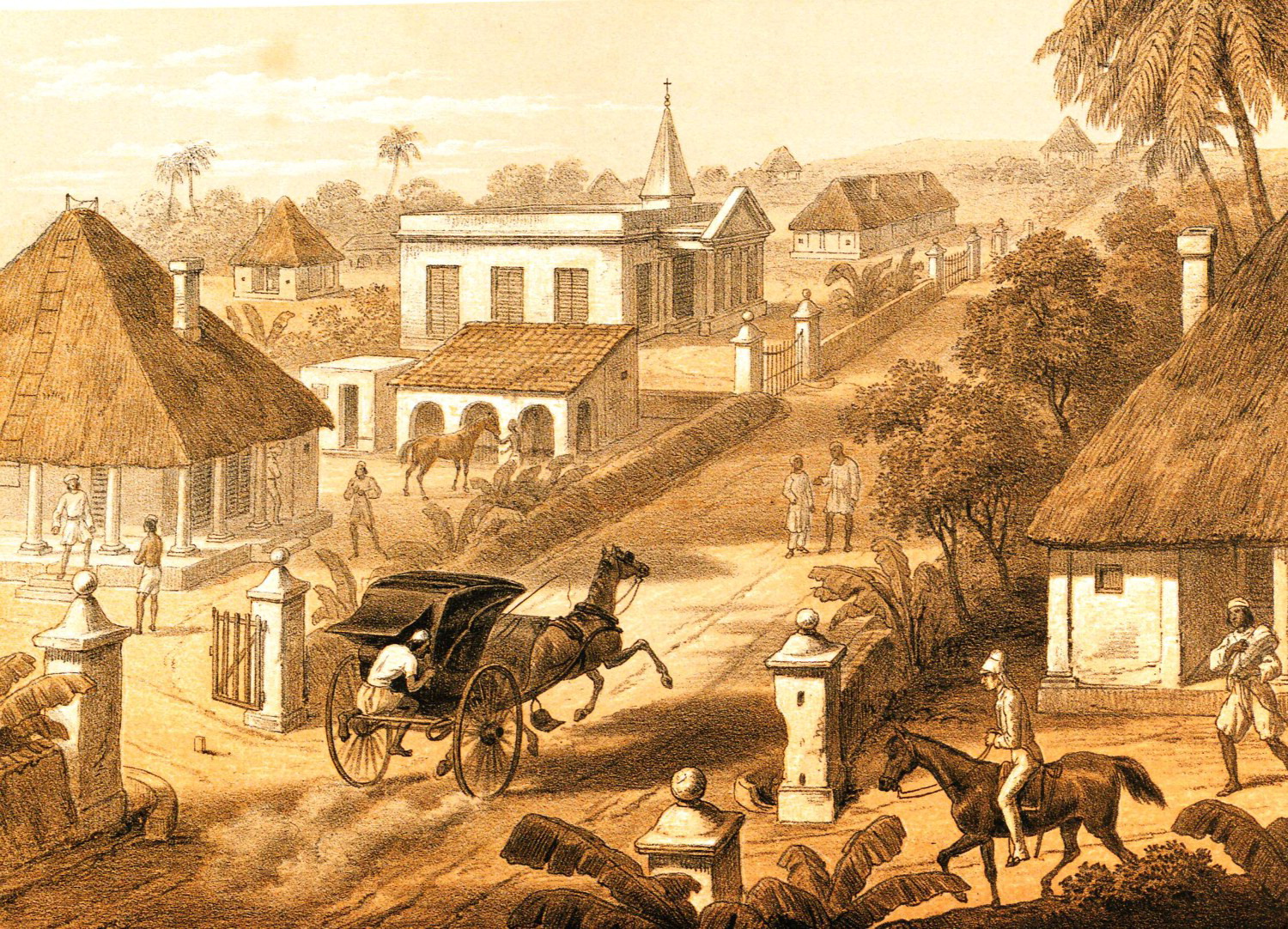
British colonial governance in India was built upon global technologies of writing produced through European mercantile colonialism; the extraction of the embodied Mughal administrative knowledge from a Persianette (or Tamil-proficient, as in Southern India) Indian clerical class, and its materialisation into official paper-based forms, as shown by Christopher Bayly; and a scribal-clerical ‘habitus’ as described by Bhavani Raman. This research focuses on the architecture, spaces and material culture associated with the paper-bureaucracy of the colonial government of Bengal that Jon Wilson calls one of the world’s earliest modern states.

A provincial administrative town in colonial Bengal. George Francklin Atkinson, Our Station, Plate 1, lithograph, from Atkinson, Curry and Rice (On Forty Plates) Or the Ingredients of Social Life at Our Station in India (London: Day & Son, 1859), © British Library Board, 1264.e.16

A provincial administrative town in colonial Bengal. George Francklin Atkinson, Our Station, Plate 1, lithograph, from Atkinson, Curry and Rice (On Forty Plates) Or the Ingredients of Social Life at Our Station in India (London: Day & Son, 1859), © British Library Board, 1264.e.16

It argues that this paper-/ writing-oriented habitus also mandated a chain of materialities and spatialities (paper-records, furniture, spaces, and architectures of colonial governance). Focusing on the colonial cutcherry(office), the nerve-centre of Bengal’s zilla sadar (provincial administrative) towns, I analyse such ‘papered spaces’ as record rooms and clerical offices. The work is conceptualised around paper as a key agent of colonial governance, including the expanding spheres of its logic, which profoundly permeated the cutcherry’s material-spatial culture and experiential ‘lifeworld’. I also reflect on how colonial paper-practices intersected with other more immaterial and mobile circuits of knowledge and information spread over the town and country, and how such paper-governance was fed, for example, by spatial geographies of paper supply and printing. For the research, I combined extensive on-ground documentations of the material fabric of the buildings with archival research (governmental papers, period literature and art) in India, Bangladesh and Britain.


https://www.tandfonline.com/doi/full/10.1080/13602365.2020.1733861 

The 7th International Congress on Construction History (7ICCH) will be held in Lisbon, from 12 to 16 July, 2021. As in 6ICCH (Brussels, 2018), the 7ICCH event will adopt a two-step procedure for proposals evaluation:

– First call: a first call for proposals for thematic sessions will be open from 15 April 2020 to 9 May 2020; followed by a

– Second call: a general call for abstracts for the usual open sessions, from 18 May to 28 June 2020.

We are what we build and how we build; thus, the study of Construction History is now more than ever at the centre of current debates as to the shape of a sustainable future for humankind. With the main theme “History of Construction Cultures”, the Congress will provide an opportunity to celebrate and expand our understanding of the ways that everyday building activities have been perceived and experienced in different cultures, times and places.

The general call for abstracts will invite proposals for inclusion in thematic sessions as well as single contributions dealing with a broad range of construction history topics (construction determinants and their relation with design, extraction and processing of materials, site management, works execution processes, knowledge transfer, actors, machines, tools, building legislation, construction – politics, economy and society, etc.). The aim will be to achieve a broad and in-depth assessment of new research in construction history.

The present call, open until 9 May 2020 invites prospective session chairs to suggest topics for thematic sessions. The proposed subjects should contribute to the debate of the latest issues, approaches and questions of research in the field of construction history research, stimulating intercultural and interdisciplinary collaboration and discussion. Proposals should include a description of the theme (max. 400 words), an explanation of the relevance of the theme (max. 400 words) and the CV of the applicant chair demonstrating his/her relevant expertise.

With the support of the Scientific Committee, the Organizing Committee will select up to 12 thematic sessions, limited to one per applicant. Chairs of the thematic sessions are expected to be present at the 7ICCH and give a short introduction to their session. They are, in collaboration with the Scientific Committee, responsible for the selection process of the submitted abstracts and for the editing process of the submitted papers. Four or five papers will be selected for each session.

No more than one paper from the chair’s research team can be selected. The Scientific Committee reserves the right to redirect papers towards other thematic or general sessions. Proposals should be sent to 7icchlisbon@gmail.com until 4 May 2020. Prospective session chairs will be informed on the evaluation of their proposals by the Organizing Committee by 18 May 2020.

More information at http://www.7icch.org

Organizing Committee:
Chair – João Mascarenhas Mateus (University of Lisbon)
Treasurer – Ana Paula Pires (NOVA University of Lisbon)
Sandra M. G. Pinto (NOVA University of Lisbon) Fernanda Rollo (NOVA University of Lisbon)
José Aguiar (University of Lisbon)
Ivo Veiga (University of Lisbon)
Milton Pacheco (Coimbra University)
Manuel Caiado (University of Lisbon)