Archive

Monthly Archives: March 2024

Tropical Modernism: Architecture and Independence at V&A reintroduces Indian and Ghanaian pioneers of the style
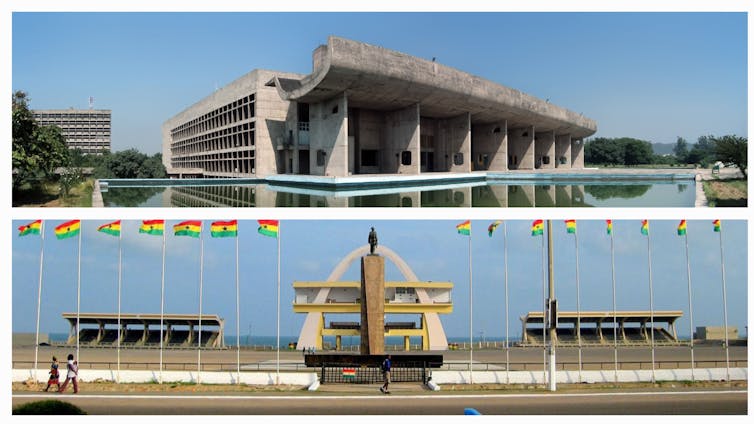
The Legislative Assembly/Chandigarh-Duncid and Independence Square in Ghana. Wikimedia Commons , CC BY
Adefolatomiwa Toye, University of Liverpool

The Tropical Modernism: Architecture and Independence exhibition at London’s Victoria and Albert Museum showcases the legacy of tropical modernism in Ghana and India.

The architectural style was developed specifically for tropical climates, so its key design consideration was optimal ventilation and minimal solar heat gain. Elaborate building forms and abstract ornamentation later became characteristic of the style.

Although the movement began with colonial architects after the second world war, it was redefined by newly independent nations of the 20th century, who wanted to create an identity detached from their colonial past. The V&A exhibition spotlights India and Ghana’s nation-building projects following their independence from Britain in 1947 and 1957 respectively.

It begins with the early work of British architects Maxwell Fry and Jane Drew in Ghana. Until a few decades ago, European and colonial architects’ designs dominated the historical narrative of tropical modernism. This narrow viewpoint is currently contested and extensive research on post-independence architecture and non-European architects is being conducted.

The V&A exhibition attempts to redress this Euro-centric story. It centres around the lesser known architects whose input has been historically overlooked or erased. It celebrates their contributions to tropical modernism and the impact of independence projects on local architectural education.

The architecture of a new nation

Chandigarh, a planning project for Punjab’s new capital after India’s partition, is one of the architectural works featured in the exhibition. The city is a famous example of 20th-century modern architecture and urban planning. It was led by European architects Le Corbusier, Pierre Jeanneret, Maxwell Fry and Jane Drew.

While the story of Chandigarh tends to be dominated by these architects (especially Le Corbusier) its creation included a budding team of Indian architects and artists, many of whom returned to India from overseas.

Works by these Indian architects are on display in the V&A show. There’s Eulie Chowdhury’s Chandigarh chair which was co-designed with Pierre Jenneret, Jeet Malhotra’s photographs of the city under construction and Giani Rattan Singh’s wooden model of the Legislative Assembly.

These architects were on the design team for the Capitol Complex, which comprised grand administrative buildings and monuments. The buildings were exposed concrete structures with sculpture-like forms and deep concrete louvres (slats that control sunlight entering a building).

Once dominated by British colonial architects, Ghana’s building industry expanded post-independence to include architects from Africa, the African diaspora, and Eastern Europe. Victor Adegbite, a Ghanaian architect, oversaw several public works as head of the country’s housing and construction corporations. He led the team for the building, popularly called Job 600, which was constructed to host the Organisation of African Unity Conference in 1965.

Nation-building programmes also acknowledged the importance of local expertise. This subsequently aided the development of local architectural practice and education. The Chandigarh College of Architecture opened in 1961 and more followed suit.

Ghana’s Africanisation policies (intended to increase the population of Africans in corporate and government positions) influenced the founding of the architecture department at Kwame Nkrumah University of Science and Technology (KNUST).

The department began by recruiting educators from Britain and around the world. On display is a student-made geodesic dome (lightweight shell structure with load-bearing properties), which was constructed during a teaching programme with American designer Buckminster Fuller.

Among the staff were Ghanaian architects like John Owusu Addo – the first African head of department. He designed new buildings for the university most notably the Senior Staff Club and Unity student hall included in the exhibition. The hall’s nine-storey blocks combine exterior and interior corridors to improve indoor ventilation.

The many dimensions of tropical modernism

Exhibitions like this are important because they educate the public on the strides made by academic institutions and cultural organisations in rewriting the history of tropical modernism.

V&A’s collaboration with the Kwame Nkrumah University of Science and Technology and Chandigarh College of Architecture was integral to the exhibition. However, the show only briefly addresses the contemporary issues of conservation, sustainability and the alternative histories of the style.

Institutions and organisations are now pushing for the conservation of tropical modernism in Asia and Africa. Although monuments like Chandigarh Capitol Complex, have attained heritage status, many are in decline, repurposed or at risk of demolition.

In India for example, the Hall of Nations, a group of pyramidal exhibition halls, was demolished in 2017. Social media platforms like Postbox Ghana and international collaborations like Docomomo International and Shared Heritage Africa project centre the African experience in documenting and reviving public interest in tropical modernism.

Unlike the architects and the experts celebrated in this exhibition, construction labourers are not as visible in historical sources because they were often unrecorded. Oral history’s ability to fill this gap diminishes with time, but we have a duty to avoid repeating the same erasure and omissions of the past. The legacy of tropical modernism is incomplete without addressing the contributions made by both professionals and labourers alike.


Adefolatomiwa Toye, PhD Candidate, School of Architecture, University of Liverpool

This article is republished from The Conversation under a Creative Commons license. Read the original article.
Timothy Latim: Reflections on Kigali writing workshop

Context

I was invited to the one week writing workshop as a guest mentor to discuss with the students of architecture, how photography can be used to support architectural writing and design. The workshop held at the University of Rwanda was in close proximity to three of the buildings being studied and I got a chance to visit and discuss the buildings with the students.

First Impressions

Kigali is coined as the city of a thousand hills. An apt description of it. Standing at any one hill one observes the landscape unfolding, the undulating hills reveal themselves in layers to the observer. While it serves as an incredible sight, the topography is also a major influence in the design and development of Kigali. The varying layers of landscape can as a metaphor to the influence that the city has had over its history. This is apparent in the diversity of essays and research topics presented by the students. A broad reflection would categories these into three main ideas in regards to time. Colonial history, contemporary influence and ambitions of the city.

Historical – Colonial influences.

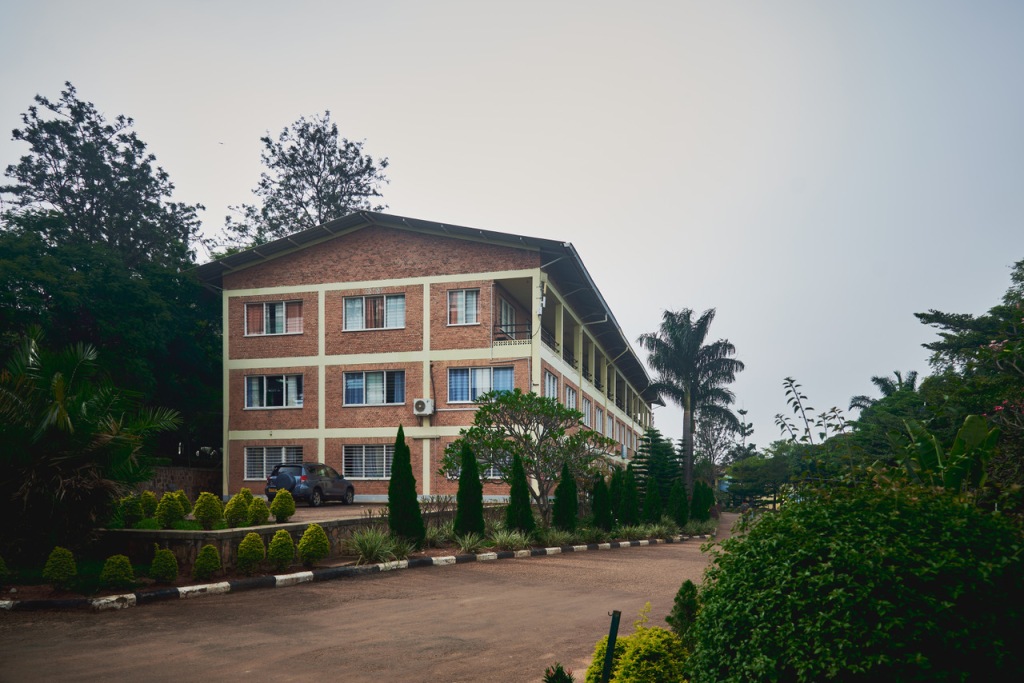
The influence on Rwanda predates the shadow of genocide. Into the realm of both native history and colonial influences. A guided tour and with the student to the Administration Building reveals an interesting dialogue between the architectural influences from the Belgium in the design and construction of the building. These were noted to be the fair faced used of materials in construction. While changes in the dynamics of Rwanda socially and politically influenced the use of the Administration building over time, from the use by military all the way to a university campus. Similar traces of the Belgium influence can be found all around the Univeristy. Which was interesting to being to unravel alongside the students.

Administration block University of Rwanda 

Contemporary influences.

Completed in 2014 by Kigali by FBW Group. The Library complex serves an example of a contemporary building. A reflection of the trends and issues currently being resolved by the architecture fraternity. The use of form in the composition of the building. A conscious effort to design the building to be passive in regards to heating and cooling. And the use of locally available materials to clad the building.

Library college of science and technology, University of Rwanda 

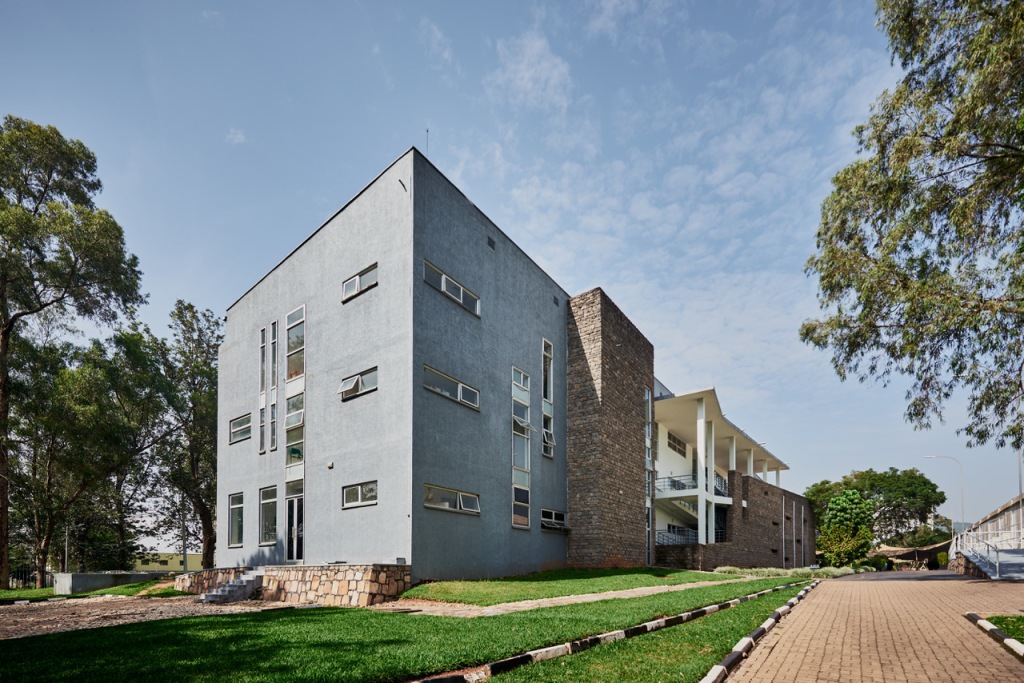
The School of Architecture, serves as an example of the wave of international architects responding to the regional influences on Rwanda. The School has a similar approach to its design. The form is prominent, a metaphorically it can be an interpretation to the hilly landscape. And the use of volcanic stone to clad the exterior of the building.

School of architecture, University of Rwanda 

While both these buildings have a very strong relationship between form and programme. The studies done were focused more on the spatial and programmatic response of the architecture. From the space planing to the layout and interpretation of the materials on programme.

Future ambitions.

A walk around the civic Centre in Kigali, draws ones attention to the values being sought after. An egalitarian space, inclusive for all walks of life. And its in this context that Norsken is found, a stone throw away from the civic heart of the city hall. The building reflects on its insides what the civic centre reflects on its outsides. The buildings programmes vary across different fields with low tech to very high tech, future and contemporary issues with possible solutions. A hybrid of activity. Startups and established companies alongside each other.

The student investigations into this building were user-centric. Focus was placed on what layout and design choices were done; so the building created an egalitarian space and facilitated encounters among its users with the hope to encourage cross pollination of ideas in these chance encounters.

Its interesting to see that the same complexities on a country level, can still be found in the rich diversity in a small group of students. The workshop served as a fantastic incubation ground for research topics. Which was witnessed in the ideas presented by the students at the end of the workshop. The duration of the workshop forced the students to narrow down to the core ideas they could investigate. This was made possible perhaps by the daily feedback sessions between the mentors and the students. The mentors placed emphasis on reviewing what was written over what was said. One observation was that there was a some articles whose conclusions were presented without an understanding of the evidence. This was also addressed in the remarks given by the mentors. A suggestion would be to allow them a period of one week after the workshop, to research their topic and review their essay after.

Congo Style: how two dictators shaped the DRC’s art, architecture and monuments

Ruth Sacks, University of Johannesburg

What kind of art is left behind by totalitarian regimes? A new free-to-read book called Congo Style: From Belgian Art Nouveau to African Independence explores the visual culture, architecture and heritage sites of the country today known as the Democratic Republic of Congo (DRC). It does so by exploring two now-notorious regimes: King Leopold II of Belgium’s Congo Colony (1908-1960) and Mobutu Sese Seko’s totalitarian Zaire, established when he seized power in a military coup in 1965 after five years of political upheaval. We asked artist and visual culture scholar Ruth Sacks five questions about her book.


What did you set out to achieve?

Years ago, while I was in Belgium on an art residency, I became interested in the early modernist art nouveau movement (1890-1914). In architecture and art, this period is part of 20th century modernism, known for a minimal, clean aesthetic that’s influenced by new technologies and the advent of machines. Art nouveau is distinctive because it’s highly decorative, while still using the new building materials of iron and glass.

What interested me was the colonial nature of art nouveau. Art nouveau came with a very strong sense of defining newly formed (or unified) nation states in western Europe. It was the style used at world fairs. These were grand exhibitions showing off western countries’ scientific and cultural achievements, including the acquisition of colonies.

A colonial pavilion in the art nouveau style at the 1897 Brussels world fair in Belgium helped establish one of the names for Belgian art nouveau: “Style Congo”.

The style is distinctive for its curling, plant-like shapes and is a major tourist feature today. The years in which it was implanted in Brussels (about 1890-1905) directly coincided with the brutal Congo regime of Belgium’s King Leopold II.

Travelling to the DRC, I located actual art nouveau buildings from the early colonial period. But it was the state sites of the early Mobutu Sese Seko regime (1965 to 1975) that captured my attention. Like art nouveau, they are steeped in a sense of nationalism and aimed at impressing. For example, the Limete Tower (in use from 1974) on Boulevard Lumumba is a massive monument intended to be a museum celebrating national culture. A tower made up of a huge raw cement tube is topped by an organic floret shaped crown, with a curving walkway leading off from its rounded lower sections.

My experience of the capital city, Kinshasa, made me rethink what cities were and could be. Buildings like Limete Tower that were designed for very different infrastructures (far more ordered, European and US systems) have weathered in fascinating ways that are often related to extremely violent historic events.

I didn’t want to present a conventional study that only analyses the design of the architecture and its functionality. The book attempts to read sites like this within the particularities of their city, its streets, plants and histories.

What did you conclude about the Leopold period?

In Leopold II’s time, the king himself was cast as the villain of the “red rubber regime” in the Congo. The Belgian colonial regime under Leopold II committed atrocities connected to the rubber industry. (The 1897 Congo Pavilion was a pavilion within the Brussels World’s Fair dedicated to displaying how the Congo provided a lucrative and exotic resource to Belgium.)

Movements like the Congo Reform Association (mainly US and British) protested against horrific conditions, including torture and mutilation, that left at least a million Congolese people dead. A great deal of the focus was on Leopold II himself and his greed, which distracted attention away from the greater system of capitalist colonial expansion that was fully endorsed by Euro-American powers.

Famously, Leopold II never set foot in the Congo and neither did the art nouveau designers who fashioned buildings and exhibition pavilions relating to the Congo. I believe this distance from the realities of life in the Congo itself allowed for the fantastical forms that were created in Belgium.

What did you conclude about the Mobutu period?

Mobutu Sese Seko was widely maligned by the Euro-American press. What’s often ignored, to this day, is that he was put in place by Belgium and the US. He was painted as the villain of the African story, fulfilling the ultimate caricature of the African kleptocrat, yet he wouldn’t have come to power without the nature of the colonialism that came before him.

Belgian colonialism followed a logic of extractivism (removing natural resources to export them) that forced the Congolese economy to supply raw materials to the west (especially Belgium), which continues today.

Mobutu is considered corrupt in the Congo today and his military dictatorship was indeed brutal and controlled the Congolese people with fear. However, his commandeering of a cultural blooming in Kinshasa in the late 1960s and early 1970s was important. Instead of dismissing what he built as only the work of a dictator, my book draws out some of the complexity of this time and what it meant to celebrate African craft, art forms and traditional culture.

The process of appropriating Euro-American artistic ideas and architectural styles in order to celebrate Africanness, as an anti-colonial statement, still holds weight today. Many of Mobutu’s towering monuments are considered objects of pride in the city.

How does this live on today?

There is something to be gained from looking at what is left in the wake of tragically violent regimes and how their structures are treated within both their societies and their immediate surroundings. How material culture is made is as important as what is made. Reckoning with monuments and memorials, and considering how these are maintained in the city, can shed often unexpected insights into the ways histories are told.

My hope is that the book remains relevant as a sign there is value in picking apart material remains of regimes that aimed for total control, but never fully achieved it. The associations that build up around public spaces and exhibitions are not necessarily only to do with the circumstances of their making, but how these stories have been filtered over time. They can alienate people but they can also engender pride.

The extractivist attitudes I describe throughout the book, which see the Congo as a resource with bountiful raw natural materials, are still very much present in our day-to-day life. The cobalt in our smartphones, computers and electric cars is mined by labourers working in near slave conditions to feed our need for the latest technology. While Congo Style stays with historical examples in Kinshasa, the built material that follows colonial ecocide is the main topic.The Conversation

Ruth Sacks, Senior Lecturer in Visual Art, University of Johannesburg

This article is republished from The Conversation under a Creative Commons license. Read the original article.

A wooden structure from the 1897 Congo Pavilion. Courtesy Ruth Sacks

We went to the Exhibition Preview at the V&A on Wednesday 20th February to see the opening of the Tropical Modernism exhibition – a full review is being prepared and we’ll share it shortly (currently under review elsewhere first…) – here’s just a few snaps from the evening…

It was an intriguing exhibition for TAG to visit – not least because most of the exhibits have already featured on this blog over the years. Perhaps the biggest privilege besides viewing all of the material was talking to Michael Hirst and discussing his work at Tema again. Some of Michael’s photographs are in the exhibition too. The first thing that stood out however, was the large queue to get in – it’s not often a private view has a long line outside…

Michael Hirst and his photographs of Tema from the late 1950s

Some of the other highlights include seeing the Buckminster Fuller geodesic dome restored and delicately hung from the ceiling. The last time we saw it was abandoned in the loft of a workshop at KNUST.

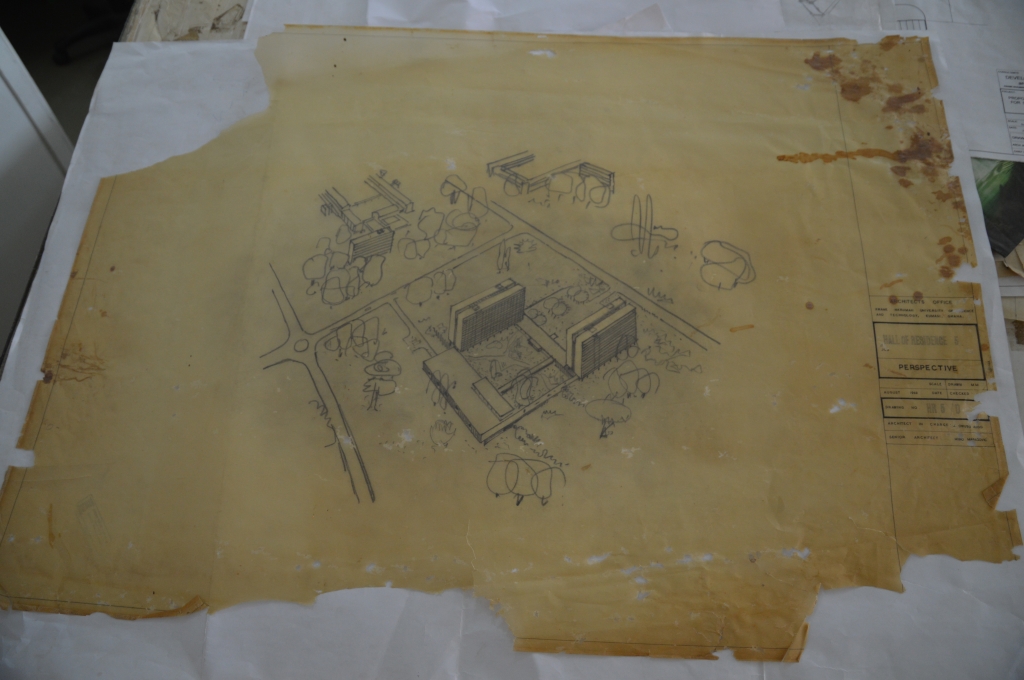
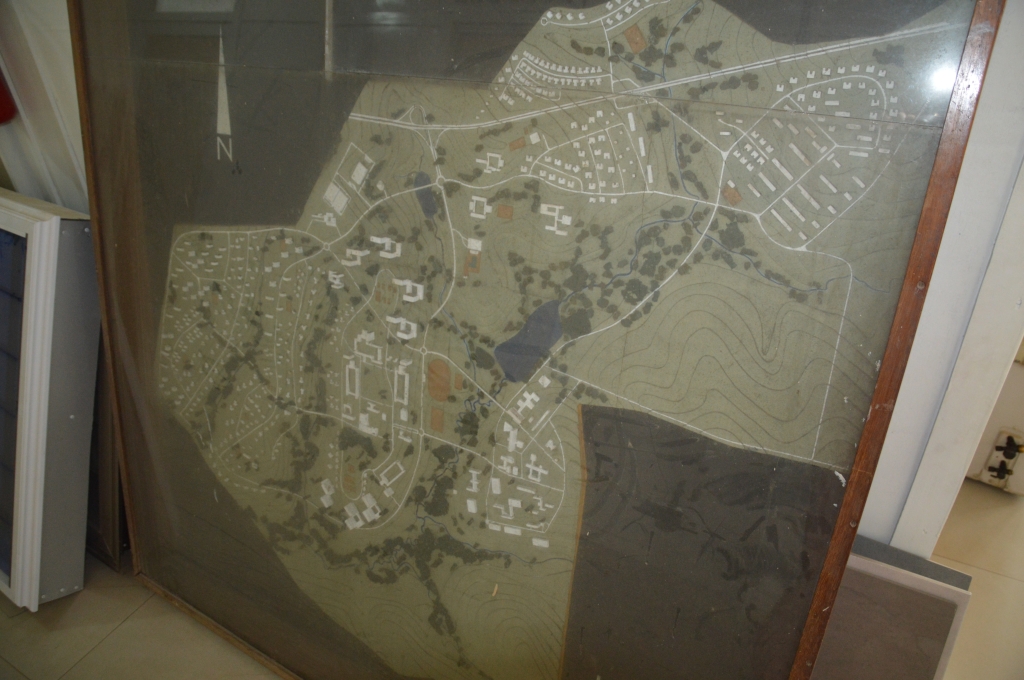
There’s also some delightful perspective drawings by John Owusu Addo in the exhibition and a model of KNUST campus too. It was such a relief to see that these drawings are now being cared for. We produced some digital copies in 2016 and 2018 and hoping the share the full set of the precious drawings here soon.

About TAGOur model of the Accra Community Centre was included alongside several other models, including Giani Rattan Singh’s timber model of Corbusier’s Assembly Building in Chandigarh, and an outstanding model of the Pragati Maidan in Delhi, by architect Raj Rewal (and foolishly demolished in 2017).

It was great to see some of Pierre Jeanneret‘s furniture on display alongside the unexpected inclusion of Nek Chand‘s sculptures. It’s a curious exhibition pulling together a range of projects around Ghana and India, with snippets from Nigeria and elsewhere.