“Diplomatic Interiors: Spaces, Practices, and Infrastructures in Historical Perspective” explores historical relationships between interior spaces and diplomacy. We invite researchers from a variety of disciplines to examine how settings such as embassy buildings, permanent chancelleries, and temporary conference venues have been shaped over time by social, technological, and material infrastructures in support of diplomatic representation, negotiation, and collaboration.
The full call and submission guidelines for abstracts are outlined on the CfP page.
Navigating Archival Fieldwork in Mumbai: Challenges, Opportunities, and Positionality
Excy Hansda E.Hansda@liverpool.ac.uk
A few months ago, I finished my fieldwork for my PhD research in Architectural History. My research investigates the microhistories of the middle-class Indians who moved to the suburbs of Bombay in the early twentieth century and the kind of spaces they lived in. Looking at a postcolonial angle, I am interested in questioning the colonial suburban vision and by highlighting the Indian agency in shaping the suburban urban housing projects, neighbourhoods and their dwellings in late-colonial Bombay. This blog reflects on the challenges and opportunities I encountered while conducting fieldwork in Mumbai. As an Indian PhD scholar based in England, fluent in both English and Hindi, I found that my position brought unique advantages and complications to archival research in Mumbai.
I have prior experience working in archives in both the UK and India. I quickly realized that my background—an Indian architect affiliated with a British academic institution working on a historical subject—often piqued interest in my project. Despite the initial curiosity my profile evoked, I was one of hundreds of Non-Resident Indians (NRI) affiliated with overseas institutions, and this seldom translated into privilege. If anything, being a North Indian, I was seen as a foreigner in Mumbai. Accessing senior bureaucrats in archival institutions and getting information smoothly and efficiently remained particularly difficult.
Finding the Right Archives
I began “getting the data” early in my PhD (February 2023), in parallel with my literature review. I started with the India Office Records at the British Library in London and expanded my search to include collections at the Liverpool School of Hygiene and Tropical Medicine, the School of Oriental and African Studies, the London School of Hygiene and Tropical Medicine, the National Archives at Kew, and others. I investigated diverse sources—Annual Administrative Reports, maps, manuals, and published books. However, due to the hyper-specific focus of my study, initial results were limited.
This led me to change my methodological approach. I revisited the literature and drew on approaches from disciplines such as cultural studies, English literature, and sociology. This led me to explore unofficial sources such as online newspapers, Town Planning Review and the Journal of the Indian Institute of Architects at the Royal Institute of British Architects Archives in London. This helped me expand my knowledge of my subject.
My first fieldwork trip to Mumbai (January 2024) opened a new chapter. I visited the Maharashtra State Archives (MSA) at Elphinstone College, Mumbai, where I discovered files rich in minute detail—memos, petitions, letters, advertisements, maps, municipal debates, and more—everything useful for my research, unlike the colonial records in London, which largely included annual administrative reports and policy documents of the colonial bodies like the Bombay Improvement Trust and the Bombay Development Department, the Mumbai archives revealed the voices and subjectivities of local Indian residents who contested colonial policies and many cases of negotiations, contestations and even micro-scale conflicts which were often absent from official reports.
Missing Records and the State of Archives
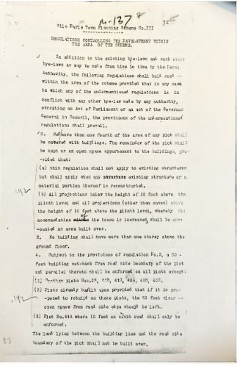
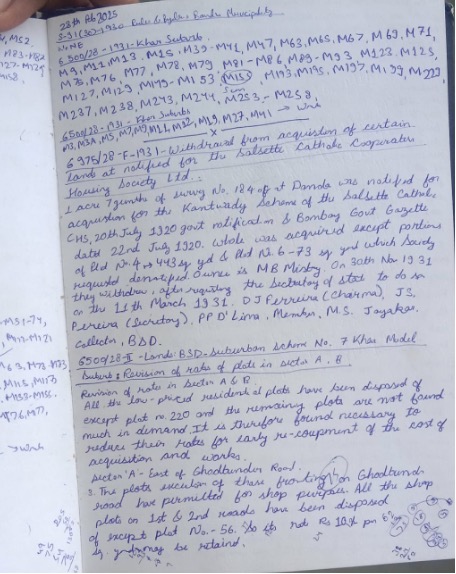
Accessing the archives was not easy. The MSA, one of India’s oldest surviving archives, is poorly maintained and has limited funds. Files are deteriorating, and storage conditions are far from ideal. The reading room is small and dusty, with limited hours—open only five days a week, six hours per day, with an hour-long lunch break. Visitors can request just five files a day. The retrieval process is slow (waiting over two hours is common). Photography is not allowed, and one must request Xerox (Fig 1) or scanned copies, which are payable only in cash. Getting Xeroxes can take 20 days or more; scans may take months. (I am still waiting for the scans that I requested in February) Therefore, I resorted to transcribing the files and making notes (Fig 3 and 4).
Many records are missing. Files before the 1920s are largely uncatalogued and are organized as volumes for entire years for each department of the archives (Revenue, Judicial, PWD, General). Finding specific content means reading through these thick volumes page by page. For post-1920s material, although some cataloguing exists, it’s often incomplete. These are specific files which are numbered, and the numbers correspond to the numbers present in the hefty indices. One has to go through the indices in order to find the files.
Once a file is located, an office peon brings it—after dusting it off (Fig 2). Some are missing completely, and the office peons cannot find them. Others are in fragmented conditions, so they cannot be accessed. While others have missing maps or pages which are crumbling into fragments.
Fig 1: Xerox of a page in a file located at the MSA
Fig 2: A File on Co-operative Housing Society at the MSA
Fig 3 and 4: Transcriptions and Notes I made based on information available in archival documents at the MSA
Finding Sources
A central database for archival material simply does not exist. I relied heavily on human networks: clerks, peons, research assistants, historians, archivists, and fellow researchers. Often, they directed me to smaller archives—usually cramped rooms within municipal offices—where old documents were kept in poor condition and disorganized bulk.
At the MSA in Elphinstone College, I was directed to the Old Customs House in Mumbai. There, I learned they only housed records from Bombay City, so I was redirected to the archives at the Municipal Corporation Office of Bombay Suburban District in Bandra, only to be told that my time period of interest was not covered. Eventually, I was pointed toward ward offices, municipal boards, and local talathi (village record) offices.
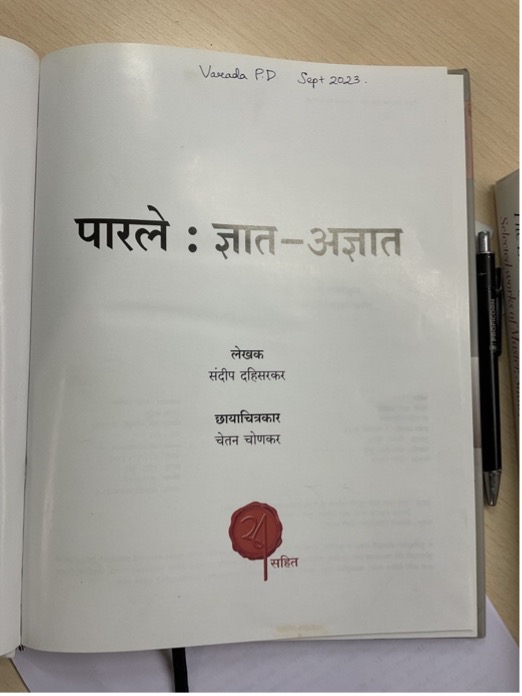
Due to reorganization across the colonial and post-independence eras and the separation of districts and provincial state, records have been scattered. The only way to find them is through local knowledge—gathered from seasoned researchers, administrators, or office staff. Sometimes, I stumbled upon data in unexpected places, such as the Dadar municipal archives or the Art Deco Mumbai Society, which provided helpful secondary sources in English and vernacular languages (Fig 5 and 6).
Fig 5 and 6: Books obtained at the Art Deco Mumbai Trust, Mumbai
The reception of these archives was also varied. Sometimes, the staff was friendly and gave me access to files, right after I showed him my ID card and university letters. In other cases, I was made to wait for half an hour before meeting the upper bureaucrat. Sometimes, I had to follow up several times before they granted me permission to visit their archives. This was the case of Municipal Corporation archives, Mumbai.
Navigating the Neighbourhoods
Beyond archives, the buildings themselves served as vital secondary sources. Many twentieth-century buildings had been demolished, redeveloped, or repurposed. Some stood vacant; others had been converted into commercial spaces, with original residents gone.
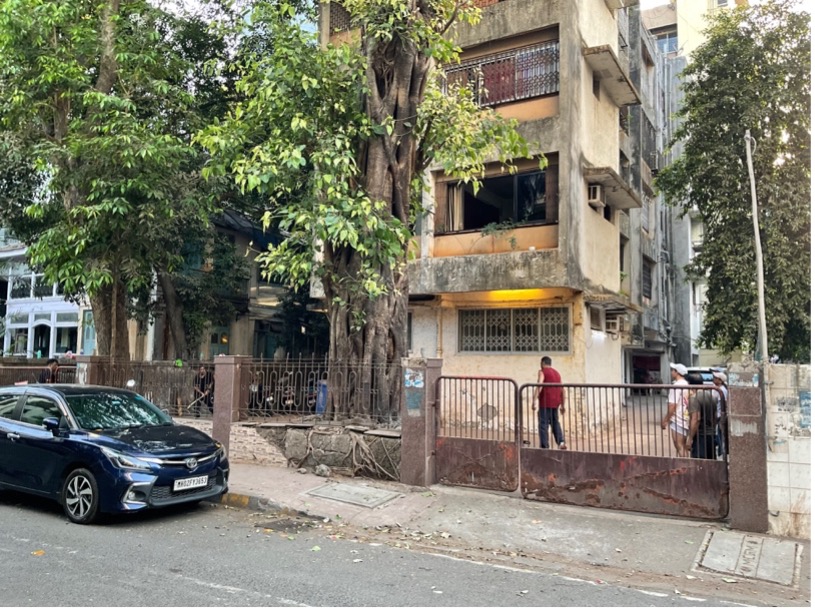
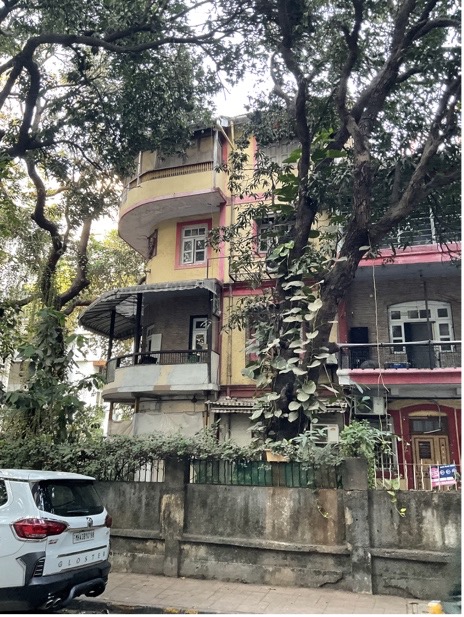
Identifying buildings from the 1930s–40s required searching for buildings with style, typology and aesthetics matching that of the 20th-century architecture of Bombay. I used secondary literature available on Mumbai, tips from fellow researchers and architects working in Mumbai, detailed reports from the Mumbai Metropolitan Region – Heritage Conservation Society (MMR-HCS), and a database created by Art Deco Mumbai Trust to search buildings. These contained valuable mapping and description of old historic surviving buildings with histories of ownership, years of construction, sketches, photographs, and drawings. I used these for site observations and photographing the exteriors of the building (Fig 7 and 8).
Fig 7 and 8: Walking in the suburban town of Khar, Mumbai as a Method to Collect Data
However, accessing the interior of the buildings was a different challenge. I was often accompanied by a local Marathi-speaking friend to help communicate. His surname “Patil”, which is common in Mumbai, could have helped me start a conversation with the local residents of Mumbai suburbs- so I thought. Residents were tight-lipped, asking questions like “Kahan rehte ho?” (Where do you live?), “Marathi nahi aati kya?” (Don’t you know Marathi?), and “Kya dharam/jaat/surname hai?” (What’s your religion/caste/surname?). These euphemistic inquiries exposed the enduring social divisions of caste, class, and religion—reminding me that while buildings and built fabric might have changed, social fabrics and the mindset of the people are just the same as in the 1930s-40s Bombay.
Language
In the scrutiny of archival works, language skills were sometimes difficult. Language agitation and violence in the name of protecting Marathi culture and identity are common in Mumbai and the provincial state of Maharashtra, where outsiders are forced to speak in Marathi. However, most of the time, people were helpful to me in finding the source materials. The historians in academic and non-academic institutions were proficient in English, Hindi, and Marathi, and they helped me with ideas for my projects. People, especially those working in lower bureaucracy, were able to speak Hindi and directed me to people and places where I could retrieve information.
Logistics of Living in Mumbai
One has to find the right months to work in Mumbai. Working in August was not ideal. The intense humidity and monsoons made things spectacularly difficult. Working in summer could be difficult as well, as the heat is intense and the humidity is dangerously high. Working during the winter is better, though it is mosquito season. I lived in Vasai, a northern suburban town outside Mumbai, and used to commute on a local train two hours away from the archives, which was at the final southern station of Bombay city. Just like what I wanted to study, I lived like a middle-class person who lived in the suburbs and commuted to the city to make ends meet.
Final Reflections
Someone who works at, for example, the British Library or the Biblioteque Nationale, would not expect this set of challenges. These challenges included obtaining sources of information from beyond the archives, pursuing people to find information, and collecting data in sometimes un-welcoming environments, for which one needs to have a different approach towards them. Being a people’s person and being street-smart helps. Networking and making connections with people make things easier and give you access to a substantial amount of information. Whilst there were complications, it was an enriching experience, making me skilled in finding sources of information, connecting dots, finding and sometimes creating a thread, and keeping backup plans ready. Here, adaptability and patience helped. Having relationships with people has helped me more than having any institutional affiliations,
Fig 9: The sign board at the local railway station from where I boarded the train to the archives, every morning
Fig 10: The family with their neighbours with whom I lived in Mumbai suburbs
Finally, although having friends-like family in Mumbai and its suburbs made me somewhat familiar with the city, however being a North Indian, miles away from Mumbai, I am sure I might not have noticed a lot of subtleties both inside and outside the archives and sites of inquiry. On the other hand, as a scholar based in England, I found certain information in files, ideas, or simply the way of living striking, which Mumbaikars would have taken for granted. I am indebted to the Patil family and my friends at IIT Powai, where I imposed myself for a significant time period. Also, my colleagues who I knew before and the ones whom I met at the archives helped me point out interesting details, showed me directions during this fieldwork, and accompanied me on several site visits. These certainly positioned me in how I was looking at the sources, the archives, the people, the suburbs and the city.
Palm leaves loosely thatched create a bushy screen wall. The screen is part of a large building designed to shelter the pieces of other plants and make them dry out quickly. They are tobacco leaves, hanging from the rafters in neat rows swaying in the breeze. Nearby, the dried ones are being plucked and gathered into sorting bags, where they find themselves stacked by quick fingers into piles of like-colored leaves and pressed into baskets woven from the fronds of the pandanus plant. Finally, they are stowed into ships built with trees far from home, hulls of oak and elm, decks of pine. Altogether, they will float back towards Europe. Dry, sort, stack, press, stow, sell.
The plantation system is a term used to describe forms of monocrop agricultural land use, of shaping land after the cultivation of single crops in climates suitable to them. Scholarly discourse in recent years has traced the historical genealogies of extraction and de-diversification of the natural world that the system, with its rapacious claims to territory over four centuries, has come to represent. Because of their low seasonal variation and consistent sunlight, tropical zones—also some of the most biodiverse places in the world—have historically been sites where the most intense forms of plantation agriculture took place. In a broader sense, from at least the seventeenth century on, the plantation system fundamentally altered how people perceived land, property, plants, people, and their environments. Artificial species flows combined with trade and commerce created a disembodied system with disastrous consequences for the ecological complexity of the world and its climate.
The recognition of this system has led to contemporary shifts in perspectives of the environment, that it is interconnected and needs diversity in order to thrive, revealing the extent to which a reimagining of existence outside of plantation logics is necessary. Conceptually, therefore, to understand the history of the plantation is also a method to understand its opposite: biological complexity and inter-species flourishing.
Architecture has had a troubled historical relationship to plantation environments. As an ordering system, dwelling device, and apparatus for synthetic plant growth, one can project a range of examples. In Europe these range from the stately residences in the British countryside of erstwhile plantation owners in the Caribbean to greenhouses for testing banana plant hybrids to tobacco auction houses in Amsterdam. Geographically removed, yet deeply intertwined are the examples in Europe’s elsewheres: coffee processing warehouses under a tropical sun, watchtowers framing their perimeter, rudimentary barracks for workers; and as counterpart, examples of living outside of or in spite of the plantation system, such as maroon communities and so-called slave gardens.
What can plants tell us about these stories, and in what ways do plant histories diversify our understanding of the plantation system and its architectures?
This two-chapter symposium is interested in the entangled histories that the plantation system produced, and each location is chosen for its historical role in specific plantation stories. Singapore Botanic Gardens was founded in 1859 under the auspices of an Agri-Horticultural society for research and experimentation and played host to a series of botanists and plant explorers as a place to grow, experiment, and distribute potentially useful plants (among others, one early success was the cultivation and propagation of Hevea brasiliensis, Para Rubber). Chapter 1, “Plant Histories” takes place in two former colonial bungalows designed by architect Alfred J. Bidwell at the turn of the century that are now part of Singapore Botanic Gardens’ recent Gallop Extension. Chapter 2, “Plantation Architectures” takes place in Villa Maraini, the former home of Emilio Maraini who made his fortune in sugar beet plantations and refineries centered in Terni, Italy. The villa was designed by Maraini’s brother, Otto Maraini in 1905, and stands on an artificial hill (a former dump) in the Ludovisi district of Rome where since 1948 it has played host to the activities of the Swiss Institute.
Plant Histories focuses on the stories that plants tell about the plantation system in monsoon Asia. This first chapter of the symposium invites contributions that explore how people use plants in/as architecture, plants that travel between places, ethnobotanical relationships on and around plantations, and the historical connections that shaped the environment, people, and architecture on plantations. We are also interested in contributions (papers, performances, artworks) that reflect on the methodological challenges and affordances of thinking-with plants and their histories.
Chapter 2: Plantation Architectures Swiss Institute (Rome), 25–27 March, 2026
Plantation Architectures re-centers the plantation as a system not only rooted in colonial geographies but also within Europe itself. In this second chapter of the symposium we welcome contributions that critically engage with the selective remembering of the past, and how Europe’s distance from sites of plantations obscured its role in the system even as it universalized itself globally. How have social, spatial, and architectural modalities informed this obfuscation? How have European claims to cosmopolitanism been grounded in histories of violence and extraction? In what ways do buildings, as architectural objects part of urban landscapes, reflect these underpinnings?
General Information
Interested participants decide which chapter they would like to attend and indicate this in their submission. A travel bursary will be available for a limited number of participants. Please indicate in your proposal if you do not have institutional funding and require travel support. The conference language will be English. All presentations are to be made in person unless urgent circumstances prevent attendance. If participants need childcare or any other accommodations, please let us know so that it can be arranged.
Submission
Please send your abstract (max. 350 words), a short CV (max. 1 page), and preferred location of participation to: voyaging.vapors@usi.ch by 31 August, 2025. Notifications will be sent out in September. The program for each chapter of the symposium will be announced in October.
Two fascinating articles and resources have been shared on the CCA website recently – Abigail Duke explores the architecture of Frank Mbanefo in ‘Weaving Modernity and Tradition’ and Asuru Lutherking Petercan examines the legacy and design philosophies of one of Nigeria’s first architects, Onafowokan Michael Olutusen
Duke writes, “In 1960, the same year that the nation gained Independence and after ten years of studying in the UK and working in the offices of Fry, Drew and Partners, Ronald Ward and Partners, and John Burnet, Tait and Partners in London, Mbanefo was invited by Godwin & Hopwood to join their office in Lagos.”
After working at Godwin and Hopwood for four years (the first Nigerian architect to do so) Mbanefo set up his own practice in 1964.
“…the Nigerian Government proposed establishing museums in four capitals—Sokoto, Maiduguri, Ibadan, and Enugu—to promote unity and establish reconciliation among the heterogeneous cultural groups across the country. While the museums in Sokoto and Maiduguri never went ahead, the National Museum in Ibadan, designed by Mbanefo, was completed in 1992. Today, it is a prominent institution and plays a vital role in promoting cultural awareness, education, and preservation for the region through showcasing the country’s rich cultural heritage. Similarly to the government’s development of architecture around the time of Independence, projects such as these museums were again tools for unification. Both the function of the museum and the style of the architecture were important.”
Petercan writes: “Onafowokan attended the Public Works Department Technical School in Lagos from 1933 to 1937—a time of questioning of the dominant colonial conventions—and went on to work as a junior technical staff member in many Nigerian and Cameroonian regions before moving to Scotland in 1946 to pursue his studies at the Royal Technical College and the University of Glasgow.
Returning to Nigeria in 1953, Onafowokan started working as a town planning officer in the Old Western Region. His knowledge and experience made a lasting impression as he moved through the departments of the Ministry of Transportation and the Ministry of Lands and Housing in Ibadan. After retiring as the Regional Chief Architect in 1968, he went into private practice under the name of Onafowokan Cityscape Group.”
Section Only for Ikorodu Lagos State Town HallBy Onafowokan Michael Olutusen – Find & Tell Elsewhere is an initiative of the Canadian Centre for Architecture (CCA) in Montreal that uses a post-custodial approach to make visible and available for research previously inaccessible architectural archives and to support local historians and researchers in sharing their work globally. The Nigeria project is a collaboration with Heritage Conservation Integration (Prof. Warebi Gabriel Brisibe, Dr EO Ola-Adisa, Arc. Yinka Williams, Abigail S. Duke, Asuru Lutherking Petercan) to curate and digitize the architectural drawings of first-generation Nigerian architects, celebrating their foundational contributions to the architectural landscape.Access to drawings of Chief Arc. Michael Olutusen Onafowokan was provided by Onafowokan Cityscape Limited, who are the custodians of his work.For more information: CCA Find and Tell Elsewhere, CC BY-SA 4.0, https://commons.wikimedia.org/w/index.php?curid=151642567






 Transnational Architecture Group