Archive

Monthly Archives: August 2025

After the Global Turn: Current Colonial, Decolonial and Postcolonial Perspectives in Architecture

What is the status of postcolonial and decolonial discourse in architecture?

How has the “global turn” in architectural discourse evolved from histories of contact, conquest and colonization?
Forty years ago, the influential essays of “‘Race,’ Writing and Difference” appeared in Critical Inquiry (Gates, 1985, 1986). Essays by Edward Said, Homi Bhabha, Gayatri Chakravorty Spivak, Hazel Carby, Jacques Derrida, Abdul R. JanMohamed, and others created new critical models that interrogated how difference had been inscribed as “race” and explored the complex interactions of race, writing and difference, which influenced architectural history and theory for several decades.

That same year, Spiro Kostof’s textbook A History of Architecture (1985) spurred a “global turn” in architecture that has complicated the field’s canon. The new global discourse seeks to understand contemporary globalization as manifested in the built environment, exemplified by the foundation of the Global Architectural History Teaching Collaborative (GAHTC) and the publication of multiple volumes on global architecture.

The global turn has attempted to close the dichotomies of East and West, North and South imposed by earlier colonial and postcolonial theories, such as Edward Said’s formulation of Orientalism as the Occident’s “other” (Said, 1978). Perspectives from the “Global South” have emerged as important correctives to the hegemony of Northern Hemisphere-centered scholarship and practice. What has resulted from this “turn” has been ambiguous, however, as it often focuses on architects from the Global North operating in the Global South or developments modeled after Western architecture and urban design, without a concomitant innovation in truly global approaches and subject matter.

This Special Issue aims to explore the field’s development from colonial, decolonial and postcolonial theory to the global turn and beyond. We encourage papers that take innovative approaches to the colonial, postcolonial, decolonial and global in architecture, including such topics as:

  • Transnational connections and flows in excess of political boundaries;
  • Decentered models of global architecture;
  • Race and architecture;
  • Feminist, subaltern and minor perspectives on architecture,
  • Empire and decolonization;
  • Migration;
  • Indigenous architecture;
  • Informal architecture;
  • Landscapes of extraction and dispossession;
  • Modernization and development;
  • Other perspectives.

More info here https://www.mdpi.com/journal/architecture/special_issues/126537KTMW

References

Critical Inquiry: Autumn 1985 (vol. 12, no. 1) and Autumn 1986 (vol. 13, no. 1); Henry Louis Gates, ed. “Race,” Writing, and Difference. Chicago: University of Chicago Press, 1986.

Global Architectural History Teaching Collaborative https://www.gahtc.org/.

Kostof, Spiro. A History of Architecture: Settings and Rituals. New York: Oxford University Press, 1985.

Said, Edward. Orientalism: Western Representations of the Orient. London: Routledge & Kegan Paul, 1978.

Dr. Patricia Morton
Guest Editor
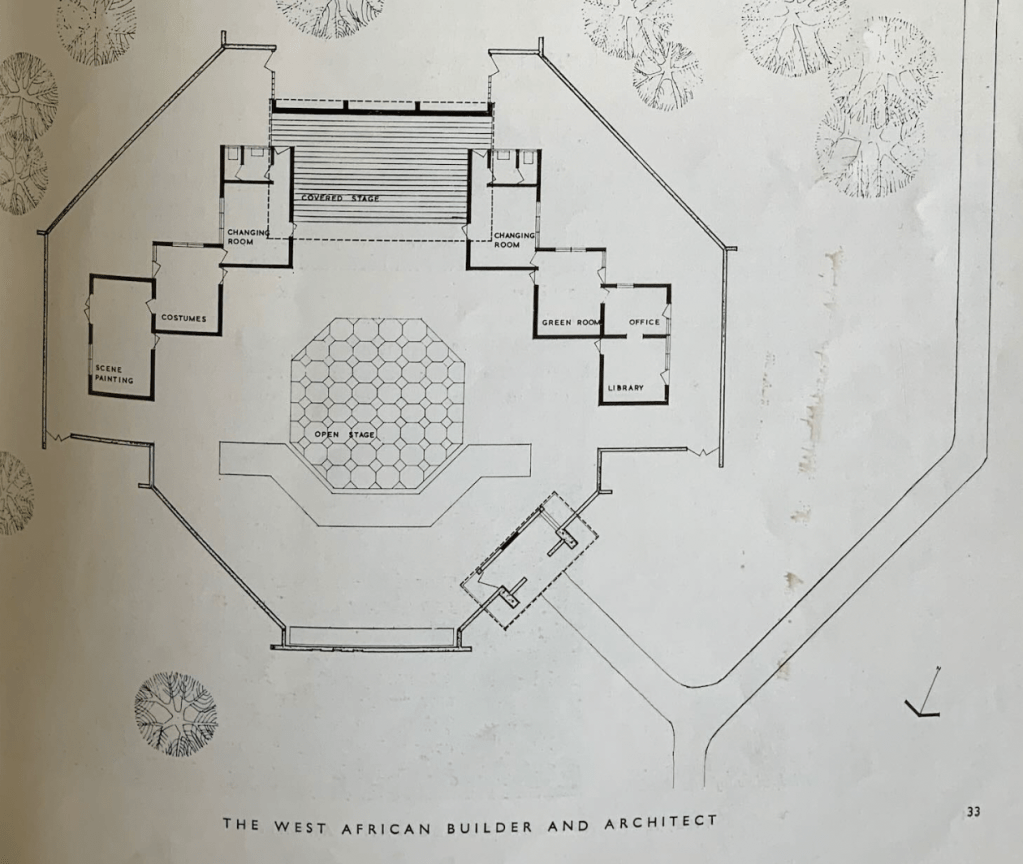
In 1958, the Ghana Arts Council and the Rockefeller Foundation provided the necessary funding to set up ‘the Experimental Theatre Players’ spearheaded by Efua Sutherland and Joe Degraft. Architects Gerlach and Gillies-Reyburn were commissioned to design the structure which was based around two performance stages – one ‘in the round’ and the other a proscenium arch theatre. It was Sutherland who generated the design strategy,

“Conceptualized by Sutherland, the dominance of traditional motifs in the architectural design of this theatre edifice was a statement of cultural renaissance, independence, and nationalism because she believed “political independence suggested cultural autonomy”

(Anku, S. S. (2022). (Post) Colonial Ghanaian Attitudes Towards Ibsen: An Overview of Ibsen Reception in Ghana Between 1930 and 1966. Ibsen Studies22(1), 3–30. https://doi.org/10.1080/15021866.2022.2063977).

The stages are enclosed by a series of interlocked rooms built from sandcrete and providing changing, offices, and other ancillary functions. The project received a full write up in the West African Builder and Architect journal in 1962.

“It was a small structure, unpretentious but handsome, traditional in inspiration yet modern in design. The dazzling whitewashed walls with their dark trim resembled a village compound and were meant to. Inside, at one end, a platform stage was covered by an overhanging roof; but the auditorium, with its seats of carved Ghanaian stools, was open to the night sky. It stood in a rough, weedy place approached by dusty footpaths, its simplicity contrasting sharply with the gaudy grandeur of Accra’s nearby Ambassador Hotel. The crowds were gathering at the entrance that was shaped like a huge traditional stool and flanked by two massive Akuaba dolls, sculpted male and female symbols of fertility”

(Anku, S. S. (2022). (Post) Colonial Ghanaian Attitudes Towards Ibsen: An Overview of Ibsen Reception in Ghana Between 1930 and 1966. Ibsen Studies22(1), 3–30. https://doi.org/10.1080/15021866.2022.2063977)

Anku further notes that the theatre was “replicated and relocated to the School of Performing Arts premises at the University of Ghana” – it’s unusual for a building to be entirely remade in a new location. The old site, as Anku notes, was near the Ambassador Hotel – this is now where the Mövenpick Hotel is located. Was the structure physically demolished, moved, and rebuilt? Perhaps the old site is where the National Theatre is located today?

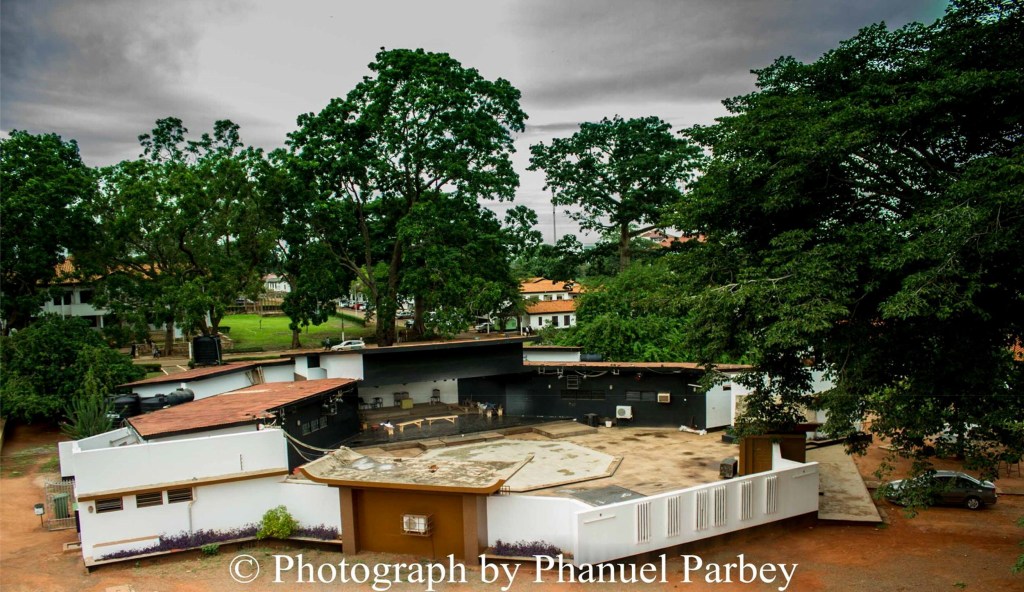
The new Drama Studio at University of Ghana, Legon. Photograph by Phanuel Parbey

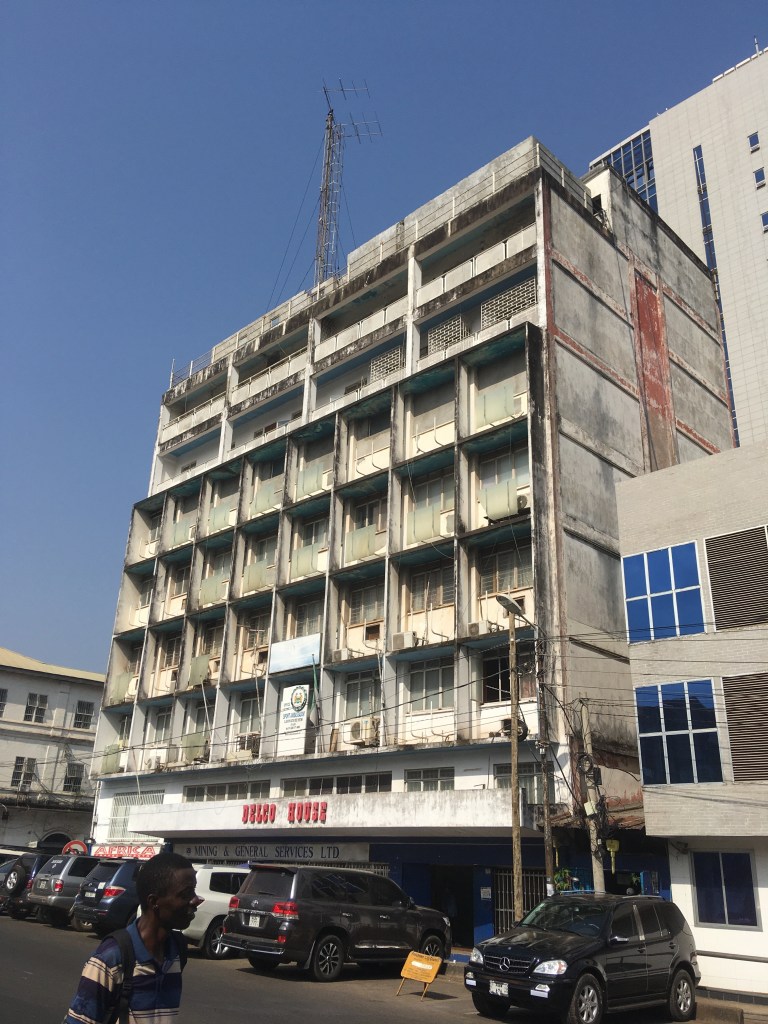
Delco Offices in Freetown, photographed in 2023, designed by Zdzisław Borysowicz in early 1960s

Have a peek at our inaugural AHUWA newsletter here: https://new.express.adobe.com/webpage/qgRzBtoiF2Snh

It’s devoted to our work-in-progress on the Polish architect Zdzisław Borysowicz – complete with lots of photos, basic biog on ‘Borys’ and how we managed to finally find out more on this fascinating architect….

The July-August 2025 edition of the Architectural Review has published an extended 9-page feature article written by Lois Quartey and Julia Gallagher on the Accra Community Centre, Ghana. The building designed by Maxwell Fry and Jane Drew, with Theo Crosby as the lead assistant, opened in 1951 and quickly became an important educational, cultural, and social hub in the city. It was paid for by the United Africa Company in an attempt to foster local support after its ‘Swanmill’ HQ was looted and burned following the 1948 Accra riots. TAG provided some drawings and photographs that accompany the article.

The primary thrust of the piece is to raise awareness of this significant historic structure – especially how it was used in the independence campaigns and beyond – and to stress just how vulnerable this building is. Currently being used as a mere store and at risk from the Marine Drive development plan – the article expands on what we covered here https://transnationalarchitecture.group/2022/06/22/accras-renaissance-fishing-harbour-marine-drive-and-a-new-cathedral/ back in 2022.

It’s a deceptively simple and even ordinary building at first sight – but after spending time exploring it’s two interconnected courtyards and assembly hall it quickly begins to feel at home, climatically comfortable, and a nice place to be. It’s also a significant structure because of its design pedigree and especially because of its political significance – so many important speeches, gatherings, and events took place here in the advent to independence and beyond. It’s also home to one of the largest installations by leading artist Kofi Antubam – that alone should secure its future. Our model that replicates one made by Fry and Drew featured in the recent V&A Tropical Modernism exhibition too.

If foreign and leading agencies such as the V&A museum and Architectural Review are prepared to give this seemingly humble building exposure, critique, and cause for preservation – surely the case can be made to restore this heritage structure and to weave it into the wider Marine Drive masterplan. Champions of Ghanaian culture https://www.design233.com/articles/in-trust-for-the-people are behind saving these works and raising awareness, but much more needs to be done.

To deliberately allow a ‘managed decline’ and slow demolition is a tragic waste and short sighted view of the building’s rich political history.