Zamarian, Patrick. (2025). The Bombay School of Architecture and the Royal Institute of British Architects (1917–1948). Fabrications, 1–41. https://doi.org/10.1080/10331867.2025.2528267
Technical Building, Sir J. J. School of Art, Bombay, 1909, designed by George Wittet and since 1926 home to the Bombay School of Architecture. Photographer unknown; from John Begg, Annual Report on Architectural Work in India 1909–1910 (Calcutta: Superintendent Government Printing, 1910).
In the early twentieth century, Bombay (now Mumbai) emerged as the largest and commercially most important city in what was then British India. With its rapid urban development offering opportunities for professional architects, the city produced the country’s first school of architecture, instituted in 1913 and, in terms of student numbers, soon among the largest such institutions in the British world. The Royal Institute of British Architects (RIBA) meanwhile claimed to promote and coordinate the training of architects across the British Empire. Using a broad range of archival records, government reports, and contemporary periodicals, this article traces the relations between the Bombay School of Architecture and the RIBA, which began during the First World War and ended following India’s independence. It argues that throughout this period the school was driven by its efforts to attain the RIBA’s “recognition,” which ultimately foundered on the RIBA’s intransigence. In contrast to its handling of schools in the settler colonies, the RIBA insisted on unrealistic metropolitan standards from the Bombay School. I therefore contend that the RIBA did not in fact pursue a coherent imperial policy; its lofty rhetoric notwithstanding, the RIBA’s role in coordinating architectural education beyond Great Britain remained limited.
General Post Office, Bombay, designed by John Begg and built between 1904 and 1913. Image from Report of the Civil and Military Works of the Public Works Department (General Branch), Bombay Presidency, for the Year 1909–1910 (Bombay: Government Central Press, 1910).
Full article available (creative commons) via the link above.
China’s Two Tropical Architectures: Climatic Regimes, Socialist Reconstruction, and Global Maoism in Guangzhou and Dar es Salaam, 1955-76, by Sun Zhijian, National University of Singapore, supervised by Prof Jiat-Hwee Chang.
Abstract:
In the contexts of decolonization and the Cold War, the tropical world became a contested arena with fierce competition among various old and new donors in the name of development aid, of which the infrastructural construction constituted the backbone. In the past decade, a growing body of literature on postcolonial tropical architecture has challenged current accounts weighed towards the built environment produced by either the former metropolitan powers or the Soviet-bloc, by shedding new light on the role of a third category of emerging aid donors, especially socialist China. Following the Sino-Soviet Split (1960), the Chinese attempted to promote an alternative socialist development path in newly-independent African states to that proposed by their Soviet-allied rivals. However, despite the allegedly age-old Sino-African solidarity, as latecomers in the unfamiliar tropics, the Chinese struggled against many challenges, among which the most crucial was the hot-and-humid climate as well as building problems it caused. This process almost coincided with their domestic socialist reconstruction through coping with the scorching heat and humidity in subtropical Guangdong under the Great Leap Forward (1958-62) and subsequent revolutions.
Based on archival materials from China, Tanzania and the UK, this thesis is a transnational history of China’s two tropical architectures in relation to both domestic politics and global geo-politics in the mid-to-late 20th century, i.e. China’s overseas architectural aid in decolonizing Dar es Salaam, Tanzania under Nyerere’s Ujamaa socialism, which was the largest sub-Saharan African recipient of China’s assistance in the Cold War, and China’s domestic subtropical modern architecture in Maoist Guangzhou, which has long been the stronghold of China’s subtropical knowledge production. Through case studies of sample projects of industrial and agricultural infrastructures in Guangzhou and Dar es Salaam, it answers two overarching questions: Since China’s two tropical architectures took place concurrently, were there any transnational interactions between their knowledge production and practice? (If so, how did they happen?) How did the Chinese socio-cultural construction of the tropics give rise to a distinctively “anti-imperialist” mechanism of tropical architecture from that of the West and socialist North?
Moving beyond traditional architectural historiography relying primarily on stylistic analysis, it draws on theories of “techno-political regimes” and “critical temperature studies” to develop the notion of “climatic regimes” to capture the interdependence between tropical architecture’s climatic management and the exercise of socio-political power. As the socio-technical arrangements of an interlinked body of climatic knowledge, thermal comfort norms, sanitary discourses, urban typologies and architectural expertise transcending Cold-War rivalries, climatic regimes render intelligible a certain set of climatic parameters, trigger remedial strategies dealing with environmental concerns and normalize people’s thermal sensation for certain political goals. It argues that China’s two tropical architectures were not only concurrent, but more importantly, were co-constitutive with each other through a highly-centralized bureaucratic network of socialist state-run institutions rather than the genius of certain individuals, in which not only architects and planners, but also building physicists, meteorologists, physiologists, ventilating engineers and technocratic Party cadres were all active mediators of global flows of resources and expertise. Divergent from the Soviet-bloc’s climatic regimes paying particular attention to former colonial thermal segregations of mass housing in Africa, the Chinese endeavors driven by the Sino-Tanzanian common appetite for rapid industrialization and self-reliance under the principle of “Production First, Livelihood Second” resulted in the uneven distribution of climatic considerations between industrial and non-industrial spaces in the work-unit typologies both within and beyond China. By revealing how the Chinese tropicality worked from within and vice versa, it contributes to existing literature on the histories of both modern Chinese architecture’s transnational influence and global tropical architecture, as well as recent scholarly attention to thermal comfort in the built environment against the Anthropogenic climate change.
As Hardly Found: Art and Tropical Architecture centres artists and artworks that have so far been overlooked by histories of ‘tropical architecture’. In this collection of essays, historians, artists and archivists address works of art connected to epicentres of teaching and practice within the movement – focusing on the Department of Tropical Architecture at the Architectural Association and its collaborators such as Kwame Nkrumah University of Science and Technology – which emerged in the mid-20th century alongside anticolonial struggles that dismantled the British Empire.
Here, authors use creative, critical and speculative methods to inhabit the gaps in archives of tropical architecture, highlighting artworks in Nigeria, Ghana, India, Indonesia, Singapore, Costa Rica, Cuba and the UK. Their contributions trace connections within a network of relations between art and architecture; one which recentres the rich and diverse forms of environmental knowledge, social values and material cultures contributed by artists working in these contexts.
We are delighted to welcome the editor, Albert Brenchat-Aguilar, and the team from AA Publications, who will give a short introduction to the book. A small installation will accompany, food and refreshments will be provided.
Hector Othon Corfiato (1892 – 3 May 1963) was a Greek architect (although some claim Egyptian). After studying at École nationale supérieure des Beaux-Arts in Paris, he established the firm of Corfiato, Thomson & Partners and was professor and director at The Bartlett School of Architecture, UCL from 1946 to 1959 (emeritus from 1960). He worked on various ecclesiastical projects including https://c20society.org.uk/c20-churches/notre-dame-de-france and https://www.architectsjournal.co.uk/news/grade-ii-listing-for-rare-corfiato-church and after his retirement the Church at Debre Libanos, Ethiopia (circa 1961).
Church at Debre Libanos, Ethiopia
He also completed some further projects in Burma, and in West Africa for the Nigerian College of Arts, Science and Technology (NCAS&T) in Zaria. Whilst in Nigeria he established an office at the collage and took on further projects including for the Manchester based firm G B Ollivant.
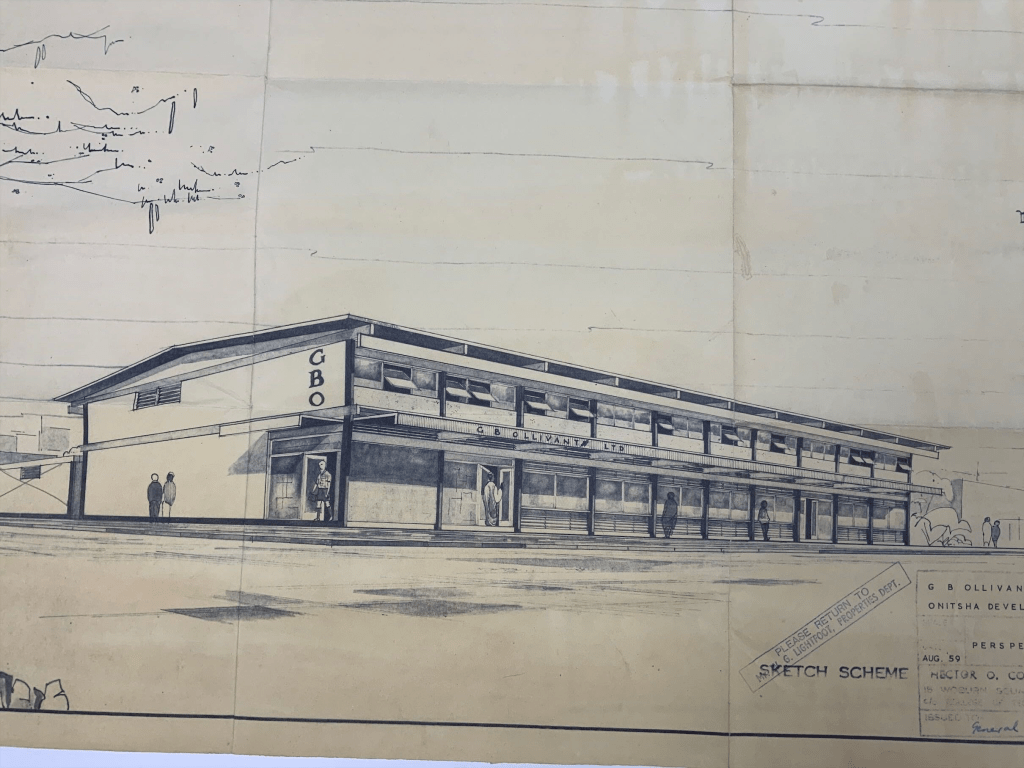
G B Ollivant (GBO) was bought by the United Africa Company in 1933 and transitioned from cotton and fabric trading into general retail, office supplies, and building management. Corfiato designed several bungalow types for the firm as well as a large retail store in Onitsha (1959) selling cottons, hardware, provisions, and fancy goods. The store was to connect to an existing Cosley store – which we suspect were hardware/builders merchants.
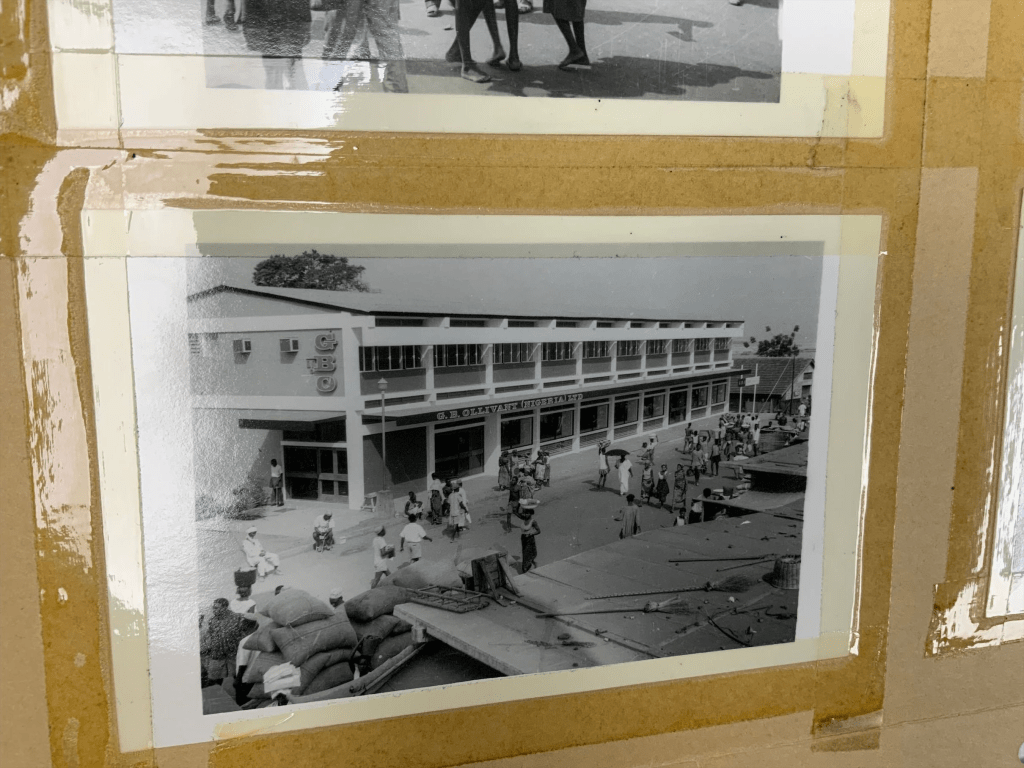
The building provided showroom spaces as well as retail and was probably used more for wholesaling than general retail. The exposed concrete frame of the building supported the overhanging roof to provide solar shading to the upper level whilst the ground floor had a further projecting canopy over pavement. It’s utilitarian and straightforward – but more than a mere warehouse and a considerable aesthetic departure from GBOs usual building style found elsewhere in West Africa. It’s looking more towards the ‘high end’ retail stores being built at the same time across Nigeria, and was part of the construction boom in Onitsha that saw the new cathedral (by Richard Nickson) and market hall (see Nigeria magazine no65, 1960).
Archive snaps of the GBO premises in Onitsha, 1959, designed by Corfiato and partners, from originals in the Unilever Archives, UAC/2/10/a1/4/4/1/5/2
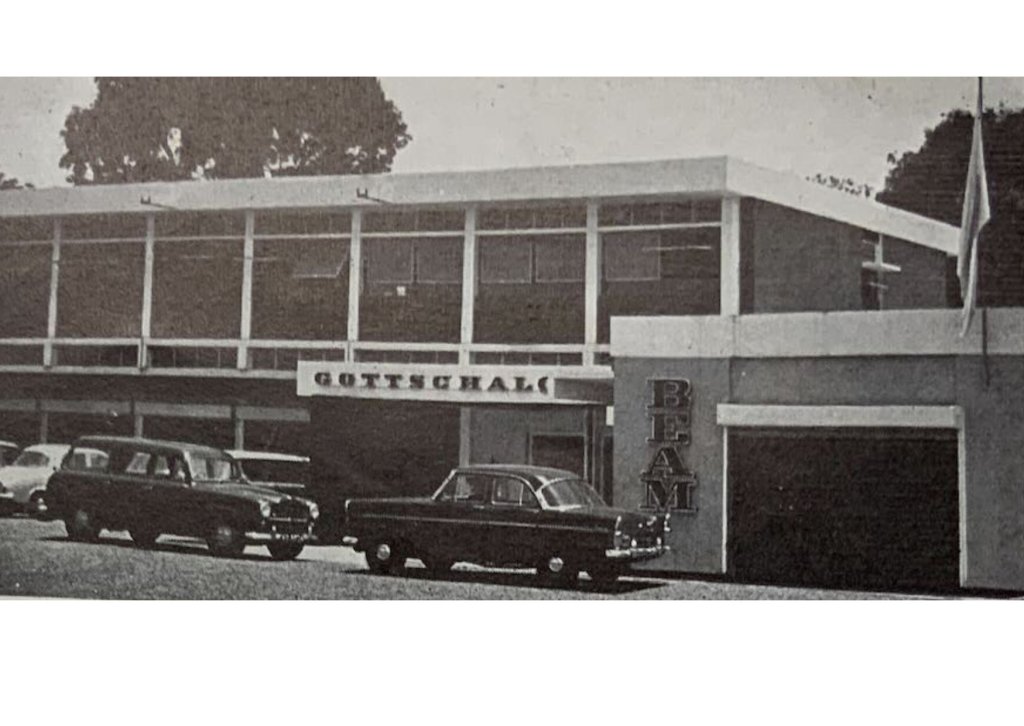
Corfiato collaborated with various other architects about whom we know very little. They’re listed in Nigeria Magazine as just “Avis” and “Horner” and are given credit for designing the Dispensary at Zaria College and a store for Gottschalck in Kaduna. The Gottschalck store closely resembles the GBO store and was also part of the UAC group.
Above Gottschalck Store at Kaduna. BEAM on the right hand side was another UAC subsidiary, ‘Business Equipment And Machines’. From Nigeria Magazine no73, 1962.
These projects raise a number of questions: Did Corfiato ever visit West Africa? Was he responsible for obtaining these commissions in the UK and then establishing a satellite office in Nigeria? Who were Avis and Horner? They were clearly a capable team and delivered some significant residential, educational, and commercial projects across Nigeria.



 Transnational Architecture Group