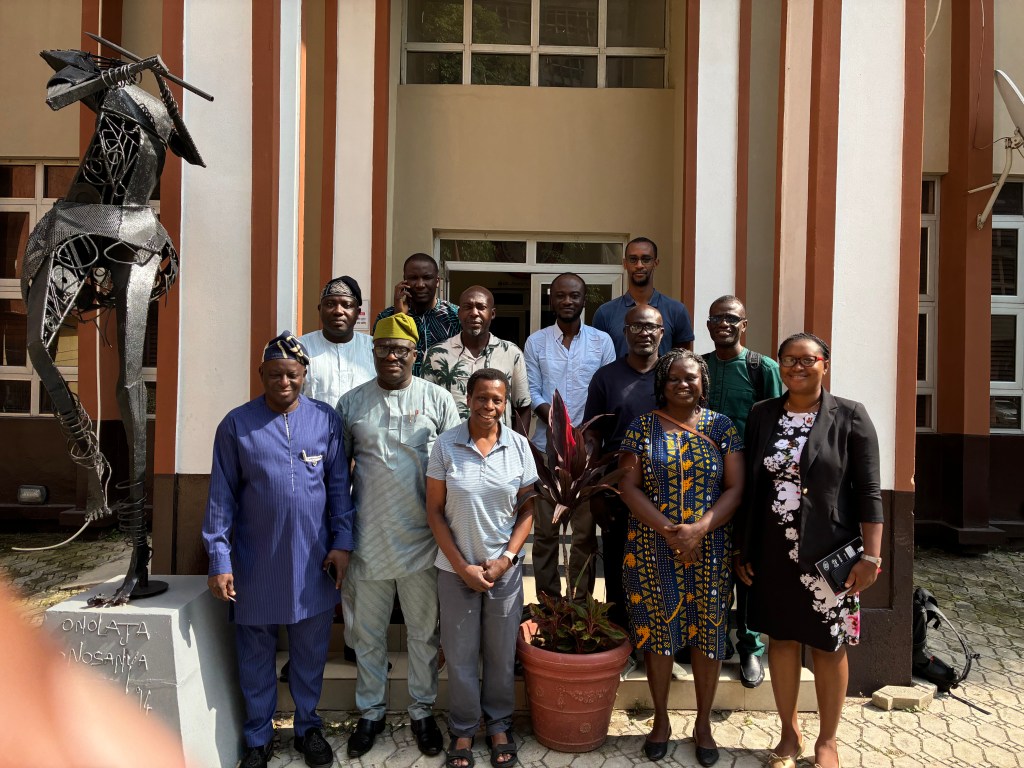
Lagos Writing Workshop Reflections 4th -7th July 2025 at University of Lagos
Lagos Workshop Reflections
Context
This document summarises the collective reflections from the Lagos Writing Workshop.
During the event, participating Early Career Researchers (ECRs) shared insights from
previous experiences organising student writing workshops in architecture. Discussions
included how to strengthen the pedagogical impact of these workshops, optimise cohort
composition, improve documentation and archiving, explore effective workshop models,
expand publishing and dissemination efforts, and establish robust logistical structures for the
long-term.
Based on these reflections, participants discussed how they might transform the workshop
series into a platform tentatively called the African Architecture History and Theory Network.
Such a platform would advance scholarship on the African built environment through various
events and opportunities for writing. It would involve academics and practitioners, on and off
the continent, who work on the history and theory of its built environment.
1. Pedagogical Impact and Institutional Uptake
A recurring theme in our conversations was the importance of tracing the workshop’s longer-
term impact. There were questions about the journeys of previous participants: Where are
they now? How many found their way into academia, and how many continued in
professional practice? More importantly, in what concrete ways did the workshop influence
their teaching, research, or approach to design and writing? This kind of follow-up could
strengthen the workshop’s role as a bridge to academic careers – if we so desired – and guide
how future editions are shaped to meet participants’ realities.
The discussion also brought up a common challenge: in many African universities, research
and writing are introduced into the curriculum only in their later stages. By that time,
valuable opportunities for skill development may have been lost. While institutional reforms
can be slow, participants identified opportunities for immediate action through informal
initiatives, such as integrating writing exercises into existing classes, establishing peer-review
groups, or mentoring students outside formal structures.
Participants emphasised the need to view the curriculum as a living and continuously
developing document that, even within the same framework, approached the material with
creativity in its delivery. This flexibility could open space for richer, more engaging writing,
teaching and development.
There was also a call to clarify the type of writing to prioritise: academic, creative, or a blend
of the two? Clearer goals would help ensure that teaching and mentoring efforts are aligned.
Finally, the group identified an opportunity for deeper institutional support: inviting
academics to serve as visiting scholars in specific schools, funded to spend extended periods
(perhaps a semester or more) and to help embed a writing community of practice more firmly
within an architecture department.
2. Cohort Composition and Interdisciplinarity
We reflected on how different compositions of workshop participant cohorts, such as single-
discipline or interdisciplinary, or those from a single institution or multiple institutions, shape
the workshop experience. Past multidisciplinary groups, comprising participants from various
universities, were seen as especially enriching, bringing fresh perspectives to both
discussions and writing. In particular, pairing architects with participants from other fields
interested in writing about buildings, as in the Accra workshops, proved valuable.
When it comes to larger participant numbers, colleagues suggested experimenting with group
essay writing. Under such conditions, each group member could contribute a section, as a
way to sustain engagement and produce richer outputs. This may require more work up front
to set it up effectively. Yet it promises to yield good results in the long run.
Another critical question was whether we had, in the past, assumed too much about
participants’ writing ability during the selection stages. In earlier workshops, many were
chosen because they could already write well. Moving forward, requesting writing samples
could help establish a baseline. Where needed, we can offer resources and strategies to help
beginners build foundational skills, as well as targeted support for advanced writers. At the
highest level, we recognised the importance of a clear framework to support and challenge
experienced writers to produce polished, high-quality outputs.
Participants also pointed out the importance of cohort size, which would shape the structure
of the workshops. Smaller groups allow for more intensive work, while larger groups may
benefit from group or collaborative approaches. But much of this needs to be discussed
alongside issues such as the number of ECR mentors available and the duration of the
workshops, and all these depend on funding.
3. ORGANISATION: Documentation, Archiving, and Knowledge Management
Lagos workshop participants also discussed the need for a more systematic approach to
capturing, storing, and sharing the knowledge generated through the workshops. This
includes establishing clear protocols for cloud storage and file sharing. These should ideally
be set up before each workshop to ensure that all forms of output are preserved and
maintained. The frameworks should provide for the archiving of materials in multiple
formats, including audio and video recordings of workshop discussions, lectures, participant
feedback, and organisers’ reflections.
We also acknowledged the central role that archival materials and comparative building
analysis can play in fostering architectural research and writing, as well as the barriers to
accessing architectural records across institutions and countries. Whilst some university
libraries may have useful records, there still exists a need to establish direct contact with
architects or their families, in case they have passed away, to explore how we might collect
and store their archives. Copyright issues emerged as a key consideration. If architectural
drawings or other archival content are to be published online, it is essential to secure the
necessary permissions from rights holders.
There was also discussion about the platform through which archived materials might be
made accessible online. Should this be a standalone website dedicated exclusively to the
workshop series, giving it a clear identity and independent visibility? Or should it be
integrated into the digital infrastructure of an existing institution, potentially offering greater
3long-term stability, technical support, and credibility? Each option carries implications for
accessibility, branding, and sustainability. We need to consider this alongside questions of
funding, audience reach, and alignment with the workshop’s broader objectives.
Finally, participants emphasised that robust archiving is just as much about accessibility as it
is about accuracy. To ensure that stored knowledge remains reliable, we discussed the
potential for an independent peer-review mechanism for workshop essays and other materials
generated. Such a system would help maintain the archive’s long-term value as both a
teaching resource and a research asset.
4. Workshop Models and Formats
We reflected on the range of workshop models used to date, from those focused on individual
essays to those built around group writing, and from standalone events to workshops
embedded within larger programmes. Each format offers distinct advantages: individual
writing allows for deeper personal engagement with a topic, while group essays can foster
collaboration, distribute workload, and produce richer, multi-voiced outputs.
Lessons from initiatives such as the Shared Heritage Fellowship suggest that embedding
workshops within broader collaborative frameworks can create valuable opportunities for
networking, resource sharing, and sustained engagement. Well-structured collaborations can
also open doors to funding streams that might otherwise be inaccessible.
Potential partners identified included:
· The Canadian Centre for Architecture (CCA), which holds relevant archives and could
host African scholars for on-site archival work as part of a workshop.
· The Museum of Modern Art (MoMA) in the United States.
· The Architecture and Design Centre in Rwanda by MASS Design Group.
· The African Futures Institute (AFI); and
· The African Architectural and Urban History Network (AFRAUHN).
Reaching out to such institutions could create new possibilities for co-organised workshops,
access to specialised collections, and cross-continental exchanges.
5. Publishing, Toolkits, and Knowledge Dissemination
We discussed the value of consolidating the insights, methods, and resources developed
through the workshop series into outputs that extend beyond the immediate cohort. Joint
publications, whether in the form of edited volumes, special journal issues, or curated online
essays, could serve both as a record of the intellectual work undertaken and as a meaningful
contribution to the broader discourse in architecture.
Platforms for such outputs could include academic journals such as Architectural Research
Quarterly, Journal of Architectural Education, and The Journal of the Society of
Architectural Historians.
Conferences such as the Society of Architectural Historians (SAH) Annual Conference, the
African Architecture Matters Forum, and the African Studies Conferences could serve as
opportunities to present findings, build networks, and position the workshops’ outputs within
both African and global conversations on architecture and heritage. Such outputs could feed
back into architectural curricula, enriching reading lists for history and theory courses and
influencing teaching practice within departments.
In parallel, the creation of practical manuals or toolkits – which draws on our collective
experience in workshop design, pedagogical strategies, and partnership building – could
support future workshops as well as other educators and institutions interested in running
similar initiatives. Toolkits could be tailored for a broader readership, including practitioners,
students, and cultural institutions, and made accessible in multiple formats: print, digital, and
ideally, open-access.
Finally, there was strong interest in forming a dedicated working group or network to develop
and promote research, teaching, and dialogue on African architectural history and theory.
Participants believed this would provide a sustained platform for collaboration and visibility
in this field. A suggested name is the African Architecture History and Theory Research
Network (AAHT), which would have a base (a writing hub) at each participating university.
These AAHT writing hubs could be dedicated to providing year-round support for student
members who develop essays for publication and who could serve as a pool to draw from for
future workshops.
6. Planning, Logistics, and Long-Term Structuring
We discussed the need for more robust logistical and planning frameworks to support the
consistent delivery of successful workshops while reducing the need to reinvent processes
each year.
For transnational events, this includes building capacity for virtual and hybrid formats to
support collaboration across countries and institutions. For in-person gatherings, challenges
such as visa applications must be addressed early. A practical step would be to send accepted
participants a checklist of required preparations immediately upon selection, to avoid delays
caused by unforeseen administrative issues.
Clear decisions will be needed regarding the frequency of workshops (e.g., annual or bi-
annual). This, in turn, will determine how much time will be required for planning. This
means formalising the workshop series as an event centred on writing and text production
about the African built environment. This will be based on a standing document outlining our
core values, mission, and vision, supported by a strategic committee responsible for
oversight, continuity, and long-term direction.
To streamline coordination, we proposed appointing an administrative lead – possibly an
intern based at the host institution – to handle logistical tasks, allowing academics to focus on
the programme’s intellectual and pedagogical components.
Alongside the list of potential collaborators, a standing register of funding and grant
opportunities would help guide application timelines and planning priorities. Planning
frameworks should also account for different funding conditions, with adaptable approaches
for both funded and unfunded workshops.
Finally, we explored strategies to expand the series to other university campuses, beginning
by consolidating our presence in key locations, such as Uganda, before extending it to new
sites. This phased approach could help ensure depth and sustainability in our growth, building
strong local networks before scaling further.
 Transnational Architecture Group