The 1951 victory for Kwame Nkrumah’s Convention People’sParty resulted in some major shifts in the procurement of new infrastructure and housing. For the electorate, housing was one of the most important issues and Nkrumah’s government was quick to recognize this potency.
His plan, announced in 1952, was to build a new port city, complete with innovative and improved housing at the highest standards. Located only 18 miles from the centre of Accra, the new city of Tema would demonstrate Nkrumah’s commitment to industrial development and that Ghana was at the centre of a pan-African vision.
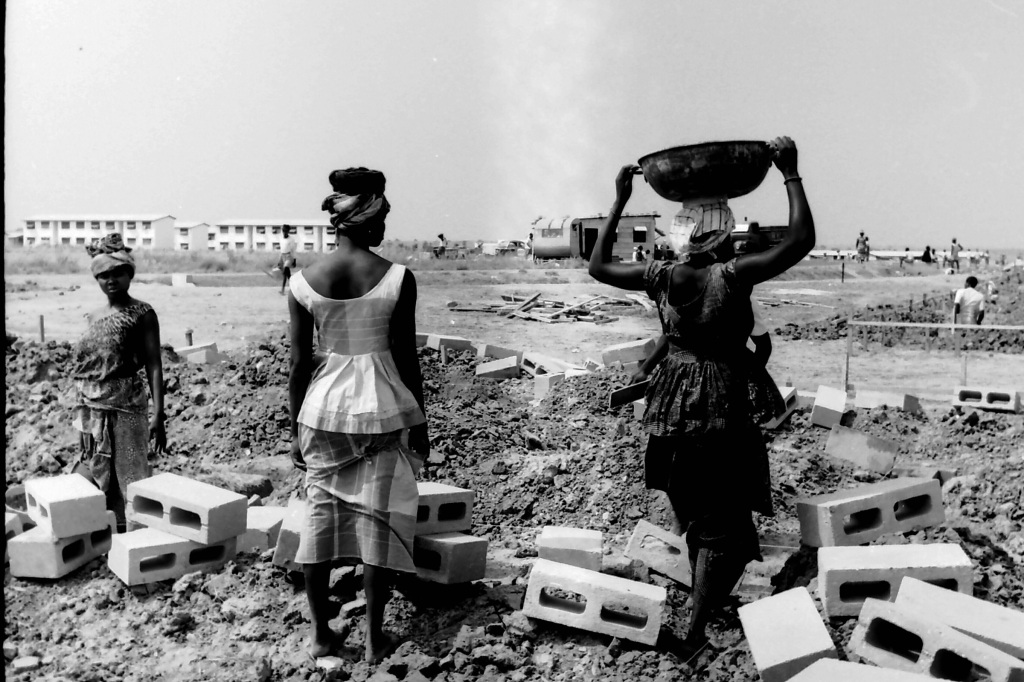
Tema under construction: female labour force transporting blocks and cement
Tema was part of a wider industrialization project that included a new aluminum smelting plant and hydroelectric power station on the Volta River. It was a major project involving international financial backing and set out the major ambition Nkrumah had for the nation during the advent of independence. For such a major project, very little is known about the first team of architects and planners responsible for the execution and delivery.
ESALA Architectural History & Theory Seminar Series
INTERVIEWS ON METHOD encompasses a cycle of pre-recorded conversations with scholars of architecture and the built environment across the globe and at all career stages. The conversations span a diversity of methods, including environmental studies, economic history, filmmaking, heritage, the study of colonialism, history of the book, print history, oral history, and exhibition. The interviews were recorded during spring of 2021.
The discussions are centred on methods for the study of architecture and the built environment for a number of reasons. The Seminar Series has always showcased works-in-progress, but turning focus to methods presented an opportunity to scrutinise the mechanisms and techniques of that work. The result is a public and durable record of emergent and changing approaches to research and teaching on the history of architecture and the built environment during the current moment.
/Dr. Elizabeth Petcu & Dr. Moa Carlsson, 20/21 AH&T Seminar Series convenors
—
If you have a question about the ESALA Architectural History and Theory Seminar Series, or would like to join our mailing list, please contact Dr Moa Carlsson: Moa.Carlsson@ed.ac.uk
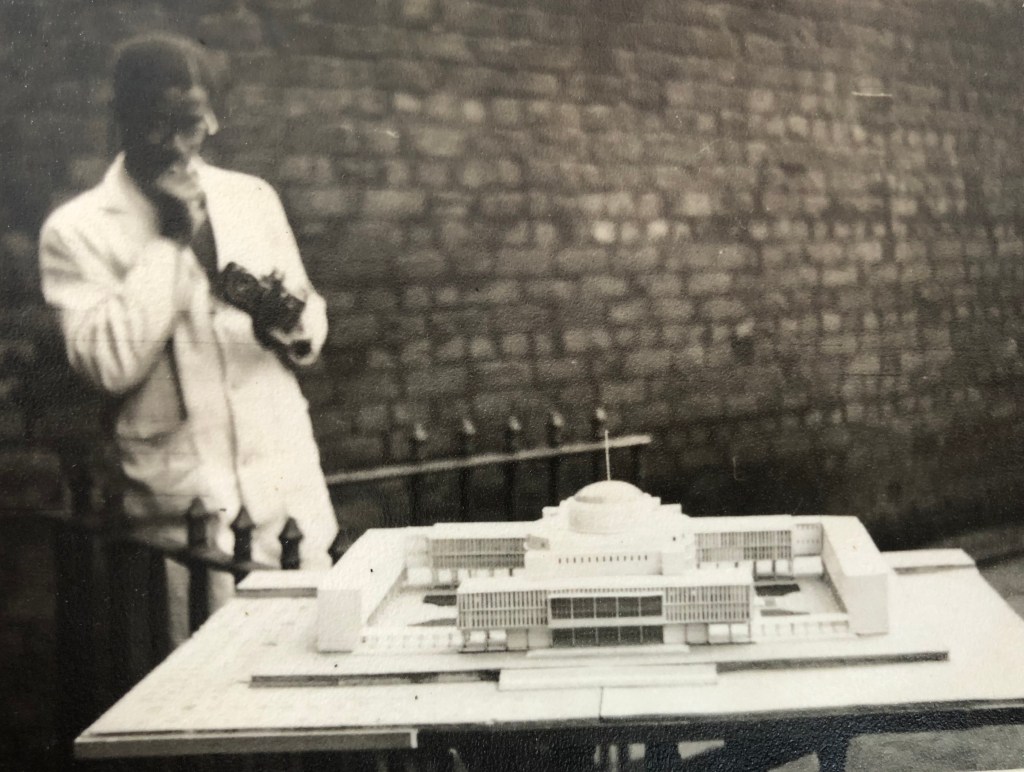
Have a look at https://www.design233.com/articles/from-buckman-to-turkson for my article on some lesser known Ghanaian architects, including John Buckman and Peter Nathaniel Kwegyir Turkson. I uncovered Turkson’s architecture thesis project in the University of Liverpool archives and discuss his plans for a new Parliament Assembly building in Accra.
Peter Turkson in Liverpool with his architectural model for a new parliament building in Accra, 1954.
Turkson wanted a design that was ‘classic in character and at the same time distinctly modern in feeling and detail…[exhibiting] the spirit of modern times’.
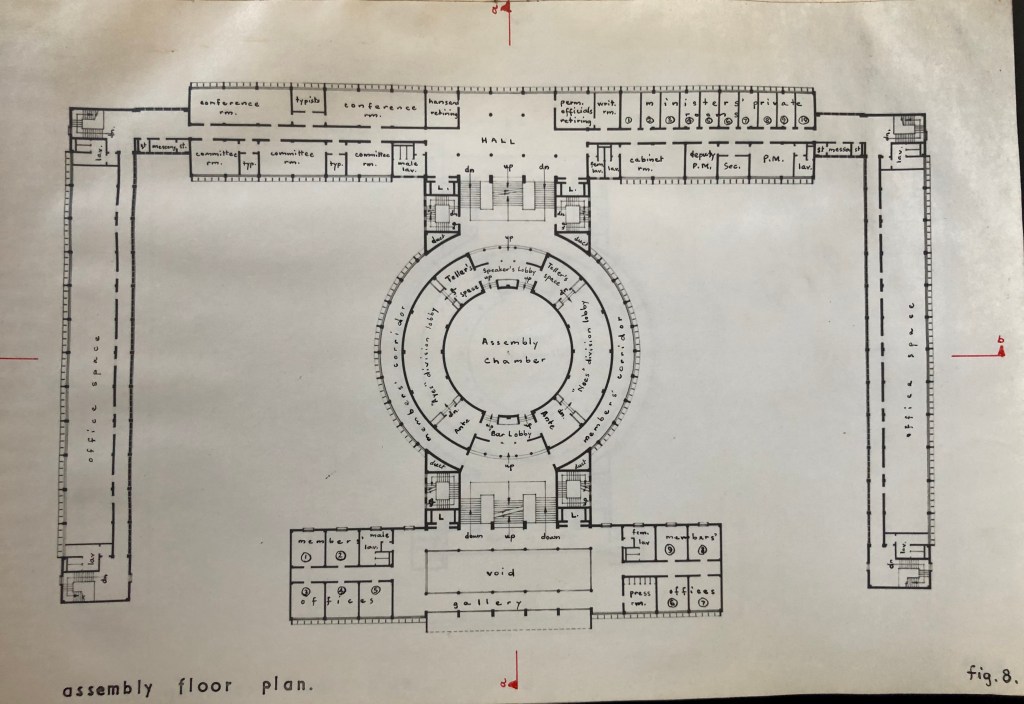
Proposal for the Accra Assembly building, by Peter Turkson, 1954
Turkson’s solution proposed using a ‘sandcrete’ (laterite soil mixed with cement) block wall along with a brise-soleil frame of fixed vertical and horizontal fins. Topping the structure and reflecting the chamber below was a reinforced concrete dome clad in copper, whilst some of the walls would be clad with faience finish. The plan was symmetrical forming two courtyards with a central drum for the debating chamber and library above.
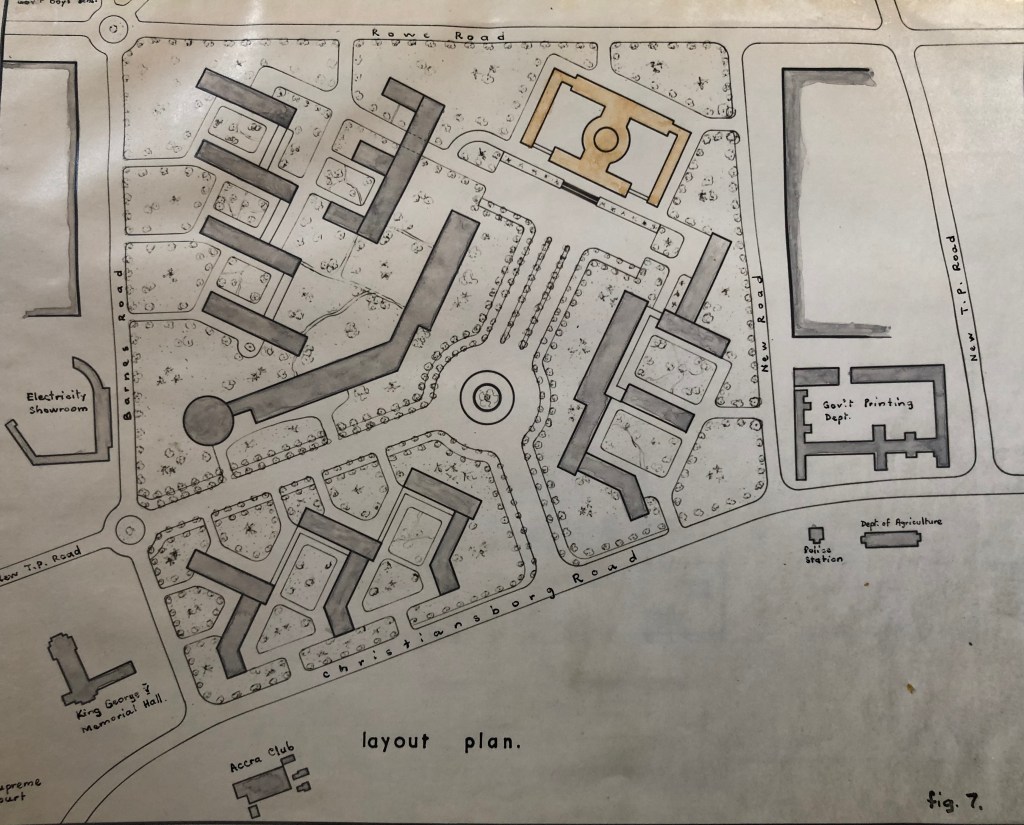
Site plan showing the proposed location of the new Assembly on Accra’s Barnes Road and Christianborg Road.
Recent years have seen an upsurge of academic, curatorial and critical interest in postwar art in Britain and around the world. This has included addressing the question of how we define what “postwar” is and how expansively we might think about the period and its cultural significance. This series of Paul Mellon Centre research seminars will showcase new perspectives on the arts of postwar Britain as an interdisciplinary and transcultural terrain of research. Talks in the series engage with the issues of empire and worldmaking, with questions of migration, the environment and with the intersections of art, technology and new media.
The sixth and last in a series of summer research seminars on The Arts of Postwar Britain 1945–1965 with Iain Jackson and Rixt Woudstra. 13th July 2022, 6pm-7.30pm, Paul Mellon Centre
25 May to 13 July 2022
A series of summer research seminars to be held on Wednesdays from May to July 2022
Paul Mellon Centre [online and in person]
Iain Jackson – Modern Architecture in West Africa: Schools, Sculptures and Magazines
This paper is concerned with modernist architecture in “British West Africa” produced in the aftermath of World War Two and the independence period of these countries.
These experimental and often provocative structures were designed for climatic comfort, as well as becoming didactic vehicles for ideas sharing ideas of a modern and liberated Africa.
The paper will discuss attempts at forming a “Bauhaus” Art School in Accra, followed by various commissions of libraries, community centres and museums that attempted to blend the most radical architectural designs with decoration, murals and sculptures. The West African context seemingly presented a “blank canvas” for newly qualified architects eager to “experiment” in ways that would be impossible in Britain. Whilst these buildings were often presented as symbols of an emerging nationalism and expectation of liberation, they also reveal the ongoing neo-colonial methods, with many relying on the patronage of multinationals such as the United Africa Company.
Finally, the paper will discuss how these projects were reported and shared, especially through the high-brow magazine Nigeria, which regularly featured extensive articles written by the architects on the latest designs.
The result was a diverse and extremely fertile context that reveals an often-overlooked set of important structures responding to a period of political flux and cultural exchange.
Rixt Woudstra – “A feeling of warmth”: Tropical Timber, Modern Interiors and the United Africa Company in Postwar Britain
In 1960, the new, modernist headquarters of the United Africa Company (UAC), one of the leading British trading businesses extracting palm oil, cocoa and other raw goods from West Africa since the late nineteenth century, opened near Blackfriars Bridge in central London. While the structure’s grey concrete and glass exterior appeared cold, inside the architects used a strikingly large variety of gleaming tropical timbers. The doors, floors and panelling, as well as most of the furniture, were made of honey-coloured idigbo, pinkish makore, fine-textured guarea, reddish-brown sapele and deep-brown African mahogany – all logged by one of the company’s subsidiaries, the African Timber and Plywood Company, in Nigeria and Ghana. Although an exceptional example, it was certainly not the only building containing exotic timbers in postwar Britain; tropical wood could be seen in and on the outside of university building, civic centres, housing estates, sport facilities and offices.
Scholars have explored how Jamaican and Honduran mahogany, sourced by enslaved workers, left an imprint on British domestic interiors and furniture design in the late seventeenth and eighteenth century. Less well known, however, is that “empire timber” – and later, “world woods” – continued to permeate British design and interior architecture well into the twentieth century. This talk focuses on the commercial activities of the UAC in Nigeria and Ghana during the 1950s and ’60s and considers how tropical timber was deployed to soften or provide a decorative element to modernism, often perceived as cold and austere. Moreover, examining tropical timber and tracing where and by whom it was logged, how it was processed, sawn, shipped and sold, enables us to see how British postwar modernism was dependent on imperial and neo-imperial networks of extraction and colonial labour.
A fascinating article by Peter Halliday on Tropical Modernism in West Africa – including some previously unseen photographs taken by his father, and site architect at Ibadan University, Anthony Halliday.
‘Archival Urge’ is the second part of the symposium ‘Document Fever’ organised by the Architectural Association in collaboration with the Architecture Space & Society Centre, Birkbeck School of Arts on 25 February 2022. This time in partnership with KNUST, this panel aims to celebrate three projects that ‘collect’ histories of architecture in very different ways. We will think, amongst other questions, about the archival impulse/fever that made these projects coincide in time and space; the archival need to collect histories that are missing in architectural history; and the diverse formats of archive-making that these projects have taken or are taking.
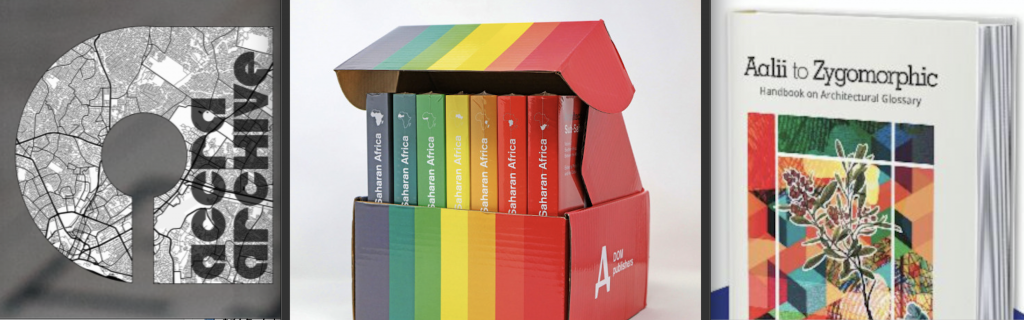
Adil Dalbai Adil graduated from Humboldt University of Berlin with a master’s degree in modern history and cultural theory, specializing in the architectural history of Eurasia and (post)colonial contexts. He worked as an editor and author for DOM publishers, focusing on architecture and urbanism. He went on to study architecture at the Technical University of Berlin and worked at Meuser Architekten on architecture projects in Western Africa. He researches and writes about architecture in Central Asia and Africa and its global interconnections. Additionally, he is a guest critic and lecturer, as well as (co)editor and author of several articles and books on architecture, including Theorising Architecture in Sub-Saharan Africa (DOM publishers, 2021). Since 2014, he has been managing editorial director of Architectural Guide Sub-Saharan Africa (DOM publishers, 2021, with Philipp Meuser and Livingstone Mukasa), a seven–volume documentation of the architecture of all 49 African countries south of the Sahara.
Kuukuwa Manful Kuukuwa is a Doctoral Researcher at the Department of Politics and International Studies at SOAS, University of London. Her research examines the sociopolitics of West African nation-building and citizenship through a study of the architecture of educational institutions. She has a Master of Architecture and a BSc Architecture degree from the Kwame Nkrumah University of Science and Technology (KNUST), and an MSc in African Studies from The University of Oxford. Her previous research has explored the positioning of Ghanaian architects in the modernist movement; Asante architectural identity; and social acceptance of earth building in urban areas. She has published in Al Jazeera, Burning House Press, Africa Is A Country, and The Metropole. Kuukuwa curates Adansisɛm— an architecture collective that documents Ghanaian architecture theory, research and practice, and runs accra archive— an architecture archives digitisation project. She also co-founded and runs sociarchi— a social architectural enterprise that advocates for, and provides architectural services to people who ordinarily cannot afford architects.
Philipp Meuser Born 1969, Managing director of Meuser Architekten GmbH and head of DOM publishers. From 1991 to 1995, studied architecture at the Berlin Technical University. From 1995 to 1996, editorial work for the Neue Zürcher Zeitung, Switzerland. Part-time postgraduate studies in the History and Theory of Architecture at the Swiss Federal Institute of Technology Zurich (ETH Zürich), graduating in 1997. PhD on the Soviet Mass Housing (Berlin Technical University, 2015). Federal Cross of Merit for cultural and scientific exchange with the states of the former Soviet Union (2018). From 1996 to 2001, policy advisor to the Senate Department for Urban Development as part of the Stadtforum Berlin. Visiting Professorship at the Kazakh National Technical University, Almaty (2015). Tutor at the Strelka Institute Moscow (2016/2017) and the Architectural Association London (Easter Island Visiting School 2017). Since 2018 Honorary Professorship at the O.M. Beketov National University of Urban Economy in Kharkiv, Ukraine. 2022 Visiting Professor for Public Humantities at Brown University in Providence/Rhode Island.
Livingstone Mukasa Livingstone Mukasa’s career has included architectural practice, urban design, master planning, real estate development, and sustainable development consulting. He founded and managed Archability, an online architectural crowdsourcing start-up, and Afritecture, an online platform on architecture in Africa. He is currently principal of Mahali, a collaborative design studio focused on cultural and contextual architectural engagement, and a frequent guest reviewer at Rensselaer Polytechnic Institute’s School of Architecture. Passionate about architecture in Africa, he is coauthor and associate editor of Theorising Architecture in Sub-Saharan Africa (DOM publishers, 2021), and Architectural Guide Sub-Saharan Africa (DOM publishers, 2021, with Philipp Meuser and Adil Dalbai), a seven–volume documentation of the architecture of all 49 countries south of the Sahara. Born in Kampala, Uganda, he holds a bachelor’s degree in Architecture from New York Institute of Technology, and graduate certificates from the Graduate School of Architecture, Harvard University in Urban Housing and Mixed–Use Developments.
Rexford Assassie Opong Rexford Assassie Opong (PhD) is currently a Full Professor of Architecture and Dean of International Programmes Office of Kwame Nkrumah University of Science and Technology (KNUST), Kumasi. He is a practicing architect of over twenty years’ experience. He obtained his Doctor of Philosophy in Architecture from the premier Liverpool School of Architecture — University of Liverpool; Masters in Urban Planning and Management from University of Rome-La Sapienza; Postgraduate Diploma in Architecture, KNUST; and Bachelor of Science in Design, UST, Kumasi. He researches and has widely published on the following topics: Architectural Identity, Metamorphosis and Disorderliness, Ecological Aesthetics and Architecture, Architecture and Fractals, The Built Environment and Climate Change,Urbanism and Architectural Modernism in Africa, Architecture and Health, Architectural Habitus, Architecture and land, Taste in Architecture, Architecture; Science and Arts Debate, and Kinship, Land, and Architecture in Urban Ghana.
Organiser and chair: Albert Brenchat-Aguilar Albert is a Lecturer (teaching) at the Bartlett School of Architecture, University College London. Previously, he co-curated the public programme and publications of the Institute of Advanced Studies, UCL, edited the digital platform Ceramic Architectures and worked as an architect in Bombas Gens Arts Centre. He is a CHASE-funded PhD student at Birkbeck and the Architectural Association with the project ‘Resource: Humans Matter and the Patterns of International Planning c. 1957-76’, whilst cataloguing the archive of educator, architect, and planner Otto Koenigsberger. His coedited volume ‘Wastiary: A bestiary of waste’ will be published soon he hopes. He has published in Architecture&Culture, Espacio Fronterizo, and The Scottish Left Review, curated shows at UCL and the Polytechnic University of Valencia, and exhibited his artworks at Museu Nogueira Da Silva. He is currently a visiting researcher at the Department of Architecture, KNUST.
PhD Research Title and Summary: Development and National Identity: Tropical Modernism in Post-Independence Nigerian Universities
The aftermath of the Second World War brought a shift in the policies of the British Empire towards the infrastructural development of colonies in West Africa. Massive projects ranging from transportation to healthcare and including education went underway in Nigeria, the largest colony in West Africa. Various commissions from the 1940s and nationalist agitations eventually led to the establishment of the first university in West Africa in 1947- the University of Ibadan, Nigeria. Colonial architects such as Maxwell Fry and Jane Drew, who specialised in modernist designs for the tropics, were hired for this and other major projects.
Ibadan University
With the country’s independence from colonial rule in the foresights in the late 1950’s, a new desire for a unified national identity arose. This aimed to erase dividing ethnic lines and create a collective identity in the culturally heterogeneous new nation. Infrastructural projects were commissioned, ranging from public buildings to higher education institutions. These projects designed and built following the tropical modernist architecture of the colonial were used in developing a new built environment for Nigeria. I am interested in examining the tropical modernist architecture of Nigerian higher education projects in the 1960s and their role in the country’s development and representing the national identity for the newly independent Nigeria.
Ibadan University
Aims and Objectives:
-examine the position of higher education projects in creating a new sense of identity and nation building
-explore the first universities established in post-independent Nigeria within the social and political context of the 1960s
-highlight the roles of Nigerian actors who championed, designed, and built higher education projects
-compare tropical modernist style of higher educational buildings before independence and post-independence
What did you do before the PhD Research?
I recently completed my master’s degree in Environmental Design at the University of Lagos, Nigeria where I also obtained my undergraduate degree in Architecture. I also worked part-time at A3: Archives of African Architecture, an organization based in Lagos that documents architecture of practices in the country and promotes documentation of endangered built environments in Africa.
Why did you pursue a PhD, and what made you choose the University of Liverpool?
I first made a choice to purse a PhD in the third year of my undergraduate degree. Research satisfied my curiosity and I found it interesting and fulfilling to investigate the unknown and/or under researched areas in architecture (that I could relate to) and share it to the public. I think I also had enough time to weigh the pros and cons and honestly question my reasons and be certain for my interest in undertaking a PhD.
I chose the University of Liverpool for a few reasons. The research area was of great interest to me. I was surrounded by tropical architecture in the University of Lagos and studied some of the buildings only as case studies for studio projects. It was exciting to do a PhD on this topic that didn’t study these buildings in isolation but within the wider context of the period they were designed and built.
The programme also provided me with the opportunity to gain experience outside academia at the National Archives in London which caught my interest. I was also confident in the calibre of my supervisors and the wealth of experience they had in their fields. It also helped that Liverpool is a coastal city with beaches and waterfront views just like Lagos.
What have you found the most fun part of the PhD, and the most challenging?
I am at the beginning of my PhD, and I find learning more about my research area interesting. There is something new to learn everyday and that alone excites me.
I think the most challenging part for me is managing the scale of my research. It is still a new experience and managing my project myself is still very unfamiliar.
Post-PhD? Any ideas of what you’d like to do next?
I do not yet have a clear path post-PhD but I am sure my programme will enable me try new opportunities within and outside academia. I think this will help me make a more informed choice.
Any advice for others interested in doing a PhD?
It is particularly important to like what you want to research. When it becomes challenging, it helps to know that you are working on something that you chose and genuinely enjoy.
You also don’t have to be very excellent in research, although experience in research helps. A PhD is a learning process, and it gets better.
Call for Papers for Modern Heritage in the Anthropocene Symposium
Modern Heritage in the Anthropocene is part of the MoHoA global collaborative and builds on the Modern Heritage of Africa symposium hosted by the University of Cape Town in September 2021. Coordinated by The Bartlett’s Professor Edward Denison and Head of the University of Liverpool’s School of Architecture, Professor Ola Uduku, along with partners at the University of Cape Town, the Africa World Heritage Fund and around the world, this upcoming hybrid symposium responds to an age of planetary crisis in which a precarious present reflects an inequitable past and a perilous future.
The international railway settlement of Fushun (northeast China), with its modern town planning and the Ryuho Colliery, built by Denang and Siemens, and home to one of the world’s largest open cast mines in the 1930s.
Modern heritage in all its forms and from around the world is the subject of this multidisciplinary symposium, presenting the paradox of being of modernity and yet threatened by its consequences. MoHoA was originally conceived within an African context to interrogate this paradox because the continent encapsulates the historical inequities that characterise the modern and its associated notions of development and progress while also facing the highest rates of urbanisation over the next 30 years, demanding new approaches to the past and present that achieve equitable and sustainable futures on a planetary scale. The outcomes of the two symposia will synthesise in the recognition of the Cape Town Document on Modern Heritage.
Call for papers
Submissions are invited from researchers, academics, and practitioners. The organisers are seeking papers or equivalent submissions that critically engage with reframing, re-evaluating, decentring, and decolonising recent, hidden or marginalised pasts in pursuit of achieving more equitable, just, and sustainable futures. Participants will contribute to the completion of the Cape Town Document on Modern Heritage, supporting policy change at a global level through our partner UNESCO.
Topics can include, but are not limited to:
Practices of coloniality, decentring and decolonising history and historiography
Considerations and conceptualisations of multiple modernities
Modern heritage and Sustainable Development Goals (SDGs)
Planetary futures and the Anthropocene
Infrastructure and (post)-industrial heritage
Combining culture and nature, and the role of natural heritage in society
Public space and memory: memorialisation, commemoration and remembering
Modern heritage and the World Heritage Convention
How to submit
Submissions should be in English or French and should be emailed to mohoa@ucl.ac.uk by 31 May 2022.
Notification of acceptance will be provided by 30 June. Abstracts should be a maximum of 300 words or equivalent format (e.g. film shorts, blog, or Instagram story) for other types of digital submissions.
Selected papers or presentations will be published as part of the MoHoA Book Series after the conference and selected extended papers will appear in a special edition of the journal ‘Curator’.
During this international conference, a series of scholars from different disciplines (history, anthropology, political science, architecture,..) and backgrounds will present their (ongoing) research on railways in Africa and engage in a conversation with Anne Wetsi Mpoma and two artists currently in residence in the context of Europalia Arts Festival, Alexandre Kyungu Mwilambwe and Arnaud Makalou. Aymar Nyenyezi Bisoka will start the day with a keynote lecture. Please note that interventions will be in French and/or English, with no simultaneous translation.
We will open a work-in-progress exhibition of work produced by students and staff of the Department of Architecture and Planning of Ghent University on the theme of the railway in Africa, conducted over the last couple of years. Two keynote lectures, one by historian Geert Castryck (University of Leipzig, Germany) and one by digital humanities scholar Chao Tayiana Maina (African Digital Heritage, Kenya) will provide a broader context on the theme. The interventions will be in English.
Document Fever: Encounters with the architecture of the *colonial architecture archive: Organised by the Architectural Association in collaboration with the Architecture Space & Society Centre, Birkbeck School of Arts
Date: Friday 25 February 2022 Time:10:00 – 17:00
Fever: An intense enthusiasm for or interest in a person, pastime, event, etc., typically widespread but short-lived; an obsession, a craze / A state of intense nervous excitement or agitation / to elevate in intensity, temperature, etc., to heighten emotionally. OED
An architectural archive is expected to contain drawings, plans, maps, photographs, models, and sample materials. However, the archives of post-war architects working for the United Nations — Jacky Tyrwhitt, Charles Abrams, or Otto Koenigsberger, to name a few — contain letters, invoices, book drafts, repetitive lecture notes, photographs, press cuttings, and, mostly, reports, piles of them. Reports consist of from two to dozens of typed pages with advice on the development of the environment as a whole, spanning issues such as landscape, ecology, economy, housing, migration, labour, water management, and others. These reports are mostly addressed at regions in Africa, Latin America, and South and Southeast Asia that were colonised at the time or had recently gained independence.
It is common to find report-based archives in Western departments of architecture and architectural institutions. Both the architectural category and the Western homes of these archives could be questioned for their interdisciplinary content and their embodiment of neo/post/post-/re/trans/inter/—/*colonial relations. These probably get complicated by other questions: the exiled condition of some of its authors, the aspirations of the UN and of the recipients of these reports, or the political and economic international dynamics behind these reports. Maybe one first question is about what these archives represent: is it their authors, their ideas and practices, their network, the lands and peoples reported, or something other?
This symposium adds to the work on *colonial networks of planning consultants since the 2000s and specifically to the work from critical studies and the social sciences developed in the 2010s on *colonial exchanges between Argentina, Brazil, Mexico, US, UK, Nigeria, South Africa, Singapore, The Philippines, Indonesia, India, Pakistan, Kuwait, Iran, Iraq, Ghana, Germany, Poland, Romania, and Belgium. This work has until now scrutinised these archives through theses on climate and race, capitalism and extraction, green infrastructure, socialist worldmaking, and misogynist endurances, amongst others. None of these topics were explicit in the archives which are partial, unclassified, and under rigorous custodianship most of the times. This symposium focusses on the feverish encounter with the architecture of the archive that made possible these forms of research and asks how to make ‘privilegings, elisions, and silencing’ of the ‘work of the archive’ present, accessible, and suggestive, if at all appropriate, in the architectural *colonial archive?
The symposium will explore the following themes:
space, geoposition, and structure of the archive;
property, representation, and audience;
socio-cultural pressures;
fantasies of the writer of the document;
encounters with the document;
critical approaches to the architectural category of these papers;
intellectual frameworks to approach these archives;
evidence finding and the power of “critical fabulations”;
emotional fever in the archive;
connection to the material and personal qualities of the archive;
and the way one would have liked that the encounter with the archive could be framed for future researchers.
CONFIRMED PARTICIPANTS:
Keynote: Sabelo J. Ndlovu-Gatsheni (Professor and Chair of Epistemologies of the Global South with Emphasis on Africa at the University of Bayreuth in Germany)
Irene Appeaning Addo (Senior Research Fellow, Institute of African Studies, University of Ghana)
Ed Bottoms (Archivist, Architectural Association)
Albert Brenchat-Aguilar (PhD student Art History, Architectural Association and Birkbeck; curator, IAS, UCL)
Mark Crinson (Professor of Architectural History, Birkbeck)
Ayala Levin (Associate Professor of Architecture and Urban Design, UCLA)





 Transnational Architecture Group