Otto Koenigsberger & Global Histories of Modernism by Vandana Baweja
Thursday 28 November 6pm – 7.30pm
Room 106 – Birkbeck School of Arts
43 Gordon Square, London WC1H 0PD
Otto H. Koenigsberger (1908–1999) was a German émigré architect who worked as the state architect in princely Mysore in British India in the 1940s. Upon emigration to London in 1951, he subsequently became an educator of Tropical Architecture (1954–1971) at the Architectural Association School of Architecture.
This presentation by Vandana Baweja (University of Florida) examines how Koenigsberger’s career can illuminate “global” as a paradigm in modernist historiography. Book Tickets (free)
New Research:Suzanne Francis-Brown & Peter Francis “Norman & Dawbarn, the UCWI, and Tropical Modernist Architecture in Jamaica” in Caribbean Quarterly, 65:1, 27-56, DOI: 10.1080/00086495.2019.1565219
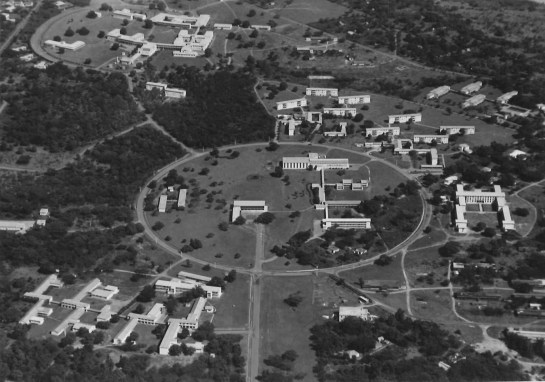
The University College of the West Indies (UCWI) At Mona, Jamaica, established immediately following World War II, was one of the early greenfield university developments among British colonies in the Southern Hemisphere, as the British sought to ameliorate patently negative social conditions.
UCWI Designed by Norman and Dawbarn. Image courtesy of Special Collections and Archives at University of Liverpool
It was also one of the early tropical iterations of the modernist aesthetic that affected European landscapes from the early to middle decades of the twentieth century, sparked by the Bauhaus school of design and the work of iconic architects of the modern movement. British architectural firm Norman & Dawbarn received the contract to design the nascent West Indian university and its associated teaching hospital only weeks after the arrival of the first principal on site in Jamaica in 1946, and the overall scheme proposed in 1947, parts of which were built in stages between 1949 and the mid-1960s, remains recognisable today despite differences at the time and subsequent shifts in architectural approach.
The Coloniality of Infrastructure: Eurafrican Legacies:
Call for Papers – Conference at the University of Basel, 24-26 June 2020
When Eurafrica emerged in the 1920s as an intellectual and political project to connect Europe with Africa, its goal was to ensure European colonial dominance in a changing world. Key to the proposed continental merger was infrastructure—not surprising at a time when railways, ports, camps, and other large-scale building projects were facilitating the extraction and movement of things for Europe while curtailing the freedom and mobility of Africans on an unprecedented scale. Recent scholarship has emphasized the centrality of Eurafrica and the type of colonialism it mustered in the history of European integration, from the EU’s founding intellectuals to its Cold-War-era realization. But continental infrastructure also played a role in African struggles for independence. Highways, ports, and dams became tools of state-building and even mobilized hopes of Panafrican integration and international solidarity. In practice, however, large-scale infrastructure required technical and financial aid which further entrenched Africa’s asymmetrical relationship to the Global North.
Today, as Africa enters a new age of development increasingly dominated by China, and the EU is in fundamental crisis, is it still possible to speak of a Eurafrican present? From the physical imprint of cities and the configuration of intercontinental airline routes, infrastructure testifies to the enduring legacies of Eurafrica. Infrastructure shapes territories and governs the mobilities within and across them, but also serves to immobilize and externalize bodies and things. The European infrastructure of the Mediterranean border regime, in which African migrants are systematically being detained or left to die, recalls colonial-era policies that valued life and dictated death along racial lines. At the same time, European aid focused on infrastructural development in Africa is increasingly targeted to counter such unwanted migration—without touching the global extraction economies that have roots in European colonial rule and continue to shape African cities and territories today. Because of these specters of Eurafrica, the EU seems structurally incapable to come to terms with its colonial past.
This conference proposes to explore historical continuities in Africa’s relationship with Europe through the lens of infrastructure. What are the infrastructural histories that bind the unequal destinies of people together across continents, and how do these legacies shape contemporary lifeworlds and international relations? How does infrastructural violence shape international relations between Africa and Europe, and how is the legacy of Eurafrica manifested in the spaces of everyday life? To answer these questions, the conference invites scholars from urban studies, history, political science, postcolonial theory, architecture, border and migration studies, and allied fields. We invite contributions that develop new perspectives of our geopolitical and interconnected urban present through its infrastructural pasts. Such studies of material and aesthetics relationships between Africa and Europe can focus on questions of lifeworlds, urban transformation, migration, territory, citizenship, development, or related themes. We are particularly interested in studies that can reveal the differential entanglements between people and places, and locate alternative forms of infrastructure, imaginaries of belonging, ongoing struggles for decolonization, and practices of world-making that decenter colonial ways of seeing, feeling, and knowing.
Confirmed Keynote Speakers:
Elizabeth Povinelli (Columbia University)
Siba N’Zatioula Grovogui (Cornell University)
Scientific Committee:
Peo Hansen (Linköping University, Sweden)
Edgar Pieterse (University of Cape Town)
Muriam Haleh Davis (University of California Santa Cruz)
Samia Henni (Cornell University)
Charles Heller (Forensic Oceanography, Geneva)
Anne-Isabelle Richard (University of Leiden)
Bilgin Ayata (University of Basel, Sociology)
Julia Tischler (University of Basel, Centre for African Studies)
Lorena Rizzo (University of Basel, Centre for African Studies)
Madeleine Herren-Oesch (University of Basel, European Global Studies)
Selection of Speakers:
Please submit an abstract of no more than 300 words and a short C.V. by 10 December 2019 to Michelle Killenberger (michelle.killenberger@unibas.ch). Applicants will be notified of acceptance in February 2020. We will cover travel and accommodation expenses for speakers in need of financial assistance.
Conference Organization:
The conference is organized by Kenny Cupers, Urban Studies, Department of Social Science at the University of Basel, in collaboration with Sociology, the Centre for African Studies, and the Institute for European Global Studies, as well as the African Centre for Cities at the University of Cape Town.
Follow-up Conference:
A follow-up conference will take place in collaboration with Prof. Edgar Pieterse at the African Centre for Cities at the University of Cape Town in June 2021. Entitled “Emerging Infrastructural Worlds: Mapping Urban Research in Africa,” this conference will map research approaches to transnational infrastructure projects across Africa and their consequences on the ground.
More information:
This conference is funded by the Swiss National Science Foundation. For more information about the conference and associated research projects, please visit:
New Research Paper: I. Jackson, O. Uduku, I. Appeaning Addo, R. Assasie Opong, “The Volta River Project: planning, housing and resettlement in Ghana, 1950–1965”, Journal of Architecture, vol 24 (4), 512-548.
This paper investigates the housing schemes proposed in connection with the Volta River Project, Ghana, in the mid-1950s to early 1960s. The Volta River Project formed part of Kwame Nkrumah’s vision for Ghana’s modernisation and industrialisation in the wake of political independence. Three associated worker housing schemes demonstrated somewhat contradictory design and construction methods, from high specification, extensive amenities, and comprehensive servicing, through to self-build ‘core’ houses amounting to little more than single-room dwellings.
Core House at New Ajena, Ghana. Built c.1961, photographed in 2017
The paper traces the complex and controversial history of these schemes, supplemented with findings of several field trips to the settlements in question, to unravel the value of the ‘Core Houses’ approach. The most successful project to incorporate indigenous agency and true collaboration was the semi-formal ‘Combined Area’ housing at Akosombo, a positive model for shared agency and collaboration in planning, housing, and facilities delivery. Sitting alongside the carefully manicured plan of Akosombo, with its regulated market, excellent health care and desire to set high standards of cleanliness, the Combined Area has not only provided homes for the lower-paid and labouring workers of the town, but has developed over time into a settlement where professionals and retired government workers are also now residing, not out of necessity but by choice. By actively developing their own homes, shared spaces and amenities there has developed a strong sense of ownership, community, and identity. The success and level of attachment to this settlement clearly extends beyond its material presence and through the shared experience of helping to cultivate a place of one’s own.
Book Review by Robin Hartanto Honggare: “Southeast Asia’s modern architecture: questions of translation, epistemology and power” by Jiat-Hwee Chang and Imran bin Tajudeen, Planning Perspectives.
When: 27-28 June 2020
Where: Girton College, University of Cambridge
Submit abstracts of 250 words to architecturesofpower@hist.cam.ac.uk by 21 October 2019.
Historians have long recognised the importance of architecture within the exercising of political power. Yet the interaction between power and place, between human actor and physical location, is a difficult one to quantify. This conference brings together political, social, cultural, and architectural historians to explore this relationship. Architecture could be mobilised to exhibit and to legitimise political power, but it could also have a profound influence on decision-makers at crucial moments of governance. Architecture has played a fundamental role in performances of statecraft. Accounting for this architectural agency, without resulting to crude spatial determinism, is one of the great methodological challenges that this conference will discuss. As architectural historians have established, the meaning of buildings vary from user to user. Often these reflected hierarchies operating within the building: experiences of the Foreign Office, for instance, differed from a Permanent Under-Secretary to a newly arrived clerk. It is this question of the subjective nature of architectural experience that we are particularly interested in exploring.
Taking broad definitions of political power and the state, we will not only consider the architecture of palaces, parliaments, and administration, but also of commercial, financial, legal, and religious sources of political authority. This conference is interested in the physical seats of power from the private residences of statesmen and women, to legislatures, embassies, and banking houses. Importantly, this conference considers how the architecture of political power evolved over time, reflecting changes in structures of government. In the late eighteenth-century, the majority of states were absolute monarchies or governed by elite oligarchs, but by the mid twentieth-century the rise of popular representation entailed very different types of architecture. Where once palaces like Versailles and Blenheim embodied the authority of ruling elites, parliaments and administrative offices soon reflected accountable styles of government.
We welcome papers on any geographical case study from the mid eighteenth-century until the twentieth. We are particularly interested in proposals that consider the role of gender, race, and class as well as questions of architectural science and technology. We are also interested in the role of architecture in the operation of imperial, economic, and religious political power. Please submit abstracts of 250 words to architecturesofpower@hist.cam.ac.uk by 21 October 2019.
On 20th June 2019 Unilever kindly hosted (with additional support from the University of Liverpool) a workshop showcasing the amazing material that can be found within business archives. It was a really great day to learn more about how different researchers are using the collections and the great work by archivist who make all of this accessible to the public.
Keynote by Valerie Johnson, Director of Research, The National Archives
Business archives – a bit of a passion killer?
Valerie Johnson opened her keynote by highlighting that business archives are often seen as dull and uninteresting – to the point she was once told by a conference organizers that he had not expected her research talk about business archives to be so interesting. Nothing could not be further from the truth. For almost any subject of interest to researchers, business archives have materials, as companies were often spearheading new developments (e.g. technology), were embedded in social and cultural trends of the day (e.g. the culture of imperialism), design history (e.g. in the Board of Trade archives) to name but a few.
In a whistle stop tour through a wide range of archives, Johnson illustrated the history of women at work through an architectural map in the ING Barings Archive, and the representations of empire in the textiles archive of John Lewis, and the United Africa Company trademarks at Unilever Historical Archives.
Johnson closed by reiterating that business records offer magnificent materials and insights into society, technology and attitudes of the past, not just the records of business operations in the narrow sense. So she closed with highlighting the importance of:
Putting the passion back into business archives!
Snippets from archival research
The day continued with wide-ranging research presentations. The morning opened with Jeanette Strickland introducing the audience to William Lever, the founder of Lever Brothers (one half of the original Unilever), a formidable businessmen and somewhat of a micro-manager.
This was followed by Frank Thorpe, University of Liverpool, talking about advertising and beyond. His presentation is based on his doctoral thesis that investigates the changing attitudes towards personal hygiene, or “BO”, and how
products like deodorant were gendered and stigmatized at times. At Unilever, he
has researched uncatalogued material, but also used a range of online newspaper
archives to understand the context within which these adverts appeared.
Ronnie Hughes offered a different view on Port Sunlight, the location of the Unilever factory and archives, where the workshop took place, by asking a key question:
What must it have been like to live in someone else’s utopia 100 years after they died?
Walking through Port Sunlight village in the morning before the workshop, this is not unlike the question we asked ourselves – would we actually like to live here,
as beautiful as it is? As a heritage site, it has a very distinct and unique
feel, which is unlike other neighbourhoods. Hughes highlights that he has asked
communities questions about what their perfect place would look like before
starting this research project. He blogs at A Sense of Place.
Prof Matt Reed finished the morning session by outlining his search for the ‘origin story’ of the collaboration between Unilever and the University of Liverpool, which dates back to 1906, which was “multi-faceted and sporadic.”
Lever donated money to a number of departments, including Civic Design and town planning. The Department of Industrial Chemistry was particularly well aligned with Lever’s business interests. Reed finished with a reflection of the value
of searching archives versus the self-taught googling that passes for research
outside of archives.
A fascinating tour of the archives at lunchtime that featured highlights such as Marmite pants.
The afternoon sessions kicked off with Dr Rory Miller’s exploration of why David Fieldhouse’s Unilever Overseas is missing a chapter on Latin America – apparently he fell out with his research assistant. 25 years ago, Miller first visited the Unilever archives to find out what was actually available on Unilever’s business in Argentina and beyond. Perusing the directors’ visiting reports, he outlined how Argentinians rarely bought Lifebuoy soap other than to wash their dogs.
In her talk about the design process, Dr Lee Wright highlighted the potential importance of archives for the design practice and the sourcing of design ideas. In her teaching, students reference the past through images they source from Pinterest, highlighting the significance of social media sites in mediating our visual understanding of the past.
The day closed with two fascinating talks, the first by Prof Iain Jackson about the development of urban architecture in Accra, Ghana in the mid-twentieth century. While the National Archives had more material on the European settlements of Accra, within other archives, such as the United Africa Company collection at Unilever, mercantile areas such as Jamestown are much better documented. Some of his collected images are available in an online book available via issuu.com (search “Accra”) here.
The workshop closed with Claire Tunstall describing their mission and how the archives has to serve many different stakeholders: internal divisions, brands and communications, outreach with schools, partnership with museums and universities and, of course, the Port Sunlight Village Trust, as well as researchers.
Hopefully, more such events, at Unilever or other major archives, will take place in the future. The workshop did not just have great presentations but also offered great opportunities to meet a wide variety of people interested in using and promoting archives.
Conference programme
10 am Registration Tea & coffee
10.20 Welcome, introductory remarks and housekeeping
– Claire Tunstall and Jeannette Strickland
10.30 Keynote Dr Valerie Johnson, Director of Research & Collections, The National Archives “What’s the use? Your research and business archives”
10.50 Q&A
11.00 Refreshments
11.15-12.30 Session 1 Chair: Prof Stephanie Decker, Aston University
11.15 Jeannette Strickland, Department of History, University of Liverpool, “Finding William Lever, the man behind the myth”
11.30 Frank Thorpe, Department of History, University of Liverpool, “Beyond the ad: filling gaps and finding new gaps”
11.45 Ronnie Hughes, Department of Sociology, Social Policy & Criminology, University of Liverpool, “Looking for Utopia”
12.00 Dr Matt Reed, Strategy Director, Materials Innovation Factory, University of Liverpool, “Turn every page”
12.15 Q&A
12.30-2.00 Lunch
Tours of Unilever Archives available at 12.45 and 1.10
2.00-3.00 Session 2 – Chair: Dr Valerie Johnson, The National Archives
2.10 Dr Rory Miller, formerly Reader in the Management School, University of Liverpool, “The Missing Chapter in David Fieldhouse’s Unilever Overseas: Unilever’s Expansion in Latin America in the Mid-Twentieth Century”
2.30 Dr Lee Wright, Senior Lecturer in the History and Theory of Design, Liverpool School of Art and Design, Liverpool John Moores University, “The value of archives and their potential to impact current design practice”
2.50 Q&A
3.05 Refreshments
3.20-4.20 Session 3 – Chair: Jeannette Strickland, University of Liverpool
3.20 Prof Iain Jackson, School of Architecture, University of Liverpool, “Traders, speculators, taste makers: the United Africa Company in Ghana”
3.40 Claire Tunstall, Head of Art, Archives & Records Management, Unilever plc, “The research potential of Unilever Archives”
4.00 Q&A
4.20 Summing up and closing remarks
4.30 Optional post-workshop drink at the Bridge Inn in Port Sunlight
Ng’ambo Atlas. Historic Urban Landscape of Zanzibar Town’s ‘Other Side’
Ng’ambo is the lesser known ‘Other Side’ of Zanzibar Town. During the British Protectorate the area was designated as the ‘Native Quarters’, today it is set to become the new city centre of Zanzibar’s capital. Local and international perceptions of the cultural and historical importance of Ng’ambo have for a long time remained overshadowed by the social and cultural divisions created during colonial times. One thing is certain: despite its limited international fame and lack of recognition of its importance, Ng’ambo has played and continues to play a vital role in shaping the urban environment of Zanzibar Town.
Ng’ambo Atlas. Historic Urban Landscape of Zanzibar Town’s ‘Other Side’ documents the material collected through the heritage-based urban planning project Ng’ambo Tuitakayo! carried out by the Government of Zanzibar in collaboration with African Architecture Matters and City of Amsterdam and under the auspices of UNESCO.
The goal of the project was to prepare a local area plan (structure plan) for the new city centre of Zanzibar’s capital. The planning exercises were from the beginning grounded in the notions of urban culture and heritage, while the principles outlined in the UNESCO Recommendation on Historic Urban Landscape provided a framework for the subsequent stages of the work.
It quickly became clear that the cultural and historic richness of Stone Town’s ‘Other Side’ merited a wider recognition than a technical planning document would allow for. At the same time presenting the outcomes of the project to a wider public through an atlas was a way to promote the history and culture of the area and contribute to the argument that urban heritage should play a central role in sustainable development of cities.
The atlas brings together and presents Ng’ambo’s rich planning history and draws attention to the outcomes of the mapping of the material and immaterial cultural landscape.It presents over hundred years of Ng’ambo’s history and urban development through maps, plans, surveys and images, and provides insights into its present-day cultural landscape through subjects such as architecture, toponymy, cultural activities, public recreation, places for social interaction, handcrafts and urban heritage.
Ng’ambo Atlas was produced by the Department of Urban and Rural Planning, Zanzibar and African Architecture Matters
Livelihoods and culture under threat in Ghana’s historic port of Jamestown
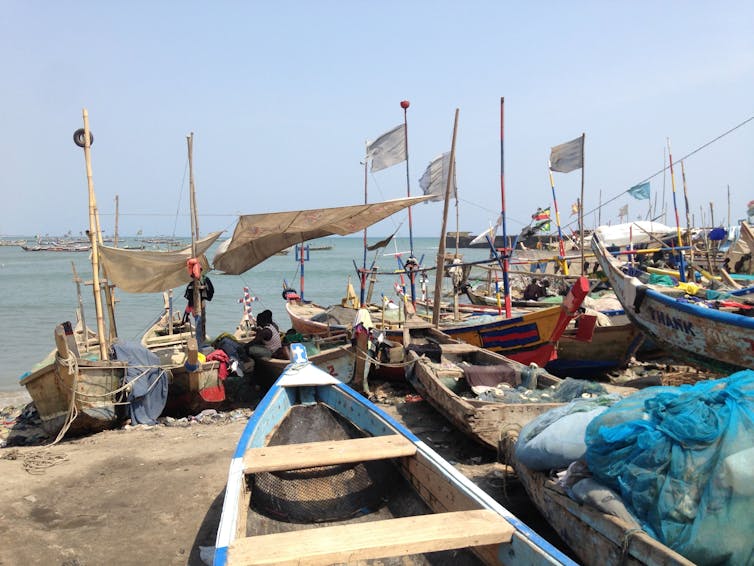
The beachfront of historical Jamestown, Ghana.
Plans are afoot to replace the historic Ghanaian fishing port of Jamestown with a Chinese-backed mechanised factory.
This is a move that will destroy traditional livelihoods, as well as damage the historic built environment. It will drastically change not only the tangible fabric of this historic town, but also impact the fishing methods, market traders and community that’s reliant on the sea.
Since 2011 I have been researching the history of Ghanaian architecture and urbanism, and have been particularly struck by its impressive collection of heritage structures and associated narratives.
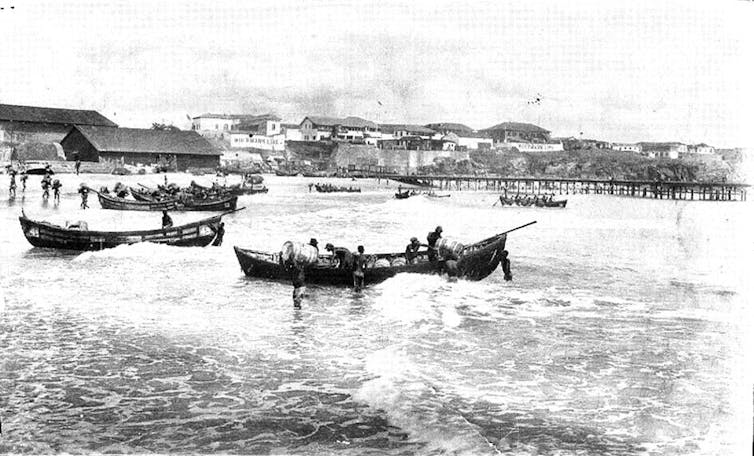
The harbour at Accra’s district of Jamestown was built to provide shelter from the heavy surf that pounds this part of the coast. The breakwater and pier were equipped with railway tracks, gantries and cranes to handle the large produce exports following the cocoa boom of the early 1900s. The wealth created from this trade saw some fine buildings being built. An array of warehouses, stores and villas survive (some very precariously) in Jamestown to this day.
Historical photograph of Jamestown. Courtesy of Wirral Archives
The shallow waters of the harbour utilised smaller surf boats who ferried the goods in and out to the ships anchored in deeper water. The creation of new ports rendered the Jamestown harbour superfluous by the 1950s and it was no longer used for international trade.
While this profoundly affected the livelihoods of the surf boat owners, as well as the economic prosperity of the Jamestown area, it has still remained an active harbour, returning its focus to fishing. New canoes are still built on the beach, nets are made, repaired and dried, and a large, if casual, fishing market trades off the shore.
Although described as a beach, it’s still a working harbour rather than a place for leisure. Businesses, residences, schools, places of worship and bars have all been established on the beach and a large population considers it their home and community. The place has a very different feel to the rest of the city. It has an intimate connection to the sea, dictated by the tides, rituals, songs and danger that accompanies all fishing communities.
It is “informal”, sometimes appears anarchic, and while not suitable in its current format for freight shipping, its potential for commercial development has caught the attention of the municipality and international investors.
New development
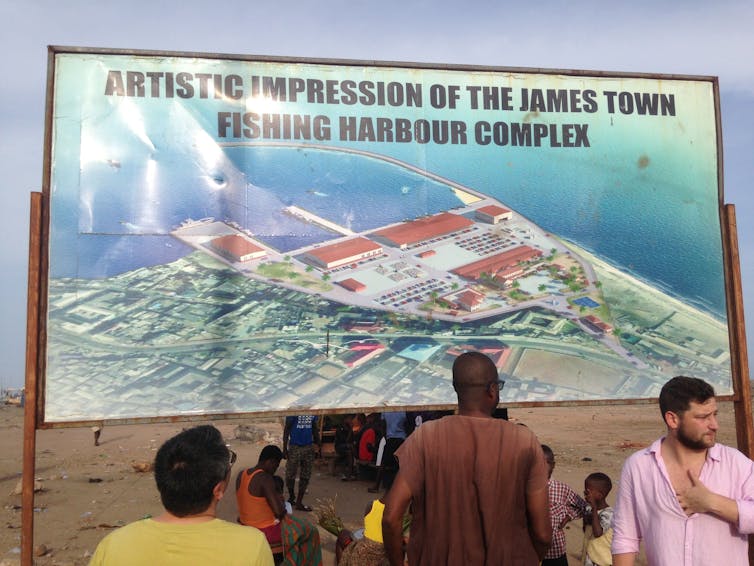
Earlier this year a billboard was suddenly erected on the beach displaying an “artist’s impression” of how the beach is to be developed. It’s a disturbing image in many ways, showing the beach completely cleared of its inhabitants. There’s also a large car park and a series of somewhat bland sheds or factories. There is not one single canoe in sight.
An artist’s impression of the new Jamestown development. Iain Jackson
The proposal (and its backers) see this site as a convenient place to construct a new factory for the mechanised processing of fish. There is nothing inherently wrong with this as an idea. But the current proposal would not only occupy a prime site with historical significance: it would displace a large community along with their heritage, skills and traditions.
There are four main considerations that have not been addressed by the current proposal. And with the beach already being cleared of its residents and traders, time is running short.
Seafront heritage site: A shoreline development with an historic waterfront requires sensitive and appropriate proposals. A failure to deliver this undersells the site’s potential. It is not appropriate for a factory and car park to be placed on this important plot.
It is hard to imagine any other international port city using its most important natural features in this way. The attractive view over the ocean offers lots of possibility for this site. Reducing it to a fish-gutting production line is shortsighted and lacks ambition.
Community discussion and liaison: The settlements and businesses located on the beach are “informal” (like most of Ghana’s economy). But this must not discount or invalidate their contribution to future development. No one is more invested in this place than the current population, part of the minority Gā community, with their own language and traditions, who have lived and traded here for centuries.
Individual fishing boats and their small hauls may not be the most efficient or lucrative methods of extracting the bounty of the sea. But they bring many advantages. The main traders (and controllers) are women affectionately known as “mammies”, who set the prices and manage supply.
This matriarchal system has been largely responsible for ensuring a strong community. Whilst these traders are fiercely competitive, they care for each other and their lives. Memories and stories are inherently bound to this place – the proposed factory would completely undermine and destroy this market and cohesion.
Mechanised production would also result in fewer employment opportunities. The power would be taken from market traders and fewer fishermen would be required.
Fish stock: Environmentally the mechanised processing and trawlers would be disastrous for the fish stock. The existing method marries periods of fallow with festivals, allowing the sea to recuperate and replenish. There is a rhythm to the current fishing method that responds to the seasons and traditions. It is unlikely this approach will be respected by the new process and the factory’s profit driven approach.
Tourist potential: The first place tourists visit when arriving in Ghana is usually Jamestown and the harbour area. Its two former slaving forts and the historic mercantile core of the town, coupled with the array of festivals and events, have so much potential as revenue creators.
They must be treated as rare commodities, not as cheap development plots. If this district is gradually eroded, its natural features, historic charm and engaging community dismissed, then what else is there for visitors to see in Accra?
In the last six months eviction processes have started to clear the beach. This is an earnest plea for this proposal to be rethought – and for this fascinating part of the city to be regenerated in a way that celebrates and respects the history and people of Jamestown.


 Transnational Architecture Group