Archive

Author Archives: jacksoniain

This gallery contains 3 photos.

Originally posted on Envisioning the Indian City:
Standing on the Esplanade crossing, looking down Lenin Sarani with the “Tipu Sultan” mosque on our left, Kawshik Aki pressed his shutter. Bringing his camera down from his eyes he looked at the preview, shook his head, took a step to the left and clicked again.Meanwhile I stood…

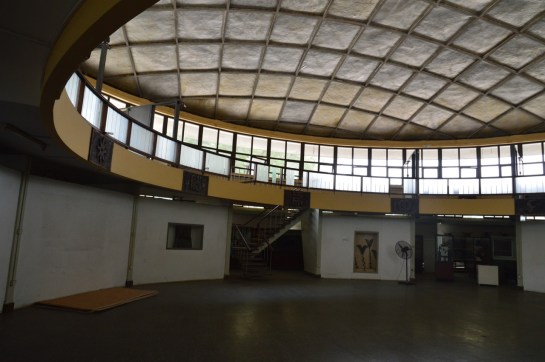
3D Printed Model of Kenneth Dike Library

We’ve been playing with a couple of 3D printers [Makerbot and Ultimaker] and testing how they might be used to create a small collection of models to supplement our History of Architecture lectures.

image

In the age of ‘Stream Capture’ and recorded lectures including a small exhibition of key case study models in the lecture theatre will hopefully entice the students to attend the live event and will also form an opportunity to further explore light, scale and the qualities of buildings that are not as easily expressed through photographs and orthographic drawings.

image

Our first test case used a computer model of the Kenneth Dike Library, Ibadan [designed by Fry and Drew] expertly produced by Jacopo Galli and generously shared with us. The model doesn’t show the entire buiding but a key section enabing the interior to be viewed. The ambition is a for an online library of models that can be downloaded and then printed as and when they are required by faculty and students.


image

Here are some further updates on the Augmented Reality App we developed for Kolkata….

cleoroberts's avatarEnvisioning the Indian City

Timescape Kolkata, an augmented reality app developed by the ETIC project, launched earlier this week at the Victoria Memorial Hall. The innovative app allows iOS and Android phone users to experience the antiquated city through photographs produced by Frederick Fiebig, W.G Stretton and Company and the reputable Bourne and Shepherd.

Once Timescape (www.time-scape.org) is downloaded from here, users can explore rare archival images and data about heritage sites in Kolkata. As you walk through the city, views will be ‘augmented’ by a corresponding nineteenth century photograph taken at the exact site. Another click or with a single swipe a host of archival information including sounds and histories will be available.

TimescapeKolkata

The idea germinated following the UGC-UKIERI funded ETIC Liverpool conference held last year. In the School of the Arts library, after negotiating theories of the contemporary city, a series of questions emerged. What if Frederick Fiebig’s handpainted candid Calcutta…

View original post 367 more words

This weekend is the final gathering of the ‘Envisioning the Indian City’ project team in Kolkata, as well as the launch of our Augmented Reality app that overlays historical photographs of Kolkata onto contemporary cartography. If you are in Kolkata please do join us.

Visualizing the City_flyer final-1

Cities are inhabited spaces felt through all our senses, especially those of touch, hearing, smell, and so on. In representation, in imagination, in planning and conceptualization, however, they are above all visualized spaces, appearing before our eyes as seen, remembered, or projected. This one-day symposium will focus on the ways in which cities and city-spaces are experienced through the visual register, though we want to interpret this term as widely as possible to include modes of conceptualizing or laying out city-spaces.

Through a series of presentations from architects, historians, literary scholars and art historians, we wish to bring out multiple ways of seeing the city: as a planned (or not-so-planned) space fitting into a conceptual grid; as a scenic location represented through art or captured in memory; and as a visual experience that feeds into the phantasmagoria of city life. Individual presenters may bring out even more nuanced ways of visualizing the city and historic proto-city sites.

The symposium is the last in a series of international workshops and research seminars under the UGC-UKIERI International Thematic Partnership ‘Envisioning the Indian City: Researching Cross-cultural Exchanges in Colonial and Post-colonial India ’ between the University of Liverpool and Jadavpur University, 2013-15: https://eticproject. wordpress.com. This research project focused on four significant city-sites, Goa, Pondicherry, Kolkata and Chandigarh – the first three originating in distinct colonial encounters (with the Portuguese, the French and the British) and the fourth a creation of the post-colonial Indian state. However, in the course of research, other cities and other ways of understanding or viewing urbanity also came into focus, and our work was immeasurably enriched by the contributions of urban historians and scholars worldwide, as part of an ongoing conversation about cities, space, modernity, and cross-cultural encounters.

In the last phase of the project, our team has been developing the Kolkata layers for the Augmented Reality App through which historic photographs and other archival footage related to existing city-sites can be accessed on one’s mobile phone. This final phase of project research has been enabled by a generous grant from the University of Liverpool and the archival resources of the British Library’s Photographic Collection. We have also been greatly assisted by support from our other non-HEI associates, such as the Victoria Memorial Hall, Kolkata, where the AR App, Timescape Kolkata, will be launched on 28th November at 6 pm, after a panel discussion featuring urban specialists and advisors to the project: Timescape Kolkata: Seeing the Past in the Present.

The day-long symposium on Visualizing the City (Jadavpur University, 10 am – 4.30 pm), however, is not simply a prelude to the launch. It will draw together perspectives from architecture, town planning, history, art, literature and contemporary urban culture to reflect on the major project theme of ‘Envisioning the Indian City’. Our invited speakers are Professors Miki Desai (CEPT Ahmedabad), Snehanshu Mukherji (Architect; Visiting Faculty, SPA Delhi), Swapan Chakravorty (Presidency University), Tapati Guha-Thakurta (CSSSCal), Jonathan Gil Harris (Ashoka University) and Dhir Sarangi (Jawaharlal Nehru University). Entry to the symposium and launch are free and we welcome participation and interaction.

Visualizing the City_flyer final

10 am:

Introductory Remarks and Welcome to Participants: Nandini Das (University of Liverpool) and Supriya Chaudhuri (Jadavpur University), ETIC Project Coordinators

10.15 am – 11.45 am: Session 1: Chair, Nandini Das

Jonathan Gil Harris (Ashoka University): From the Ethiopian Highlands and Baghdad to the Nehr-e-Ambari: How to Build a Transnational Deccan City Dhir Sarangi (Jawaharlal Nehru University): French Visualizations of India through Maps and Drawings from the 18th Century

  1. 45 am – 12 noon: Coffee

12 noon – 1.30 pm: Session 2: Chair, Nilanjana Gupta 

Snehanshu Mukherjee (TEAM/ Visiting Faculty, SPA Delhi): The Vanishing City

Miki Desai (CEPT Ahmedabad): Towns in Transition: a Missing Link in Visualizing the Indian Urbanity: Case Study, Gujarat

1.30 pm – 2.30 pm Lunch

 2.30 pm – 4.00 pm: Session 3: Chair, Supriya Chaudhuri

Tapati Guha-Thakurta (Centre for Studies in Social Sciences, Calcutta): The City in the Archive: Calcutta’s Visual Histories

Swapan Chakravorty (Presidency University): ‘All Its Several Lodgings Composed’: Visualizing Houses of Art for a New Kolkata

All are welcome.

Please join us after the Symposium for the launch of the AR App, Timescape: Kolkata, at Victoria Memorial Hall, 6 pm

New Research: Gyoji Banshoya (1930–1998): a Japanese planner devoted to historic cities in the Middle East and North Africa, published in Planning Perspectives by Kosuke Matsubara

Gyoji Banshoya (1930–1998) was a Japanese urban planner whose life-work was urban planning in the Middle East and North Africa. The purpose of this paper is to provide an overview of his work, which still remains unknown. His early masterpiece, the ‘Square House’, shows how he was influenced by Kiyoshi Seike to apply historic spatial composition to realize width and convertibility in low-cost housing.

Gyoji Banshoya
K. Shinohara, M. Yamada, K. Seike, G. Banshoya, and S. Miyasaka. Source: Hayashi, “Seike Kiyoshi to Gendai no Jukyo Design,” 6

Following this, Banshoya studied under the supervision of Gerald Hanning and George Candilis at Ateliers de Baˆtisseurs in Paris, and went to Algiers to engage in the study of ‘evolutionary habitat’. As a United Nations Development Programme (UNDP) expert, he began working with Michel Ecochard in 1962 in Beirut, Damascus, and Aleppo. They were responsible for the elaboration of master plans for these three cities, and that of Damascus still remains as a legally active master plan today. Coupled with the Syrian political struggle since the 1980s, there has been some reaction against their modernist policies. However, the case is made for a detailed examination of Banshoya’s work, and re-evaluation of its legacy for the urban planning history of the Middle East and North Africa.

You may read the full article here: http://www.tandfonline.com/doi/pdf/10.1080/02665433.2015.1073610


EAUH Helsinki 2016

European Association for Urban History 2016 Conference: 

Reinterpreting Cities

24-27 August 2016, Helsinki, Finland


CALL FOR PAPERS

Deadline: 31 October 2015

Session:

M19. Settler Cities: A Useful Concept to Reinterpret Transnational Urban History?

In the opening lines of his massive Replenishing the Earth: The Settler Revolution and the Rise of the Anglo World, 1783-1939, James Bellich presents a challenge to historians eager to reinterpret cities in a transnational framework: do cities like Chicago and Melbourne on opposite sides of the planet share characteristics by virtue of their foundation and political rule by white settlers intent on dwelling permanently upon lands forcibly taken from their indigenous inhabitants?
This panel will explore this question by calling upon scholars to reflect on the concept of “Settler Cities.” What defines such a city? Are their clear boundaries, or does the definition involve a subtle degrees of separation form the broader category of colonial city? Are there broad commonalities in the histories of these cities that merit singling them for scrutiny as a group? Are they best seen as a special subset of colonial cities or is there a way in which they expand or transcend that long-used concept? Are there webs of connections between these cities and between them and the imperial metropoles that make this concept especially useful as a subset of the new subfield of transnational urban history? What if we go beyond Bellich’s focus on the “Anglo World,” and consider Algiers, Elizabethvillle/Lubumbashi, Windhoek, Batavia, Jerusalem, and even Mexico City or Rio de Janeiro in the same universe as Cape Town, Chicago, Vancouver, San Francisco, Belfast, and Sydney? Are there non-western settler cities? Why did the settlers in some cities abandon their project of settlement while others stay, helping to cause some of the most intractable conflicts on earth?
Participants should not only bring their research on individual settler cities to the table, but also contemplate several themes underlying the concept of settler cities: especially dense connections and flows between these cities and between them and metropolitan hubs; the diversity of flows between these cities, including not only people, money, ideas, and urban practices, but also jurisprudential systems, organizational forms, urban economic structures, group identities, and political cultures; especially complex forms of urban politics that includes conflicts between settlers, between settlers and metropolitan governments as well as with indigenous people; real estate practices involving people who plan to invest in urban land for future generations unlike the more transient European populations of non-settler colonial cities; and interventions in urban spatial politics that include especially complex forms of segregation and law-of-conquest authoritarianism.

Keywords:
colonial cities, segregation, settler colonies, transnational urban history, urban politcs

Period:
Modern

Type:
Main session

Session organisers:
Carl Nightingale, University at Buffalo SUNY, United States of America
Vivian Bickford-Smith, University of Cape Town, South-Africa
Johan Lagae, University of Gent, Belgium

EAUH Helsinki 2016

European Association for Urban History 2016 Conference:

Reinterpreting Cities

24-27 August 2016, Helsinki, Finland


CALL FOR PAPERS

Deadline: 31 October 2015

Session:

Women on the Edge: Mobility and Regionalism from the Margins

 Leading Question: How did transnationally mobile female actors engage and shape the development of a regionalism discourse in the fields of architecture and planning in the twentieth century?

From the mid-twentieth century, the expanding discourses on regionalism in a globalizing field of architecture championed and eventually canonized the works of architects such as Charles Correa, Geoffrey Bawa and Muzharul Islam. In addition to working in emerging nation-states, the family backgrounds, educations and client bases of these architects ensured that they were actively involved in powerful transnational networks.

In this session we will investigate the significance of such transnational mobility in the development of the regionalism debate, shifting the focus critically from canonized male actors to “marginal” female actors—opening this term and the actors it may describe as platforms for debate—including architects, planners, patrons, and users, in order to explore the fringes of architectural and planning history. We aim to find a more inclusive angle from which to examine connections between transnational mobility, regionalism and local lived environments, as well as the geopolitical, social and economic events and processes that catalyzed their intersection.

As a factor of globalization that accompanied the modern colonial and postcolonial moments—whether a function of privileged access to international networks or the result of forced migration—transnationalism and an emerging landscape of cosmopolitan sites offered women new proving ground outside established social, cultural, and commercial spheres. We are particularly interested in the modalities of this peculiar confluence of labor, politics, and culture, noting as examples the practices of Jane Drew in West Africa, Catherine Bauer in India, Minnette de Silva in Hong Kong, and Erica Mann in Kenya, which were contoured by transgressions of the borders of colonies and new nations. We also see that the transnationalism of certain female figures—Jacqueline Tyrwhitt, Sibyl Moholy-Nagy, Margaret Michaelis—resulted in their profound discursive engagement in modernist debates on regionalism and vernacular or everyday architecture. By studying village housing in the Gold Coast and anonymous architecture in North America and Europe, establishing cottage industries in rural Kenya, or writing histories on Asian regional architecture, many of these agents operated independently of the expected dialogical frameworks between colony and postcolony.

We seek papers that explore the roles, practices, and networks of transnational female actors from the margins; the reception and transmission of their work; and their imbrication with architecture and urbanism discourses on regionalism and the vernacular in the twentieth century.

Keywords:

gender, global south, mobility, postcolonial, regionalism

Period:

Modern

Type:

Specialist session

Session organisers:

Anooradha Iyer Siddiqi, New York University, USA

Rachel Lee, TU Berlin, Germany

Submission Guidelines:

  • Paper proposals can only be submitted online. Proposals and texts sent by post or email will not be considered. To submit a paper proposal, please create a user account on the abstract system on the EAUH2016 website https://eauh2016.net/.
  • Abstracts of paper proposals should not exceed 300 words.
  • Deadline for paper proposals submission: October 31, 2015
  • Notification of paper acceptance: December 15, 2015

Call for Papers: Revisiting African Modernism at docomomo 14th International Conference 

6-9 Sep 2016,  Calouste Gulbenkian Foundation,  Lisboa,  Portugal

docomomo International is now accepting abstracts for the 14th International docomomo Conference that will take place in Calouste Gulbenkian Foundation, Lisbon, Portugal, September 6–9, 2016. Please submit abstracts no later than October 18, 2015 (12 pm GMT), for one of the 29 thematic sessions listed here.

One session that will be of specific interest to TAG followers is the ‘Revisiting African Modernism’ session…

“Africa’s history of architectural modernism and modernist landscapes is no longer unknown or obscure.  This session seeks to build on that established foundation by asking contributors to explore the potential contribution of the buildings and infrastructure of this era (c. 1945 – 1970s) to our understanding and engagement with Africa today. Does their original programme make them adaptable for 21st century contemporary urbanism? Are there specific case studies or examples of buildings and landscapes that demonstrate positively (or negatively) adaptive re-use possibilities or experience?

Past docomomo sessions on Africa have (arguably rightly) been occupied with debating Africa’s involvement in docomomo, as both a subject and a participatory region. This session recognizes the increasing inclusion of African nations; South Africa, Egypt, Ghana (proposed) into the docomomo “family”. It also acknowledges contributions from African and Africa-focused researchers in a number of past docomomo publications.

This panel session seeks to expand these contributions into a contemporary discourse, devoted to the investigation of the methods, and means, by which Africa’s modernist past can contribute more than just historical research to the Africans and Africa-focused researchers of the 21st century. We are particularly interested in contributions that consider built “ensembles” within urbanist contexts in African communities or cities, such as university campuses, housing masterplans, and industrial complexes/towns. “

Session Chairs: Ola Uduku, University of Edinburgh, Scotland; Miles Glendinning, University of Edinburgh, Scotland.

Book Review: Jaqueline Tyrwhitt: A Transnational Life in Urban Planning and Design

Ashgate, Farnham, 2013.

By Ellen Shoshkes

ISBN 9781409417781

44 black and white figures

£55.00

9781409417781

What an extraordinary life. This biography carefully chronicles and assembles (in some detail) the life and career of one of the forgotten heroines of the twentieth century planning world. Forgotten is perhaps too strong, as Tyrwhitt is one of those figures that ‘crops up’ rather regularly; aspects of her work are frequently mentioned in conference presentations or cited in journal articles, but she is never the focus of attention despite being, as Shoshkes reveals, a global player. Indeed she is almost omnipresent throughout the planning sphere of the twentieth century when one reads the amount of work she facilitated and the influence she held over publications, translations, lecture courses, planning strategy, international housing and development programmes. Furthermore, she also undertook considerable research into urbanism and planning, yet this is the first volume to draw all these twists and turns together. A good biography is able to not only describe and discuss the person in question, but to also pull in the wider debates and to position the life and works within a broader context – this book manages to effortlessly achieve this feat and is to be commended for it. The narrative adopts a chronological format split over five parts, which neatly track the major episodes of Tyrwhitt’s life. Perhaps one of the reasons for Tyrwhitt’s relative obscurity is because she didn’t have a career in the conventional sense, but rather careered through life bouncing from one project to the next, barely making ends meet. She was also a woman, unmarried, sometimes unkempt, and seemed to care for little beyond friendships and her work. She didn’t establish her own practice or publish provocative tracts, rather operated in a supporting role for the likes of Jose Luis Sert, Sigfried Giedion and Constantinos Doxiadis. As a planner, she left few tangible remains and was not concerned with formulating her legacy as some of her more egotistical collaborators were. She was more focused on getting the job done and took on the important tasks of organising, facilitating and disseminating findings, often with little appreciation from those she made look exceptional. One of her most prolonged and significant roles was translating Giedion’s epic publications, although to label Tyrwhitt’s contribution as a translator somewhat undersells her contribution. She was really a co-author and collaborator, honing Giedion’s ideas and clarifying his arguments – as well as translating them into English. She had a longterm friendship with Giedion which may have strayed into romance, but even this collaboration had its limits and Tyrwhitt stopped working with Giedion long after what most associates would have endured or put up with. Throughout her life there were strong male characters that she supported and encouraged but in the course of time these roles were often inverted and they became dependent on Tyrwhitt.

Although one may know something of Tyrwhitt’s life and work (most planners will be aware of the book she edited on Patrick Geddes in India, for example) this book reveals so much more, and it is very surprising just how far and wide she worked and travelled. One of the more shocking revelations is Tyrwhitt’s involvement with the British Fascists and her decision to experience Hitler’s Germany firsthand in 1937. Very little is said about Tyrwhitt’s political persuasions in later life, but judging from the company she kept it can be safe to assume that she ‘mellowed’ from her early flirtations with the political Right. Her work with the UN in India and Indonesia is another significant aspect of the book and adds new insight into the international agencies that operated in the post-war era. The sources are drawn from numerous archives and the research is detailed and thorough; although very little critical appraisal of Tyrwhitt’s work is made – was any of it implemented, or did any of her students put it into practice? Perhaps an epilogue of influence could have been added as a reprise or conclusion, but this is surely minor criticism of what is a substantial and valuable contribution.

This is a welcome volume to the history of twentieth century architecture and planning; it fills so many gaps, opens up new connections and networks, and goes someway to finally giving Jacky the credit she deserves for a lifetime’s concerted effort to improving and understanding our cities and landscapes.

Exhibition: Nek Chand at Pallant House Gallery, Chelmsford, until 25th October

img_3386_0

This is a rare chance to see Nek Chand’s work in the UK, and in an external setting which is how the sculptures should be seen. Pallant House Gallery has a large group of sculptures on show courtesy of the Nek Chand Foundation.

I re-visited Nek Chand’s Rock Garden, Chandigarh in August, eager to see how it was being treated and maintained following Nek Chand’s passing in June. I was very concerned that at best it would not be managed properly, and my worst fears were theft and destruction of this unique creation. It was such a relief to see it all looking better than ever. The walkways were clean, litter free and everything was running smoothly. Whilst work seems to have ground to a halt in ‘phase 3’ this may not be a bad thing. Perhaps we now need to think of the garden as being complete and any further changes to be made with utmost care and restraint.