Archive

Author Archives: jacksoniain

Liverpool India Fellowships

Life changing, world shaping

The University of Liverpool has recently launched a search for up to 10 outstanding early career and established researchers from India to spend 3 – 6 months at the University of Liverpool.  The fellowships offer funding for living costs plus a travel grant.  Applications will be welcomed across all three Faculties; referencing one of the seven research themes (http://www.liv.ac.uk/research/research-themes/) may assist you.

Full details of the programme can be found at: www.liverpool.ac.uk/research/liverpool-india-fellowships/, closing date for applications is 6th December 2013.

Workshop and Roundtable discussion: 28th November 2013 Liverpool School of Architecture.

This workshop is concerned with the architecture, design and planning proposals developed by architects/planners from Poland during the mid-late twentieth century. In particular it seeks to address how people and ideas have migrated beyond national borders and with what effect. Without the networks of empire and trade that aided so many British and Western European architects to practice around the world in the twentieth century, how and why did so many Polish architects obtain commissions beyond the immediate reach of Eastern Europe?

One answer to the above question was the placing of a Polish School of architecture within the Liverpool school during World War Two. In 1942 the British Council approached the university with the proposal that was part of a broader plan that saw other academic disciplines placed in other UK universities, such as a veterinary school at Edinburgh.

The Polish School of architecture was inaugurated by the Prime Minister of Poland and Commander-in-Chief, General Wladyslaw Sikorski in November 1942 – although the school had actually been in operation from June 1941. Staff and students worked on theoretical schemes such as for the rebuilding of a specified Polish village, along with designs for hospitals, blocks of flats, factories, town halls and the like. Professor Budden commenting on the Polish School’s tenure in Liverpool noted that although ‘the work…is in the mainstream of contemporary architectural thought and practice, it is yet distinctively expressive and national in character. The forms employed are in the main familiar, but they are given an unmistakably Polish inflection – and the result is the more interesting and vigorous for that…’

What was this inflection that Budden observed and can we begin to discern a specific Polish approach to twentieth century architecture and planning?

The Polish School is but one of the many networks, vectors and agencies that facilitated the export of Polish architecture and architects. What other modes of migration were pursued? What happened after the Polish School and where did its graduates go on to practice?

These are the most basic questions that we hope to discuss and address, but suggestions, other case studies and individual biographies are very welcome.

Papers and work-in-progress are most welcome. 20 minute papers followed by 20 minutes discussion. For further information or to submit abstracts of 200 words please email Iain Jackson ijackson@liv.ac.uk  or Peter Richmond richdrp@hotmail.co.uk.  Deadline for abstracts is 14th October 2013.

Village Housing in the Tropics: With Special Reference to West Africa

The seminal book on Tropical Architecture by Jane Drew and Maxwell Fry has been republished by Routledge 66 years after its first edition was bravely produced by Lund Humpries.

villagehousing

The slender volume loaded with Fry’s cartoons and sketches became an instant hit, with its engaging insights and empirical findings.  It was not aimed at the specialist or technician, rather the generalist and interested reader looking for quick tips to solve familiar problems. The book gives pragmatic advice on the siting of villages, housing orientation and matters relating to sanitation and health. Although the content was far from novel or radical, it presented previously dry and mundane material in a manner that was easy to understand, and encouraged greater attention to be given to the everyday housing problems of West Africa.

The book was used by Fry and Drew as a promotional tool,  they included a copy along with their CV’s when applying to be considered for the University of Ibadan project and it almost certainly influenced their consideration for Chandigarh. It set them apart from others working in tropical regions,  and with its emphasis on village housing firmly aligned them with the Colonial Office’s desire to promote ‘Development and Welfare’.

It almost goes without saying, but the publication was a product of its time and formed part of the colonial enterprise. Within the front and back endpapers of the book a map of the world is coloured to highlight Britain’s Colonial territories, highlighting where the book’s advice could be dispensed and treating all ‘tropical’ territories as one and the same irrespective of their specific contexts and climatic variations.

Available to purchase here: Village Housing in the Tropics: With Special Reference to West Africa (Studies in International Planning History)

PhD Studentship ‘Envisioning the Indian City’ (ETIC)

If you would like to pursue a PhD  at Liverpool University that relates to our understanding of the Indian City, then please consider applying for this studentship (fees only).

Further details about the application process can be found at: http://www.jobs.ac.uk/job/AGJ840/phd-studentship-in-envisioning-the-indian-city-spaces-of-encounter/

The main objectives of ETIC are to examine the following broad areas of inquiry:

(1) how and why the city has functioned as the focus of cross-cultural exchanges in both colonial and post-colonial India;

(2) the nature of the marks that such exchanges have left on the socio-cultural and imaginative identities of the cities in question;

(3) the ways in which they have shaped, and been shaped by, the urban space and the physical fabric of the city in each case; and

(4) the ways in which the nature of such exchanges vary both synchronically, across geographical regions in the same period, and diachronically, across historical periods (sixteenth century till the present).

ETIC involves scholars from English literature, History, Architecture and Modern Languages, with specialisms covering the sixteenth century till the present. The exact PhD topic is open to discussion with potential applicants, but must be related to furthering our understanding of the Indian city. Projects that work across disciplinary boundaries (such as attending to both cultural and spatial/architectural traces of encounter in sixteenth century Goa or twentieth century Pondicherry or Chandigarh, for instance), or those that work across one or more of the selected cities, are especially welcome. Responsibilities will also involve providing some support to the ETIC project, such as helping with meetings, organising reading lists, helping to organise small symposia and gathering source material, uploading data to blog/website.

Applications are invited from students with a good first degree (First, 2:1 or equivalent) or a post-graduate degree in a relevant discipline.

The Doctoral scholarship is available for up to three years full-time study starting on or before September 2013 which will cover the cost of University tuition fees at UK/EU rates, as well as providing tailored early career development training within a thriving intellectual and social community of over 800 researchers and 300 postgraduate researchers.

For more information or to discuss possible research projects further, please contact envisioningtheindiancity@gmail.com.

Indian Connections with the Liverpool School of Architecture

I’m hoping to uncover more connections, exchanges and networks between India and the Liverpool School of Architecture. Please feel free to get in touch if you know of any other Indian Architects and Planners who studied in Liverpool during the early-mid twentieth century, or were directly influenced by Reilly, Budden, Gardner-Medwin, Abercrombie, Holford.This post focuses on three architects who came from India to study at Liverpool; Srinivasarao Harti Lakshminarasappa (BArch in 1921), T. J. Manickham (BArch in 1940) and D. V. R. Rao (BArch in 1950). In all three cases their careers have adopted a tripartite approach of practice, teaching and writing.  In the cases of Manickam and Rao they also worked in the West Indies and Middle East, respectively, with the UN. Gardner-Medwin had taken a similar role in India during the early 1950s. The role of the UN in terms of development/welfare/self-build is an interesting and under-researched component of ‘Tropical Architecture’ in the post WW2 era. Furthermore as demonstrated in these two cases, non-European professionals were advising on planning and architecture matters in other parts of the world, illustrating a shift in power-knowledge relations and a more complex network of exchange than the polar colonizer-colonized model would suggest.

Srinivasarao Harti Lakshminarasappa. Born circa 1885.
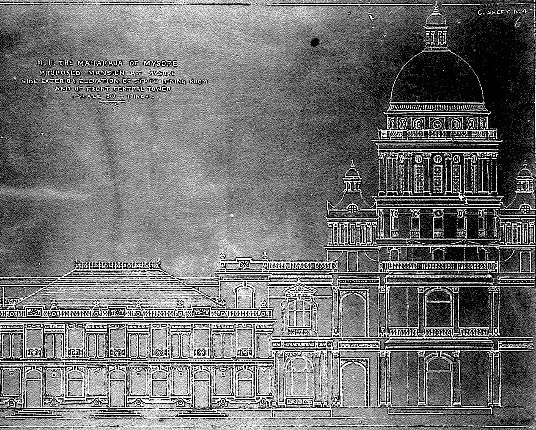
Lalit_palace
Lalit Mahal Palace, Mysore, circa 1930s

He was the chief architect to the Maharaja of Mysore and worked on the ostentatious Lalit Mahal Palace, completed around 1930, along with  E. W. Fritchley.He also worked on a number of other prestigious projects, including Mysore Town Hall and the Municipal offices, known as the BBMP building (built 1933-36) and was also involved in education as the Principle of the College of Engineering, Bangalore.

T. J. Manickam (1913-1974) Manickam studied at University of Mysore before studying at Liverpool where he completed the BArch degree in 1940 and the Post Graduate Diploma in Civic Design in 1946. He then returned to India, and took up office in the substantial Public Works Department (PWD) before establishing the School of Town & Country Planning in Delhi in 1955.

tjm

T. J. Manickam, circa 1970s.

In conjunction with the ITPI he established the Planning Campus in 1958 and merged with the Architecture department of Delhi polytechnic in 1959 to form the School of Planning and Architecture (SPA). This is a prestigious school and is ranked amongst India’s top architecture schools. Manickam designed a new campus in 1965.
Aware of the importance of disseminating his findings and the reputation of the school, Manickham also founded the journal, Urban and Rural Planning Thought in 1958 (based on the Town Planning Review). He also wrote several articles for Urban & Region al Planning, “Housing Crisis in the east” (1971) for example, and the books New Towns in India, (SPA, 1960), and Housing Crisis in the East, (SPA, 1970)

Furthermore he served as a UN co-ordinator in the West Indies (Trinidad and Tobago) and was a UN Advisor to the Government of Jamaica between 1963-66.

D. V. R. Rao: Prof. Rao has been kind enough to write some of his memories of Liverpool and career highlights and these are included below (email correspondence with Jackson, 2012)
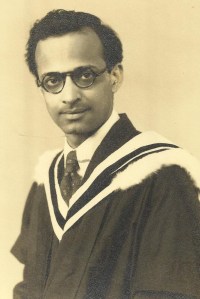
DVR Rao Liverpool University

D.V.R. Rao graduation photograph, Liverpool, 1950

“I am pleased to have had the opportunity to reminisce on my Liverpool days and answer some of the questions posed by Dr Iain Jackson

Why I chose Liverpool– After graduating in civil Engineering from Bangalore University I decided to go to the UK for further studies under the Tata scholarship. Prof Manickam and Mr Lakshminarasappa were both graduates from Liverpool practising in Bangalore at that time. Both spoke highly of the quality of education at the Liverpool School of Architecture which is why I decided on Liverpool and travelled there after the war

Prof Budden –I studied under Prof Budden whom I remember as an excellent teacher and particularly proficient in classic architecture. I graduated from Liverpool university in 1950.There were no other Indian students at the time. Liverpool University was not particularly well known in India except to a small section of post graduate students teachers and academics

Subsequent career– I returned to India in 1950 did a few small assignments and was subsequently appointed to IIT Kharagpur as architect to the campus and assistant professor of the Department of Architecture and Regional Planning. I was fortunate enough to meet Prof Vishwanath Prasad who had earlier worked with Prof Abercrombie, planner of Greater London and Prof Matthews of Clyde valley Regional development. I was promoted to Professor and Head of department of Architecture

In 1963 I took over as officiating director of the SPA, Delhi during the absence of Prof Manickam who was away on a 3 year foreign assignment [Ed – on the UN mission to West Indies].  On Prof Manickam’s return I continued in the SPA as Professor and Head of Department of housing studies  as I had developed a keen interest in social housing which had become a serious issue.  I initiated research into the sociological and economic aspects of massive social housing programmes for disadvantaged people. This drew the attention of UN organizations who were conducting similar studies in other developing countries

Following the sad and untimely passing away of Professor Manickam I took over as director of the school.I developed a strong research centre on rural housing and construction of demonstration houses to help improve the quality of houses in rural areas. Meanwhile I had also worked towards getting the School elevated to the status of a deemed university

In 1977 I was invited by the United Nations to serve as technical advisor in Town and Regional planning in Saudi Arabia . I worked mainly in Riyadh and other Emirates for 9 years from 1977 to 1986 .During this time our team (comprised of a number of international architects and planning consultants) undertook planning and development of major cities alongside a national spatial strategy for equitable distribution of the population. This became the basis for all further and future development in Saudi Arabia.

I retired in 1986 and returned to India. Since then I have been associated with a few consultancy groups.In recent years I have withdrawn from any active participation on grounds of advancing age and deteriorating health”.

I would like to express my thanks to Prof. Rao and his family for helping with this research and for providing the photograph above.

A.E.S. Alcock and the planning of Asawasi, Kumasi

As part of our research into the architecture and planning in West Africa we have uncovered some important work undertaken by Alfred Edward Savige (“Bunny”) Alcock. He worked as  Town Engineer in Kumasi, 1936-45, and then as Gold Coast Town Planning Advisor from 1945-56. Whilst working in Kumasi, Alcock was a pioneer in developing self-build villages. He set up small scale production lines where the villagers could produce ‘swishcrete’ blocks, prefabricated roof trusses and various sanitation devices such as latrines and communal laundries.

DSCF0073

This work was all carefully documented by Alcock and his hand-made photo album survives in the National Archives, London.  Maxwell Fry and Jane Drew worked with Alcock on this ‘experimental village’ (they were credited in Alcocks album) and went on to plan the larger second phase of the development, known as Asawasi. Fry described how the project grew, ‘from being a little experiment has become a big scheme spawning all over the hillside.’

Alawasi_plan

The plan above shows the complete development arranged into ten compounds (housing groups). The area coloured pink was the original village planned by Alcock with the remaining areas designed by Fry and Drew. Alcock proposed a terraced (row) housing approach to create ‘interior’ courtyards, or ‘open compounds’. Alcock described it as a ‘ a repetitive pattern of garden and service compounds alternating… this pattern is adapted to curving contours in the main estate.’ There was a low-tech thrifty approach to the development as Alcock describes,

‘door and window furniture was made from scrap iron by blacksmiths. It was stronger and cheaper than imported furniture.’ In the kitchen a hood and flue were provided by using ‘old tar drums covering all four fire places shared by eight tennants’
Fry and Drew’s Village Housing in the Tropics is indebted to this early development. Alcock proudly noted that his designs could exceed the current building regulations and reduce costs. The big idea was for the government to supply the materials (and technical knowledge) with the villagers providing the labour. It was a system that became very popular throughout West Africa, although it was not always a fair and equitable solution.

DSCF0075

Alcock took over from Fry as the Town Planning Advisor in Accra and was instrumental in the initial planning of Kwame Nkrumah’s Volta River project, new port and town Tema. He (along with Helga Richards) published his findings in a series of ‘How to’ building guides. Although less commercially successful than Fry and Drew’s acclaimed Village Housing in the Tropics manual, Alcock’s books were far more pragmatic and explanatory. There is also an element of humour in his books. How to Plan your Village for example is all about an educated villager returning to his old village and helping them to restore it – the character is named ‘Kwame’  – an overt reference to Nkrumah and a metaphor for the radical changes he was proposing.

howtovillage

Tropical Architecture and the West Indies

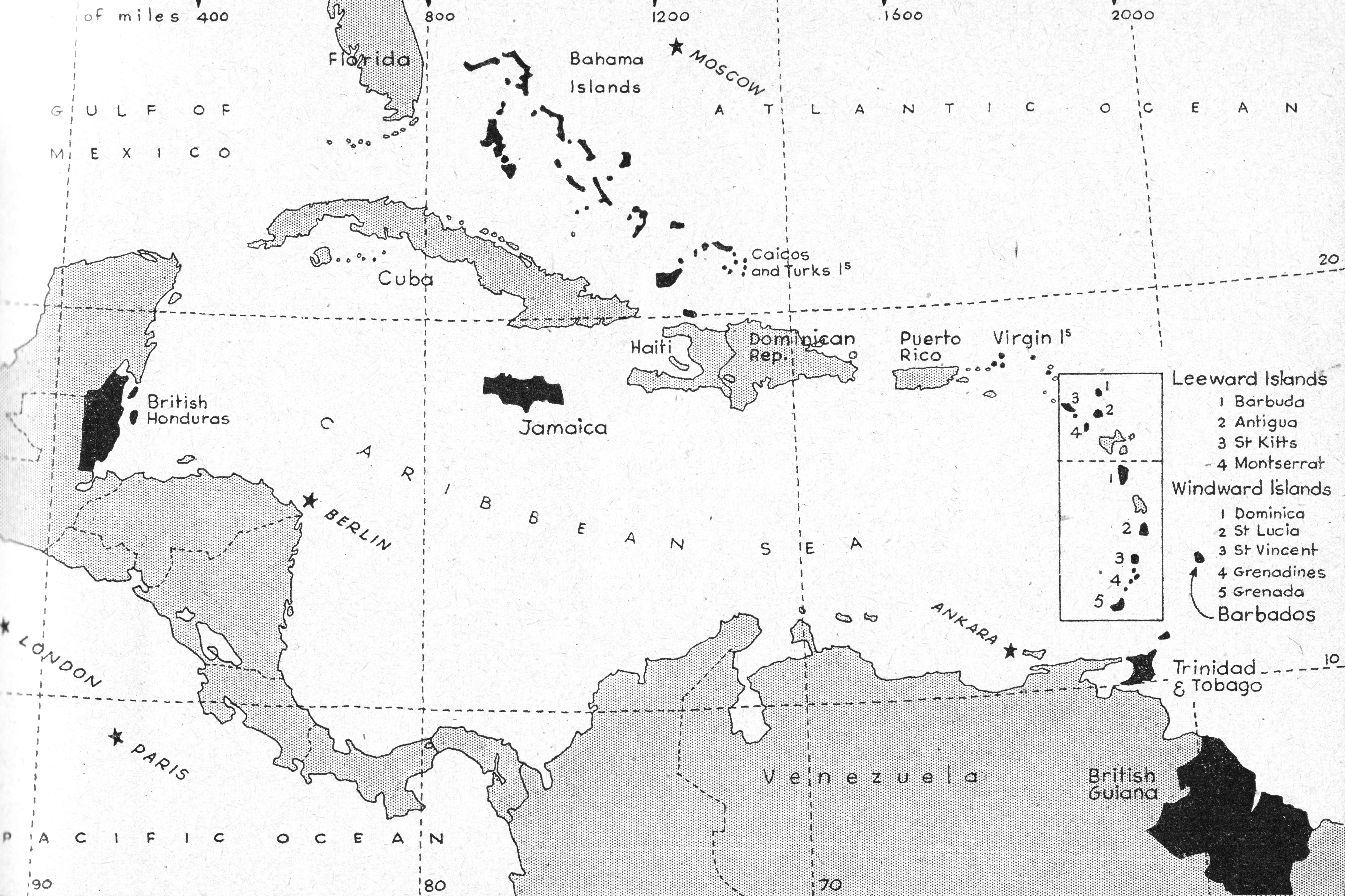
The work undertaken in the West Indies during WW2 was to have a significant impact on the later works that followed in West Africa. Robert Gardner-Medwin was posted to the West Indies during WW2 whilst serving in the Corps of Royal Engineers. His mission, working with funding from the Colonial Development and Welfare legislation, was to undertake ‘research’ into building techniques, materials, indigenous housing and new educational buildings. The funding was triggered by riots and general unrest during the 1930s. The British West Indies was the name given to a disparate collection of islands, as well as two mainland territories, Honduras in Central America, and Guyana in South America. Gardner-Medwin plotted this on a map which he overlayed with European capital cities to emphasize the scale of the region he was responsible for.

002_plan_WI

A small team who accompanied him, including two of his former students from the Architectural Association, London, Leo De Syllas and Gordon Cullen.

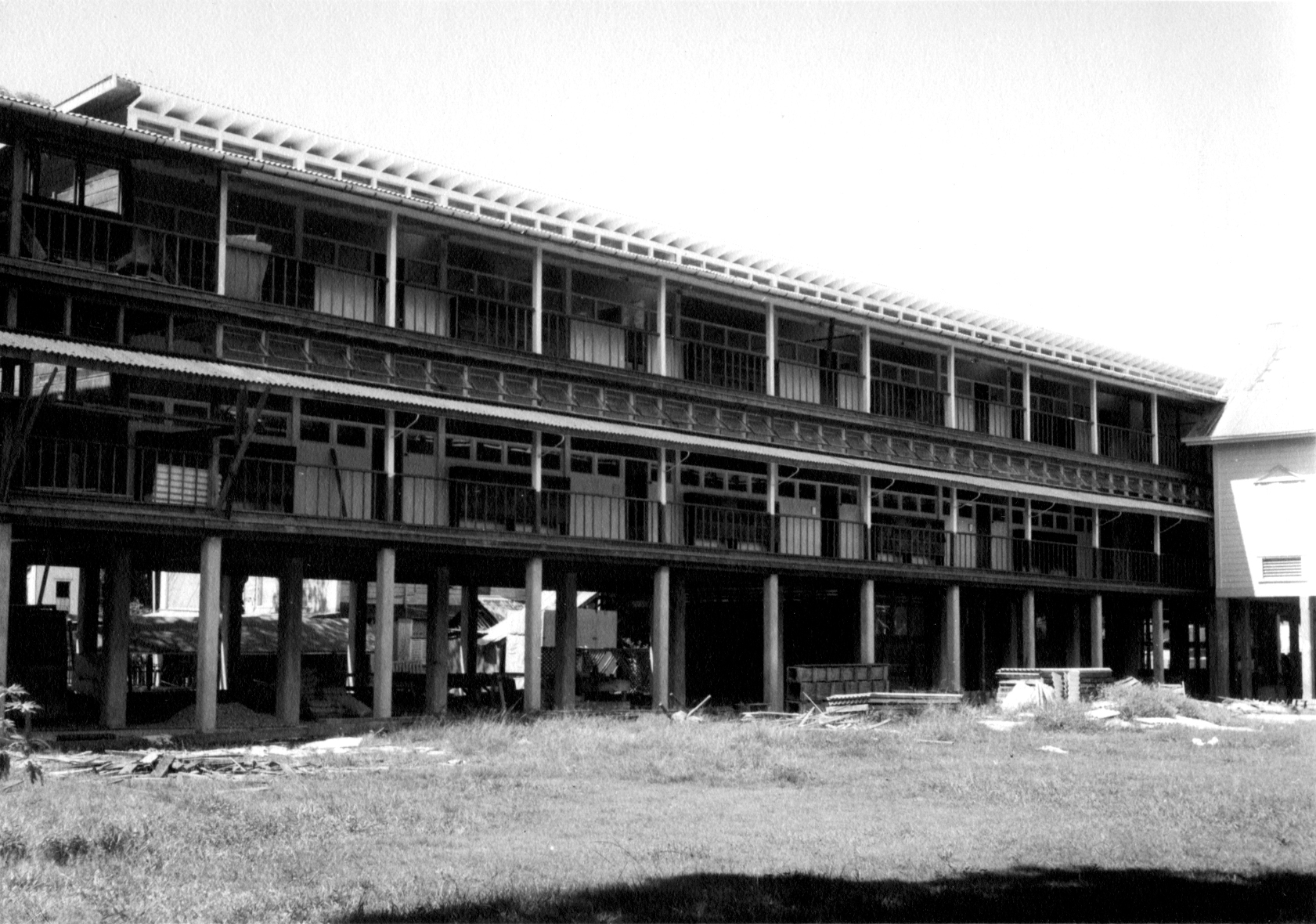
Leo De Syllas is of particular interest as he was commissioned to design several schools in the West Indies, including Bishops High School, Georgetown. Here we see the use of local materials, simple but expressive detailing, the use of verandahs, covered walkways and courtyards – all deployed in an attempt to control the interior temperatures of the spaces and all indebted to the colonial architecture that preceded it. De Syllas would go one to work in Africa with the Architects Co-Partnership.

Bishops High School, Georgetown

They also proposed schemes that moved the existing dwellings from one place to another in an attempt to reduce density, which they believed correlated with better health.

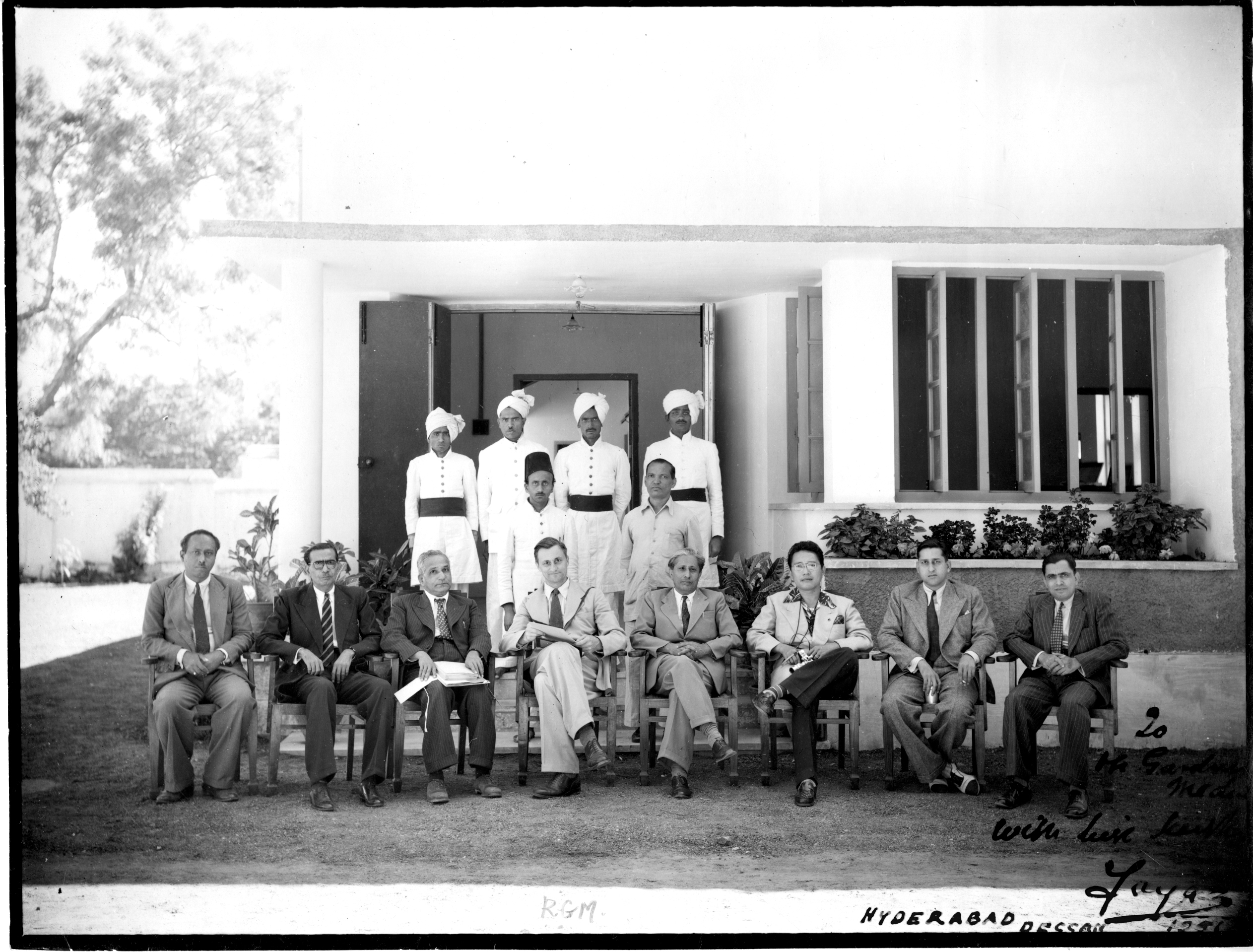
When a fire broke out in Georgetown destroying the town centre, Gardner-Medwin was on hand to replan it, and noted how the local hardwoods were more fire-resistant than steel framed buildings. After the war he returned to the UK, working in Scotland and designing health centres before taking over from Lionel Budden as head of the Liverpool School of Architecture. His work in the tropics was not over however, and he joined a UN sponsored team investigating low cost housing in India in 1951. On this tour he met with and was shown Otto Koenigsberger’s work in Delhi as well as many other schemes throughout the country. India was a hotbed of planning activity at this time, with Chandigarh being constructed and the low cost housing exhibition being staged in New Delhi (organized by Jacqueline Tyrwhitt).

017
Jackson has recently published a paper that discusses this topic in greater detail; it can be downloaded here.