This film documents work songs of a fishing community in Ghana, the West-African roots of the work-song tradition shown in the films “Afro American Worksongs in a Texas Prison” and “Gandy Dancers”. The film shows the community singing as it pulls fish nets onto the shore and men on boats in heavy surf singing to pace their rowing. It was shot 40 miles northeast of Accra, Ghana, January 7th or 8th, 1964.
The film material is part of the Seeger collection at the Library of Congress.
Following a six month delay due the COVID-19 Pandemic, our latest project to research the Architecture of the United Africa Company has finally started. With generous funding from the Leverhulme Trust, the project will run for two years and result in a series of papers, exhibition, and a monograph.
The Principal Investigator is Iain Jackson (Liverpool School of Architecture), with Co-Investigator Claire Tunstall (Global Head of Art, Archives and Records Management, Unilever Archives and Records Management). This close collaboration will allow the project to have full access to the 1000 linear metre UAC archive held at Port Sunlight, Wirral.
The three research associates for the project are Ewan Harrison, Michele Tenzon, and Rixt Woudstra.
F&A Swanzy Store, Axim, 1903, Unilever Archive
Background
The history of West African cities has often focused on government projects, health, segregation and so on, with far less attention given to the one of the largest contributors to the built environment – the mercantile traders and their endeavours.
This project will investigate the impact of the mercantile developments across former ‘British West Africa’ starting with the late 19thC and ending with the early years of political independence of each nation. The shops, trading centres, high streets, and factories offer an alternative view of these cities, and whilst some of these buildings are ‘everyday’ functional structures, when viewed collectively they form a large and significant assembly across the West African region. Through these buildings and wider town plans that accommodated them, the imperial mission is clearly revealed, as are changing tastes, designs, technologies, and economic positions. The architecture, interior spaces, and streetscape serves as a gauge for wider political development, as well as mapping social shifts as the quest for independence came to fruition.
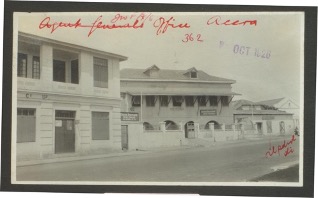
J. Walkden’s Store, Accra,1920, Unilever Archive
One of the largest of these firms operating in West Africa was the United Africa Company (UAC). Whilst formally established in 1929 its constituent firms trace back to the late 18thC and include the Royal Niger Company (operating from the territory that is now Nigeria) and the African and Eastern Trading Company, as well as a whole range of other enterprises. These businesses were effectively operating in a quasi-government capacity and held immense power and influence over what became the colonial occupation of the region. Their contribution to the built environment shaped transport infrastructure, housing, town planning, as well as industrial development of docklands, warehouses, and factories. They also developed more glamorous projects including high-end department stores incorporating the latest design and retail environments; and shaped the fashions and cultural agenda of the towns through facilities such as cinema halls and community centres.
Kingsway Store, Accra, 1950s, Unilever Archive
How did the UAC contribute to the development of the built environment in West Africa, and in what way did it shape the streets, districts, and cities within this region?
Beyond the pragmatic requirements of the business, what type of architecture and planning was it pursuing, and how did this inform the streetscape and experience of the West African city?
Objectives
To develop a new historical study of West African town and cities through the buildings, plans, and infrastructure projects of one of the largest trading conglomerates in the region, the United Africa Company.
Archives
The primary data for this project is held in the UAC Archive, now part of the Unilever Archives, located in Port Sunlight, Wirral. This is a substantial collection and an unapparelled set of material relating to British and post-colonial West Africa. It is a largely ‘untapped’ archive, recently catalogued, and forms a unique set of documents relating to the various businesses ran and acquired by the UAC. In addition to the written sources, the collection includes an exceptional set of photographic records, company films, and recordings of interviews with UAC employees. We’ll also consult various other repositories including the UK National Archives; The Public Records and Archives Department(PRAAD) in Accra, and the National Archives in Sierra Leone (held at Fourah Bay College, Freetown); National Archives of Nigeria (Ibadan Branch).
The 20th anniversary of the Modern Heritage Programme, jointly initiated by UNESCO, ICOMOS, and DOCOMOMO, in 2021 presents a timely and important opportunity to reflect on the transformative cultural experiences and global consequences of the recent past that heralded the dawn of the anthropocene and its many impacts on climate, society, and the planet. Despite these impacts, the ‘modern’ era and its legacies are comparatively undervalued and overlooked, and disproportionately concentrated and interpreted in ‘the west’. MoHoA contends that Africa’s experiences of plural modernities include the positive and negative, colonial and post-colonial, tangible and intangible, urban and rural, culture and nature. This will need greater scholarly attention and can be instructive and transformative in framing modernities and modern heritage globally, as well as addressing the challenges of sustainability continentally. On the one hand, Africa’s contemporary cities, many of which are products of modern encounters, face the highest rates of urbanisation in the world over the next half a century, straining populations and resources, urban landscapes and rural hinterlands, and placing modern heritage at serious risk of alteration or destruction. On the other hand, the unique human settlement patterns in Africa, provides a new dimension, reflected in the cultural landscapes, “combining works of nature and humankind, they express a long and intimate relationship between peoples and their natural environment”.
The African World Heritage Fund has identified modern heritage as amongst the most marginalised heritage categories on the continent, demanding investment in research and documentation to better protect, increase resilience and subsequently Africa’s representation on the UNESCO World Heritage List. Through improved methods of understanding and assessing significance, raising public awareness and promoting inscription on local or global registers, Africa’s modern heritage has a vital role in contributing to rural and urban sustainability in line with the UN’s Sustainable Development Goals (SDGs), the New Urban Agenda (NUA), the African Union’s Agenda 2063, and the Historic Urban Landscapes (HUL) Approach.
MoHoA plans two symposia over two years and a series of supporting thematic workshops. The first symposium, focusing on Africa, will be hosted by the University of Cape Town in September 2021 and titled ‘Modern Heritage of Africa’. The second will be global in scope and hosted by The Bartlett School of Architecture (UCL) in 2022 and titled ‘Modern Heritage in the Anthropocene’. The outcome UCT symposium will lead to proposing a ‘The Cape Town Document on Modern Heritage’ supporting efforts to modify international policy and guidance on modern heritage in line with present and future planetary challenges of ecological, social and economic equity. This will be presented to the World Heritage Committee as part of the reporting exercise and as a side event at the relevant Committee Session. The UCL symposium will discuss the wider implications of the MoHoA globally.
We invite submissions to the International Symposium on the Modern Heritage of Africa and welcome papers and other forms of communication including video, music, performance and literature accompanied with a commentary and interpretation focusing on any of the following themes evolving from the brain storming isivivana last August, highlighting both cultural and natural heritage, the tangible and intangible and their symbiotic relationships:
Considerations of modernities in Africa
Modern Heritage and Sustainable Development in Africa (SDGs)
Infrastructure development, particularly industrialization and transportation systems, as activators of modernism in Africa
Natural heritage and its role in society, linking culture and nature
Public spaces, memorialization and commemoration in postcolonial Africa
Modern Heritage of Africa and the World Heritage Convention
Any other theme not covered by the above
Abstracts: Contributions with African experiences of modernities and the sharing of heritage knowledge and we welcome abstracts of up to 300 words or equivalent format (e.g. film shorts, blog, Instagram story) for other types of digital submissions. For general reference in terms of format – see below. To submit an abstract, email: modernheritageofafrica@gmail.com
The abstracts: Date to be finalised
forming results: Date to be finalised
Publication: Selected papers or presentations will be published as part of the Modern Heritage of Africa Book Series to be published after the conference.
Audience: academia, heritage fields, professionals and practitioners from diverse disciplines addressing the tangible and intangible, culture and nature, documentation, archives and collections. We encourage participation from colleagues and institutions from Africa, particularly from youth and women.
Networking: Institutions of African Studies, Schools of Cultural Studies, Architecture and Planning – African Union and professional bodies.
Languages: Français and English
Dates:22 and 23 September and 24 September, South Africa Heritage Day 2021
Venue: University of Cape Town, South Africa
Participation: online registration will be required and is free; a $50 donation will be welcome.
Format: The MoHoA symposium will be a virtual, hybid, academic event, a dialogical field capable of moving beyond disciplinary boundaries with social and cultural exchanges. To ground its activities and foster dialogue, we invite proposals, ranging from operational practices to speculative and theoretical questionings. These can be presented in written, built, coded, drawn, figured, imagined, filmed, modelled or in any other format (do not hesitate to consult with us for any exotic format or idea!).
Contributions may take the following forms:
Paper presentations that will be shared and discussed through joint working sessions and panel discussions. These might include theoretical work, but also case studies and project reports. To submit your paper proposal, you must submit an abstract of up to 300 words.
Projects, models, images, devices, pieces of coding, hardware and all other kinds of contributions. These must be submitted by sending a 300-word optionally illustrated abstract in the form of a single PDF including text and images (max 5mb).
Contributions can be signed individually or collectively.
Contributors are welcome to submit more than one proposal in one or more formats. If selected, all contributors are responsible for covering the costs of sending their work in time for presentation. The conference is led by the University of Cape Town and planned virtually with a possible physical component on campus; please state if you would able to attend in person.
If selected, contributors might be assigned to a 15-min paper/project presentation session or a debate session to discuss their work. Or both. These might be done in person, by possibly attending one of the conference’s sites, or remotely. The final format and topics of the sessions will be configured once all submissions have been received, so it is possible and desirable that participants will be grouped in thematically coherent yet interdisciplinary sessions.
The University of Liverpool and The National Archives are pleased to announce the availability of a fully funded collaborative doctoral studentship, under the Arts and Humanities Research Council (AHRC) Collaborative Doctoral Partnership (CDP) scheme.
Using The National Archives extensive collections the project will investigate how the West African ‘built environment’ has been shaped to respond to various political, economic, and welfare demands and ambitions. The particular timeframe will cover the transition from colonial rule into independence period. After tracking these broader notions across ‘British West Africa’, the project will pursue a narrower focus on one of the four former British colonies.
How were ideas of ‘self’, identity, freedom, and so on, expressed through new construction and town planning? How did former colonisers, and other foreign groups attempt to shape and influence these developments in the ‘post-colonial’ period. How were notions of identity, nation, and ‘new beginnings’ expressed by the postcolonial nations?
The aim of the project is to investigate how political ideas, and notions surrounding identity, nationhood, and statecraft are expressed or manifest through the built environment.
Infrastructure, prestige projects, and grand architectural schemes are often used to infer power, or suggest modernity, development, and progress. Equally, more (seemingly) mundane developments, such as housing, can be as revealing in terms of power structures and wider ambition. In a problematic and contested political situation these types of projects become highly charged and significant expressions of a nation’s collective (and often contested) identity. This is even more meaningful in a colonial context, and architecture, town planning and infrastructure, in part, become symbolic expressions of the colonial power.
The objective of this project is to examine these notions within the West African context over a period of time that spans the late colonial era and early post-colonial period. This was a particularly volatile moment, charged with excitement and optimism, and a desire to somehow ‘start again’ and rebuild a new nation with a new vision. Architecture and planning would shift from being expressions of colonial dominance and subjugation to being expressions of nationalism, hope, and modernisation.
It is sometimes tempting to see the event of Independence as an abrupt and sudden moment. The clock strikes twelve and everything suddenly changes – and whilst this is true, it is also oversimplifying a complex event that is, to some degree, still being played-out today. There is also a sense of inertia in the built environment and existing city plans, methods of development, and networks of expertise stubbornly persist and outlast political dynasties.
The desire for the newly independent nations to express their hard-fought freedom through physical, often large-scale triumphant (sometimes infrastructure) projects was met with the former colonial power’s aspiration to continue offering technical assistance, expertise, and trade. It resulted in a complex blend of nationalism, reimagining/reinventing identity and Pan-African ambition, further mixed with the additional influences of ‘non-aligned’ socialist assistance and US, World Bank, and UN concerns.
The independence of these nations was not an abrupt severance from the former colonial power, but a feathered, gradual transition coupled with intense global interest eager to retain or cultivate influence and trade advantage.
It makes for a fascinating narrative that reveals the shift from overt imperialism, to one of post-WW2 ‘technical assistance’, ‘development’, and fiscal packages from an array of competing agencies and organisations, met with a desire to express African modernisation, liberation, and success.
Start date 1st October 2021
Applications due 25th May 2021
Interviews planned for 22nd June 2021
For any enquiries please contact: Professor Iain Jackson on: ijackson@liv.ac.uk
How to Apply: To apply for this studentship, please send the following documents to artsrecruit@liverpool.ac.uk:
Full Curriculum Vitae (CV)
Cover Letter expressing motivation for applying and pursuing a PhD on this topic.
Project Plan: This is your chance to set out how you would like to design and plan the research project and should not exceed 1000 words. Please produce a Project Plan that includes the following headings:
Proposed project outline and suggested research questions
Proposed Methodology
The National Archives / other archival sources to be consulted
Selected Bibliography.
The project can be undertaken on a full-time or part-time basis.
CDP doctoral training grants fund full-time studentships for 45 months (3.75 years) or part-time equivalent. The studentship has the possibility of being extended for an additional 3 months to provide professional development opportunities, or up to 3 months of funding may be used to pay for the costs the student might incur in taking up professional development opportunities.
The student is eligible to claim additional travel and research related expenses (worth up to £1000 per year for four years) during the course of the project, courtesy of The National Archives.
· We want to encourage the widest range of potential students to study for a CDP studentship and are committed to welcoming students from different backgrounds to apply. We particularly welcome applications from Black, Asian, Minority Ethnic backgrounds as they are currently underrepresented at this level in this area.
· Applicants should have an undergraduate degree in subjects allied to the Built Environment/Architecture/History/Cultural Geography.
· A Masters level qualification is desirable but not essential. Applicants may be able to demonstrate equivalent experience in a professional setting (e.g. producing and researching written reports, public outreach and liason, working with collections and archives).
· Experience of working in West Africa is desirable but not essential.
· Applicants must be able to demonstrate an interest in the archives sector and potential and enthusiasm for developing skills more widely in related areas.
· As a collaborative award, students will be expected to spend time at both the University and The National Archives.
This is a joint project with AHRC Collaborative Doctoral Partnership programme. The external partner is the National Archive, Kew. See View Website The award pays full maintenance for all students, both home and international students. The National Minimum Doctoral Stipend for 2021/22 is £15,609, plus an allowance of £1000 per year and a CDP maintenance payment of £550 per year.
Here are the recordings from the Crucibles, Vectors, Catalysts: Envisioning The Modern City, event from 2nd and 9th March 2021. Thank you to all of our excellent speakers, and for the interesting questions and discussions.
PROGRAMME: Session 1: Crucibles, 15:00-16:30 (UTC) Building the Modern City: Expressions of Identity, Change and Power, Moderated by Iain Jackson
This panel will explore state-sponsored programmes, planned cities and masterplans in cities such as Lagos, Tehran and Baghdad. It will examine architecture as expressions of nationalism and nationalist political agendas as well as its relationship to big business, corporations and mercantile ventures.
Rupture, Transition and Continuity in Baghdad’s Master Plans: From Minoprio to Miastoprojekt
Session 2: Vectors, 17:00-18:30 (UTC) Connecting the Modern City: Networks, Alliances and Knowledge Production; Moderated by Clara Kim
This panel will explore the practice of modern architecture through colonial-postcolonial networks and geopolitical alliances. It will explore cities in Mozambique within the context of other Lusophone countries, post-Partition East & West Pakistan, as well as the dissemination of knowledge and technical expertise through pedagogy.
Correspondences, Transfers and Memory: Maputo’s “Age of Concrete”
Farhan Karim (University of Kansas)
Archaeology of the Future: Constantinos Doxiaidis in East and West Pakistan
Patrick Zamarian (University of Liverpool)
Global Perspectives and Private Concerns: The AA’s Department of Tropical Architecture
TUESDAY 9 MARCH Session 3: Catalysts, 15:00-16:30
Fragments of the Modern City: Memories, Echoes and Whispers Moderated by Osei Bonsu
This panel will explore the collaborations, connections and entanglements that developed between art and architecture during a dynamic period of building in Morocco, India and Iraq. It will examine the legacy and afterlives of these projects through the investigation of under-recognised figures and narratives in art and architecture.
Speakers:
Lahbib el Moumni & Imad Dahmani (founders of MAMMA, Mémoire des Architectes Modernes Marocain)
Initiatives toward saving modern heritage of Morocco
Ram Rahman (Photographer/Curator)
Building Modern Delhi, The Nehruvian Post-Independence Renaissance
Amin Alsaden (Independent Scholar)
Syntheses Across Disciplines: Rifat Chadirji and Art-Architecture Liaisons in Modern Baghdad
Explore modern cities and architectural production in the blurred era of the independence and postcolonial period
Join us for three sessions which will bring together scholars, researchers and curators to explore architectural production in the blurred era of independence to the post-colonial period of the mid-20th century, focussing on cities in Africa, Middle East and South Asia.
Whether driven by socialist agendas (Nehruvian in India and Nkrumah in Ghana), monarchies (Pahlavis in Iran and Hashemite in Iraq), quasi colonial protectorates, or pan-continental aspirations, architecture (and especially Modernism) was a key apparatus for nation-building, for re-imagining identities and a means to project and invent a new image of the future. The seminar seeks to explore the use of architecture as both physical infrastructure and symbolic expression, as well as its vulnerability to the vicissitudes of changing politics and policies of the times.
The role of cities as crucibles, vectors and catalysts for developing new expressions of identity, change and power is key. Cities in this period saw the emergence of schools of thought, dynasties and collaborations were formed, networks and ideas were shared and publications were disseminated. While the desire of a newly independent nation was often to consolidate a single national collective identity, it was through the urban centres that strands of coherent, yet often multiple identities were formed. The role of figures such as Rifat Chadirji, Mohamed Makiya, Jane Drew and Maxwell Fry were important as they often operated within multiple cities and cross-cultural contexts that spanned the colonial to postcolonial divide.
These urban centres were either newly built, or they were remade and reimagined through city infrastructure, government buildings, universities, cultural institutions and national monuments. Architecture schools, state sponsored projects and external agencies feed into the discussion and warrant further exploration. The seminar explores the transnational connections, diverse political agendas and complex allegiances which informed architectural development in this period.
Seminar convenors:
Iain Jackson, Professor of Architecture and Research Director, Liverpool School of Architecture
Clara Kim, The Daskalopoulos Senior Curator, International Art, Tate Modern
Nabila Abdel Nabi, Curator, International Art, Tate Modern
PROGRAMME TUESDAY 2 MARCH
Session 1: Crucibles, 15:00-16:30 (UTC)
Building the Modern City: Expressions of Identity, Change and Power
Moderated by Iain Jackson
This panel will explore state-sponsored programmes, planned cities and masterplans in cities such as Lagos, Tehran and Baghdad. It will examine architecture as expressions of nationalism and nationalist political agendas as well as its relationship to big business, corporations and mercantile ventures.
Rupture, Transition and Continuity in Baghdad’s Master Plans: From Minoprio to Miastoprojekt
Session 2: Vectors, 17:00-18:30 (UTC)
Connecting the Modern City: Networks, Alliances and Knowledge Production
Moderated by Clara Kim
This panel will explore the practice of modern architecture through colonial-postcolonial networks and geopolitical alliances. It will explore cities in Mozambique within the context of other Lusophone countries, post-Partition East & West Pakistan, as well as the dissemination of knowledge and technical expertise through pedagogy.
Correspondences, Transfers and Memory: Maputo’s “Age of Concrete”
Fahran Karim (University of Kansas)
Archaeology of the Future: Constantinos Doxiaidis in East and West Pakistan
Patrick Zamarian (University of Liverpool)
Global Perspectives and Private Concerns: The AA’s Department of Tropical Architecture
TUESDAY 9 MARCH
Session 3: Catalysts, 15:00-16:30 (UTC)
Fragments of the Modern City: Memories, Echoes and Whispers
Moderated by Nabila Abdel Nabi
This panel will explore the collaborations, connections and entanglements that developed between art and architecture during a dynamic period of building in Morocco, India and Iraq. It will examine the legacy and afterlives of these projects through the investigation of under-recognised figures and narratives in art and architecture.
Speakers:
Lahbib el Moumni & Imad Dahmani (founders of MAMMA, Mémoire des Architectes Modernes Marocain)
Initiatives toward saving modern heritage of Morocco
Ram Rahman (Photographer/Curator)
Building Modern Delhi, The Nehruvian Post-Independence Renaissance
Amin Alsaden (Independent Scholar)
Syntheses Across Disciplines: Rifat Chadirji and Art-Architecture Liaisons in Modern Baghdad
PhD Profile: Here’s the latest in our PhD profile series
Name: Rim Yassine Kassab PhD Research Title and Summary: The medina’s continuity, between revitalization and reconstruction – Cases of Old Rabat and Old Aleppo
The difficult balance between preservation of heritage authenticity and integrity, and adaptation to contemporary needs requires urban heritage to change and evolve. Transformation is a natural process of a city, but when the change is drastic, sudden and unplanned due to a conflict, a new context emerges. This is the case of Old Aleppo in Syria, that has seen 75% of its heritage being either destroyed or damaged. On the other hand, new socio-economic dynamism and urban practices can also transform the face of the urban heritage. The pace of this transformation is slower, but can be equally drastic. Rabat’s old city, in Morocco, for example, is currently undergoing many such ‘rehabilitation’ projects.
Both of these medinas are inscribed in the Unesco’s World Heritage Sites. A medina is the historic core of the city, and the cultural, social and economic hub of everyday life in the cities of the MENA region (Middle East and North Africa). The urgency of reconstruction and revitalisation are crucial : safeguarding the values of the urban and social fabrics of the medinas is not only important for them as World Heritage Sites, but also pivotal for the continuity of lives and livelihoods in these historic places.
However, community participation is lacking within government and international regulations for the processes of reconstruction or revitalization. Without taking people into consideration, many issues arise:
-a furthering of the conflict,
-a neglect of the community’s needs
-the loss of the medina’s values through inacceptable change.
How can we safeguard the continuity of the past, to inform the future of the medina, particularly in the face of its current challenges ? How does the authentic medina look in the eyes of its various communities? How should reconstruction and revitalization be considered, so that the values and tangible/intangibles attributes of the medina are preserved while meeting the current needs of its users ?
The choice of Morocco and Syria is not arbitrary: they were the first countries to be studied in the literature, and they belong to the extreme West and East in the Islamic World, as well as diverse conditions of change. This will allow us to study the nuances of the concept of continuity and the values associated with it: continuity in times of peace (Morocco) is totally different than after a conflict (Syria), as the first is about bettering peoples lives, while the latter is about reconciliation as well.
The methodology is built around primary data gathered from cases studies, along with conducting field work, such as mapping, photographing and cataloguing, as well as interviewing a wide range of current users of medinas (inhabitants, shop owners, street vendors, police officers, tourists) and the old community that have a strong link and many memories associated with it.
Aims and Objectives:
-Presenting the voices of the medina’s community
-Documenting the changes of the medina, from archival to before the current transformations to now
-Cataloguing the tangible and intangible attributes of the medina
-Presenting the values on which reconstruction/regeneration should be considered
-Incorporating methods such as the Walk and Talk interview, and gathering data through social media
What did you do before the PhD Research?
Before the PhD research, I completed both my masters degree: one in Architecture at the National School of Architecture in Rabat (Morocco), and one master research in University of LeMans (France) on history, civilisations and heritage. Throughout my double degree studies, I wrote three master dissertations. The first one, “Habous district, a colonial urban adventure”, shows how the French have understood and built a district in Casablanca following the urban model of the medina. The second one, “Damascus : resilience of a city at war”, which is an urban analysis of the Syrian capital city and provides solutions to its resilience during and after the crisis. The last one, “The old city of Damascus, history of its urban resilience” investigated the resilience of the city’s historic core whilst facing urban modernity.
After graduating, I started directly applying for a PhD. While sending applications and doing interviews, I was doing an internship at the United Nations, working on research in conflicted areas, through the lens of international relations. I also joined “Rabat-Salé mémoire”, a non-profit organisation for Rabat’s cultural heritage, where I was the head of the research department, and carried out a comprehensive analysis on a Moroccan urban heritage called the Oudayas Qasba. I was also responsible for training volunteer tour-guides for this same heritage, for the ‘week of heritage’ in Rabat.
Why did you pursue a PhD, and what made you choose University of Liverpool?
Born in a mixed family and being exposed to two different cultures (Syrian and Moroccan) always triggered my curiosity about people’s culture and the impact it has on their building and tangible and intangible heritage. As a result, from my youngest age, I became aware of the cultural diversity the world has and was interested in its representation in form of cultural expressions, architecture and urban heritage. This also gave me hope about human kind, because we don’t just fight each other through war, but we can achieve many beautiful things. I became interested in cultural heritage, but more specifically the heritage of my countries: the medinas. Even if I studied them in my Masters, I wanted to know more because not enough attention has been paid to their set of tangible and intangible values. The subject is the first reason why I wanted to do a PhD. The second reason is that pushing boundaries and exploring new ideas is the core of my personality. I don’t like repetition and predictability, whereas research is a continuous new intellectual adventure. Each day we learn something new about the world but also about ourselves. Finally, my aim is not only the educational qualification, which is absolutely great, but I hope to make even the smallest impact on people’s life and experience.
For the choice of Liverpool University, I started by looking for an UK institution thanks to its reputation for research and all the good things my cousins said about the excellence of the anglo-saxon system. Secondly, I wanted to challenge myself. Being in the French system all my life, I aimed to explore a new system of thoughts and new ways of doing research . Also, having a better proficiency of the english language is a remarkable asset to have in life, and another challenge I was looking forward to. The University of Liverpool brought an optimal environment for me to carry out my research: its reputation as an excellent university in terms of teaching and research encouraged me to pursue the application process. Also, my research aligns with the Heritage theme, one of the key research theme at the University of Liverpool in general and the School of Arts in particular. Finally, the research group ArchiAM provides a notable research platform where I can share my ideas and exchange reflective and critical discussions with fine researchers.
What have you found the most fun part of the PhD, and the most challenging?
The most fun part of the PhD is the data collection: going to the field (in my case the medina), meeting and interviewing a considerable range of people, taking pictures of beautiful monuments, of everyday life activities, of domestic buildings, of street atmospheres, immersing yourself in the old city. Each day, people surprise me with original information. Some even invited me to their house to visit, others came to me asking me if I needed anything, some gave beyond what was asked because they were happy to have their opinion listened to. It is a pleasure to see people eager to talk about their heritage. I feel the most grateful when I realise that I am studying a subject people are passionate about, that I am doing something worthwhile and meaningful. This is when I feel the most productive: when my research is progressing, I feel the most motivated by it. However, this is not to idealise field work neither, because setbacks, rejections and difficulties are omnipresent.
The most challenging part of the PhD is this roller-coaster of emotions between being confident about your research’ subject and thinking you’re going in the right direction, then loosing track of your initial idea by getting lost in a myriad of interesting subjects. Feeling like you have no idea what you are doing and that you lost valuable time is the worst feeling that I have during the PhD. There are so many interesting methods, concepts and problematics that it is difficult for me to focus on one thing. Besides, there is an ongoing anxiety about feeling like I haven’t read enough: literature review never finishes !
Post-Phd? Any ideas of what you’d like to do next?
I would like to leave my options open at this point. Like during PhD, there are so many interesting options, both academia and industry sounds good. Academia will allow me to continue doing research and to teach, something that I would love to try. Another considerable option is working with my home country government or international organisations like Unesco to implement better management policies for heritage.
In general, I know that the best end result of doing a PhD is to develop valuable transferable skills: problem-solving capacities, working independently, managing stress, better communication skills (both oral and written), time management. So no matter which job I will take up after, a PhD is definitely an incredibly useful experience for me.
Any advice for others interested in doing a PhD?
The first and most important advice is that you should embark in a PhD for the right reasons: a drive for research and a subject you’re passionate about. Do not apply just to be called Dr. one day.
The second advice is for the PhD journey: it is a marathon, not a sprint. It is crucial to have a good work-life balance. You should be prepared for difficult times, and if you don’t take care of yourself properly, it will be harder for you to continue, or worse, you might hate the PhD. As much as you can, enjoy the process ! It is as important, or even more important, than the end result, which is obtaining the degree.
With a formal existence spanning early modern to contemporary history, the British Empire supported complex networks of trade, war and settlement. It intervened in land-based expansions as well as maritime worlds and prefigured a global architectural history. Yet research that seeks to critically address the empire and its legacy poses complex challenges for the architectural historian: the mental-mapping of bureaucratic systems across multiple continents, finding evidence of buildings and landscapes for which little documentation exists, sitting with a complex past and present of race, gender, religion, nationalism and capitalism.
This writing group is formed as an empathetic structure for scholars writing books and dissertations on imperial and colonial histories. We seek to create a space for researchers to share resources on chapter writing, structuring and revision. Writing is often an isolating activity, particularly for emerging scholars with non-Eurocentric specialisations that are underrepresented in the academy. To this end, we especially encourage applications from early-career researchers and those whose primary field sites are located outside of Great Britain. This project is among the first within the society’s new Race and Ethnicity network, a new effort to foster greater equality, diversity and inclusivity within the Society of Architectural Historians of Great Britain.
The group will meet for two hours every two months, with participants alternating between workshopping their own draft chapters and that of another in the writing group. Participants must commit to reviewing and presenting once every four months. To mitigate time zones and geographies, all events will be held over Zoom.
HOW TO JOIN
To join, please send a one-page cover letter and a brief project abstract to info@sahgb.org.uk with the subject line ‘Application: Writing Group on Architecture and Empire’ by 15 January 2021. The cover letter should state why you would like to be a part of the group and your general meeting availability, and the abstract should address the dissertation or book project you hope to work on as part of the writing group. All interested participants will be notified by 31 January 2021. The group will meet every other month beginning in February 2021. The meeting times, format and specific group expectations will be refined amongst participants during the first meeting and reviewed on a regular basis.
The aim of this project is to investigate if, and to what extent do ‘tropical modernist’ structures modify or mitigate climatic conditions to create more ‘comfortable’ interiors.
Most of these structures were designed to be passively cooled and as such have a permeable façade composed of concrete screens or louvres to facilitate cross ventilation air-flow, and to create shade. A good example is the Children’s Library in Accra, designed by Nickson and Borys in 1957.
Mainly built during the 1930s-70s, these buildings are now at an age when they require refurbishment and rehabilitation – although this is mainly superficial and does not involve structural correction. There are various options pursued, many involving the installation of air-conditioning units. For the AC to be effective it ideally requires a sealed interior volume, rendering the existing permeable façade unsuitable.
Standard Chartered Bank: as built and passively cooled
Standard Chartered Bank: refurbished, clad in glazed panels and reliant on AC
One solution being increasingly used in Ghana is to externally clad the façades with a glazed screen, as seen on the Standard Chartered Bank on Accra’s High Street.
The glazing cuts out street and traffic noise and reduces dust infiltration, as well as enabling the interior to be mechanically cooled. But in terms of energy usage (consumption of AC and in the fabrication of the glazed units) it is far from ideal. Furthermore, there is the financial cost of cooling what is now effectively a greenhouse in a hot and humid climate. Architecturally the building has also been dramatically altered. It is now a bland non-descript block, and lacks the patterns, shading effects, and references to the floors behind the façade. I’m not suggesting that this example is a prestigious heritage monument, but rather using it to illustrate what is becoming an increasingly common approach to refurbishment. Fortunately, in this case glazing can be easily removed and the older structure has been preserved inside.
Our project has several objectives, including to:
Recognise and promote the significance of these 20thC modernist structures.
Determine if the passive cooling approach does create sufficiently comfortable interiors.
Investigate what conditions are comfortable for the occupants of these buildings.
Investigate alternatives to AC that provide low cost and low energy comfortable interiors without detrimentally impacting upon the architectural quality.
To test both inland and coastal conditions we’ve selected a case study at KNUST in Kumasi, and another at the University of Ghana, Accra. Both buildings are university libraries, and as such have a large number of daily visitors that we can consult. The library at KNUST was designed as a louvred screen wall, fully adjustable from the interior, and also has a later brutalist extension with a twin façade arrangement and partially air-conditioned interior.
KNUST Library: a facade of adjustable louvres
At Accra, the Balme Library takes a more colonial/traditional approach with a series of courtyards, loggias and high ceilings. Some of the rooms have been retro-fitted with air-conditioning, whilst at the same time naturally ventilated. Both libraries are large institutional buildings and have the potential to consume large amounts of energy should they be refurbished with full AC and cooled to ASHRAE recommendations. Furthermore, it is important for the health and education of the staff and students that these buildings are comfortable places to spend time in, and to study.
Balme Library at University of Ghana
In each building we’ve installed a number of Hobo data-loggers that record the temperature and humidity at regular intervals. Whilst this data allows us to determine whether the internal temperature/humidity is different to the external condition, it does not tell us if the conditions are comfortable to the inhabitants. To establish this, we’ve consulted the library users and staff to enquire how comfortable they feel in the various library spaces. The respondents also recorded their attire, age, sex, and how long they have been in the library prior to completing the survey. Over 250 people completed the survey at KNUST in January 2020. We will repeat this in the ‘rainy season’, and conduct similar surveys at Accra. When we’ve gathered this data we can correlate the data-logger findings with those of the user surveys. We’re also constructing 3d computer models of the buildings to test various refurbishment scenarios and cooling options.
Mojca Smode Cvitanovic, ‘New Paper: Tracing the Non-Aligned Architecture: Environments of Technical Cooperation and the Work of Croatian Architects in Kumasi, Ghana (1961-1970)’ Histories of Postwar Architecture, 3(6), 34-67. Full paper available here: DOI: https://doi.org/10.6092/issn.2611-0075/10450
Unity Hall, KNUST, designed by Miro Marasović and John Owusu Addo, 1968.
Focusing on the work of a group of Croatian i.e. Yugoslav architects in Ghana, the paper explains the nature of technical cooperation as a model of temporary international contract work in relation to the specificities of the environment built consequently. It focuses on the engagement of Miro Marasović as the head of the Kwame Nkrumah University of Science and Technology Development Office from 1961 to 1964. As its contextual framework, the paper addresses bilateral technical cooperation as a form of international communication and exchange, the practices of the Non-Aligned Movement, and the interrelations of the pre- and post-independence generation of modern architecture in Africa.