Archive

British Colonial Architecture

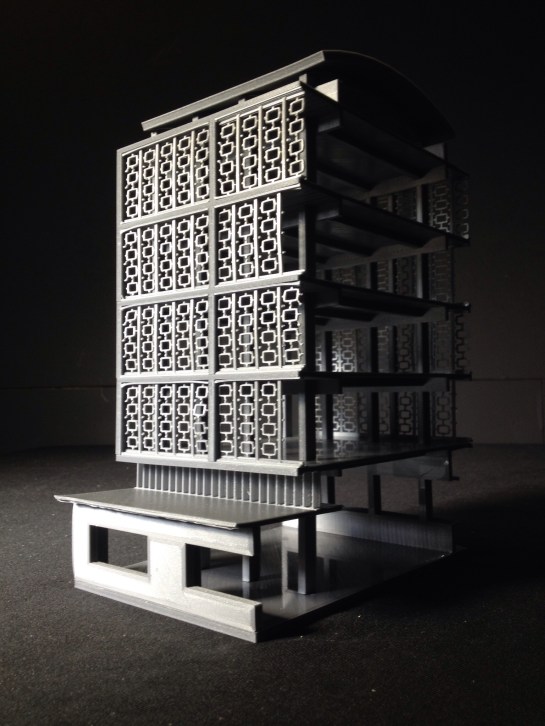
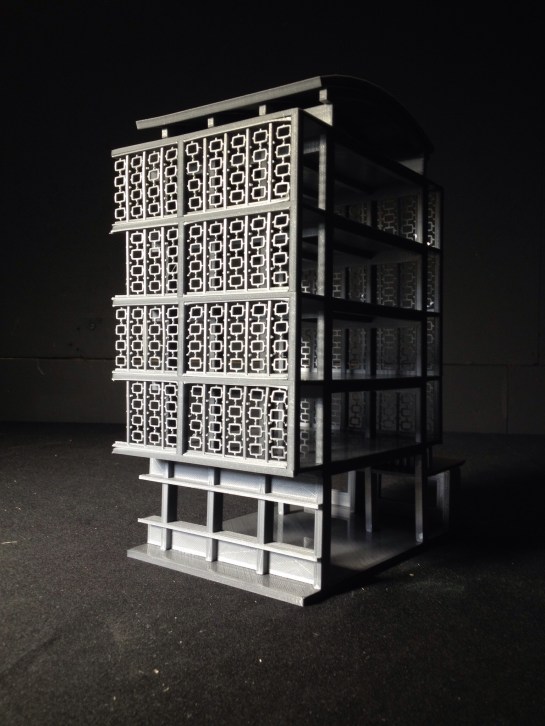
3D Printed Model of Kenneth Dike Library

We’ve been playing with a couple of 3D printers [Makerbot and Ultimaker] and testing how they might be used to create a small collection of models to supplement our History of Architecture lectures.

image

In the age of ‘Stream Capture’ and recorded lectures including a small exhibition of key case study models in the lecture theatre will hopefully entice the students to attend the live event and will also form an opportunity to further explore light, scale and the qualities of buildings that are not as easily expressed through photographs and orthographic drawings.

image

Our first test case used a computer model of the Kenneth Dike Library, Ibadan [designed by Fry and Drew] expertly produced by Jacopo Galli and generously shared with us. The model doesn’t show the entire buiding but a key section enabing the interior to be viewed. The ambition is a for an online library of models that can be downloaded and then printed as and when they are required by faculty and students.


image

Here are some further updates on the Augmented Reality App we developed for Kolkata….

cleoroberts's avatarEnvisioning the Indian City

Timescape Kolkata, an augmented reality app developed by the ETIC project, launched earlier this week at the Victoria Memorial Hall. The innovative app allows iOS and Android phone users to experience the antiquated city through photographs produced by Frederick Fiebig, W.G Stretton and Company and the reputable Bourne and Shepherd.

Once Timescape (www.time-scape.org) is downloaded from here, users can explore rare archival images and data about heritage sites in Kolkata. As you walk through the city, views will be ‘augmented’ by a corresponding nineteenth century photograph taken at the exact site. Another click or with a single swipe a host of archival information including sounds and histories will be available.

TimescapeKolkata

The idea germinated following the UGC-UKIERI funded ETIC Liverpool conference held last year. In the School of the Arts library, after negotiating theories of the contemporary city, a series of questions emerged. What if Frederick Fiebig’s handpainted candid Calcutta…

View original post 367 more words

EAUH Helsinki 2016

European Association for Urban History 2016 Conference: 

Reinterpreting Cities

24-27 August 2016, Helsinki, Finland


CALL FOR PAPERS

Deadline: 31 October 2015

Session:

M19. Settler Cities: A Useful Concept to Reinterpret Transnational Urban History?

In the opening lines of his massive Replenishing the Earth: The Settler Revolution and the Rise of the Anglo World, 1783-1939, James Bellich presents a challenge to historians eager to reinterpret cities in a transnational framework: do cities like Chicago and Melbourne on opposite sides of the planet share characteristics by virtue of their foundation and political rule by white settlers intent on dwelling permanently upon lands forcibly taken from their indigenous inhabitants?
This panel will explore this question by calling upon scholars to reflect on the concept of “Settler Cities.” What defines such a city? Are their clear boundaries, or does the definition involve a subtle degrees of separation form the broader category of colonial city? Are there broad commonalities in the histories of these cities that merit singling them for scrutiny as a group? Are they best seen as a special subset of colonial cities or is there a way in which they expand or transcend that long-used concept? Are there webs of connections between these cities and between them and the imperial metropoles that make this concept especially useful as a subset of the new subfield of transnational urban history? What if we go beyond Bellich’s focus on the “Anglo World,” and consider Algiers, Elizabethvillle/Lubumbashi, Windhoek, Batavia, Jerusalem, and even Mexico City or Rio de Janeiro in the same universe as Cape Town, Chicago, Vancouver, San Francisco, Belfast, and Sydney? Are there non-western settler cities? Why did the settlers in some cities abandon their project of settlement while others stay, helping to cause some of the most intractable conflicts on earth?
Participants should not only bring their research on individual settler cities to the table, but also contemplate several themes underlying the concept of settler cities: especially dense connections and flows between these cities and between them and metropolitan hubs; the diversity of flows between these cities, including not only people, money, ideas, and urban practices, but also jurisprudential systems, organizational forms, urban economic structures, group identities, and political cultures; especially complex forms of urban politics that includes conflicts between settlers, between settlers and metropolitan governments as well as with indigenous people; real estate practices involving people who plan to invest in urban land for future generations unlike the more transient European populations of non-settler colonial cities; and interventions in urban spatial politics that include especially complex forms of segregation and law-of-conquest authoritarianism.

Keywords:
colonial cities, segregation, settler colonies, transnational urban history, urban politcs

Period:
Modern

Type:
Main session

Session organisers:
Carl Nightingale, University at Buffalo SUNY, United States of America
Vivian Bickford-Smith, University of Cape Town, South-Africa
Johan Lagae, University of Gent, Belgium

Call for Papers: Revisiting African Modernism at docomomo 14th International Conference 

6-9 Sep 2016,  Calouste Gulbenkian Foundation,  Lisboa,  Portugal

docomomo International is now accepting abstracts for the 14th International docomomo Conference that will take place in Calouste Gulbenkian Foundation, Lisbon, Portugal, September 6–9, 2016. Please submit abstracts no later than October 18, 2015 (12 pm GMT), for one of the 29 thematic sessions listed here.

One session that will be of specific interest to TAG followers is the ‘Revisiting African Modernism’ session…

“Africa’s history of architectural modernism and modernist landscapes is no longer unknown or obscure.  This session seeks to build on that established foundation by asking contributors to explore the potential contribution of the buildings and infrastructure of this era (c. 1945 – 1970s) to our understanding and engagement with Africa today. Does their original programme make them adaptable for 21st century contemporary urbanism? Are there specific case studies or examples of buildings and landscapes that demonstrate positively (or negatively) adaptive re-use possibilities or experience?

Past docomomo sessions on Africa have (arguably rightly) been occupied with debating Africa’s involvement in docomomo, as both a subject and a participatory region. This session recognizes the increasing inclusion of African nations; South Africa, Egypt, Ghana (proposed) into the docomomo “family”. It also acknowledges contributions from African and Africa-focused researchers in a number of past docomomo publications.

This panel session seeks to expand these contributions into a contemporary discourse, devoted to the investigation of the methods, and means, by which Africa’s modernist past can contribute more than just historical research to the Africans and Africa-focused researchers of the 21st century. We are particularly interested in contributions that consider built “ensembles” within urbanist contexts in African communities or cities, such as university campuses, housing masterplans, and industrial complexes/towns. “

Session Chairs: Ola Uduku, University of Edinburgh, Scotland; Miles Glendinning, University of Edinburgh, Scotland.

Book Review: Jaqueline Tyrwhitt: A Transnational Life in Urban Planning and Design

Ashgate, Farnham, 2013.

By Ellen Shoshkes

ISBN 9781409417781

44 black and white figures

£55.00

9781409417781

What an extraordinary life. This biography carefully chronicles and assembles (in some detail) the life and career of one of the forgotten heroines of the twentieth century planning world. Forgotten is perhaps too strong, as Tyrwhitt is one of those figures that ‘crops up’ rather regularly; aspects of her work are frequently mentioned in conference presentations or cited in journal articles, but she is never the focus of attention despite being, as Shoshkes reveals, a global player. Indeed she is almost omnipresent throughout the planning sphere of the twentieth century when one reads the amount of work she facilitated and the influence she held over publications, translations, lecture courses, planning strategy, international housing and development programmes. Furthermore, she also undertook considerable research into urbanism and planning, yet this is the first volume to draw all these twists and turns together. A good biography is able to not only describe and discuss the person in question, but to also pull in the wider debates and to position the life and works within a broader context – this book manages to effortlessly achieve this feat and is to be commended for it. The narrative adopts a chronological format split over five parts, which neatly track the major episodes of Tyrwhitt’s life. Perhaps one of the reasons for Tyrwhitt’s relative obscurity is because she didn’t have a career in the conventional sense, but rather careered through life bouncing from one project to the next, barely making ends meet. She was also a woman, unmarried, sometimes unkempt, and seemed to care for little beyond friendships and her work. She didn’t establish her own practice or publish provocative tracts, rather operated in a supporting role for the likes of Jose Luis Sert, Sigfried Giedion and Constantinos Doxiadis. As a planner, she left few tangible remains and was not concerned with formulating her legacy as some of her more egotistical collaborators were. She was more focused on getting the job done and took on the important tasks of organising, facilitating and disseminating findings, often with little appreciation from those she made look exceptional. One of her most prolonged and significant roles was translating Giedion’s epic publications, although to label Tyrwhitt’s contribution as a translator somewhat undersells her contribution. She was really a co-author and collaborator, honing Giedion’s ideas and clarifying his arguments – as well as translating them into English. She had a longterm friendship with Giedion which may have strayed into romance, but even this collaboration had its limits and Tyrwhitt stopped working with Giedion long after what most associates would have endured or put up with. Throughout her life there were strong male characters that she supported and encouraged but in the course of time these roles were often inverted and they became dependent on Tyrwhitt.

Although one may know something of Tyrwhitt’s life and work (most planners will be aware of the book she edited on Patrick Geddes in India, for example) this book reveals so much more, and it is very surprising just how far and wide she worked and travelled. One of the more shocking revelations is Tyrwhitt’s involvement with the British Fascists and her decision to experience Hitler’s Germany firsthand in 1937. Very little is said about Tyrwhitt’s political persuasions in later life, but judging from the company she kept it can be safe to assume that she ‘mellowed’ from her early flirtations with the political Right. Her work with the UN in India and Indonesia is another significant aspect of the book and adds new insight into the international agencies that operated in the post-war era. The sources are drawn from numerous archives and the research is detailed and thorough; although very little critical appraisal of Tyrwhitt’s work is made – was any of it implemented, or did any of her students put it into practice? Perhaps an epilogue of influence could have been added as a reprise or conclusion, but this is surely minor criticism of what is a substantial and valuable contribution.

This is a welcome volume to the history of twentieth century architecture and planning; it fills so many gaps, opens up new connections and networks, and goes someway to finally giving Jacky the credit she deserves for a lifetime’s concerted effort to improving and understanding our cities and landscapes.

The 20th Century Urbanism and Landscape in Africa conference recently held at the Edinburgh School of Landscape Architecture (ESALA), University of Edinburgh. It took place from 7 to 8 October, and focused on the subtheme of ‘Research Challenges and opportunities’.

The first day of the conference was dedicated to presentations by the four Key Note speakers, who were Dr Rexford Oppong of KNUST Ghana, Prof Luc Verpoest of KU Leuven, Prof Johan Lagae of Ghent University and Dr Iain Jackson of University of Liverpool. Although their presentations all brought the conference’s key theme of ‘Research Challenges and Opportunities’ to the fore, their various approaches and contexts had provided more divergent and interesting perspectives to the discussion.

The areas of interest covered by the four speakers ranged from Dr Oppong’s  “Challenges and Opportunities of Conservation Research and Documentation on the Urbanist and landscape heritage of KNUST”, to Prof Verpoest “Mind the gap: from historiography to [urban] preservation. The African case” and Dr Jackson’s “Research Challenges and opportunities in West Africa”. Prof Johan Lagae also presented a talk on the challenges of his on-going research on urbanism in Congo.

Picture2

Cover picture for Dr Jackson’s “Research Challenges and Opportunities in West Africa”

In Dr Oppong’s talk, he presents the KNUST as a campus set, and much preserved in the Modernist architectural theme of the 1950s. However, the current state of its architectural drawings archives as highlighted in his presentation, need urgent conservation and documenting for posterity. He therefore gives insights into his current research in this regard, and the challenges of the project. One main challenge he sights is in getting the current University and secondary school students (who also played a part in the survey) to recognise the input of indigenous Ghanaian Architects in the building designs.

vc lodge

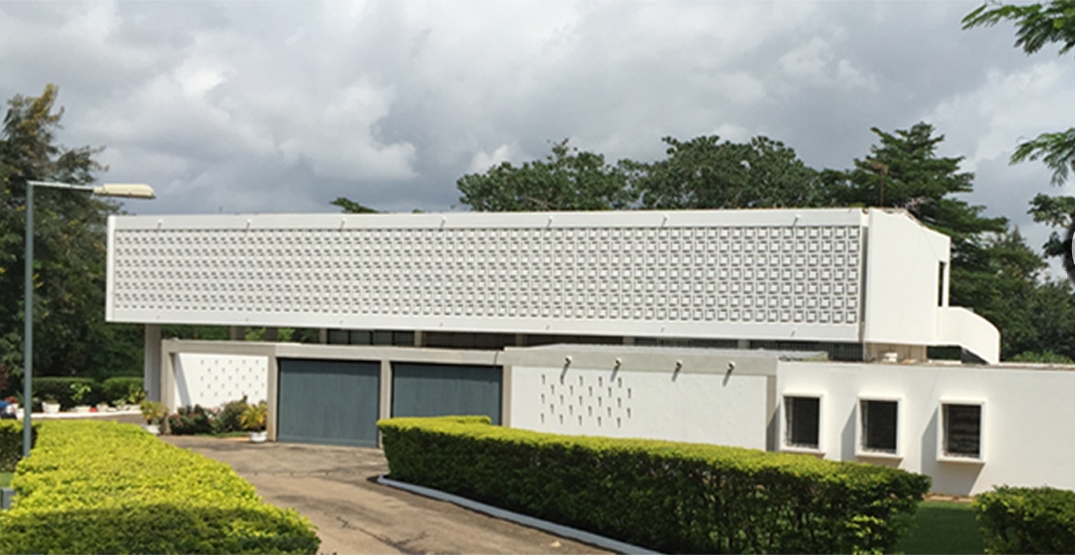
The Vice-Chancellor’s Lodge, KNUST Ghana

The challenges of conservation and documentation raised by Dr Oppong, was a theme which ran through the other presentations. However, in Prof Verpoest’s talk, he suggests that further strands of investigations are needed to be explored on the subject. Rather than being limited to buildings and famous architectural pieces he argues, researching conservation, preservation and documentation should look at the wider picture of processes, institutions, mechanisms and historical context. In essence, it should go beyond the built object as an individual subject of analysis. He therefore discusses this in the light of recent projects by Docomomo, where research is being done to go beyond individual building conservation to urban building conservation. He also explains how the organization is seeking to have regional linkages in selected African countries.

Picture2

An image of Africa’s changing society as illustrated in Prof Verpoest’s presentation

Prof Verpoest’s  suggestion of research into urban, rather then individual building conservation, preservation and documentation in Africa and globally, is also seen to form the crux of work done by the third key note speaker – Prof Johan Lagae. In his current research in Congo, Prof Lagae looks at various types of infrastructure – Missionary, Railroad and Hospitals, but all within the wider urban form context and everyday living. He also looked at the Post Belgian period in Congo around 1965, and raises the issue of building production and technology – but again questions “where were the Congolese in all these?” On the challenge faced in his research, he stated practical issues of language, electricity, relating with local chiefs etc. He also notes the fantastic data and drawings present in the archives, but which unfortunately lacks infrastructure.

Picture5

Picture of King Leopold II of Belgium in an archival administrative document on the Congo

Prof Lagae’s question on the contribution of natives, and poor archival infrastructure are two issues which Dr Jackson’s also raises in his presentation on Research Challenges in West Africa. With regard to the native contribution, he suggest that urgent work is required on the works of native architects in particular. While supporting the need for improved archival infrastructure in West Africa, however, Dr Jackson also makes a case for more fieldwork participation – arguing that “We have to get our hands dirty and explore…to create new photographs and records of the buildings”. He also suggest that further to such fieldwork exercises, the adoption of new technologies, like Drones and GPS need be encouraged to produce astonishing results. As seen in Professors Verpoest and Lagae talk, Dr Jackson was also of the Opinion that Architectural history needs to move beyond the conservation and preservation of important buildings. He argues rather, that research in this area become more inclusive of the intangible and the ephemeral, and sample user experiences and opinions. His talk raises several other questions on research challenges in West- Africa, including the theoretical base, further studies into Village plans and the PWD, art works and murals, architectural teaching etc. A most significant point he however raises, is on the need for collaborative research, rather than the lone-wolf and fear of plagiarism approach.

photo (1)

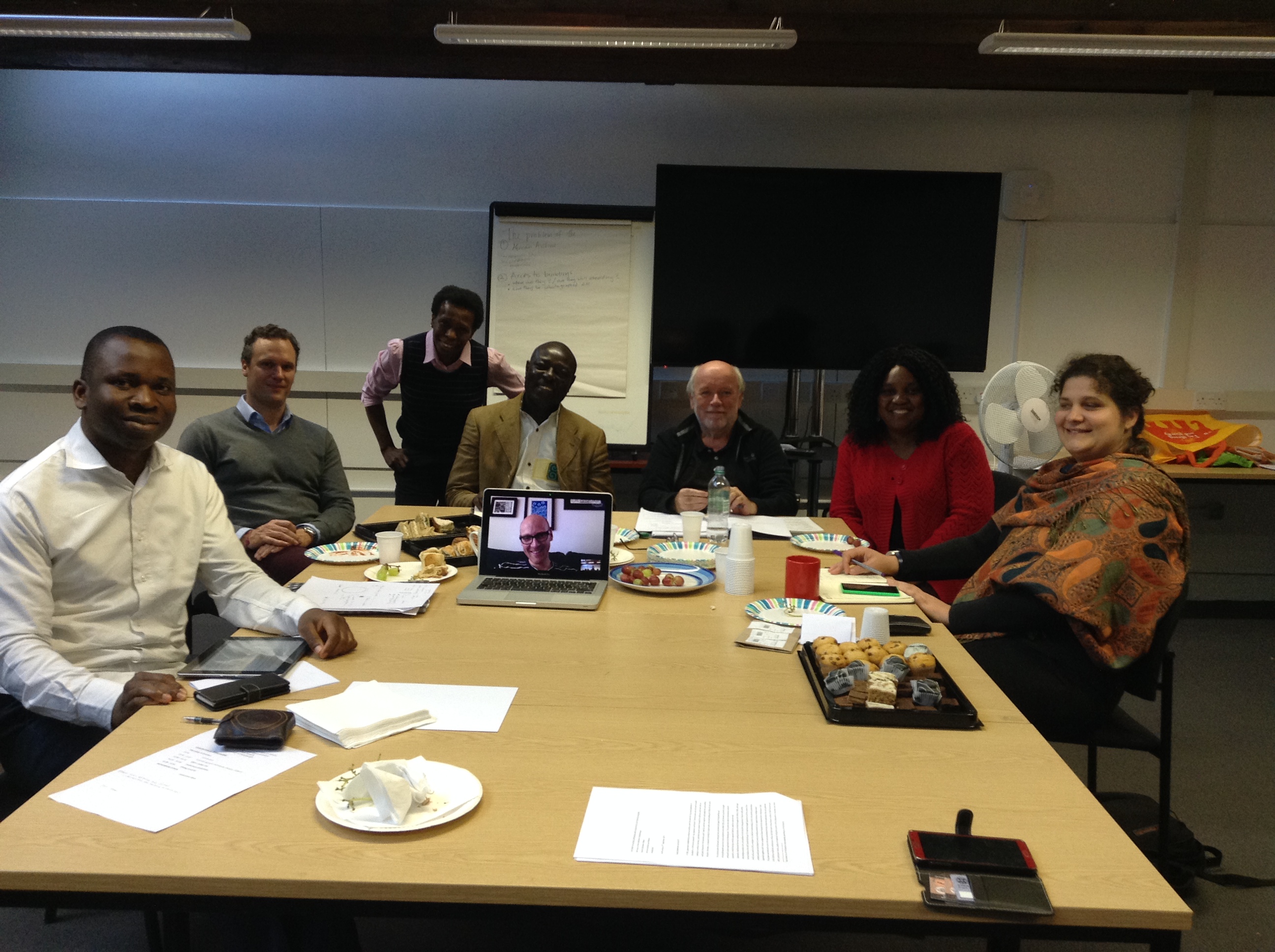
Delegates at the 20 Century Urbanism and Landscape in Africa Conference on 8 Oct 2015; Left to right are Meshack, Dr Alex Brymer, Dr Ola Uduku, Dr Rexford Oppong, Dr Iain Jackson (on Skype), Professor Verpoest, Yemi Salami, Dr Ruxandra

Scheduled for the second day of the conference were two presentations to be given by Yemi Salami and Anthony Folkers. Anthony Folkers was not in attendance at the conference but had his paper presented by Dr Uduku The paper was titled “The Spirit of George Lippsmeier and His Institute for tropical Building”. Yemi, had only recently submitted her PhD and is awaiting her viva to take place. She gave a talk on the challenges of undertaking a doctoral research in Nigeria, and her paper was titled: “Challenges of Conducting a Doctoral Research in Nigeria: Reflections from my PhD work on “the Architecture of the Public Works Department in Nigeria, c1900-1960”. Here she discussed challenges ranging from very slow bureaucratic processes, to ill equipped archives and security and insurgency issues, as some of the hindrances she faced during her research. The symposium then held at the end of Yemi’s presentation, with Dr Jackson joining the debate via Skype.


Bubonic plague, colonial ideologies, and urban planning policies: Dakar, Lagos, and Kumasi, by Liora Bigon, in Planning PerspectivesDOI:10.1080/02665433.2015.1064779

The Third Plague Pandemic originated in Southwest China in the mid-nineteenth century, reached Africa’s shores around 1900, and spread globally for about a century. This article examines three plague loci in colonial Senegal (Dakar, 1914), Nigeria (Lagos, 1924), and the Gold Coast (today’s Ghana; Kumasi, 1924). A tripartite comparative analysis is made of French and British doctrines of colonial rule, colonial urban planning policies, and anti-plague practices. While some common features are demonstrated in the policies and practices of the colonizing forces such as the implementation of rigorous measures and embracing segregationist solutions, divergent features can also be distinguished. These relate to the methods of implementation of planning and anti-plague policies, in accordance with colonial ideology (assimilation, direct and indirect rule); and to the very nature of autochthonous communities, responses, and levels of agitation. Our both comparative and more nuanced site-related view is also based on a large collection of archival and secondary materials from multilateral channels.

The full article may be viewed here: http://www.tandfonline.com/doi/abs/10.1080/02665433.2015.1064779

cleoroberts's avatarEnvisioning the Indian City

Tuesday 18th August 2015

The second day opened with two papers addressing the architectural development and planning of Chandigarh. Iain Jackson (Senior Lecturer, School of Architecture, University of Liverpool) explored the overlooked and quotidian portions of the city in his paper, ‘Chandigarh Dwellings: Ghastly Good Taste or Flamboyant Modernism’. Departing from the over-cited work on the city by Le Corbusier, Pierre Jeanneret, Maxwell Fry and Jane Drew, he detailed his early research into private developments which have avoided similar ossification. 

His documentation of these private dwellings showed idiosyncratic modification contra to the city’s founding vision. Discussing this independence from the Government’s arbitration of taste and aesthetic agenda, Jackson proposed a series of classifications including Punjabi Baroque. He stated that this peacock flamboyancy and non-utilitarian adaptation showed Chandigarh remained open, unresolved and signalled the failure of modernist notions of ‘home’. 

New Chandigarh villa New Chandigarh villa

Melissa Smith (Banduksmith Studio/Visiting Faculty, CEPT…

View original post 1,521 more words

Conserving West African Modernism Workshop and Conference Report

KNUST Kumasi, 2 – 18th July 2015

From the 2nd to 18th July 2015 Ola Uduku spent time at the Kwame Nkrumah University of Science and Technology (KNUST), Kumasi Ghana, working with Dr Rexford Assasie Oppong, to set up and run the inaugural “Conserving West African Modernism” workshop culminating in an international conference held from the 13th – 14th July at KNUST.

There were a number of objectives for the project; firstly the visit provided an initial attempt to explore the possibilities of Edinburgh University’s Scottish Centre for Conservation Studies, (SCCS) and Architecture School becoming involved in research collaboration activities centred on the Modernist heritage of the KNUST campus both in terms of architectural history and also international- tropical conservation practice. Also included in this collaboration was the Liverpool University School of Architecture, (LSA) which has research expertise and archival material on the work of Maxwell Fry and Jane Drew who were involved in the development of Kumasi and Ghana’s post-WW2 architectural heritage.

DSC_0463

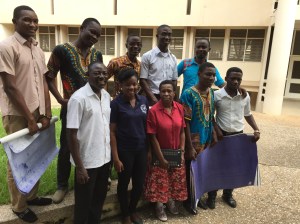
Second, the project sought to make an initial assessment of the modernist heritage site and buildings at KNUST with a view to using these as a basis for documentation, to support the application for Ghana to become a member of the international modernism conservation organisation Docomomo International. This also included a public outreach element in which the project engaged with local university school children in a campus buildings tour and questionnaire session to raise awareness and interest in the buildings on the KNUST campus.

Third, the project sought to explore the possibilities of having the SCCS at Edinburgh University support the development of an MSc. Course in conservation and also contributions to architectural history teaching, initially via online courses, using available media technology at both institutions. In connection with this, linkages to architectural history teaching at the Liverpool School of Architecture and its future research-links with Ghana were also examined.
PG_KNUST2

Also at public and international outreach level, work was undertaken with Junior high school students to raise awareness about the modernist architectural legacy on the Kumasi campus, via a series of tours, discussions and ‘snap-voting’ on buildings judged ‘best’ by the pupils. At the international level the project enlisted PG architecture students to work on listing key campus buildings, using the Docomomo, (the international organisation for conserving modernist buildings and landscapes), fiche listing template. This is with a view to working with KNUST staff and students towards compiling material required to apply for Ghana’s membership of Docomomo in the next biennial conference in 2016.
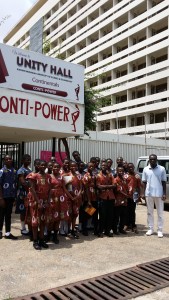
GROUP_UNITY

The project culminated with a well-attended two-day conference at KNUST, where keynote speeches were given by; KNUST Professor emeritus H. Wellington, and Professor Miles Glendinning, Director SCCS, University of Edinburgh. Teams of Junior High School and KNUST Architecture PG students also gave presentations, showing the work they had done during the preceding week’s ‘KNUST Modernism’ workshops.

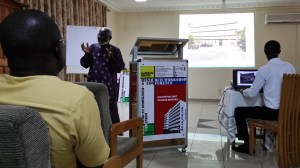
miles_rex_me Prof_Wellington

Providently the conference also heard the views and reminiscences of Profs Wellington, Owuso Addo, and Arc. J Larbi, all eminent Ghanaian architects and educators, who had been historically involved with the development of the campus, since its inception in the mid 1950s to the 1990s, who attended the workshop. Representatives from the Ghana Institute of Architects, the Lands and Survey office at KNUST, associated faculty staff from the College of Architecture, Arts, and Planning, and from the ArchiAfrika organisation, were also in attendance.

The various workshops and final conference was made possible by funding and in–kind support received from a number of bodies including: The African Studies Association UK, ArchiAfrika, The University of Edinburgh, The University of Liverpool and KNUST.

The Communique below was issued at the conclusion of the conference:

Conserving West African Modernism and Urbanism Research Workshop and Conference Communiqué

 At the inaugural workshop / conference, ‘Conserving West African Modernism and Urbanism’, held at KNUST, Kumasi, Ghana on 13-14 July 2015 – an event which involved staff and student participants from the KNUST Junior High School, KNUST Architecture postgraduates, and which was attended by a range of national and international invitees including the Ghanaian architectural luminaries Prof. J. Owusu-Addo, Prof. H. N. A. Wellington, and Arc. S. O. Larbi, along with Prof. Miles Glendinning from the University of Edinburgh, Scotland – it was agreed to pursue the following specific objectives:

  • To continue with the primary objective of the project in supporting and developing an appreciation and culture of conservation in West Africa, in collaboration with DOCOMOMO International – commencing with the task of researching and conserving the heritage modernist movement campus layout and buildings at KNUST, Kumasi, and pursuing the establishment of a Ghanaian national chapter of DOCOMOMO;
  • To work to develop collaborative research links related to KNUST’s building history, with the Edinburgh School of Architecture and Landscape Architecture (University of Edinburgh) and the Liverpool School of Architecture (University of Liverpool), with expected joint academic research outputs.
  • To explore the possibilities of developing a Department of Architecture -KNUST Masters programme in history/ conservation studies with support and collaboration from the Scottish Centre for Conservation Studies (SCCS) at the University of Edinburgh, and the Liverpool School of Architecture (LSA);
  • To seek funding to develop a West African Modernism Archival Project, (WAMAP) which would have the Department of Architecture, KNUST as its centre. Its objective will be to create a digital archive of KNUST’s extant material records of its historical development, comprising plans, models, and oral histories contributed by surviving actors involved in the founding and development of the campus. This project would aim ultimately to evolve into an international centre and nexus for modernist building research in West Africa.

In this communiqué we also acknowledge the desirability of developing full links with cognate research and academic bodies within Ghana, including the Institute of African Studies and the Department of Archaeology and Heritage Studies, at the University of Ghana, Legon, together with other associated educational and professional institutions, including the Ghana Museums and Monuments Board, the Ghana National Archives, the Ghana Institute of Architects, and ArchiAfrika.

  15th July 2015
Dr Rexford Assasie Oppong Dr Ola Uduku
Department of Architecture,

Kwame Nkrumah University of Science and Technology, Kumasi, Ghana

Edinburgh School of Architecture and Landscape Architecture,

University of Edinburgh, Scotland

*** Further news, Iain Jackson, Rexford Assasie Oppong and Ola Uduku will be collaborating on a British Academy Funded International Partnership and Mobility Grant “Architecture and planning in the Tropics; from Imperial Gold Coast to Tropical Ghana“,  starting in November 2015. ***
This looks like it will be a very informative and productive conference. I look forward to seeing many of you there.

sujaanmukherjee's avatarEnvisioning the Indian City

Envisioning the Indian City: People, Places, Plans
International Workshop
Monday 17th – Tuesday 18th August 2015
Jadavpur University, Kolkata, India

Envisioning the Indian City (ETIC) is a UGC-UKIERI Thematic Partnership Project (2013-15) between the University of Liverpool, UK and Jadavpur University, India. The Project (seehttp://eticproject.wordpress.com/ ) studies Indian cities as crucibles of cross-cultural encounter, with special focus on Goa, Pondicherry, Kolkata, and Chandigarh. Over the past two years, with numerous seminars, research projects, lectures and presentations, and two International Workshops held in Kolkata and Liverpool, the Project has brought together a variety of interdisciplinary approaches to urban studies, cultural history, on-site research, archives, city planning, architecture, the city in art and representation, collective memory and communities in the city.

In the third of our International Workshops, to be held at Jadavpur University on 17-18 August 2015, we welcome presentations on urban encounters and exchanges through individual  and…

View original post 172 more words