Archive

British Colonial Architecture

A.E.S. Alcock and the planning of Asawasi, Kumasi

As part of our research into the architecture and planning in West Africa we have uncovered some important work undertaken by Alfred Edward Savige (“Bunny”) Alcock. He worked as  Town Engineer in Kumasi, 1936-45, and then as Gold Coast Town Planning Advisor from 1945-56. Whilst working in Kumasi, Alcock was a pioneer in developing self-build villages. He set up small scale production lines where the villagers could produce ‘swishcrete’ blocks, prefabricated roof trusses and various sanitation devices such as latrines and communal laundries.

DSCF0073

This work was all carefully documented by Alcock and his hand-made photo album survives in the National Archives, London.  Maxwell Fry and Jane Drew worked with Alcock on this ‘experimental village’ (they were credited in Alcocks album) and went on to plan the larger second phase of the development, known as Asawasi. Fry described how the project grew, ‘from being a little experiment has become a big scheme spawning all over the hillside.’

Alawasi_plan

The plan above shows the complete development arranged into ten compounds (housing groups). The area coloured pink was the original village planned by Alcock with the remaining areas designed by Fry and Drew. Alcock proposed a terraced (row) housing approach to create ‘interior’ courtyards, or ‘open compounds’. Alcock described it as a ‘ a repetitive pattern of garden and service compounds alternating… this pattern is adapted to curving contours in the main estate.’ There was a low-tech thrifty approach to the development as Alcock describes,

‘door and window furniture was made from scrap iron by blacksmiths. It was stronger and cheaper than imported furniture.’ In the kitchen a hood and flue were provided by using ‘old tar drums covering all four fire places shared by eight tennants’
Fry and Drew’s Village Housing in the Tropics is indebted to this early development. Alcock proudly noted that his designs could exceed the current building regulations and reduce costs. The big idea was for the government to supply the materials (and technical knowledge) with the villagers providing the labour. It was a system that became very popular throughout West Africa, although it was not always a fair and equitable solution.

DSCF0075

Alcock took over from Fry as the Town Planning Advisor in Accra and was instrumental in the initial planning of Kwame Nkrumah’s Volta River project, new port and town Tema. He (along with Helga Richards) published his findings in a series of ‘How to’ building guides. Although less commercially successful than Fry and Drew’s acclaimed Village Housing in the Tropics manual, Alcock’s books were far more pragmatic and explanatory. There is also an element of humour in his books. How to Plan your Village for example is all about an educated villager returning to his old village and helping them to restore it – the character is named ‘Kwame’  – an overt reference to Nkrumah and a metaphor for the radical changes he was proposing.

howtovillage

Exports Only?

Export Architecture. To the casual reader, this phrase may come across as almost self-explanatory, devoid of any further need for clarification. Export, most will reason, literarily connotes the transfer of a product from its source of production to a foreign or external recipient, usually in exchange for a fee, charge or emolument. As for Architecture, the reader might almost think, well, we all know what architecture is! Caution is however advised, as such perceived ‘knowledge’ on architecture could often be very superficial.

In spite of the lack of complexity to the reasoning described above, it does provide a basic insight to export as a means of product transfer. The ‘Product’ here, is however largely limited to a perception of manufactured (or material) goods, but which exportation clearly transcends. Culture, lifestyle, language, and fashion among other things, are immaterial endeavours also exported across borders. Architecture, possibly rated material in terms of the physical building components it employs, and immaterial with regards to construction methods, building forms and functional requirements – has been exported all through history by explorers, adventurers, and new settlers.

Lagos European Quarters

The architecture established in Nigeria during the British colonial era could well be assumed a classic example of export architecture, with features that reflected architectural traits from the heart of empire and were alien to the prevailing indigenous buildings of the time. It may however constitute a very hasty and almost erroneous judgement to assume that all British colonial buildings were export products. Could there perhaps, have been instances where indigenous architectural style and features were adapted, or even wholly copied in colonial building?

Writing on the building works carried out by European builders in Nigeria, Arthur M. Foyle in a 1951 The Builder Journal, had noted the character of early houses for government staff in Nigeria. He observed that while they were built of timber in the south, in the north and in the more inaccessible areas, staff housing were usually constructed of local materials and often by local labour using traditional methods of construction.

Image

Hausa Built form, Northern Nigeria

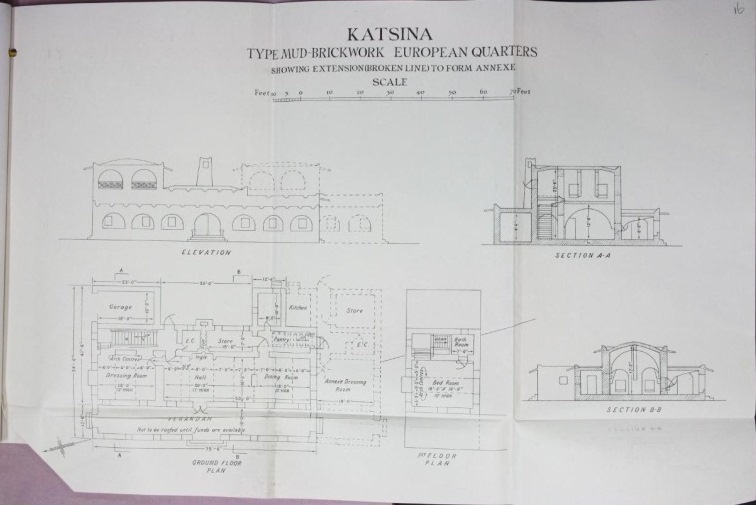
This ‘Type Mud brick European quarters’ designed by Nigeria’s colonial Public Works Department presented here, was sourced from a 1933 technical paper of the department, and rightly corroborates Foyle’s observation. The European quarters’ adapted features may perhaps, be better understood if analyzed on surviving Hausa built form models of Northern Nigeria. Although its plan retains a European model with a garage, hall, pantry, store and dressing room on the ground floor, and features a bedroom and bathroom upstairs, the quarters design largely adapts local form and materials to accommodate the colonial lifestyle.

Image

1933 Drawing of European Quarters at Katsina

Nigerian Public Works Department Troop Quarters, designed for the Royal West African Frontier Force

While recently going through archival materials on Nigeria’s colonial Public Works Department, I came across a troop quarters design for the RWAFF. The abbreviation sounded familiar, but I could not readily remember what it stood for and had to do a google search for further insight.  Results returned from the search brought it all flooding back to my memory; RWAFF is the abbreviation for Royal West African Frontier Force. To gain an initial casual understanding about the force, I took a quick look at Wikipedia and was able to obtain this excerpt – “The West African Frontier Force (WAFF) was a multi-battalion field force, formed by the British Colonial Office in 1900 to garrison the West African colonies of Nigeria, Gold Coast, Sierra Leone and Gambia. In 1928 it received royal patronage, becoming the Royal West African Frontier Force (RWAFF).”

13.3.6 GeorgeV

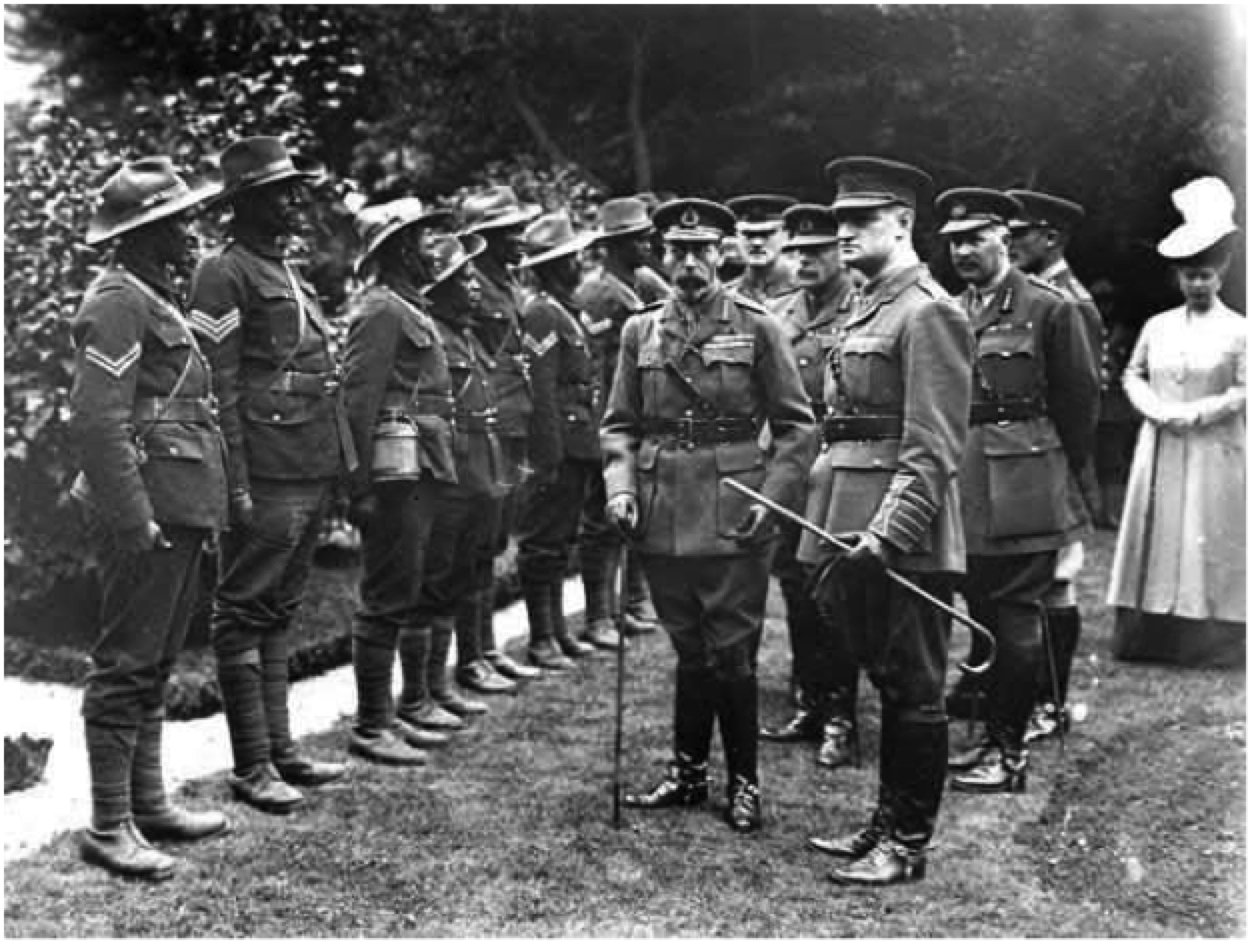
Soldiers on Parade for Visit by King George V and Queen Mary.

In a 1952 paper entitled “The story of the Royal West African Frontier Force”, published by the Royal United Service Institution journal, Brigadier F.A.S Clarke (DSO) however attempts to give a more scholarly account of the origins, services and numerical composition of the Force. In telling the RWAFF story, he sums up his account of its activities with this assertion: “though the force habitually wore a scarlet suave jacket, fez, and cummerbund on ceremonial parades, it has never been merely a ‘picturesque constabulary’ as some would now have us believe”. He gives instances of laborious and painstaking operations,expeditions and invasions conducted by RWAFF units in their bid to capture enemy territory. More importantly, he provides the organizational structure of the force, as well as its numerical composition. According to him, the force consisted of a Headquarters Company, a Raffle Company, platoons and battalions.  He equally notes that the total strength of a 1938 WAFF battalion, apart from British personnel, was 591 African troops and 219 carriers (those who bore the WAFF’s heavy loads of ammunition and supplies), with Nigeria providing the major quota.

13.3.6 Troops

RWAFF troops boarding a military plane.

The availability of such data might suggest a basis on which P.W.D architects developed accommodation schedules for RWAFF troop quarters designs. One of these designs was what I had sourced from my archival search, and is presented below:

13.3.6 Quarters

Drawing of RWAFF Quarters by the Nigeria PWD.

The troop quarters consisted of a ten-room block with an external measurement of 108’3”. It was fronted by an open veranda, and surrounded by an open drain which conveyed waste water to a surface disposal system. Each room had an internal measurement of 18’6” by 10’0”, and was accessed through a doorway from the open veranda. Although each room had a rear window, the space between the top of the door and the wall plate was also fitted with an expanded metal ventilator. This enabled cross ventilation and adequate air flow within each room. The roofing favoured a deep gable design to facilitate rain water run-off during the frequent tropical rain storms.

Research Seminar Presentation

Wednesday 13th February was the PhD research seminar day at the Liverpool School of Architecture. I gave a 15 minute presentation on the recent progress of my research. My research had started out by examining the development of Nigeria’s architectural profession during the mid-twentieth century. Findings made in the course of the research, however, revealed an outstanding level of architectural output by the country’s colonial Public Works Department (PWD), yet to be the subject of any known research.

This translates into an apparent gap in the studies done on Nigeria’s architectural history as a whole, and its British colonial architectural history in particular. My research’s new line of investigation is therefore centred on British colonial public works architecture in Nigeria, with the aim of bridging this gap in literature. In a bid to provide a fuller understanding of the department’s output as well, the research’s focus of investigation now covers the period from 1900 to 1960.

As my presentation discussed, one issue raised from literature is that private sector architecture tended to blaze new trails and to produce more innovative designs than the PWD. I therefore employed these images from the West African Builder and the Architects’ Journal to analyse this argument.

13.2.18 Lagos

13.2.18 Lagos2

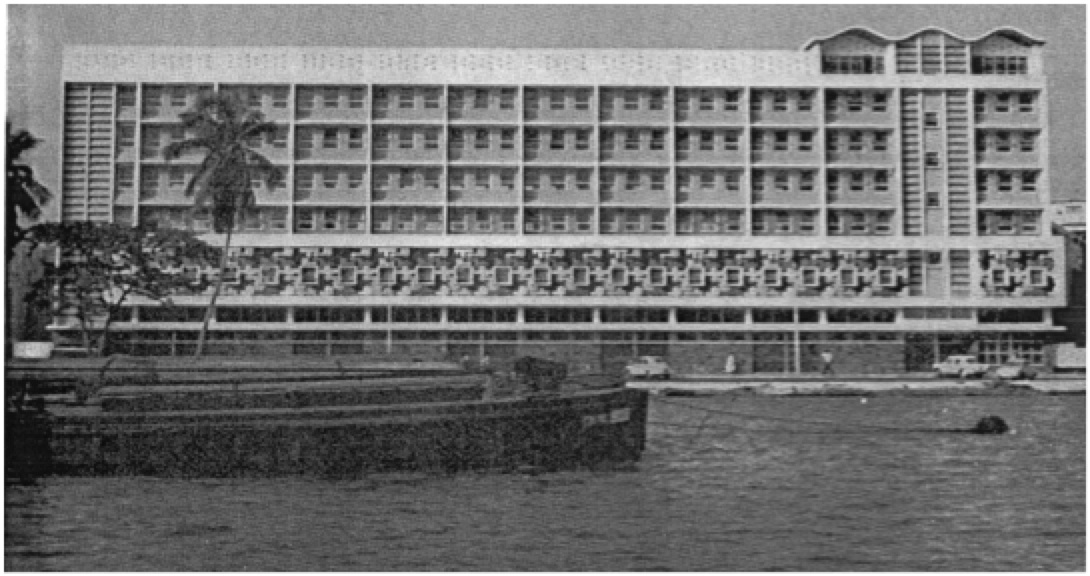
The first is the 1959 General Post Office, Lagos, designed under the supervision of Charles Stevenson, PWD Senior Architect.  The other image is the 1960 Nigerian Port Authority Headquarters, also in Lagos, designed by W.H. Watkins Gray & Partners. With both buildings featuring a similar modernist approach to their designs at that time, the ‘less innovative’ view to public works designs may need to be further questioned.

British Colonial Architecture in Nigeria, 1900-60.

Yemi Salami’s study explores British colonial architecture in pre-independent Nigeria. Beginning at the turn of the twentieth century and culminating in the year of independence, the investigation traces a significant period of transformation in the country’s history. Notably, it explores the rise of its colonial style buildings, which had come to cater for emerging uses in government, commerce, healthcare, transportation and other contemporary uses of the time.

Previous studies showcase a rich presence of these buildings in pre-independent Nigeria, particularly with reference to the climate responsive “tropical architecture” of the mid-twentieth century. The architectural careers of a few notable professionals are likewise widely explored. However, were these projects and professionals the only modern influences to Nigerian architecture at the time? Who were the other architects and what were they designing? Furthermore, what forms of colonial buildings existed before the mid-twentieth century climate responsive trend?

The aim of this PhD research, therefore, is to obtain a more accurate understanding of the events and circumstances which shaped colonial architectural forms and practice in pre-1960 Nigeria. It will employ a qualitative historical research strategy, by sourcing and investigating materials from previous literature, archival records and existing projects from the period.