Archive

Eastern European

November 8, 2025–April 12, 2026: Office Southeast in collaboration with Dana Salama

During the 1960s, Accra stood at the center of the anticolonial world. As the capital of Ghana—the first independent country in sub-Saharan Africa following European colonization—the city drew revolutionaries, intellectuals, and artists from across the continent and the Cold War divides. Ghana’s first leader, Kwame Nkrumah, envisioned Accra as a showcase of African statehood and invited architects to help shape its future.

Exhibition Photograph, courtesy of Łukasz Stanek, 2025.

Intersections traces the collaboration of two architects who responded to that call: Ghanaian Victor Adegbite (1925–2014) and Hungarian Charles Polónyi (1928–2002). Polónyi arrived in Accra as part of Eastern European technical assistance programs supporting Ghana’s transition to socialism. He worked for the Ghana National Construction Corporation (GNCC), where Adegbite—a Howard University graduate—served as chief architect. In their work at the GNCC they mobilized architectural resources from the socialist, capitalist, and non-aligned countries and designed buildings that responded to Ghana’s needs, means, and aspirations.

The exhibition centers on the housing projects designed by Adegbite and Polónyi, which embodied the many dimensions of independence—from representing a new elite to the state’s provision of housing for all social groups. By juxtaposing family archives from the United States and Hungary—preserved by the architects’ daughters—the exhibition both reconstructs and reenacts an encounter from sixty years ago. By recording how the buildings designed by Adegbite and Polónyi have been appropriated by their inhabitants, it shows how the architects’ work continues to impact Accra’s urban landscapes.

Curators: Michael Dziwornu and Łukasz Stanek, in collaboration with Dana Salama.
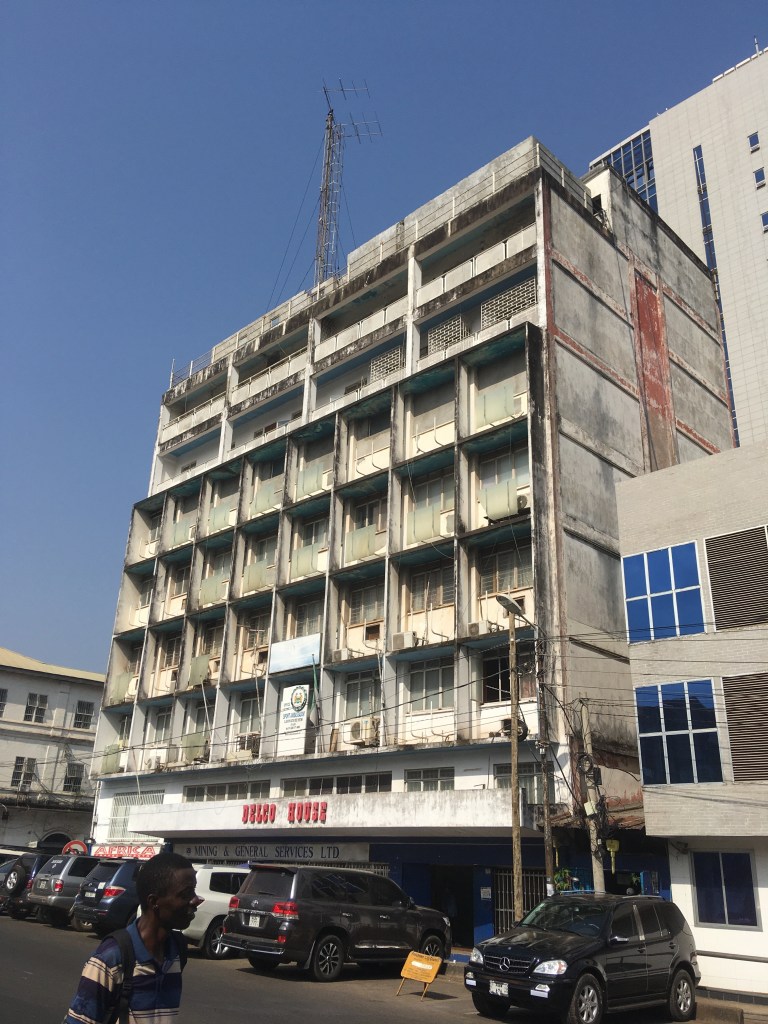
Delco Offices in Freetown, photographed in 2023, designed by Zdzisław Borysowicz in early 1960s

Have a peek at our inaugural AHUWA newsletter here: https://new.express.adobe.com/webpage/qgRzBtoiF2Snh

It’s devoted to our work-in-progress on the Polish architect Zdzisław Borysowicz – complete with lots of photos, basic biog on ‘Borys’ and how we managed to finally find out more on this fascinating architect….

Stanek Ł. Hegemony by Adaptation: Decolonizing Ghana’s Construction Industry. Comparative Studies in Society and History. Published online 2024:1-34. Full paper available here: doi:10.1017/S0010417524000185

Soviet Uzbekistan Today (Through the Republican Press Pages). August. (Tashkent: The Uzbek Society of Friendship and Cultural Relations with Foreign Countries, 1963).

This paper discusses competing visions of the decolonization of Ghana’s economy during the first decade of the country’s independence from Britain (1957–1966), and the agency and horizon of choice available to the Ghanaian decision-makers in charge of implementing these visions. It focuses on Ghana’s construction industry, both as an important part of the national economy and as a condition for Ghana’s broader social and economic development in the context of colonial-era path-dependencies and Cold War competition. By taking the vantage point of mid-level administrators and professionals, the paper shows how they negotiated British and Soviet technological offers of construction materials, machinery, and design. In response to Soviet claims about the adaptability of their construction resources to Ghana’s local conditions, the practice of adaptation became for Ghanaian architects and administrators an opportunity to reflect on the needs, means, and objectives of Ghana’s construction industry, and on broader visions of Ghana’s economic and social development. Beyond the specific focus on the construction industry, this paper conceptualizes the centrality of adaptation in enforcing technological hegemony during the period of decolonization, and discusses African agency beyond the registers of extraction and resistance that have dominated scholarship on the global Cold War.