Archive

European Transnational

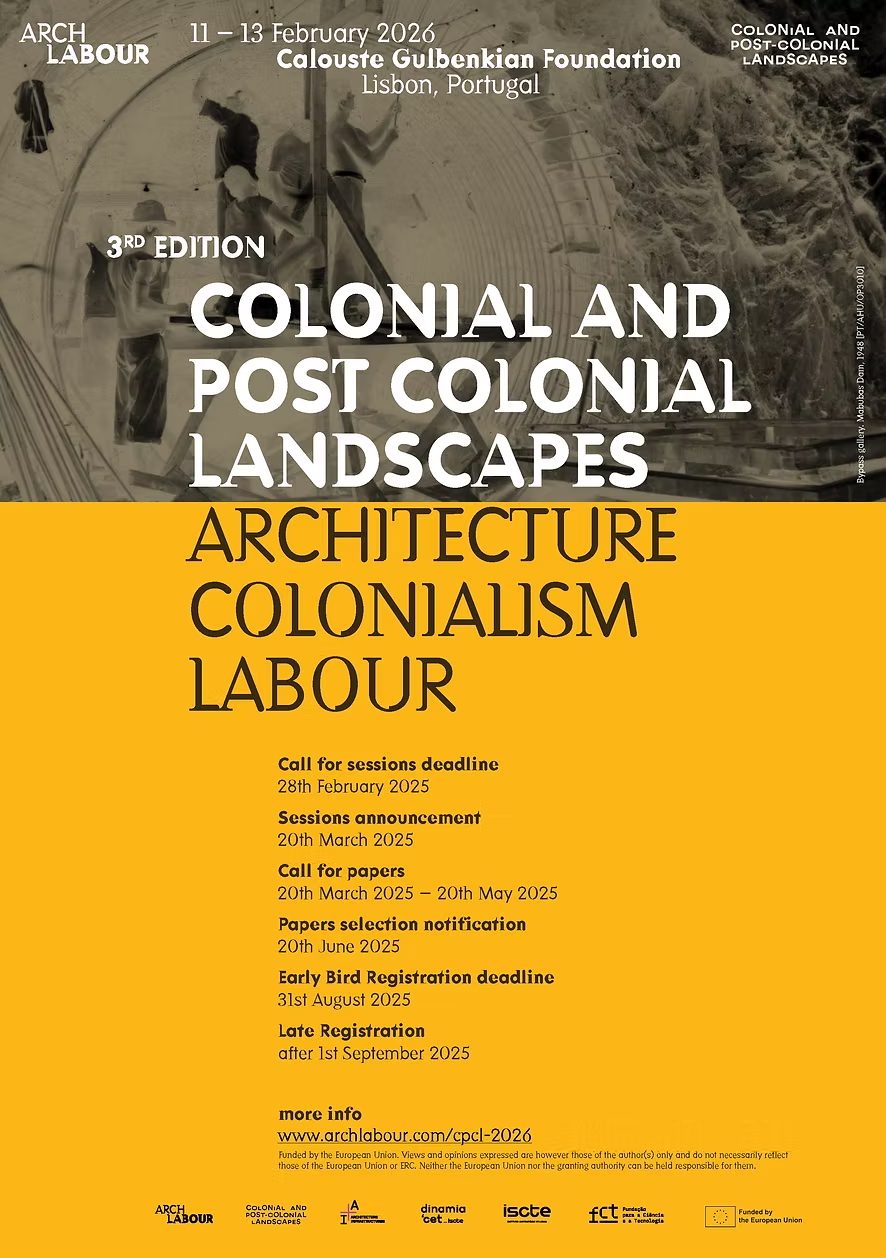
11-13 February 2026
Fundaรงรฃo Calouste Gulbenkian, Lisbon
โ€‹

After questioningย Architecture, Cities and Infrastructureย (2019) andย Architecture, Colonialism and Warย (2023), the third edition of theย Colonial and Post-colonial Landscapes Congressย (2026) will intersect the topics ofย Architecture, Colonialism and Labour.: https://www.archlabour.com/cpcl-2026

Although a common topic in colonial historiography, the influence of large-scale labor on the creation of built environmentsโ€”including the design, construction, and maintenance of infrastructure, buildings and landscapesโ€”has not been fully explored in the context of colonial architecture. The topic has significant implications not only for the description of past societies, but especially for the comprehension and support of present-day communities with colonial pasts and their relationship to the production of space. Connecting architecture and labor in these contexts offers a promising avenue for addressing some of the challenges encountered by postcolonial societies. These include the relationship with “Western” construction technologies and materials, scarcity of traditional building systems and their undervalued insights on climate adaptation and sustainable solutions, and persistent racial and gender inequalities in public works labor environments.

This congress welcomes contributions from diverse geographical, disciplinary, and chronological backgrounds to promote a wide and tough-provoking debate, crossing the history of colonial architecture, labour and social history and construction technology.

Spaces for Health and Healing in Africa

Symposium 16 โ€“ 17 April 

Liverpool School of Architecture 

Liverpool School of Architecture, at the University of Liverpool and the Program in the History of Science, Medicine, and Technology of the Johns Hopkins University invite proposals for a hybrid symposium to be held in Liverpool from the 17-18 April 2025.  

Pathology Labs, Korle Bu Hospital, Accra, c1958

We welcome presentations that explore various settings for health and healing, such as shrines, sacred healing huts, and herbal ‘apothecaries’ and other spaces for indigenous medicine and healing practices; โ€˜basicโ€™ health care infrastructure incorporating dispensaries, clinics, and hospitals  developed for early missionary and colonial medicine; post-independence medical centres. We are also interested in papers examining the use of healthcare โ€˜vectorsโ€™ such as barefoot doctors, travelling midwives and paramedics and their spread of health care practices such as vaccinations, and childhood nutrition programmes in urban and rural areas. 

We are interested in the settings for full range of medical specialisms from paediatrics to psychiatry and also more contemporary physical design responses to contemporary pandemics such as Ebola and Covid. Evidence and records of mixtures of indigenous and western healthcare practices in some community settings and the emergence and involvement of teaching hospitals in healthcare planning is also of interest.  

Other possible topics include the role of military hospitals, colonial and modern, and contemporary healthcare infrastructure and provisions for displaced persons and refugees.  We encourage interdisciplinary approaches–history of medicine, medical anthropology and sociology, oral history, among others. 

Our area of interest is the African continent, from the โ€˜MEANAโ€™ countries of the maghreb, north of the Sahara, to all countries South of the Kalahari and East and West of the Sahara. Health and healing facilities on islands in proximity to main continental mass such as Zanzibar, Mauritius, Fernando Po and Cape Verde are also of unique interest. 

We are seeking to publish selected outputs from the symposium in a volume currently under negotiation with the publisher. We welcome abstracts (500 words max) and short CVs (1page) Please also indicate whether you intend to deliver your paper in person or online. For more information please contactย  Ola Udukuย o.uduku@liverpool.ac.uk or Bill Leslie,ย swleslie@jhu.edu

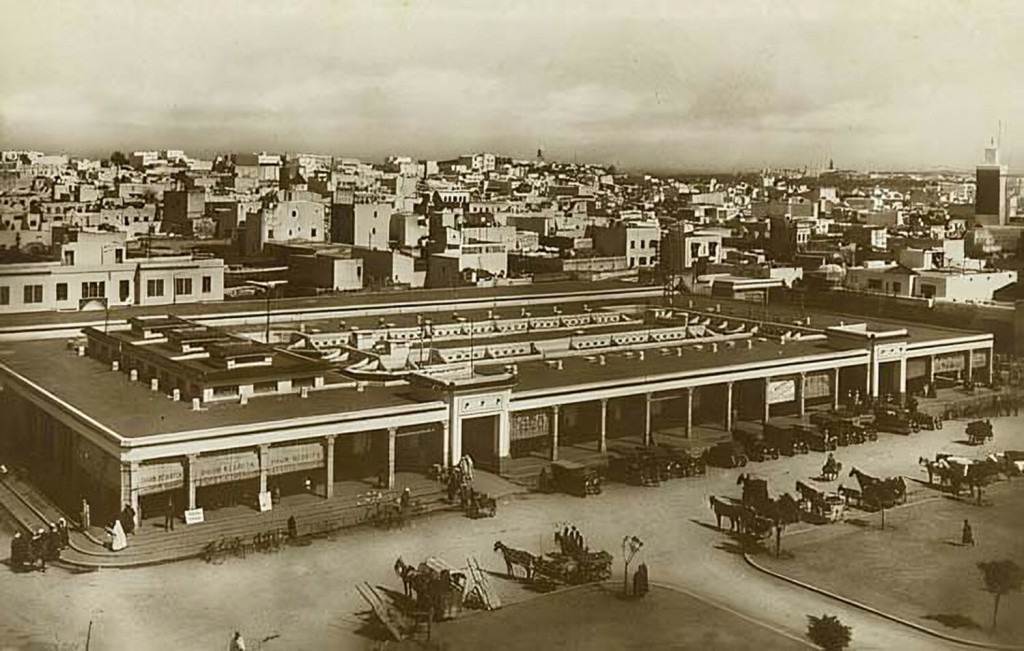
Central Market Rabat. Source: Postcard, 1925 (Authorโ€™s collection).

Rim Yassine Kassab writes:

In 1925, the Central Market of Rabat was built at the outskirt of the medina (the old city) by French Colonial powers (1912-1956). Despite being the only element displayed in colonial maps of the medina, and one of Rabat’s current landmarks, the history of the market is still unknown. Drawing on the National Moroccan archives and on colonial postcards, the article explores the historical and urban significance of the Central Market for Rabat colonial and postcolonial history. It argues that the market constitutes a unique architectural and urban case for Rabat as it both challenged and reinforced the colonial agenda. Planning principles like the policy of association, the โ€˜image of the city’ and the โ€˜dual city’ were not only defied by the market, but also by the demolition of the part of the wall in front of it. This revealed the inconsistencies and lack of homogeneity of the colonial approach. Moreover, without the wall, the medina became penetrable by the โ€˜Ville Nouvelle‘ (New Town). Engaging with the Central Market is significant for the history of colonial planning, but also for todayโ€™s Rabat identity construction, inscribed in 2012 in the UNESCO World Heritage Sites and elected cultural capital in 2022.

Read the full article in Planning Perspectives , Open Access: https://www.tandfonline.com/doi/full/10.1080/02665433.2022.2130964

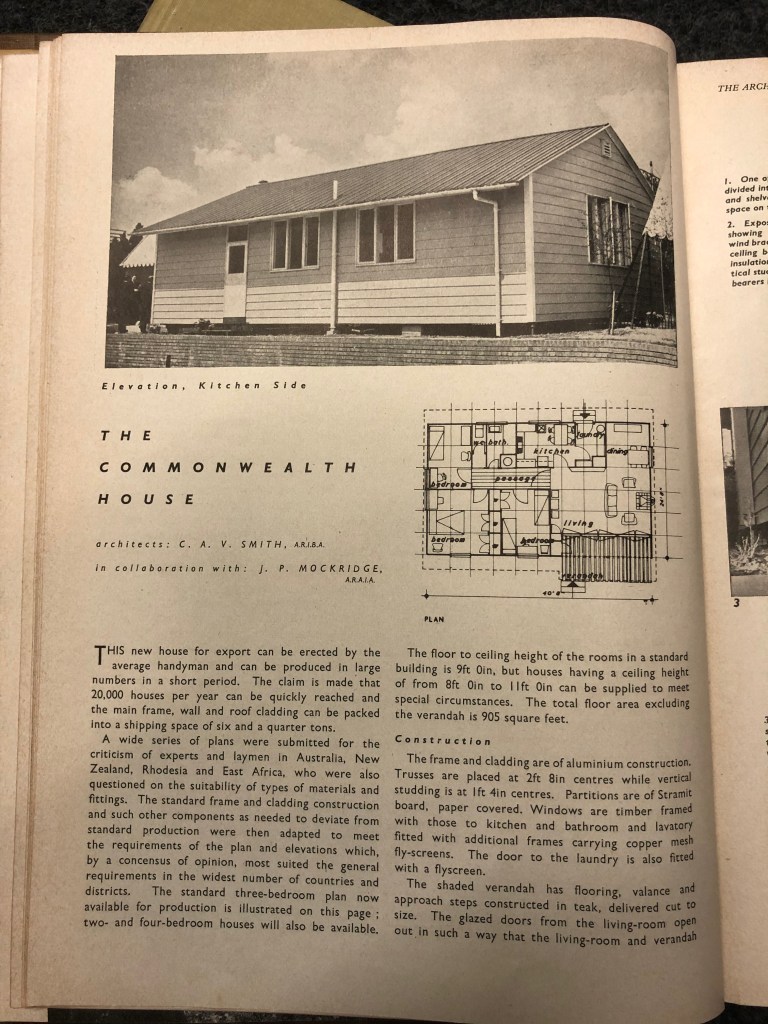
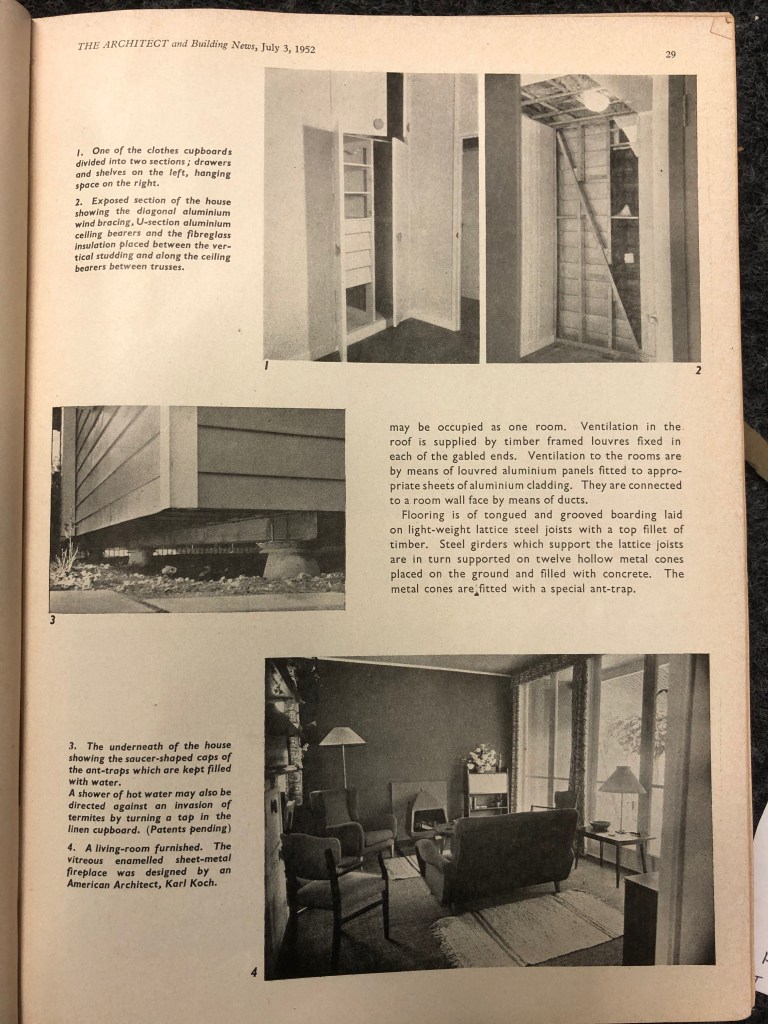
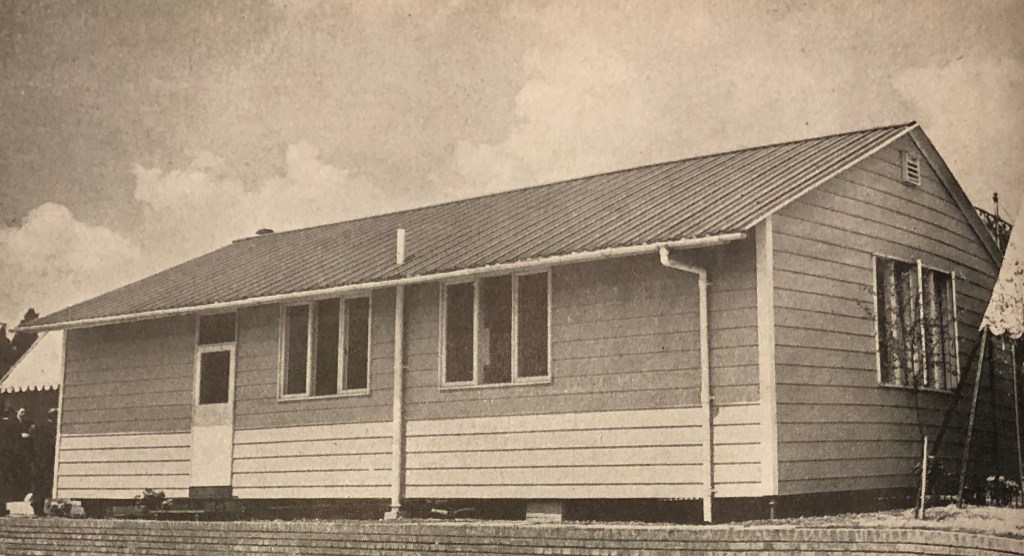
In theย Architect and Building News from July 1952 there’s an intriguing article for a partially-prefabricated โ€˜Commonwealth Houseโ€™.

The house could be easily shipped and โ€˜erected by the average handymanโ€™, aided by a standardised kit of parts would make manufacturing simple and predictable.ย 

The house was designed by Charles A. V. Smith with John Pearce Mockridge, following a consultation with potential makers and inhabitants. The architects adjusted their designs to suit a consensus – resulting in a house very much designed by committee with a predictable, if utilitarian and efficient, floor plan.

The brief was to develop a house that would be suitable across the geographical and climatic zones of Australia, New Zealand, Rhodesia (now Zimbabwe), and East Africa. Over 20,000 units were expected to be built per year to meet the demand for emigrating workers and their families eager to escape war-torn Britain for opportunities elsewhere.ย 

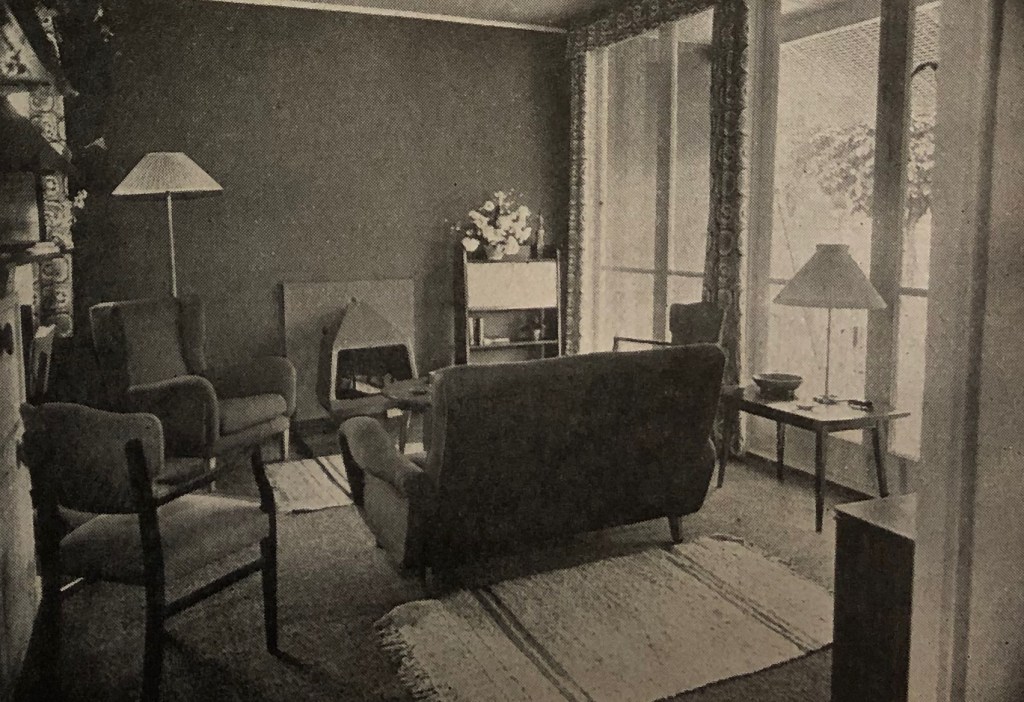
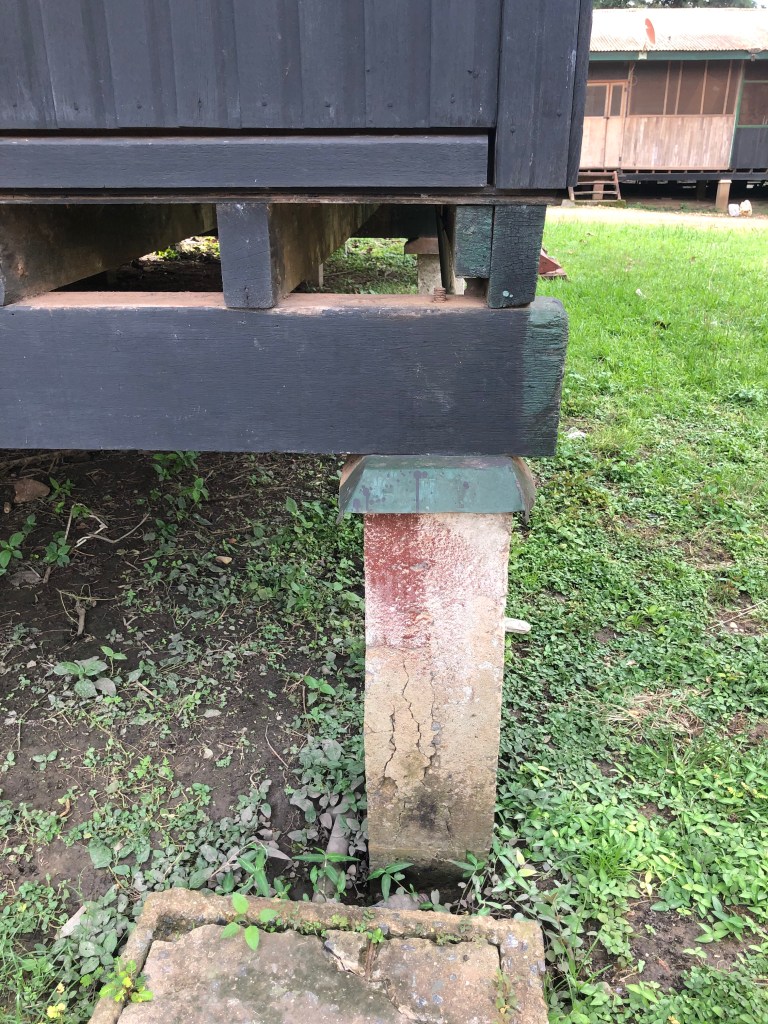
The house had an aluminium frame structure, and the cladding materials could vary depending on availability and final conditions. It was placed on concrete posts with an ant-trap to resist termite attack. The prototype erected on Great West Road in Hounslow was fitted out with furniture and a fireplace designed by American architect Carl Koch (1912-1998), who later pioneered several prefabricated house designs in the US.ย 

Theย Commonwealth Houseย design was very similar to houses we saw in the timber saw-mill town of Samreboi in Ghana – even down to the ant-trap detailing.ย 

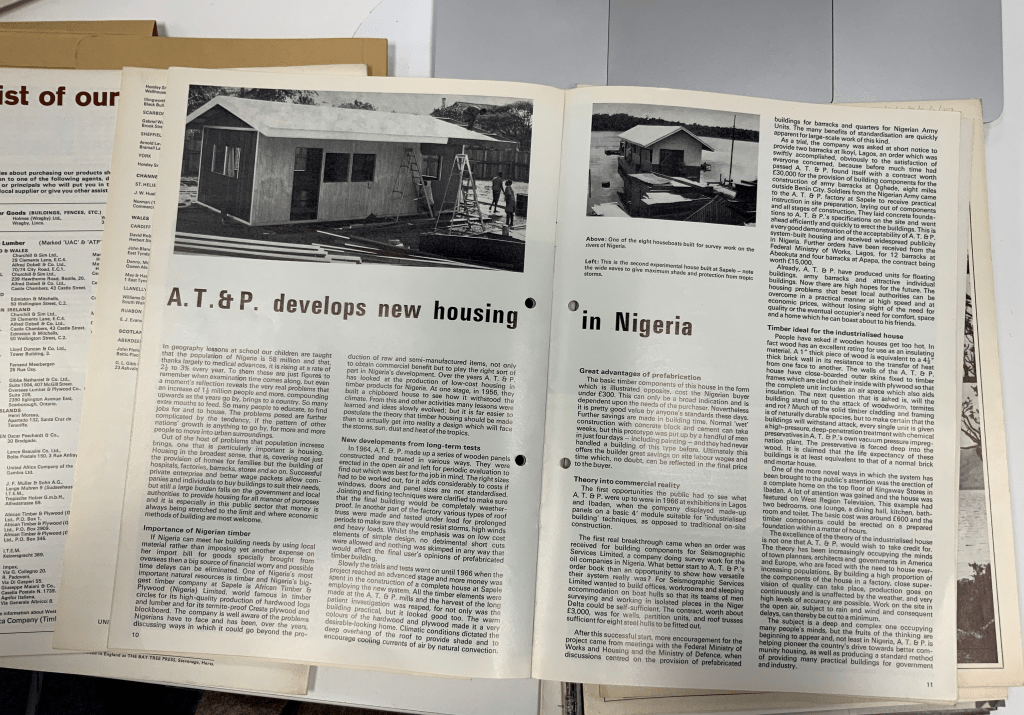
The African Timber and Plywood Company (AT&P), who owned the mill and were responsible for most of the housing, were also attempting to develop their own housing kits and to expand into new products and markets.ย 

By 1954 AT&P had begun to discuss prefabrication techniques and processes at both Samreboi and their larger station at Sapele in Nigeria. The drive and urgency for this type of production was heightened by increased competition and political efforts to quickly improve housing standards in West Africa. The Dutch firm Schokbeton had been awarded a large order for prefabricated housing in Ghana, and contractors Taylor Woodrow were eager to expand their building products export wing.

Architect Edric Neel (1914-1952) developed a consortium of architectural consultants with Taylor Woodrow in 1944 to research new structures that could be quickly assembled and fabricated. The group was called Arcon and their first project was a temporary prefabricated house. The system developed into a set of lightweight tubular steel components that could be easily welded together. The faรงade, if required, could be made of local materials, metal sheets, or cement board cladding, as required. The system was intended for export and into โ€˜tropical conditionsโ€™ in particular. The units could be readily scaled and used to assemble large factories and sheds with large spans. Many of the factories and mills (including those at Samreboi) utilised this standardised and low-risk approach to construction.

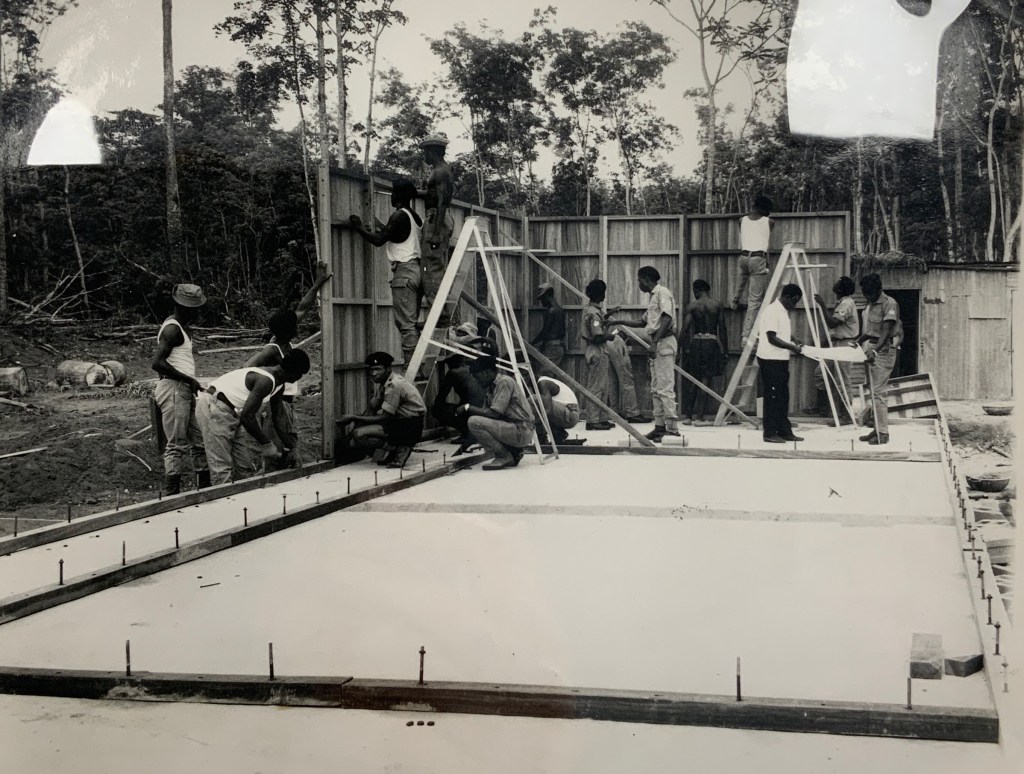
Over the next 15 years AT&P began developing a series of prefabricated houses, but rather than developing a frame and cladding approach they created integrated wall panels (like flat-pack furniture) with modular dimensions so that windows and doors could be added where required. They called it the AT&P System Building, and priced a small house at ยฃ500 โ€“ compared to the ยฃ1200 Schokbeton model. 

The system was adopted for military projects and housing, and continued to be deployed into the 1970s with AT&P developing many different variations and types.

Invented Modernisms: Getting to Grips with Modernity in Three African State Buildings
Kuukuwa Manful,ย Innocent Batsani-Ncube,ย Julia Gallagher

Jubilee House, Accra, Ghana.ย Source: Julia Gallagher, March 2019

This article examines recent attempts to create specifically African forms of modernist political architecture that draw on โ€˜traditionalโ€™ or โ€˜pre-colonialโ€™ aesthetic forms and ideas. Taking examples of three prestigious structures โ€“ the presidential palace in Ghana, the parliament in Malawi and the Northern Cape regional parliament in South Africa โ€“ the article shows how vernacular ideas have been incorporated into state-of-the-art political architecture, producing new or explicitly โ€˜Africanโ€™ forms of modernism. It explores how such buildings, which draw on โ€˜invented traditionsโ€™, are used alongside conventional, monolithic representations of the state to produce โ€˜invented modernismsโ€™ that both uphold and question the African state as a project of modernity.

Read the full article here: https://doi.org/10.1111/cura.12505

During the past month weโ€™ve continued our exploratory work in the Unilever archive pursuing a broad scoping exercise to determine and survey what is contained within Storeroom Number 4. The archive catalogue is extensive, detailed, and provides incredibly useful descriptions of what lies within โ€“ but inevitably there are unexpected items and fine details that remain beyond the limits of the usual cataloguing descriptions.ย 

East Street, Freetown, 1905

Our sampling has examined a wide range of materials, including the large photographic albums from the late 19thย and early 20thC. These carefully preserved documents reveal the early ventures in the Oil Rivers, the exploits of the Niger Company, the development of Freetown, and new buildings in Ghana. The albums have provided important details of the early trading stations that transitioned from boat hulks to riverbank factories and stores of the Niger Delta, Burutu, and beyond. The collection includes photographs of everyday street scenes, new stores, and wharf extensions, we well as major political events. The images from Freetown, Sierra Leone, by photographerย Alphonso Sylvester Lisk-Carewย (1887โ€“1969) takenย in 1905, reveal a systematic street-by-street catalogue of the burgeoning town, and details of new store being built for Peter Ratcliffe Ltd. Most of the various trading companies produced and retained extensive photographic records, including, for example G. B. Ollivant with its Manchester warehouses filled with calico and wax prints ready for export to the coast.ย ย Palm oil was the main export commodity being shipped from West Africa, and William Hesketh Leverโ€™s plantations in Congo are an essential part of this story. Weโ€™ve uncovered some early photos of the plantations and worker housing at โ€˜Levervilleโ€™ (now Lusanga).ย 

Housing at Samreboi

Weโ€™ve began to review the timber processing factories and associated settlements of Sapele and Samreboi. Trading as theย African Timber and Plywood Companyย the archive includes an important set of material on the creation of these sawmills, processing plants, and associated staff housing and facilities. The Company was also involved in developing a series of experimental prefabricated and kit housing. Weโ€™re especially interested in the relationship the UAC had with construction and building materials companies/contractors, and weโ€™ve reviewed the archival files connected to Taylor Woodrow. The UAC was a shareholder in this major construction company, and weโ€™d like to examine how the two enterprises collaborated to deliver their building programmes and wider ambitions. The complex web of UAC businesses and shareholding arrangements becomes ever more complex and entangled.ย 

Management Housing at Samreboi

A significant portion of the UAC archive is devoted to brewing and breweries. The UAC established collaborative ventures with Heineken and Guinness to produce the famousย Starย beer and a range of malt-flavoured beverages. Weโ€™ve found some extraordinary designs for worker welfare facilities designed by Godwin and Hopwood at the Lagos brewery, as well as factory layouts and extensive promotional material. This is another example of the UAC working with specialist producers, spreading its risk, and also creating new business for its various subsidiaries. A similar model was deployed with UAC Motors that imported various vehicles and acted as agents, spare suppliers, and repair garages for the manufacturers in Europe and US.ย 

Godwin and Hopwood Lagos Brewery Welfare Block

Retail and Wholesale business remained a core part of the UAC enterprise with theย Kingswayย Department stores being the most prominent and well-known retailer. Some excellent work has already been done on Kingsway, but the extensive archival material reveals a lot more to examine.ย ย Major photographic collections and architectural drawings devoted this array of shops and their lavish interior displays have been carefully preserved. The largest and most famous branches were at Accra and Lagos, but other lesser-known stores at, for example, Apapa (designed by T P Bennett, 1960) and Jos, clearly warrant further research and investigation.ย 

Sketch for Apapa Kingsway Store, by TP Bennett
Kingsway Stores at Jos, Nigeria

Our archival trawling exercise will continue until Christmas 2021 and weโ€™re hoping that by that time weโ€™ll have a clearer picture of the overall collection and the areas/themes weโ€™ll continue to investigate to much greater depths. 

Crucibles, Vectors, Catalysts: Envisioning the Modern City

Hosted online across two days in March 2021, the Hyundai Tate Research Centre: Transnational and Liverpool School of Architectureโ€™s โ€œCrucibles, Vectors, Catalysts: Envisioning the Modern Cityโ€ seminar investigated 20thย century identities for postcolonial and post-independence cityscapes in Africa, South Asia and the Middle East.

Convened by Iain Jackson, Professor at the Liverpool School of Architecture, Clara Kim, the Daskalopoulos Senior Curator for International Art at Tate Modern and Nabila Abdel Nabi, Curator for International Art at Tate Modern; the seminar explored stories from these โ€˜highly charged moment[s] in the history of city making or shapingโ€™.[1]

The seminar specifically positions cities as incubators for the generation of national identity and for โ€˜Modernityโ€™. However, were individual cities sufficient for such grand objectives, or were they more isolated and fragmented sites for local, yet innovative gestures? Presenters demonstrated examples where both centralised urban contexts (including major urban planning initiatives and more piecemeal developments) and wider networks proved valuable in creating or indeed reasserting national and regional identities.

The destructive process of creating mid-century urban environments defined many global contexts. Whether in response to the need for new national identities in postcolonial contexts, reconstruction and housing following the devastating effects of war and a baby boom or strategies to address perceived โ€˜blightโ€™ and urban flight, urban renewal, with its top-down, Bauhausian, car-focused, and federally funded backbone epitomised Modernity.

Some cities benefitted from a relatively early reconsideration of the blank slate approach to city planning. Lukasz Stanek described how Miastoprojekt, a Krakow-based state planning office of designers envisioned the future of post-revolutionary Baghdad through their experiences with reconstructing historic Warsaw after the Second World War.[2]

Using architectural and design services as a politically and financially motivated form of state aid during the Cold War, the Miastoprojekt plans rejected key aspects of Baghdadโ€™s first modern city plan, including the demolition of the cityโ€™s Ottoman era historic and vernacular architecture, and tripling the size of the city at a local level without consideration for expansion through regional developments.[3]

Miastroprojektโ€™s legacy continued beyond the Baghdad planning commissions through design work and education with Polish and Czechoslovakian architects teaching Polish perspectives of Modernism in Iraqi universities. By the 1990s, with the fall of communism, Polish designers reversed Miastroprojektโ€™s strategy and were thinking Warsaw through Baghdad to revitalise their cities.

Big plans were not constrained to single urban environments. Fahran Karimโ€™s โ€˜archaeology of the futureโ€™ presentation explored the role of a foreign designer in creating Pakistani nationalism; Greek architect and planner Constantinos Doxiaidis. Karim asks, โ€œHow do you represent a country without a past. Fractured geographically into East and West wingsโ€ฆ 1000 miles of India between it?โ€[4]

Doxiaidis preferred stark Modernism, justified through statistical analysis and designed without classical Islamic aesthetic details. He utilised plan forms, practical details and building types that he believed (or presented) to be essentially Islamic.[5] Doxiaidis planned refugee settlements and Islamabad to include โ€™gossip squaresโ€™, souks, Dochala huts and central mosques.

Despite conducting ethnographic fieldwork and survey (aerial photography), Doxiaidis imported his understanding of Islamic community planning and architecture from his research in the middle east and projected the needs and traditions of widely dispersed refugees on narrow local contexts. Unsurprisingly, the communities adapted or removed many of Doxiaidisโ€™ design features or simply did not use the spaces created for them, preferring to adapt their homes or build vernacular sites suited to their cultural preferences instead. While in practice, many of these adaptations and rejections were practical, Doxiadisโ€™ technical expertise and foreign perspective failed to deliver built environments that suited and sustained the needs and preferences of Pakistanโ€™s new citizens.[6]

Considering what was happening between East and West Pakistan, Ram Rahman shared a richly illustrated and personal view of the cultural and political context for his father Habib Rahmanโ€™s contributions to the โ€˜Nehruvian post-independence renaissance of Delhi.โ€™

Habib Rahman, a young MIT-trained Bauhausian architect, was recruited by Nehru to work in Delhi, where he organised an international low-cost housing exhibition in 1954, including plans and a model for his own design for low-cost housing. Rahmanโ€™s house design was reproduced across India 100,000โ€™s of times to address a critical housing shortage.

Rahman was a prolific designer and his work, including the World Health Organisation headquarters building of 1963 (demolished) and later designs for three monumental tombs epitomised Indian modernity.

Professional training and architectural education were key vectors for transnational exchange and development in postcolonial contexts. However, as Patrick Zamarian described in his presentation, the development of the Department of Tropical Architecture (DTA) at the Architectural Association (AA) in London was related as much to the independent administrative structure of the AA and its struggling economic position in the 1950โ€™s as it was to meeting the challenges of Modern design in foreign contexts.

Zamarian recognised the problematic and homogenizing term โ€˜Tropical Architectureโ€™ and then described the global networks of designers, patrons and educators who delivered training for a generation of British and international students, with a curriculum based on technological solutions for climatic design and a Modern design aesthetic that disregarded local aesthetic and cultural traditions.[7]

When the department visited Ghana, โ€œthese ideas for Tropical Architecture fell apart. [The curriculum] shifted from a generic science-based approach to a local and sensitive one, focused increasingly on housing, planning and eventually sustainable development.โ€[8]

Ola Udukuโ€™s exploration of Modernist Lagos focused on the cumulative impacts of the DTA trained architects, engineers and Italian contractors who contributed to the rapid development of the marina district for independent Nigeriaโ€™s first capital city.[9] Although Lagos benefitted from major infrastructure improvements, the architecture described in Udukuโ€™s presentation was piecemeal and demonstrated the evolution and intensification of development for the district from colonial centre to financial district.

Examples include Maxwell Fry and Jane Drewโ€™s Co-operative Bank Lagos (1959) and the Architects Co-Partnershipโ€™s Bristol Hotel.[10] A Lagos building that encapsulated the international design collaborations for the time is the James Cubbitt and Partnersโ€™ Elder Dempster Lines building (1961), which introduced sleek modern lines, natural cross-ventilation, engineering innovations (pile foundations) contributed by Ove Arup and a distinctive funnel-shaped top structure alongside a notable collection of Nigerian artworks in the lobby. Nigerian designs for the time include Oluwole Olumuyiwaโ€™s Crusader House (1955) and elegant villas outside Lagos by Obi Obembe Associates.

In other contexts, a national approach to recreating identity was accomplished through the redevelopment of pilgrimage networks and tourist destinations, including hotels and museums.

Talinn Grigor introduced the Society for National Heritage (SNH) and the role of the Shahโ€™r in asserting the hegemony of the ruling class and Iranian elite (and recreating national identity) through the demolition and reconstruction of over 40 historic mausoleums to encourage secular and cultural tourism.[11] Examples include the mausoleums of Ferdawsi (1934) in Tus and Hafiz (1938) in Shiraz. Grigor argues that these new Modern mausoleums were integral to the creation of an aspirational middle-class culture in Iran, becoming a network for national tourism that remains today.

The Shahโ€™r and the tremendous wealth generated by the Iranian oil industry funded the design and construction of avant-garde Modern environments and later more traditionally inspired art and architectural contexts, culminating in the uniquely Iranian expression of modernism inspired by traditional wind towers for the Tehran Museum of Contemporary Art (Kamran Diba, 1977).[12]

Lahbib el Moumni and Imad Dahmaniโ€™s presentation on post-independence Moroccan architecture included a second example of state-sponsored activities to promote tourism with Modern architecture. This was developed through hotels constructed outside urban centres in the countryโ€™s dramatic landscapes. Examples of exquisite and richly contextual forms from architects Abdeslem Faraoui and Patrice de Mazieres include the Hotel Les Gorges du Dadรจs (1974) and Hotel at Taliouine (1971-72) were shared, both to demonstrate the value of these sites and to explore the challenges of engaging communities with their recent past. [13]

The expressive and contextual Modernism of Morocco was certainly not isolated for post-colonial contexts. Amin Alsadenโ€™s presentation demonstrates how urban renewal programmes in Baghdad in the 1950s created a sense of cultural and heritage loss, which predicated a culturally specific interpretation of Modern art and architecture for the city. He focused particularly on the work of architect Rifat Chadirji who merged globalism and regionalism in his designs.[14]

Alsaden described Rifatโ€™s earliest buildings as somewhat derivative but noted that through the 1960โ€™s his designs evolved to incorporate traditional shapes and plan forms, marrying social needs to social forms, and incorporating the narrow round arch form, in both elevation and plan.

Anna Tostoesโ€™ presentation on the work of Amรขncio (Pancho) Guedes in Mozambican cities clearly demonstrates how the architectโ€™s designs coupled global technical, aesthetic, and cultural movements for the time with traditional and vernacular forms to create unique buildings for Maputo which continue to engage with local communities, including the Saipal Bakery (1954), Smiling Lion Building (1954-55) and the Abreu Santos and Rocha Building (1953-56).[15]

These Guedes landmarks remain relevant to 21st century contexts, but many other postcolonial buildings have been heavily altered or demolished. In my experience as a built heritage professional, architecture of the recent past, whether in postcolonial contexts, Europe, or the Americas is especially vulnerable to inappropriate alterations and loss.

Coupled with the experimental, academic, inefficient and sometimes foreign or dehumanising aspects of mid-century Modern architecture and urban renewal, it can be difficult โ€˜to loveโ€™ and costly to restore for sustainable 21st century purposes. Outside losses from the traumatic impact of military conflict or political maneuvering, it comes as no surprise that the architecture that has sustained and remains relevant to local communities is the architecture that originally engaged with its local context and traditions.

These landmark buildings need champions like Mรฉmoire des Architectes Modernes Marocainโ€™s (MAMMA) and DoCoMoMo to promote their value against ever greater development pressures. โ€œCrucibles, Vectors and Catalystsโ€ moved the discussion forward, but there are clearly collaborative opportunities for research and advocacy to be progressed.

Heather McGrath Alcock is PhD researcher at University of Liverpoolโ€™s School of Architecture studying the global development of planned company towns. Heather returned to academia after twenty years as a built heritage practitioner based in New York City and later London and the Wirral. Heather had the opportunity to work on landmarks of the Modern movement, including the United Nations Headquarters in Manhattan, a thematic survey of mid-century modern houses in New Canaan, Connecticut started by โ€œthe Harvard Fiveโ€, and the former Pan American Building at 200 Park Avenue, Manhattan.

References

Daechsel, Markus. 2011. ‘Seeing like an expert, failing like a state? Interpreting the fate of a satellite town in early post-colonial Pakistan.’ in Marcel Maussen, Veit Bader and Annelies Moors (eds.), Colonial and Post-Colonial Governance of Islam (Amsterdam University Press).

Talinn, Grigor. 2004. ‘Recultivating “Good Taste”: The Early Pahlavi Modernists and Their Society for National Heritage’, Iranian Studies, 37: 17-45.

Uduku, Ola. 2006. ‘Modernist architecture and โ€˜the tropicalโ€™ in West Africa: The tropical architecture movement in West Africa, 1948โ€“1970’, Habitat International, 30: 396-411.


[1] Jackson, Ian. โ€œIntroductory remarks for Crucibles sessionโ€ from โ€œCrucibles, Vectors, Catalysts: Envisioning the Modern Cityโ€. Online. 2nd March 2021.

[2] In his presentation, โ€œRupture, Transition and Continuity in Baghdadโ€™s Master Plans: From Minoprio to Miastoprojektโ€ on 2nd March 2021, Stanek noted that the Iraqi coup which toppled the monarchy in 1958 instigated a new era of collaboration with Eastern European architects and planners; networks established to โ€œcompete with and confront Western European and American hegemony to establish a new independent Iraq through its capital city Baghdad.โ€

[3] Baghdadโ€™s first modern city plan was completed in 1956 by the British architect and town planner Sir Charles Anthony Minoprio, Hugh Spencley and Peter Macfarlane for the countryโ€™s Western aligned Hashemite monarchy.

[4] Karim, Fahran. โ€œArchaeology of the Future: Constantinos Doxiaidis in East and West Pakistanโ€, from Crucibles, Vectors, Catalysts: Envisioning the Modern City seminar, Session 2, Vectors; 2nd March 2021.

[5] Ibid. According to Fahran Karim, Doxiaidisโ€™ patron Ayub Khan โ€œsubscribed to a social theory of development but weakened democracy to validate his authoritarian rule because he felt that the poor, uneducated [masses] couldnโ€™t participate in democracy.โ€ 

[6] According to Markus Daechsel in his 2011 contribution ‘Seeing Like an Expert, Failing Like a State?

Interpreting the Fate of a Satellite Town in Early Post-Colonial Pakistan’, in Colonial and Post-Colonial Governance of Islam, ed. by Marcel Maussen, Veit Bader and Annelies Moors (Amsterdam University Press, 2011), p 159-160, there were many problems associated with the rapid and uneven development of the refugee settlements (lack of basic services (running water, electricity, sewers) and infrastructure (storm sewers), unfinished civil engineering works and the relatively poor refugee communities could not afford rents for the shop spaces, so were not used.

[7] Including Michael Pattrick, Director of the AA in the 1950โ€™s who saw the new department as a way to improve the Associationโ€™s finances and academic standing, to Maxwell Fry who supervised the first few years of the department and then culminating in Otto H. Kรถnigsbergerโ€™s (1908 โ€“ 1999) leadership. From Zamarian, Patrick. โ€œGlobal Perspectives and Private Concerns: The AAโ€™s Department of Tropical Architectureโ€, from Crucibles, Vectors, Catalysts: Envisioning the Modern City. Online. 2nd March 2021. 

[8] Ibid. 

[9] Lagos was the original capital city for independent Nigeria. However, it is now the capital of Lagos State since the Nigerian capital city moved to Abuja in 1991.  

[10] Ola Uduku, ‘Modernist Architecture and โ€˜the Tropicalโ€™ in West Africa: The Tropical Architecture Movement in West Africa, 1948โ€“1970’, Habitat International, 30 (2006), 399.

[11] In ‘Recultivating “Good Taste”: The Early Pahlavi Modernists and Their Society for National Heritage’, Iranian Studies (2004), Talinn Grigor noted that โ€œFor the modernists, therefore, the control over the physical and conceptual “heritage” enabled them to erase the immediate past to construct the “progressive” future. Destruction of building-as-representation [traditional sites of religious pilgrimage] proved central to the construction of the pending utopian future. Architecture was imperative to the success of the [Society for National Heritage] SNH’s modernizing agenda.โ€

[12] The Museum opened months before the revolution started which saw the monarchy overthrown and exiled from the country.

[13] While more ancient histories and built heritage are preserved and underpin 21st century cultural identity in Morocco, the architecture of the mid-twentieth century has been over-looked, inappropriately altered or destroyed. Mรฉmoire des Architectes Modernes Marocain (MAMMA) was created in 2016 by young architects concerned with the loss of these sites. 

[14] Alsaden noted in his 9th March 2021 presentation โ€œSyntheses Across Disciplines: Rifat Chadirji and Art-Architecture Liaisons in Modern Baghdadโ€ for Crucibles, Vectors and Catalysts: Envisioning the Modern City, Chadirji was part of the elite bohemian culture of Baghdad, which included artists and architects who were educated in Europe and America. Against the backdrop of political turmoil, they created a vibrant, creative society that embraced Modernism โ€˜as an act of rebellion against the legacy of British architects who had used Neo-classical designs with orientalist tropesโ€™. 

[15] Tostoes, Ana. โ€œCorrespondences, Transfers and Memory: Maputoโ€™s โ€™Age of Concreteโ€™โ€, from Crucible, Vectors, Catalysts: Envisioning the Modern City seminar, Session 2, Vectors; 2nd March 2021.

This congress calls for papers that will examine the movement of people and things around and across the Indian Ocean Rim and reveal instances or patterns of transfer that may complicate assumed centre-periphery dynamics, or correspond more closely to the idea of South-South cooperation. It looks to engage new political framings like the Non-Aligned Movement (NAM) or the Group of 77 (G77) and the resulting New International Economic Order (NIEO) that would reconfigure the transfer of construction materials and labour, and consequently architectural knowledge, across this region. But it also hopes to discuss the potentialities for greater solidarity that emerged from broader philosophical notions of โ€˜neutralismโ€™ โ€˜human dignityโ€™ and โ€˜justiceโ€™ and how these have affected the ethics of construction in the Global South. Finally, it is expected that all these considerations will find a place in the discussion of migrant populations and their negotiations with these constructed political and cultural categories, living across and beyond them in a constant state of liminality. 

Abstracts (300 words) for proposed papers are invited to be submitted toย camea@adelaide.edu.auย by 20th June 2021. Congress will meet on 7th-9th November 2021.

Please see the attached Call for Papers for further details:

On behalf of co-convenors: Peter Scriver, Katharine Bartsch and Amit Srivastava

Explore modern cities and architectural production in the blurred era of the independence and postcolonial period

Join us for three sessions which will bring together scholars, researchers and curators to explore architectural production in the blurred era of independence to the post-colonial period of the mid-20th century, focussing on cities in Africa, Middle East and South Asia.ย 

Register here: https://www.eventbrite.co.uk/e/crucibles-vectors-catalysts-envisioning-the-modern-city-tickets-138966892717

Whether driven by socialist agendas (Nehruvian in India and Nkrumah in Ghana), monarchies (Pahlavis in Iran and Hashemite in Iraq), quasi colonial protectorates, or pan-continental aspirations, architecture (and especially Modernism) was a key apparatus for nation-building, for re-imagining identities and a means to project and invent a new image of the future. The seminar seeks to explore the use of architecture as both physical infrastructure and symbolic expression, as well as its vulnerability to the vicissitudes of changing politics and policies of the times.

The role of cities as crucibles, vectors and catalysts for developing new expressions of identity, change and power is key. Cities in this period saw the emergence of schools of thought, dynasties and collaborations were formed, networks and ideas were shared and publications were disseminated. While the desire of a newly independent nation was often to consolidate a single national collective identity, it was through the urban centres that strands of coherent, yet often multiple identities were formed. The role of figures such as Rifat Chadirji, Mohamed Makiya, Jane Drew and Maxwell Fry were important as they often operated within multiple cities and cross-cultural contexts that spanned the colonial to postcolonial divide. 

These urban centres were either newly built, or they were remade and reimagined through city infrastructure, government buildings, universities, cultural institutions and national monuments. Architecture schools, state sponsored projects and external agencies feed into the discussion and warrant further exploration. The seminar explores the transnational connections, diverse political agendas and complex allegiances which informed architectural development in this period. 

Seminar convenors:

  • Iain Jackson, Professor of Architecture and Research Director, Liverpool School of Architecture
  • Clara Kim, The Daskalopoulos Senior Curator, International Art, Tate Modern
  • Nabila Abdel Nabi, Curator, International Art, Tate Modern

PROGRAMME
TUESDAY 2 MARCH

Session 1: Crucibles, 15:00-16:30 (UTC)

  • Building the Modern City: Expressions of Identity, Change and Power
    • Moderated by Iain Jackson

This panel will explore state-sponsored programmes, planned cities and masterplans in cities such as Lagos, Tehran and Baghdad. It will examine architecture as expressions of nationalism and nationalist political agendas as well as its relationship to big business, corporations and mercantile ventures.

Speakers:

  • Talinn Grigor (University of California, Davis)
    • Building a (Cosmopolitan) Modern Iran
  • Ola Uduku (Manchester School of Architecture)
    • Lagos International Metropolis: A cityโ€™s adventure in tropical architecture as an expression of dynamic modernism and growth in the mid 20th century
  • Lukasz Stanek (University of Manchester)
    • Rupture, Transition and Continuity in Baghdadโ€™s Master Plans: From Minoprio to Miastoprojekt

Session 2: Vectors, 17:00-18:30 (UTC)

  • Connecting the Modern City: Networks, Alliances and Knowledge Production
    • Moderated by Clara Kim

This panel will explore the practice of modern architecture through colonial-postcolonial networks and geopolitical alliances. It will explore cities in Mozambique within the context of other Lusophone countries, post-Partition East & West Pakistan, as well as the dissemination of knowledge and technical expertise through pedagogy.

Speakers:

  • Ana Tostรตes (University of Lisbon)
    • Correspondences, Transfers and Memory: Maputoโ€™s โ€œAge of Concreteโ€
  • Fahran Karim (University of Kansas)
    • Archaeology of the Future: Constantinos Doxiaidis in East and West Pakistan
  • Patrick Zamarian (University of Liverpool)
    • Global Perspectives and Private Concerns: The AAโ€™s Department of Tropical Architecture

TUESDAY 9 MARCH

Session 3: Catalysts, 15:00-16:30 (UTC)

  • Fragments of the Modern City: Memories, Echoes and Whispers
    • Moderated by Nabila Abdel Nabi

This panel will explore the collaborations, connections and entanglements that developed between art and architecture during a dynamic period of building in Morocco, India and Iraq. It will examine the legacy and afterlives of these projects through the investigation of under-recognised figures and narratives in art and architecture.

Speakers:

  • Lahbib el Moumni & Imad Dahmani (founders of MAMMA, Mรฉmoire des Architectes Modernes Marocain)
    • Initiatives toward saving modern heritage of Morocco
  • Ram Rahman (Photographer/Curator)
    • Building Modern Delhi, The Nehruvian Post-Independence Renaissance
  • Amin Alsaden (Independent Scholar)
    • Syntheses Across Disciplines: Rifat Chadirji and Art-Architecture Liaisons in Modern Baghdad

This event is organised by Hyundai Tate Research Centre: Transnational and Liverpool School of Architecture.

Call for Participants: Writing Group on Architecture and Empire
Society of Architectural Historians of Great Britain

https://www.sahgb.org.uk/news/architectureandempire

With a formal existence spanning early modern to contemporary history, the British Empire supported complex networks of trade, war and settlement. It intervened in land-based expansions as well as maritime worlds and prefigured a global architectural history. Yet research that seeks to critically address the empire and its legacy poses complex challenges for the architectural historian: the mental-mapping of bureaucratic systems across multiple continents, finding evidence of buildings and landscapes for which little documentation exists, sitting with a complex past and present of race, gender, religion, nationalism and capitalism.

This writing group is formed as an empathetic structure for scholars writing books and dissertations on imperial and colonial histories. We seek to create a space for researchers to share resources on chapter writing, structuring and revision. Writing is often an isolating activity, particularly for emerging scholars with non-Eurocentric specialisations that are underrepresented in the academy. To this end, we especially encourage applications from early-career researchers and those whose primary field sites are located outside of Great Britain. This project is among the first within the societyโ€™s new Race and Ethnicity network, a new effort to foster greater equality, diversity and inclusivity within the Society of Architectural Historians of Great Britain.

The group will meet for two hours every two months, with participants alternating between workshopping their own draft chapters and that of another in the writing group. Participants must commit to reviewing and presenting once every four months. To mitigate time zones and geographies, all events will be held over Zoom.

HOW TO JOIN

To join, please send a one-page cover letter and a brief project abstract to info@sahgb.org.uk with the subject line โ€˜Application: Writing Group on Architecture and Empireโ€™ by 15 January 2021. The cover letter should state why you would like to be a part of the group and your general meeting availability, and the abstract should address the dissertation or book project you hope to work on as part of the writing group. All interested participants will be notified by 31 January 2021. The group will meet every other month beginning in February 2021. The meeting times, format and specific group expectations will be refined amongst participants during the first meeting and reviewed on a regular basis.

This writing group is convened by Sonali Dhanpal (Newcastle University), Sben Korsh (University of Michigan) and Y.L. Lucy Wang (Columbia University).