Archive

European Transnational

Global Architectural History Teaching Collaborative at MIT

How do we teach the global history of architecture? What should we include in our classes and where can we gather the information, knowledge and sources that enable meaningful narratives to emerge? Is the global survey course even possible, or should we be utilising distinct and precise case studies to discuss the global condition instead?

These are just some of the questions that Global Architectural History Teaching Collaborative is attempting to answer as well as to create a community of scholars who will share and exchange knowledge to change the way we think about the history of architecture.. The GAHTC has been established by Mark Jarzombek and Vikramāditya Prakāsh with funding provided from Andrew W. Mellon Foundation, see http://gahtc.org for more information.

Grants are available for teaching teams to develop new teaching material and modes of teaching that deal with global history, from the beginning of time to the modern. This is a major challenge, but very exciting. In the current round of grants 9 teams have been accepted with the following ambitions:

Rachel_lee_MIT

Panorama of the participants (photo by Rachel Lee)
  • Architecture and Climate in a Global Perspective – Team Daniel Barber
  • Sites and Networks of Global Modernity – Team Bob Cowherd
  • Globalizing a Humanities Approach to Architectural History – Team Ann C Huppert
  • Scales of Modernity – Team Jonathan Massey
  • The Architecture of Global Modernity, 1000-2000 CE – Team Kenny Cupers
  • The Global Turn: Architecture and the Built Environment Since World War Two – Team Michelangelo Sabatino
  • Technologies of Movement and Communication – Team Shundana Yusaf
  • East Asian Architecture from A Global Perspective: Cultural Transactions and the Development of Traditions – Team Shuishan Yu
  • The Modern Metropolis – Team Eric Mumford

At the first workshop, held in MIT (9th and 10th October 2014), each group gave a presentation that outlined their position and ambition. Most also proposed a distinct module of lectures/seminars and a discussion/critique followed. Day two was composed of a number of workshops that discussed ‘Deliverables and Digitisation’, ‘Pedagogy’, ‘The problem of teaching architecture made before 1800’, and ‘future ambitions’. A digital resource has been developed that will contain some of the data: http://www.timescape.io/login

GAHTC_prakash

Vikram Prakash addressing conference.

Team Daniel Barber became known as the ‘Climate group’  – which is a perfectly accurate and succinct way of describing us, with the caveat that climate is not the only factor to determine the architecture we’re interested in.

We are proposing six themes/lectures, each to be lead by one team member:

“Architecture without Architects” and the Timeless Climatic Type [Albert Narath]

Colonial Architecture and Climate in Africa and Asia [Ola Uduku]

Sanitation, climate and statecraft in colonial societies [Iain Jackson]

Modernism, Climate, and Post-colonial development [Rachel Lee]

Universal Science and International Architecture after World War II [Daniel Barber]

Air Conditioning Takes Command [Jiat-Hwee Chang]

Rachel_lee_MIT2

Panorama of the Participants (photo by Rachel Lee)

TAG will continue to track the developments of GAHTC and to report on future developments…

Herbert Rowse Research Project, funded by the RIBA.

Iain Jackson and Peter Richmond have been awarded a research grant from the RIBA to investigate the work of Herbert James Rowse (1887–1963). He was without doubt one of the most outstanding architects of his generation and through his work on a number of high-profile commissions he shaped the inter-war cityscape of Liverpool in a way that no other architect has done since. Whilst the trajectory of the evolution of his stylistic preferences can be clearly traced in the work he undertook in Liverpool, his output was not confined to the city and in the course of his career, he worked on major projects in Britain, Europe, Asia and North America. After local pupillage, in 1905 Rowse entered the school of architecture at Liverpool University, where Charles Reilly had just been appointed Roscoe professor.

DSCF0539

Mersey Tunnel Ventilation Shaft, Liverpool, 1931-

Gaining a first-class certificate in 1907, Rowse was also the joint winner of the Holt travelling scholarship, which took him to Italy and started a lifelong interest in Italian Romanesque and Renaissance architecture. A set of measured drawings arising out of his Italian studies won him an honourable mention in the silver medal competition of the RIBA in 1910. In the same year he became an associate of the RIBA whilst employed as an assistant to Frank Simon, who in 1912 had won the competition for the Manitoba parliament building. Rowse worked in Simon’s Winnipeg office in 1913. He also travelled extensively throughout North America and worked briefly in Chicago and New York. On his returned to Liverpool, Rowse opened his own practice in 1914 and during the First World War he worked for the Admiralty designing ‘purely functional buildings’.

DSCF0534

Woodside Tower for Mersey Tunnel, Birkenhead, 1931-

Following the War, he re-launched his practice with a commission for the Fairrie sugar refinery in Liverpool. Rowse’s competition-winning design for the Liverpool shipping office (the India Buildings) in 1924 was the first among a series of large-scale commercial commissions in the city, often carried out in partnership with other individuals or firms; these included Martins Bank (1927–32), Lloyds Bank (1928–32), and the Bibby Shipping Line offices (1930). The Lloyds Bank branch in Church Street was in Italian Romanesque, while for bigger buildings Rowse used a rich, eclectic classicism, often with a distinct American Beaux-Arts flavour – a style that was simultaneously being promoted by Reilly at the Liverpool School. In 1931 he was appointed consultant to the Mersey tunnel authority, and designed the tunnel approaches, arched entrances, and ventilation towers. The largest tower housed the tunnel authority offices, and was a distinguished addition to the group of tall buildings at Liverpool’s pierhead; whilst the Woodside tower on the Cheshire side of the Mersey won Rowse the 1937 RIBA bronze medal. His tunnel authority schemes featured low-relief sculpture and art deco work, leaning towards the stripped classical style favoured by both European totalitarian regimes and American New Deal designers. At this time Rowse was working closely with Tyson Smith, Liverpool’s leading modern sculptor.

The Philharmonic Concert Hall (1936–9), with its simplified brick massing and its restrained decoration, was much closer to mainstream European modernism, and is apparently inspired by W. M. Dudok. It was this approach which informed his designs for the British pavilion at the Empire Exhibition, Glasgow (1938), the Pharmaceutical Society headquarters in Brunswick Square, London (1937), and the Pilkington Glass Company offices in St Helens, Lancashire (1938–9) all of which displayed similar Dudokian influences combined with American Streamline Moderne styling. War again frustrated Rowse’s professional career just when he was beginning to win substantial commissions outside Liverpool. In 1947 he completed the Pharmaceutical Society building (now London University’s pharmacy school) and secured the Woodchurch cottage housing scheme, in Wirral, upstaging his mentor Charles Reilly with a scheme ‘traditionally English in character … modified to suit contemporary limitations and resources’. Woodchurch was one of the biggest regional projects in the era of post-war austerity, and won Rowse a bronze medal for housing from the Ministry of Health. However, the architect resigned before completion, following a dispute with the client. Rowse designed diplomatic buildings at Delhi and Karachi in 1951. He also advised the Belgians on post-war reconstruction, and was awarded the Order of Leopold II in 1950. However, he took no further recorded part in British practice until he won the competition for the renovation of the ‘Rows’ in Chester (with Thomas Harker) just before his death in 1963.

http://www.architecture.com/RIBA/Becomeanarchitect/Fundingyoureducation/Researchfunding/ResearchTrustAwards/2014Recipients/IainJacksonandPeterRichmond.aspx

International Planning History Society Conference, St. Augustine, Florida

20-24 July 2014, Rachel Lee


DSCF2348_St Augustine

The Castillo de San Marcos – St. Augustine has a tradition of transnational encounters


Following the 2012 conference in Sao Paulo, Brazil, the 16th biennial International Planning History Society (IPHS) conference was held in tropical St. Augustine last week, with the splendid campus of Flagler College providing the setting for the 3-day event.


DSCF2362_Flager College

Flagler College was originally built as a luxury hotel by the railroad magnate Henry Flagler


In addition to an entire session devoted to “International Exchanges and the Development of Planning” chaired by Steven Ward (Oxford Brookes University) and including the following speakers and presentations: Jose Geraldo Simoes Junior (Mackenzie University) “International Exchanges in the Beginning of the Modern Urbanism: The ‘Relevance of the First Conferences and Expositions of Urbanism Held in Europe and the United States, 1910-1913’”, Nuray Ozaslan (Anadolu University)“The Idea of ‘International’ and Local Planning Actors for the Development of Istanbul in the 1950s”, Shira Wilkof (University of California, Berkeley)“From Europe to Palestine and Back: Transnational Planners and the Emergence of Israeli Planning Thought”, Noah Hysler Rubin (Bezalel Academy of Art and Design, Jerusalem) “Planning Palestine: British and Zionist Plans”, Haiyi Yu, Fang Xu and Hua Wen, (North China University of Technology) “Learning Foreign Experiences and Building Local Systems: Duality of Modern Chinese Urban Planning History”, many of the other sessions included papers with transnational themes.


Otto Koenigsberger

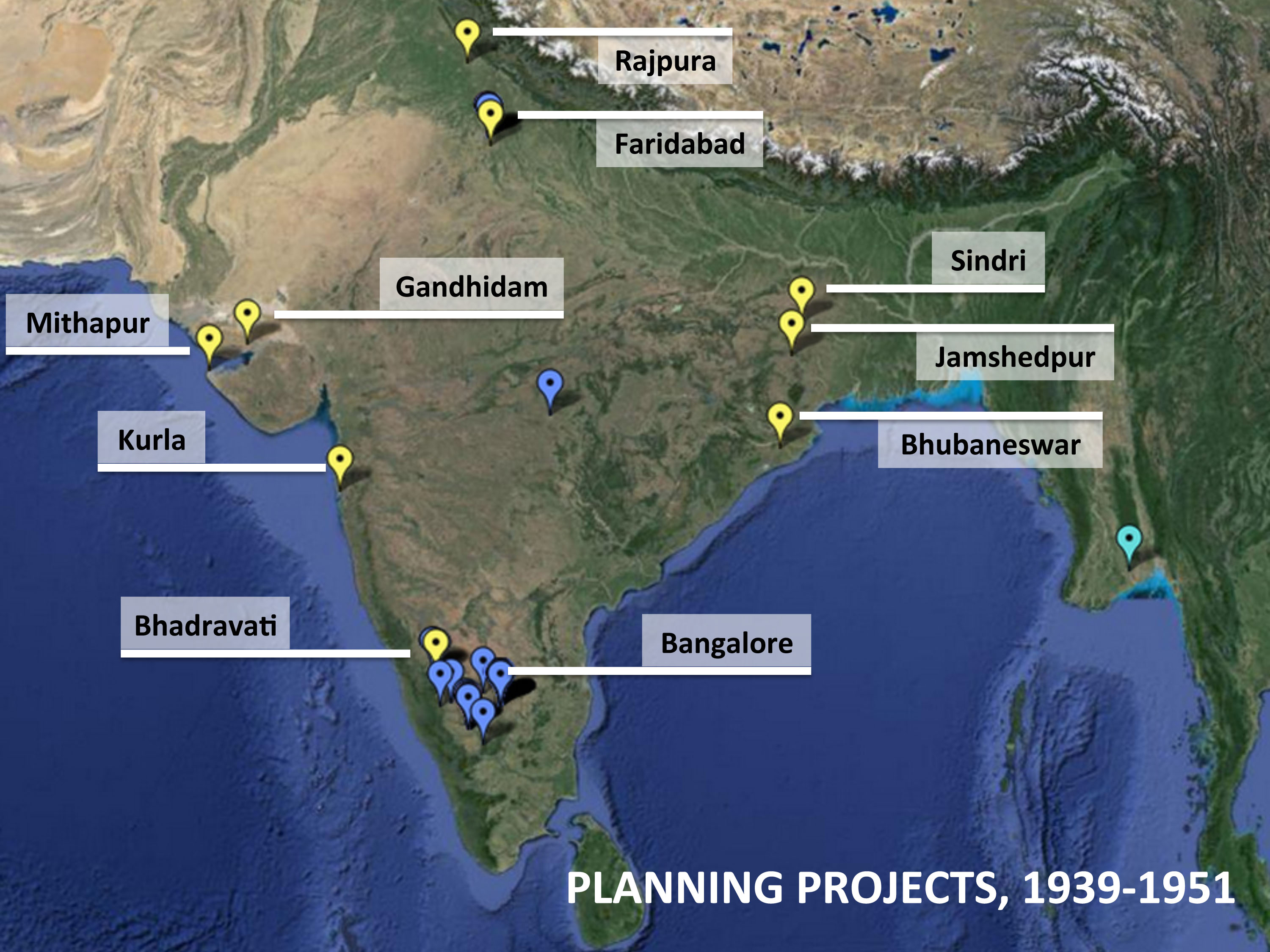
Map showing location of Otto Koenigsberger’s planning projects in India, 1939-1951


Amongst these papers, there was a focus on examples from India. Kristin Larsen and Laurel Harbin (University of Florida) studied Albert Mayer’s influence with their paper “American Regionalism in India: How Lessons from the New Deal Greenbelt Town Program Translated to Post-World War II India”, Rachel Lee (Technical University, Berlin) concentrated on Otto Koenigsberger in “From Static Master Plans to ‘Elastic Planning’ and Participation: Otto Koenigsberger’s Planning Work in India (1939-1951)” and Ray Bromley (University at Albany – SUNY) presented a paper on “Patrick Geddes’s Plan of Indore: The Inside Story”.


Abuja Presentation Slide

Part of the transnational team involved in the planning of Abuja, Nigeria


Another geographical zone of transnational planning interest was sub-Saharan Africa, with papers by Tiago Castela (University of Coimbra) “Peripheries in a History of Urban Futures: Planning for the Government of Informal Spaces in Late Colonial Mozambique” and Rachel Lee (Technical University, Berlin) “Beyond East-West: GDR Development Planning Transfer – from Oil Presses in Ghana to the Master Plan for Abuja”. Examples of transnational planning from China included a paper titled “Richard Paulick and the Import of Modernism in China” by Li Hou (Tongji University), and Benyan Jiang and Masaki Fujikawa (University of Tsukuba) investigated the German and Japanese influences on green spaces in Qingdao – “Conflicts and Continuity: The Development of Green Spaces in Qingdao, China (1898-1945)”.


After 3 intense days of papers and roundtables, the IPHS conference went out with a bang with an “after party”, with music provided by the conference organiser Christopher Silver’s (University of Florida) rock band In Crisis.


DSCF2356_Conference After Party

Planning historians rock St. Augustine


As well as the great papers and partying, thanks to Planning Perspectives editor Michael Hebbert (University College London), I was delighted to find a copy of the Appendix to the Volta River Project Report at Anastasia Books, St. Augustine. The Volta River Project provided the impetus for several transnational UN planning missions to Ghana (formerly Gold Coast) with team members including Albert Mayer and Otto Koenigsberger.


DSCF2360_Volta River Project

An unlikely find at a St. Augustine used bookstore


The abstracts of the abovementioned papers can be downloaded from the IPHS conference website http://iphs2014.dcp.ufl.edu/documents/Abstracts-IPHS2014.pdf and a revised version of the conference proceedings will be online soon.


kuva.123453

AALTO BEYOND FINLAND ARCHITECTURE AND DESIGN

2nd Alvar Aalto Researchers Network Seminar

Rovaniemi, Finland 16-18 February 2015


Call for papers
The 2nd Alvar Aalto Researchers Network Seminar, “Aalto beyond Finland. Architecture and Design” aims to create a network of researchers interested in the work of the Finnish architect Alvar Aalto. The meeting in Rovaniemi, in February 2015, will be an opportunity to present up-to-date research and provide a significant meeting point for those fascinated by Aalto’s buildings and projects, in a relaxed and collegial atmosphere.

Aalto’s work has had an exceptional impact beyond Finland since the opening of his office in Turku in 1927. Before World War II, his furniture was exhibited in strategic venues in Europe and America, from which Aalto established a solid network of professional contacts. During the post-war period, he took on many assignments and received great recognition in various foreign countries. His buildings, scattered around the world, as well as his unrealised projects, contributed to spreading Aalto’s design method in  different architectural communities, thereby proving its validity outside Finland. Even countries in which Aalto did not design any projects or construct any buildings, such as Japan, Australia, New Zealand, Norway, Spain, and Portugal, were influenced by his work. Although recent scholarly studies have contributed to an exploration of Aalto’s work abroad and its impact in the international context, they are fragmented, dwelling on national questions, without a holistic view. The 2nd Alvar Aalto Researchers Network Seminar “Aalto beyond Finland. Architecture and Design” strives for a comprehensive survey of the impact of Aalto’s architectural and design works abroad, in order to highlight those thematic communalities and connections among different international experiences.

The seminar will be organised in two session types:

1. The “thematic session” will include papers of 20 minutes each, plus 10 minutes of discussion. Suggested topics may include, but are not limited to:
• Aalto’s impact in post-war international architectural culture
• Aalto’s furniture exhibitions
• Personalities who established a peculiar relationship with Aalto
• The impact of foreign cultures on Aalto’s work

2. The “PechaKucha-style session” will consider papers of 10 minutes each (20 images), plus a short discussion. It will be focused on an analysis of Aalto’s buildings and projects outside Finland. Papers might tackle either one or a group of buildings/projects. Authors of accepted papers are encouraged to avoid reading presentations.

Participants in both sessions have to submit an abstract and, if selected, provide a final paper (3000 to 6000 words long) to be published in the proceedings. For more details, see the timetable.

After the seminar, there will be an opportunity to visit Alvar Aalto’s more remote, and yet fascinating, buildings in Oulu and Vaasa, on the Finnish West coast. The tour will end in Alajärvi and Seinäjoki, where Aalto’s cultural and civic centre has recently been extended with a widely acclaimed new library by the Finnish office JKMM Architects. On Friday 21st February, there will be a possibility to visit the Viipuri Library, which has recently been restored.

Timetable

Timely submission of papers is critical to the success of the programme. The procedures and timetable detailed below will apply.

1. 15th June 2014 – Deadline for proposals
Abstracts in a Word document of no more than 300 words, accompanied by a short biography of the author (max. 200 words) and low-resolution jpeg images, should be sent to Merja Vainio (Alvar Aalto Academy assistant, merja.h.vainio@alvaraalto.fi). Please specify the type of session for which your paper should be entered (“thematic session” or “PechaKucha-style session”).

2. 15th July 2014 – Notification of acceptance
Notification of acceptance will be given on or before Tuesday 15th July.
The number of accepted proposals will be limited. After receiving the notification of acceptance, speakers will have access to low-resolution images of drawings and photographs from the Alvar Aalto Museum Archives, for their own research.

3. 29th September 2014 – Submission of paper, full text
The final papers (both in the “thematic session” and the “PechaKucha-style session”) will be 3000 to 6000 words long (including endnotes) and will comprise up to 10 illustrations each. Each paper will be screened by the committee to ensure its quality of exposition and relevance to the call. The committee may require further rewriting of the paper to bring it up to an acceptable standard. All the approved papers will be published in the proceedings book, which will be released at the seminar in February 2015.

4. 20th October 2014 – Submission of revised papers (if requested by the committee)

5. 30th October 2014 – Opening of registration
All participants must pay the registration fee. It is €270 euros per person and covers registration, lunches, coffees, and VAT. The participation fee for students is reduced to €80.

6. 26th November 2014 – Closing of registration

7. 16th-18th February 2015 – Conference dates

The committee looks forward to receiving proposals in response to the call, and is happy to respond to inquiries from interested parties. The committee will publish the definitive programme of the seminar on the website of the Alvar Aalto Foundation at a later date. Questions may be addressed to Esa Laaksonen, Silvia Micheli, and Aino Niskanen, via e-mail, to Merja Vainio (Alvar Aalto Academy assistant, merja.h.vainio@alvaraalto.fi).
List of Aalto’s buildings and projects abroad

Participants might find it useful to consult the following list of countries for which Aalto worked on one or more projects, or in which he built one or more buildings. For more details, please visit the web page http://file.alvaraalto.fi/search.php.


Conveners:
Alvar Aalto Academy, Tiilimäki 20, 00330 Helsinki, Finland

Esa Laaksonen esa.laaksonen@alvaraalto.fi

Merja Vainio merja.h.vainio@alvaraalto.fi

Silvia Micheli The University of Queensland School of Architecture, Australia

Aino Niskanen Aalto University School of Arts, Design and Architecture, Finland