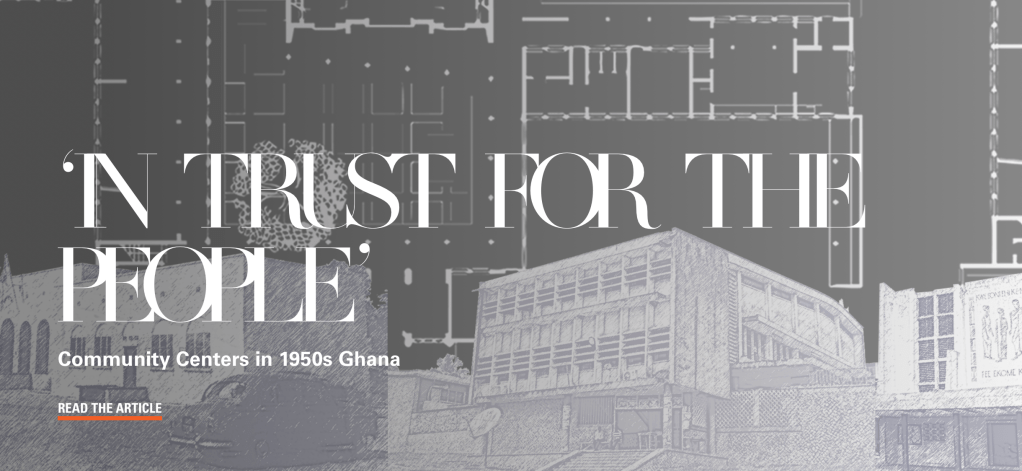
Have a look at the latest article from Design233 on Community Centers in Ghana, including the Accra Community Centre (paid for by the UAC) and Tarkwa Community Center (paid for by the Manganese Mining Company) – both designed by Fry and Drew. In addition to these modernist works the more formal and classically inspired centre at Kyebi is discussed – this centre is more of a mystery… We know it was funded by the Consolidated African Selection Trust (CAST)- but who designed it, and why did CAST commission such a lavish project?
Accra Community Center PlanTarkwa Community Center articleKyebi Community Center
Jubilee House, Accra, Ghana. Source: Julia Gallagher, March 2019
This article examines recent attempts to create specifically African forms of modernist political architecture that draw on ‘traditional’ or ‘pre-colonial’ aesthetic forms and ideas. Taking examples of three prestigious structures – the presidential palace in Ghana, the parliament in Malawi and the Northern Cape regional parliament in South Africa – the article shows how vernacular ideas have been incorporated into state-of-the-art political architecture, producing new or explicitly ‘African’ forms of modernism. It explores how such buildings, which draw on ‘invented traditions’, are used alongside conventional, monolithic representations of the state to produce ‘invented modernisms’ that both uphold and question the African state as a project of modernity.
The George Padmore Library: A Potential Attribution
Text by Dr Ewan Harrison
George Padmore Library in Accra ,Ghana
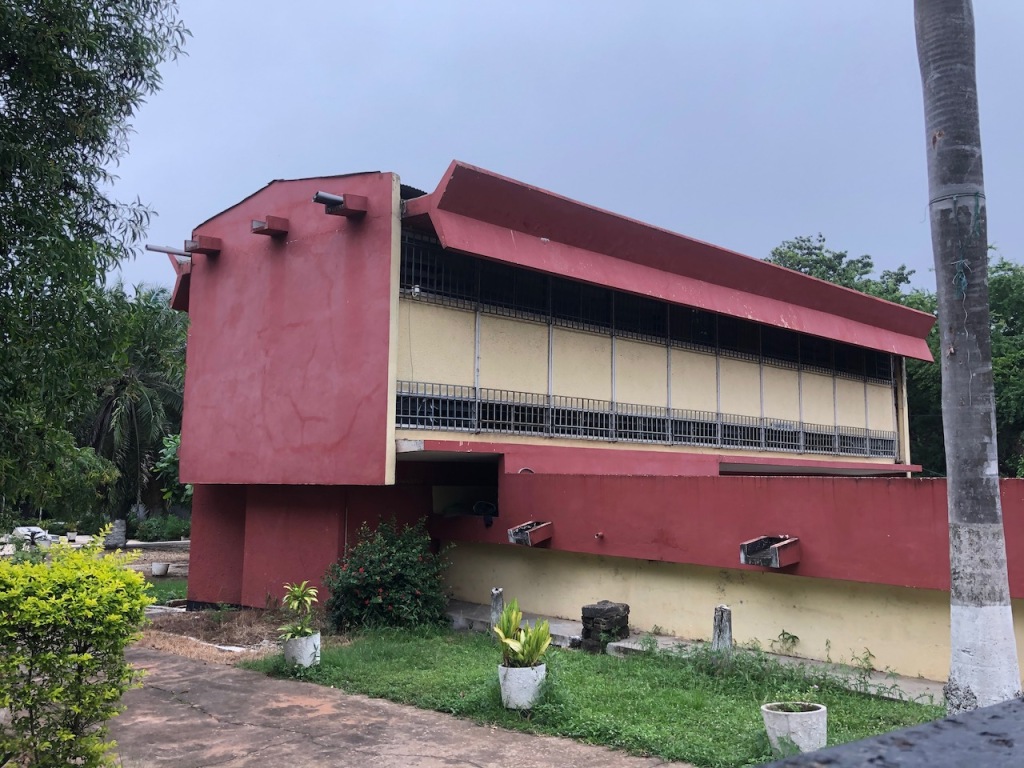
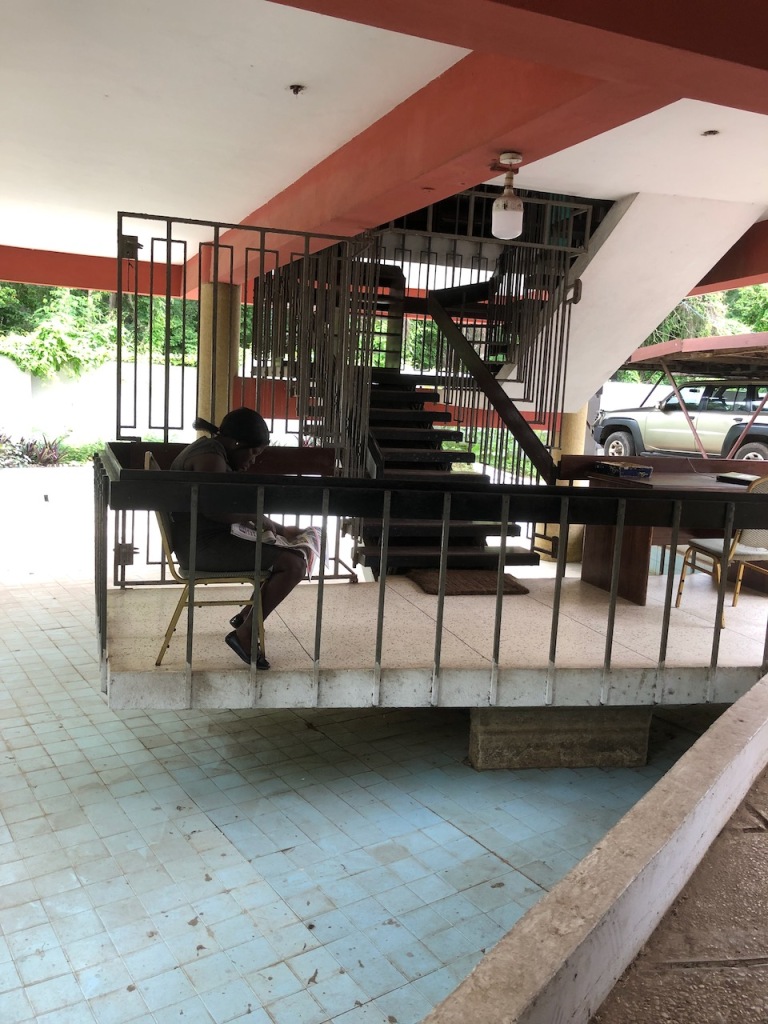
The George Padmore Library in Accra is a dynamic composition. Its principal block houses a fan-shaped reading room that extends from an apsidal end wall. This is raised up on pilotis, and is entered via a delicately wrought cantilevered staircase that itself springs from a fan-shaped expanse of terrazzo floating above a reflective pool. Externally, the facades are defined by horizontals of louvred glazing which allow for free air circulation, keeping the reading room at a comfortable temperature, and a strongly modelled canopy with sculpturally expressed rain water outflows. The building was established by the first president of the republic of Ghana, Kwame Nkrumah, in memory of the pan-Africanist writer, journalist and activist George Padmore. Padmore, who was born in Trinidiad, Nkrumah during the 5th Pan Africanist Conference, held in Manchester in 1945, and on Ghana’s independence, Padmore moved to Ghana to work for Nkrumah’s government as a diplomatic adviser. Sometime following Padmore’s death, Nkrumah’s government built the library in his memory, to house Padmore’s archive and a growing African studies library collection. The Library continues to function as Ghana’s primary deposit library to this day.
Reflecting Pool and staircase of George Padmore Library
Before visiting, I had assumed that the building was likely designed by Nickson & Borys. Responsible for the design of both the Accra Central Library complex and the nearby Ghana National Archives building in the late 1950s, the practice might have seemed the natural fit for a commission to design a bespoke library in Accra at this date. However, on visiting the George Padmore Memorial Library, after having recently spent time in both of Nickson & Borys libraries in the city, the manifest differences in both spatial planning and design between those and the George Padmore Memorial Library became clear. Whilst both the Accra Central Library and the National Library are simple, cubic buildings, the architect of the George Padmore seems to have rejected the rectilinear in their handling of the main reading room. The Nickson & Borys buildings use brise-soliel and pierced concrete walls to dissolve the wall plane: creating lightweight buildings. In contrast, the George Padmore is a heavier, starker, more sculptural composition: much of its drama comes from strongly modelled canopies and sculptural concrete rainwater outflows, and its main facades feature long planes of unbroken concrete.
Curved gable and reflecting pool of George Padmore Library
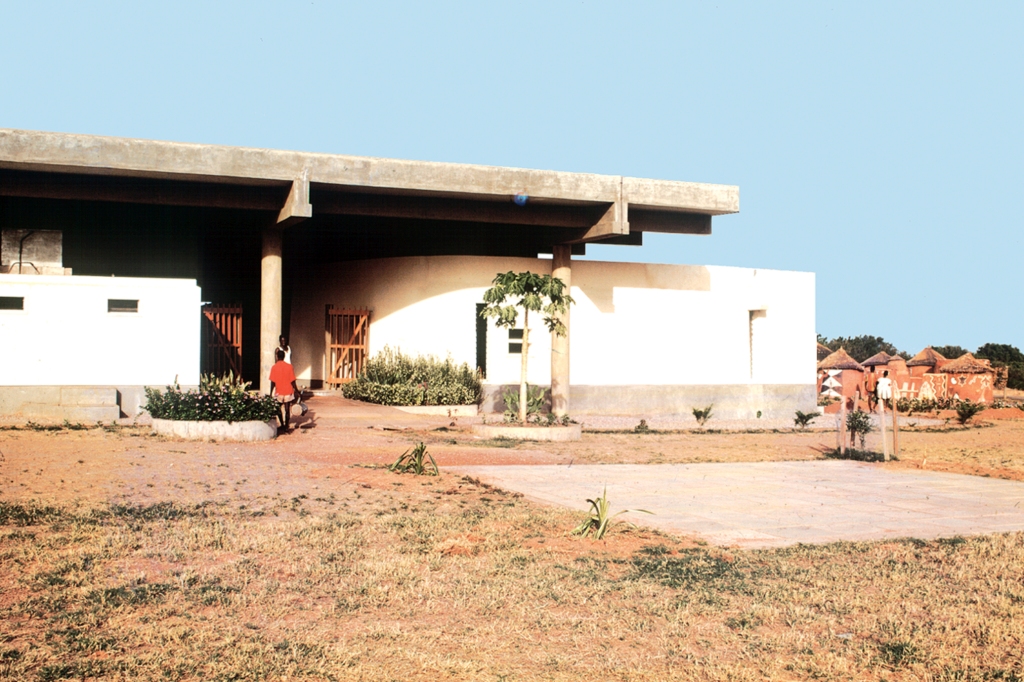
This points to another possible attribution, a design by Max Bond Jnr (1935-2009). The scion of a prominent African-American family, Bond studied architecture at the Harvard School of Design before working at Le Corbusier’s Paris atelier (1958-61) and the New York practice Pedersen and Tiley (1961-64). Bond believed that African-American culture should ‘hark back to Africa,’[1] and thus in 1963 wrote to Nkrumah asking for a job. By 1964 Bond was established in Accra as an employee of the Ghana National Contracting Corporation, the state’s contractor, working on designs for buildings at the government complex at Flagstaff House. Two of the precepts he outlined as central to his practice in Ghana were a ‘responsiveness to climate,’ and ‘modern buildings for new institutions.’[2] Bond’s most famous commission for the GNCC, the design of a public library at Bolgatanga, in the country’s arid northern region, strongly evidences these concerns. The Bolgatanga library project, which features four discrete volumes – two library reading rooms, a lecture hall and an administration block – under a free-standing roof designed to maximise cooling air circulation throughout the complex, is very different in its massing to the George Padmore Memorial Library. But there is something in Bond’s heavy roof at the Bolgatanga Library, in his handling of the oval wall of the Lecture Hall, and the sculptural treatment of the rainwater goods which show clear affinities with the George Padmore Memorial Library. And there are reasons beyond the stylistic to suggest Bond’s authorship of the building. Padmore’s intellectual project, and, it can be argued, much of Kwame Nkrumah’s political one, resolved around drawing attention to the shared heritage and struggles of Africans and the African diaspora throughout the Atlantic world. In this context, a design by an African-American architect, resident in Ghana, might have seemed especially suitable.
Neither the Accra Town Planning archives, the papers of the Ghana Library Board or the archive of the Padmore Memorial Library itself shed much light on the building’s authorship, although a letter in the National Archives of Accra politely rebuffing an offer from Nickson & Borys to fund a memorial plaque to Padmore is certainly suggestive that the building’s patrons didn’t think a practice headed by European emigres a suitable one to design a memorial to a titan of Pan-Africanism (dated 1961, this letter makes no mention of the project for the Library, suggesting that it predates the library’s construction). Questions remain, however. The Bolgatanga Library was extensively published, if the Padmore is by Bond, why wouldn’t he have seen that it too received attention in architectural publications? Why wouldn’t he accord it a central place in his Ghanian oeuvre? Was this perhaps a collaborative job, an awkward collaboration with one of the expatriate architectural practices that Nkrumah wished to side-line, practices like Nickson & Borys? Or with Eastern European or Yugoslavian architects employed by the GNCC? The last might be the most likely, given Ghana’s political culture in the early 1960s, and Padmore’s own long, if increasingly fractious, association with the Communist Party. Conclusive answer may well lie in the collections of the Avery Library at Columbia, which holds Max Bond Jnr’s archives, or in the private papers of Kwame Nkrumah. For now, a tentative attribution will have to suffice.
George Padmore Library Interior: Photo Iain Jackson
[1] J, Max Bond Jnr and the Approproation of Modernism in a Library Design in Ghana
[2] J, Max Bond Jnr and the Approproation of Modernism in a Library Design in Ghana
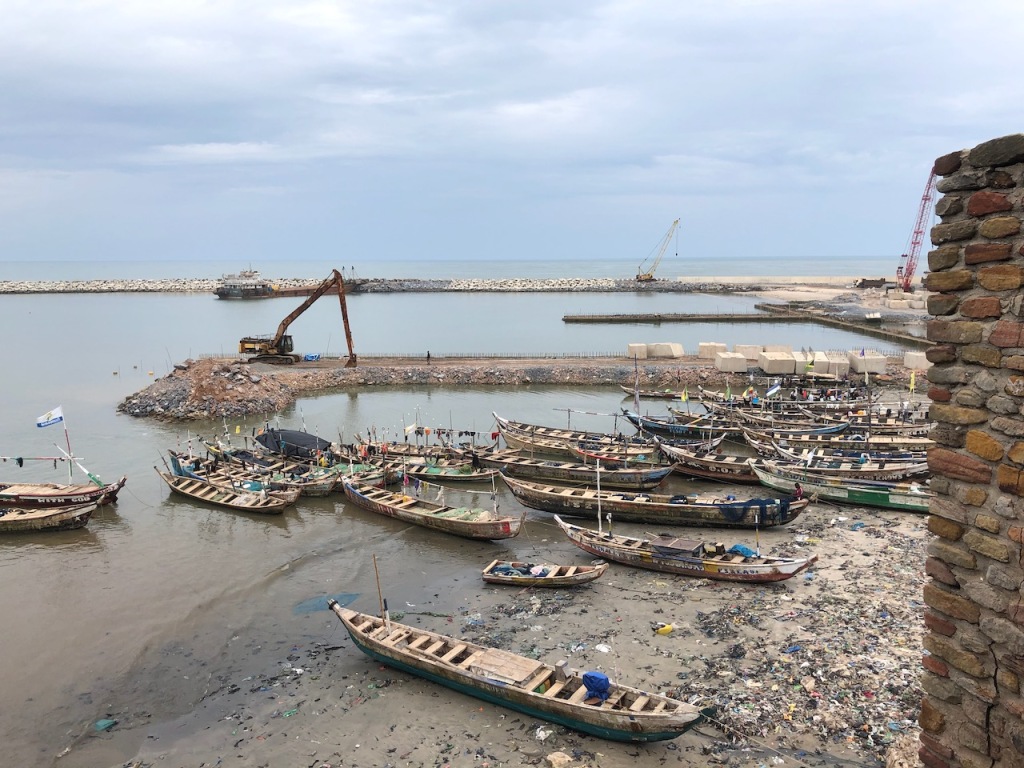
Returning to Accra after a 30 month break, I was expecting there to be changes, but not on the scale I witnessed. Three major projects have commenced – the new cathedral; the Marine Drive project; and the new fishing harbour. When completed they will have a drastic impact on the city and how it is experienced. Marine Drive, in particular, promises some spectacular changes to the much neglected and large sea front. For a port city Accra has never really utilised its enviable position overlooking the sea with its refreshing breeze, until now. The scale of the Marine Drive project is vast and incorporates the set design piece of Independence Square as its focal point.
The New HarbourMarine Drive SiteHoardings around the new Cathedral
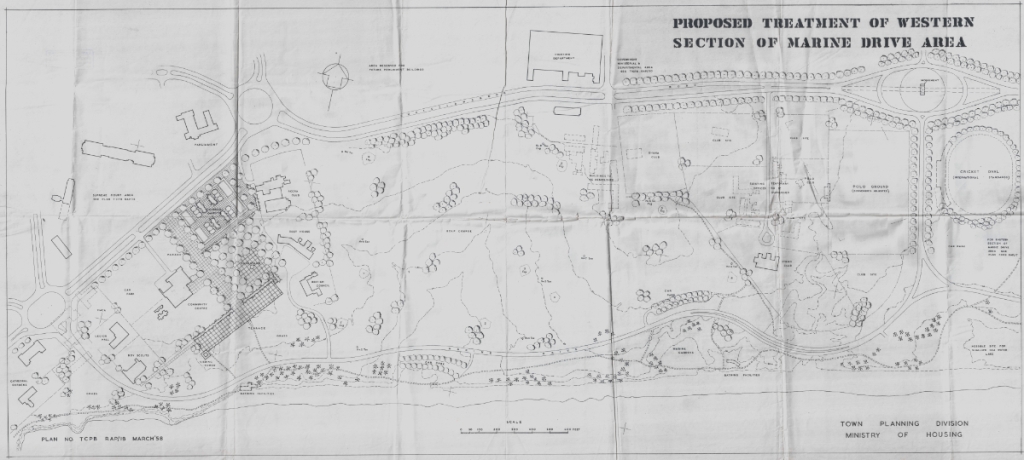
The project for Marine Drive initially commenced back in 1958 with Geoffrey Jellicoe as lead designer, and various other projects have been mooted since. Jellicoe’s proposal centred around the Community Centre, and also utilised the cricket stadium and polo pitch on the current site of Black Star Square, as well as a golf course and series of club houses.
1958 plan for Marine Drive: source PRAAD
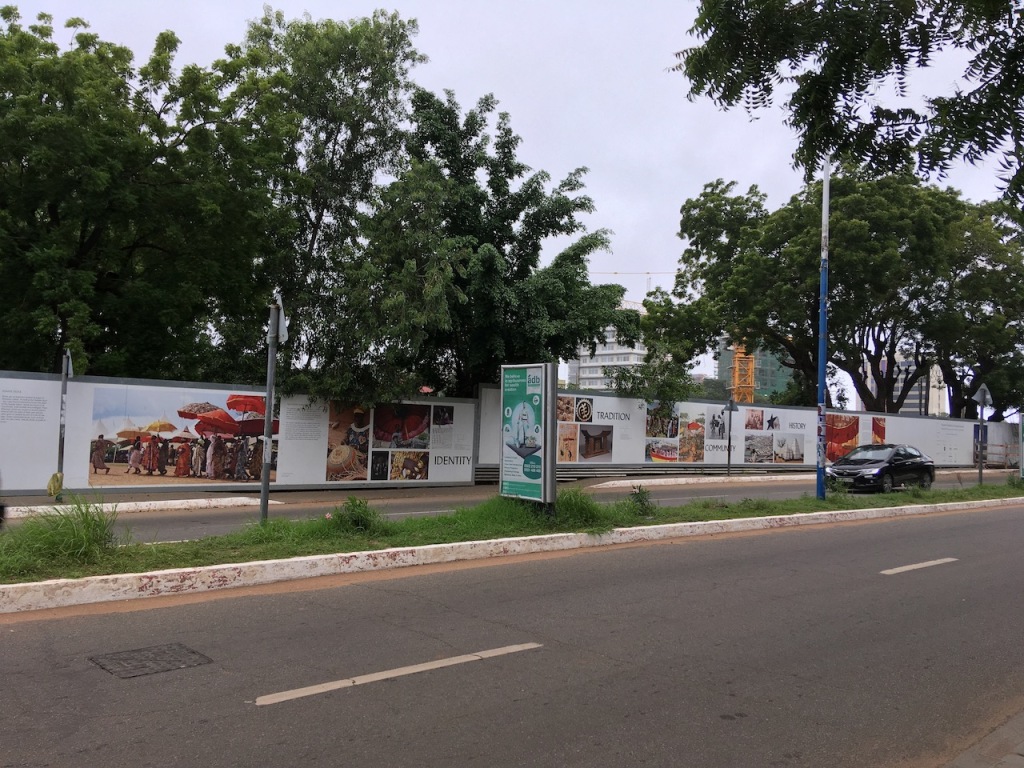
After so many other false starts it looks like Marine Drive is finally going to happen this time, with Sir David Adjaye as the lead architect. Whereas Jellicoe’s design was mainly concerned with providing sport facilities to the Colonial residents, the new proposal includes provision for other leisure facilities including beach bars, shopping, a promenade, and a series of residential and commercial towers. Sir David’s practice is also designing the new Accra cathedral and initial ground works have also commenced, with the site hoarded off and clad with architectural renderings explaining the project’s concept.
A rendering of the new Marine Drive project: towers around Black Star Square.Current view of Black Star Square
The fishing harbour project has resulted in an extension of the old breakwater wall along with some major engineering works linking the shore to the harbour, as shown above.
It’s impressive that the city is conducting works of this scale, ambition, and vision. We’ll continue to record the developments here and to document the changes.
We also revisited the classic modernist constellation of the law court, library, and community centre. Whilst the library is still in use the community centre is not, other than as a store. It’s looking particularly tired, and the building fabric is beginning to deteriorate. Its future is uncertain, and as it sits within the Marine Drive development area discussed above it isn’t clear what, if any, it’s role will be. Even the beautiful Ghana Club is potentially at risk from the new development. It’s been mooted that the club might have to be physically moved to a new site. It’s not an impossible solution as the upper level is a timber structure with louvred facades. It could be jacked up and rolled to a new location, but equally it’s also disappointing that these older structures were not incorporated and woven into the new plans.
Community Centre / Store?Abandoned Christmas decorations in the Community CentreThe Ghana Club – potentially at risk of demolition / being moved elsewhere?
The 1951 victory for Kwame Nkrumah’s Convention People’sParty resulted in some major shifts in the procurement of new infrastructure and housing. For the electorate, housing was one of the most important issues and Nkrumah’s government was quick to recognize this potency.
His plan, announced in 1952, was to build a new port city, complete with innovative and improved housing at the highest standards. Located only 18 miles from the centre of Accra, the new city of Tema would demonstrate Nkrumah’s commitment to industrial development and that Ghana was at the centre of a pan-African vision.
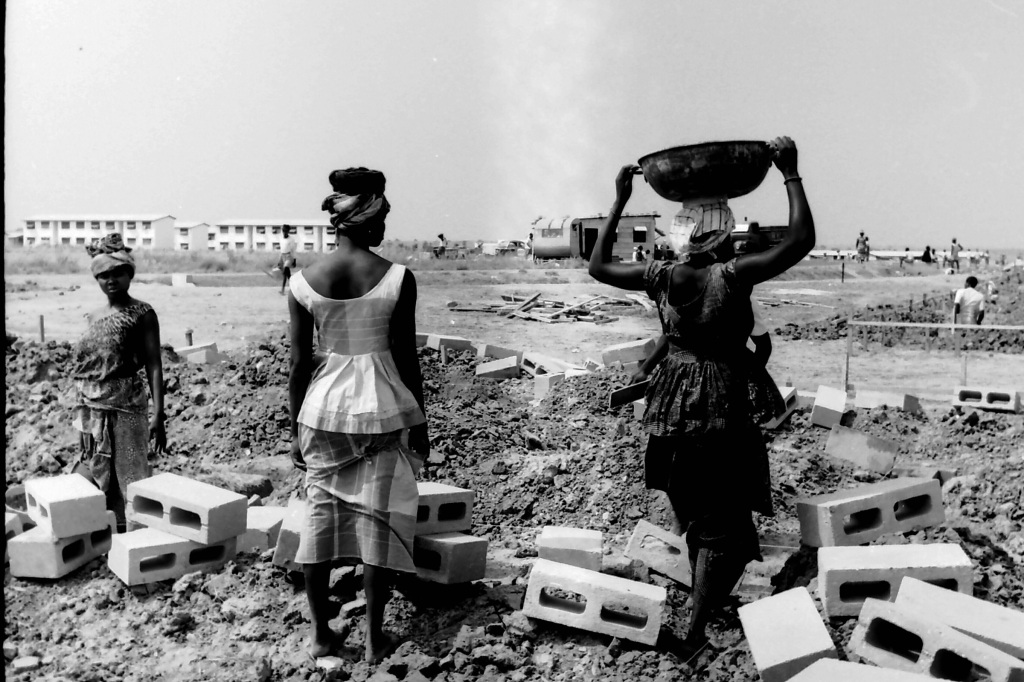
Tema under construction: female labour force transporting blocks and cement
Tema was part of a wider industrialization project that included a new aluminum smelting plant and hydroelectric power station on the Volta River. It was a major project involving international financial backing and set out the major ambition Nkrumah had for the nation during the advent of independence. For such a major project, very little is known about the first team of architects and planners responsible for the execution and delivery.
Have a look at https://www.design233.com/articles/from-buckman-to-turkson for my article on some lesser known Ghanaian architects, including John Buckman and Peter Nathaniel Kwegyir Turkson. I uncovered Turkson’s architecture thesis project in the University of Liverpool archives and discuss his plans for a new Parliament Assembly building in Accra.
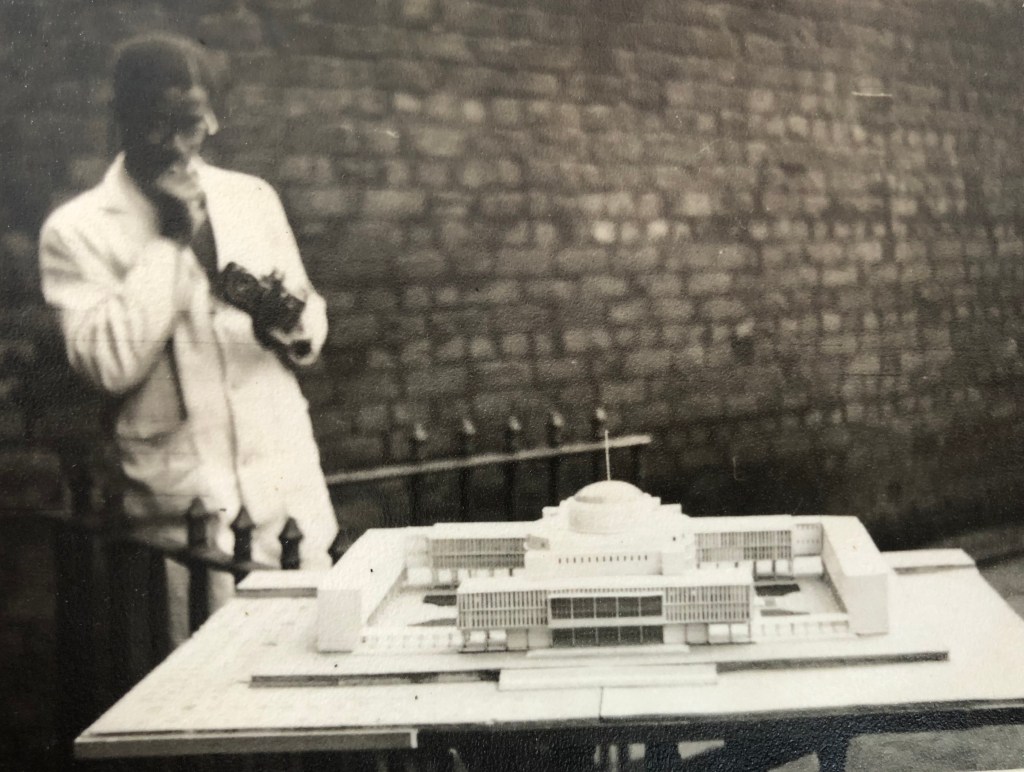
Peter Turkson in Liverpool with his architectural model for a new parliament building in Accra, 1954.
Turkson wanted a design that was ‘classic in character and at the same time distinctly modern in feeling and detail…[exhibiting] the spirit of modern times’.
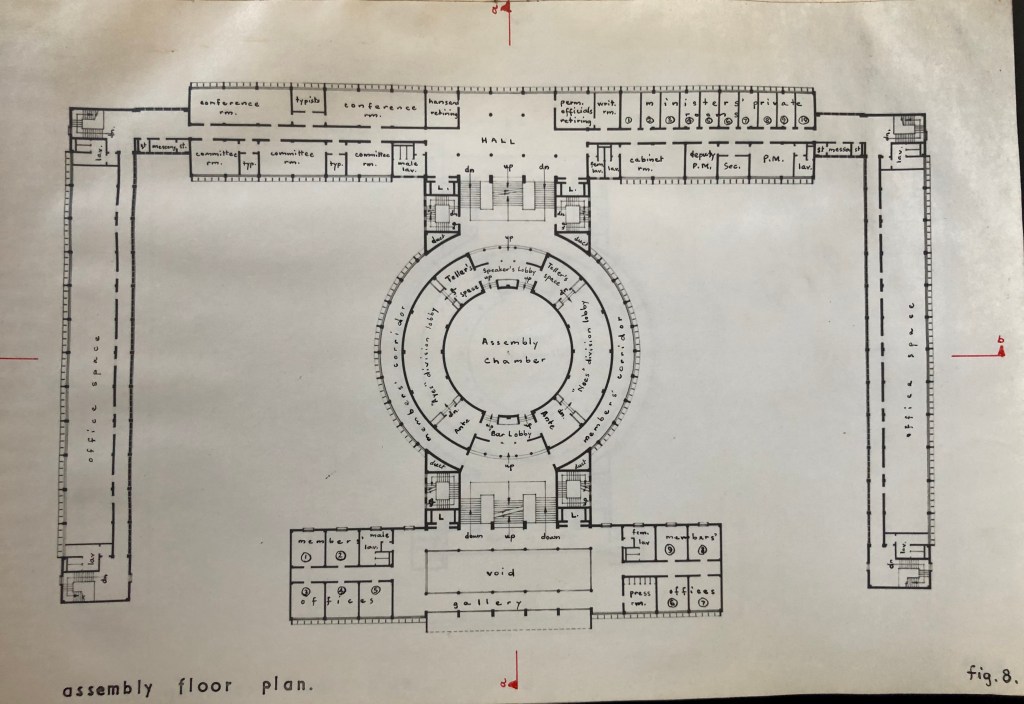
Proposal for the Accra Assembly building, by Peter Turkson, 1954
Turkson’s solution proposed using a ‘sandcrete’ (laterite soil mixed with cement) block wall along with a brise-soleil frame of fixed vertical and horizontal fins. Topping the structure and reflecting the chamber below was a reinforced concrete dome clad in copper, whilst some of the walls would be clad with faience finish. The plan was symmetrical forming two courtyards with a central drum for the debating chamber and library above.
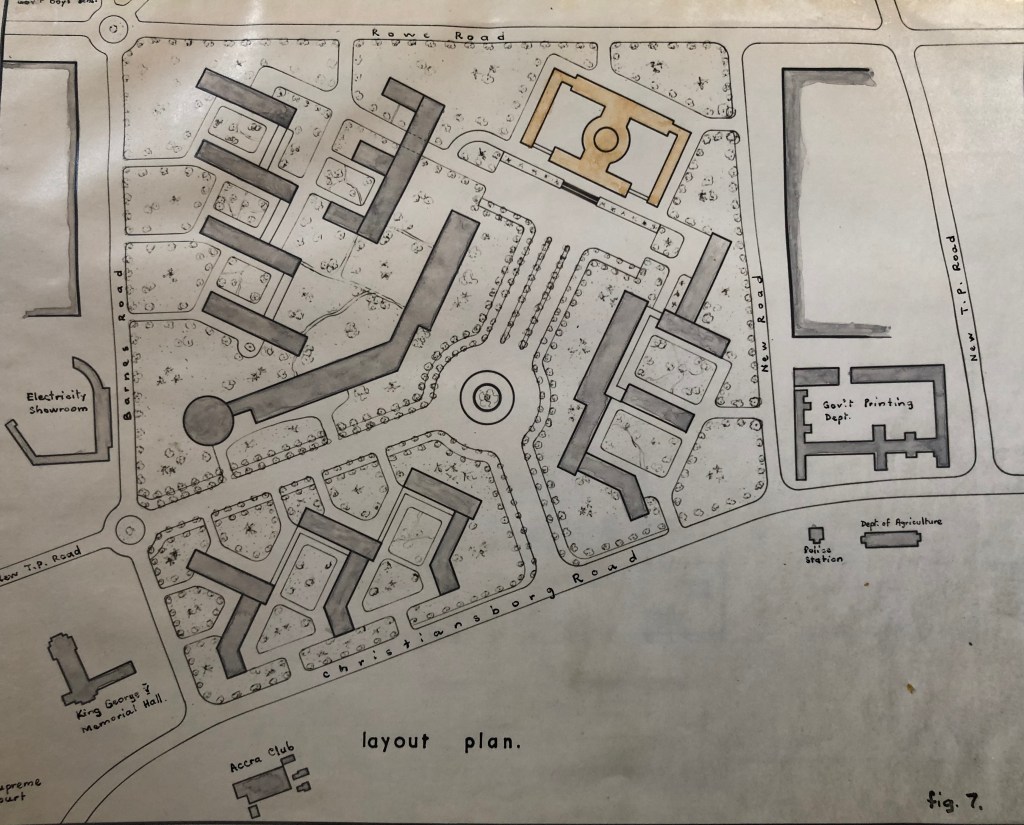
Site plan showing the proposed location of the new Assembly on Accra’s Barnes Road and Christianborg Road.
Recent years have seen an upsurge of academic, curatorial and critical interest in postwar art in Britain and around the world. This has included addressing the question of how we define what “postwar” is and how expansively we might think about the period and its cultural significance. This series of Paul Mellon Centre research seminars will showcase new perspectives on the arts of postwar Britain as an interdisciplinary and transcultural terrain of research. Talks in the series engage with the issues of empire and worldmaking, with questions of migration, the environment and with the intersections of art, technology and new media.
The sixth and last in a series of summer research seminars on The Arts of Postwar Britain 1945–1965 with Iain Jackson and Rixt Woudstra. 13th July 2022, 6pm-7.30pm, Paul Mellon Centre
25 May to 13 July 2022
A series of summer research seminars to be held on Wednesdays from May to July 2022
Paul Mellon Centre [online and in person]
Iain Jackson – Modern Architecture in West Africa: Schools, Sculptures and Magazines
This paper is concerned with modernist architecture in “British West Africa” produced in the aftermath of World War Two and the independence period of these countries.
These experimental and often provocative structures were designed for climatic comfort, as well as becoming didactic vehicles for ideas sharing ideas of a modern and liberated Africa.
The paper will discuss attempts at forming a “Bauhaus” Art School in Accra, followed by various commissions of libraries, community centres and museums that attempted to blend the most radical architectural designs with decoration, murals and sculptures. The West African context seemingly presented a “blank canvas” for newly qualified architects eager to “experiment” in ways that would be impossible in Britain. Whilst these buildings were often presented as symbols of an emerging nationalism and expectation of liberation, they also reveal the ongoing neo-colonial methods, with many relying on the patronage of multinationals such as the United Africa Company.
Finally, the paper will discuss how these projects were reported and shared, especially through the high-brow magazine Nigeria, which regularly featured extensive articles written by the architects on the latest designs.
The result was a diverse and extremely fertile context that reveals an often-overlooked set of important structures responding to a period of political flux and cultural exchange.
Rixt Woudstra – “A feeling of warmth”: Tropical Timber, Modern Interiors and the United Africa Company in Postwar Britain
In 1960, the new, modernist headquarters of the United Africa Company (UAC), one of the leading British trading businesses extracting palm oil, cocoa and other raw goods from West Africa since the late nineteenth century, opened near Blackfriars Bridge in central London. While the structure’s grey concrete and glass exterior appeared cold, inside the architects used a strikingly large variety of gleaming tropical timbers. The doors, floors and panelling, as well as most of the furniture, were made of honey-coloured idigbo, pinkish makore, fine-textured guarea, reddish-brown sapele and deep-brown African mahogany – all logged by one of the company’s subsidiaries, the African Timber and Plywood Company, in Nigeria and Ghana. Although an exceptional example, it was certainly not the only building containing exotic timbers in postwar Britain; tropical wood could be seen in and on the outside of university building, civic centres, housing estates, sport facilities and offices.
Scholars have explored how Jamaican and Honduran mahogany, sourced by enslaved workers, left an imprint on British domestic interiors and furniture design in the late seventeenth and eighteenth century. Less well known, however, is that “empire timber” – and later, “world woods” – continued to permeate British design and interior architecture well into the twentieth century. This talk focuses on the commercial activities of the UAC in Nigeria and Ghana during the 1950s and ’60s and considers how tropical timber was deployed to soften or provide a decorative element to modernism, often perceived as cold and austere. Moreover, examining tropical timber and tracing where and by whom it was logged, how it was processed, sawn, shipped and sold, enables us to see how British postwar modernism was dependent on imperial and neo-imperial networks of extraction and colonial labour.
‘Archival Urge’ is the second part of the symposium ‘Document Fever’ organised by the Architectural Association in collaboration with the Architecture Space & Society Centre, Birkbeck School of Arts on 25 February 2022. This time in partnership with KNUST, this panel aims to celebrate three projects that ‘collect’ histories of architecture in very different ways. We will think, amongst other questions, about the archival impulse/fever that made these projects coincide in time and space; the archival need to collect histories that are missing in architectural history; and the diverse formats of archive-making that these projects have taken or are taking.
Adil Dalbai Adil graduated from Humboldt University of Berlin with a master’s degree in modern history and cultural theory, specializing in the architectural history of Eurasia and (post)colonial contexts. He worked as an editor and author for DOM publishers, focusing on architecture and urbanism. He went on to study architecture at the Technical University of Berlin and worked at Meuser Architekten on architecture projects in Western Africa. He researches and writes about architecture in Central Asia and Africa and its global interconnections. Additionally, he is a guest critic and lecturer, as well as (co)editor and author of several articles and books on architecture, including Theorising Architecture in Sub-Saharan Africa (DOM publishers, 2021). Since 2014, he has been managing editorial director of Architectural Guide Sub-Saharan Africa (DOM publishers, 2021, with Philipp Meuser and Livingstone Mukasa), a seven–volume documentation of the architecture of all 49 African countries south of the Sahara.
Kuukuwa Manful Kuukuwa is a Doctoral Researcher at the Department of Politics and International Studies at SOAS, University of London. Her research examines the sociopolitics of West African nation-building and citizenship through a study of the architecture of educational institutions. She has a Master of Architecture and a BSc Architecture degree from the Kwame Nkrumah University of Science and Technology (KNUST), and an MSc in African Studies from The University of Oxford. Her previous research has explored the positioning of Ghanaian architects in the modernist movement; Asante architectural identity; and social acceptance of earth building in urban areas. She has published in Al Jazeera, Burning House Press, Africa Is A Country, and The Metropole. Kuukuwa curates Adansisɛm— an architecture collective that documents Ghanaian architecture theory, research and practice, and runs accra archive— an architecture archives digitisation project. She also co-founded and runs sociarchi— a social architectural enterprise that advocates for, and provides architectural services to people who ordinarily cannot afford architects.
Philipp Meuser Born 1969, Managing director of Meuser Architekten GmbH and head of DOM publishers. From 1991 to 1995, studied architecture at the Berlin Technical University. From 1995 to 1996, editorial work for the Neue Zürcher Zeitung, Switzerland. Part-time postgraduate studies in the History and Theory of Architecture at the Swiss Federal Institute of Technology Zurich (ETH Zürich), graduating in 1997. PhD on the Soviet Mass Housing (Berlin Technical University, 2015). Federal Cross of Merit for cultural and scientific exchange with the states of the former Soviet Union (2018). From 1996 to 2001, policy advisor to the Senate Department for Urban Development as part of the Stadtforum Berlin. Visiting Professorship at the Kazakh National Technical University, Almaty (2015). Tutor at the Strelka Institute Moscow (2016/2017) and the Architectural Association London (Easter Island Visiting School 2017). Since 2018 Honorary Professorship at the O.M. Beketov National University of Urban Economy in Kharkiv, Ukraine. 2022 Visiting Professor for Public Humantities at Brown University in Providence/Rhode Island.
Livingstone Mukasa Livingstone Mukasa’s career has included architectural practice, urban design, master planning, real estate development, and sustainable development consulting. He founded and managed Archability, an online architectural crowdsourcing start-up, and Afritecture, an online platform on architecture in Africa. He is currently principal of Mahali, a collaborative design studio focused on cultural and contextual architectural engagement, and a frequent guest reviewer at Rensselaer Polytechnic Institute’s School of Architecture. Passionate about architecture in Africa, he is coauthor and associate editor of Theorising Architecture in Sub-Saharan Africa (DOM publishers, 2021), and Architectural Guide Sub-Saharan Africa (DOM publishers, 2021, with Philipp Meuser and Adil Dalbai), a seven–volume documentation of the architecture of all 49 countries south of the Sahara. Born in Kampala, Uganda, he holds a bachelor’s degree in Architecture from New York Institute of Technology, and graduate certificates from the Graduate School of Architecture, Harvard University in Urban Housing and Mixed–Use Developments.
Rexford Assassie Opong Rexford Assassie Opong (PhD) is currently a Full Professor of Architecture and Dean of International Programmes Office of Kwame Nkrumah University of Science and Technology (KNUST), Kumasi. He is a practicing architect of over twenty years’ experience. He obtained his Doctor of Philosophy in Architecture from the premier Liverpool School of Architecture — University of Liverpool; Masters in Urban Planning and Management from University of Rome-La Sapienza; Postgraduate Diploma in Architecture, KNUST; and Bachelor of Science in Design, UST, Kumasi. He researches and has widely published on the following topics: Architectural Identity, Metamorphosis and Disorderliness, Ecological Aesthetics and Architecture, Architecture and Fractals, The Built Environment and Climate Change,Urbanism and Architectural Modernism in Africa, Architecture and Health, Architectural Habitus, Architecture and land, Taste in Architecture, Architecture; Science and Arts Debate, and Kinship, Land, and Architecture in Urban Ghana.
Organiser and chair: Albert Brenchat-Aguilar Albert is a Lecturer (teaching) at the Bartlett School of Architecture, University College London. Previously, he co-curated the public programme and publications of the Institute of Advanced Studies, UCL, edited the digital platform Ceramic Architectures and worked as an architect in Bombas Gens Arts Centre. He is a CHASE-funded PhD student at Birkbeck and the Architectural Association with the project ‘Resource: Humans Matter and the Patterns of International Planning c. 1957-76’, whilst cataloguing the archive of educator, architect, and planner Otto Koenigsberger. His coedited volume ‘Wastiary: A bestiary of waste’ will be published soon he hopes. He has published in Architecture&Culture, Espacio Fronterizo, and The Scottish Left Review, curated shows at UCL and the Polytechnic University of Valencia, and exhibited his artworks at Museu Nogueira Da Silva. He is currently a visiting researcher at the Department of Architecture, KNUST.
Shared Heritage Africa: Call for Applications: Digital Fellowships March-September 2022: https://sha.architectuul.com
We are pleased to announce an open call for 6 Digital Fellowships, to be awarded to students and young professionals in architecture related fields or with demonstrable interest in architecture, who are based in Ghana, Uganda or Nigeria.
The documentation and investigation of buildings can tell us a lot about how politics works, and a lot about the nature of the relationship between state and society – a concern of all partner organisations. The project focuses on the rediscovery of post-war modern buildings from the 1950-1970s. These fall in the period of independence from colonial rule, here from the United Kingdom (Ghana 1957, Nigeria 1960 and Uganda 1962), and have a great educational and socio-political significance. One focus of our discussions with the respective universities, which were founded by the majority during this period of independence and for which new campuses were usually built, among others:
Kwame Nkrumah University of Science and Technology (KNUST), Kumasi, Ghana (1952/1961),
University of Lagos (UNILAG), Lagos, Nigeria (1962),
University of Nigeria (UNN) (formerly Nigeria College of Arts Science and Technology), Nsukka, Nigeria,(1950s),
Busitema University (formerly National College of Agricultural Mechanisation), Busitema, Uganda (1968),
Kyambogo University (formerly Uganda Polytechnic), Kampala, Uganda (1958).Digital Fellowship ProgramThe 6 month long digital fellowship program involves participants working on documentation, investigation and representation of those post-war modernist buildings from the 1950-1970s in Ghana, Nigeria and Uganda. The fellowship program focuses on development of written and visual material on those buildings through scientific writing, photography and digital publishing using different media (text, photo, film and internet).The fellows will be involved in online tutoring and in-person activities undertaken over the period. They will contribute to the online platform Architectuul and the new digest/Blog “Shared Heritage Africa”, allowing for exchange with the professional actors and society, locally and globally. The results shall be presented and discussed at the 17th International DOCOMOMO Conference (IDC) in Valencia (Spain) in September 2022. Each fellow will receive a travel grant for joining the conference.
EligibilityPlease note the following conditions for participation:
– Students and young professionals in architecture related fields or with demonstrable interest inarchitecture and other related disciplines, such as: Architecture, Urban Design, History, Social Science,Journalism, Urban Studies, Creative Writing, are eligible to participate.
– If they are based in Ghana, Uganda or Nigeria.
– Strong written communication skills and/or photography and/or digital publishing skills are required.
– Previous experience conducting and communicating ideas or research publicly (blogs, articles,dissertations) is desirable.
For the past months, we have been exploring the vast United Africa Company (UAC) archive held at Unilever in Port Sunlight. The archive documents decades of commercial activity in West Africa, which left a significant imprint on the built and natural environment. The UAC extracted raw materials such as palm oil and timber, but also exported finished goods such as cars, building materials, and refrigerators. The UAC also sold British products in its department stores across Ghana, Nigeria, and Sierra Leone. Meanwhile, it operated its own shipping line, named Palm Line, that ferried goods between the UK and West Africa. We have come across a variety of different materials, ranging from maps documenting the company’s palm oil plantations in the Congo and architectural drawings showing the modern Kingsway stores in Lagos and Freetown, to detailed notes related to the design of the UAC’s port, Burutu, in the Niger Delta.
Tropical hardwood at Sapele, NigeriaAfrican Timber and Plywood Concessions in Ghana, ca. 1955
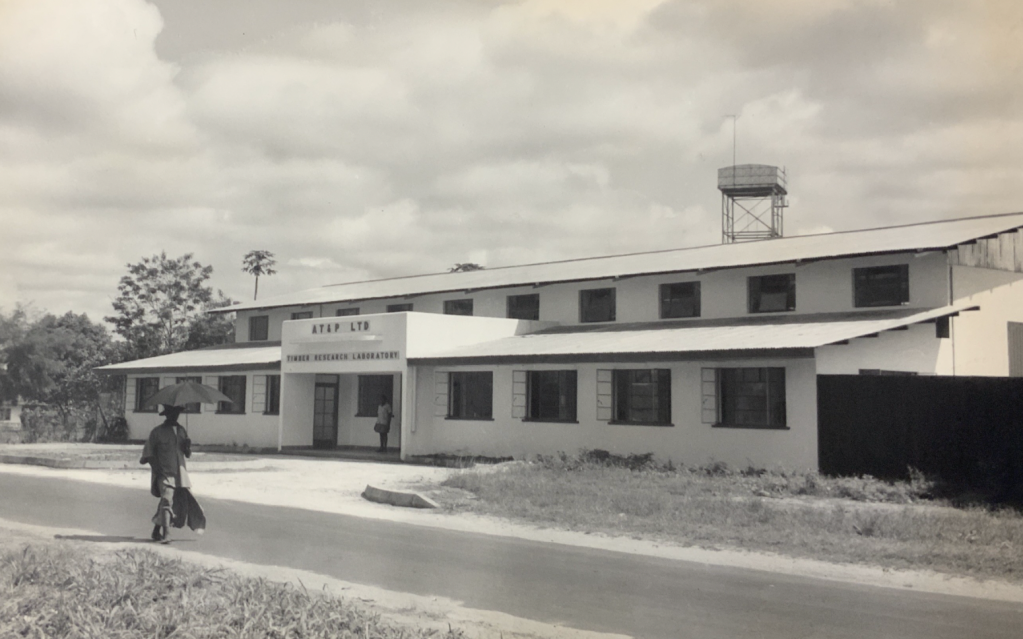
One aspect of the UAC I have been focusing on these past months is the company’s timber operations in Ghana and Nigeria. In the early twentieth century, the UAC founded the African Timber Company (later the African Timber and Plywood Company), located in Sapele, Nigeria. Through a range of concession agreements with local chiefs, they managed to consolidate vast areas of territory around Sapele from which they extracted a wide range of different tropical hardwoods for export to the UK. At the same time, the company began operating in Ghana (then still the Gold Coast), in Samreboi, a hundred miles inland from the port of Takoradi. After World War II, they also built a plywood factory in Sapele—the first of its kind in this area and described as ‘the largest industrial plant in West Africa’—and began producing plywood at a large scale. Using photographs and written documentation, I have begun to explore the construction of these two company towns and their wider infrastructure. While the factories and processing plants were built using prefabricated steel sheds made by Arcon (also responsible for prefabricated houses in the UK during the postwar period), the bungalows for the company’s British employees can be described as traditional. Later, a Timber Research Laboratory was added, as well as showrooms, and several local facilities such as a (plywood) cinema and clubhouse. Through felling hundreds of thousands of logs every year, the company irrevocably left an imprint on these two areas in Ghana and Nigeria and had a devastating impact on the natural environment.
The plywood factory in Sapele, NigeriaSapele, Nigeria, in the 1950sThe Timber Research Laboratory at Sapele, Nigeria
What is interesting is how the work of the African Timber and Plywood Company aligns with the British government’s focus on ‘empire timber’, or the push to use timber in Britain from different parts of the empire for furniture as well as architecture and interior design. While the government attempted to promote empire timber through a variety of exhibitions in the first decades of the twentieth century, the UAC archive reveals how widespread the use of tropical hardwood and plywood produced in Sapele and Samreboi was during the postwar period. Often marketed as giving ‘a feeling of warmth’, it was used for modern furniture made by the Conran Design Group, doors, window frames, and outside paneling for a variety of council housing, but also as interior decoration and flooring in buildings such as the Commonwealth Institute in London and the Commonwealth Royal Pool in Edinburgh. The former headquarters of the UAC in London, United Africa House at Blackfriars, is another case in point: the building’s interior functioned as a display of tropical timber, ranging from mahogany to African walnut and Sapele hardwood—all produced by the company.
Modular furniture designed by the Conran Design Group, made of African walnutDifferent types of tropical hardwood used for the interior of United Africa House, London, 1960s
Another fascinating aspect is the shift to production for the local, West African market in the 1960s and ‘70s, after Independence. Aside from furniture, one innovation was ATP Systems Building, a prefabricated building system using tropical hardwood and plywood. The company promoted this as an affordable, quick, and flexible way to build without requiring much technical knowledge. Documents I found in the archive point out that ATP Systems Building was widely deployed in, for example, Warri, a rapidly growing oil town in Nigeria, to build houses, offices, and schools.
The ATP Showroom in Benin City, Nigeria (originally built for the Lagos Trade Fair of 1962)An ATP employee selling an ATP Systems Building bungalow in Nigeria, ca. 1970
Overall, the archive of the African Timber and Plywood company demonstrates, once again, how (modern) architectural construction in Britain was shaped by colonialism and, conversely, how British companies continued to impact design in the former colonies after independence. Many questions, however, are still unanswered. How, for example, was the work of the timber companies related to the colonial government’s efforts to promote empire timber from Nigeria? How should we understand the widespread use of (colonial) timber in postwar Britain? What prompted the shift to focus on the Nigerian market after Independence? How successful was ATP Systems Building? Over the coming months, we will continue to explore these issues.