Archive

Heritage

Thank you to Prof. Ola Uduku of Manchester School of Architecture for reviewing the ‘Sharing Stories from Jamestown’ exhibition. The exhibition has been extended to run until the end of June 2019. Below I’ve uploaded a 360 degree panoramic view – you can ‘click and drag’ the film to have a look around….

ouduku's avatarWARUH: West African Rapid Urbanisation and Heritage Conservation Research Network

Iain Jackson’s exhibition co-curated by Allotey Konuah-Bruce and Joe Addo opened to great acclaim on Saturday evening at the Jamestown Café, venue, near Ussher Fort. Curiously the café it was confirmed by local elders who attended the opening is accurately in Usshertown; the exhibition launch providing a great forum for these questions to be aired and for detailed discussions to be had.

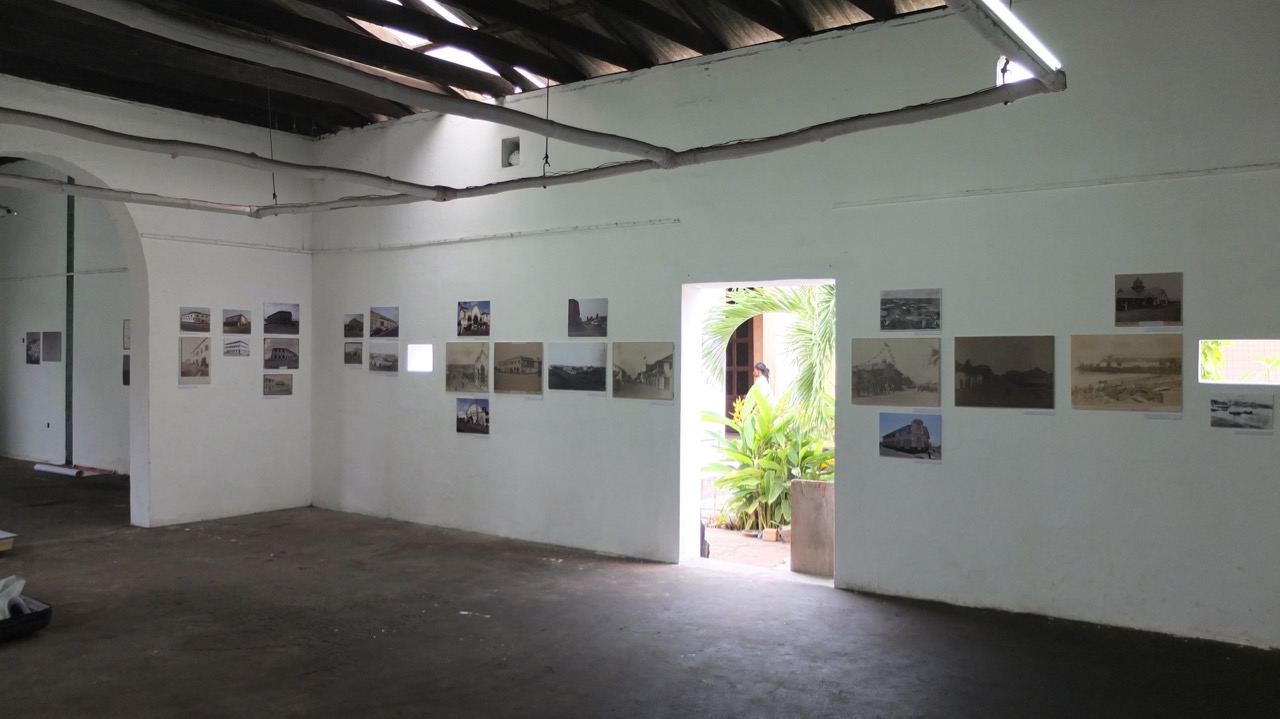
Historic photographs and maps of ‘old’
Jamestown buildings have been placed next to those which show their age,
condition and use, in ‘contemporary’ Jamestown have been displayed in the lower
gallery of the Jamestown Café, which itself features in the exhibition as Tarquah
house, the dwelling and warehouse of one of Jamestown’s wealthy local
merchants, who had originally had it built. The exhibition represents a true
joint collaboration between Iain Jackson and Allotey Konuah-Bruce who have
formed a close and productive working relationship as they have spent the…

View original post 244 more words

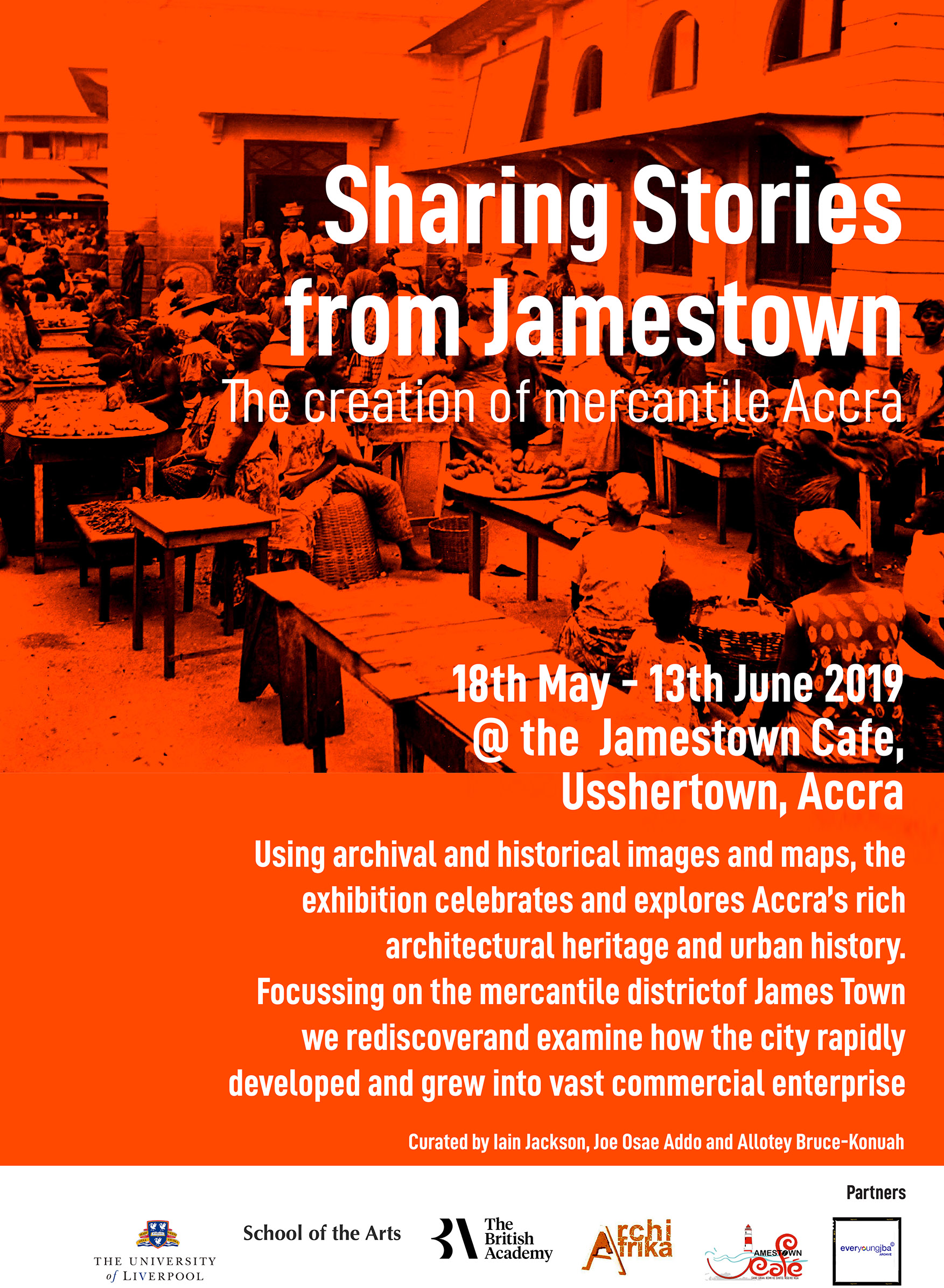
You are invited to our Exhibition, ‘Sharing Stories from Jamestown’, opening on the evening of Friday 17th May 2019 at Jamestown Cafe, High Street, Accra. All very Welcome! The exhibition will run until 13th June.

We’ll be exhibiting vintage photographs, plans and drawings from over ten archives and private collections that have been gathered together here for the first time. To accompany the exhibition we’ve also produced a catalogue that attempts to explain and contextualise the images, and to tell the history of Accra’s development, planning and architecture. You can read the digital version below. We’re indebted to Allotey Bruce-Konuah for expertly setting out the catalogue.

Exhibition Catalogue available at issuu: https://issuu.com/transnationalarchitecture/docs/sharingstories_accra_2019_jackson

We will include more photographs and 360 degree footage of the exhibition as soon as it is installed.

This is an excellent opportunity for emerging writers and students. Last year’s gathering produced some excellent work, and this year we will have the exhibition at James Town Cafe as a provocation and stimulus for debate….

ouduku's avatarWARUH: West African Rapid Urbanisation and Heritage Conservation Research Network

We are pleased to announce that we are now accepting applications for the 2019 British Academy – ASAUK funded 2019 African Architecture Writing Workshops. These workshops are offered for postgraduate students looking to develop their academic writing skills in the areas of architecture, urbanism and related disciplines.

This year there are two workshops. The first to be offered will take place in May 2019

FIRST WORKSHOP DETAILS

“Sharing
Stories from Jamestown and the Creation of Mercantile Accra” Writing Workshop

Monday, May 12 – Sunday, May 18, 2019

This workshop explores the colonial
and mercantile architecture of Jamestown, the British settlement area of
colonial Accra and located in Ga Mashie. This writing workshop is linked to the
May 17 exhibition organized by Professor Iain Jackson (University of Liverpool) and Joe Osae-Addo and Allotey Bruce-Konuah (Jamestown Cafe), which will showcase archival and historical images and
maps of Accra’s…

View original post 420 more words

 (sub) URBAN TROPICALITY: Urban challenges in the tropical zone

International Network of Tropical Architecture (iNTA) Conference at The University of Queensland, Brisbane, Australia,  5 – 8 December 2019

The cities and urban centres of the (sub) tropics are where the greatest challenges facing our collective future can be found. They are where the challenges of global warming, inequality and the migration of people fleeing political unrest or climate change are at their most extreme. The 2019 International Network of Tropical Architecture (iNTA) conference provides a forum to discuss architectural and design solutions for a resilient, smart and just future for urban centres in the tropics.

Founded in Singapore in 2004, the International Network for Tropical Architecture (iNTA) is a networking platform for international researchers and practitioners to collaborate and learn from each other about problems and solutions pertaining to architecture and urban design in the tropical (and sub-tropical) regions and brought together by the shared climatic imperatives and opportunities of these regions. The iNTA permanent secretariat is located at the Department of Architecture, School of Design and Environment at the National University Singapore.

The 2019 iNTA conference is hosted by the School of Architecture at The University of Queensland, located in Brisbane, capital city of the state of Queensland, Australia. Brisbane is proximate to both the fastest growing urban centres in Asia and many Small Island Developing States (SIDS) most at risk from climate change, including Kiribati, Marshall Islands, Federal States of Micronesia, Marshall Islands, Niue and Tuvalu amongst others. Queensland’s most northern extremity, Cape York, sits at the confluence of the Indian and Pacific Oceans, those very same oceans that generate the weather systems that circle the globe and affect the destiny of millions of people.

For those who live in the so-called “global south,” there is a sense of urgency about the challenges arising from rapidly changing climate conditions. Matters are not merely academic, but dynamic and concrete. Before the launch of iNTA, discourse around architecture and urbanism in the tropics was framed by centres of scholarship in Europe and North America. The malingering aftermath of devastating tropical storms such as Maria and Irma (2017) in the Caribbean and Typhoon Haima (2016) in the Philippines challenges such ascendancy. The 2019 iNTA conference in Brisbane brings discourse to a subtropical city at the crossroads of cultures, regions and climate zones. At a time when Australia’s role in the region continues to be questioned, it provides an opportunity to enhance north-south dialogue. 

Submission Information & Instructions

Submit abstracts of no more than 300 words in length by email as Word documents to:  https://easychair.org/conferences/?conf=inta2019.  Please name the email subject ABSTRACT-SURNAME and use this name for your submission file as well.

  • Abstract deadline: 26 April 2019
  • Submission of full papers for review: 26 July 2019
  • Submission of final papers for publication: 18 October 2019

 All abstracts will be considered by the conference academic committee; authors will be invited to prepare a full paper (no longer than 4,500 words); authors wishing their papers to be published in conference proceedings should submit their final papers for peer review on or before 26 July 2019. The date for submission of final papers is 18 October 2019. Authors may opt out of publication.

Conference Streams 

Tropical Architecture refers to constructed architectural and urban environments relating the climatic and natural conditions of the tropical (and sub- tropical) regions, and interacting with various local specifics of culture, urban fabric and technology. Contributions to the following conference streams are sought. 

1.            Tropical Urbanism  

Stream focussing on challenges to and solutions for enhanced liveability in urban centres of the tropics. Papers might address:

  • projects or propositions for reversing or healing the degradation and collapse of urban centres under rapid growth; 
  • urban infrastructures at risk: rising sea-levels, increasing storm intensity, expanding torridity and aridity.
  • urban adaptation responses : design planning policy, governance and codes
  • urban forms shaped by determinants other than climate alone, such as topography, nature, cultural life. 
  • vegetation in (sub) tropical cities: cultivation in gardens and the peri-urban or neglect in terrain vague

2.             Tropical Architecture :: Contemporary Tropical-isms

Stream focussing on individual designs/ architectural, infrastructure, adaptation projects.  What is it that makes the contemporary architectural project tropical? Or the tropical project contemporary? Papers might illuminate projects that demonstrate instances of : 

  • building technologies: tropical and subtropical applications including 
  • passive low energy and carbon neutral architecture
  • climate mitigation strategies
  • equity in the tropical city
  • the (sub)tropical tower
  • contemporary architecture (still) learning from vernacular traditions
  • reciprocities/dialogue between architecture and tropical environments: between the zeitgeist of a globalized culture and a project’s specific circumstance. 

3.            Narratives of Disease, Discomfort, Development and Disaster ::  Reconsidering Tropical Architecture and Urbanism  

The idea of tropical architecture and urbanism initially developed through a particular connection between discourses on disease, spatial practices and optimum architectural typologies, which were believed to circumvent the spread of tropical diseases and to maintain the comfort of the white settler. After the Second World War, the focus shifted from the European settlement of the colonial tropics to the self-development and governance of the world’s tropical regions; a phenomenon necessitated and propelled by post-war decolonization and global regimes of development aid. Accompanying this change was a shift away from the physiological comfort of the colonial settler to a new focus on indigenous cultures, vernacular building traditions, use of local materials, and increasing appreciation for the psychological value of cultural conventions, including superstition and taboo. The aim of this stream is to examine how “triumph” in the tropics was imagined across multiple geographies, by various subjects, through diverse discourses, and at different times and to critically investigate the roles architecture and urban planning played in this process. We particularly welcome papers that offer historical case studies of tropical and subtropical architecture and urbanism examined through one of four lenses: 

  • disease 
  • discomfort
  • development or disaster.

This stream will be convened by Dr Deborah van der Plaat (The Univerity of Queensland), Dr Vandana Baweja (University of Florida) and Professor Tom Avermaete (ETH Zurich).

4.             Historic Urban Landscapes and Tropicality 

The Historic Urban Landscape is a new approach recommended by UNESCO that recognises and positions the historic city and its core as a resource for the future and the centre for the urban development process. Papers might address:

  • operational principles for urban conservation models: respecting values, traditions and environments of different cultural contexts.
  • historic urban centres and tropical vulnerability 
  • mapping urban heritage values and attributes
  • planning, design and implementation of development projects in historic urban centres
  • adaptive use and re-use impacting authenticity and integrity of physical and social fabric in historic urban centres
  • Small Island Developing States (SIDS) of the Pacific and Caribbean: their vulnerability and resilience

Sharing Stories from James Town and the Creation of Mercantile Accra
Forthcoming Exhibition at James Town Cafe, 17th May 2019

I’ve been working in Jamestown, Accra to start planning an exhibition on the colonial and mercantile architecture of the district. Using archival and historical images and maps the exhibition will celebrate and explore Accra’s rich architectural heritage and urban history. The exhibition will focus on the warehouses, stores, factories and offices of James Town and examine how the city rapidly developed into a vast commercial enterprise.

The images for the exhibition have been generously provided by Unilever, Barclays, UK National Archives, The British Museum and private collections. Most of these images have not been exhibited before and we’re delighted that they will be shown in Accra, and in very close proximity to where they were originally taken.

IMG_4426 (1).jpg

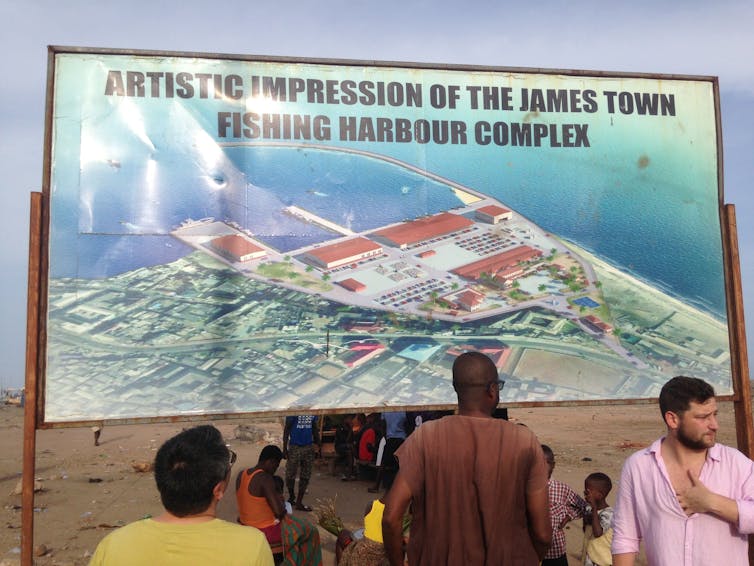
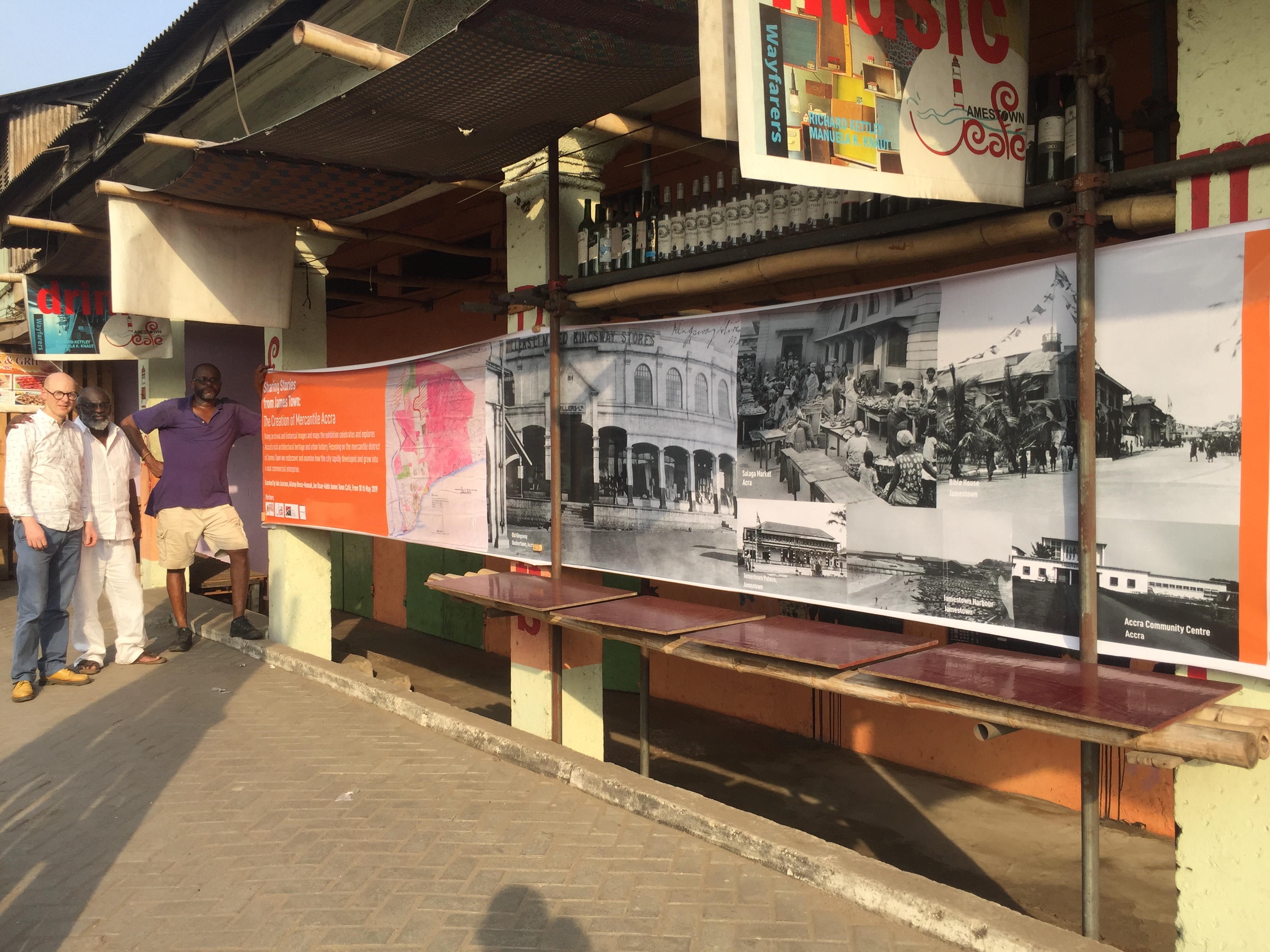
Exhibition Promotional Banner outside James Town Cafe with Iain Jackson [L], Joe Osae-Addo [C] and Allotey Bruce-Konuah [R]

There will be a printed/PDF catalogue to accompany the exhibition showing both archival and modern photographs of the buildings, along with historical maps, and we will hang large photographic banners of the archival images directly onto the historic buildings in James Town.

The main exhibition (co-designed with architect Joe Osae-Addo and designer Allotey Bruce-Konuah) will be hosted by ArchiAfrika at the James Town Café, from 17th May 2019. We’re also hoping that it will go on tour to University of Ghana (details to be announced). In June there will be an additional exhibition hosted at the James Town Café  curated by Lukasz Stanek and Ola Uduku of Manchester School of Architecture – and we’ll include more on both exhibitions here.

We’ve also started a new project to produce 360 degree panoramic photographs (and films) of some of the key sites and streets in James Town (and its environs). The images have been captured with a Ricoh Theta camera and we’ve taken over 200 photographs/ short films to date. The clips will be pieced together as a series of films and overdubbed with a commentary on the history and significance of the buildings in view. The films may be viewed with a VR headset for a more immersive experience. Allotey Bruce-Konuah already gives tours of James Town, and these films will enable his expertise to reach a wider audience, as well as encouraging new visitors to make the trip to this unique and highly important portion of Accra.


A World of Architectural History is the 4th annual conference of the Architectural Research in Europe Network Association (ARENA).

mf_conference_image_1_web

The conference aims to critique and celebrate the latest global advances within architectural history over the last few decades, by focusing upon the word ‘global’ in two senses: 

  • Geographically – referring to the increasing inclusion of all parts of the world in more complex and multiple discourses of architectural history
  • Intellectually – the ongoing expansion of architectural history into other academic subjects, plus the reception of ideas/themes from those subjects

Recognition will be given to a more inclusive approach to architectural history that seeks to incorporate the histories of all countries/regions, and to the significant contributions now being made through interdisciplinary links with other subjects. As such, the conference will represent the forefront of the field internationally and discuss where architectural history ought to head in the future.

Conference presenters will include those from a wide range of subject areas within The Bartlett Faculty of the Built Environment and leading figures in architectural history across the world. Both invited speakers and those selected via an open call will contribute their papers.

Conference themes

Eight thematic areas will be presented over the two days of the conference, with these themes also framing the call for papers:

  • Culture and Architectural History
  • Architectural History and Design Research
  • The Expanded Field
  • Colonialism, Post-Colonialism and Beyond
  • History, Environment and Technology
  • Architectural History as Pedagogy
  • Global Domesticity
  • Informalities, Identities and Subjectivities

https://www.ucl.ac.uk/bartlett/architecture/events/2018/nov/world-architectural-history-conference


British Academy – ASAUK Funded Ghana Architecture Writing Workshop 6–8 July

Apologies for the short notice – but if you’re in Accra this weekend and want an opportunity to improve your writing skills, there are some free places to join an excellent Architectural Writing Workshop.

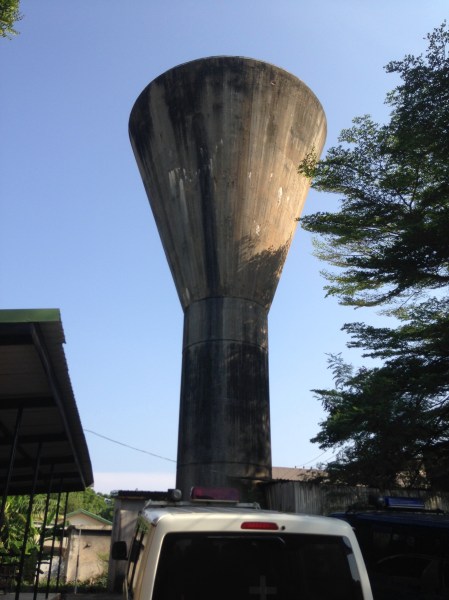
IMG_1436

Water tower at Korle Bu, Accra.

Please do get in touch with Prof. Ola Uduku on o.uduku@mmu.ac.uk for more details and see: British Academy – ASAUK Funded Ghana Architecture Writing Workshop  6–8 July

Architecture in the Age of Mechanical Reproduction: Glasgow School of Art and its Future

Like many people, I was again saddened, shocked, and frankly annoyed to see Charles Rennie Mackintosh’s masterpiece, the Glasgow School of Art, engulfed in smoke and flame for the second time in just four years. It was a radical piece of architecture that helped to shape the development of early 20thC Modernist architecture, and unlike a lot of contemporary and experimental work it was much loved and held a popular appeal.
The charred remains have yet to cool, but a fierce debate has erupted on the future of the building. On the one hand there is an impassioned plea to demolish and rebuild a new structure that would be something of ‘our time’; with any attempts to refabricate the ‘original’ resulting in a ‘replica’, that is, a fake.

Glasgow school of Art

Glasgow School of Art, by Charles Rennie Mackintosh

This faction argues that a rebuilt school would be rendered a ‘museum piece’, and that a new school would somehow respond better to the needs of today’s students.  For sure, it is a compelling argument and after the shock of the tragic event it shows a fighting spirit and an optimism that all architects possess to create a better future. If an architect were to design a new building today that mimicked, or somehow parodied the ‘Mackintosh style’, then for sure, that would not be the way forward for architecture. But this is not a newly commissioned project, rather it should be a restoration of a dilapidated shell.

“The handle has been replaced several times, and the blade was changed once, but this knife has been in our family for centuries”

Unlike other works of art, such as painting or sculpture, there is a utilitarian, designerly approach in building, and buildings are made of many components, materials and finishes. They can all be replaced or remade. Certain parts of a building inevitably wear-out and have to be replaced; lead flashing is carefully reinserted, roofs are precisely re-laid, window frames rot, and sometimes windows are smashed and replaced. We accept this continual, sensitive remaking and in the case of buildings like the GSA undertake this process with extreme diligence. This is all part of a building’s ability to endure time and survive, and whilst a fire rapidly accelerates this process, it need not be the end. Buildings are never complete, they are always unfinished and being continually remade through the acts of everyday use. They develop patina, tarnishes, stains, and are weathered, changing all buildings for better or for worse. This aging cannot be replicated of course, but it demonstrates that a building is not a pristine artefact, there is a spectrum of aging and renewal.

The surviving GSA structure could be retained and kept in its ruinous state as a kind of memorial to what we once had. Some of the ‘original’ fabric would be retained and fixed to commemorate Mackintosh’s genius. It could become a shrine with a steady pilgrimage of architects’ eager to touch the stone relics with their direct link back to the hand of the Mackintosh. This would surely be the worst type of preservation – for whilst we would have the vestiges of the School there would be no joy, no use, just a sad lament. The surviving stones might enable a façade to be retained, or possibly form a similar condition to that deployed by Basil Spence at Coventry Cathedral, in the aftermath of World War Two. Whilst this might preserve the outer shell, or image, it wouldn’t suffice because the interiors at GSA were so rich and possibly even more important than the building’s skin.

We should not be afraid to remake architecture, because architecture as a concept is detached from its manifestation as a building. There is the idea and its representation often in the form of drawings and physical models, and then there is the physical construct. The physical entity is of course very important, but it is an outworking of an idea. Unlike painting, where the hand of the artist is important (but not essential) architecture is always remote from the act of construction. Architects make drawings that are then interpreted and fabricated by teams of artisans, technicians and craftspeople into the built object. Inevitably there are gaps between the artist’s intentions and the drawings they produce, and then of course there are numerous clefts between the drawings and the constructed piece. Decisions are made ‘on site’ and changes made on the hoof – this is all part of the construction process. In many buildings there is even a devolution of some parts of the design to the craftspeople on site, especially in decorative pieces, or commissioned artworks and sculptures. The core idea remains and is entirely the responsibility (and gift) of the designer, but it is important not to overly fetishize the object as a fixed, pristine artefact.

A burned out Jaguar E-Type can be fully restored, and even enhanced to suit modern environmental standards as the ‘Concept Zero’ illustrates. In no way does this detract from the ‘original’ duplicated model, nor the enjoyment of driving the vehicle. Indeed, there is pleasure and pride to be had from such a restoration. There is certainly room to manoeuvre here in construction and many buildings are sensitively restored and enhanced for modern living and reduced energy use. The drawings produced by Mackintosh (and his wife Margaret) survive and the recent scans and computer models of the building produced in response to Fire no.1 will enable a faithful rebuilding of the GSA. There is no technical reason why this school could not be rebuilt. Other art forms revel in this ability to be remade and enjoyed; music is recorded, plays are performed, artists issue facsimile casts and photographers offer limited edition prints. Walter Benjamin foresaw this in his seminal writing, ‘Art in the age of mechanical reproduction’. I’m not suggesting that multiple GSAs are licensed, but rather the single edition we had is carefully remade in honour of Mackintosh and the city which this building has helped to define and create.

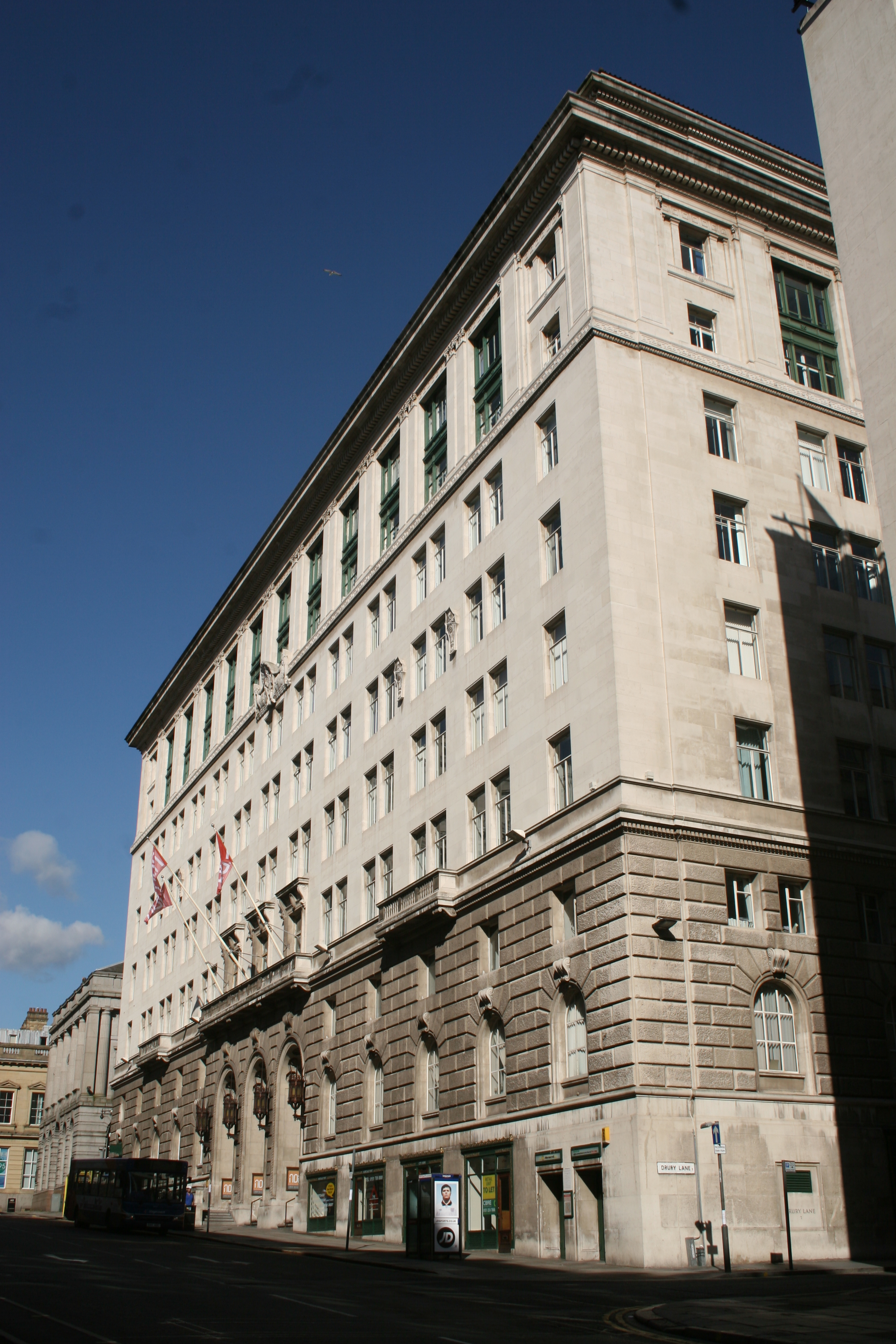
India Buildings by Herbert Rowse

India Buildings by Herbert Rowse

There are claims that a rebuilt School would not be ‘of our time’. Some, like eminent architect Alan Dunlop have claimed that Mackintosh’s would indeed want ‘to see a new school of art fit for the 21stcentury’ – but we can never truly know the wishes of the deceased. Surely the GSA is an excellent didactic tool for today’s students, and in any case it is not very old – it’s a mere blink of an eye in the broader scheme of things. To remake it now would not be a disservice to ‘our time’ but would be a measure of how we value and cherish such works of art. So many buildings have been regrettably erased following fire – to the detriment of our built environment. Gavin Stamp’s publication, Britain’sLost Citiesis a roll call of this approach, whereas when the decision to rebuild has been made the results are rarely questioned. We do not hear claims of, ‘we should have pulled this down and replaced it with something else’. Herbert Rowse’s India Buildings in Liverpool was carefully rebuilt after the effects of incendiary bombs – its authenticity is not questioned because of this; it simply becomes part of the building’s story. Mies van der Rohe’s Barcelona Pavilion was also famously remade and it continues to bring pleasure and delight to all who see it. It is far better to experience this wonderful design than to imagine it’s ‘spirit’ or look at the old photographs.  Plus, we live in an age when this is possible – it is ‘of our time’ to replicate and reproduce components and objects that are better than the ‘originals’.


SaveSave

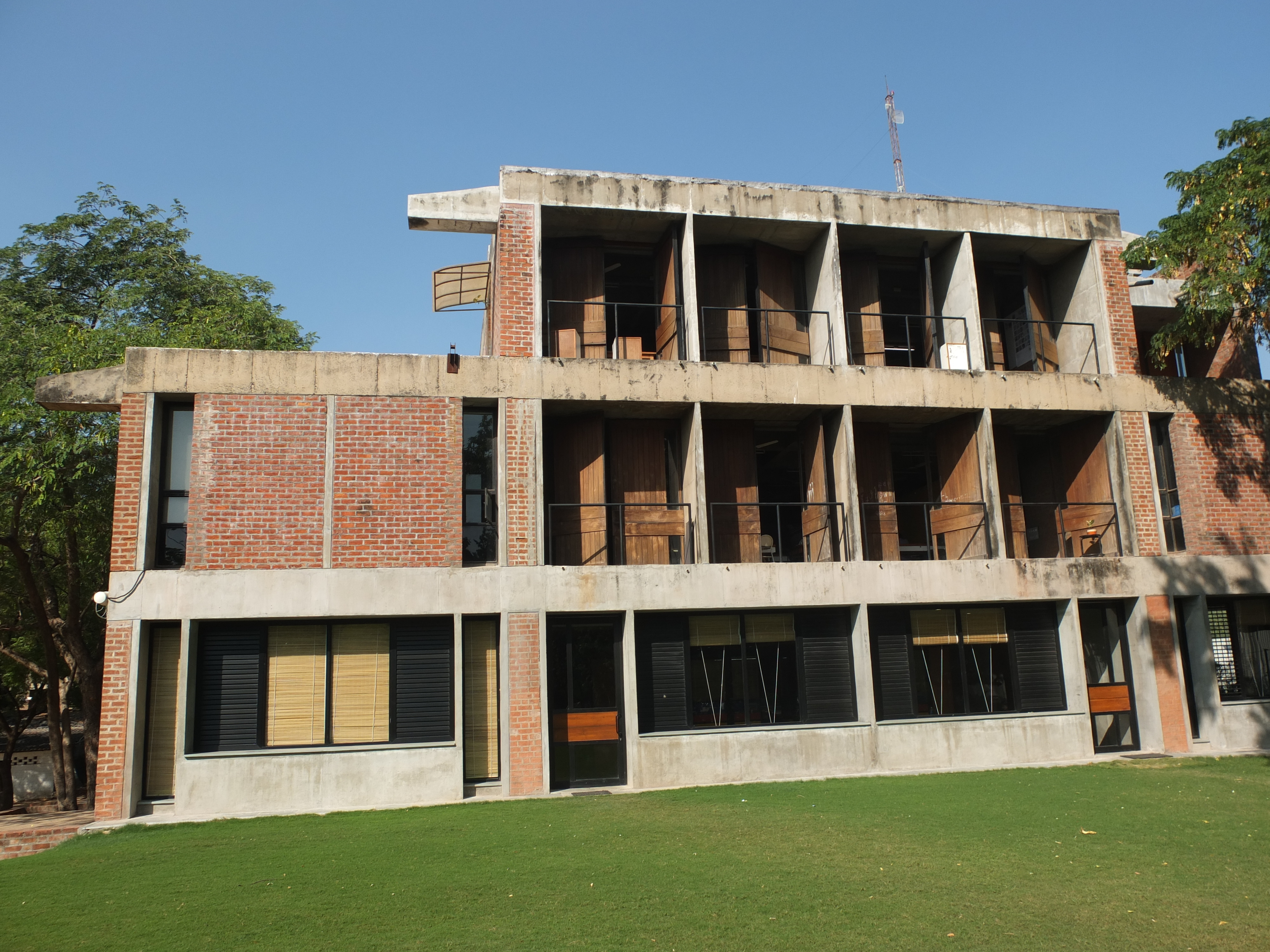
I’ve been spending some time working in and around Accra, and in particular at the Public Records and Archives Department. This archive has undergone major changes in the last five years and is a great place to undertake research with helpful staff and quick responses to queries. Located in a distinctive building with bold concrete brise soleil and a brave concertinaed roof over the entrance space, its interiors rely exclusively on passive ventilation. I was looking mainly at the late colonial records including those of the Public Works Department, sanitation, land, and town planning.

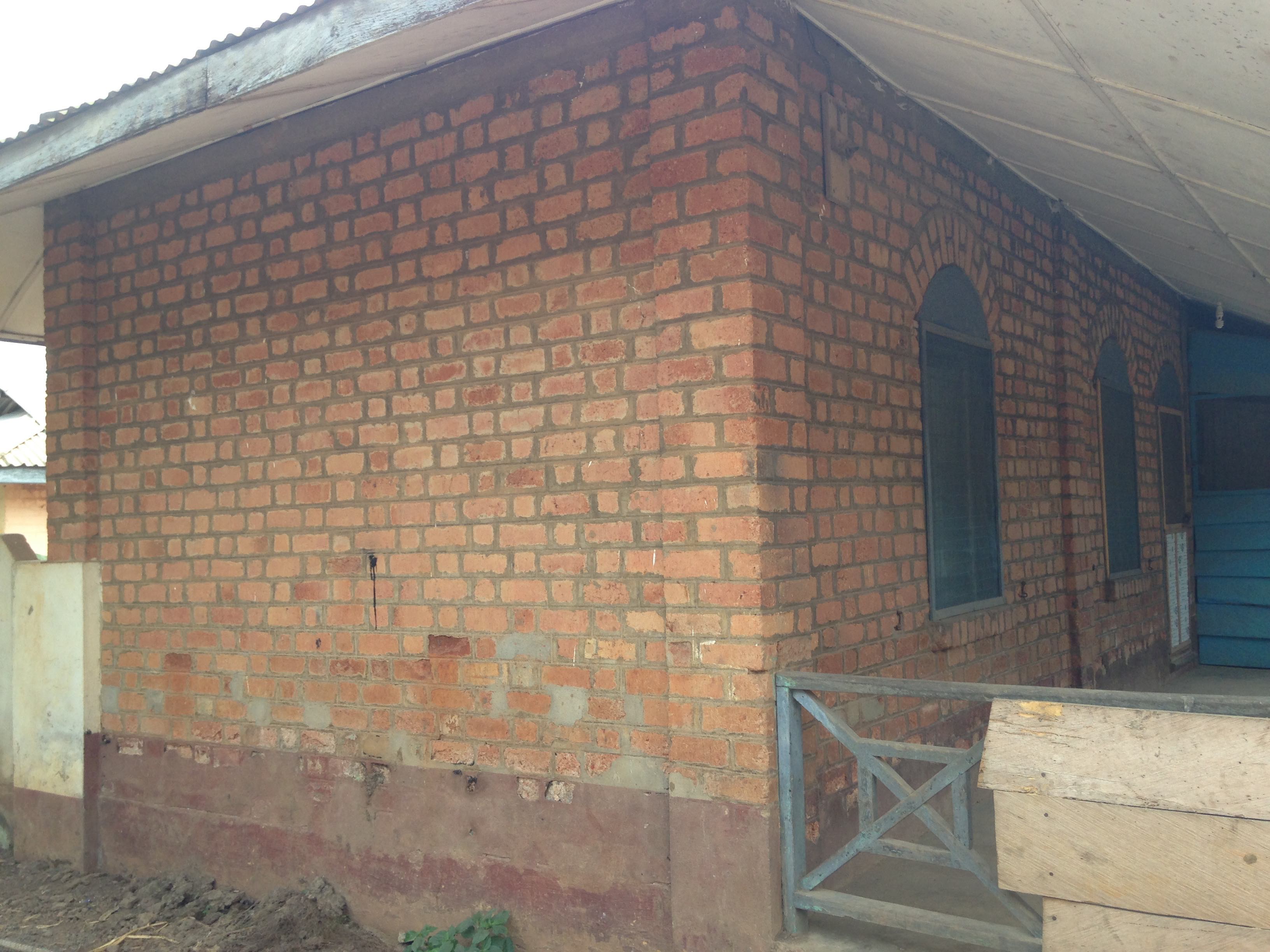
Experimental Swishcrete blocks at Kibi
Experimental Swishcrete blocks at Kibi from 1945
IMG_1003.jpg
Experimental Swishcrete housing at Kibi from 1945. Note the arches above the windows and doors

There were many discoveries and lots to celebrate (and eventually publish), but one particularly interesting find related to a folder called ‘Experimental housing at Kibi’. This gave lots of details on an attempt to build a couple of dwellings in swishcrete (i.e. laterite and concrete mix) blocks in the gold mining town of Kibi, with a view to saving on cement costs and also creating an aesthetic that was more in keeping with the vernacular. It was a particularly exciting find, as we had stumbled across these houses earlier this year, and were taken by their unique construction. The archives revealed that Jane Drew was involved in their design and that she visited the site in early April 1945. It must have formed part of her work on village housing. Although modified and extended the houses still stand and clearly demonstrate the strength of this construction method having survived over 70 years.

Outside of the archives, I managed to finally track down Denys Lasdun’s Paterson Simon’s Office in Accra, 1962 (thanks to the help of their current Managing Director John Traynor). It was formerly a supermarket and toyshop called Farisco.

I was hoping to see the Optimist Club in Sekondi, but as suspected, I was too late and the influential African club has been demolished and now replaced with a large youth centre. Fortunately, Nate Plageman did manage to visit the club before it was demolished and you can see his photos here. Despite this loss, it was good to use copies of the early plans of Sekondi from 1900-1920, housed in the UK National Archives, to further explore the town. I was particularly taken by the Venice Cinema located at the edge of the settlement by the lagoon (was this how the cinema got its name?) and the wonderful merchant villas and stores that can still be found in dilapidated abundance throughout the town.

Venice Cinema, Sekondi

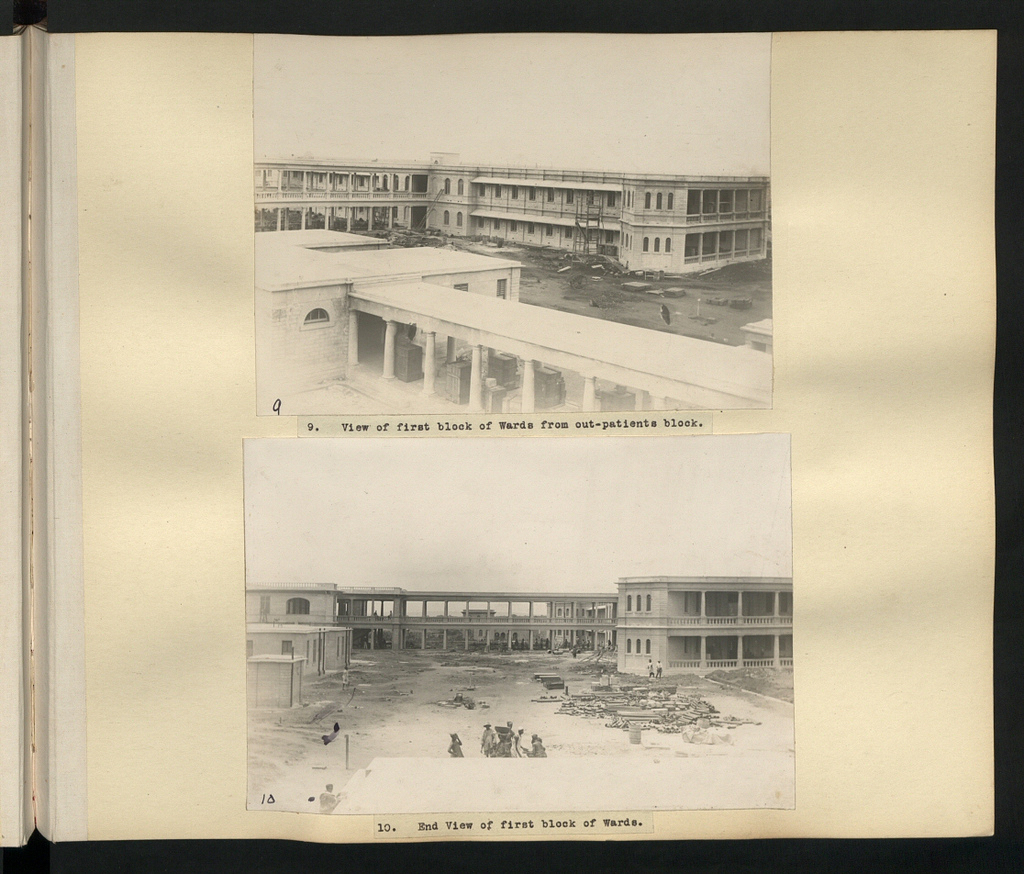
Accra continues to seduce with its array of late colonial structures and modernist set pieces. At Korle Bu just west over the lagoon from Jamestown the hospital dominates the landscape. The hospital forms part of the trilogy of projects developed by Gordon Guggisberg in the 1920s (along with Achimota Schooland Takoradi town and docks). The old hospital structures remain, looking almost like they did when built (and similar to the harbour board buildings in Takoradi) – as captured on Africa Through a Lens. The later brutalist addition to the hospital was by Kenneth Scott, looking more restrained and orderly than the edgier and abrupt Effia Nkwanta hospital in Takoradi by Gerlach and Gillies-Reyburn. If you visit Korle Bu hospital continue to walk through the grounds and head out to the staff housing, tennis courts and garden sanctums that lie secretly beyond – it is a hidden, gentile world of privilege that still manages to exist just a couple of miles from the excitement and paucity of Jamestown.


Korle Bu Hospital, Accra
Korle Bu Hospital, Accra photographed shortly after completion, 1928


Call for Papers: COLONIAL AND POSTCOLONIAL LANDSCAPES: Architecture, Cities, Infrastructures

16th – 18th January 2019  |   Lisbon | Calouste Gulbenkian Foundation
DSC_0412

The infrastructure of the colonial territories obeyed the logic of economic exploitation, territorial domain and commercial dynamics among others that left deep marks in the constructed landscape. The rationales applied to the decisions behind the construction of infrastructures varied according to the historical period, the political model of colonial administration and the international conjuncture.

This congress seeks to bring to the knowledge of the scientific community the dynamics of occupation of colonial territory, especially those involving agents related to architecture and urbanism and its repercussions in the same territories as independent countries.

It is hoped to address issues such as how colonial infrastructure has conditioned the current development models of the new countries or what options taken by colonial administrations have been abandoned or otherwise strengthened after independence.

The congress is part of the ongoing research project entitled “Coast to Coast – Late Portuguese Infrastructural Development in Continental Africa (Angola and Mozambique): Critical and Historical Analysis and Postcolonial Assessment” funded by ‘Fundação para a Ciência e Tecnologia’ (FCT – Foundation for Science and Technology), which has as partner the Calouste Gulbenkian Foundation (FCG).

The aim of this congress is to extend the debate on the repercussions of the decisions taken by the colonial states in the area of ​​territorial infrastructures – in particular through the disciplines of architecture and urbanism – in post-independence development models and the formation of new countries with colonial past


1. Projecting Power in Colonial and Post-Colonial Angola and Mozambique: Architecture, Urban Design, Public Art and Monuments (Jeremy Ball, Gerbert Verheij)

2. China in African, Latin American and Caribbean territories: Examining spatial transformations around diplomacy and economic aid (Valeria Guzmán Verri, Natalia Solano Meza)

3. Spaces in the Americas: current efforts towards a non-Eurocentric theory (Fernando Luiz Lara, Marcio Cotrim Cunha)

4. Planned Violence: Post/Colonial Urban Infrastructures, Literature and Culture (Dominic Davies, Elleke Boehmer)

5. Infrastructural development in the European Portuguese territory in the late colonial period (Paulo Tormenta Pinto, João Paulo Delgado)

6. Peripheral infrastructures in late colonial cities (Tiago Castela)

7. Single and collective housing as a modern laboratory in colonial territories: from public order to private initiative (Ana Magalhães)

8. Beyond Colonialism: Afro-Modernist Agents and Tectonics as Expression of Cultural Independence  (Milia Lorraine Khoury, Diogo Pereira Henriques)

9. (De)constructing the Right to the City: Infrastructural policies and practices in Portuguese-speaking African countries (Sílvia Viegas, Sílvia Jorge)

10. The interrupted utopia. Landscapes of modern collective housing in Former European Colonies  (Roberto Goycoolea, Inês Lima Rodrigues)

11. Globalized Regionalism: the inheritance of colonial infrastructure (Eliana Sousa Santos, Susanne Bauer)

12. Materiality & Mobility in the construction of Colonial Landscapes (Alice Santiago Faria)

13. The transnational live project: critical reflections on the ethics, politics and pedagogies of collaborations between the global north and global south (Jhono Bennett, James Benedict Brown, Peter Russell)

14. Colonial Spatiality in African Sahara Regions (Samia Henni)

15. Urban Legacies: linking enclaving and social identities (Anna Mazzolini, Morten Nielsen)

16. The spatialization of population control in late colonialism: contexts, modalities, dynamics (Miguel Bandeira Jerónimo)