Archive

Historiography

Explore modern cities and architectural production in the blurred era of the independence and postcolonial period

Join us for three sessions which will bring together scholars, researchers and curators to explore architectural production in the blurred era of independence to the post-colonial period of the mid-20th century, focussing on cities in Africa, Middle East and South Asia. 

Register here: https://www.eventbrite.co.uk/e/crucibles-vectors-catalysts-envisioning-the-modern-city-tickets-138966892717

Whether driven by socialist agendas (Nehruvian in India and Nkrumah in Ghana), monarchies (Pahlavis in Iran and Hashemite in Iraq), quasi colonial protectorates, or pan-continental aspirations, architecture (and especially Modernism) was a key apparatus for nation-building, for re-imagining identities and a means to project and invent a new image of the future. The seminar seeks to explore the use of architecture as both physical infrastructure and symbolic expression, as well as its vulnerability to the vicissitudes of changing politics and policies of the times.

The role of cities as crucibles, vectors and catalysts for developing new expressions of identity, change and power is key. Cities in this period saw the emergence of schools of thought, dynasties and collaborations were formed, networks and ideas were shared and publications were disseminated. While the desire of a newly independent nation was often to consolidate a single national collective identity, it was through the urban centres that strands of coherent, yet often multiple identities were formed. The role of figures such as Rifat Chadirji, Mohamed Makiya, Jane Drew and Maxwell Fry were important as they often operated within multiple cities and cross-cultural contexts that spanned the colonial to postcolonial divide. 

These urban centres were either newly built, or they were remade and reimagined through city infrastructure, government buildings, universities, cultural institutions and national monuments. Architecture schools, state sponsored projects and external agencies feed into the discussion and warrant further exploration. The seminar explores the transnational connections, diverse political agendas and complex allegiances which informed architectural development in this period. 

Seminar convenors:

  • Iain Jackson, Professor of Architecture and Research Director, Liverpool School of Architecture
  • Clara Kim, The Daskalopoulos Senior Curator, International Art, Tate Modern
  • Nabila Abdel Nabi, Curator, International Art, Tate Modern

PROGRAMME
TUESDAY 2 MARCH

Session 1: Crucibles, 15:00-16:30 (UTC)

  • Building the Modern City: Expressions of Identity, Change and Power
    • Moderated by Iain Jackson

This panel will explore state-sponsored programmes, planned cities and masterplans in cities such as Lagos, Tehran and Baghdad. It will examine architecture as expressions of nationalism and nationalist political agendas as well as its relationship to big business, corporations and mercantile ventures.

Speakers:

  • Talinn Grigor (University of California, Davis)
    • Building a (Cosmopolitan) Modern Iran
  • Ola Uduku (Manchester School of Architecture)
    • Lagos International Metropolis: A city’s adventure in tropical architecture as an expression of dynamic modernism and growth in the mid 20th century
  • Lukasz Stanek (University of Manchester)
    • Rupture, Transition and Continuity in Baghdad’s Master Plans: From Minoprio to Miastoprojekt

Session 2: Vectors, 17:00-18:30 (UTC)

  • Connecting the Modern City: Networks, Alliances and Knowledge Production
    • Moderated by Clara Kim

This panel will explore the practice of modern architecture through colonial-postcolonial networks and geopolitical alliances. It will explore cities in Mozambique within the context of other Lusophone countries, post-Partition East & West Pakistan, as well as the dissemination of knowledge and technical expertise through pedagogy.

Speakers:

  • Ana Tostões (University of Lisbon)
    • Correspondences, Transfers and Memory: Maputo’s “Age of Concrete”
  • Fahran Karim (University of Kansas)
    • Archaeology of the Future: Constantinos Doxiaidis in East and West Pakistan
  • Patrick Zamarian (University of Liverpool)
    • Global Perspectives and Private Concerns: The AA’s Department of Tropical Architecture

TUESDAY 9 MARCH

Session 3: Catalysts, 15:00-16:30 (UTC)

  • Fragments of the Modern City: Memories, Echoes and Whispers
    • Moderated by Nabila Abdel Nabi

This panel will explore the collaborations, connections and entanglements that developed between art and architecture during a dynamic period of building in Morocco, India and Iraq. It will examine the legacy and afterlives of these projects through the investigation of under-recognised figures and narratives in art and architecture.

Speakers:

  • Lahbib el Moumni & Imad Dahmani (founders of MAMMA, Mémoire des Architectes Modernes Marocain)
    • Initiatives toward saving modern heritage of Morocco
  • Ram Rahman (Photographer/Curator)
    • Building Modern Delhi, The Nehruvian Post-Independence Renaissance
  • Amin Alsaden (Independent Scholar)
    • Syntheses Across Disciplines: Rifat Chadirji and Art-Architecture Liaisons in Modern Baghdad

This event is organised by Hyundai Tate Research Centre: Transnational and Liverpool School of Architecture.

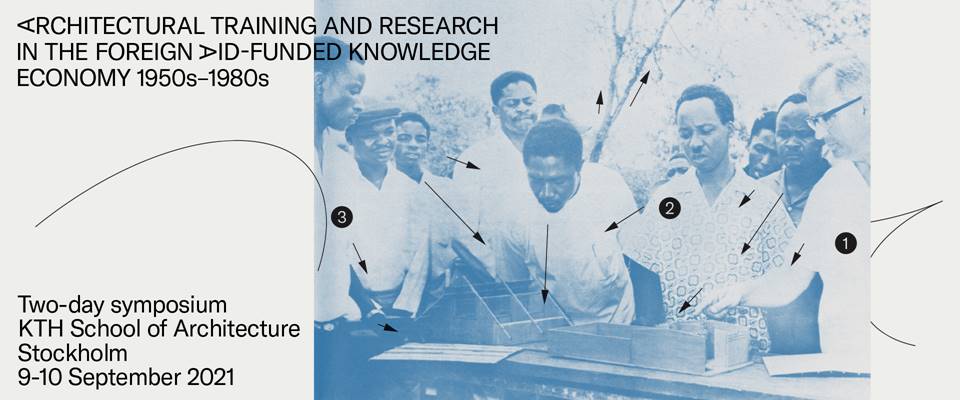
Architectural Training and Research in the Foreign Aid-Funded Knowledge Economy, 1950s-1980s.

Two-day symposium, KTH School of Architecture, Stockholm, 9-10 September 2021.CALL FOR PAPERS / Submission deadline: 1 April 2021. 

From the 1950s to the late 1980s, the politics and economies of foreign aid – instigated by both the ‘capitalist West’ as well as the ‘communist East’ – gave rise to a whole infrastructure destined to assist the progress of ‘developing countries’ on their ‘path to development’. The various North-South exchanges that took place in the name of ‘development’ have left a deep imprint on the geopolitical landscape of postcolonial Africa, Asia, and Latin America. Largely instituted through bilateral relations between individual states, these ‘aid’ initiatives involved not only financial and material resources but also various forms of knowledge and expertise; as such, the modalities of this global, foreign aid-funded infrastructure boosted the creation and reinforcement of all sorts of institutional actors to efficiently exchange knowledge – largely through training courses, educational programs and/or research projects. In the light of widespread rural migration and intensive, rapid urbanization processes, expertise on the built environment was a particularly salient form of knowledge to the aims of foreign aid. Hence, architecture, urbanism and planning were no strangers to an emerging foreign aid-funded knowledge economy – a context in which the production and circulation of knowledge were intimately tied to the political-economic value attributed to them by foreign aid diplomacy.

How did architectural knowledge figure in foreign aid-sourced international relations, and what frameworks were set in place to efficiently exchange that knowledge?

For this two-day symposium, we seek scholarly work that critically analyzes, contextualizes, or theorizes the establishment and functioning of such institutional actors, training courses, educational programs, research centers, and other infrastructures for knowledge exchange that emerged under the aegis of development and targeted ‘Third World’ clients. We welcome a wide range of methodological and creative perspectives as well as less empirical (but well-informed) theoretical approaches that interpret this phenomenon from a postcolonial or decolonizing perspective. We also encourage contributions that scrutinize the intersections of these histories with discussions of gender, race, religion and nationalism.


This two-day symposium will be held in Stockholm on 9-10 September 2021. In light of the current pandemic the event will be organized either in a hybrid format, allowing for both in-person and online attendance, or, if health regulations dictate, as a fully online event. The symposium is envisioned as one long, thematically well-focused discussion, without parallel strands, and aims to bring 12 to 15 established as well as young scholars together from every discipline that engages with the topics outlined above. 
We’re happy to receive anonymized abstracts of up to 300 words and 1 optional image until 1 April 2021, submitted via email to architectureforeignaid@arch.kth.se. Acceptance will be dependent on an anonymous review of the abstract by the scientific committee. If a different format than that of a presentation based on a paper would be more suitable to your work, please contact us (same deadline applies).


Scientific committee: Sebastiaan Loosen (KTH), Erik Sigge (MIT), Helena Mattsson (KTH), Viviana d’Auria (KU Leuven) and Kenny Cupers (University of Basel).


Please find the full CFP attached and visit our website for up-to-date information: architectureforeignaid.arch.kth.se
Best regards
Sebastiaan Loosen, Erik Sigge & Helena Mattsson

International Perspectives on the Future of Architecture and Urbanism in the Post-COVID Age
Online Symposium, January 29-30, 2021, 11am-2pm US Eastern Time

Register for this conference at https://bit.ly/EpidemicUrbanism to join us for one or both days. If you have any questions, please contact epidemicurbanism@gmail.com. The deadline for registration is January 25th. 

Organizers: Mohammad Gharipour and Caitlin DeClercq, Epidemic Urbanism Initiative

Long before the appearance of COVID-19, the urban fabric of cities across the world had been shaped by prior epidemics. Indeed, the study of historic, global epidemics has illuminated the many ways in which urban life and architecture have changed during times of pestilence. With the outbreak of each epidemic has come new scientific understandings of disease, new modes of governing of social life and interaction, novel efforts to intervene in and prevent infection, the exacerbation of social inequities, and the creation of new occupational and social roles. Each of these outcomes has been enacted and emplaced in the built environment over time and across diverse geographies through the design or re-design of buildings and public spaces, the quarantine or redirection of goods and people, the adoption of new social roles, and the imposition of new urban design policies and practices. Spanning two days, this symposium, comprised of scholars and practitioners from twenty countries, will confront the impacts of this pandemic on cities and imagine new possibilities for a post-COVID urban landscape through topics including:

  • January 29th, 2021 (11am-2pm EST) topics: Response and Experience; Ecology and Sustainability; and Education and Pedagogy 
  • January 30th, 2021 (11am-2pm EST) topics: Design and Interventions; Healthcare Design; and Social Justice and Equity

Register for this conference at https://bit.ly/EpidemicUrbanism to join us for one or both days. If you have any questions, please contact epidemicurbanism@gmail.com. The deadline for registration is January 25th. This virtual conference is sponsored by the AIA Design & Health Research Consortium (DHRC). The Epidemic Urbanism Initiative (EUI) was founded by Dr. Mohammad Gharipour and Dr. Caitlin DeClercq in March 2020. This is the fourth international conference hosted by the EUI. All prior conferences and additional conversations are publicly available at the EUI YouTube channel

Panel 1. Response and Experience (Friday, January 29)
Moderator: Eliana Abu-Hamdi Murchie (USA)
Impacts of COVID-19 on Liming as a Form of Commoning in Trinidad and Tobago Nicole de Lalouvière and Renelle Sarjeant (Trinidad and Switzerland)
Superblocks as a Promising Pandemic Response and Experience in Barcelona, Spain Federico Camerín, Luca Fabris, and Riccardo Balzarotti (Italy)
Paradigm Shift of Work and the Workplace amid the Pandemic in the UAE Mouza Al Neyadi and Kheira Aoul (UAE)
Experiential Learning to Support Remote Instruction in an Australian Architecture Design Studio Ross T. Smith and Cecilia de Marinis (Australia)
Protective Barriers in US Cities During and After the COVID-19 Pandemic Aki Ishida (USA)

Panel 2. Ecology and Sustainability (Friday, January 29)
Moderator: Michael Vann (USA)
Landscape and Eco-systemic Intensification Strategies During and After Pandemics in Milan, Italy Andrea Oldani (Italy)
Communities, Schools, and Future Ecologies in Washington DC, USARebecca Milne, Sean O’Donnell, and Bruce Levine (USA)
Urban Form and Thermally Comfortable Pedestrian Streetscapes in Post-COVID Mendoza, Argentina Maria B. Sosa, Erica Correa, and Maria A. Canton (Argentina)
Emergency Responsive Design in Housing Typologies in the Post-COVID Kigali, Rwanda Manlio Michieletto (Rwanda)

Panel 3. Education and Pedagogy (Friday, January 29)
Moderator: Ashraf Salama (Scotland)
Equitable Remote Design Education in the Post-COVID the American Great Plains Bud Shenefelt (USA)
Implications for Placemaking Pedagogy in an Archipelagic Setting during Pandemics in the Philippines Richard Carraga, Shirley Maraya, Maria Joelyca Sescon, and Iderlina Mateo-Babiano (The Philippines and Australia)
An Online Student Workshop as a Pedagogical Experiment Necessitated by COVID-19 in Serbia Mladen Pešić and Miloš Kostić (Serbia)
Pedagogical Responses to COVID-19 and Rethinking Norms of Architectural Education in the UAEAhmad Sukkar and Emad Mushtaha (UAE)
Assessing the Experience of Virtual Learning Techniques in an Urban Design Studio in the USAHessam Ghamari and Nasrin Golshany (USA)

Panel 4. Design and Interventions (Saturday, January 30)Moderator: Louisa Iarocci (USA)
The Fall of Starchitecture and the Future of Architectural Practice in the Post-COVID UK Elizabeth Walder (Wales)
Urban Design and Public Transport in the Age of Pandemics in Harare, Zimbabwe Brilliant Mavhima (Zimbabwe)
Envisioning a Post-COVID Hybrid Work/Housing Solution in an Architectural Studio in Berlin, Germany Robinson Michel (Germany)
Sustaining Safe Construction Operations in the U.S. During COVID-19 Babak Memarian, Sara Brooks, and Jean Christophe Le (USA)

Panel 5. Healthcare Design (Saturday, January 30)
Moderator: Anjali Joseph (USA)
Spatial Strategies to Separate COVID Patients within Hospital Building Infrastructure Pleuntje Jellema, Ann Heylighen, and Margo Annemans (Belgium)
Hospital Ward Flexibility, Equity, and Virus Exposure Risk in Freetown, Sierra Leone Stavroula K. Koutroumpi (England)
Rethinking Personal Space Needs in Hospital Settings in the Post-COVID Era Lusi Morhayim (Israel)
Epidemic Metabolism in Oncology Hospital Design Practices during the Post-COVID Age Katarina Andjelkovic (Serbia)
Visualizing Healthcare Design’s Alternative Futures through Technical and Typological InnovationJeremy Kargon and Rolf Haarstad (USA)

Panel 6. Social Justice and Equity (Saturday, January 30) Moderator: Irene Hwang (USA)
Responding to an Unequal Society through Agile and Adaptable Teaching Strategies in South Africa Melinda Silverman and Sandra Felix (South Africa)
Pandemics and the Exacerbation of Social Inequities in Urban Informal Settlements in Pakistan Amna Shahzad (Pakistan)
Reinterpretation of Traditional Urban Space and Social Justice in the Post-COVID Lagos, Nigeria Timothy Odeyale (Nigeria)
Shared, Accessible, and Healthy Streets in Post-Pandemic American Cities Celen Pasalar and George Hallowell (USA)

Call for Participants: Writing Group on Architecture and Empire
Society of Architectural Historians of Great Britain

https://www.sahgb.org.uk/news/architectureandempire

With a formal existence spanning early modern to contemporary history, the British Empire supported complex networks of trade, war and settlement. It intervened in land-based expansions as well as maritime worlds and prefigured a global architectural history. Yet research that seeks to critically address the empire and its legacy poses complex challenges for the architectural historian: the mental-mapping of bureaucratic systems across multiple continents, finding evidence of buildings and landscapes for which little documentation exists, sitting with a complex past and present of race, gender, religion, nationalism and capitalism.

This writing group is formed as an empathetic structure for scholars writing books and dissertations on imperial and colonial histories. We seek to create a space for researchers to share resources on chapter writing, structuring and revision. Writing is often an isolating activity, particularly for emerging scholars with non-Eurocentric specialisations that are underrepresented in the academy. To this end, we especially encourage applications from early-career researchers and those whose primary field sites are located outside of Great Britain. This project is among the first within the society’s new Race and Ethnicity network, a new effort to foster greater equality, diversity and inclusivity within the Society of Architectural Historians of Great Britain.

The group will meet for two hours every two months, with participants alternating between workshopping their own draft chapters and that of another in the writing group. Participants must commit to reviewing and presenting once every four months. To mitigate time zones and geographies, all events will be held over Zoom.

HOW TO JOIN

To join, please send a one-page cover letter and a brief project abstract to info@sahgb.org.uk with the subject line ‘Application: Writing Group on Architecture and Empire’ by 15 January 2021. The cover letter should state why you would like to be a part of the group and your general meeting availability, and the abstract should address the dissertation or book project you hope to work on as part of the writing group. All interested participants will be notified by 31 January 2021. The group will meet every other month beginning in February 2021. The meeting times, format and specific group expectations will be refined amongst participants during the first meeting and reviewed on a regular basis.

This writing group is convened by Sonali Dhanpal (Newcastle University), Sben Korsh (University of Michigan) and Y.L. Lucy Wang (Columbia University).

This thematic section of ABE Journal, edited by  Jiat-Hwee Chang and Daniel J. Ryan, explores the wide-ranging socio-environmental implications of comfort for architectural history. The contributions over this and the next issue complicate and expand upon our understanding of comfort. Each essay unpacks how comfort was situated and assembled in the built environment of different temporalities and geographies, beyond the taken-for-granted immediacy of the present and the discursive familiarity of temperate European and North American contexts.

 “The five zones showing in a graphic manner the climates, peoples, industries and productions of the earth” published by Western Publishing House, Chicago, in 1887

Drawing from the cognate fields of scholarship in, among others, Science and Technology Studies, Postcolonial Studies, and Sociology of Practice, the contributions show how, during the past two centuries, comfort and the built environment were historically entangled with (settler) colonialism and decolonization, and the various (dis)enchantments of modernities and modernization in Asia, Australia, Latin America, and West Africa. By understanding comfort in relation to these cross-cultural and cross-climatic encounters, these contributions have far-reaching implications for comprehending our shifting and situated relationships with not just built environmental transformations but also planetary climate change.

Full edition freely available here: https://doi.org/10.4000/abe.7853

We are delighted to offer researchers at select partner universities an opportunity to apply for one of University in Liverpool’s Virtual Fellowships.

The Fellowships are open to researchers working in the field of heritage and are open to early career as well as established researchers.

The Fellowships provide an opportunity for selected candidates to gain collaborative research experience in an international research environment with the aim of publishing or co-publishing a specific piece of research in an international journal or equivalent venue and fostering long-term collaboration.

The Fellowships are fully online and travel to the UK is not required.

Successful candidates will have the opportunity to collaborate virtually with a research group or designated individuals at the University of Liverpool.

The Fellowship will offer:

  • one to one research mentoring, including support in analytical and interpretive methods in heritage research: this will be delivered at a distance through zoom or similar platforms
  • relief from teaching and other duties to pursue the completion and write-up of a piece of research for publication
  • access to online research resources and training including GIS training; Photogrammetry; AutoCAD and visualisation (3D Max); 3D scanning; Fieldwork/ documentation methods support and guidance with academic writing in English
  • opportunities for research collaboration through “virtual” participation in relevant research group activities in Liverpool.

Full details on how to apply here: https://www.liverpool.ac.uk/humanities-and-social-sciences/research/training-and-support/virtual-fellowships/

Impatient Cities of the Gulf: Post-oil Architecture in Flux – Call for Papers – HPA 8/2021

Today’s general perception of Gulf cities is based on the assumption of a futuristic vision; a visionary development and a cluster of hi-tech constructions.

Since the striking of oil, this ‘brave new world’ has been a testing ground for experimental, risk imbued architecture and real estate. The sudden affluence and ambition of the rulers to demonstrate progress and social advancements (sometimes expressed through outlandish ‘iconic’ designs) has certainly fired this drive. The building of cities seemed an appropriate culvert for the vast funds generated, turning what was once barren into a fertile land.

Screenshot 2020-07-30 at 09.59.44

Furthermore, there is an ever-present sense of the ‘tabula-rasa approach’ that forced (or perhaps tempted) architects to pursue different and alternative design processes. Gulf cities seem to permit the idea, if not always the reality, of being able to ‘start again’, to be re-made, re-imagined and re-Modernised. There is a sense of being forever in the ‘now’, with ‘historical’ projects stretching back mere decades. Perhaps this desire to continually reinvent brought about shortcomings in early Modernist paradigms, and the rapid rise of new social/cultural/artistic concepts (such as pop art/metabolism/structuralism/post-modernism/idiosyncratic and so on).

These preliminary reflections offer an image of the Gulf as a fluid ambit that challenged designers for several decades in the light of a central question: how do architects build in a place with a constantly changing context? How are ideas of history, tradition, memory, and heritage constructed in this flux?

In the second half of the 20th century, the circumstantial conditions generated a series of experimental, utopian, sometimes unbuildable projects with a high level of idealisation. Some are renowned such proposals as Wright’s plan for Baghdad or the Smithsons’ Kuwait mat-building. Many are still to be unearthed as they were shelved and never implemented, or abandoned along the way, altered or demolished.

In other cases, the region’s specific constraints – such as limited material availability, narrow construction time and harsh climate, led architects to original ideas, technologies, and procurement methods with highly inventive and analytical processes.

Moreover, modern architecture in the Gulf seems somehow different for sporting an urge for negotiating the local context by ‘flirting’ with traditional elements of locality, such as geometrical motifs, shapes, textures or colour palette. The liberal application of decorative motifs, patterns, applied ornamentation needs careful examination, especially when it is so diligently applied to forms and arrangements more generally associated with a more austere modernist agenda.

The editors invite papers that extend the discussion on the Gulf built environment during the modernisation era, over the duality global/local as terms in opposition. Contributions are encouraged to analyse different architectural narratives, approaches and schools of thought to compensate the assumption that flattens ‘modernity’ as a one-directional, repetitive and monotone practice acquired and acritically transplanted into the Arab Peninsula.

Focusing on the second half of the 20th century, and with an eye on the contemporary implications, possible topics include, but they are not limited to:

–          Experimental and inventive design practices

–          Global aspiration and local constraints

–          Context negotiation

–          Materiality

–          Knowledge exchanges and bijective practices

–          Modernity, tradition and transition

–          De-colonial urbanism

–          Identity formation and the built environment

–          Place-making, streetscapes and scale

Authors must submit directly full papers using www.hpa.unibo.it.

The guidelines for paper submission are available at https://hpa.unibo.it/about/submissions#authorGuidelines

Please, fill in the author’s profile with all the information required as:

• Applicant’s name

• Professional affiliation

• Title of paper

• Abstract

• 5 keywords

• A brief CV (max 2,000 characters)

Please submit the proposal in the form of MS Word (length between 4,200 and 8,500 characters). The submitted paper must be anonymous. Please delete from the text and file’s properties all information about name, administrator etc. Papers should clearly define the argument in relation to the available literature and indicate the sources which the paper is based on.

All papers received will go through a process of double-blind peer review before publication.

HPA also looks for contributions for the review section. https://hpa.unibo.it/about/editorialPolicies#sectionPolicies

To address questions to the editors:
roberto.fabbri@udem.edu
Iain.Jackson@liverpool.ac.uk

– 31 December: Deadline for paper submission

– January: Notification of acceptance

– January-March: Peer-review process

– April-May: Copy editing and proofreading

– June 2021: Publication

Online Symposium: Epidemic Urbanism Reflections on History: 28 May and 29 May 2020

Screenshot 2020-05-15 at 14.22.45

Epidemic illnesses – not only a product of biology, but also social and cultural phenomena – are as old as cities themselves. The recent pandemic of COVID-19 has put into perspective the impact of epidemic illness on urban life and exposed the vulnerabilities of the societies it ravages. So how can epidemics help us understand urban environments? And what insights from the outbreak and experience of and the response to previous urban epidemics might inform our understanding of COVID-19?

Addressing these questions, this online symposium on Thursday 28 and Friday 29 May, 16:00–18:00 BST (11:00–13:00 US EST) will bring together academics from a range of disciplines to present case studies from across the globe demonstrating how cities in particular are not just the primary place of exposure and quarantine, but also the site and instrument of intervention.

Each presentation will tell a story of a city, an outbreak of illness, and the city’s response to the epidemic, addressing notable interventions or actions implemented and their effects. Some will discuss the impact of the epidemic on urbanism, urban design and urban planning. Others consider epidemic influence on architecture, the built environment and the experience of illness.

Presentations will cover a range of illnesses and epidemics, geographies, time periods and urban interventions. The observations on the impact of these epidemics on society and urban life seek to offer insights to understand, critique or complicate the conception of and response to COVID-19 because the symposium ultimately aims to create a space in which to use history as a medium to provide a better understanding of the current crisis and how it might shape our future.

Information and Registration:

Web: https://bit.ly/EpidemicUrbanism

Email: epidemicurbanism@gmail.com

Register by 20 May 2020.

The 7th International Congress on Construction History (7ICCH) will be held in Lisbon, from 12 to 16 July, 2021. As in 6ICCH (Brussels, 2018), the 7ICCH event will adopt a two-step procedure for proposals evaluation:

– First call: a first call for proposals for thematic sessions will be open from 15 April 2020 to 9 May 2020; followed by a

– Second call: a general call for abstracts for the usual open sessions, from 18 May to 28 June 2020.

We are what we build and how we build; thus, the study of Construction History is now more than ever at the centre of current debates as to the shape of a sustainable future for humankind. With the main theme “History of Construction Cultures”, the Congress will provide an opportunity to celebrate and expand our understanding of the ways that everyday building activities have been perceived and experienced in different cultures, times and places.

The general call for abstracts will invite proposals for inclusion in thematic sessions as well as single contributions dealing with a broad range of construction history topics (construction determinants and their relation with design, extraction and processing of materials, site management, works execution processes, knowledge transfer, actors, machines, tools, building legislation, construction – politics, economy and society, etc.). The aim will be to achieve a broad and in-depth assessment of new research in construction history.

The present call, open until 9 May 2020 invites prospective session chairs to suggest topics for thematic sessions. The proposed subjects should contribute to the debate of the latest issues, approaches and questions of research in the field of construction history research, stimulating intercultural and interdisciplinary collaboration and discussion. Proposals should include a description of the theme (max. 400 words), an explanation of the relevance of the theme (max. 400 words) and the CV of the applicant chair demonstrating his/her relevant expertise.

With the support of the Scientific Committee, the Organizing Committee will select up to 12 thematic sessions, limited to one per applicant. Chairs of the thematic sessions are expected to be present at the 7ICCH and give a short introduction to their session. They are, in collaboration with the Scientific Committee, responsible for the selection process of the submitted abstracts and for the editing process of the submitted papers. Four or five papers will be selected for each session.

No more than one paper from the chair’s research team can be selected. The Scientific Committee reserves the right to redirect papers towards other thematic or general sessions. Proposals should be sent to 7icchlisbon@gmail.com until 4 May 2020. Prospective session chairs will be informed on the evaluation of their proposals by the Organizing Committee by 18 May 2020.

More information at http://www.7icch.org

Organizing Committee:
Chair – João Mascarenhas Mateus (University of Lisbon)
Treasurer – Ana Paula Pires (NOVA University of Lisbon)
Sandra M. G. Pinto (NOVA University of Lisbon) Fernanda Rollo (NOVA University of Lisbon)
José Aguiar (University of Lisbon)
Ivo Veiga (University of Lisbon)
Milton Pacheco (Coimbra University)
Manuel Caiado (University of Lisbon)

The Coloniality of Infrastructure: Eurafrican Legacies:
Call for Papers – 
Conference at the University of Basel, 24-26 June 2020

IMG_0730

When Eurafrica emerged in the 1920s as an intellectual and political project to connect Europe with Africa, its goal was to ensure European colonial dominance in a changing world. Key to the proposed continental merger was infrastructure—not surprising at a time when railways, ports, camps, and other large-scale building projects were facilitating the extraction and movement of things for Europe while curtailing the freedom and mobility of Africans on an unprecedented scale. Recent scholarship has emphasized the centrality of Eurafrica and the type of colonialism it mustered in the history of European integration, from the EU’s founding intellectuals to its Cold-War-era realization. But continental infrastructure also played a role in African struggles for independence. Highways, ports, and dams became tools of state-building and even mobilized hopes of Panafrican integration and international solidarity. In practice, however, large-scale infrastructure required technical and financial aid which further entrenched Africa’s asymmetrical relationship to the Global North.
Today, as Africa enters a new age of development increasingly dominated by China, and the EU is in fundamental crisis, is it still possible to speak of a Eurafrican present? From the physical imprint of cities and the configuration of intercontinental airline routes, infrastructure testifies to the enduring legacies of Eurafrica. Infrastructure shapes territories and governs the mobilities within and across them, but also serves to immobilize and externalize bodies and things. The European infrastructure of the Mediterranean border regime, in which African migrants are systematically being detained or left to die, recalls colonial-era policies that valued life and dictated death along racial lines. At the same time, European aid focused on infrastructural development in Africa is increasingly targeted to counter such unwanted migration—without touching the global extraction economies that have roots in European colonial rule and continue to shape African cities and territories today. Because of these specters of Eurafrica, the EU seems structurally incapable to come to terms with its colonial past.
This conference proposes to explore historical continuities in Africa’s relationship with Europe through the lens of infrastructure. What are the infrastructural histories that bind the unequal destinies of people together across continents, and how do these legacies shape contemporary lifeworlds and international relations? How does infrastructural violence shape international relations between Africa and Europe, and how is the legacy of Eurafrica manifested in the spaces of everyday life? To answer these questions, the conference invites scholars from urban studies, history, political science, postcolonial theory, architecture, border and migration studies, and allied fields. We invite contributions that develop new perspectives of our geopolitical and interconnected urban present through its infrastructural pasts. Such studies of material and aesthetics relationships between Africa and Europe can focus on questions of lifeworlds, urban transformation, migration, territory, citizenship, development, or related themes. We are particularly interested in studies that can reveal the differential entanglements between people and places, and locate alternative forms of infrastructure, imaginaries of belonging, ongoing struggles for decolonization, and practices of world-making that decenter colonial ways of seeing, feeling, and knowing.
Confirmed Keynote Speakers:
Elizabeth Povinelli (Columbia University)
Siba N’Zatioula Grovogui (Cornell University)


Scientific Committee:
Peo Hansen (Linköping University, Sweden)
Edgar Pieterse (University of Cape Town)
Muriam Haleh Davis (University of California Santa Cruz)
Samia Henni (Cornell University)
Charles Heller (Forensic Oceanography, Geneva)
Anne-Isabelle Richard (University of Leiden)
Bilgin Ayata (University of Basel, Sociology)
Julia Tischler (University of Basel, Centre for African Studies)
Lorena Rizzo (University of Basel, Centre for African Studies)
Madeleine Herren-Oesch (University of Basel, European Global Studies)
Selection of Speakers:
Please submit an abstract of no more than 300 words and a short C.V. by 10 December 2019 to Michelle Killenberger (michelle.killenberger@unibas.ch). Applicants will be notified of acceptance in February 2020. We will cover travel and accommodation expenses for speakers in need of financial assistance.
 
Conference Organization:
The conference is organized by Kenny Cupers, Urban Studies, Department of Social Science at the University of Basel, in collaboration with Sociology, the Centre for African Studies, and the Institute for European Global Studies, as well as the African Centre for Cities at the University of Cape Town.
Follow-up Conference:
A follow-up conference will take place in collaboration with Prof. Edgar Pieterse at the African Centre for Cities at the University of Cape Town in June 2021. Entitled “Emerging Infrastructural Worlds: Mapping Urban Research in Africa,” this conference will map research approaches to transnational infrastructure projects across Africa and their consequences on the ground.


More information:

This conference is funded by the Swiss National Science Foundation. For more information about the conference and associated research projects, please visit: