Liverpool School of Architecture, at the University of Liverpool and the Program in the History of Science, Medicine, and Technology of the Johns Hopkins University invite proposals for a hybrid symposium to be held in Liverpool from the 17-18 April 2025.
Pathology Labs, Korle Bu Hospital, Accra, c1958
We welcome presentations that explore various settings for health and healing, such as shrines, sacred healing huts, and herbal ‘apothecaries’ and other spaces for indigenous medicine and healing practices; ‘basic’ health care infrastructure incorporating dispensaries, clinics, and hospitals developed for early missionary and colonial medicine; post-independence medical centres. We are also interested in papers examining the use of healthcare ‘vectors’ such as barefoot doctors, travelling midwives and paramedics and their spread of health care practices such as vaccinations, and childhood nutrition programmes in urban and rural areas.
We are interested in the settings for full range of medical specialisms from paediatrics to psychiatry and also more contemporary physical design responses to contemporary pandemics such as Ebola and Covid. Evidence and records of mixtures of indigenous and western healthcare practices in some community settings and the emergence and involvement of teaching hospitals in healthcare planning is also of interest.
Other possible topics include the role of military hospitals, colonial and modern, and contemporary healthcare infrastructure and provisions for displaced persons and refugees. We encourage interdisciplinary approaches–history of medicine, medical anthropology and sociology, oral history, among others.
Our area of interest is the African continent, from the ‘MEANA’ countries of the maghreb, north of the Sahara, to all countries South of the Kalahari and East and West of the Sahara. Health and healing facilities on islands in proximity to main continental mass such as Zanzibar, Mauritius, Fernando Po and Cape Verde are also of unique interest.
We are seeking to publish selected outputs from the symposium in a volume currently under negotiation with the publisher. We welcome abstracts (500 words max) and short CVs (1page) Please also indicate whether you intend to deliver your paper in person or online. For more information please contact Ola Uduku o.uduku@liverpool.ac.uk or Bill Leslie, swleslie@jhu.edu
Timothy Latim: Reflections on Kigali writing workshop
Context
I was invited to the one week writing workshop as a guest mentor to discuss with the students of architecture, how photography can be used to support architectural writing and design. The workshop held at the University of Rwanda was in close proximity to three of the buildings being studied and I got a chance to visit and discuss the buildings with the students.
First Impressions
Kigali is coined as the city of a thousand hills. An apt description of it. Standing at any one hill one observes the landscape unfolding, the undulating hills reveal themselves in layers to the observer. While it serves as an incredible sight, the topography is also a major influence in the design and development of Kigali. The varying layers of landscape can as a metaphor to the influence that the city has had over its history. This is apparent in the diversity of essays and research topics presented by the students. A broad reflection would categories these into three main ideas in regards to time. Colonial history, contemporary influence and ambitions of the city.
Historical – Colonial influences.
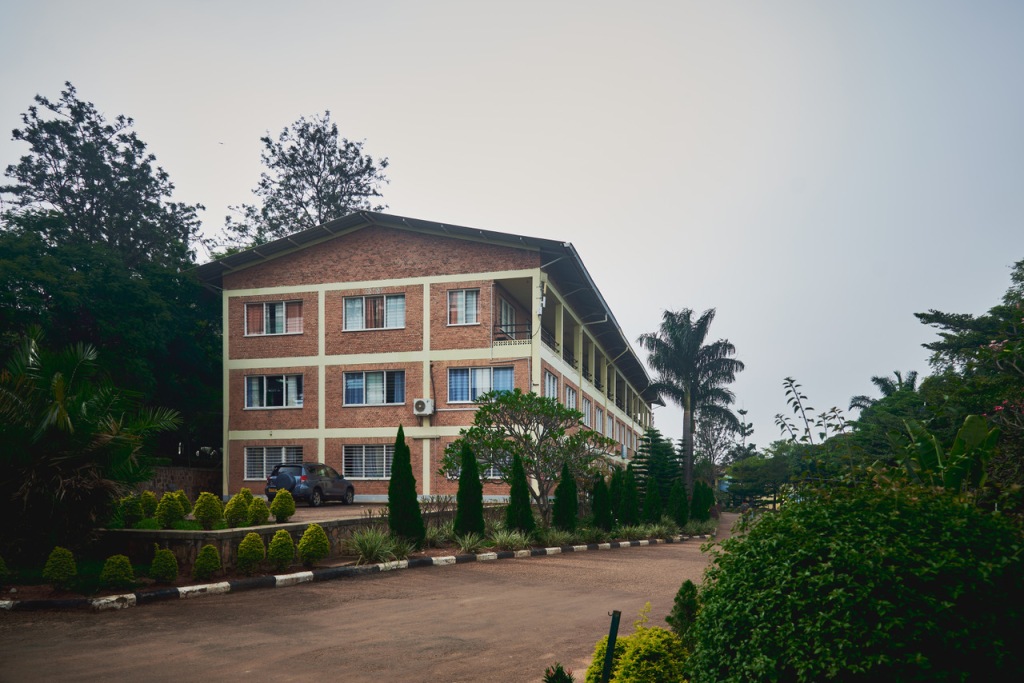
The influence on Rwanda predates the shadow of genocide. Into the realm of both native history and colonial influences. A guided tour and with the student to the Administration Building reveals an interesting dialogue between the architectural influences from the Belgium in the design and construction of the building. These were noted to be the fair faced used of materials in construction. While changes in the dynamics of Rwanda socially and politically influenced the use of the Administration building over time, from the use by military all the way to a university campus. Similar traces of the Belgium influence can be found all around the Univeristy. Which was interesting to being to unravel alongside the students.
Administration block University of Rwanda
Contemporary influences.
Completed in 2014 by Kigali by FBW Group. The Library complex serves an example of a contemporary building. A reflection of the trends and issues currently being resolved by the architecture fraternity. The use of form in the composition of the building. A conscious effort to design the building to be passive in regards to heating and cooling. And the use of locally available materials to clad the building.
Library college of science and technology, University of Rwanda
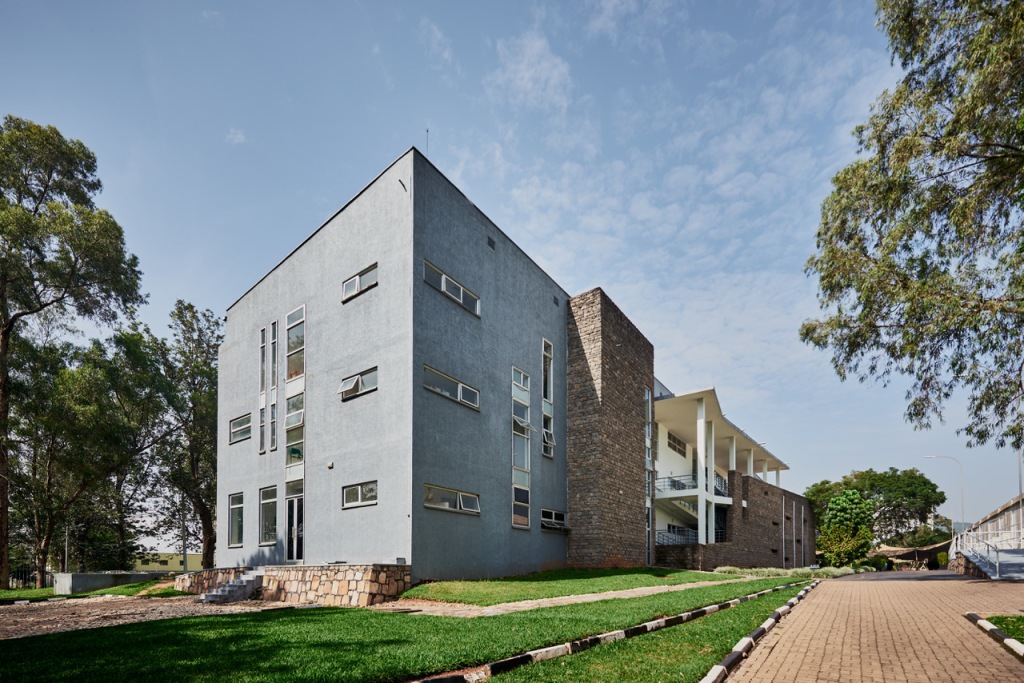
The School of Architecture, serves as an example of the wave of international architects responding to the regional influences on Rwanda. The School has a similar approach to its design. The form is prominent, a metaphorically it can be an interpretation to the hilly landscape. And the use of volcanic stone to clad the exterior of the building.
School of architecture, University of Rwanda
While both these buildings have a very strong relationship between form and programme. The studies done were focused more on the spatial and programmatic response of the architecture. From the space planing to the layout and interpretation of the materials on programme.
Future ambitions.
A walk around the civic Centre in Kigali, draws ones attention to the values being sought after. An egalitarian space, inclusive for all walks of life. And its in this context that Norsken is found, a stone throw away from the civic heart of the city hall. The building reflects on its insides what the civic centre reflects on its outsides. The buildings programmes vary across different fields with low tech to very high tech, future and contemporary issues with possible solutions. A hybrid of activity. Startups and established companies alongside each other.
The student investigations into this building were user-centric. Focus was placed on what layout and design choices were done; so the building created an egalitarian space and facilitated encounters among its users with the hope to encourage cross pollination of ideas in these chance encounters.
Its interesting to see that the same complexities on a country level, can still be found in the rich diversity in a small group of students. The workshop served as a fantastic incubation ground for research topics. Which was witnessed in the ideas presented by the students at the end of the workshop. The duration of the workshop forced the students to narrow down to the core ideas they could investigate. This was made possible perhaps by the daily feedback sessions between the mentors and the students. The mentors placed emphasis on reviewing what was written over what was said. One observation was that there was a some articles whose conclusions were presented without an understanding of the evidence. This was also addressed in the remarks given by the mentors. A suggestion would be to allow them a period of one week after the workshop, to research their topic and review their essay after.


 Transnational Architecture Group