Maxwell Fry, the architect and planner of Ibadan University, considered the campus to be the highlight of his career, although he confessed that he found the Kenneth Dike library elevation too ‘lace-like’.
It is an extraordinary structure and we’ve covered it on the TAG blog previously, as well as printing a 3D sectional model of the structure. Taking a more retro step, I’ve now produced a hand-drawn (rotring, ink wash) front elevational drawing of the building (minus the small reading room on the RHS and smaller structure on the LHS, for clarity).
Kenneth Dike Library at Ibadan University, Nigeria
The drawing stretches over 2 x A1 sheets and has been scanned, pieced together, and the blue ‘sky’ added in Photoshop. I’m going to follow drawing with some additional studies into various libraries in Ghana – especially the Children’s Library in Accra (Nickson and Borys); Sekondi Regional Library (James Cubitt); Koforidua Library (also by Cubitt); KNUST Library (?) and the iconic Bolgatanga library by Max Bond.
Sharing Stories from James Town and the Creation of Mercantile Accra
Forthcoming Exhibition at James Town Cafe, 17th May 2019
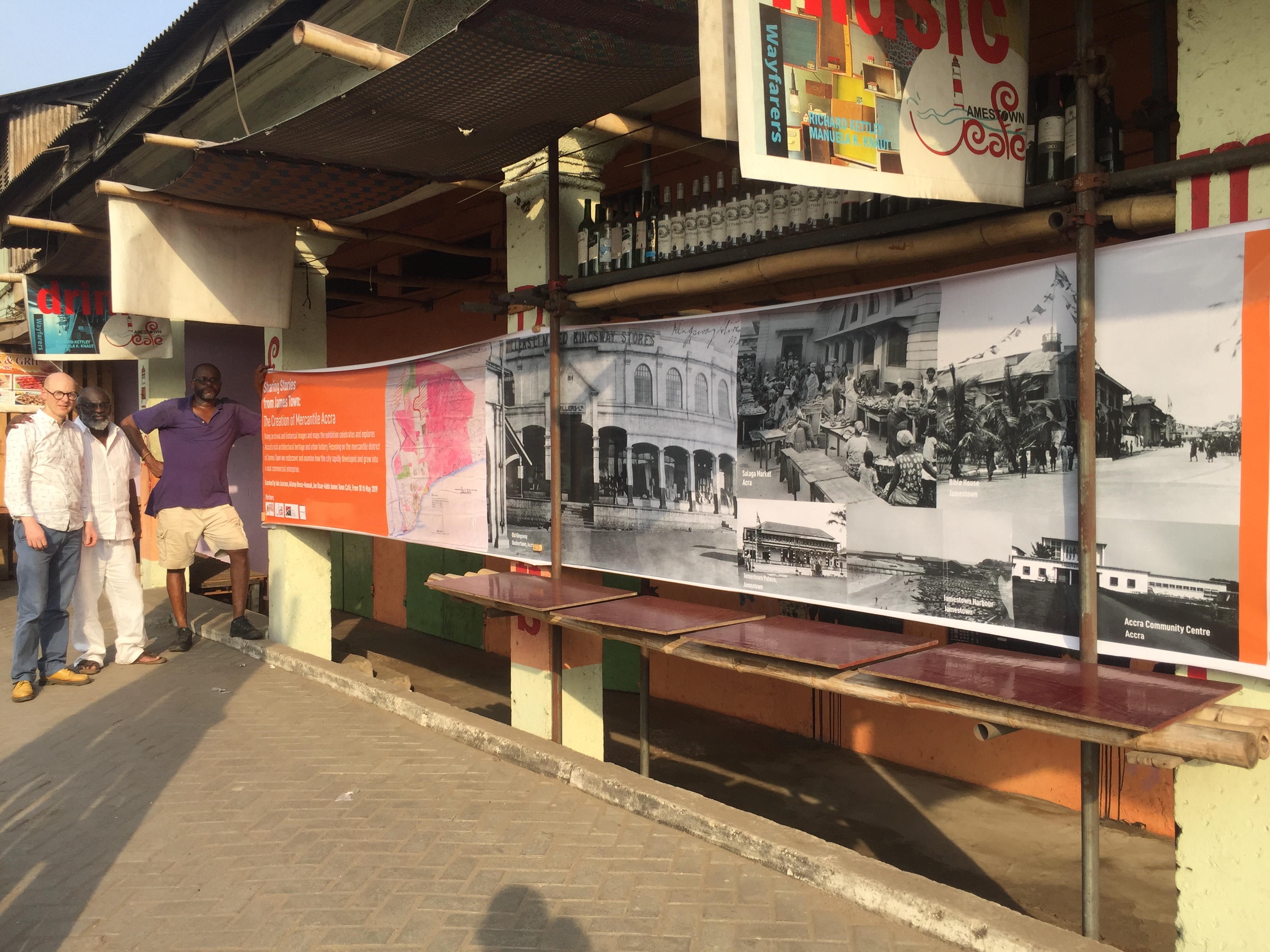
I’ve been working in Jamestown, Accra to start planning an exhibition on the colonial and mercantile architecture of the district. Using archival and historical images and maps the exhibition will celebrate and explore Accra’s rich architectural heritage and urban history. The exhibition will focus on the warehouses, stores, factories and offices of James Town and examine how the city rapidly developed into a vast commercial enterprise.
The images for the exhibition have been generously provided by Unilever, Barclays, UK National Archives, The British Museum and private collections. Most of these images have not been exhibited before and we’re delighted that they will be shown in Accra, and in very close proximity to where they were originally taken.
Exhibition Promotional Banner outside James Town Cafe with Iain Jackson [L], Joe Osae-Addo [C] and Allotey Bruce-Konuah [R]
There will be a printed/PDF catalogue to accompany the exhibition showing both archival and modern photographs of the buildings, along with historical maps, and we will hang large photographic banners of the archival images directly onto the historic buildings in James Town.
Kingsway Store, 1914
Kingsway Store 2018
The main exhibition (co-designed with architect Joe Osae-Addo and designer Allotey Bruce-Konuah) will be hosted by ArchiAfrika at the James Town Café, from 17th May 2019. We’re also hoping that it will go on tour to University of Ghana (details to be announced). In June there will be an additional exhibition hosted at the James Town Café curated by Lukasz Stanek and Ola Uduku of Manchester School of Architecture – and we’ll include more on both exhibitions here.
We’ve also started a new project to produce 360 degree panoramic photographs (and films) of some of the key sites and streets in James Town (and its environs). The images have been captured with a Ricoh Theta camera and we’ve taken over 200 photographs/ short films to date. The clips will be pieced together as a series of films and overdubbed with a commentary on the history and significance of the buildings in view. The films may be viewed with a VR headset for a more immersive experience. Allotey Bruce-Konuah already gives tours of James Town, and these films will enable his expertise to reach a wider audience, as well as encouraging new visitors to make the trip to this unique and highly important portion of Accra.
A World of Architectural History is the 4th annual conference of the Architectural Research in Europe Network Association (ARENA).
The conference aims to critique and celebrate the latest global advances within architectural history over the last few decades, by focusing upon the word ‘global’ in two senses:
Geographically – referring to the increasing inclusion of all parts of the world in more complex and multiple discourses of architectural history
Intellectually – the ongoing expansion of architectural history into other academic subjects, plus the reception of ideas/themes from those subjects
Recognition will be given to a more inclusive approach to architectural history that seeks to incorporate the histories of all countries/regions, and to the significant contributions now being made through interdisciplinary links with other subjects. As such, the conference will represent the forefront of the field internationally and discuss where architectural history ought to head in the future.
Conference presenters will include those from a wide range of subject areas within The Bartlett Faculty of the Built Environment and leading figures in architectural history across the world. Both invited speakers and those selected via an open call will contribute their papers.
Conference themes
Eight thematic areas will be presented over the two days of the conference, with these themes also framing the call for papers:
Jawaharlal Nehru, Otto Koenigsberger, Amrit Kaur and unknown others visit the Housing Factory, 1950. | Courtesy: Koenigsberger family
The refugee crisis that followed the division of India and Pakistan in August 1947 intensified the already dire housing situation in Indian cities. In Delhi, where the population had almost doubled over the previous decade, causing a severe housing shortage, some 500,000 refugees sought shelter. As well as camps outside the city, Delhi’s verandahs, gardens and pavements were filled with displaced people while communal violence raged in the streets.
The “noble mansion of free India where all her children may dwell” that Prime Minister Jawaharlal Nehru envisioned building in his Independence Day speech must have seemed a pipedream to Delhi’s homeless. Nonetheless, the central government committed to developing housing solutions that would provide dignified, sustainable, low-cost shelter to help counter the refugee crisis.
Responsible for leading this project was Otto Koenigsberger, Director of Housing in the Ministry of Health. Koenigsberger, who was born in 1908 in Berlin, Germany, had been working in exile in India since 1939. Unable to continue his work as an architect in Berlin due to Nazi persecution, Koenigsberger – who was of Jewish background – had migrated to Bangalore, where he held the position of Government Architect and Town Planner in the erstwhile princely state of Mysore for nine years.
Otto Koenigsberger at his desk in Delhi, 1950.
In addition to his extensive government work in Mysore, he built up a private practice, working on large-scale urban planning projects such as the Jamshedpur Development Plan for Tata & Sons, or the master plan for Bhubaneswar, the new capital of Orissa. Koenigsberger was also a founding editor of MARG magazine. Before being called to Delhi to work with the central government, Koenigsberger had become a prominent figure in India’s evolving architectural landscape and had established a reputation as a town planner.
Throughout his time in India, he had also displayed enthusiasm and ambition for developing low-cost, prefabricated housing. Arguing that mass production was particularly suited to India because of the “simpler” housing needs of the Indian worker’s family, Koenigsberger designed the Tata House for Jamshedpur.
Tata House, 1945Sri Jayachamarajendra Institute of Indian Medicine, circa 1948Dining Hall, Indian Institute of Science, Bangalore, circa 1946Jamshedpur Development Plan, 1945Tata House, 1945Sri Jayachamarajendra Institute of Indian Medicine, circa 1948
Built on a light steel framework, with walls of precast aerated concrete blocks and a barrel-vault roof of the same material, the component parts could be transported by lorry and assembled on site. In Mysore, too, Koenigsberger was involved in the development of a mass-manufacture housing scheme initiated by Bangalore industrialists and a British engineering firm to meet the severe housing lack in urban areas. Like many other prefab schemes that were initiated in the 1940s, however, these projects remained on the drawing board.
Good idea on paper
It is not surprising that when Koenigsberger was invited to advise the government of India on the chronic housing shortage, he recommended prefabricated housing as a viable solution. From October 1948, as Director of Housing, he began setting up the Hindustan Housing Factory in Delhi, which was to serve the capital city, supplementing rather than replacing the traditional construction of houses and targeting refugee housing needs.
It was a pilot project, initiated with the aim of replication across India’s urban centres. The simple single-storey housing units produced by the factory offered two rooms, rear and front verandahs, a kitchen and a separate bathroom and lavatory accessed via a small rear courtyard. While they could be added to incrementally or combined to make larger units, the real innovation of the houses was the use of large load-bearing aerated-concrete wall panels that were quickly cured by the relatively new process of autoclaving.
Delhi prefab, 1950.
The aerated-concrete panels offered excellent thermal properties and could be produced using local materials. Doors and windows were to be fitted to the panels in the factory so that site work could be reduced to building simple masonry foundations and assembling the ready-made panels.
Government Housing Factory with aerated concrete panels in the foreground, 1950.
Series of crises
What could possibly go wrong? Well, pretty much everything, as it turned out.
ADVERTISEMENT
To begin with, the delivery of prototypes of the houses, which were needed for testing in local conditions and finalising design details, was delayed. Meanwhile, the Ministry of Health took over six months to establish the factory’s management and administration structure, define its constitution, select its committee and hire skilled staff, which postponed the commencement of actual building work.
Apart from that, a dock fire in Liverpool, the sinking of a ship loaded with vital supplies in the Red Sea, the overcrowding of Bombay’s harbour in the summer of 1949 and shortages of special wagons for the transport of heavy machinery from Bombay and Calcutta to Delhi, all hampered progress. It was not until the summer of 1950 that the factory started producing houses, after a backlash in the press and Parliament had already begun.
Departure amidst scandals
To make matters worse, a worrying number of the aerated-concrete panels started breaking during autoclaving, while others developed cracks after erection. The houses were falling apart. Unable to solve the problem, production stopped in December 1950. The scandal that ensued ended Koenigsberger’s career in India. Politicians who had been against the scheme launched an aggressive attack in Parliament, which was intensified in the media and supported by groups that had hoped the project would fail, including the PWD and elements of the construction industry.
Headlines such as “The Full Dope on GOI’s Pre-Fab Racket,” and “Prefab Housing Project A Criminal Waste” coursed through the press. Health Minister Rajkumari Amrit Kaur dismissed Koenigsberger as manager of the housing factory in April 1951 and he subsequently retired from his government duties, returning to Europe bitterly disappointed.
Press clippings on the scandal, 1951.
Koenigsberger, a naturalised Indian citizen, settled in London, where most of his family was living. He continued his work on low-cost housing and urban development in rapidly growing cities but as director of the Department of Tropical Studies at the Architectural Association, Professor of Development Planning at University College London and in his advisory roles for the United Nations, World Bank and various nation states. His book Manual of Tropical Housing and Building, co-authored with TG Ingersoll, Alan Mayhew and SV Szokolay and published in 1974, became ubiquitous in architecture school libraries in South Asia and other “tropical” geographies. He died in London at the age of 90.
Ironically, production of the panels resumed shortly before Koenigsberger’s departure from India. The autoclaving had brought out peculiarities in the local cement that were “nursed” by adding more lime. The Hindustan Housing Factory still exists, albeit under another name: Hindustan Prefab. According to their website, their premises include a Technology Park, where parts of the failed refugee housing are displayed.
Call for Papers: COLONIAL AND POSTCOLONIAL LANDSCAPES: Architecture, Cities, Infrastructures
16th – 18th January 2019 | Lisbon | Calouste Gulbenkian Foundation
The infrastructure of the colonial territories obeyed the logic of economic exploitation, territorial domain and commercial dynamics among others that left deep marks in the constructed landscape. The rationales applied to the decisions behind the construction of infrastructures varied according to the historical period, the political model of colonial administration and the international conjuncture.
This congress seeks to bring to the knowledge of the scientific community the dynamics of occupation of colonial territory, especially those involving agents related to architecture and urbanism and its repercussions in the same territories as independent countries.
It is hoped to address issues such as how colonial infrastructure has conditioned the current development models of the new countries or what options taken by colonial administrations have been abandoned or otherwise strengthened after independence.
The congress is part of the ongoing research project entitled “Coast to Coast – Late Portuguese Infrastructural Development in Continental Africa (Angola and Mozambique): Critical and Historical Analysis and Postcolonial Assessment” funded by ‘Fundação para a Ciência e Tecnologia’ (FCT – Foundation for Science and Technology), which has as partner the Calouste Gulbenkian Foundation (FCG).
The aim of this congress is to extend the debate on the repercussions of the decisions taken by the colonial states in the area of territorial infrastructures – in particular through the disciplines of architecture and urbanism – in post-independence development models and the formation of new countries with colonial past
The cartographic and the geopolitical: advocating a new agenda in architectural thinking and research.
Jianfei Zhu; in Architectural Review Quarterly.
Extract
Today, there is an increasing use of terms such as ‘transnational architecture’, ‘architecture beyond Europe’, ‘architecture of China, Japan and Korea’, ‘China in Africa’ and ‘Socialist architecture in Africa’. This signals a change in the basic outlook in thinking and research around architecture towards a problematic concerning geography and geopolitical relations. Michel Foucault, as early as 1967, had already said that ‘history’ was being replaced by ‘geography’, and a historical outlook on an endless timeline was being replaced by a new awareness of a finite world, of a world geography, of things happening ‘here and there’, of space and place, and of a ‘network’ we were all located within (in a speech published later as ‘Of Other Spaces: Principles of Heterotopia’). My contention is that, due to many factors, today more than any other time, a world-historical paradigm in architectural research is being replaced, or at least radically reformed, by a new one that methodologically privileges local and material happenings as horizontally connected to other sites and happenings, in a networked geographic spread: it involves a cartographic perspective that challenges endogenous, national and formalist categories.
Rural networks and planned communities: Doxiadis Associates’ plans for rural settlements in post-independence Zambia
Petros Phokaides; in Journal of Architecture
Abstract
The paper focusses on the planning of rural settlements by the Athens-based firm Doxiadis Associates (DA), a key, even if unrealised, project for Zambia’s nation-building and development efforts in the mid-1960s. In line with post-war discourses of modernisation, DA employed Christaller’s 1933-Central Place Theory and its abstract hexagonal geometrical model to organise different-sized settlements within a single spatial system. By introducing a hierarchical rural network over Zambia, the firm aimed to standardise rural settlement patterns and to formulate a strategy to alleviate rural-urban migration. DA’s top-down, large-scale approach even exceeded the State’s aspirations and the firm’s visions eventually faced two challenges: First, DA’s modernist planning was questioned by the social/ecological considerations as formulated by George Kay’s counterproposal on resettlement policy. Secondly, DA’s ‘urbanising’ visions for rural areas were forestalled by some of the country’s realities, which remained out of the planners’ field of control, and eventually called for more cautious responses to the realities on the ground. By exposing the challenges DA’s rural proposal faced, the paper ultimately contemplates the multiple, and even conflicting reactions towards Zambia’s rural settlement projects, and also adds nuances to the wider histories of rural development in Africa.





 Transnational Architecture Group