Ng’ambo Atlas. Historic Urban Landscape of Zanzibar Town’s ‘Other Side’
Ng’ambo is the lesser known ‘Other Side’ of Zanzibar Town. During the British Protectorate the area was designated as the ‘Native Quarters’, today it is set to become the new city centre of Zanzibar’s capital. Local and international perceptions of the cultural and historical importance of Ng’ambo have for a long time remained overshadowed by the social and cultural divisions created during colonial times. One thing is certain: despite its limited international fame and lack of recognition of its importance, Ng’ambo has played and continues to play a vital role in shaping the urban environment of Zanzibar Town.
Ng’ambo Atlas. Historic Urban Landscape of Zanzibar Town’s ‘Other Side’ documents the material collected through the heritage-based urban planning project Ng’ambo Tuitakayo! carried out by the Government of Zanzibar in collaboration with African Architecture Matters and City of Amsterdam and under the auspices of UNESCO.
The goal of the project was to prepare a local area plan (structure plan) for the new city centre of Zanzibar’s capital. The planning exercises were from the beginning grounded in the notions of urban culture and heritage, while the principles outlined in the UNESCO Recommendation on Historic Urban Landscape provided a framework for the subsequent stages of the work.
It quickly became clear that the cultural and historic richness of Stone Town’s ‘Other Side’ merited a wider recognition than a technical planning document would allow for. At the same time presenting the outcomes of the project to a wider public through an atlas was a way to promote the history and culture of the area and contribute to the argument that urban heritage should play a central role in sustainable development of cities.
The atlas brings together and presents Ng’ambo’s rich planning history and draws attention to the outcomes of the mapping of the material and immaterial cultural landscape.It presents over hundred years of Ng’ambo’s history and urban development through maps, plans, surveys and images, and provides insights into its present-day cultural landscape through subjects such as architecture, toponymy, cultural activities, public recreation, places for social interaction, handcrafts and urban heritage.
Ng’ambo Atlas was produced by the Department of Urban and Rural Planning, Zanzibar and African Architecture Matters
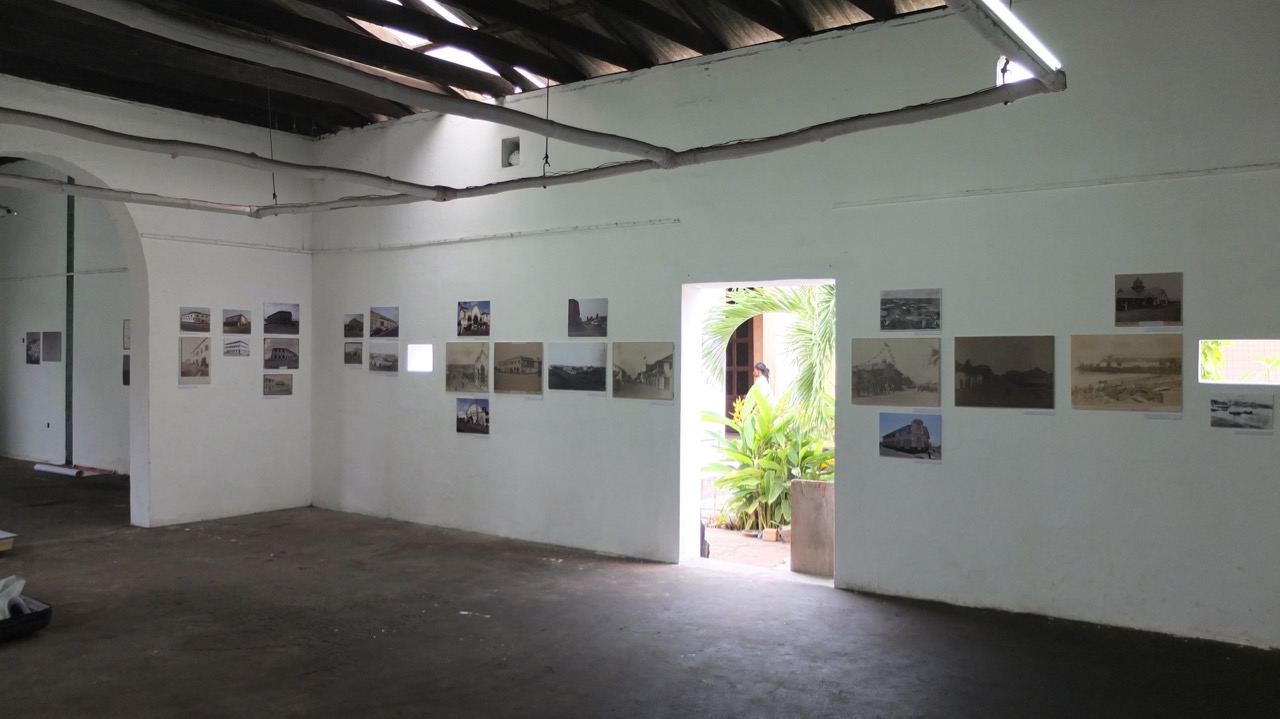
Thank you to Prof. Ola Uduku of Manchester School of Architecture for reviewing the ‘Sharing Stories from Jamestown’ exhibition. The exhibition has been extended to run until the end of June 2019. Below I’ve uploaded a 360 degree panoramic view – you can ‘click and drag’ the film to have a look around….
Iain Jackson’s exhibition co-curated by Allotey Konuah-Bruce and Joe Addo opened to great acclaim on Saturday evening at the Jamestown Café, venue, near Ussher Fort. Curiously the café it was confirmed by local elders who attended the opening is accurately in Usshertown; the exhibition launch providing a great forum for these questions to be aired and for detailed discussions to be had.
Historic photographs and maps of ‘old’
Jamestown buildings have been placed next to those which show their age,
condition and use, in ‘contemporary’ Jamestown have been displayed in the lower
gallery of the Jamestown Café, which itself features in the exhibition as Tarquah
house, the dwelling and warehouse of one of Jamestown’s wealthy local
merchants, who had originally had it built. The exhibition represents a true
joint collaboration between Iain Jackson and Allotey Konuah-Bruce who have formed a close and productive working relationship as they have spent the…
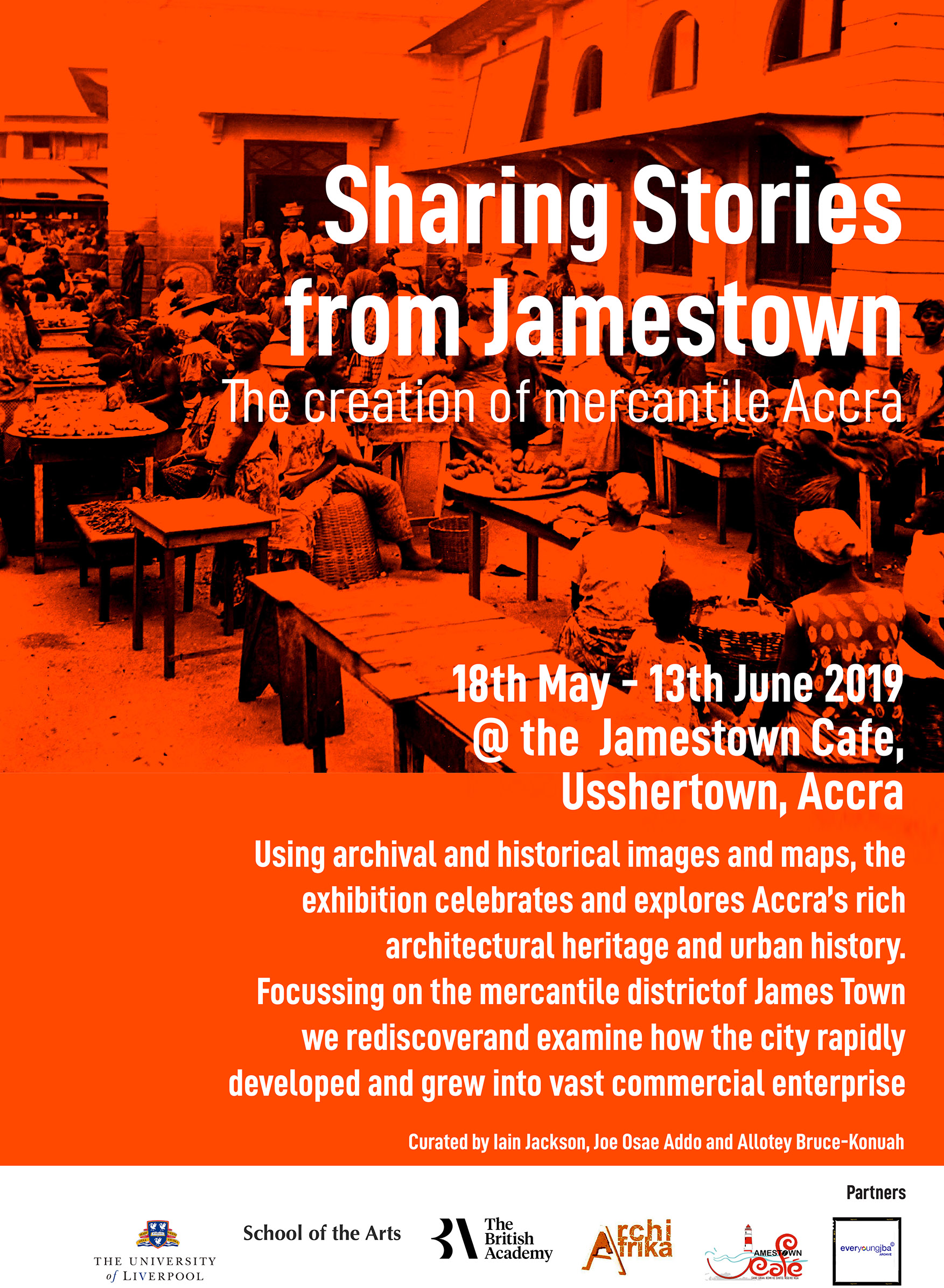
You are invited to our Exhibition, ‘Sharing Stories from Jamestown’, opening on the evening of Friday 17th May 2019 at Jamestown Cafe, High Street, Accra. All very Welcome! The exhibition will run until 13th June.
We’ll be exhibiting vintage photographs, plans and drawings from over ten archives and private collections that have been gathered together here for the first time. To accompany the exhibition we’ve also produced a catalogue that attempts to explain and contextualise the images, and to tell the history of Accra’s development, planning and architecture. You can read the digital version below. We’re indebted to Allotey Bruce-Konuah for expertly setting out the catalogue.
This is an excellent opportunity for emerging writers and students. Last year’s gathering produced some excellent work, and this year we will have the exhibition at James Town Cafe as a provocation and stimulus for debate….
We are pleased to announce that we are now accepting applications for the 2019 British Academy – ASAUK funded 2019 African Architecture Writing Workshops. These workshops are offered for postgraduate students looking to develop their academic writing skills in the areas of architecture, urbanism and related disciplines.
This year there are two workshops. The first to be offered will take place in May 2019
FIRST WORKSHOP DETAILS
“Sharing
Stories from Jamestown and the Creation of Mercantile Accra” Writing Workshop
Monday, May 12 – Sunday, May 18, 2019
This workshop explores the colonial
and mercantile architecture of Jamestown, the British settlement area of
colonial Accra and located in Ga Mashie. This writing workshop is linked to the
May 17 exhibition organized by Professor Iain Jackson (University of Liverpool) and Joe Osae-Addo and Allotey Bruce-Konuah (Jamestown Cafe), which will showcase archival and historical images and maps of Accra’s…
A. M. Martin & P. M. Bezemer (2019): The concept and planning of public native housing estates in Nairobi/Kenya, 1918–1948, Planning Perspectives, DOI: 10.1080/02665433.2019.1602785
Estate lay-out Kaloleni, 1943, A.J.S. Hutton. Source: G.W. Ogilvie, The Housing of Africans in the urban areas of Kenya. The Kenya Information Office: Nairobi. 1944
Abstract: Interwar public housing estates for native citizens in Sub-Sahara African cities, represent hybrids of global and local urban concepts, housing typologies and dwelling habits.
The authors explain such hybrids via exploratory research note as a result of transmutation processes, marked by various (non)human actors. To categorize and compare them, Actor Network Theory (ANT) is applied and tested within an architecture historical framework. Nairobi/Kenya functions as pars pro toto with its Kariakor and Kaloleni estates as exemplary cases. Their different network- outcomes underpin the supposition that actor-oriented research can help to unravel a most essential, though neglected part of international town planning history.
Plan and elevation of two one-room dwellings, Kaloleni, 1943, A.J.S. Hutton. Source: G.W. Ogilvie, The Housing of Africans in the urban areas of Kenya. The Kenya Information Office: Nairobi. 1946
(sub) URBAN TROPICALITY: Urban challenges in the tropical zone
International Network of Tropical Architecture (iNTA) Conference at The University of Queensland, Brisbane, Australia, 5 – 8 December 2019
The cities and urban centres of the (sub) tropics are where the greatest challenges facing our collective future can be found. They are where the challenges of global warming, inequality and the migration of people fleeing political unrest or climate change are at their most extreme. The 2019 International Network of Tropical Architecture (iNTA) conference provides a forum to discuss architectural and design solutions for a resilient, smart and just future for urban centres in the tropics.
Founded in Singapore in 2004, the International Network for Tropical Architecture (iNTA) is a networking platform for international researchers and practitioners to collaborate and learn from each other about problems and solutions pertaining to architecture and urban design in the tropical (and sub-tropical) regions and brought together by the shared climatic imperatives and opportunities of these regions. The iNTA permanent secretariat is located at the Department of Architecture, School of Design and Environment at the National University Singapore.
The 2019 iNTA conference is hosted by the School of Architecture at The University of Queensland, located in Brisbane, capital city of the state of Queensland, Australia. Brisbane is proximate to both the fastest growing urban centres in Asia and many Small Island Developing States (SIDS) most at risk from climate change, including Kiribati, Marshall Islands, Federal States of Micronesia, Marshall Islands, Niue and Tuvalu amongst others. Queensland’s most northern extremity, Cape York, sits at the confluence of the Indian and Pacific Oceans, those very same oceans that generate the weather systems that circle the globe and affect the destiny of millions of people.
For those who live in the so-called “global south,” there is a sense of urgency about the challenges arising from rapidly changing climate conditions. Matters are not merely academic, but dynamic and concrete. Before the launch of iNTA, discourse around architecture and urbanism in the tropics was framed by centres of scholarship in Europe and North America. The malingering aftermath of devastating tropical storms such as Maria and Irma (2017) in the Caribbean and Typhoon Haima (2016) in the Philippines challenges such ascendancy. The 2019 iNTA conference in Brisbane brings discourse to a subtropical city at the crossroads of cultures, regions and climate zones. At a time when Australia’s role in the region continues to be questioned, it provides an opportunity to enhance north-south dialogue.
Submission Information & Instructions
Submit abstracts of no more than 300 words in length by email as Word documents to: https://easychair.org/conferences/?conf=inta2019. Please name the email subject ABSTRACT-SURNAME and use this name for your submission file as well.
Abstract deadline: 26 April 2019
Submission of full papers for review: 26 July 2019
Submission of final papers for publication: 18 October 2019
All abstracts will be considered by the conference academic committee; authors will be invited to prepare a full paper (no longer than 4,500 words); authors wishing their papers to be published in conference proceedings should submit their final papers for peer review on or before 26 July 2019. The date for submission of final papers is 18 October 2019. Authors may opt out of publication.
Conference Streams
Tropical Architecture refers to constructed architectural and urban environments relating the climatic and natural conditions of the tropical (and sub- tropical) regions, and interacting with various local specifics of culture, urban fabric and technology. Contributions to the following conference streams are sought.
1. Tropical Urbanism
Stream focussing on challenges to and solutions for enhanced liveability in urban centres of the tropics. Papers might address:
projects or propositions for reversing or healing the degradation and collapse of urban centres under rapid growth;
urban infrastructures at risk: rising sea-levels, increasing storm intensity, expanding torridity and aridity.
urban adaptation responses : design planning policy, governance and codes
urban forms shaped by determinants other than climate alone, such as topography, nature, cultural life.
vegetation in (sub) tropical cities: cultivation in gardens and the peri-urban or neglect in terrain vague.
Stream focussing on individual designs/ architectural, infrastructure, adaptation projects. What is it that makes the contemporary architectural project tropical? Or the tropical project contemporary? Papers might illuminate projects that demonstrate instances of :
building technologies: tropical and subtropical applications including
passive low energy and carbon neutral architecture
climate mitigation strategies
equity in the tropical city
the (sub)tropical tower
contemporary architecture (still) learning from vernacular traditions
reciprocities/dialogue between architecture and tropical environments: between the zeitgeist of a globalized culture and a project’s specific circumstance.
3. Narratives of Disease, Discomfort, Development and Disaster :: Reconsidering Tropical Architecture and Urbanism
The idea of tropical architecture and urbanism initially developed through a particular connection between discourses on disease, spatial practices and optimum architectural typologies, which were believed to circumvent the spread of tropical diseases and to maintain the comfort of the white settler. After the Second World War, the focus shifted from the European settlement of the colonial tropics to the self-development and governance of the world’s tropical regions; a phenomenon necessitated and propelled by post-war decolonization and global regimes of development aid. Accompanying this change was a shift away from the physiological comfort of the colonial settler to a new focus on indigenous cultures, vernacular building traditions, use of local materials, and increasing appreciation for the psychological value of cultural conventions, including superstition and taboo. The aim of this stream is to examine how “triumph” in the tropics was imagined across multiple geographies, by various subjects, through diverse discourses, and at different times and to critically investigate the roles architecture and urban planning played in this process. We particularly welcome papers that offer historical case studies of tropical and subtropical architecture and urbanism examined through one of four lenses:
disease
discomfort
development or disaster.
This stream will be convened by Dr Deborah van der Plaat (The Univerity of Queensland), Dr Vandana Baweja (University of Florida) and Professor Tom Avermaete (ETH Zurich).
4. Historic Urban Landscapes and Tropicality
The Historic Urban Landscape is a new approach recommended by UNESCO that recognises and positions the historic city and its core as a resource for the future and the centre for the urban development process. Papers might address:
operational principles for urban conservation models: respecting values, traditions and environments of different cultural contexts.
historic urban centres and tropical vulnerability
mapping urban heritage values and attributes
planning, design and implementation of development projects in historic urban centres
adaptive use and re-use impacting authenticity and integrity of physical and social fabric in historic urban centres
Small Island Developing States (SIDS) of the Pacific and Caribbean: their vulnerability and resilience
Maxwell Fry, the architect and planner of Ibadan University, considered the campus to be the highlight of his career, although he confessed that he found the Kenneth Dike library elevation too ‘lace-like’.
It is an extraordinary structure and we’ve covered it on the TAG blog previously, as well as printing a 3D sectional model of the structure. Taking a more retro step, I’ve now produced a hand-drawn (rotring, ink wash) front elevational drawing of the building (minus the small reading room on the RHS and smaller structure on the LHS, for clarity).
Kenneth Dike Library at Ibadan University, Nigeria
The drawing stretches over 2 x A1 sheets and has been scanned, pieced together, and the blue ‘sky’ added in Photoshop. I’m going to follow drawing with some additional studies into various libraries in Ghana – especially the Children’s Library in Accra (Nickson and Borys); Sekondi Regional Library (James Cubitt); Koforidua Library (also by Cubitt); KNUST Library (?) and the iconic Bolgatanga library by Max Bond.
Junior Staff Quarters, near Christianborg Castle, Accra
New Buildings in the Commonwealth edited by Jim M. Richards in 1961 pulled together many articles from earlier editions of the Architectural Review. It formed an important set of essays, photographs and illustrations with each geographically themed chapter written by an architect familiar with that part of the world. Maxwell Fry wrote the West Africa section and he selected some of the best buildings from the proceeding decade to feature in his piece, including some lesser known works from relatively unknown architects.
Junior Staff Quarters, Accra
The opening project for the Ghana section was a housing scheme from Accra designed by the Public Works Department Chief Architect, G. Halstead with architects-in-charge D. A. Barratt and W. J. Clarke. Very little is known about these architects, apart from Halstead worked with S. Bailey (townplanner) on the new layout of Tamale in 1953..[1]
The Accra housing project is a very carefully designed set of 24 apartments arranged across three blocks. Each dwelling faces into the courtyard space and are one room deep to maximise cross ventilation. Each house also has its own private balcony/court for sleeping outside and cooking.
The formal arrangement and sloping roofs are all carefully arranged and the quality of the build is exceptional. I’ve wanted to see these houses for some time now and it was a special moment to see them come into view as I made my way from the 17th Century Danish ‘Christianborg Castle’. The houses were constructed as ‘Junior Staff Quarters’ for people working at the Castle (which was then used as the Prime Minister’s Residence) during the early years of Ghana’s independence.
The houses remain largely unaltered from the original design, albeit lacking some basic maintenance. I spoke to a number of the current residents and they very much enjoy living here. The sense of community is strongly felt, and overlooked internal courtyard adds security. Parts of Community 1 at Tema have a similar feel but don’t quite achieve the ‘walled city in miniature’ qualities of this project. It marks a significant shift from the compound and ‘village-housing’ projects built elsewhere at the time, and continues to offer many clues for how we might design inexpensive housing in Ghana today.
Sharing Stories from James Town and the Creation of Mercantile Accra
Forthcoming Exhibition at James Town Cafe, 17th May 2019
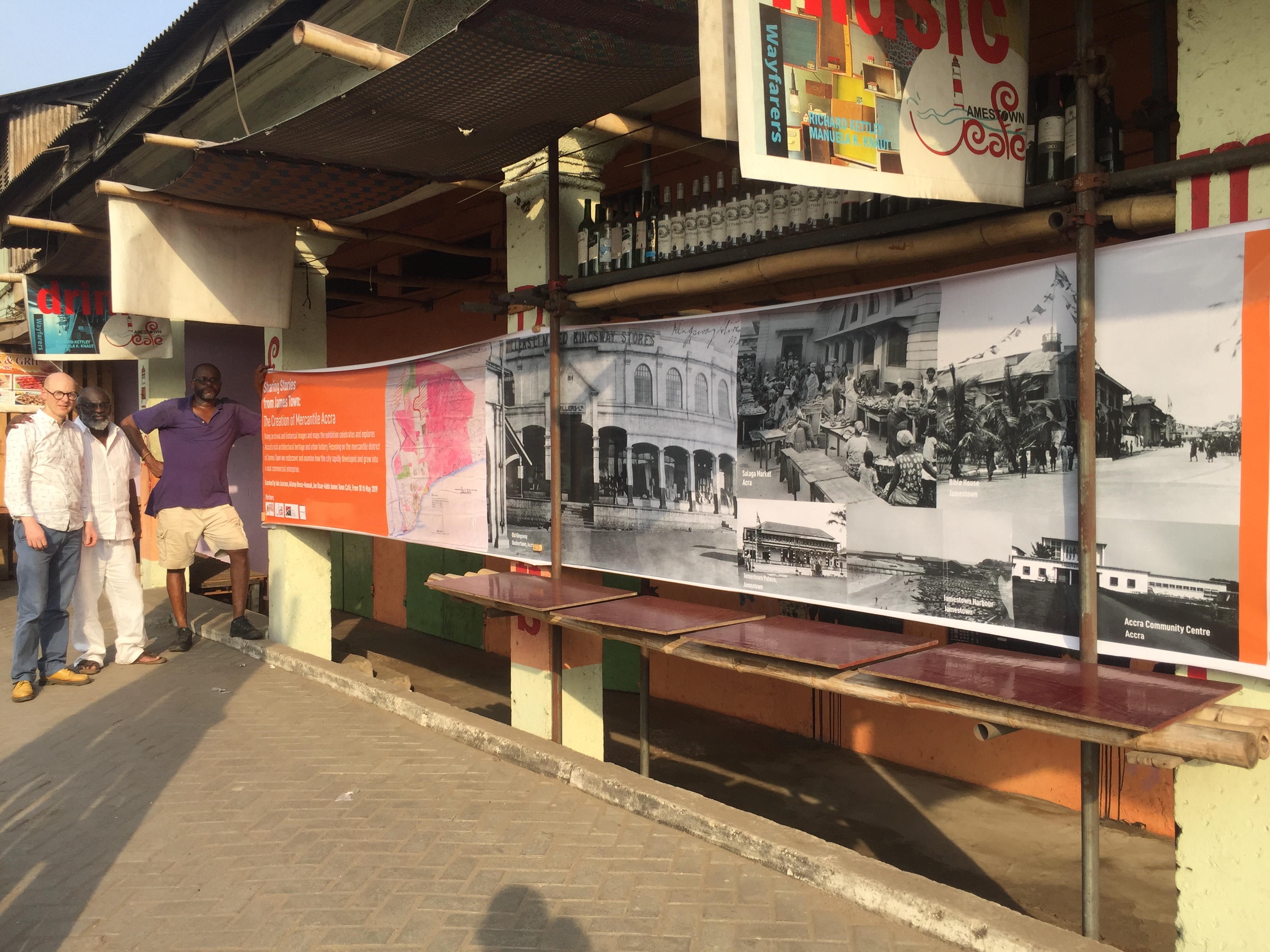
I’ve been working in Jamestown, Accra to start planning an exhibition on the colonial and mercantile architecture of the district. Using archival and historical images and maps the exhibition will celebrate and explore Accra’s rich architectural heritage and urban history. The exhibition will focus on the warehouses, stores, factories and offices of James Town and examine how the city rapidly developed into a vast commercial enterprise.
The images for the exhibition have been generously provided by Unilever, Barclays, UK National Archives, The British Museum and private collections. Most of these images have not been exhibited before and we’re delighted that they will be shown in Accra, and in very close proximity to where they were originally taken.
Exhibition Promotional Banner outside James Town Cafe with Iain Jackson [L], Joe Osae-Addo [C] and Allotey Bruce-Konuah [R]
There will be a printed/PDF catalogue to accompany the exhibition showing both archival and modern photographs of the buildings, along with historical maps, and we will hang large photographic banners of the archival images directly onto the historic buildings in James Town.
Kingsway Store, 1914
Kingsway Store 2018
The main exhibition (co-designed with architect Joe Osae-Addo and designer Allotey Bruce-Konuah) will be hosted by ArchiAfrika at the James Town Café, from 17th May 2019. We’re also hoping that it will go on tour to University of Ghana (details to be announced). In June there will be an additional exhibition hosted at the James Town Café curated by Lukasz Stanek and Ola Uduku of Manchester School of Architecture – and we’ll include more on both exhibitions here.
We’ve also started a new project to produce 360 degree panoramic photographs (and films) of some of the key sites and streets in James Town (and its environs). The images have been captured with a Ricoh Theta camera and we’ve taken over 200 photographs/ short films to date. The clips will be pieced together as a series of films and overdubbed with a commentary on the history and significance of the buildings in view. The films may be viewed with a VR headset for a more immersive experience. Allotey Bruce-Konuah already gives tours of James Town, and these films will enable his expertise to reach a wider audience, as well as encouraging new visitors to make the trip to this unique and highly important portion of Accra.
A World of Architectural History is the 4th annual conference of the Architectural Research in Europe Network Association (ARENA).
The conference aims to critique and celebrate the latest global advances within architectural history over the last few decades, by focusing upon the word ‘global’ in two senses:
Geographically – referring to the increasing inclusion of all parts of the world in more complex and multiple discourses of architectural history
Intellectually – the ongoing expansion of architectural history into other academic subjects, plus the reception of ideas/themes from those subjects
Recognition will be given to a more inclusive approach to architectural history that seeks to incorporate the histories of all countries/regions, and to the significant contributions now being made through interdisciplinary links with other subjects. As such, the conference will represent the forefront of the field internationally and discuss where architectural history ought to head in the future.
Conference presenters will include those from a wide range of subject areas within The Bartlett Faculty of the Built Environment and leading figures in architectural history across the world. Both invited speakers and those selected via an open call will contribute their papers.
Conference themes
Eight thematic areas will be presented over the two days of the conference, with these themes also framing the call for papers: