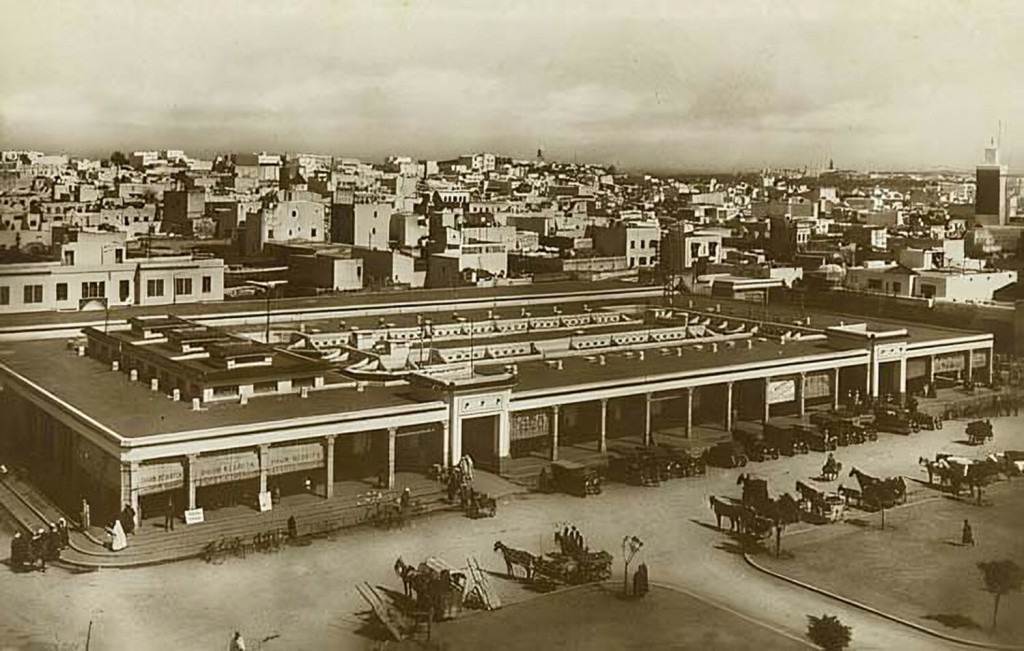
In 1925, the Central Market of Rabat was built at the outskirt of the medina (the old city) by French Colonial powers (1912-1956). Despite being the only element displayed in colonial maps of the medina, and one of Rabat’s current landmarks, the history of the market is still unknown. Drawing on the National Moroccan archives and on colonial postcards, the article explores the historical and urban significance of the Central Market for Rabat colonial and postcolonial history. It argues that the market constitutes a unique architectural and urban case for Rabat as it both challenged and reinforced the colonial agenda. Planning principles like the policy of association, the ‘image of the city’ and the ‘dual city’ were not only defied by the market, but also by the demolition of the part of the wall in front of it. This revealed the inconsistencies and lack of homogeneity of the colonial approach. Moreover, without the wall, the medina became penetrable by the ‘Ville Nouvelle‘ (New Town). Engaging with the Central Market is significant for the history of colonial planning, but also for today’s Rabat identity construction, inscribed in 2012 in the UNESCO World Heritage Sites and elected cultural capital in 2022.
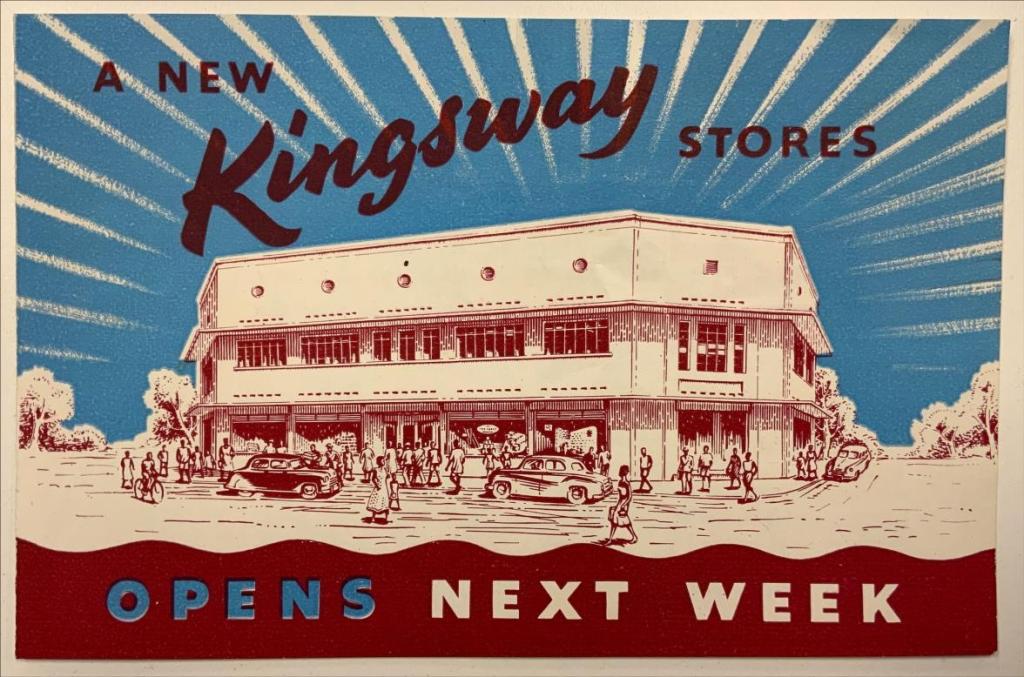
Kingsway, Sekondi Advertisement Picture courtesy of Unilever Archives
Kingsway Stores was the most exclusive retail chain in colonial British West Africa. Established by a British import-export firm, Miller Brothers, the chain’s first two department stores opened in Accra and Kumasi in 1915-1920 and were explicitly modelled on Harrods and Selfridges. Named for the boulevard in London’s Holborn, where Millers was headquartered in a stodgily baroque office building, the Kingsway Stores sold imported food, clothing and home wear to a primarily British expatriate clientele. By 1929, a series of mergers and takeovers saw Miller Brothers absorbed into Unilever’s vast African subsidiary, the United Africa Company, which is currently the subject of a collaborative research project led by the University of Liverpool and Unilever Archives, and funded by the Leverhulme Trust.
Kingsway Stores, Sekondi, 2022 Image: Iain Jackson
The Kingsway chain grew under the United Africa Co.’s ownership and by the early 1950s, Kingsway stores traded in each of the British West African capitals, Accra, Lagos, Freetown, Banjul, and in many of the larger towns and cities across the region: Kumasi, Cape Coast, Sekondi, and Tamale in the Ghana, and in Jos and Kaduna in Nigeria. Like many of these stores, the Sekondi store was designed by the Unilever In-House Architects and Engineering Department, headed by James Lomax-Simpson. A graduate of the University of Liverpool School of Architecture, Lomax-Simpson designed numerous buildings for Unilever, including housing at the famous company town, Port Sunlight. The designs that his team produced for United Africa Co. offices, warehouses and retail stores across West Africa tended towards the mildly moderne, with some slight modifications for local climatic conditions through the use of canopies and verandas to provide shading from the sun and allow for the higher loads of rainwater run-off required during the rainy season. The Sekondi Kingsway store is a paradigmatic example of this work.
Party at Kingsway Store in Bathurst/Banjul, Gambia, held in 1953. Picture courtesy of Unilever Archives.
The growth of the Kingsway chain in the interwar years reflected the expansion of British expatriate technicians, civil servants and businessmen during a period known as ‘the second colonial occupation.’ Increased investment in development projects, ultimately designed to maximise the flow of cocoa and precious metals from West Africa and thus boost Britain’s dollar reserves, saw not only an increase in British expatriate staff working in late colonial West Africa, but also their increasing embourgeoisement. The growth of the chain also reflected, and, indeed, facilitated, changes in the gender balance of British communities in West Africa. British women were originally discouraged from settling in the region, but by the 1940s the availability of malaria prophylaxis and yellow fever vaccines saw increasing numbers of women taking positions within colonial administrations, and wives joining their husbands on tours of duty across the region. As Laura Ann Stoler notes, the presence of European women ‘accentuated the refinements of privilege and the etiquettes of racial difference… women put new demands on the white communities to tighten their ranks, clarify their boundaries and mark out their social space.’ Racially segregated bungalow reservations proliferated across ‘British’ West Africa in this period. Within these reservations, ‘Europeanness’ was performed through a constant round of dinner parties, drinks parties, tennis parties, through the consumption of imported tinned and preserved food, through patterns of dress and home decoration. Kingsway stores, which emphasised that ‘orders were delivered direct to bungalows,’ supplied all the goods required for this memetic of bourgeoise English life.
By the mid-1950s, as political decolonisation neared in West Africa and both civil services and expatriate companies increasingly ‘Africanised’ their staff, the Kingsway Stores faced the loss of its primary customer base. Perhaps paradoxically, the company management combatted this through a programme of expansion. Boldly modernist new stores, designed by the British commercial architectural firm TP Bennett & Partners, were opened in Accra, in the Lagos suburbs, in Ibadan and Port Harcourt in Nigeria. At the same time, didactic marketing campaigns – exhibitions, product demonstrations, fashion shows – were instrumentalised to sell a vision of modern, and, indeed, modernist, domesticity to an elite African clientele. An Ideal Homes Exhibition, sponsored by the British Design Council and held at the Lagos Kingsway Store in 1962, for example, offered advice on ‘such subjects as how to create harmony with simple furnishings and the tricks of entertaining which make a house-wife into a hostess.’ Kingsway at the end of empire therefore shrewdly manoeuvred itself away from selling ‘Europeanness,’ to selling ‘Modernity’ to the emerging, post-colonial, African elite, a shift in mode that sheds light on the entanglements between modernist architecture and design on the one hand, and colonial and neo-colonial profit extraction on the other.
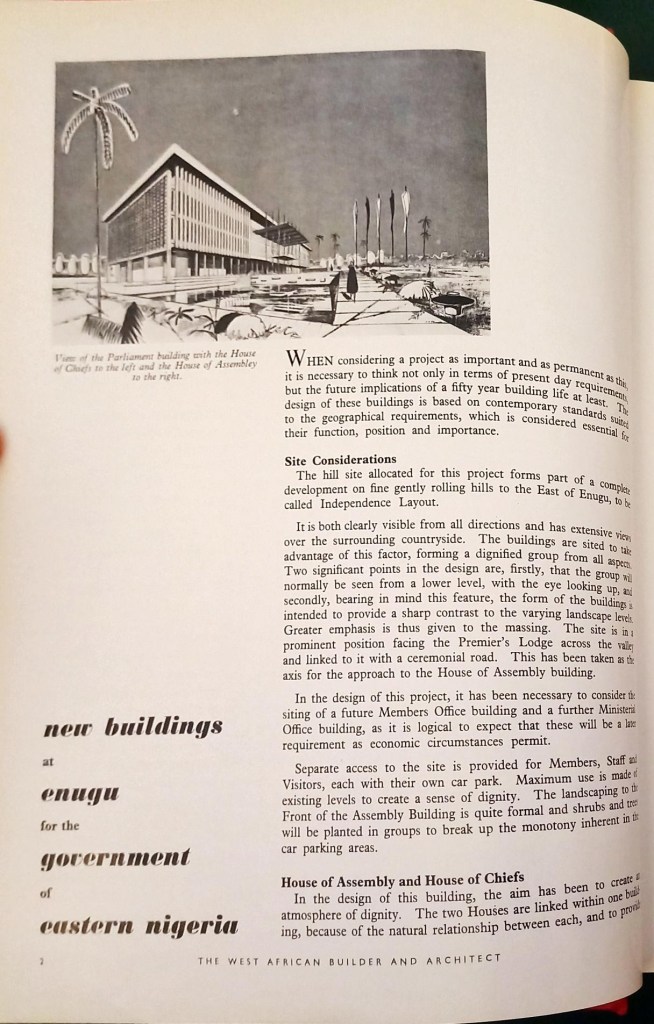
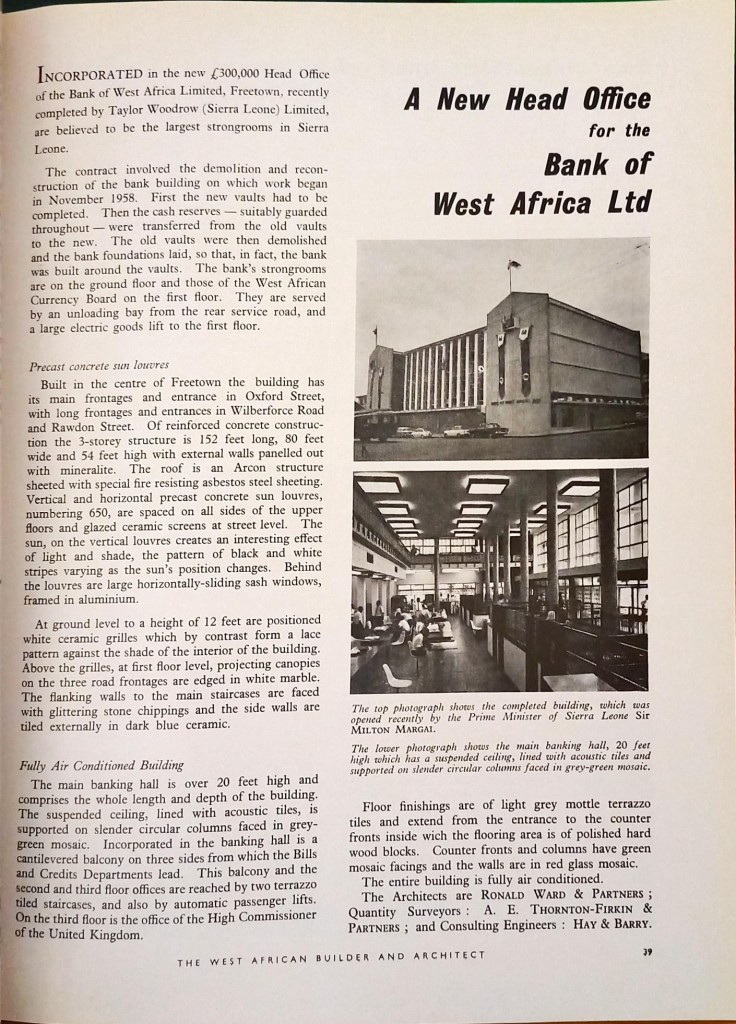
The first architectural journal in West Africa, The West African Builder and Architect (WABA) was published in 8 volumes between 1961 and 1968, and covered the field of architecture and building in the region. Nation-building programmes had started in newly independent West African nations by the early 1960s. These projects were centred on large-scale infrastructure projects for national development, which sparked a boom in design and construction. In contrast to earlier architecture journals on colonial Africa that were published for a metropolitan readership,i WABA was founded by and for professionals based in West African countries to share information on practice in the developing industry and encourage cooperation among practitioners. ii
The journal began with an editorial panel of British architects: Kennett Scott in Ghana, and Anthony Halliday and Robin Atkinson of Fry & Drew and Partners in Nigeria.iiiOluwole Olumuyiwa, one of the few Nigerian architects who studied abroad and established practices upon their return, was the only West African on the panel. Among the WABA’s target audience was the modest number of engineering and architecture students studying in West Africa. It aspired to equip them with valuable information regarding their future careers that were specific to their environment.
Published articles included news on new projects finished in Ghana, Nigeria, Liberia, and Sierra Leone as well as articles by skilled professionals discussing contemporary design and building methods in West Africa. Regular publication features included technical reviews of new products, updates on development work in the countries covered, and advertising placements.
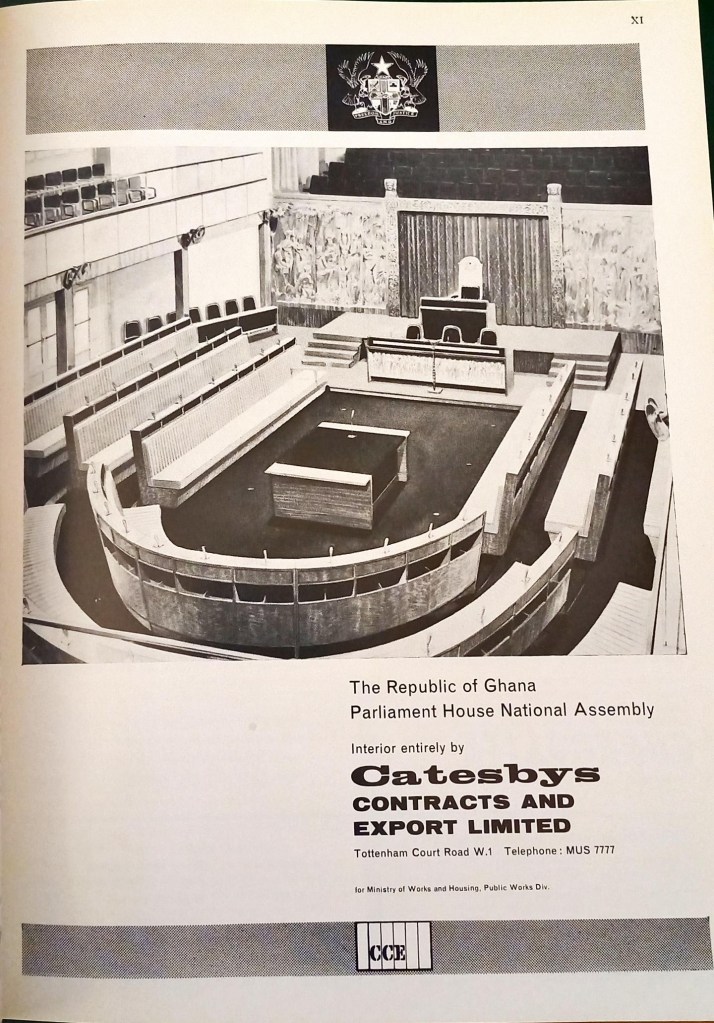
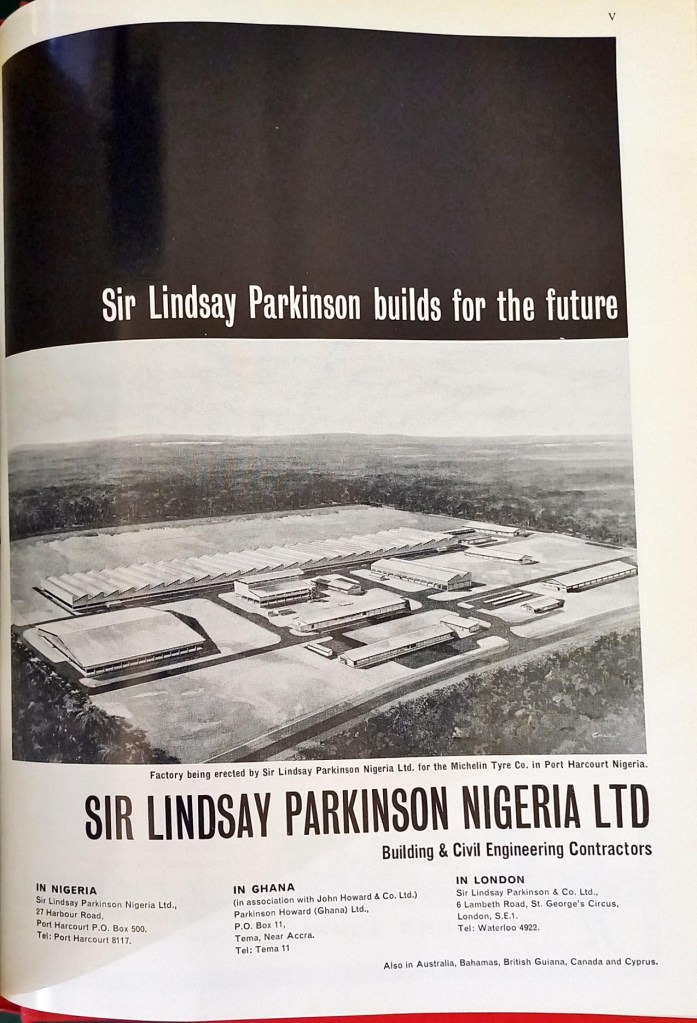
At that time, British practices operating since the 1940s dominated the architecture field in the region. They completed late colonial buildings using tropical modernist designs. This group of foreign architectural firms, including James Cubitt & Partners, Kennett Scott Associates, Architects’ Co-Partnership, Fry, Drew & Partners, etc., produced a significant number of the new structures published in the WABA journal. The projects of the general contractor, Taylor Woodrow and the engineering consultant, Ove Arup & Partners were also listed. Buildings for government organisations, corporations, and residences, constituted the bulk of the reported projects. Facilities for telecommunications, transport and healthcare were also mentioned.
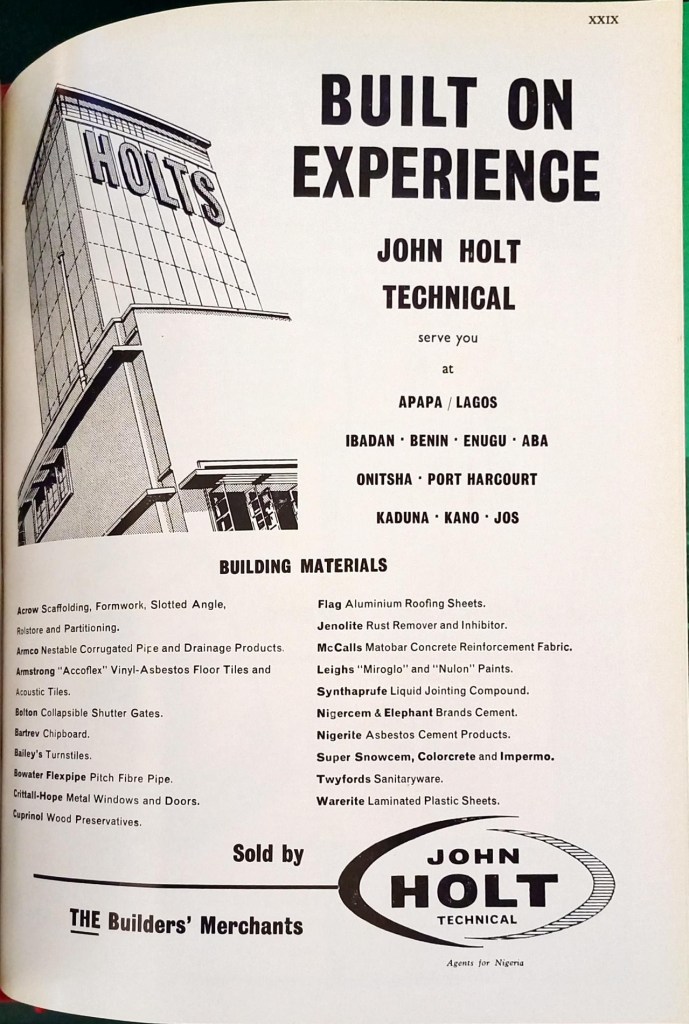
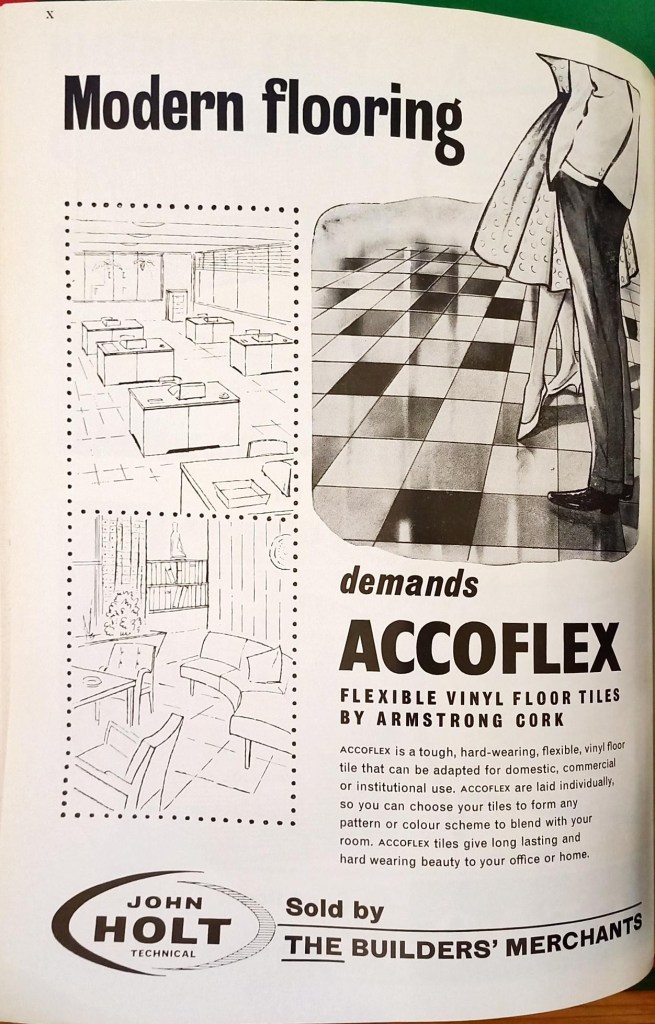
The WABA journal served as a reference for the purchase and sale of building supplies and services through advert placements, advertisers index and buyers’ guides. Advertisements in volumes 1 and 2 of the journal reflect the state of the construction industry in the early 1960s independent West Africa. As the region’s manufacturing industry was in its cradle, building supplies and equipment were primarily imported and distributed by West African-based agents. Most of the distributors’ advertisements in the journal were from multinational corporations that were at the forefront of trade in colonial West Africa such as United Africa Company, GBO (G.B. Ollivant) and CFAO (Compagnie Française de l’Afrique Occidentale). GBO Building Department for example was a former subsidiary of British merchant GB Ollivant and had been operating in Nigeria since the late 19th century. Vivian, Younger & Bond Ltd and John Holt Technical were among more well-known suppliers with numerous locations throughout West Africa.
By constructing new facilities and forming partnerships with public and private organisations, foreign manufacturers also expanded their presence in West Africa. In their various local factories, International Paints (West Africa) Ltd., Dorman Long (Ghana) Ltd., and Nigerite (in Nigeria) produced paint, steel, and asbestos sheets respectively. The headlines of these corporations’ advertisements in WABA highlighted the launch of new plants and their support of the local economy. Additionally, advertisements for locally produced goods included the clause “made in Ghana” or “made in Nigeria.”. There was a minimal presence of indigenous manufacturing companies. NIGERCEM-Nigeria’s first locally owned cement factory was the only producer to include this feat in its advertisement.
Some organizations used their advertisements to highlight their importance and reputation in the sector. Advertisements for general contractors and subcontractors were designed to appear as portfolios of completed and continuing projects. The advertisement pages for the metal component company Henry Hope & Sons Ltd always showed an image of a brand-new building fitted with their curtainwalls and/or sun breakers. This was displayed alongside a brief overview of the building including its location and architect’s name.
The journal adverts reflected companies’ recognition of their role in nation-building. Multinational corporations boasted of their delight and pride in partaking in the “progress” and “growth” of the economy and the future of new countries. Was this marketing approach merely chosen to appeal to the development-oriented nature of the new market, or was it implemented to emulate previous advertisements by foreign businesses (like UAC) in response to criticism of neo-colonialism? iv
Companies targeted their advertisements not only at professionals but also at citizens in West Africa. These advertisements directed at building occupants first appeared in the 1962 issues and frequently alluded to modernity. Adverts for flooring, sanitary fittings, and appliances included large texts with phrases like “gracefully modern” and “modern living.” This contrasted with building supplies adverts-directed at professionals-which hardly referenced modern living. The late colonial era’s ‘africanization’ programmes aided the growth of the middle class by giving priority to the education and employment of Africans by public and private sector organisations. Likewise, housing initiatives launched by government agencies like the Ghana Housing Corporation and the Nigerian LEDB (Lagos Executive Development Board) in the 1950s attracted this demographic. They were characterised by their higher economic and educational status, as well as a household lifestyle distinct from the traditional communal family structure.v Was the reference to a modern lifestyle a marketing strategy to attract the West African middle class who had adopted a western-oriented lifestyle?
The WABA journal provides an account of the building sector’s development in independent West Africa. The journal advertising demonstrated how companies promoted their products to appeal to both individual and national ideals of growth while navigating the shifting socio-political landscape.
i See Hannah le Roux and Ola Uduku, ‘The Media and the Modern Movement in Nigeria and the Gold Coast’, NKA (Brooklyn, N.Y.), 2004.19 (2004), 46–49.
ii ‘Introduction’, The West African Builder and Architect, 1:1 (1961), 1.
iii In 1961, the Nigerian office of Fry, Drew and Partners became Fry, Drew, Atkinson Architects Nigeria under the leadership of Robin Atkinson. ‘Nigeria Developments’, The West African Builder and Architect, 1.4 (1961), 108.
iv Bianca Murillo, ‘“The Devil We Know”: Gold Coast Consumers, Local Employees, and the United Africa Company, 1940–1960’, Enterprise & Society, 12.2 (2011), 317–55
v Daniel Immerwahr, ‘The Politics of Architecture and Urbanism in Postcolonial Lagos, 1960-1986’, Journal of African Cultural Studies, 19.2 (2007), 165–86 (p.175)
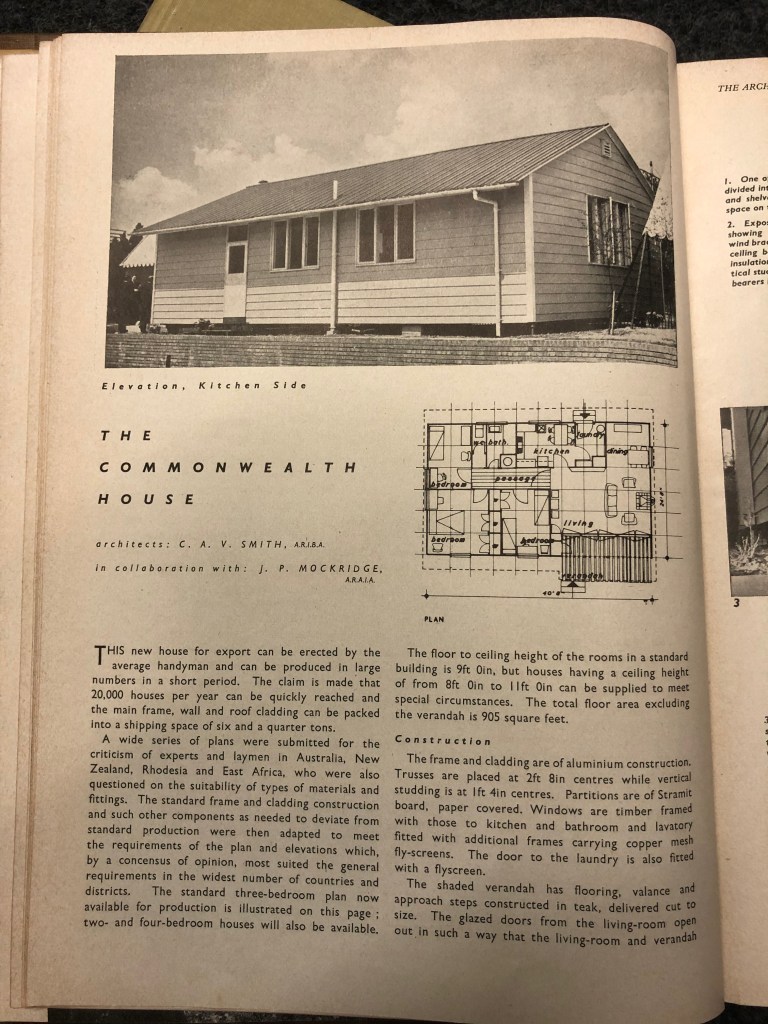
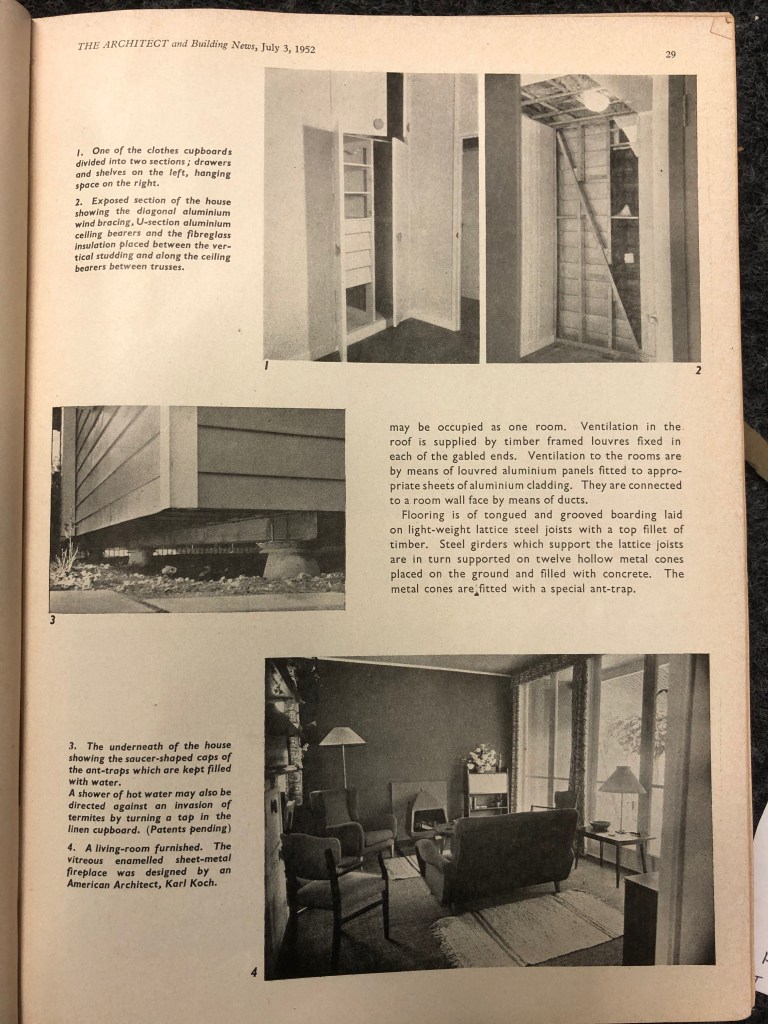
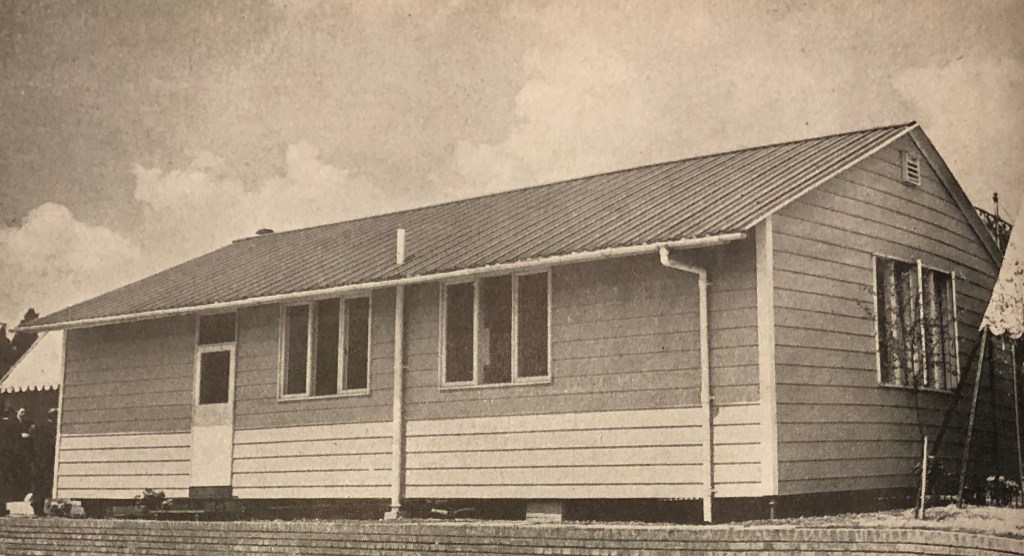
In the Architect and Building News from July 1952 there’s an intriguing article for a partially-prefabricated ‘Commonwealth House’.
The Commonwealth House
The house could be easily shipped and ‘erected by the average handyman’, aided by a standardised kit of parts would make manufacturing simple and predictable.
The house was designed by Charles A. V. Smith with John Pearce Mockridge, following a consultation with potential makers and inhabitants. The architects adjusted their designs to suit a consensus – resulting in a house very much designed by committee with a predictable, if utilitarian and efficient, floor plan.
The brief was to develop a house that would be suitable across the geographical and climatic zones of Australia, New Zealand, Rhodesia (now Zimbabwe), and East Africa. Over 20,000 units were expected to be built per year to meet the demand for emigrating workers and their families eager to escape war-torn Britain for opportunities elsewhere.
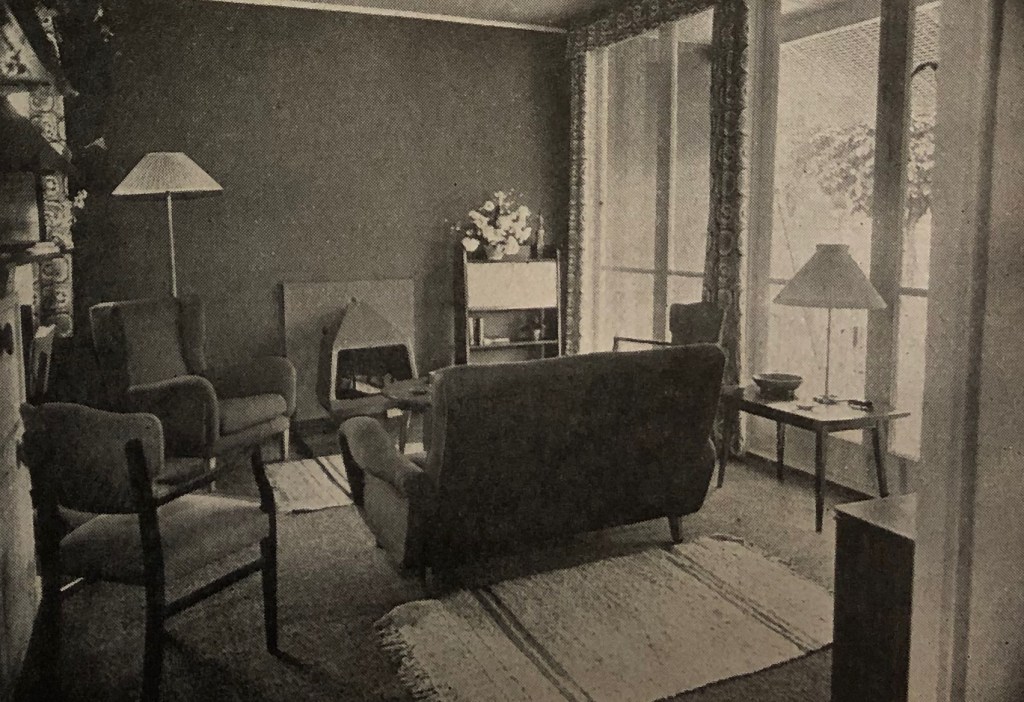
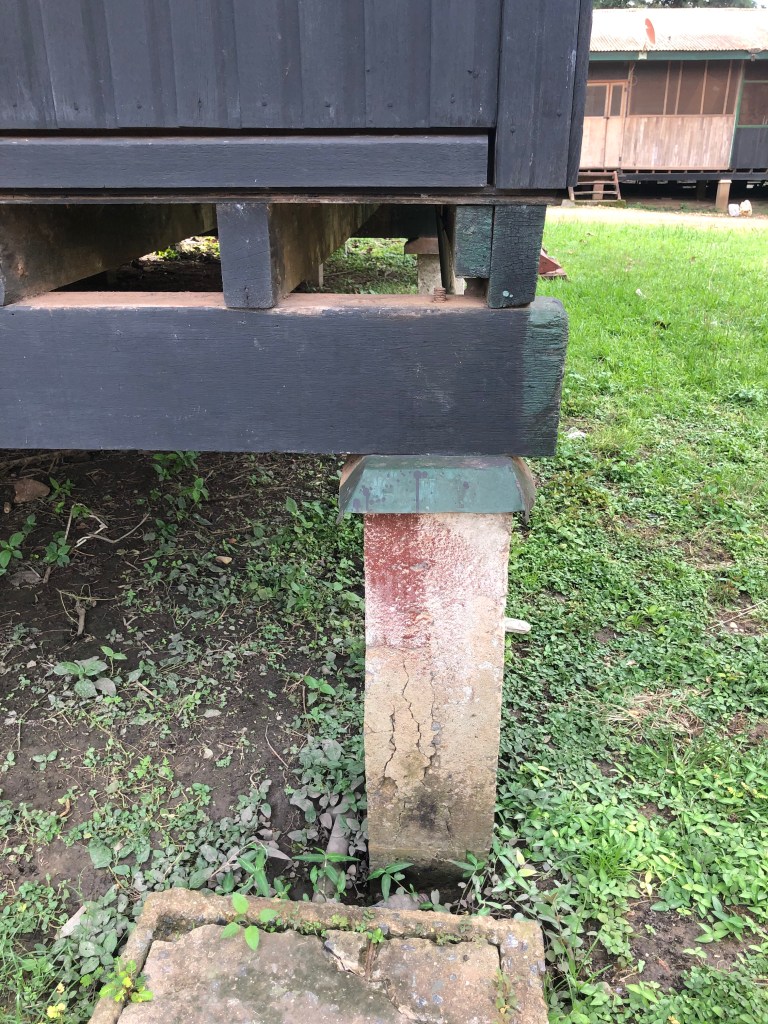
The house had an aluminium frame structure, and the cladding materials could vary depending on availability and final conditions. It was placed on concrete posts with an ant-trap to resist termite attack. The prototype erected on Great West Road in Hounslow was fitted out with furniture and a fireplace designed by American architect Carl Koch (1912-1998), who later pioneered several prefabricated house designs in the US.
The Commonwealth House design was very similar to houses we saw in the timber saw-mill town of Samreboi in Ghana – even down to the ant-trap detailing.
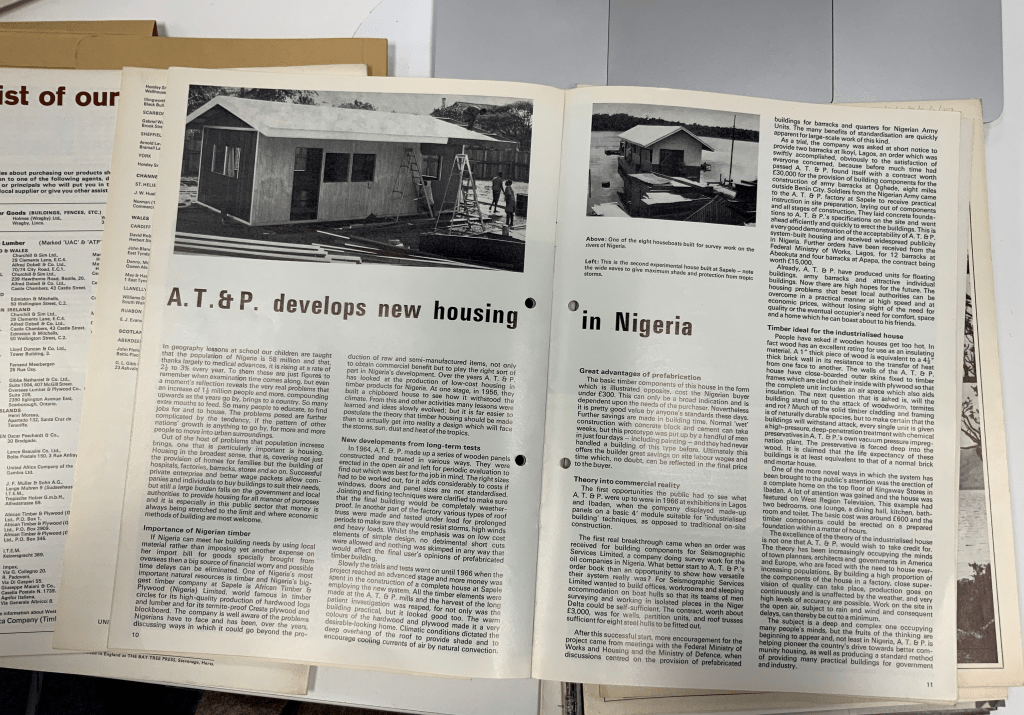
The African Timber and Plywood Company (AT&P), who owned the mill and were responsible for most of the housing, were also attempting to develop their own housing kits and to expand into new products and markets.
Timber framed housing in Samreboi, GhanaTimber framed housing in Samreboi, GhanaAnt trap detail
By 1954 AT&P had begun to discuss prefabrication techniques and processes at both Samreboi and their larger station at Sapele in Nigeria. The drive and urgency for this type of production was heightened by increased competition and political efforts to quickly improve housing standards in West Africa. The Dutch firm Schokbeton had been awarded a large order for prefabricated housing in Ghana, and contractors Taylor Woodrow were eager to expand their building products export wing.
Architect Edric Neel (1914-1952) developed a consortium of architectural consultants with Taylor Woodrow in 1944 to research new structures that could be quickly assembled and fabricated. The group was called Arcon and their first project was a temporary prefabricated house. The system developed into a set of lightweight tubular steel components that could be easily welded together. The façade, if required, could be made of local materials, metal sheets, or cement board cladding, as required. The system was intended for export and into ‘tropical conditions’ in particular. The units could be readily scaled and used to assemble large factories and sheds with large spans. Many of the factories and mills (including those at Samreboi) utilised this standardised and low-risk approach to construction.
Saw Mill at Samreboi, Ghana
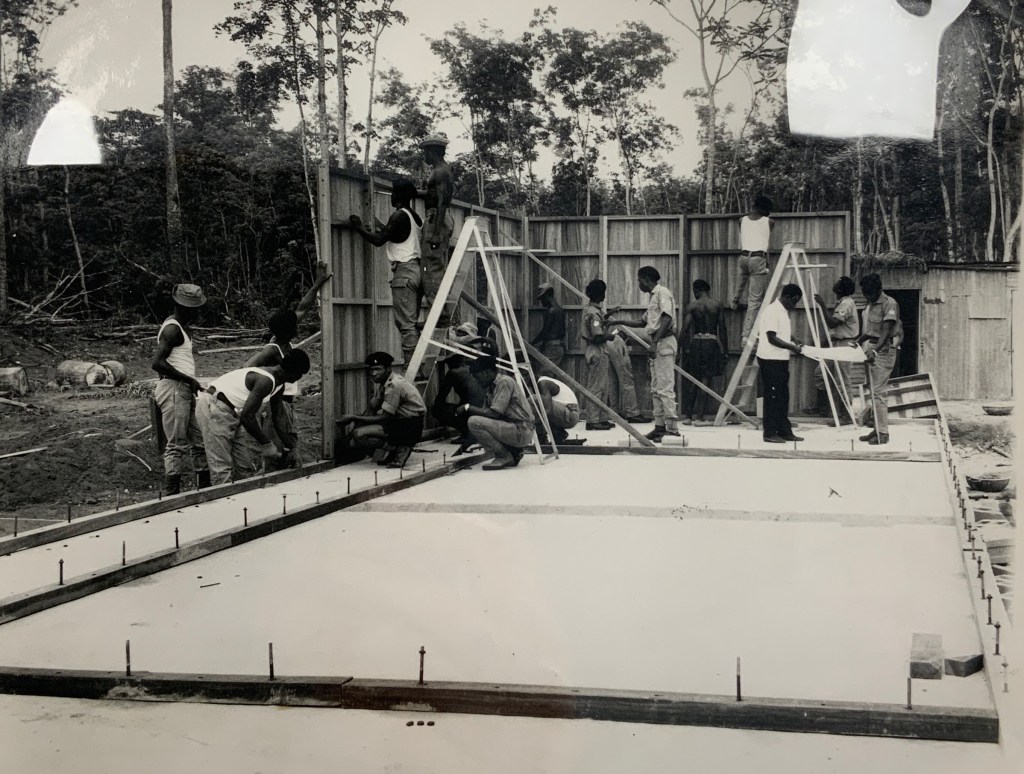
Over the next 15 years AT&P began developing a series of prefabricated houses, but rather than developing a frame and cladding approach they created integrated wall panels (like flat-pack furniture) with modular dimensions so that windows and doors could be added where required. They called it the AT&P System Building, and priced a small house at £500 – compared to the £1200 Schokbeton model.
The system was adopted for military projects and housing, and continued to be deployed into the 1970s with AT&P developing many different variations and types.
The latest issue of Planning Perspectives investigates the role international organizations such as the United Nations, the World Bank, and the Red Cross played in the architecture discourse and the rise of ‘global experts’. The collection of articles, co-edited by Filippo De Dominicis and Ines Tolic, explores development plans and housing schemes, but also events related to dissemination or training implemented especially, but not exclusively, during the decolonisation phase in the 1950s and 1960s and the so called ‘development decades’.
In an article published in open access which I co-authored with Axel Fisher, Foreign aid for rural development: village design and planning in post-independence Morocco, we asked ourselves to what degree the work of architects and urban planners was influenced by the shifting and competing development agendas of the United Nations’ technical assistance, the FAO – Food and Agriculture Organization, and the World Bank. We start from the analysis of architects’ involvement in three rather diverse rural development projects implemented in Morocco after the 1956 independence in which community development and infrastructure-driven approaches overlapped. In doing so, we question the architects’ capacity to translate the strategic objectives in functional programmes, and to make ‘spatialized politics’ most vividly palpable.
Inês Nunes is a PhD student at University of Coimbra, Portugal and is investigating, “The Social Within the Tropical: Jane Drew and Minnette de Silva designing an inclusive modernism in the tropics”. Here’s an update on a recent visit to the RIBA archive.
“My dearest, darling Jane”: unfolding Fry and Drew Papers
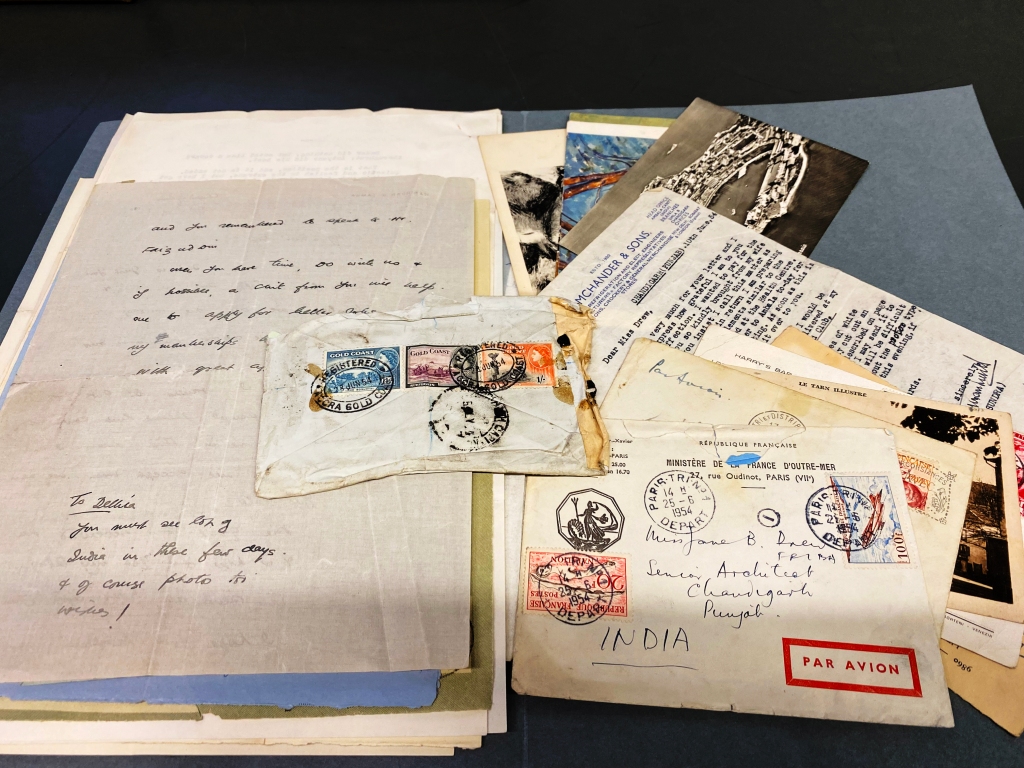
In a conversational tone, Maxwell Fry addresses Jane Drew from the ‘remote’ mid-1940s Accra. “Darling Max”, she replicates. Their correspondence, a lively itinerary from West Africa, India, Iran, or Mauritius, belongs to a treasure chest named Fry and Drew Papers. It is accessible, along with unrivaled archival material, in the RIBA Architecture Study Rooms of the Victoria & Albert Museum(London).
Love notes handwritten on hotel letterheads, diaries displaying candid reflections about life, and memoirs manuscripted on paper bags are entangled with professional-wise material. Included are lectures and articles revealing narratives about architecture, extraordinarily illustrated with colourful drawings or sharp pencil sketches. Both are complemented by miscellaneous data: postcards, press cuttings, administrative files, address books… The characters gain life in every opened box. Their voices echo through calligraphies, signatures, ideas.
In its uniqueness, Fry and Drew Papers are an overwhelming resource regarding the life and work of both architects and an efficient record of the dynamic of their global scope partnership. Even so, it excels. Flexible and embracing enough to accommodate diverse interests and aims, unpublished personal letters, diaries, and autobiographies provide captivating details to any enthusiast – for instance, Fry’s diary was only made accessible in 2021. Furthermore, the archive is a source of knowledge about British historiography and significant architectural thematics: the MARS Group, the Modern Movement, Tropical Architecture, and Chandigarh are noteworthy.
Overall, the research was a privilege and the expectations were exceeded. My deep gratitude to Dr. Shireen Mahdavi for supporting this endeavour. The wealth of these primary sources allows an experience that couldn’t have been more rewarding. By immersing in Fry and Drew’s universe, how inspiring becomes their lifetime of respect and companionship, the robustness of their practice, and the profound vow to “produce towns and housing that will be loved, lived in and cared for” (Drew, F&D/27/2).
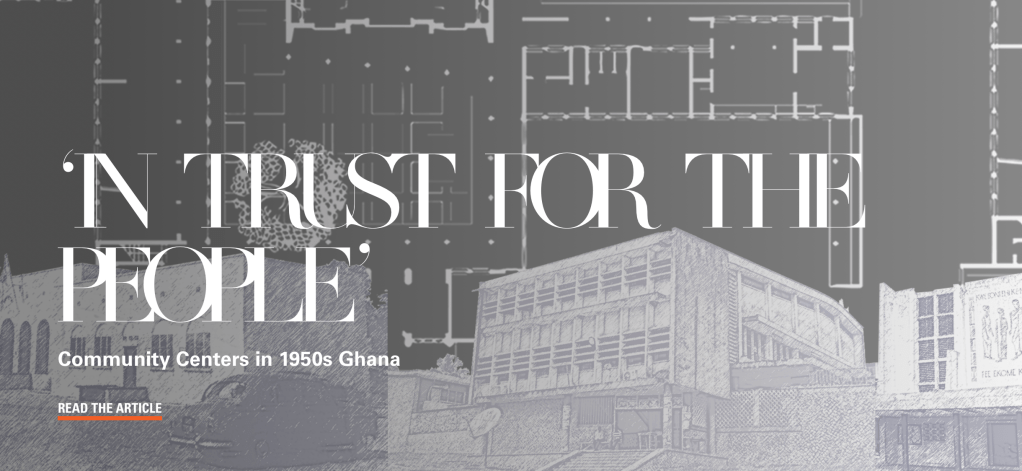
Have a look at the latest article from Design233 on Community Centers in Ghana, including the Accra Community Centre (paid for by the UAC) and Tarkwa Community Center (paid for by the Manganese Mining Company) – both designed by Fry and Drew. In addition to these modernist works the more formal and classically inspired centre at Kyebi is discussed – this centre is more of a mystery… We know it was funded by the Consolidated African Selection Trust (CAST)- but who designed it, and why did CAST commission such a lavish project?
Accra Community Center PlanTarkwa Community Center articleKyebi Community Center
An annotated diary of my visit to the Democratic Republic of Congo: a brief stop in Kinshasa before flying to Kisangani and then, following the Congo River, a preliminary exploration of one the regions where the Huileries du Congo Belge – HCB had established its oil palm plantations.
This trip would have not been possible without the help of >>Istituto per la Bioeconomia – CNR and Forets (Formation et Recherche dans le Tshopo) – >>Cifor (Centre for International Forestry Research).
May 2022
Kinshasa — Me and Ottaviano landed in Kinshasa on a Monday morning. I had never crossed the Equator before.
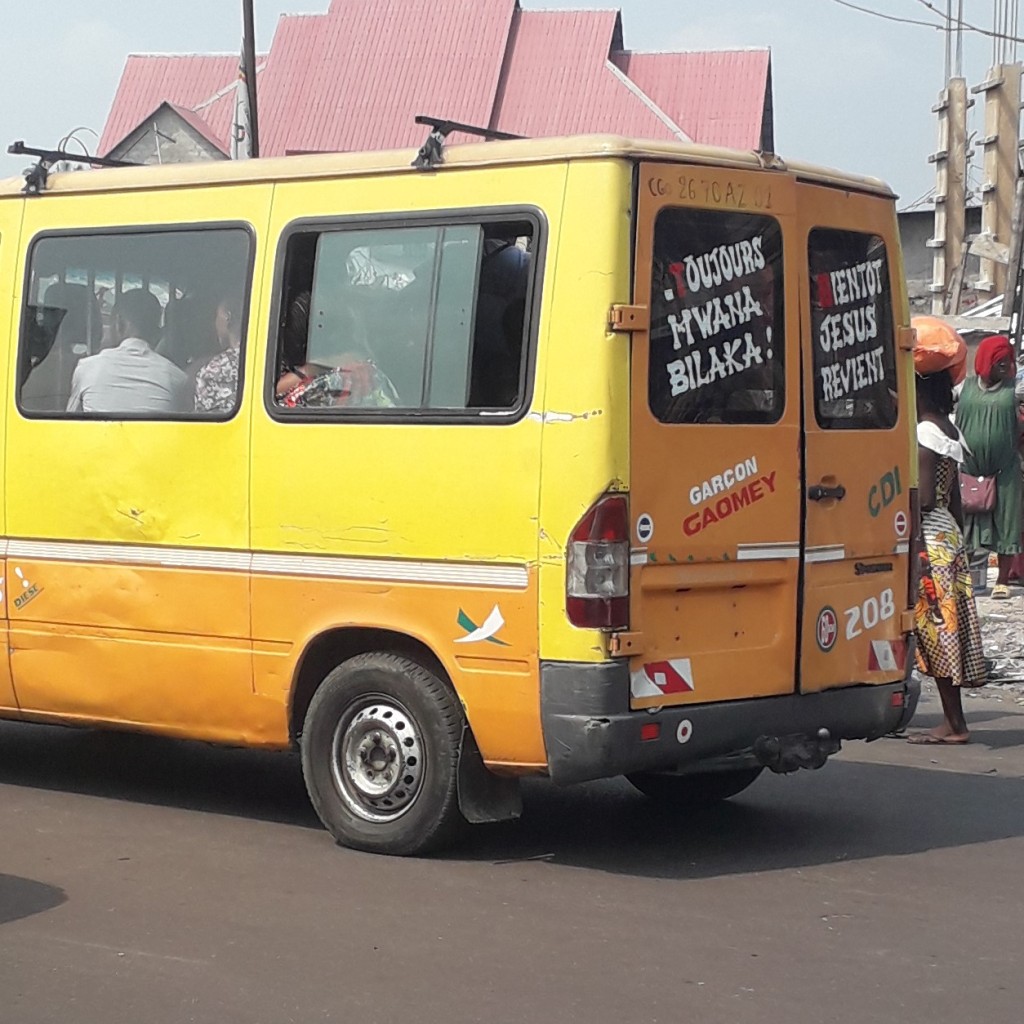
Papa Victor is waiting for us outside on a white Toyota jeep with a EU flag on the door and dents and scratches on all sides. A description that would fit most of the vehicles I travelled in during this trip and, as I came to discover, a stereotype for Westerners in this country. Victor is a tall, pleasant man who talk and laugh quietly even when we plunge into the suffocating traffic of Kinshasa. The 25 kilometers between the airport and my hotel in Gombe are an endless sequence of taxis, yellow Wokswagen vans running with the doors open to bring some air to the passengers squeezed inside, a multitude of weva moto-taxis, and trucks covered in sticky black dust.
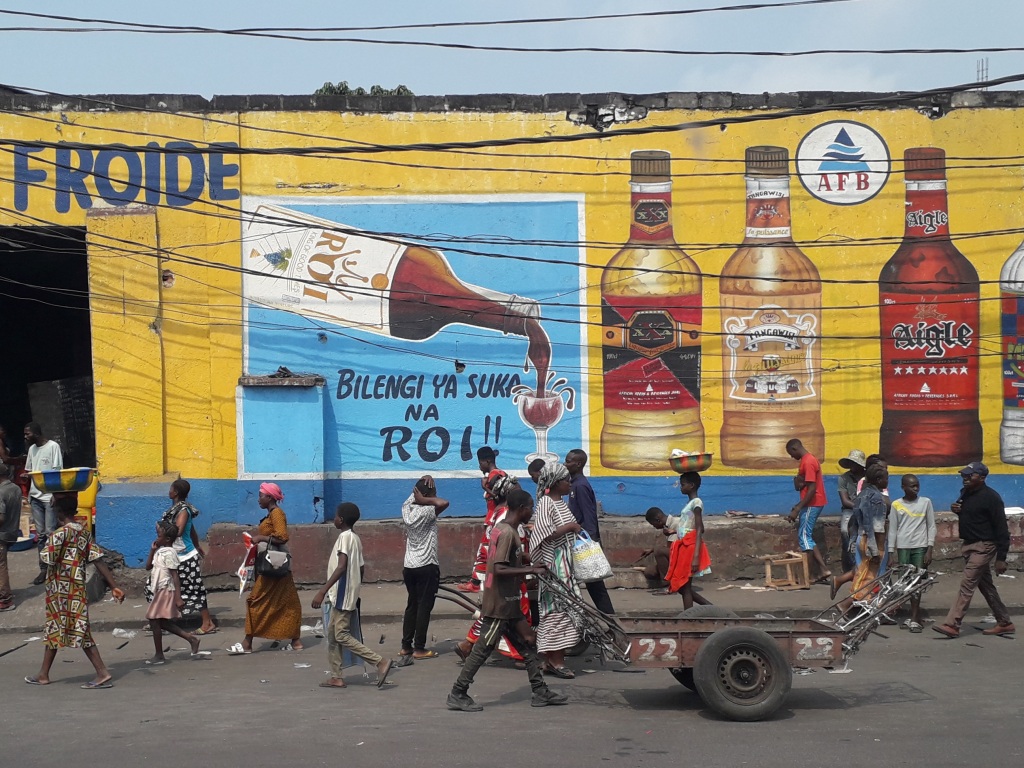
The two days in Kinshasa are chaotic. We meet with some people and don’t see much. I watch street scenes, buildings, and billboards passing by from the window of Victor’s car.
During the last night in the city, I meet my old friends and former colleagues Raphael, Paul, and Pietro – who became a real Kinois in the meanwhile. From the hall of my overpriced hotel Raphael, tells me with his usually sharp irony: “Il faut que tu sors de cette Leopoldville”. And so we drive away, leaving Gombe behind us. Paul, who has a thing for infrastructures, gives us a lecture from behind the wheel of his car while we cross the city. Boulevard du 30 Juin, which originally connected the two Stanley’s times settlements of Kintambo Ngaliema and Nshasha, and later became the first of the large avenues of the colonial capital [>>Kinshasa Then and Now]. Avenue des Huileries, pointing to the area formerly occupied by the Huileries du Congo Belge, now hosting its successor Marsavco.. And then, Matonge, the neighborhooud that everyone here calls the musical capital of the DRC. After having lived for years few hundred meters from Matonge (Brussels) – a product of Congolese diaspora in Belgium – I finally get to see its original counterpart.
It’s early in the morning when we leave again for the airport but the city is well awake.
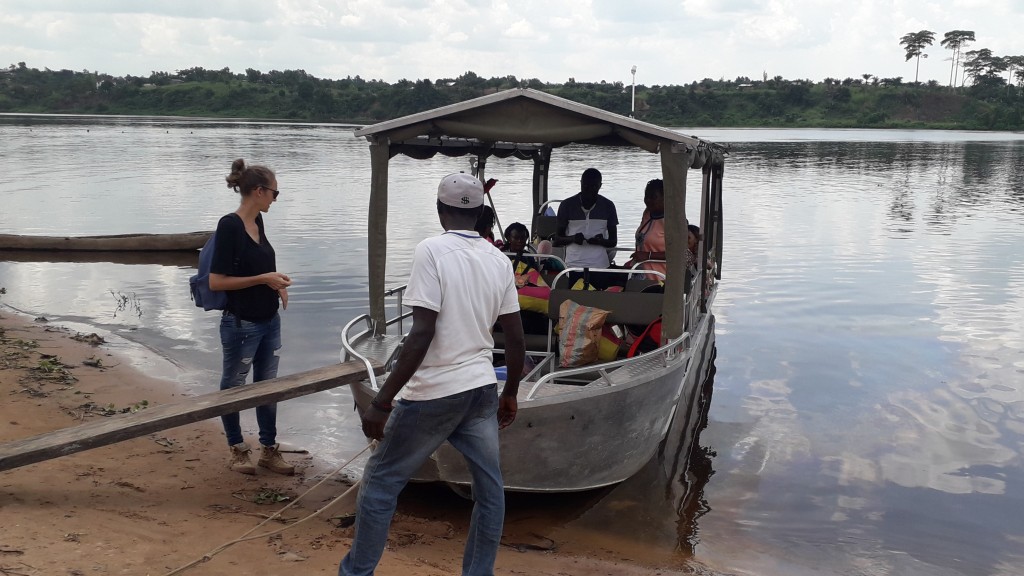
Congo River — After landing in Kisangani we are brought directly to the dock on the Tshopo river. The beach, as docks are locally called borrowing the word from English, is just a sandy stretch where dugout canoes and boats come ashore. We get on board of the canot rapide that Cifor made available for us and, following the Tshopo and Lindi rivers, we finally reach the Congo. Few kilometres upriver, the Wagenia/Boyoma falls, a one-hundred kilometres long sequence of cataracts, make the river impossible to navigate. After the falls, the Congo begins its ‘quiet’ descent of the 1,700 navigable kilometers dividing the place where we are navigating now from Kinshasa’s Pool Malebo before rushing again, through impressive rapids, up to Matadi and to the Ocean.
From this moment on, this broad, magnificient river, with its banks covered in thick vegetation, becomes the silent protagonist of the travel.
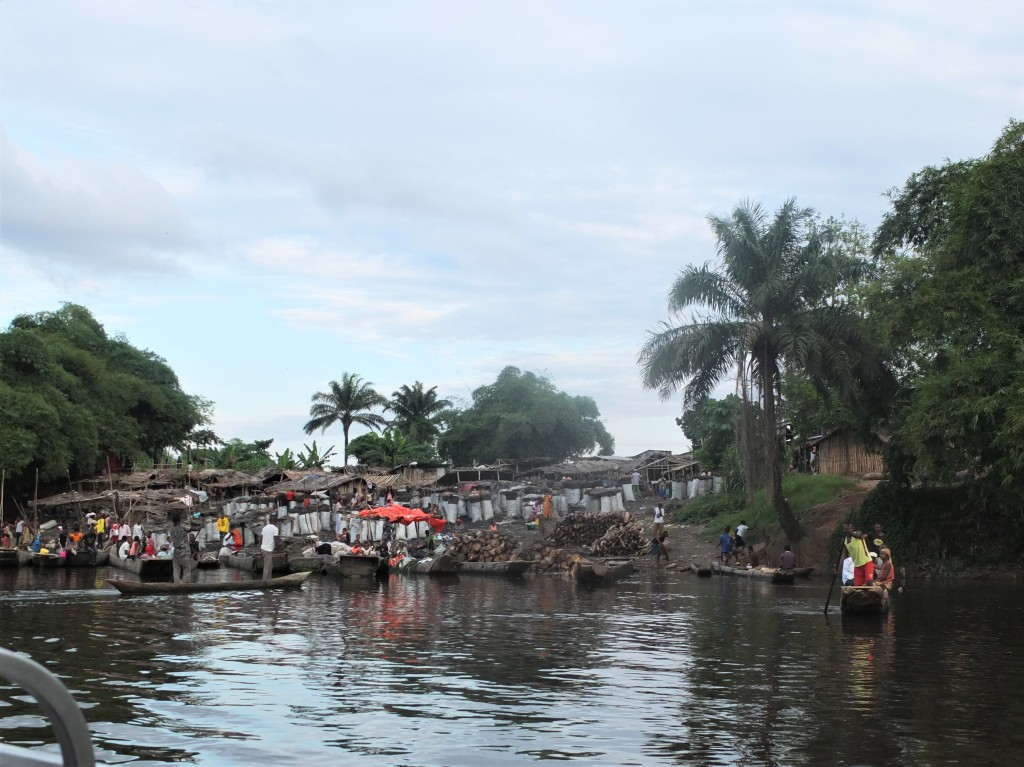
Moving along the river coast, the canot go past busy docks where pirogues – simple boats built by carving a single tree trunk and manouvred by one or two rowers – carry large, white sacks of coal to sell. Apart from our boat and the infrequent barges, the river is populated by these small crafts and by the noisy baleinières (‘whaler’), a wooden boat used for goods transport. Besides being painfully slow, the two half-sunken relics I could spot along the way, testify the scarce reliabilty of these bizarrely named boats.
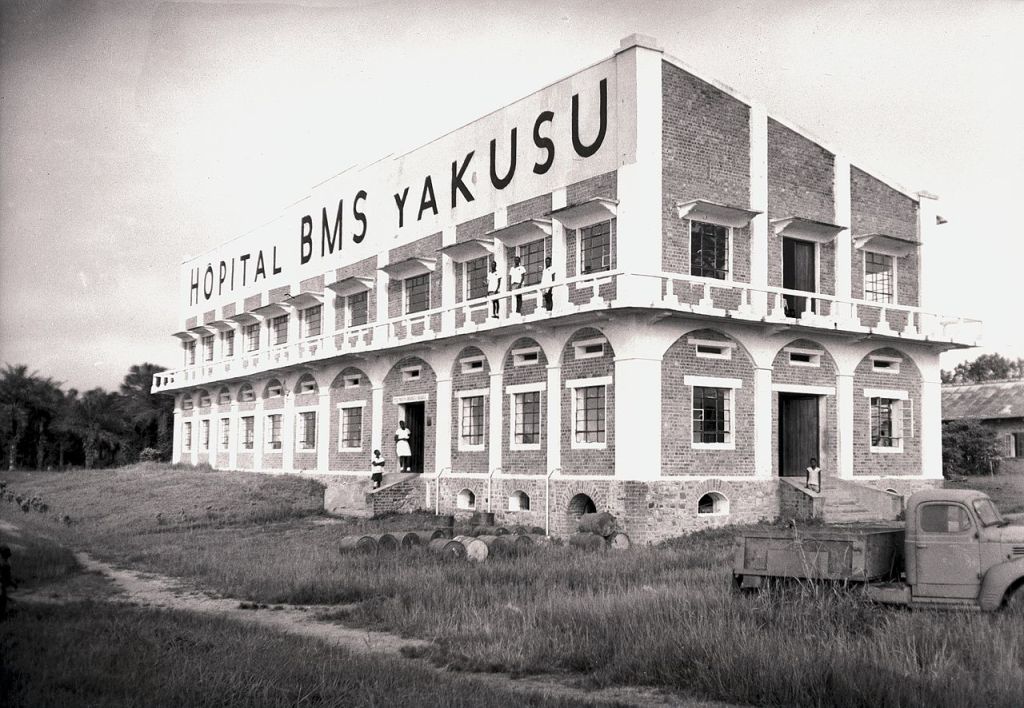
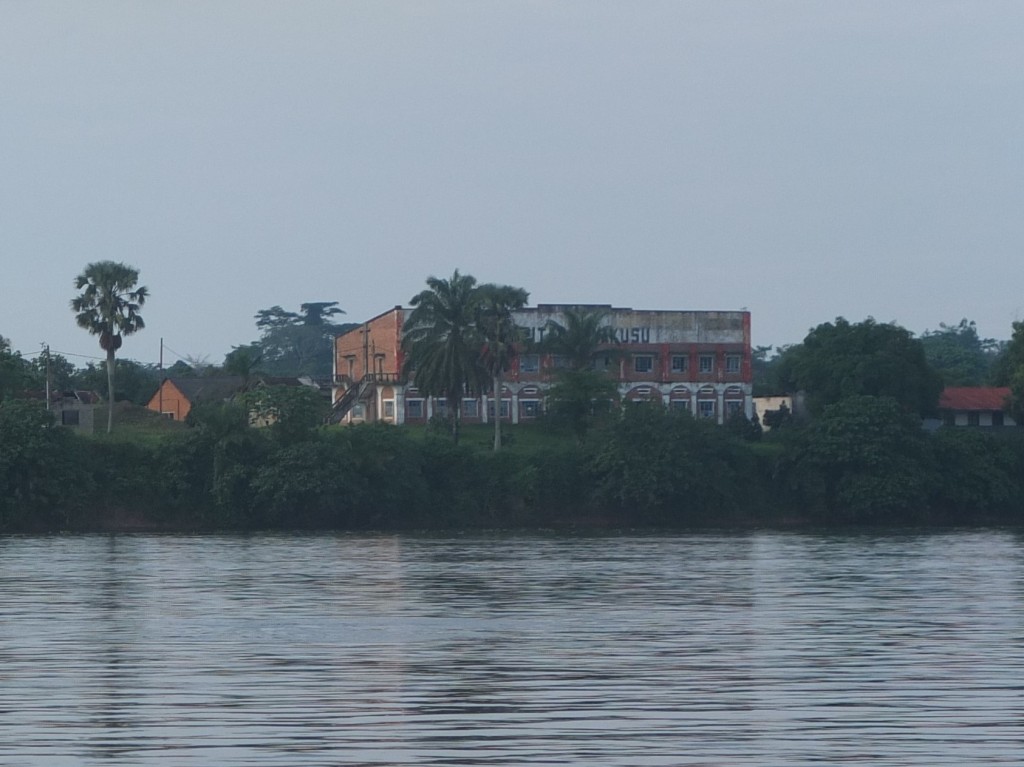
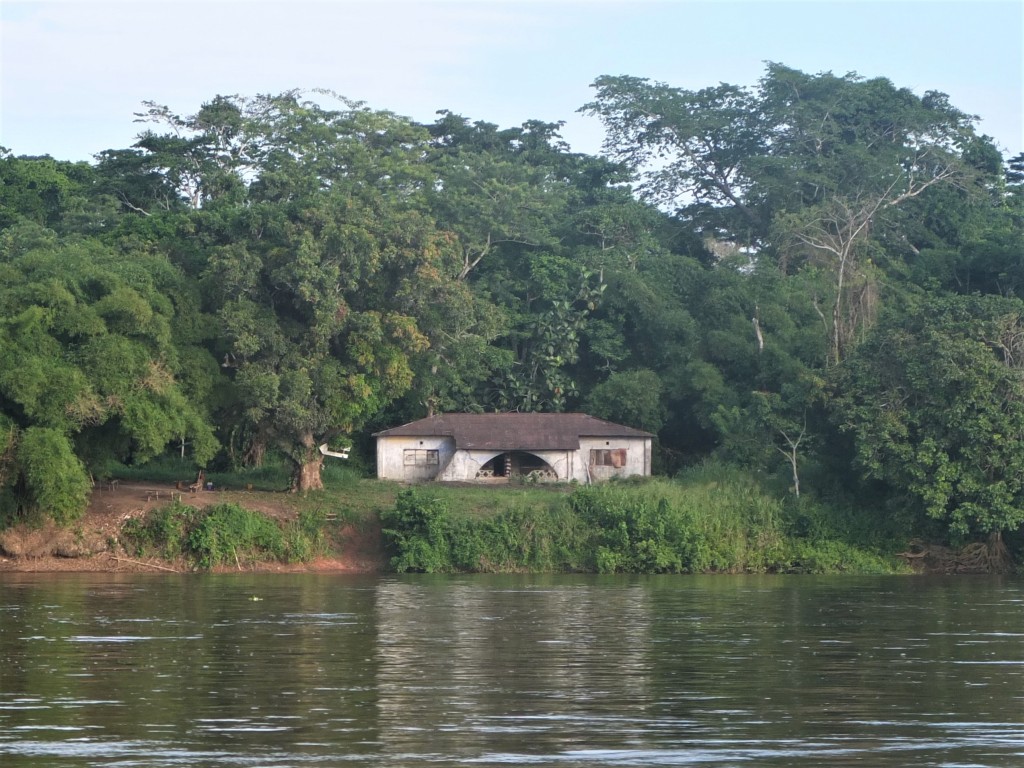
From the canot, on the right bank, flanked by colonial villas, I spot the prominent facade of the Yakusu hospital, a now run-down gem of the Baptist Missionary Society in the Belgian Congo and an important institution for the educational and medical history of the country [Nancy Rose Hunt,>>Colonial lexicon: of birth ritual, medicalization, and mobility in the Congo].
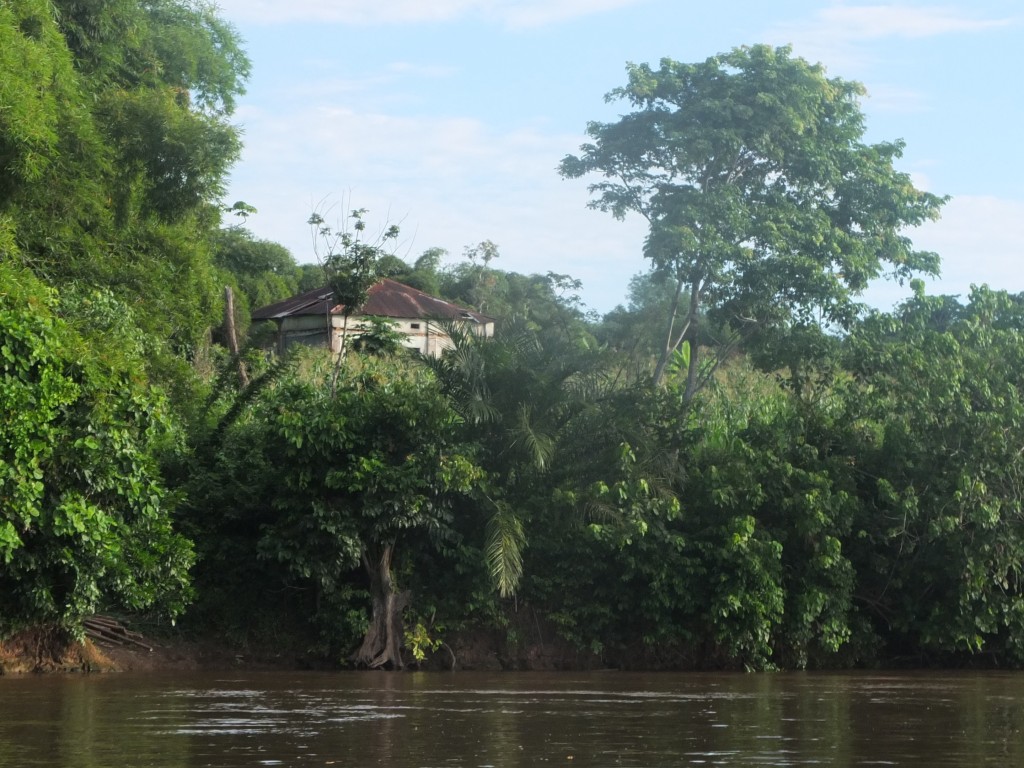
Further down the river, the Belgika, a private island owned by the heirs of a high-rank military chief under Mobutu dictatorship. Our boat speeds close to the coast; the waves agitate the fishermen’s pirogues moving under the branches of leaning trees. The shape of old buildings with porches facing the river vanishes rapidly behind the vegetation. >>During the colonial time, the island was a coffee and rubber plantation owned by the Comptoir Colonial Belgika. The company realised barracks for the workers and villas for the European technicians and now, half a century after it abrupty left the island, those buildings are occupied by the few hundred people still living on the island or are left in disrepair.
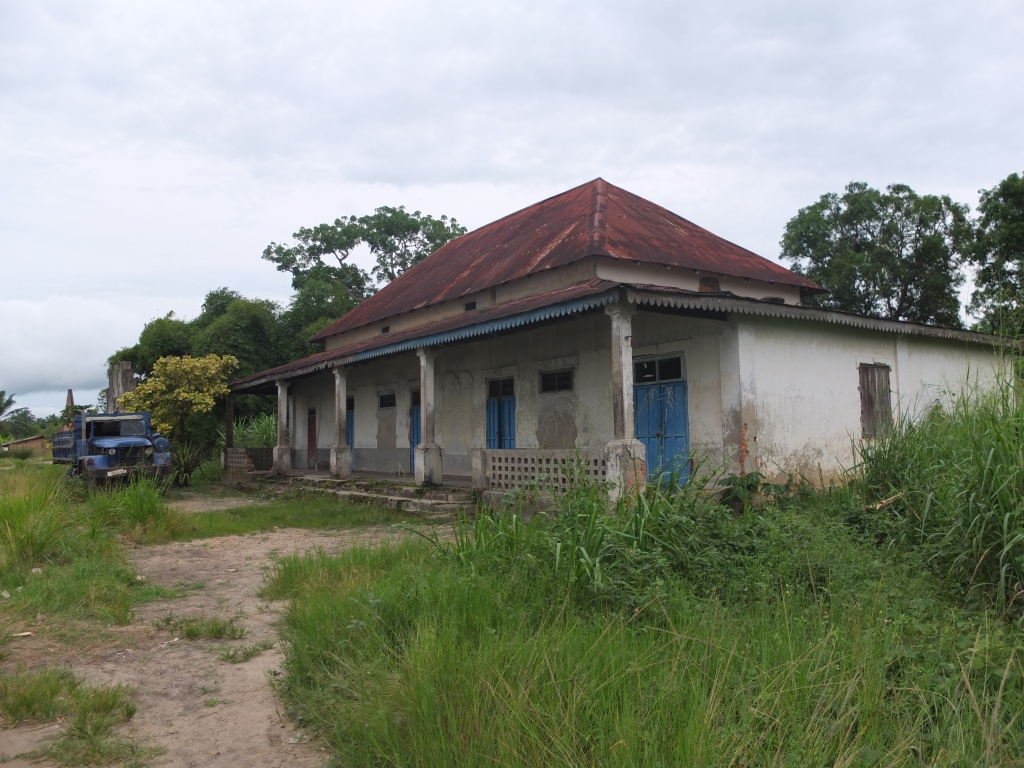
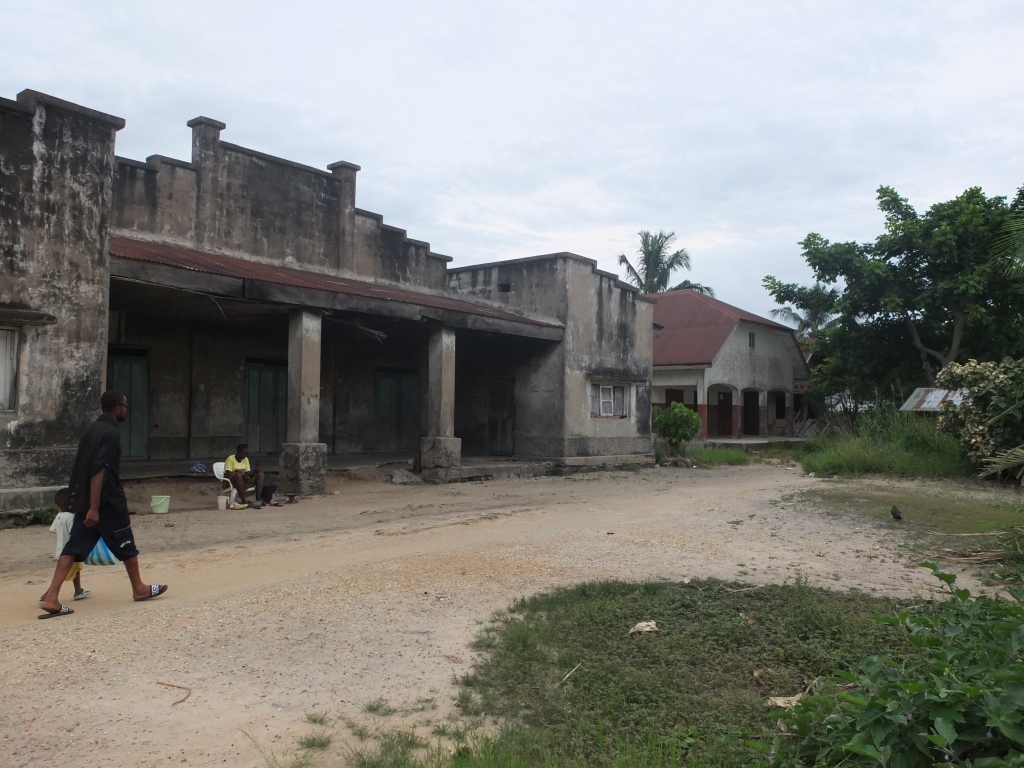
Yanonge — 50 kilometers downriver to Kisangani, we disembark in Yanonge, a small town built around a river dock and its market; a commercial gate to the river for the backland Opala territory and the Turumbu people. Up from the dock, over the steep river banks, I can read dates and names of European firms inscribed on the front of wharehouses now surrounded by the wooden stands of the weekly market. Along the riverfront, the traders’ villas and shops are almost untouched. Guélor, who shows me the place, lives in one of them with his family of five. The rest of the town is made of single-floor brick houses – the construction material coming from the local furnaces – and by simple clay, wood and straw houses. Outside the busy market area and the two main roads, people walk calmly in the shade of the many acacia and palm trees.
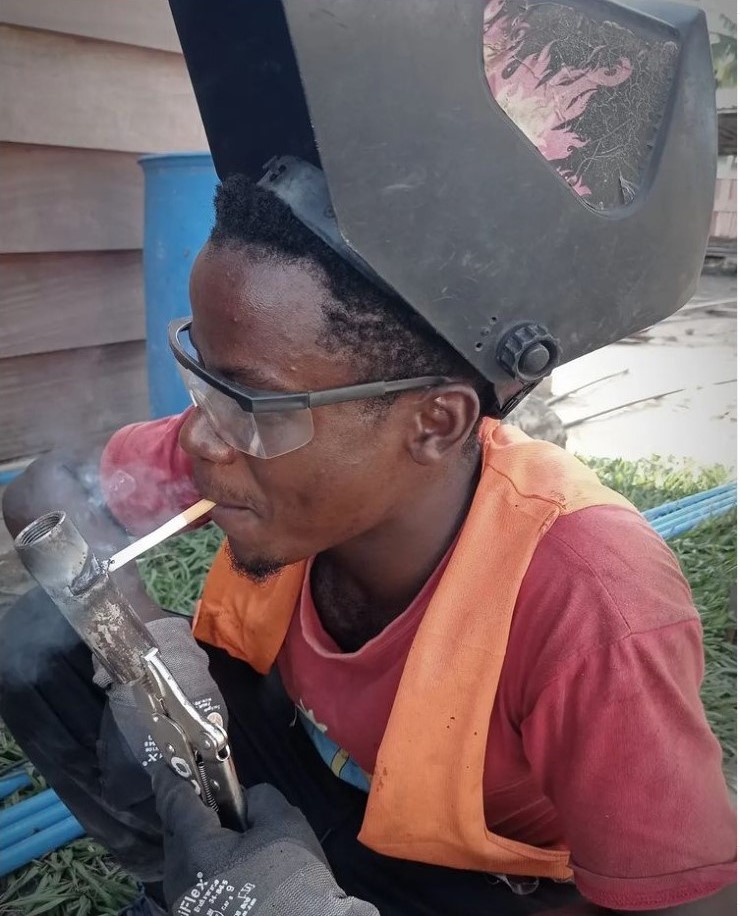
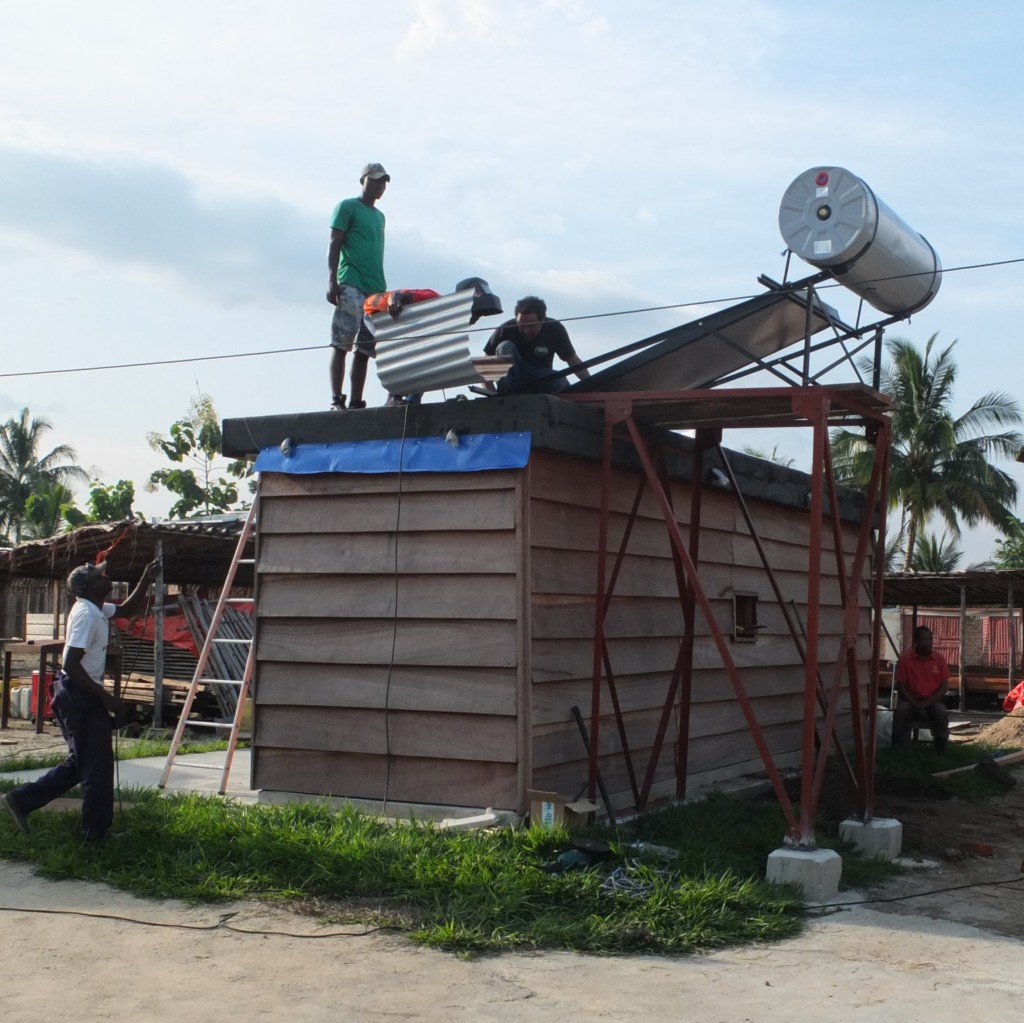
Since few years, Cifor established one of its bases in the town and carries our reforestation, agricultural and local development projects. Silvia, among the many other things, coordinates the construction of a small sawmill. A solar drying kiln is close to completion and an oddly sorted team of Congolese and Italians welds metal, cuts wood boards, make electrical and hydraulic connections, rushing to complete it before our departure. (My contribution to the works is barely symbolic). The aim is to prepare the way for a locally managed, and economically sustainable activity which, allowing to meet the quality standards required for exporting wood, would eventually offer a credible alternative to illegal logging [>>Forets]
Fabrice lighting a cigarette with a welded piece / Vittorio at work: photos O.A.
During our days in Yanonge we stay at the local Catholic mission. Outside cities, missions often offers one of the few reasonably comfortable accommodations and in Yanonge, the Comboni community also gives the occasion for some peculiar encounters. Our early equatorial evenings are filled by the accounts of Father Vittorio, a truly remarkable character who spent 50 years in the Congolese rainforest, has unlimited energies, and a passion for >>improbable projects. When sitting in front of the usual plate of rice, pondu and tilapia, he starts talking and so I put my recorder on the table. I collect hours and hours of his improvised local history monologues in which he mixes personal memories with the accounts of the people among whom he have lived. “There weren’t many books in the places I have lived – he keeps saying, not without theatricality – but people love to talk to good listeners.”
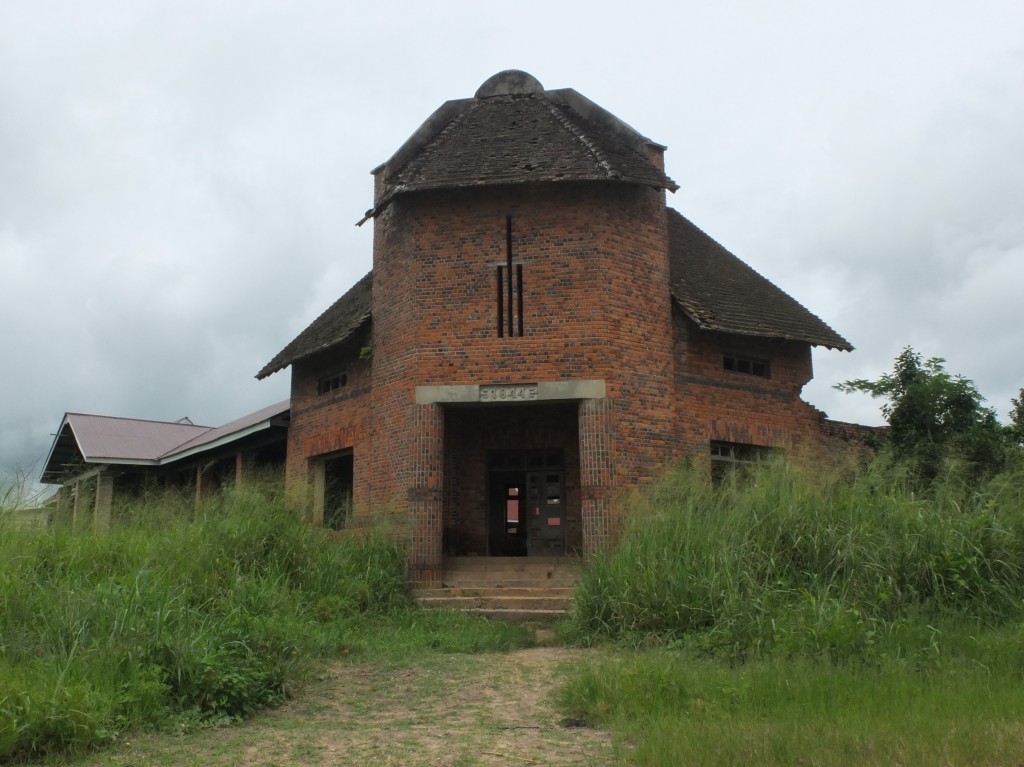
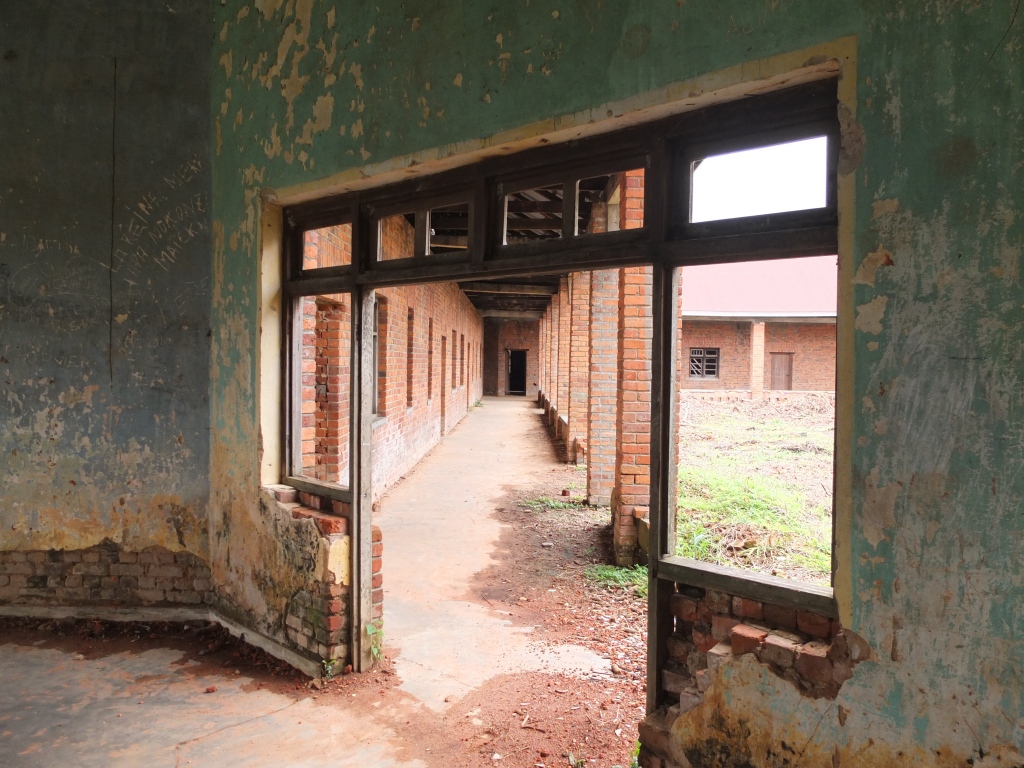
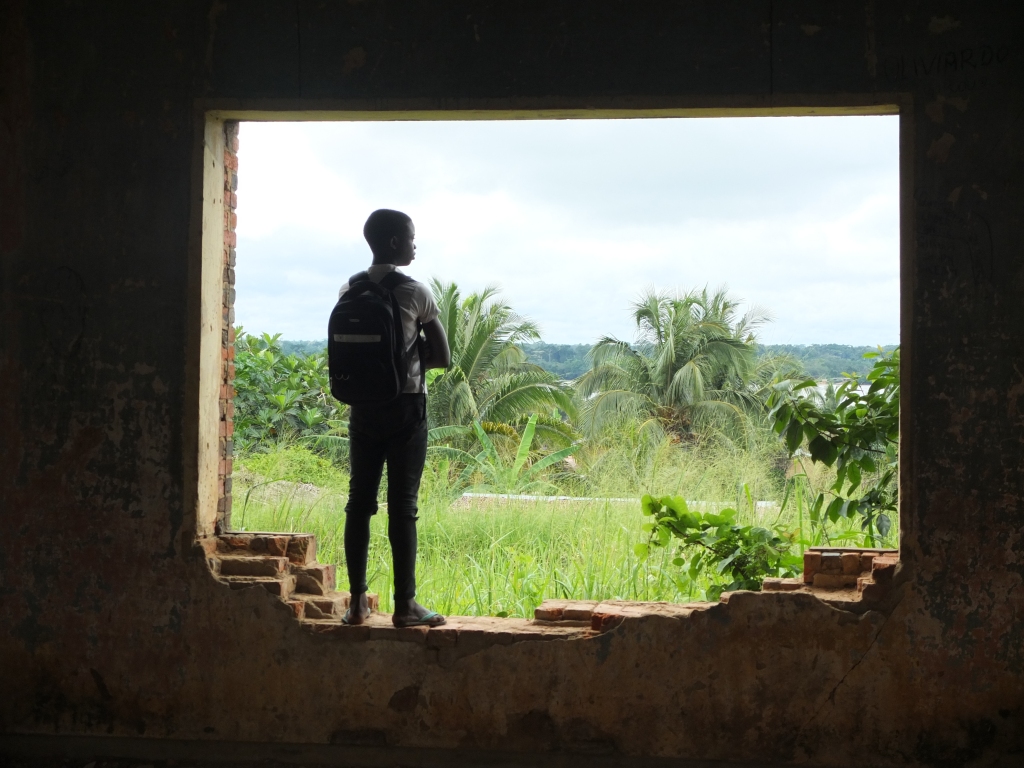
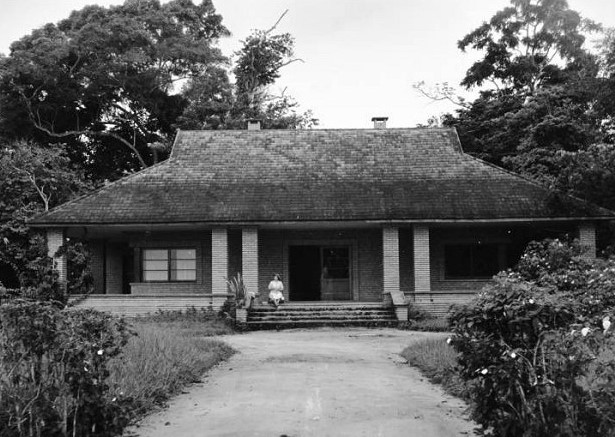
Here, the buildings have stories to tell too. The religious mission was established in the early days of the Belgian Congo and abandoned for decades after the brutal incursion in the convent by the Simba rebels in 1964. The concrete lintel mounted on rounded jambs – a motive that many times I saw in Brussels – at the entrance of what was the mission’s carpentry school is marked with the date ‘1944’. Behind the art-deco facade, a large room covered with an overly complex wooden trusses system. The three wings with porches on both sides form a courtyard and are in ruin. Part of the high-pitched roofs – a large ventilated chamber was originally left on top of classrooms to protect them from the heat – had been replaced; the rest had crumbled. Kids are everywhere, playing among the teetering walls. Our not so credible recommendations to stay away from the crumbling structures are (quite understandably) ignored. The mostly disappeared wood worshop is now a favourite spot for discreet nocturnal encounters and Paolo says that the large wood cutting machine built in Belgium in the 1940s was still bolted to the floor until not so long ago.
Private archive Vittorio Farronato
Next to this complex, the church and the old convent – now used as a school. The convent has a familiar shape that I had never had the chance to look closely before. A single-floor building – despite what the view from the outside may suggest – with a central corridor cutting longitudinally, facade-to-facade, through the building and rooms on both sides. Seen in cross-section, the corridor with openings placed at the ceiling level was meant to extract the hot air through natural ventilation. Next to this group of buildings and most probably coeval, a structure carrying a sign MATERNITE’ and two groups of identical brick houses which once hosted the school’s teachers.
The few days I planned on staying in this small town became more than a week as I’m stuck in bed, ill. “The full tropical experience” Iain writes me from Liverpool. I missed the boat for my next destination and I look for an alternative.
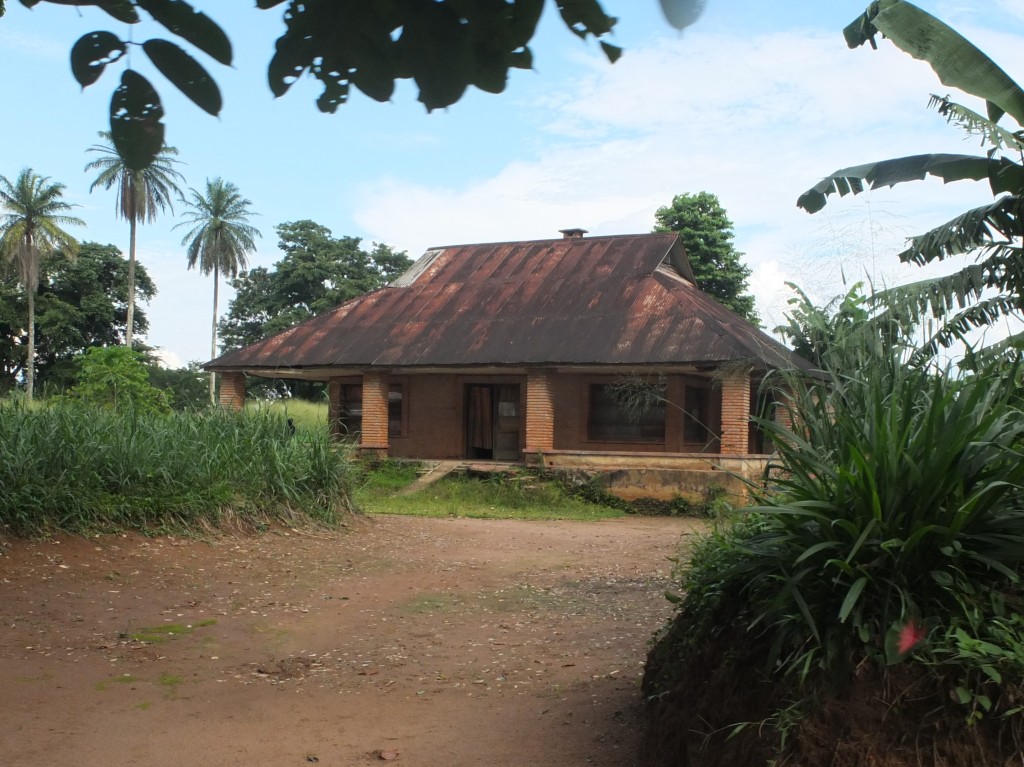
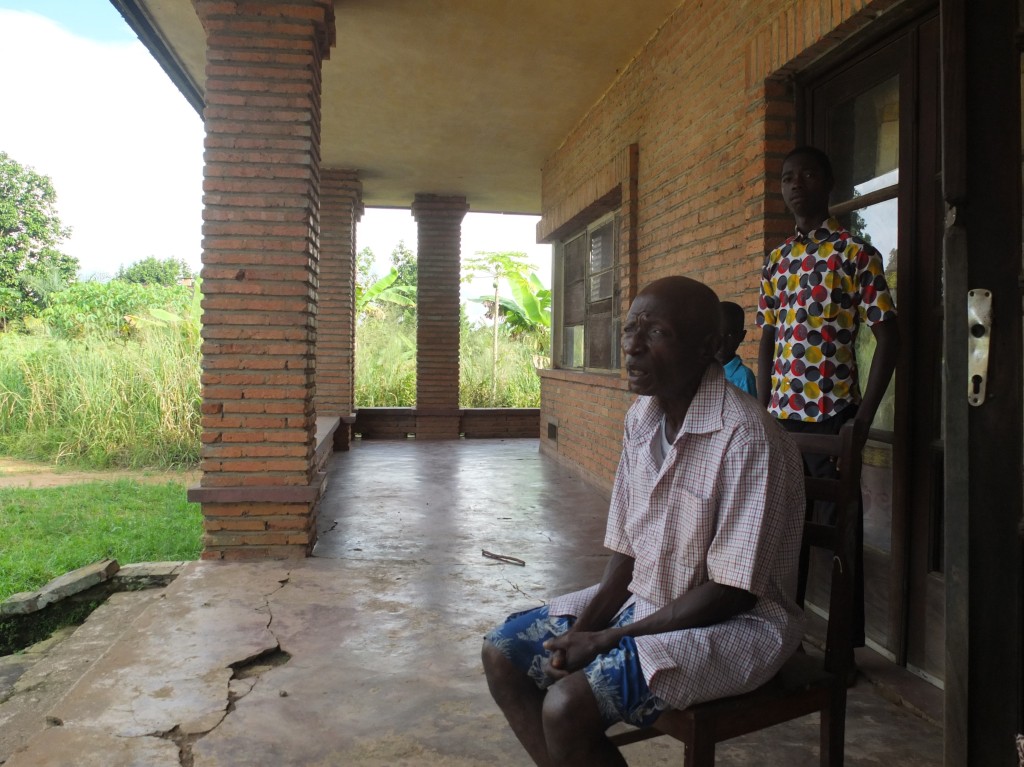
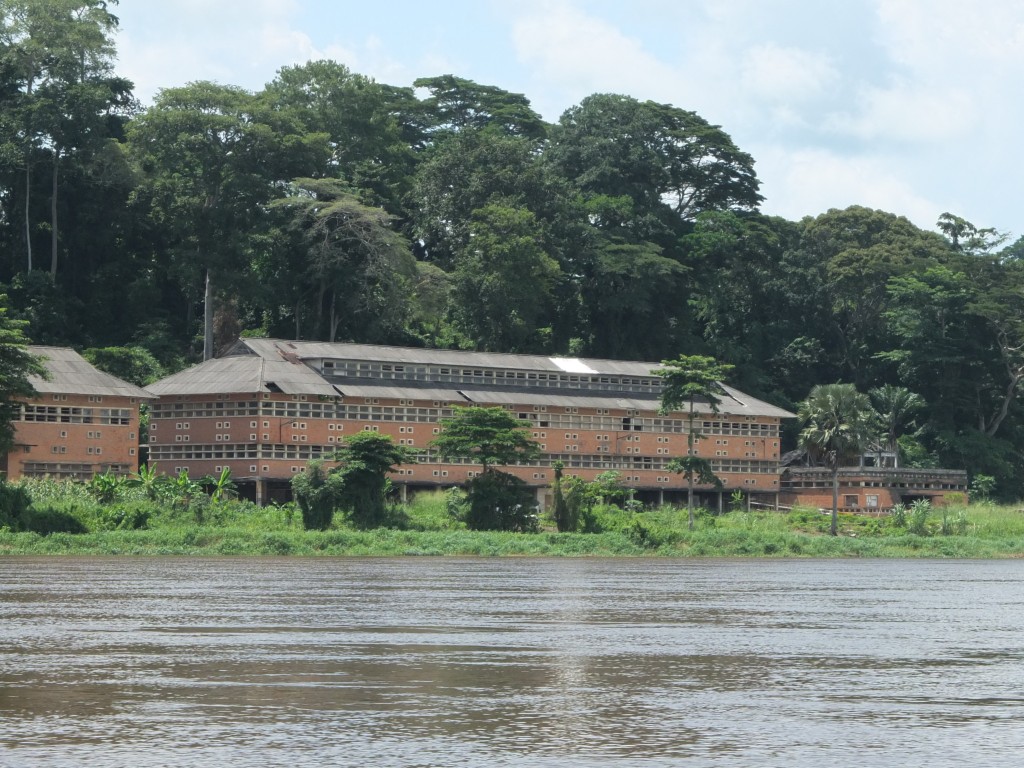
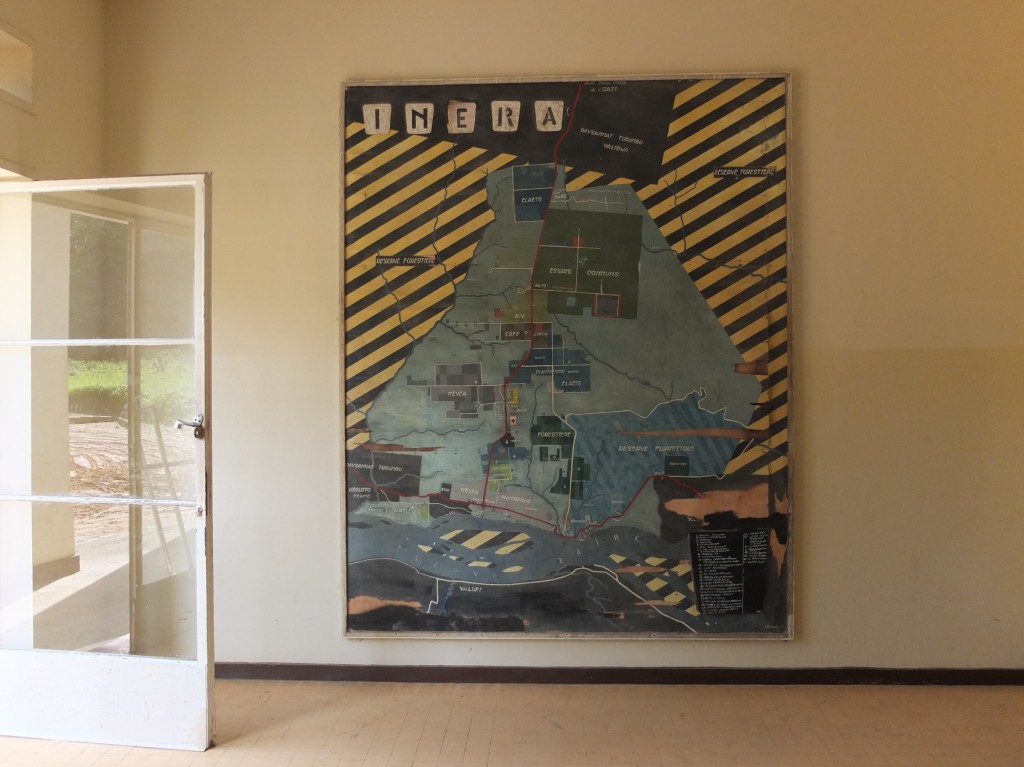
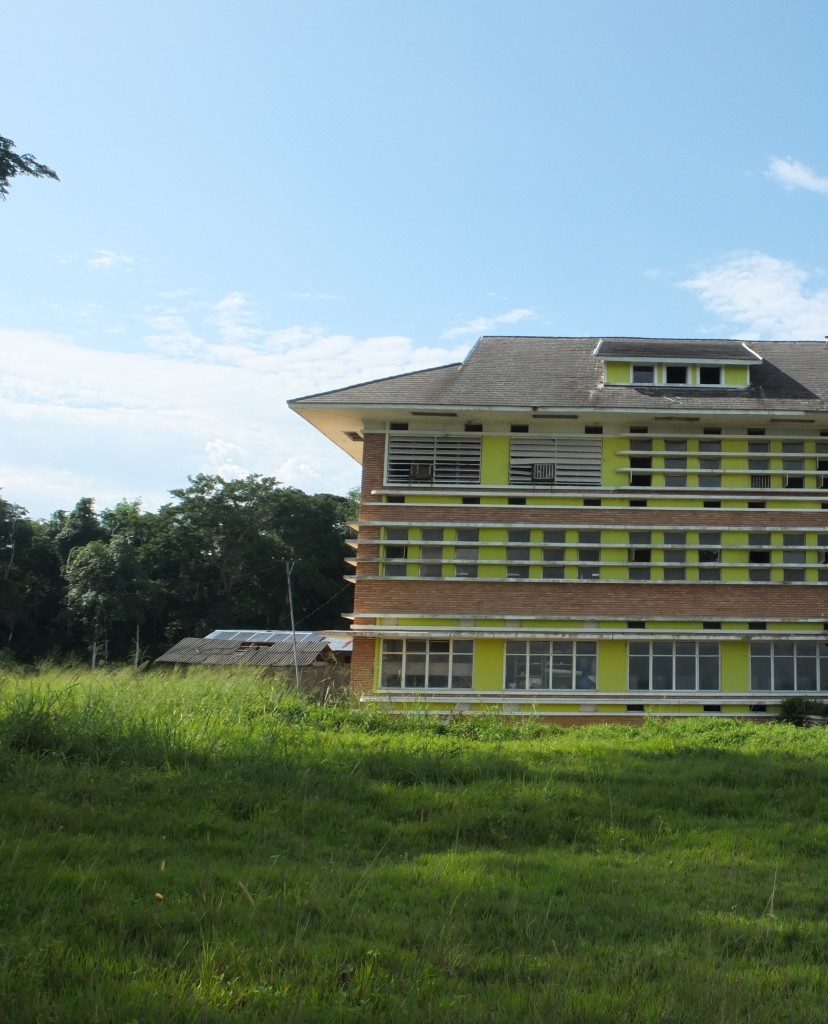
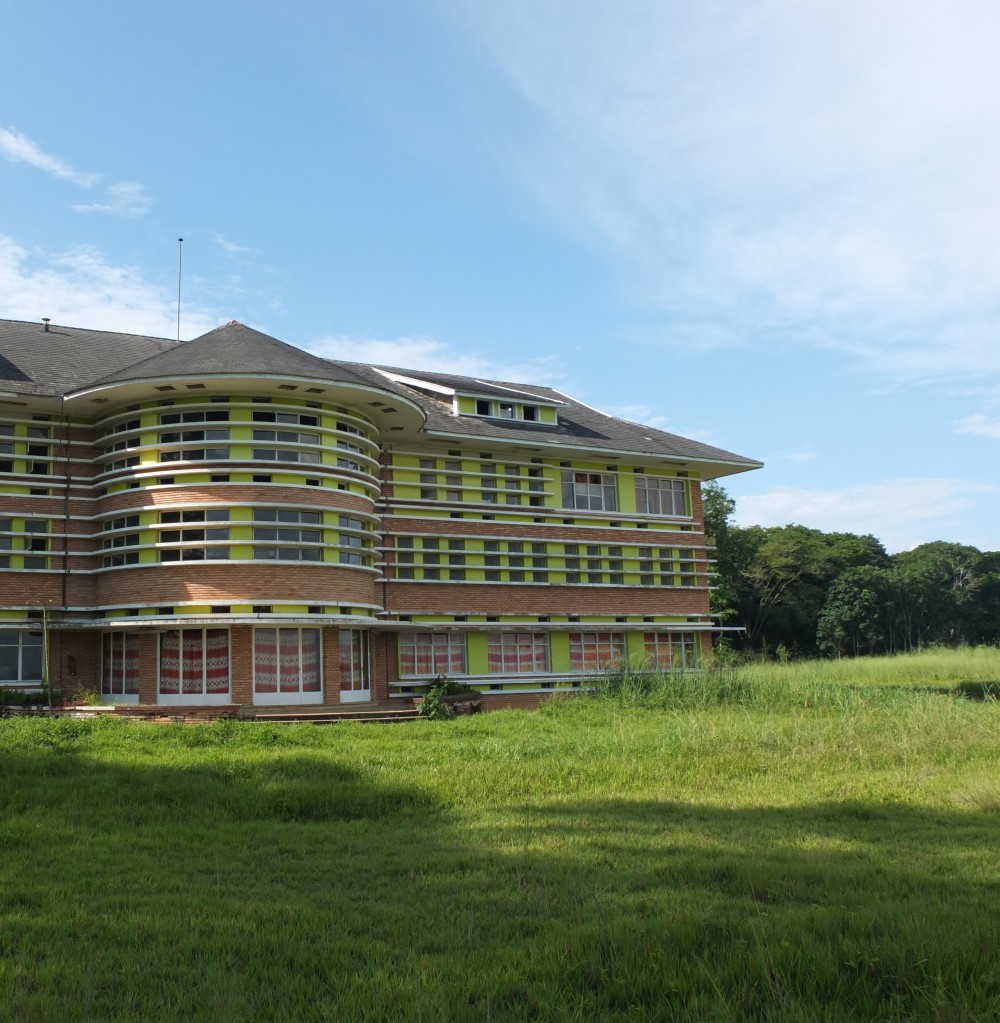
Yangambi — Sitting on the backseat of a motorbike running on a rutted dirt road, the lacking comfort is compensated by the view of riverine villages plunged in the luxuriant vegetation and by the glimpses of open horizon on the Congo river. When approaching the Yangambi reserve, the red brick walls of large villas appears on the side of the road, half concealed by the foliage of large ferns. The 250 villas built between 1933 and 1960 scattered across the reserve once housed the scientists and technicians of what was one of the largest ecological, biological, and agricultural research hubs in Africa, the >>Institut National pour les Etudes Agronomiques du Congo Belge – INEAC, later renamed INERA. The derelict storage tanks and the broken windows of the two large buildings facing the river port are the first visible signs of the now partly lost thriving life of this centre. But some sections of the research hub are >>still active.
During the few days I spend in Yangambi, Dorcas drive me from one section to the other of the reserve The library, inside the recently restored administrative building, has a large collection of magazines and publications dating back both to the colonial and Mobuto’s regimes as well as reports and correspondence documenting the exchanges that the institution had established with private companies such as the Huileries du Congo Belge and Lever Brothers. Even today, the centre carries out agronomic research and provide the germinated seeds of oil palm trees to smaller and larger >> Elaeis plantations in the country. The number of houses, communal facilites, and buildings dedicated to the different research sectors that I could brielfy see from the car or from the photographic albums stored in the library would definetely deserve to be explored with more attention but I’ve run out of time. The boat is waiting.
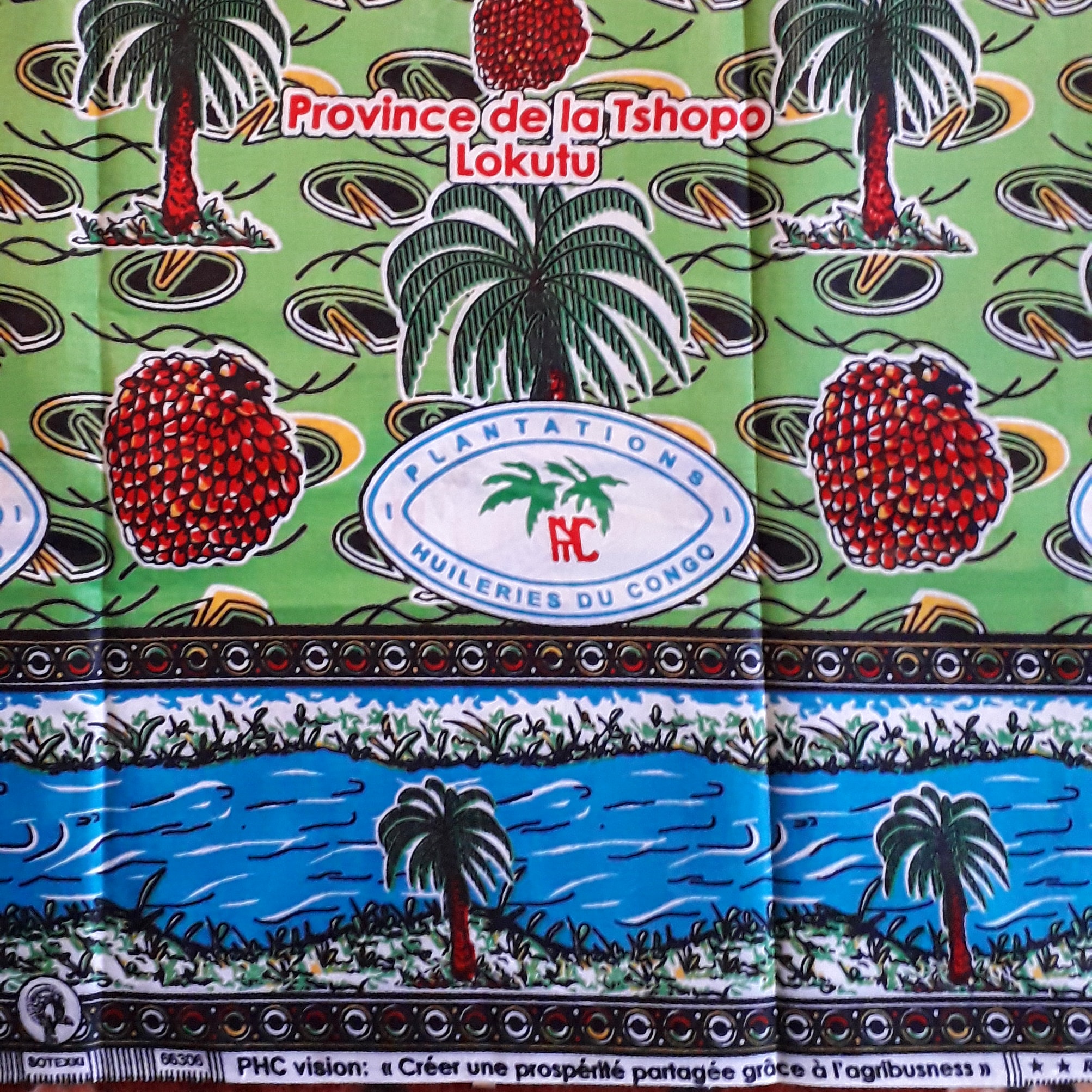
Kisangani — I’m already on the way back to Kinshasa when, during a two days stop in Kisangani that allows for a quick visit to the city, I find a piece of wax print fabric depicting the destination of my next trip to the DRC. In a small shop, one of the last selling locally produced Congolese wax fabric, among the most bizarelly decorated pieces of cloths, one is dedicated to the >>Plantation et Huileries du Congo, the company owning three of the former HCB plantation. Over a green background, the same palm tree and red oil palm bunch is repeated over and over. At the bottom, a sketched and colourful representation of the Congo River and its green banks along with some particularly >>optimistic mottoes of the company.
I greet the country carrying with me this small trace of the persisting signs of British-Belgian colonial capitalism in Congo. Lokutu (Elisabetha), Bumba (Alberta), and Lusanga (Leverville), three of the five company towns built by the Huileries du Congo Belge will be the subject of my next fieldwork in the coming months.
Jubilee House, Accra, Ghana. Source: Julia Gallagher, March 2019
This article examines recent attempts to create specifically African forms of modernist political architecture that draw on ‘traditional’ or ‘pre-colonial’ aesthetic forms and ideas. Taking examples of three prestigious structures – the presidential palace in Ghana, the parliament in Malawi and the Northern Cape regional parliament in South Africa – the article shows how vernacular ideas have been incorporated into state-of-the-art political architecture, producing new or explicitly ‘African’ forms of modernism. It explores how such buildings, which draw on ‘invented traditions’, are used alongside conventional, monolithic representations of the state to produce ‘invented modernisms’ that both uphold and question the African state as a project of modernity.
The George Padmore Library: A Potential Attribution
Text by Dr Ewan Harrison
George Padmore Library in Accra ,Ghana
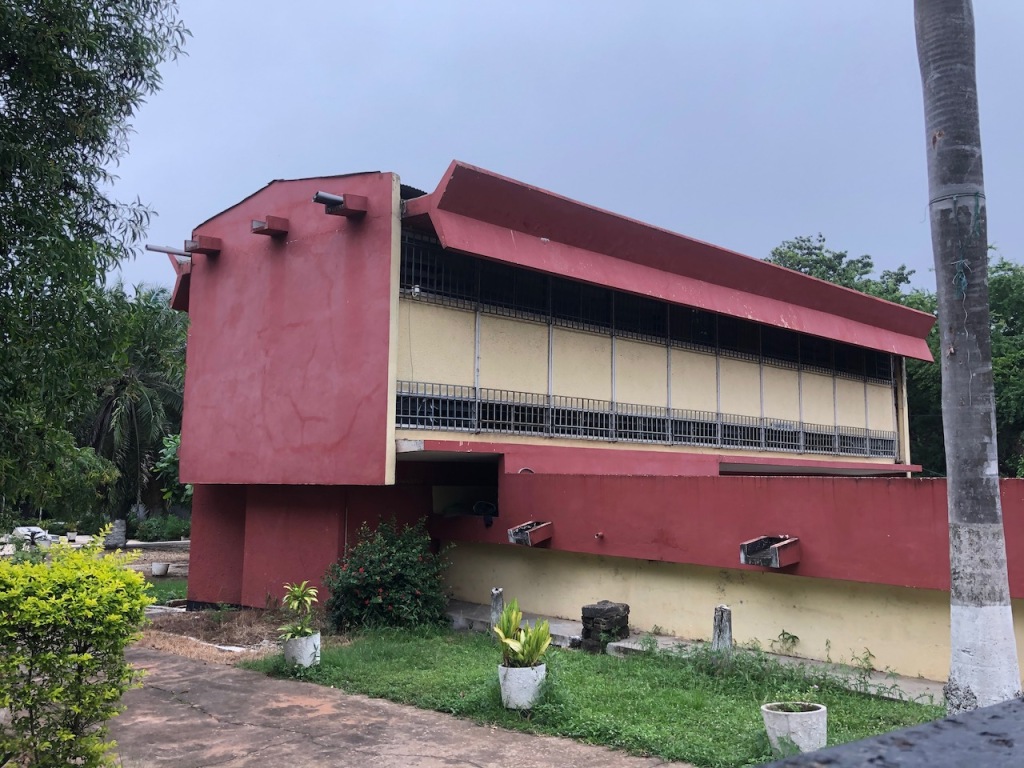
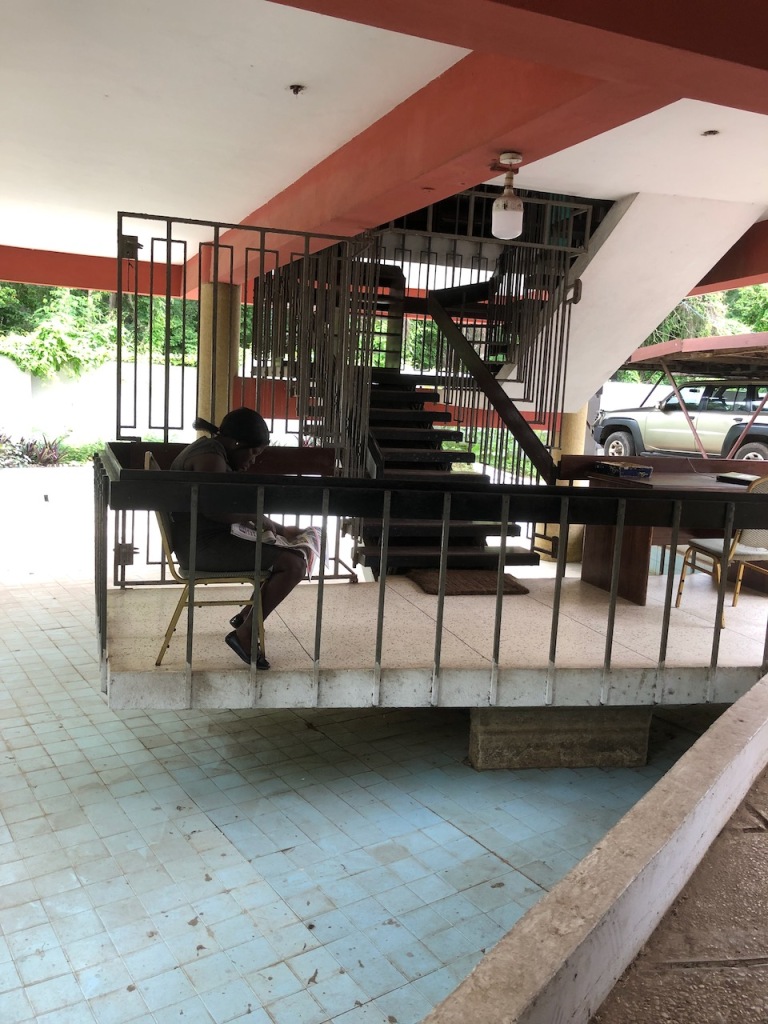
The George Padmore Library in Accra is a dynamic composition. Its principal block houses a fan-shaped reading room that extends from an apsidal end wall. This is raised up on pilotis, and is entered via a delicately wrought cantilevered staircase that itself springs from a fan-shaped expanse of terrazzo floating above a reflective pool. Externally, the facades are defined by horizontals of louvred glazing which allow for free air circulation, keeping the reading room at a comfortable temperature, and a strongly modelled canopy with sculpturally expressed rain water outflows. The building was established by the first president of the republic of Ghana, Kwame Nkrumah, in memory of the pan-Africanist writer, journalist and activist George Padmore. Padmore, who was born in Trinidiad, Nkrumah during the 5th Pan Africanist Conference, held in Manchester in 1945, and on Ghana’s independence, Padmore moved to Ghana to work for Nkrumah’s government as a diplomatic adviser. Sometime following Padmore’s death, Nkrumah’s government built the library in his memory, to house Padmore’s archive and a growing African studies library collection. The Library continues to function as Ghana’s primary deposit library to this day.
Reflecting Pool and staircase of George Padmore Library
Before visiting, I had assumed that the building was likely designed by Nickson & Borys. Responsible for the design of both the Accra Central Library complex and the nearby Ghana National Archives building in the late 1950s, the practice might have seemed the natural fit for a commission to design a bespoke library in Accra at this date. However, on visiting the George Padmore Memorial Library, after having recently spent time in both of Nickson & Borys libraries in the city, the manifest differences in both spatial planning and design between those and the George Padmore Memorial Library became clear. Whilst both the Accra Central Library and the National Library are simple, cubic buildings, the architect of the George Padmore seems to have rejected the rectilinear in their handling of the main reading room. The Nickson & Borys buildings use brise-soliel and pierced concrete walls to dissolve the wall plane: creating lightweight buildings. In contrast, the George Padmore is a heavier, starker, more sculptural composition: much of its drama comes from strongly modelled canopies and sculptural concrete rainwater outflows, and its main facades feature long planes of unbroken concrete.
Curved gable and reflecting pool of George Padmore Library
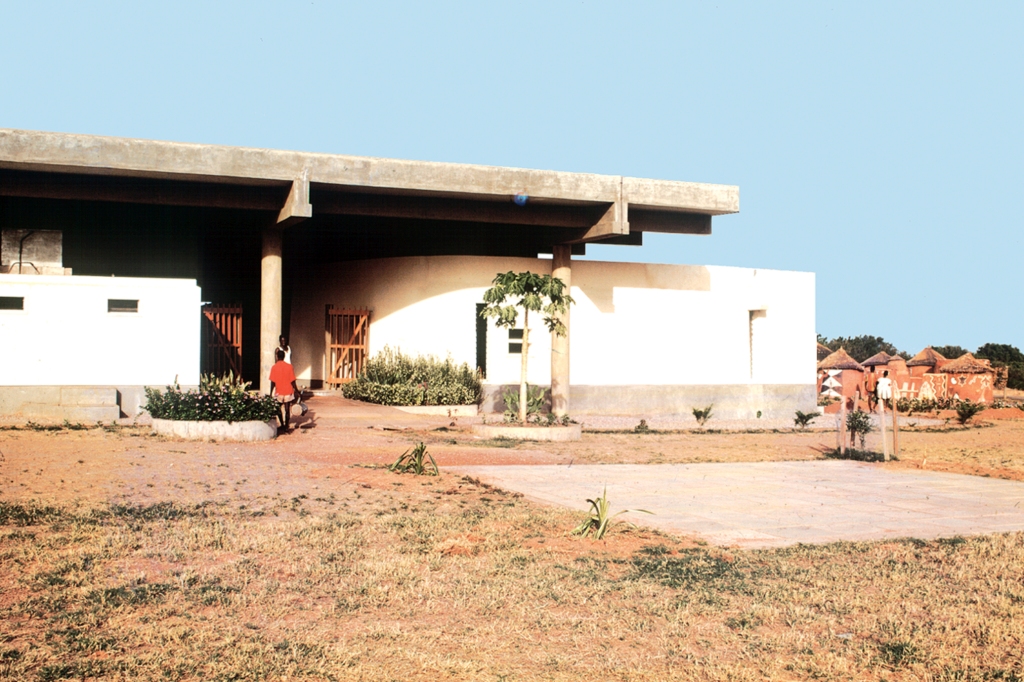
This points to another possible attribution, a design by Max Bond Jnr (1935-2009). The scion of a prominent African-American family, Bond studied architecture at the Harvard School of Design before working at Le Corbusier’s Paris atelier (1958-61) and the New York practice Pedersen and Tiley (1961-64). Bond believed that African-American culture should ‘hark back to Africa,’[1] and thus in 1963 wrote to Nkrumah asking for a job. By 1964 Bond was established in Accra as an employee of the Ghana National Contracting Corporation, the state’s contractor, working on designs for buildings at the government complex at Flagstaff House. Two of the precepts he outlined as central to his practice in Ghana were a ‘responsiveness to climate,’ and ‘modern buildings for new institutions.’[2] Bond’s most famous commission for the GNCC, the design of a public library at Bolgatanga, in the country’s arid northern region, strongly evidences these concerns. The Bolgatanga library project, which features four discrete volumes – two library reading rooms, a lecture hall and an administration block – under a free-standing roof designed to maximise cooling air circulation throughout the complex, is very different in its massing to the George Padmore Memorial Library. But there is something in Bond’s heavy roof at the Bolgatanga Library, in his handling of the oval wall of the Lecture Hall, and the sculptural treatment of the rainwater goods which show clear affinities with the George Padmore Memorial Library. And there are reasons beyond the stylistic to suggest Bond’s authorship of the building. Padmore’s intellectual project, and, it can be argued, much of Kwame Nkrumah’s political one, resolved around drawing attention to the shared heritage and struggles of Africans and the African diaspora throughout the Atlantic world. In this context, a design by an African-American architect, resident in Ghana, might have seemed especially suitable.
Neither the Accra Town Planning archives, the papers of the Ghana Library Board or the archive of the Padmore Memorial Library itself shed much light on the building’s authorship, although a letter in the National Archives of Accra politely rebuffing an offer from Nickson & Borys to fund a memorial plaque to Padmore is certainly suggestive that the building’s patrons didn’t think a practice headed by European emigres a suitable one to design a memorial to a titan of Pan-Africanism (dated 1961, this letter makes no mention of the project for the Library, suggesting that it predates the library’s construction). Questions remain, however. The Bolgatanga Library was extensively published, if the Padmore is by Bond, why wouldn’t he have seen that it too received attention in architectural publications? Why wouldn’t he accord it a central place in his Ghanian oeuvre? Was this perhaps a collaborative job, an awkward collaboration with one of the expatriate architectural practices that Nkrumah wished to side-line, practices like Nickson & Borys? Or with Eastern European or Yugoslavian architects employed by the GNCC? The last might be the most likely, given Ghana’s political culture in the early 1960s, and Padmore’s own long, if increasingly fractious, association with the Communist Party. Conclusive answer may well lie in the collections of the Avery Library at Columbia, which holds Max Bond Jnr’s archives, or in the private papers of Kwame Nkrumah. For now, a tentative attribution will have to suffice.
George Padmore Library Interior: Photo Iain Jackson
[1] J, Max Bond Jnr and the Approproation of Modernism in a Library Design in Ghana
[2] J, Max Bond Jnr and the Approproation of Modernism in a Library Design in Ghana