Ghana’s housing – an historical retrospective.
Ola Uduku writes:
Visiting Ghana gives one the chance to step back through time – there is an abundance of housing which has survived the vicissitudes of the temporal, physical and socio economic life of more than fifty years; and in certain cases an entire century of existence in the unforgiving tropical climate which comprises much of Southern Ghana’s landscape. In two weeks we came across these special gems.
Timber housing: Colonial Ghana, then called the Gold Coast along with Nigeria had significant swathes of forests which were sources of tropical hardwood. The Colonial government established significant agro-forestry concerns in both countries, which resulted in timber research stations. The two houses in this post are examples of experimental worker housing that these research stations were responsible for developing. We think that the Kibi house, near the market town of Koforidua, is over one hundred years old. The other lapped wood house was found at the Aburi botanic gardens, which had previously been the site of a sanatorium. Interestingly both buildings have substantial elements preserved including; walls, casement windows, wooden flooring and roofing elements. Generally only the non ‘wood’ roofing sheets have had to be replaced.

Former Sanatorium at Aburi

Forestry Housing in Kibi
Brick Housing: At Kibi also across the road from the ‘forestry’ house we found an example of a demonstration brick building. This was a semi detached pair of worker quarters set out as a single depth bungalow with a wide verandah and walls one brick thick. The first building retained the balcony format whilst the second had its balcony appropriated to create more space for the larger families who now occupied these buildings.
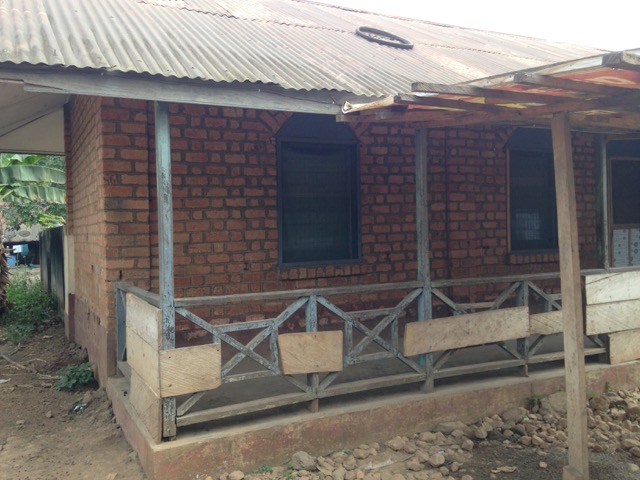
Experimental Brick Housing in Kibi
Impregilo Prefabricated Housing
Going to Akosombo Community One – which was where the elite staff and also the contractor Impregilo had its staff quarters revealed a further rare find. Built on a higher part of the Community One hill ridge are the original staff quarters for Imregilo staff, we assume these would have been for the Italian foremen and remain in near pristine condition. The original prefabricated lightweight wall-panels can be seen clearly in the neat avenue of houses which looked in some ways like a re-created Italian village scene. A number of the houses had the individually built ‘sit out’ verandah areas with views to the Akosombo landscape and the staff club below.

Prefabricated housing for Italian contractors at Akosombo

View of the Akosombo Dam from Community 1
Today’s domestic architecture in Ghana as in much of West Africa unfortunately seems to have not incorporated much of the ‘environmental design rules’ that these and other residences of this early post independence era were able to employ. The site orientation, use of lightweight materials, utilisation of large areas of operable fenestration, and shading, have all contributed to make these now historic houses exemplars of how domestic buildings could be built to ensure thermal comfort without reliance on today’s ubiquitous air conditioning systems. Surely it is now time to re-evaluate the principles so aptly demonstrated in these houses and use them as a basis for developing a more sustainable response to tropical housing in Africa today.



 Transnational Architecture Group