Archive

Tag Archives: architectural history

‘The Influence of Fry and Drew’ Conference, Abstract 16

Alan Powers, ‘Maxwell Fry and Jane Drew – the Romantic turn’

The paper will start from Fry’s ‘A Letter about Architecture’ in Horizon magazine, May 1946, in which Fry addressed Drew as well as a wider non-specialist  readership. It represents a transitional period in Fry’s career that began before the war with some lesser known buildings such as the brick built house Warham’s Ash, Hereford, and the Cecil Residential Club in North Gower Street. These were more varied in materials and form than the Modernist buildings through which he first acquired fame in the years 1933-36, and anticipate, along with Goldfinger’s Willow Road houses and some other examples, the next ten or fifteen years of stylistic development in English and European Modernism. There is no accepted term for describing this romantic turn in Modernism, at least until the 1947 coinage ‘New Empiricism’. The style remained current in much of Fry and his practice’s work well into the 1950s.

In the Horizon text, and in Fine Building, 1944, Fry reveals the thinking that moved him and other members of his generation to move on to a second version of Modernism that was deliberately anti-machine and reflected the writings of D. H. Lawrence and Lewis Mumford to which he referred. In the paper, these written sources will be related to Fry’s work and that of his contemporaries in Britain, Sweden and the USA to fill out a more complete account of this change of direction.

..

Dr Alan Powers, FSA, Hon. FRIBA, has written widely on twentieth century British architecture, art and design and curated a number of exhibitions. He was Professor of Architecture and Cultural History at the University of Greenwich before becoming an independent scholar with a range of teaching activities. He has had a long association with the Twentieth Century Society, becoming Chairman 2007–12. He was founder editor of its journal Twentieth Century Architecture and with Elain Harwood and Barnabas Calder is a joint editor of the monograph series, jointly with English Heritage and RIBA, Twentieth Century Architects. His books include Britain, in the series Modern Architectures in History and Serge Chermayeff, designer, architect, teacher. Eric Ravilious, artist and designer will be published by Lund Humphries in October 2013. In 2011–12, Alan Powers was awarded a British Academy Mid-Career Fellowship on the theme, Figurative Architecture in the Time of Modernism.

‘The Influence of Fry and Drew’ Conference, Abstract 15

Vanessa Vanden Berghe, ‘Aspects of collaboration in the work of Oliver Hill and Maxwell Fry’

This paper seeks to explore through an examination of the work of two twentieth century architects Maxwell Fry and Oliver Hill how their work can shed new light on the existence of alternative forms of modernism.

At first sight, this unlikely comparison would suggest that Fry’s development follows the conventional path of architectural modernism whilst Hill’s work tends to be seen as deviating from such a modernist trajectory putting himself and his work at the margins of architectural history. However, on closer inspection we can see that both Fry and Hill offered ‘different’ architectural approaches that underline the existence of wider manifestations of modernism in England. Their collaboration on the Dorland Hall exhibition (1933) suggests that these differences in approach were underpinned by their shared commitment to bringing good design to a wider public. Other collaborations reinforced this sense of creative partnership between friends, partners and clients. This is evidenced in Fry and Gropius’s collaboration on Impington Village College (1939) and Hill’s Thatched House at Knowle (1925) in which regionalist influences in their oeuvre reveal how both architects early on in their careers sought to increasingly create buildings with a distinctive sense of place and identity.

Analysing various aspects of Hill’s and Fry’s collaborations and the influence that these projects have had subsequently on architectural production, I will argue that such a wider approach not only adds to our knowledge of alternative expressions of modernism but that it also increases our understanding of how these architects commonly sought to integrate modernism within the larger cultural and regional frameworks of interwar Britain.

..

Vanessa Vanden Berghe has studied History of Art at the University of Ghent, Belgium. She completed an MA in the history and theory of architecture at the University of East London in 2001, where she also lectures and is currently in the final stages of her MPhil (also at UEL) researching the Enigma of British Modernism through the work of Oliver Hill. She most recently contributed a chapter entitled: ‘Oliver Hill: a window on Regionalism in Britain during the interwar period’ in Regionalism and modernity during the interwar period (edited by Leen Meganck, Linda Van Santvoort & Jan De Maeyer) published by KADOC-Artes.

‘The Influence of Fry and Drew’ Conference, Abstract 14

’Yemi Salami, ‘Fry and Drew’s Influence on Colonial Public Works Architecture in Nigeria’

This study examines the influence of Maxwell Fry and Jane Drew on the architecture of Nigeria’s Colonial Public Works Department (PWD).  Mostly referred to as Fry and Drew, literature provides accounts of their coming to work in West Africa as architects and professional advisors during the mid-twentieth century. They are also deemed to have pioneered alongside other private architects of the time, the climate responsive design that has come to be known as ‘tropical architecture’.

The literature equally provides a glimpse into operations by the Public works Department (PWD). The department had largely produced the country’s earlier colonial buildings, as well as a good number of its mid-twentieth century buildings. The period therefore experienced a blend of designs by the new private architects and by the PWD. But did the designs of the new entrant private architects generate an impact on colonial building? How did the PWD build before this time? Did it have a design tradition by which it operated? Was this tradition affected by the new influences, particularly from Fry and Drew?

To answer these questions, the study will examine two Fry and Drew buildings and their application of tropical design principles. It will then explore two building types done by the PWD – a courthouse and a post office. For each building type, the study will examine its design in the earlier colonial years, as well as during the tropical architecture trend.  Changes arising in the new design will then be identified and discussed, particularly those most likely based on fry and drew influences. The purpose therefore, is not only to establish if Fry and Drew influenced PWD designs, but to also know what features they had influenced.

..  

Yemi Salami is a PhD student at the Liverpool School of Architecture, University of Liverpool. Her research investigates British colonial architecture in Nigeria between 1900 and 1960. Specifically, the research aims to understand the colonial administration’s Public Works Department (PWD), and the architecture which it produced within the period of study. Yemi held a faculty position at Olabisi Onabanjo University Ago-Iwoye, Nigeria, before enrolling for her PhD in November 2011.

‘The Influence of Fry and Drew’ Conference, Abstract 13

Jorge Figueira and Bruno Gil, ‘Dry and Humid and Everywhere: The work of Amâncio (Pancho) Guedes in Mozambique’

In the seminal Tropical Architecture in the dry and humid zones, published in 1964 by Maxwell Fry and Jane Drew, the work of Amâncio Guedes (“Pancho” Guedes, Lisbon, 1925), in Mozambique, appears recurrently as an example of the themes aimed by the authors. The relationship between Pancho’s work and the concerns of Fry and Drew is umbilical, even if the Portuguese architect is more corrosive and incendiary than pedagogical.

Our presentation aims to contextualize and problematize the works of Pancho Guedes referenced by Fry and Drew, as part of his vast production between the early 1950’s and 1975, an itinerary that ends with the decolonization process of the “Portuguese Africa” ​​in 1974. Pancho’s work refers to the condition of Portugal as a colonial power blasted by a great artistic, experimental, “climatological” voracity, which Fry and Drew capture in Tropical Architecture…, demonstrating a particular geo-culture within the colonial process in Africa. Accordingly, we sustain that the general invocation of the post-colonialism – “can the subaltern speak?” – finds in Pancho Guedes a particular resonance. Pancho is a colonizer colonized by modern architecture, from which he is always in a desire/rejection process. All his work is envisioned, in the manner of Team 10 and beyond Team 10, and certainly under the influence of the theses by Fry and Drew, to mourn the more dogmatic aspects of modern architecture, showing affection towards the locality, using techniques and styles that aim to adapt or lacerate the modern canon towards the local. The archaic, primitive and vernacular recurrently appear in his work, more in the manner of an “automatic writing” than an analytical mode. The high point of this trip is the publication that he imagines of 1001 portas do caniço (doors from the slums of Lourenço Marques/Maputo), photographed relentlessly in very beautiful slides.

..

Jorge Figueira graduated in Architecture at the University of Porto, 1992. PhD Degree at the University of Coimbra, 2009, with a thesis entitled The Perfect Periphery. Post-modernity in Portuguese Architecture, 1960-1980. Director and Assistant Professor at the University of Coimbra’s Department of Architecture. Researcher at the Social Studies Centre (University of Coimbra). Professor at the PhD Programme in the Faculty of Architecture of University of Porto. Coordinator at the University of Coimbra of the Red PHI Patrimonio Historico-Cultural Iberoamericano. Curator of international exhibitions such as “Álvaro Siza. Modern Redux”, Instituto Tomie Ohtake, Sao Paulo, Brazil, 2008. Editor of Álvaro Siza. Modern Redux, Hatje Cantz (Berlin). Author of several books on contemporary architecture, including O Arquitecto Azul, Coimbra University Press, 2010. Has published texts in Arquitectura Viva, Casabella and A+U and has a column on architectural criticism in Público newspaper.

Bruno Gil graduated in Architecture at the University of Coimbra, Portugal, 2005. Following the graduation thesis entitled “Architecture School, Today” he continues research in that subject. Currently, he is developing his PhD at the Centre for Social Studies and at the Department of Architecture of the University of Coimbra, with a grant from the Foundation for Science and Technology, Portugal. His thesis focuses on issues related to the practice of architectural research, identifying disciplinary specificities, research cultures, topics and methods. He is a contributor at the University of Coimbra to the Red PHI Patrimonio Historico-Cultural Iberoamericano. He has participated in diverse international conferences and workshops, published texts in architecture magazines and was co-founder of the NU magazine and its director between 2003 and 2004.

‘The Influence of Fry and Drew’ Conference, Abstract 12

Claire Louise Staunton and James Price, ‘Subverting modernism through autonomous urbanism’

The film Corrections and Omissions (2013, James Price) presents two cases of anarchic urbanism in contemporary Chandigarh. The first concerns the domestic dwellings built for low and mid-rank government employees in Sector 22, designed by Jane Drew & Maxwell Fry. Residents have defied the Chandigarh edict on a small scale by adapting the buildings to their individual and family needs; by altering the room size, use and the building shape as well as permitting “homeless” low caste families to squat on their allocated land in exchange for services such as cleaning, guarding or ironing.

Secondly, the film introduces to the viewer the off-grid village of Burail. In a struggle to keep perfect order and perfect form within the 56 sectors that make up the city, the temporary slums which appear on the fringes of the grid are systematically flattened by the state. The exceptions to this are the villages that pre-date the arrival of Le Corbusier and his team, and still exist enclosed by the masterplan. Burail lies in the centre of sector 45. Its community has persistently defied all planning regulations, is built along an irregular, diagonal axis; its thoroughfares and alleyways missing from the official city map.

The paper unpacks and allies these two examples of anarchic architecture as a subaltern creation of complex spaces, which subvert the grid, and disrupt several current narratives that de-politicise or renew colonialism. Such urbanism operates within an alternative economy outside of the dominant forces of capital and development and is an inherently political act. The paper proposes that these practices expose the contradiction between the principles of indigenous architecture (Drew 1963, Drew & Fry 1964) which insisted upon learning from the vernacular thus adapting designs for the needs and habits of future Chandigarh residents and the modernist imperative to uphold the truth of materials, which guards pure design from “from whims of individuals” (Chandigarh Edict). Furthermore, this paper suggests that the increasing heritagisation of Drew & Fry’s buildings are antithetical to their ambitions for their architecture and renders the planned districts de-politicised.

..

Claire Louise Staunton is the director/curator of Inheritance Projects and Flat Time House, London. Inheritance is a small group of independent curators and researchers (Laura Guy, Becky Ayre) that organises exhibitions, events, new commissions, publications and research projects. Initiated in 2007 as a vehicle to interrogate museological schemata, the narrations of history and personal and national heritage Inheritance has developed into wider territories of investigation. Inheritance works with artists, musicians and writers in collaboration with institutions to produce new knowledges and develop politically informed, critical discourses around particular topics or situations. The exchange between Inheritance curators with filmmakers, artists, writers, residents and historical artefacts offers a multiperspectival narration by a number of speakers from different places and times.

Inheritance leads a long-term investigation of the visual culture of intentionally planned urban areas (New Towns) and their migrant populations. This research project has involved a project space in Shenzhen which served to question heritage and art history in a new migrant city, an exhibition and ‘Research Lab’ unpacking the theoretical and practical applications of community at MK Gallery, Milton Keynes and more recently a performative presentation concerning the willing blindness of new developments, at Sarai, New Delhi. Other key project areas include the destabilisation of heritage through artists’ activities often redressing colonial, feminist and wider political histories in the contemporary. This has included a residency programme with the National Trust, a radio show and exhibitions in traditional museum spaces.

James Price is a documentary and experimental filmmaker who has been working with Inheritance Projects since 2010. Price’s films have been shown on the BBC, Channel 4, and More4, in art exhibitions and international film festivals. Television projects include the mini-series What is Freedom? (Channel 4, 2009) a critical investigation of liberty and freedom in USA, and A Piece of the Moon (Channel 4 / More 4, 2008) an exploration of the capitalising of outer-space and the agents who are establishing the market. The People In Order series (Channel 4, 2006) has gone on to be shown at festivals in the UK, Germany, the Netherlands, Poland, Australia and the USA and was the first series of 3 Minute Wonders to be selected by Channel 4 in their annual review of work. James Price has also exhibited video installations and photography in the UK. His 2006 installation, Conversation, an exploration of human interaction and judgment, has shown in the UK, Canada, the USA, and Iran. This work is being distributed as an educational aid in the UK, Australia and North America. In 2012 he produced The Body Adorned a semi-permanent installation in the Anthropology Department at the Horniman Museum, London.

‘The Influence of Fry and Drew’ Conference, Abstract 11

José Luís Possolo de Saldanha, ‘Luís Possolo – The Portuguesespeaking Architect at the 1st AA Course in Tropical Architecture’

Luís Gonzaga Pedroso Possolo (Lisbon, 1924) was the only Portuguese‐speaking architect at the 1954/55 first edition of the Architectural Association’s Course in Tropical Architecture, held under Maxwell Fry.

Possolo’s performance seems to have been of a high standard there. In his report for the Portuguese Overseas Affairs Undersecretary of State, he points out that from all 120 designs by the students in class, only seven were selected for an exhibition at the AA ‐ Possolo being the only one to have two designs shown.

The grading panel at the course was made of Fry, Jane Drew, and J. Mckay Spence (who was Deputy Director for the Department). All grading reports on Possolo’s designs are extant, as well as his AA Diploma and a number of interesting documents ‐ such as his letters to, and from, Fry, Drew, Drake & Lasdun, upon finishing his Course at the AA, that show he was close to being hired by the office. However, he chose instead to return to Portugal, where he worked at the Overseas Planning Office (Gabinete de Urbanização do Ultramar) and produced a number of fine designs for Portuguese Africa.

Possolo’s auspicious period at the GUU then led him to privately design a number of highly creative projects – two of which were particularly important in Mozambique and Angola’s development and modernisation: the buildings for the Cambambe Dam, in Angola, and the Nacala Cement Factory, a mile north of the Mozambican city and port of Nacala.

In Possolo’s papers, we also find sketches deriving from projects by Fry and Drew, and a number of black‐and‐white photographs of tropical architecture by British offices. These provide evidence of the young architect’s keenness in following tropical architecture along the guidelines of the AA course. This also clearly comes through in his own built projects for Africa.

..

José Luís Possolo de Saldanha graduated in architecture at the Universidade Técnica de Lisboa Faculty of Architecture in 1990. He held a scholarship (1999–2002) from Fundação Calouste Gulbenkian for his PhD, which he presented in 2003 at the University of Seville Superior Technical School of Architecture.

He has lectured in Architecture since 1996, and is an Assistant Professor with tenure in the Architecture and Urbanism Department at ISCTE-IUL (University Institute of Lisbon), where he has been teaching since 2006. He is presently President of the Pedagogic Council of this Higher Education Institution for the 2013–2014 biennium.

José Luís Saldanha is a member of the Dinâmia-CET Research Centre at ISCTE-IUL and has presented papers and authored, or co-authored, articles, books and chapters of books on a wide range of architectural themes, such as landscape, building design and tropical architecture. He has also been active in designing architecture for private and institutional clients in continental and insular parts of Portugal.

‘The Influence of Fry and Drew’ Conference, Abstract 10

Rachel Lee, ‘Searching for the Social in the Tropical’

Tropical architecture was institutionalised as a professional field in the metropolis of mid-twentieth century London. Drawing on theories developed over two centuries by military and medical experts, and augmented by the experiences of modern architects and planners who had worked in Britain’s colonial territories, tropical architecture is generally understood as a climate-centric approach to building in the ‘tropics’.

This conception, however, may be too reductive. Several of the key protagonists involved in the institutionalisation of tropical architecture were not exclusively concerned with the climatic aspects of building in tropical regions. Perhaps in contrast to the hygiene engineers who preceded them, they shared a commitment to creating buildings that attempted to understand and respond to the social needs of the users e.g. in the West Indies Robert Gardner-Medwin endeavoured to create buildings that suited the social customs as well as the climatic conditions and the building materials; in Chandigarh Fry and Drew made social surveys, the results of which influenced the designs of buildings such as shops, houses and cinemas; and in 1950, as the Federal Republic of India’s Director of Housing, Otto Koenigsberger began conducting an extensive social survey of Delhi.

With a view to creating a more nuanced understanding of the history of tropical architecture, this paper will attempt to illuminate the role that social issues played in the development of the field. While taking into account recent scholarship that has highlighted tropical architecture’s inextricable links to decolonisation, it will address to what extent tropical architecture was stripped of social concerns and examine why, despite the more inclusive interests of some of the figures key to its development, it was reduced to a climate-based technoscientific field.

..

Rachel Lee is a research associate at the Brandenburgische Technische Universitaet Cottbus and a lecturer at the Technische Universitaet Berlin, where she is currently completing her doctorate on Otto Koenigsberger’s works and networks in exile. She is also a member of MOD Institute – an urban research and design collective based in Bangalore and Berlin.

‘The Influence of Fry and Drew’ Conference, Abstract 9

Antony Moulis, ‘Designing with landform and climate: Fry and Drew’s contribution to the Chandigarh master plan’

In the book Tropical Architecture in the Humid Zone (1956) Maxwell Fry and Jane Drew strongly criticise both ‘Garden City’ and ‘grid-iron’ layouts as ‘unrealistic’ to housing and town planning in the tropical context. Key to their own planning precepts is a practical concern for the relationship of landform and climate – the prevention of erosion, the securing of road drainage and respect for the natural contours – leading to housing layouts subtly adjusted to the prevailing conditions. For Fry and Drew such an approach emerged productively from their work begun in the British government’s West African colonies in 1944 and continued at Chandigarh, India, between 1951 and 1954. Their specific critique of both Garden City and grid-iron forms – the prevailing planning approaches in mid-20th century modernism – could be viewed as a direct legacy of their experiences in Chandigarh, where the partners found themselves working within the constraints of the city’s famous master plan, drawn by the Swiss-French architect Le Corbusier, which was broadly understood as a rational gridded revision of the original Garden City plan devised by the US planner Albert Mayer. Yet subtle adjustments of the city’s gridded layout to account for features of the land reveal the greater agency of Fry and Drew in the master plan’s formation and speak of their knowledge and experience of planning in the tropics already gained from their West African work up to 1950.

Based on research of the architects’ archives held by the RIBA and the V&A Museum, this paper gathers evidence of Fry and Drew’s contribution to the Chandigarh master plan, drawing upon testimony of both partners of events surrounding the master plan’s making in early 1951. By seeing Chandigarh’s overall layout in context with the architects’ own strategies for housing and town planning in the tropics published between 1947 and 1956 the paper will argue the key role of Fry and Drew in substantiating the Chandigarh master plan as more than simply an abstract conceptualisation of city form.

..

Antony Moulis is Associate Professor and Director of Research in the School of Architecture at the University of Queensland, Australia. His research on practices of design in mid-twentieth century modern architecture includes archival research at the Fondation Le Corbusier, the Alvar Aalto Academy, and the Canadian Architectural Archives. His architectural writing for professional and academic journals appears in ARQ, AA Files, Architectural Theory Review, Architecture Australia, Monument, Architectural Review Australia, and The Journal of Architecture. He is currently a Chief Investigator on an Australian Research Council Discovery project on eminent Australian architect John Andrews, known for his work in North America in the 1960s and ‘70s, including Gund Hall at Harvard. Moulis co-convened the 2011 Conference of the Society of Architectural Historians, Australia & New Zealand, and was awarded Best Paper at the Society’s 2010 Conference for his research of the collaborative links between Jorn Utzon and Le Corbusier.

Building a New Middle East – Israeli architect in Iran

Neta Feniger

bandar abbas and bushehr

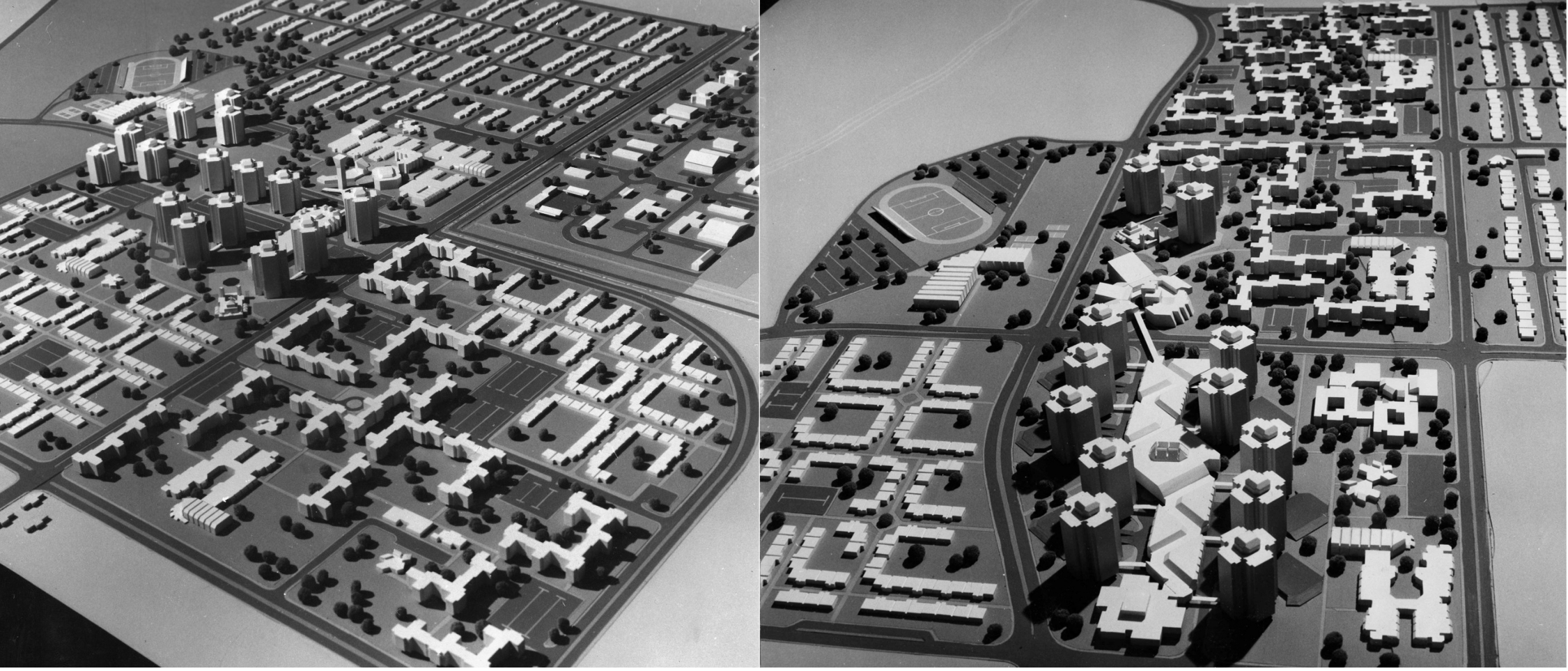
Models of the neighborhoods in Bushehr (left) and Bandar Abbas (right)

In the spring of 1972 representatives of the Iranian Navy arrived in Israel in search of an architect. The Navy was building bases on the shores of the Persian Gulf and when the facilities were almost completed, it was realized that no accommodation had been provided for the troops and their families. The Israeli construction firm assigned to the project suggested employing an Israeli architect known for speedy planning and implementation skills acquired during nation-building.

The Israeli-Iranian relations (1950-1979) opened up a new market for Israeli architects and construction companies for whom work in Iran was a chance to extend professional enterprise in the Middle East. Iran was in the midst of modernization, and was looking for foreign professionals with high levels of expertise. Israelis were looking for work as the Israeli market declined after the years of intense nation building. In the course of two decades (mainly the 1960s and 1970s) Israeli architects were involved in varied projects in Iran, demonstrating manifold approaches for adjusting their practice acquired back home.

The Navy project was one of the bigger projects by Israeli architects in Iran. The Israeli architect, Dan Eitan (1931-) was chosen especially by Navy representatives on account of his housing project in Israel. Nevertheless, Eitan saw this project as an opportunity to rectify modernism and make it more considerate of cultural and social needs and of local environmental conditions.

The project was planned in three locations, Bandar Abbas and Bushehr – then small fishing towns – and the island of Kahrg where a major oil port was already operating. At the latter site, Eitan’s project consisted of a few dwelling units. For Bandar Abbas and Bushehr it included a master plan, detailed town plans, designing three types of housing, infrastructures, and neighbourhood amenities. The Navy planning office provided a brief programme specifying different dwelling units for different ranks, including densities and unit sizes. The final plans for all three sites amounted to about 12,000 dwelling units and the required amenities. Some of the buildings, such as mosques and the admiral’s villa, were included in Eitan’s plans but they were designed by Iranian architects.

Hadish in Bandar Abbas

Google Earth image of Bandar Abbas, marked – the area built according to Eitan’s plan.

bushehr 2

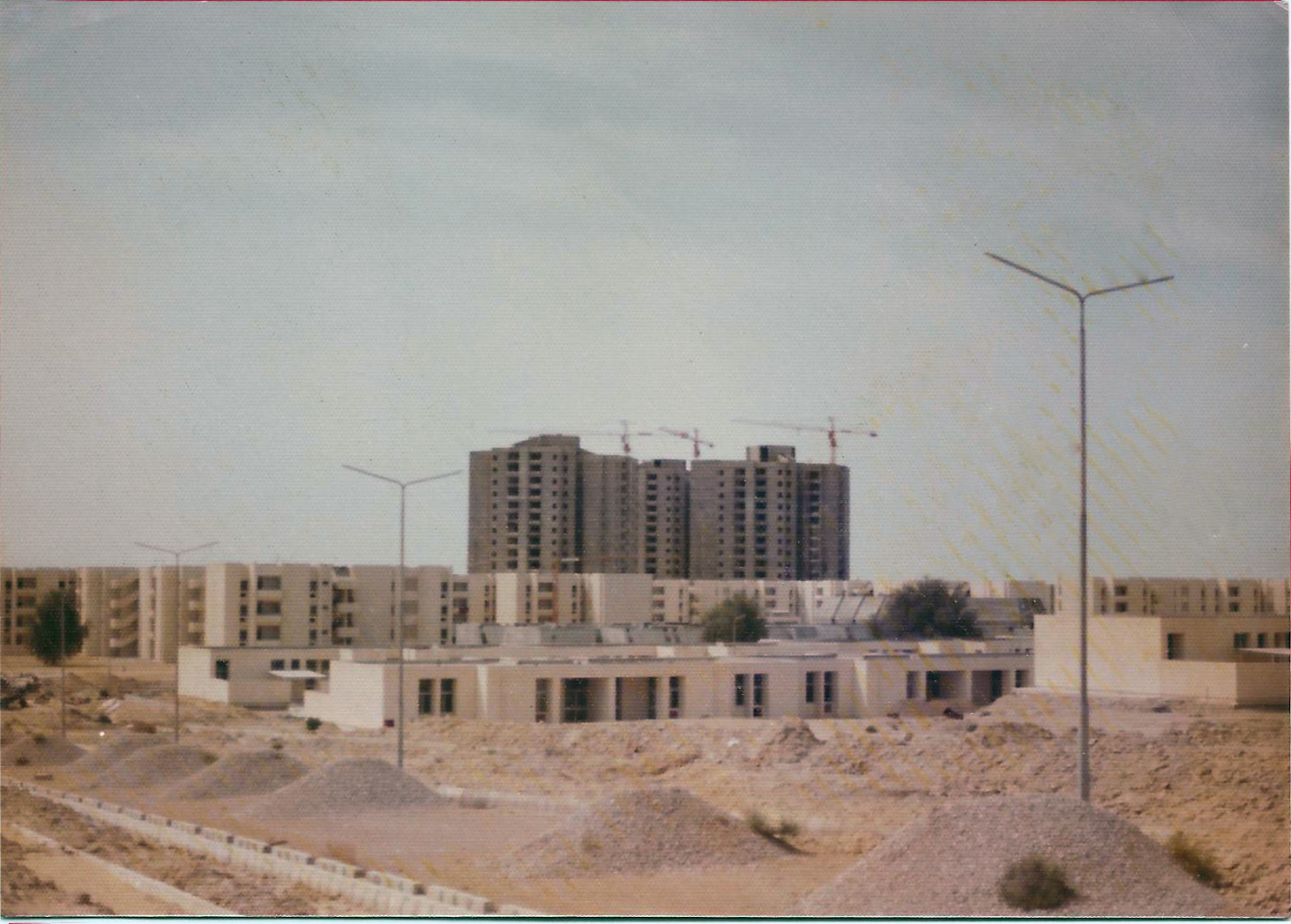
Bushehr during construction (1975): in front detached houses, in the middle 4 floor housing and 15 storey buildings in the background.

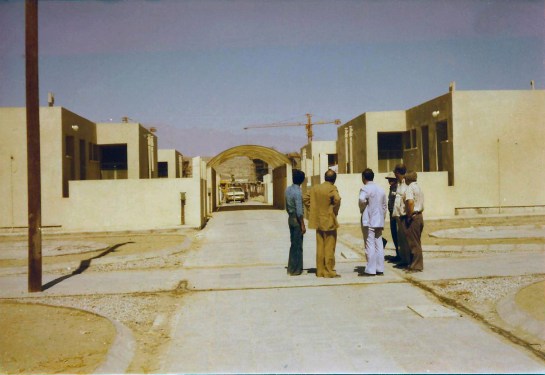
Eitan’s scheme followed Israeli town-planning models of the time, avoiding street grids and creating building clusters with public and semi-public areas. This was very different from the pattern of the surrounding built-up areas, which is still distinguishable in the overall developed areas. The housing design was modular, with different module units for each housing type. The 15-storey building comprised 100 split-level apartments. Each mezzanine floor included 4 apartments radiating out from the elevator shaft. The four-storey buildings were comprised of modular units linked to each other like dominoes on each side, resulting in the creation of semi-public enclosed courtyards. Single-family detached houses for senior officers varied in design, to allow flexibility of purpose, had fiberglass-covered pedestrian atria between them. The whole neighbourhood was connected by shaded pathways leading for the community amenities.

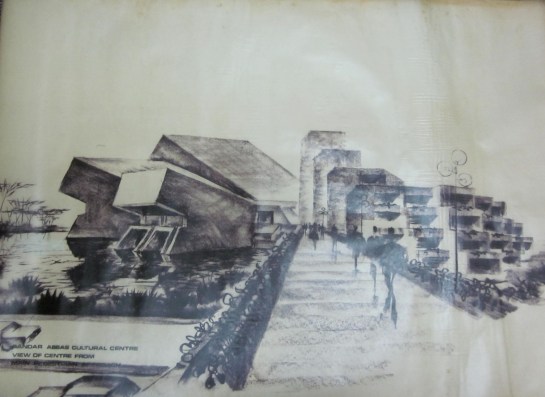
Attention to the harsh local climate was of main concern. Eitan, assisted by an Israeli climate planning expert, integrated new techniques for moderating heat and glare in homes and public areas. The local amenities were carefully planned with inner patios and shaded outdoor spaces. The cultural centre (which was never built) was to be surrounded by a moat, with a bridged entrance, and external concrete prisms shading the windows.
bandar abas officers

Fibreglass covered pedestrian walks in Bandar Abbas
tarbut perspective

Perspective of plan for Bandar Abbas cultural centre (never built)

Eitan, unlike many of his Israeli contemporaries, never adopted vernacular elements in his design, neither in Israel nor in Iran. For him, the quest for the locale was not a question of appearance, but of deep cultural understanding of the society in which he worked, and a desire to create architecture appropriate to local needs and conditions. Thus, his project in Iran was not about representing Iranian culture, but about understanding this culture and how its inhabitants lived. He even consulted a psychologist, trying to comprehend the experience of women left behind for long periods of time when their men are at sea, and created a community centre designed to accommodate their needs.

Sensitivity to local tradition was part of Eitan’s intention to make modern architecture less intrusive. He felt that his professional integrity, especially as a Haraji – a stranger, and a Jew – demanded sensitivity and respect for his clients and their Muslim tradition. The location of the bathrooms is an example of his attitude. According to Iranian Islamic law, all bathrooms should face away from Mecca, i.e. in accordance with the geographic position of Tehran, should be in the north-east corner of the house. However, since the Gulf lies further to the south, he pointed out that the south-eastern location was more correct and insisted on obtaining religious authorization for the bathrooms’ new location.

For Eitan, architectural modernism was a means of creating better living environments. In the Navy Project, however, his approach to modernism often became a point of friction with his employers. The navy’s officials explained that he had been hired as a foreign expert, based on his architectural achievements in Israel. Eitan, however, was striving for socio-cultural harmony in his projects, while the Iranians required a plan that would provide the necessary amenities, and be easily implemented in the fastest way possible. Eitan explains:

“At one point the Navy asked me why the project wasn’t moving faster. I told them that I needed to learn their culture. They said – ‘No. Bring your own culture. That’s why we hired you’. But I told them I only brought my profession. I merged my culture with theirs and then integrated it in the plan.”(Eitan in interview- August 2010)

In Israel, Eitan rarely had a chance to work with clients, since he was building housing for new immigrants who had not yet arrived. In Iran he received detailed information concerning prospective users, and was able to get acquainted with his clients, and plan for their needs.

Eitan’s approach was universal, but at the same time local and specific, though the project was also greatly influenced by Israeli architectural discourse of the time. It was not an Israeli-Iranian hybrid, mainly because Israeli architecture had no apparent tradition, and Eitan did not seem to be influenced by contemporary or traditional Iranian architecture.The Navy Project was specifically planned for a specific location and users, but was nonetheless modernist and universal.

..

This post is based on the article: Neta Feniger& Rachel Kallus (2013): “Building a ‘new Middle East’: Israeli architects in Iran in the 1970s”, The Journal of Architecture, 18:3, 381-401. Materials are with permission of architect Dan Eitan, who I would like to thank for his kindness and full access to his archive and memory.
‘The Influence of Fry and Drew’ Conference, Keynote 3

Jiat-Hwee Chang, ‘Contextualizing Fry and Drew’s Tropical Architecture: Climate as Agency’

Influence acts in both directions. While Maxwell Fry and Jane Drew were indeed influential figures in the fields of modern architecture, town planning and tropical architecture, they were undoubtedly also shaped by various forms of external influences. This paper will explore some of these influences on Fry and Drew. The focus of this paper is, however, not so much on the influence of personae – such as teachers, mentors, patrons, colleagues and friends of Fry and Drew – but with the conditions of possibility – specifically historical structure, socio-political conditions and technoscientific infrastructure – that shaped the ways Fry and Drew produced tropical architecture in Africa and Asia during the mid-twentieth century.

Through a close reading of two books by Fry and Drew – Village Housing in the Tropics (1947) and Tropical Architecture in the Humid Zone (1956) – this paper seeks to understand what were the influences on Fry and Drew’s discourse and practice of tropical architecture. Broadly speaking, this paper will explore two main forms of influence on Fry and Drew. One, it situates Fry and Drew’s tropical architecture in the longer genealogy of European, particularly British, buildings in the tropics. While Fry and Drew’s work in the tropics contributed to the institutionalisation of tropical architecture in the mid-twentieth century and was posited as something new and modern, this paper argues that their work was inextricably linked to prior colonial “tropical architecture” and, in particular, carried historically sedimented meanings of tropicality. Two, this paper locates the influences on Fry and Drew’s tropical architecture within the mid-twentieth century moment. Specifically, it shows how Fry and Drew’s tropical architecture was undergirded by the technoscientific infrastructure of building research in climatic design. This paper also argues that the socio-political conditions of decolonisation and development in the British Empire/Commonwealth facilitated Fry and Drew’s production of tropical architecture.

Drawing on the notion of what science studies scholars James Rodger Fleming and Vladimir Jankovic call “climate as agency” that translates matters of concern into matters of fact, this paper seeks to show that, common to the two aforementioned broad forms of influence, the tropical climate in tropical architecture was more than a statistical index of weather trends. Tropical climate was elevated as a prime consideration in the design and construction of tropical architecture because it was seen as an agency and a force that informed social habits, affected health, shaped socio-economic progress and determined the welfare of a territory’s population.

..

Chang Jiat Hwee is Assistant Professor at the Department of Architecture, National University of Singapore. He obtained his Ph.D. in Architecture from the University of California at Berkeley in 2009. His interdisciplinary research on (post)colonial architectural history and theory, and the socio-technical aspects of sustainability in the built environment have been published as various book chapters and journal articles. He is currently working on a book titled A Genealogy of Tropical Architecture: Colonialism, Ecology and Nature (to be published by Archi-text series, Routledge). He is the co-editor of Non West Modernist Past (2011) and a special issue of Singapore Journal of Tropical Geography on “tropical spatialities”(2011). He is also the author of two monographs on contemporary architecture in Singapore.