Archive

Tag Archives: architectural history

‘Aim for the moon’

Jane Drew

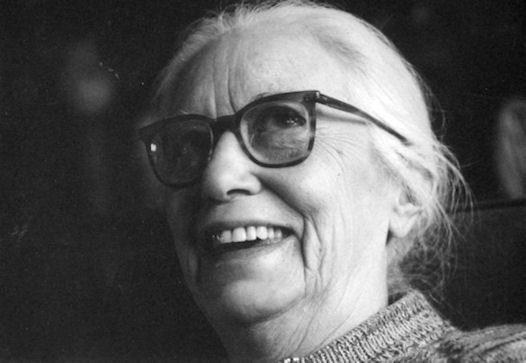
In about 1991, Jane Drew lectured to students at the Hull School of Architecture and advised them to ‘aim for the moon’. Drew gave a good overview of her life and career, showing images of her work at Chandigarh, Ibadan University and in Iran. During this period she was writing her biography, although never published, and similar ideas and themes are present in the lecture here: most notably, her willingness to work hard and make mistakes, and her (perceived) luck in becoming an architect. Of being a woman architect, she said: ‘I think its a bit like making a monkey draw. If a monkey can draw it’s wonderful. If a woman can do something well it’s … I think being a woman is really a help or has been, rather than otherwise.’

A transcript of the interview has been kindly sent in by Malcolm Dickson and can be downloaded here: Drew Lecture at Hull, c1991

‘The Influence of Fry and Drew’ Conference, Abstract 8

Daniel A. Barber, ‘Designing with Climate in the Suburb: Olgyay and Olgyay and the American Influence of Fry and Drew’

In the late 1940s and early 1950s, when Maxwell Fry and Jane Drew were exploring methods for building in the tropical climates of West Africa, interest in architecture and climate was also the concern of many practitioners in the Americas. Richard Neutra’s commissions in Puerto Rico, for example, involved school designs with induced ventilation; design innovations across Brazil and South America developed dynamic shading systems; in the US, the American Institute of Architects collaborated with House Beautiful to produce a series of articles on “Climate Control” and a handbook for architects.

This presentation will briefly summarize this American interest, and then focus on the work of Victor and Aladar Olgyay, twin Hungarian émigrés working at MIT and Princeton in the period. Committed Corbusians, the Olgyay’s met Fry in London in 1936, soon after he completed his Sun House, and were inspired by his use of the materials and methods of modernism towards a more refined relationship to climate. The Olgyay’s books Solar Control and Shading Devices (1957) and Design with Climate (1963) codified and popularized the global climatic discourse. They also present an early attempt to place these interests in historical perspective.

Whereas Fry and Drew developed their strategies in the context of the economic development goals of Britain’s former colonies, the Olgyay’s focused on the American suburb. The second part of the presentation will focus on the challenges they faced. In addition questions of orientation, materials, and building shape, developing means by which architects could engage scientific analyses of climate were paramount, as they allowed for a generalized method for designing subdivisions according to regional differences. Their method for climatic subdivision design was briefly influential, before the affordability of HVAC rendered their analyses mute – a historical consequence, as the presentation will conclude, that has ramifications for the present.

..

Daniel A. Barber is an Assistant Professor of Architectural History at the University of Pennsylvania, where he is also the Associate Chair of the Department of Architecture. His research looks at the role of architectural technologies in the infrastructural and territorial transformations of the immediate post-World War II period in the United States. His current book project is titled A House in the Sun: Modern Architecture and Solar Energy in the Cold War.

Barber’s essays have appeared in numerous periodicals, including Grey RoomThe Journal of ArchitectureDesign Philosophy Papersthresholds, and DASH; he has also published articles in numerous edited volumes. An essay is forthcoming in Technology and Culture.

Barber received a PhD from Columbia University, and was a post-doctoral fellow at Harvard University Center for the Environment. He has held visiting positions at Oberlin College, Barnard College, and the University of Auckland, New Zealand.

‘The Influence of Fry and Drew’ Conference, Keynote 2

Elizabeth Darling, ‘The Conditions for an Architecture for To-day: A discussion of the inter-war architectural scene in England’

Taking its cue from the title of a 1938 lecture by Wells Coates, this paper considers the conditions that created the generation of architects in inter-war England that included Jane Drew and Maxwell Fry. Its ultimate concern is to offer some conclusions about how such conditions shaped Fry and Drew’s desire to transform space and society in particular, and, at a broader level, the nature of English modernism as a whole.

The paper will explore several conditions in order to achieve this goal. Chief among them are the educational contexts in which Drew and Fry studied, and hence what this might tell us about the modernisms they would practise. Among the earliest of the generation of women to train professionally, Drew attended the Architectural Association at a time when it was just beginning its shift towards a more avowedly ‘modern’ stance. Fry, by contrast, was a product of the Liverpool Beaux-Arts system that the AA would eschew not long after Drew graduated.  Important too, were the intellectual milieux which the pair inhabited, and their friendship networks. This is evident in the comradeship of Coates and Fry, an alliance forged following their first meeting some time in 1923-4. Out of this emerged a commitment to training themselves in modern culture and to make connections with allied avant-garde groups, a strategy which allowed them to become the natural leaders of an institutionalising English modern movement. Drew, likewise, shared a network of progressive friends – such as the Communist architect Justin Blanco White –an engagement particularly with modern art, and an equal skill at organisation and propagandising, something which did much to keep the movement alive during the war years.

Referencing other collaborations, and key inter-war architectural projects, particularly by Fry, the paper concludes its concern to contextualise the English side of Drew and Fry’s modernism.

..

Elizabeth Darling works on 20th century British architectural history with a particular interest in inter-war modernism, social housing, and gender. She has published on the nature of authorship in the design process; the innovative practices of the inter-war voluntary housing sector, the housing consultant Elizabeth Denby and the relationship between citizenship and the reform of domestic space in inter-war Britain. Her book, on British architectural modernism, Re-forming Britain: Narratives of Modernity before Reconstruction, was published by Routledge in early 2007 while an edited volume (with Lesley Whitworth), Women and the Making of Built Space in England, 1870-1950 was published by Ashgate in autumn 2007. Her research focuses on three main areas: the link between urban renewal and social (especially child welfare) reform in the slums of Edinburgh in the early 20th century; the arena in which progressive ideas about design and space were developed and disseminated in 1920s Britain, and an in-depth study of the work and life of the architect-engineer Wells Wintemute Coates, which research is supported by funding from the Paul Mellon Centre for the Study of British Art and the RIBA Research Trust. She is most recently the author of Wells Coates, published by the RIBA in collaboration with the 20th Century Society & English Heritage (2012).

‘The Influence of Fry and Drew’ Conference, Abstract 7

Viviana d’Auria, ‘“The most difficult architecture to create”:  Fry, Drew & Partners’ contested legacies and the vicissitudes of low-cost housing design in (post)colonial Ghana’.

As has been well documented, Maxwell Fry and Jane Drew were intensely involved in British West Africa. From their Accra-based office, they designed the cornerstones of late colonial welfare development, ranging from hospitals to universities. Explorations of their West African work however, have neglected housing design, including the ways in which it confronted colonial antecedents and how expatriate practitioners and local professionals confronted its legacy. This disregard is all the more challenging seen the weight it had for Fry and Drew themselves, as well as its overall significance for general post-war technical assistance.

Indeed, in the case of housing conception too, the partnership’s work was envisaged at a time of confidence in the reconciliation of modernism and development within the walls of a low-income dwelling. Freshly-arrived in Chandigarh after several years spent in West Africa, Fry and Drew were important contributors at the United Nations Housing Seminar in New Delhi in 1953. At the event, their efforts not only earned them recognition with the prize-winning conception of House 23, but was also the topic of Fry and Drew’s paper, who underscored how low-cost dwellings were “of all architecture the most difficult to create”.

On such premises, this contribution focuses on pre-Chandigarh housing design in Ghana. By looking at cases from the Accra-Tema Metropolitan Area, it wishes to comment more particularly on how the partnership was concerned with indigenous dwelling cultures. It then reflects on how this centre of attention was (or not) picked up by international technical assistance and local government planning in the following decades. The notion of ‘growing’ and ‘extendable’ housing, in addition to gender-based typologies will be inquired into by means of selected cases such as the Jamestown slum clearance scheme, the work of the Tema Development Corporation and of the International Co-operative Housing Development Association.

..

Viviana d’Auria is Lecturer in Human Settlements in Development at the Department of Architecture, Urbanism and Planning (University of Leuven) and NWO Rubicon fellow at the Department of Geography, Planning and International Development Studies (University of Amsterdam). Her dissertation Developing Urbanism in Development: Five Episodes in the Making of the Volta River Project in (Post-)colonial Ghana 1945-76 (KU Leuven, 2012) explored the contribution of transnational technical assistance projects to the epistemology of (post-)colonial urbanism through the particular case of the Volta River Project. Critical spatial analyses of modern dwelling environments and their lived-in ‘hereafter’ are an integral part of her research within a more general interest in modern urbanism in non-Western contexts. On this note, Viviana’s post-doctoral inquiry is comparatively exploring home space in Greater Accra and Lima by focusing on the socio-spatial history of modern ‘incremental’ neighbourhoods such as Tema Manhean and Villa El Salvador.

‘The Influence of Fry and Drew’ Conference, Abstract 6

Barnabas Calder, ‘Cohabitation or collaboration? Drake and Lasdun of Fry Drew Drake and Lasdun’.

After the termination of Berthold Lubetkin’s Tecton partnership in 1949 two of the partners, Lindsay Drake and Denys Lasdun, accepted an offer from Fry and Drew of a new partnership. This lasted until the retirement of Drake in 1959, at which Lasdun left too to establish Denys Lasdun & Partners.

Drake & Lasdun seem to have maintained a considerable level of autonomy within the partnership, publishing their work separately, invariably as ‘Drake and Lasdun of Fry Drew Drake and Lasdun’. Letters from the time reveal that Lasdun actively resisted closer architectural involvement with Fry and Drew, and he always maintained later that the relationship was purely an office-share for reasons of expedience. Yet a publication of Drake and Lasdun’s work in Architectural Design, February 1958, includes projects which were never again acknowledged by Lasdun, and which, in stylistic terms, look much closer to the oeuvre of Fry and Drew.

The decade-long existence of Fry Drew Drake and Lasdun was a productive one for both sides of the partnership. A number of the buildings of this period for which Lasdun led the design process have been continuously recognised since as amongst the most original and interesting buildings of British modernism – Bethnal Green “Cluster Block” social housing exhibited at CIAM, Hallfield School, and the outline design phases of the Royal College of Physicians and a block of luxury flats in St James’s Place.

This paper will explore the dynamics of the partnership, drawing on interviews with surviving assistants in Fry Drew Drake and Lasdun, and on the limited archival evidence, to investigate how Drake & Lasdun operated within the shared offices, and whether the cohabitation had any influence on the architectural output of the partners.

..

Barnabas Calder is Lecturer in Architecture at the Liverpool School of Architecture. His research centres on the architecture of Denys Lasdun, about whose National Theatre he wrote his PhD, before spending two years cataloguing much of Lasdun’s archive at the RIBA. He is currently researching and writing a complete works of Lasdun funded by the Graham Foundation, to be published as a web resource by the RIBA. Lasdun Online will be composed of illustrated discursive entries on each of Lasdun’s projects, accompanied by thematic essays on aspects of Lasdun’s practice and its context.

Barnabas is also writing a book on British Brutalism for William Heinemann, and a single-volume story of architecture for Penguin. His other research interests include Cedric Price, on whom he curated an exhibition at the Lighthouse, Glasgow, in 2011 and the Bartlett, London, 2012.

‘The Influence of Fry and Drew’ Conference, Keynote 1

Hilde Heynen, ‘Modernism, colonialism and feminism. Theoretical reflections on the entanglements in the life and work of Jane Drew’.

The entanglement between modernism and colonialism has been a topic of serious consideration in recent decades. Following the lead of Edward Said, it is argued that colonial discourse was intrinsic to European self-understanding: it is through their conquest and their knowledge of foreign peoples and territories (two experiences which usually were intimately linked), that Europeans could position themselves as modern, as civilized, as superior, as developed and progressive vis-à-vis local populations that were none of that. The crucial – if often only implicit – role of colonial discourse in the endeavour of modernism thus has to be acknowledged. Likewise it seems that modernism and feminism are in some sort of entanglement: they share – at least – the ideals of emancipation and liberation for all, although it is also clear that modernist discourse favours male protagonists and masculine interests.

Jane Drew as a person and an architect found herself in the midst of these entanglements. As a committed participant in the Modern Movement, she was engaged in questions of housing in the UK as well as elsewhere, in British colonies or ex-colonies. Her commitment to the Modern Movement was not contradictory to, but rather continuous with, her service to the colonial state. Her involvement in the construction of Chandigarh was also consistent with the hegemonic position of modernism, criticized by later postcolonial thinkers. As one of the very few active woman architects of her generation, she must have encountered quite some antagonism and sexism from colleagues, clients and superiors.

This lecture will ponder these entanglements, inquiring about Jane Drew’s position as a woman architect in the tropics, investigating whether the ‘colonial’ conditions offered her a kind of laboratory for deploying her full capacities as an architect, which might have been more difficult in the more conventional environment of the UK. The lecture will not focus on the life and work of Jane Drew as such, but rather use these as a starting point for developing some theoretical reflections.

..

Hilde Heynen is Full Professor and Chair of the Department of Architecture, Urbanism and Planning at the University of Leuven. Her research focuses on issues of modernity, modernism and gender in architecture. She is the author of Architecture and Modernity. A Critique (MIT Press, 1999) and the co-editor of Back from Utopia. The Challenge of the Modern Movement (with Hubert-Jan Henket, 010, 2001), Negotiating Domesticity. Spatial productions of gender in modern architecture (with Gulsum Baydar, Routledge, 2005) and The SAGE Handbook Architectural Theory (with Greig Crysler and Stephen Cairns, Sage, 2012). She regularly publishes in journals such as The Journal of Architecture and Home Cultures.

‘The Influence of Fry and Drew’ Conference, Abstract 5

Jacopo Galli, ‘Edwin Maxwell Fry and Jane Drew – Architecture as a Climatic Device’.

With their numerous designs in West Africa from 1949 to 1960 Edwin Maxwell Fry and Jane Drew established an innovative design system that was later conceptualized in their book Tropical Architecture in the Dry and Humid Tropics in 1964. What is now known as Tropical Architecture consisted in a process of transculturalization of European modernism that was heavily influenced by climatic and social concerns. This design system can been seen as the sum and intersection of different climatic devices that were specifically thought in order to respond to one or more climatic inputs. Otto Koenisberger saw African vernacular architecture as a pedagogic model for the design of climatic devices: materials and technologies were used in order to achieve a balance with the environment.

Fry & Drew applied this concept and generated an impressive amount of architectural devices that were modified and overlapped in an anti-vernacular way. This can be considered an embryonic step towards a quantitative architecture not solely based on the designer’s genius but on a set of scientific data that influenced and transformed architecture.

This assumption does not affect the audacity and boldness of design: the research on innovative building materials or the regeneration of historical building techniques. Every design choice in Tropical Architecture was taken respecting the concepts of convenience and opportunity, shading devices or breathing walls took form based solely on climate and are a great example of anti-vernacular regional modernism.

Through a critical redrawing of the buildings it is possible to comprehend design mechanisms in order to verify how the different devices were used in response to the different climatic conditions. The research does not intend to verify the technological functionality of the devices but the architectural coherence displayed in their use. Understanding this design system allows us to retrace how architectural design could be shaped by climatic factors and scientific data, in order to comprehend an important step in the history of transnational modernism.

..

Jacopo Galli is a PhD candidate at IUAV University in Venice. He holds a bachelor degree in Architecture from the University of Parma and a masters degree in Sustainable Architecture from IUAV University in Venice. He is currently working on a dissertation that investigates British Tropical architecture in West Africa of the 1940s and ’50s as an innovative design system representing an embryonic stage of climate responsive design. The dissertation is particularly focused on the book Tropical Architecture in the Dry and Humid Tropics seen as the masterpiece of Edwin Maxwell Fry’s and Jane Drew’s entire career. The analysis of the book will be carried out through an understanding of the main influences on Fry and Drew’s African designs such as Tropical Medicine and Colonial Technologies and through a critical redrawing and analysis of the buildings used as examples in the manual.

‘The Influence of Fry and Drew’ Conference, Abstract 4

Christine Hui Lan Manley, ‘Modern City versus Garden City: Housing at Harlow New Town’.

During post-war reconstruction debates, Garden City supporters promoted low-density housing, while modernist architects advocated high-density high-rise regional planning. As members of the MARS Group, E. Maxwell Fry and Jane Drew fell into the latter camp, with Fry playing a key role in the development of the MARS Plan for London. The post-war New Towns program provided the ideal opportunity to test these new planning concepts, especially since a number of MARS Group members were commissioned to design the towns. Gibberd was selected to plan Harlow and was determined to create a modernist town with an urban character. Naturally, he turned to fellow MARS Group member Fry to design housing in the first neighbourhood, Mark Hall North.

In partnership with Jane Drew, Maxwell Fry designed housing groups ‘Tanys Dell’ and ‘The Chantry’ at Harlow. However, hampered by the low density recommendations, the housing in Mark Hall North was considered a ‘failure’ in 1953 by The Architectural Review. This paper seeks to examine the process involved with the design of the neighbourhood to show that a modernist agenda was, in this instance, compromised by the overpowering influence of the Garden City model.

By analysing the distribution and layout of housing in Mark Hall North, this paper will reveal how Gibberd, Fry and Drew sought to create higher density housing groups in an attempt to orientate the New Town toward the modernist high-density vertical city paradigm and away from the low-density Garden City planning model. However, government design publications and Ministry officials had envisaged Garden City type planning for the New Towns. This paper will argue that despite the various strategies employed by Gibberd, Fry and Drew at Mark Hall North, ultimately, the prevailing inclination toward Garden City planning restricted the creation of a modern urban character at this first neighbourhood in Harlow.
..

Christine Hui Lan Manley is currently completing her PhD at the Mackintosh School of Architecture. Her research centres on the concept of ‘urbanity’ – a notion which developed in Britain through architectural discourse during the 1940s and ’50s. Christine’s PhD research investigates how urbanity was defined and understood by the architectural avant-garde, and how the idea was applied to the design of housing in the Post-War New Towns.

Christine became interested in housing design whilst working for a London-based architectural practice, where she designed plans for high density sites and worked on innovative social housing schemes. Her interest in the development of housing in a historical context arose during research carried out during Diploma and Masters studies at the Mackintosh School. Christine is a member of the C20th Society and currently edits their ‘Building of the Month’ feature. Her PhD research is funded by the Arts and Humanities Research Council (AHRC).

­­

‘The Influence of Fry and Drew’ Conference, Abstract 3

Łukasz Stanek, ‘Tropical Architecture as Cold War Discourse in Post-Independence Ghana (1960–1966)’.

While scholars have convincingly linked the genealogy of tropical architecture to the colonial networks of the British Empire within the processes of decolonization, the role of Cold War dynamics in this genealogy has been much less recognized. This paper fills in this gap by discussing the cosmopolitan architectural practices in Ghana during the presidency of Kwame Nkrumah (1960–1966), with the specific focus on the Accra International Trade Fair. This ensemble was designed by architects and engineers from socialist Poland according to the principles of “tropical architecture” as advocated by Maxwell Fry and Jane Drew: the translation of modernist architecture according to local climate, technology, and society. The construction of the Fair was a part of broader debates on “building in the tropics” in the Soviet Union and Poland, in response to the engagements of professionals from socialist countries in Europe in Africa and Asia since the late 1950s. Yet in spite of being one of the most prominent ensembles in Nkrumah’s Accra, the Trade Fair was never included to publications about “tropical architecture” nor was it presented in the journal “Western African Architect and Builder” which promoted “tropical architecture” well into the 1970s. This absence needs to be seen as expressing the “intellectual division of labor” specific for the Cold War that allowed acknowledging the work of architects from socialist countries as technological objects, but not as architectural ones.

Based on archival research and fieldwork in Poland, Hungary, Croatia, and Ghana, this talk will show how the discourse on “tropical architecture” offered a way for expressing ideological and economic antagonisms among architectural practices in mid-1960s Accra. At the same time, this paper will signal points of connection among practitioners from both sides of the Iron Curtain in early post-independence Ghana, including the School of Architecture in Kumasi, where Fry and Drew would discuss the principles of tropical architecture with colleagues from Hungary and Yugoslavia.

..

Łukasz Stanek is the 2011–2013 Mellon Post-Doctoral Fellow at the Center for Advanced Studies in Visual Arts (CASVA), National Gallery in Washington and Lecturer at the Manchester Architecture Research Centre, University of Manchester. Stanek authored Henri Lefebvre on Space: Architecture, Urban Research, and the Production of Theory (University of Minnesota Press, 2011) and he is currently editing Lefebvre’s unpublished book about architecture, Vers une architecture de la jouissance (1973). Stanek’s second field of research is the transfer of architecture from socialist countries to Africa and the Middle East during the Cold War. On this topic, he published ‘Miastoprojekt Goes Abroad. Transfer of Architectural Labour from Socialist Poland to Iraq (1958–1989)’ in The Journal of Architecture (17:3, 2012) and the book Postmodernism Is Almost All Right. Polish Architecture After Socialist Globalization (Fundacja Bęc-Zmiana Warsaw, 2012). He has taught at the ETH Zurich and Harvard Graduate School of Design.

‘The Influence of Fry and Drew’ Conference, Abstract 2

Ana Tostões and Zara Ferreira, ‘How to be Modern and Design with Climate: Fry and Drew’s Legacy and the School Programme in Mozambique (1955-1975)’.

Maxwell Fry (1899-1987) and Jane Drew (1911-1996) headed an essential role on the design with climate issue. They contributed to reveal the possibility of a Modern Movement architecture applied to the tropics showing what was beyond the Brazilian Modern and its formal answer. An efficient and technical approach was achieved connecting design tools with sanitarian requirements, establishing a methodological and pedagogical brand disclosed by their research, lessons, publications (Fry; Drew, 1964) and buildings (Kultermann, 2000, 54).

Their action was reflected on the development of the Modern Movement architecture in the former African Portuguese colonies, throughout the ’50s and ’60s, namely in Mozambique: in the scope of the African investment overseas conducted by the “Estado Novo” dictatorship (1926-1974) the educational programme was the main focus following other African countries strategies, according to updated UNESCO policies.

Though, in the beginning the high schools buildings were designed in the metropolis, Lisbon, through the Colonial Urbanization Office (GUC), soon the role would be taken by the local offices receiving influences from the Tropical Architecture in Dry and Humid Zones at the Architectural Association course, in London, sponsored by GUC to their employees. At the same time, two facts come together: the wave of Portuguese architects’ emigration to African colonies and the increasing autonomy of these territories (Tostões; Oliveira, 2010). So, one may say that Fry and Drew prepared a whole generation of Portuguese architects skilled on tropical climates design methods.

In Mozambique, it gave rise to the development of the Public Works Department, where a school trail-blazer concept was developed by Mesquita (1919-?). Widely developed between 1955 and 1975 (the year of the colonies independence), seeking for an efficient energetic performance and comfort in a tropical climate, a modus operandi has been conceived and applied (Ferreira, 2012).

The paper aims to demonstrate how the Modern Movement ideology has been locally interpreted, following Fry and Drew knowledge and pedagogy. Their influence will be analyzed in order to enlighten the school building culture using some case studies.

References:

FERREIRA, Zara, O Moderno e o Clima na África Lusófona. Arquitectura escolar em Moçambique: o programa de Fernando Mesquita (1955-1975). Dissertation to obtain the degree of Master in Architecture. Lisbon: IST-UTL, 2012.

FRY, Maxwell, DREW, Jane, Tropical Architecture in the Dry and Humid Zones. London: BT Batsford, 1964.

KULTERMANN, Udo; FRAMPTON, Kenneth, World Architecture 1900-2000: A Critical Mosaic. Central and Southern Africa, Vol. 6, China Architecture & Building Press, Springer-Verlag Wien New York, 2000

TOSTÕES, Ana; OLIVEIRA, Maria Manuel, “Transcontinental Modernism. M&G as an Unité d’habitation and a factory complex in Mozambique”, DOCOMOMO International Journal 43 – 2010/2 Brasilia 1960-2010, Winter 2010, pp. 70-73.

..

Ana Tostões is an architect, architectural historian and chair of Docomomo International (www.docomomo.com). She is Associate Professor with Habilitation at IST-UTL, Lisbon, where she is in charge of the architectural PhD programme. Her research field is the history of architecture and the city of the twentieth century, in which she develops an operative view, oriented towards the conservation of modern architecture, focusing especially on post-war architectural culture and on the relations between European, African and American production. On these topics she has published books and scientific articles and curated exhibitions. She’s actually coordinating the research project (PTDC/AUR-AQI/103229/2008) EWV: Exchanging World Visions. The project aims to study Sub-Sahara African architecture and planning mostly built in Angola and Mozambique during the modern movement period.

Contact: ana.tostoes@ist.utl.pt

Zara Ferreira is an Intern Architect and Research Fellow at Instituto Superior Técnico (IST-UTL), Master in Architecture at IST-UTL with a dissertation entitled The Modern and the Climate in the Lusophone Africa. School buildings in Mozambique: the Fernando Mesquita concept (1955-1975). Based on the systematic analysis of case studies, on which she carries out the analysis and the interpretation of the systems and technologies designed to respond to specific levels of comfort for the tropical climate, along with the analysis of the organization of the built environment and the functional typology, the essay aims to contribute for the characterization of the school’s architectural program (developed under the scope of the research project EWV: Exchanging World Visions).

Contact: zara.c.ferreira@ist.utl.pt