Contemporary Architecture in East Africa: An Empire of Good Practice[i] or Shadows of Neocolonialism?
Killian Doherty
The expression of individual and collective black identity flourishes in various diverse cultural endeavors. Architecture seems to have been circumvented by this program of intense cultural expression; one wonders whether this is a result of a latent bias within the processes of architectural discourse or merely a time lag before an important and creative awakening.
—Edward Ihejirika, “Identity as Intensive Continuity”[ii]
Throughout the mid to late twentieth century the former colonies in Africa were viewed as a fecund terrain, a creative test-bed for architects eager to “cut their teeth” on modernism. European architects practicing under the auspices of postcolonial religious and state powers, in a quasi-missionary capacity, built churches, schools, and cultural institutions. These have since become regarded as “powerful symbols and logical citadels” attesting to the “prestige of western knowledge.”[iii] A 2011 documentary entitled Build Something Modern captures this period in which architects working during the 1950s were inspired and eager to replicate the monumentality of Le Corbusier’s Chandigarh in India across East and West Africa. These architects referred to themselves as “card-carrying modernists” and regaled with frenzied zeal about the joys of being able to build nearly whatever one wanted at that time.
In 1946 the German architect Ernst May moved to East Africa, initially to work as a farmer, but then was drawn back into architectural practice in order to complete several large housing, educational, and master planning commissions across Kenya, Tanzania, and Uganda (notably a cultural master plan for Kampala), mainly for British clients and expatriates.[v] However, it was actually with the work of the British architectural duo Maxwell Fry and Jane Drew in West Africa, some ten years earlier, following World War II (Fry and Drew worked on Chandigarh with Le Corbusier), that European modern architecture was transposed to Nigeria, Ghana, and Togo. This delicately revised modernism fuelled desires of these decolonized states to become first world countries and alluded to a superiority of Western architectural methods, particularly evident within Maxwell Fry’s abrasive comments on the impossibility of anything else.
A Nigerian aesthetic? On what would it be based that is as solid as the plywood techniques, the old timber traditions of Finland?
—Ola Uduku, “The Colonial Face of Educational Space”[vi]
Dubbed “an Empire of good practice,”[vii] Fry and Drew’s work in West Africa forged the basis of teachings that became the Department of Tropical Architecture at the Architectural Association in London. This work of this period however, “fabricated a mythology”[viii] that architecture as a cultural artefact was somehow independent from political influences; the modern built environment across Africa was and since then has been irrevocably influenced by this period.
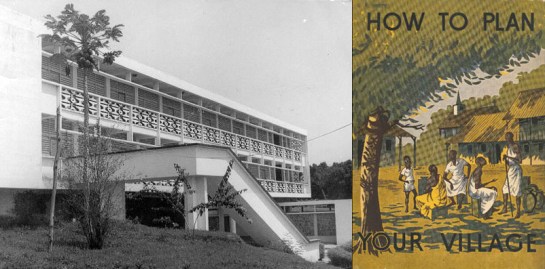
Maxwell Fry and Jane Drew, Mfantsipim School, Cape Coast, Ghana, 1947 / Alfred Edward Savige Alcock, How to Plan Your Village (London and New York, 1953), front cover
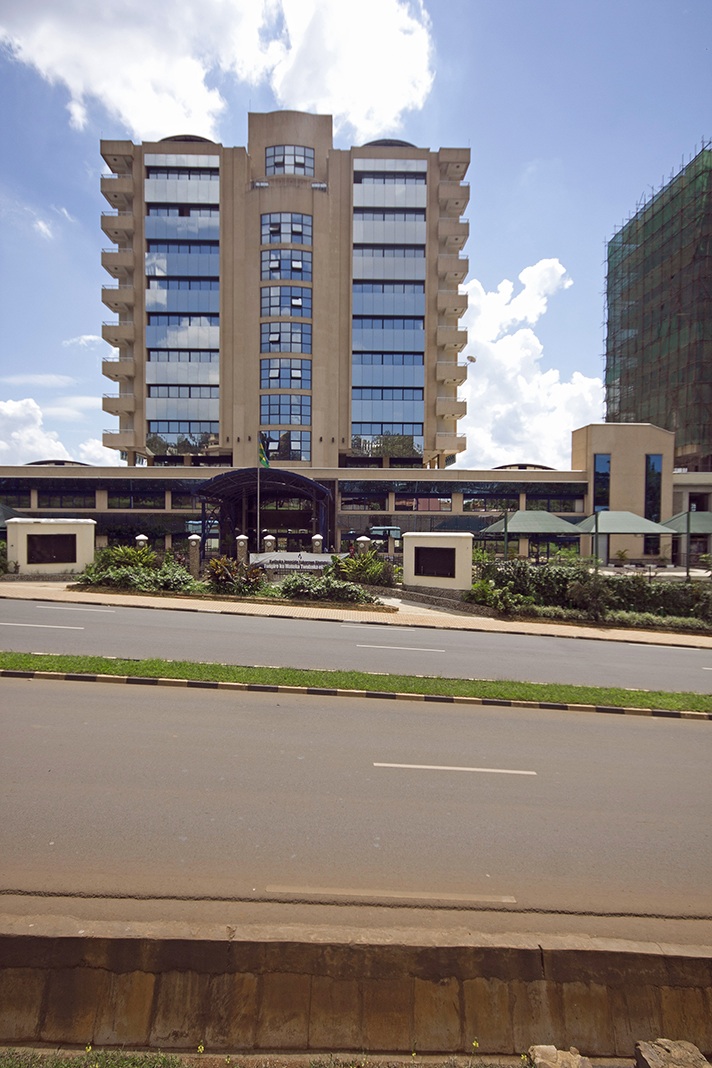
Today, rapid growth in East African cities has brought about intense urban redevelopment, with modernity still held aloft as the panacea. This has consequently bifurcated the agenda of those working in architecture and urban planning, resulting in built work based on lofty neoliberal urban visions replete with an imported, bland modernism (such as in Kigali[ix] and Nairobi[x]), as well as of those working in the field of humanitarian aid and development. It is within the latter field of development that a wave of contemporary architectural practice has emerged, which is also being acknowledged by the exhibition ‘Afritecture – Building Social Change‘.[xi]

New building in Kigali as part of the city master plan. Courtesy Killian Doherty
Given that Maxwell Fry’s “Empire” is readily acknowledged for its limited ability to legitimize African modern architecture[xii] and that the majority of architectural NGOs from the West are still very much disseminating modernism within Africa, one has to ask whether any lessons have been learned. How can Western practice outrun the ghosts of the postcolonial and come closer to a modern African architecture? As interests between local governments, international NGOs, and architectural projects are inextricably intertwined, is this contemporary mode of practice simply the newest facet of neocolonialism?
Quite simply it is the design in Western psychology to set Africa up as a foil to Europe, a place of negations at once remote and vaguely familiar in comparison with which Europe’s own state of spiritual grace will be manifest.
—Chinua Achebe, “An Image of Africa”[xiii]
As a Western architect in Africa, I feel perpetually tainted by the postcolonial legacy, the remnants of which obscure one’s ability to practice with clarity. Looking at recent projects, it is abundantly clear there is still relative freedom to experiment in (East) Africa. Considering that, in the past, Africans have “had little to say in response” to architecture, the question remains whether this wave of contemporary architecture has emerged from an engaged, local critical dialogue, or from one that remains entrenched in Western discourse.
Much in the way that the modern movement heralded the promise of social improvements, the same ideology is very much at the root of humanitarian design and evident within today’s developmental lexicon. This is a lexicon with which one is constantly bound by the reality that interests are never truly neutral. As such, we as architects might be accused of being fluent in NGO rhetoric, something that the urbanist Kai Vöckler calls “Donor Speak.”[xiv] Here, interventionist work does not emerge from a “neutral system of values,” but, in fact, “[its] goal is to align everything with the political aims of the donor” or stakeholders, who, more often than not, consist of a first-world audience.
“Architecture is business as well as culture,”[xv] Fredric Jameson has claimed, and as such, projects are permanently locked into conflict between the tangible and the intangible, between that of costs and programme versus the articulation of local identity and culture. This is an exasperating paradox whereby the programmatic factors within the process of architectural design are prioritised, obfuscating an understanding of particular cultural practices. A paradox which Christopher Cripps, a practitioner in Ghana, also acknowledges suggesting “a slice from the budget of any construction project be used to force attention on its cultural context.”[xvi]
Form and aesthetics tend to dictate conversations about architecture and local identity. The architect and theorist Neal Leach acknowledges the complexity of how cultural identity may, or may not, influence architectural form, stating that “cultural identity, therefore, emerges as a complex field of operations that engages with—but is not defined by—cultural artifacts such as architecture.” Also addressing this issue, Homi Bhabba, a cultural theorist who writes about postcolonial identities, suggests an approach of “hybridity,” whereby a combination of multiple identities, not a fusion of them, is considered as a method to acknowledge divergent practices and traditions; in the case of architecture, as a consideration of contextualizing built form.[xvii]
As culture becomes increasingly globalized, and African identity subsequently becomes more watered down, it is much harder to define the purpose and give clarity to one’s work within these muddied contexts. As such, the risks of running aground are greater as architecture, when done wrong, is incongruously invasive and culturally deleterious.
With these complexities and constraints in mind, it can be difficult to dispel fears of neocolonialism. To dispel the legacy of the so-called superiority of Western architectural practices one must make an effort to engage in a more meaningful manner. New architectural agendas, for instance, call for an attuned reflexivity toward the respective socioeconomic contexts in which they operate, yet still manage to deal with budgetary limitations and aesthetic, form-related inquiries into identity. Therefore, the approaches exhibited by new agendas of contemporary practice throughout Africa, in which the “application of universal principles to local conditions”[xviii] is no longer the dominant mode of thinking, are all the more critical.
It is this era’s underwriting of service to society within architecture as a profession that sets it apart from the former, postcolonial Empires of good practice. A forceful mode of practice that combats the legacies of colonialism impedes the threats of a globalized culture, but, most importantly, hopefully, stirs an elusive “creative awakening”[xix] in an emerging generation of African architects.

Community centre under construction, Kimisagara. Courtesy Killian Doherty
[i] R. Windsor Liscombe, “Modernism in Late Imperial British West Africa: The Work of Maxwell Fry and Jane Drew, 1946–56,” Journal of the Society of Architectural Historians 65, no. 2 (June 2006), pp.188–215. Taken from Maxwell Fry’s biographer.
[iii] O. Uduku, “The Colonial Face of Educational Space,” in White Papers, Black Marks, ed. L. Lokko (London, 2000).
[iv] Nicky Gogan and Paul Rowley, Build Something Modern (Dublin, 2011), film, 70 min.
[v] K. Gutschow, “Das Neue Afrika: Ernst May’s 1947 Kampala Plan as Cultural Program,” in Colonial Architecture and Urbanism in Africa: Intertwined and Contested Histories, ed. F. Demissle (London, 2009).
[ix] The Kigali Conceptual masterplan, Rwanda.
[x] Tatu City Masterplan, Kenya.
[xi] At the Munich Architecture Museum.
[xiii] C. Achebe, “An Image of Africa,” Research in African Literatures 9, no. 1, Special Issue on Literary Criticism. (Spring 1978), pp. 1–15.
[xiv] K. Vöckler, Volume issue 4 (2010).
[xv] F. Jameson, “Is Space Political?,” in Rethinking Architecture, ed. N. Leach et al. (London, 1997).
[xvi] C. Cripps, (2003) “Architecture in Europe and the South: Some African Experiences,” paper delivered at the N-AERUS Annual Seminar, Beyond the Neo-Liberal Consensus on Urban Development: Other Voices from Europe and the South, Paris, 2003, Network-Association of European Researchers on Urbanization in the South (website), http://www.n-aerus.net/web/sat/workshops/2003/papers/docs/13.pdf (accessed on June 5, 2013)
[xvii] N. Leach, “Belonging: Towards a Theory of Identification with Place,” Prospecta 33 (2002), pp. 126–33; and “‘Belonging,’ London: Postcolonial City,” AA Files 49 (2003), pp. 76–82.
[xix] E. Ihejirika, “Identity as Intensive Continuity,” in White Papers, Black Marks, ed. L. Lokko (London, 2000).
..
This post appears in full in the catalogue accompanying the forthcoming exhibition ‘Afritecture – Building Social Change’ to be held at Munich Architecture Museum, 14 September 2013 to 12 January 2014.

 Transnational Architecture Group