Archive

Tag Archives: Education

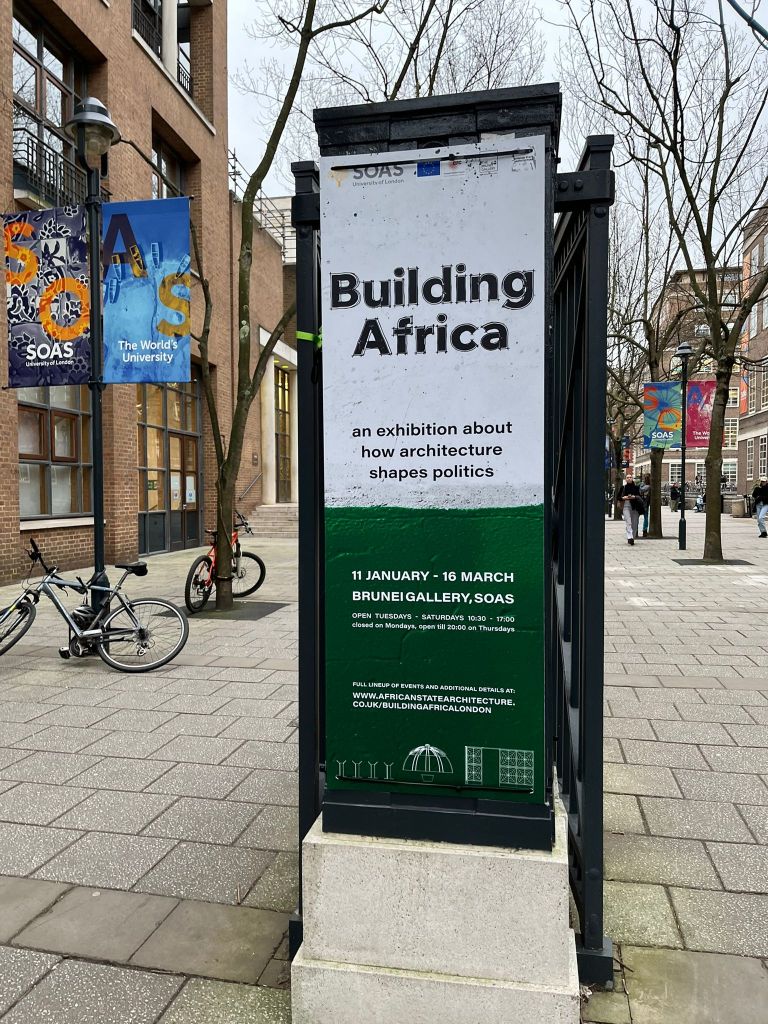
Building Africa Exhibition at SOAS 

The Building Africa Exhibition curated by Julia Gallagher and Kuukuwa Manful is currently showing at the Brunei Gallery SOAS until 16 March 2024. This is a smaller version of the exhibition which was first shown in Ethiopia as part of the State Architecture Research project at SOAS with Prof Gallagher as its director.

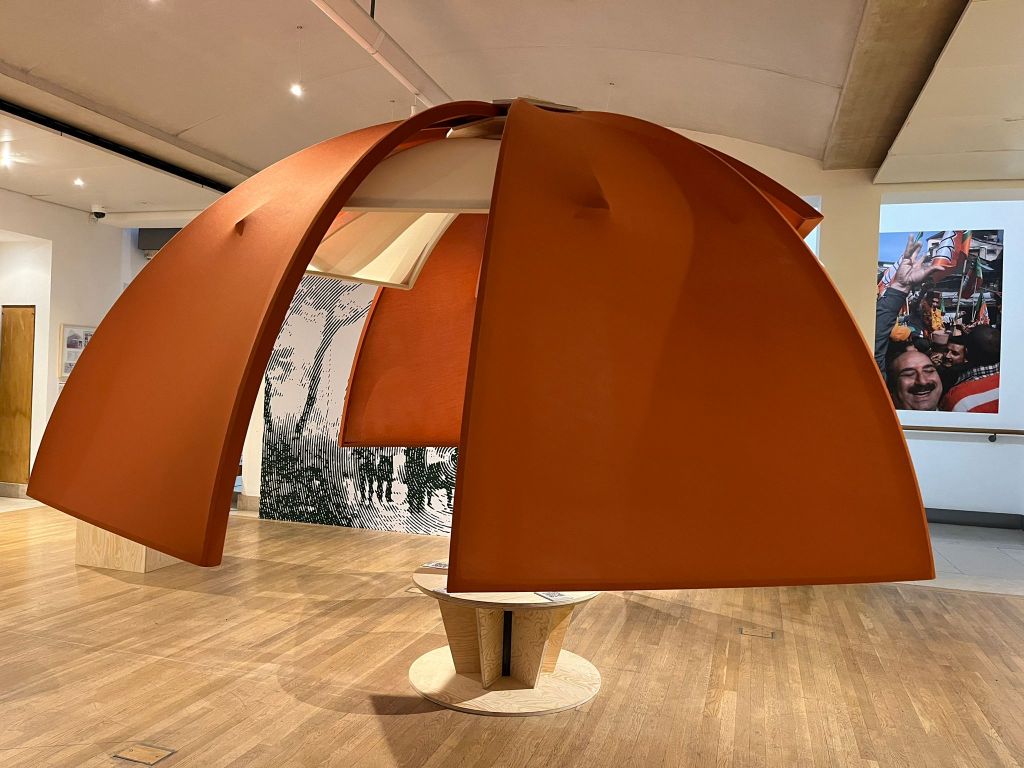
The SOAS exhibition is full of colour featuring, film, photography, a large-scale physical model-installation, publications and school uniforms and memorabilia.  Located in the main gallery space, sections deal with the school history of Ghana, ‘state-built architecture in several African countries, highlighted in the exhibition by images of Ghana’s alternating seats of power, (Osu Castle and State House), and the African Unity building constructed in Addis Ababa. A conceptual installation structure evoking African unity has also been produced by the work of a young Ethiopian architect , Nahom Teklu whose umbrella structure enables exhibition visitors view in VR the ‘state’ architecture of different parts of Africa, it also harks back to the idea of pan-African unity where the umbrella unites all states on the continent.

The exhibition’s thesis that buildings shape us, is made clear to viewer and particularly how the state’s involvement is central to this process of power, positioning, and identity,  particularly in Africa, from its colonial past to the now post-colonial  contemporary situated-ness in Africa’s modern cities to secondary schools in Ghana in which the schools shaped would be future leaders. This was both by the design of the schools within a colonial frame but also school uniforms, motos and other paraphernalia of educational engagement.

State built institutions such as seats of government (state house in the case of Ghana) or stadia (exemplified in the exhibition by the main stadium in Kinshasa) have a more mixed relationship where they both are sites of power, and international events (the Muhammed Ali – Frazier rumble in the jungle, Kinshasa stadium film footage is on show)  or symbols of African Unity  (shown through AU building in Addis Abeba, which often results in tensions of perceptions and strategic plans for future use as regimes and state actors change.

The exhibition also connects the viewer to the research which has underpinned it. This includes the 2023 book Building African Futures edited by Gallagher and Emmanuel Ofori-Sarpong, and Manful; and Manful’s thesis – and a number of papers members of the State Architecture project have published as reports and in peer reviewed journals.

Building Africa packs a dense amount of African state-built architectural history into a a viewable gallery which audiences are invited to view, engage with and critique, helpful post-it notes are provided for this process. The curators explain that this is an adjusted version of the larger 7 panel exhibition and of the conceptual architectural installation has had to be cut short to fit the gallery space. This does not detract from this well-planned and already publicly pleasing and well- received  exhibition.   

One day in January at Trocadero Square, Lekki, Lagos...  

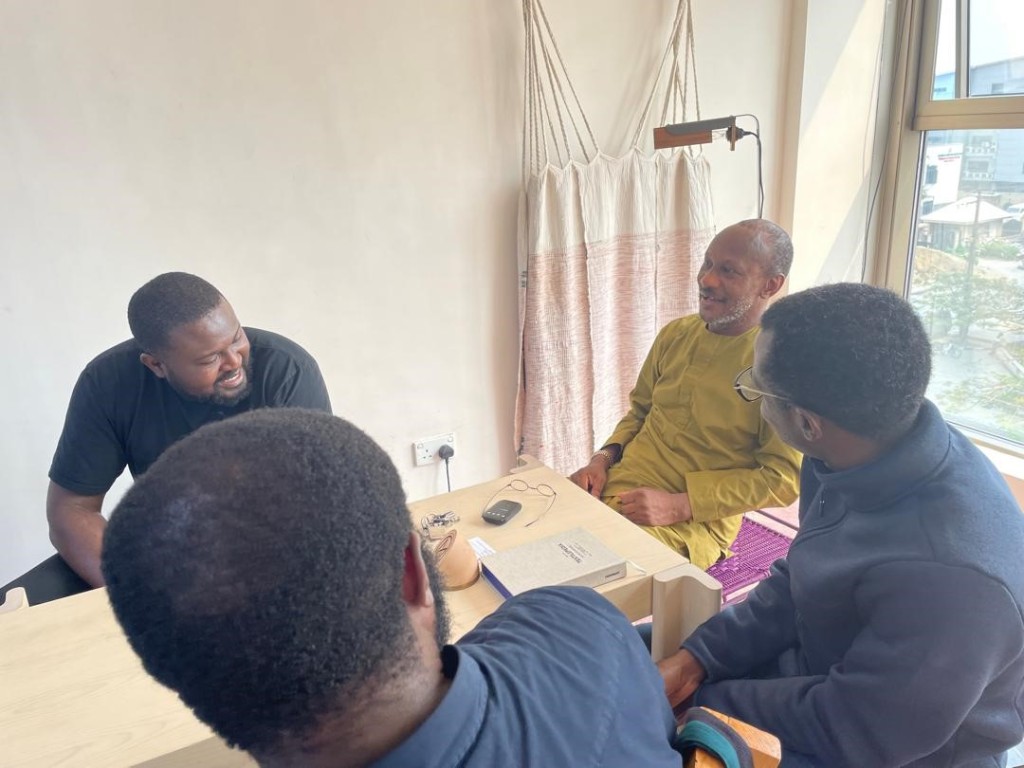
On our last day in Nigeria we planned to meet Nifemi Marcus Bello, a remarkable Nigerian product designer who has had his work shown to great acclaim at the Sharjah Triennale. Joining us was Associate Prof Seyi Akerele who had just completed a Virtual Fellowship at the University of Liverpool with Ola Uduku.  

Seyi Akerele and Ade Shokunbi (photo O.Uduku)  

 It also seemed an ideal chance to meet up with some other creatives too, and we invited  Adeyemo Shokunbi to join us. Shokunbi is a fascinatingly creative architect, whose Abijo Mosque received the Abdullatif Al Fozan Award for Mosque Architecture for the fourth cycle 2020 – 2023.  Most recently Shokunbi has also made waves with his shipping container formed MAD (Make A Difference) Project at the University of Lagos and he will shortly be a taking up a Teaching Fellowship offered by the Obel Foundation in Denmark.  James Inedu George also made time to join the party. George was one of Joe Owuso-Addo’s ‘New Blood’ from the 2021 Venice Biennale. A phone call from Shokunbi summoned Chuka Ihonor – writer art curator, impresario and activator extraordinaire. 

Iain Jackson and Nifemi Marcus-Bello  (photo O.Uduku) 

The discussion which followed we felt lucky to have been allowed to listen in and occasionally contribute to. The key theme unsurprisingly was the dearth of the linking of academic teaching with the realities of practice. We heard tales of the assembled team, unsuccessful attempts at reaching out to the academy who either were disinterested or actively ignored these linkages. James Inedu-George was more direct in his criticism of relationships and links between practice and gown. 


L – R Nifemi Marcus-Bello, Ola Uduku and Ade Shokunbi (photo I. Jackson) 

The pre-eminence of the expatriate architect from South Africa,  and in particular SAOTA was expressed. It was felt that Nigerian’s found it difficult to feel pride in local architecture and creative practice. Wealthy clients garnered a sense of prestige by hiring architects from overseas.  It was a throwback to Demas Nwoko’s struggle for acceptance by the Nigerian architectural profession despite his clear brilliance as a creative designer whose roots were in his initial ABU architecture training.  Collaborative practice and design also needed a wakeup call as the discussion critiqued the ‘lone architect-creator’ syndrome where collaboration was actively discouraged and firms struggled to scale their enterprise to deliver large projects. 


Ade Shokunbi and  James Inedu-George (photo O.Uduku) 

With Chuka we’d like to ‘bring’  highlights of Sharjah Triennale to Nigeria. Nigerian creatives featured so strongly in this exhibition, and it seems appropriate to share this work with a Nigerian audience.  

Back clockwise, Nifemi Marcus-George, Chuka Ihonor, Seyi Akerele and James Inedu-George (Photo O.Uduku) 

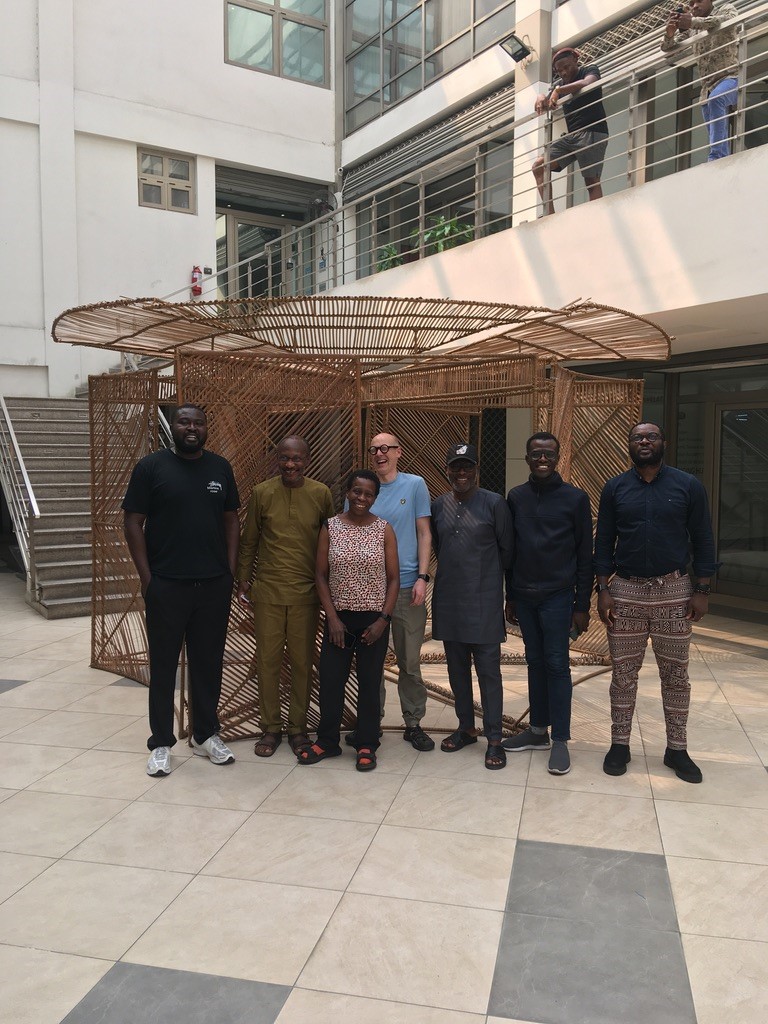
Something special happened at this informal and chance encounter. From this gathering of creatives, educators, authors, makers, and architects a refreshing and encouraging discussion flowed. We shouldn’t stop here. We would be honoured to host the next platform for what might be termed an African Creative Awakening, and present below what we might call the Trocadero Call to Action (TCA) in deference to this auspicious meeting at the Trocadero Square in Lekki – the place to have been on Thursday 18th January in Lekki, Lagos. 

The TCA Participants and Observers: 

L – R. Nifemi Marcus-Bello, Chuka Ihonor, Ola Uduku, Iain Jackson, Ade Shokunbi, Seyi Akerele and James Inedu-George  (Photo  Nifemi Marcus Bello Studios)  


  1. The future of Architectural Education in and around Western Africa 
  1. Practice Building and the process of commissioning, designing, and making architecture. 
  1. The purpose, shape, and expression of architecture within the Western African context, and how this is communicated and shared. 

Name: Adefolatomiwa Toye

PhD Research Title and Summary: Development and National Identity: Tropical Modernism in Post-Independence Nigerian Universities 

The aftermath of the Second World War brought a shift in the policies of the British Empire towards the infrastructural development of colonies in West Africa. Massive projects ranging from transportation to healthcare and including education went underway in Nigeria, the largest colony in West Africa. Various commissions from the 1940s and nationalist agitations eventually led to the establishment of the first university in West Africa in 1947- the University of Ibadan, Nigeria. Colonial architects such as Maxwell Fry and Jane Drew, who specialised in modernist designs for the tropics, were hired for this and other major projects. 

Ibadan University

With the country’s independence from colonial rule in the foresights in the late 1950’s, a new desire for a unified national identity arose. This aimed to erase dividing ethnic lines and create a collective identity in the culturally heterogeneous new nation. Infrastructural projects were commissioned, ranging from public buildings to higher education institutions. These projects designed and built following the tropical modernist architecture of the colonial were used in developing a new built environment for Nigeria. I am interested in examining the tropical modernist architecture of Nigerian higher education projects in the 1960s and their role in the country’s development and representing the national identity for the newly independent Nigeria.

Ibadan University

Aims and Objectives:

-examine the position of higher education projects in creating a new sense of identity and nation building

-explore the first universities established in post-independent Nigeria within the social and political context of the 1960s

-highlight the roles of Nigerian actors who championed, designed, and built higher education projects

-compare tropical modernist style of higher educational buildings before independence and post-independence

What did you do before the PhD Research?

I recently completed my master’s degree in Environmental Design at the University of Lagos, Nigeria where I also obtained my undergraduate degree in Architecture. I also worked part-time at A3: Archives of African Architecture, an organization based in Lagos that documents architecture of practices in the country and promotes documentation of endangered built environments in Africa.

Why did you pursue a PhD, and what made you choose the University of Liverpool?

I first made a choice to purse a PhD in the third year of my undergraduate degree. Research satisfied my curiosity and I found it interesting and fulfilling to investigate the unknown and/or under researched areas in architecture (that I could relate to) and share it to the public. I think I also had enough time to weigh the pros and cons and honestly question my reasons and be certain for my interest in undertaking a PhD.

I chose the University of Liverpool for a few reasons. The research area was of great interest to me. I was surrounded by tropical architecture in the University of Lagos and studied some of the buildings only as case studies for studio projects. It was exciting to do a PhD on this topic that didn’t study these buildings in isolation but within the wider context of the period they were designed and built. 

The programme also provided me with the opportunity to gain experience outside academia at the National Archives in London which caught my interest. I was also confident in the calibre of my supervisors and the wealth of experience they had in their fields. It also helped that Liverpool is a coastal city with beaches and waterfront views just like Lagos.

What have you found the most fun part of the PhD, and the most challenging?

I am at the beginning of my PhD, and I find learning more about my research area interesting. There is something new to learn everyday and that alone excites me. 

I think the most challenging part for me is managing the scale of my research. It is still a new experience and managing my project myself is still very unfamiliar. 

Post-PhD? Any ideas of what you’d like to do next?

I do not yet have a clear path post-PhD but I am sure my programme will enable me try new opportunities within and outside academia. I think this will help me make a more informed choice.

Any advice for others interested in doing a PhD?

It is particularly important to like what you want to research. When it becomes challenging, it helps to know that you are working on something that you chose and genuinely enjoy. 

You also don’t have to be very excellent in research, although experience in research helps. A PhD is a learning process, and it gets better.

Conserving West African Modernism Workshop and Conference Report

KNUST Kumasi, 2 – 18th July 2015

From the 2nd to 18th July 2015 Ola Uduku spent time at the Kwame Nkrumah University of Science and Technology (KNUST), Kumasi Ghana, working with Dr Rexford Assasie Oppong, to set up and run the inaugural “Conserving West African Modernism” workshop culminating in an international conference held from the 13th – 14th July at KNUST.

There were a number of objectives for the project; firstly the visit provided an initial attempt to explore the possibilities of Edinburgh University’s Scottish Centre for Conservation Studies, (SCCS) and Architecture School becoming involved in research collaboration activities centred on the Modernist heritage of the KNUST campus both in terms of architectural history and also international- tropical conservation practice. Also included in this collaboration was the Liverpool University School of Architecture, (LSA) which has research expertise and archival material on the work of Maxwell Fry and Jane Drew who were involved in the development of Kumasi and Ghana’s post-WW2 architectural heritage.

DSC_0463

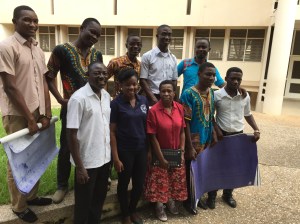
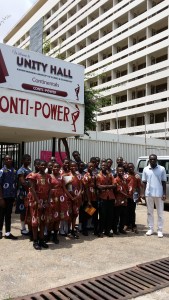
Second, the project sought to make an initial assessment of the modernist heritage site and buildings at KNUST with a view to using these as a basis for documentation, to support the application for Ghana to become a member of the international modernism conservation organisation Docomomo International. This also included a public outreach element in which the project engaged with local university school children in a campus buildings tour and questionnaire session to raise awareness and interest in the buildings on the KNUST campus.

Third, the project sought to explore the possibilities of having the SCCS at Edinburgh University support the development of an MSc. Course in conservation and also contributions to architectural history teaching, initially via online courses, using available media technology at both institutions. In connection with this, linkages to architectural history teaching at the Liverpool School of Architecture and its future research-links with Ghana were also examined.
PG_KNUST2

Also at public and international outreach level, work was undertaken with Junior high school students to raise awareness about the modernist architectural legacy on the Kumasi campus, via a series of tours, discussions and ‘snap-voting’ on buildings judged ‘best’ by the pupils. At the international level the project enlisted PG architecture students to work on listing key campus buildings, using the Docomomo, (the international organisation for conserving modernist buildings and landscapes), fiche listing template. This is with a view to working with KNUST staff and students towards compiling material required to apply for Ghana’s membership of Docomomo in the next biennial conference in 2016.
GROUP_UNITY

The project culminated with a well-attended two-day conference at KNUST, where keynote speeches were given by; KNUST Professor emeritus H. Wellington, and Professor Miles Glendinning, Director SCCS, University of Edinburgh. Teams of Junior High School and KNUST Architecture PG students also gave presentations, showing the work they had done during the preceding week’s ‘KNUST Modernism’ workshops.

miles_rex_me Prof_Wellington

Providently the conference also heard the views and reminiscences of Profs Wellington, Owuso Addo, and Arc. J Larbi, all eminent Ghanaian architects and educators, who had been historically involved with the development of the campus, since its inception in the mid 1950s to the 1990s, who attended the workshop. Representatives from the Ghana Institute of Architects, the Lands and Survey office at KNUST, associated faculty staff from the College of Architecture, Arts, and Planning, and from the ArchiAfrika organisation, were also in attendance.

The various workshops and final conference was made possible by funding and in–kind support received from a number of bodies including: The African Studies Association UK, ArchiAfrika, The University of Edinburgh, The University of Liverpool and KNUST.

The Communique below was issued at the conclusion of the conference:

Conserving West African Modernism and Urbanism Research Workshop and Conference Communiqué

 At the inaugural workshop / conference, ‘Conserving West African Modernism and Urbanism’, held at KNUST, Kumasi, Ghana on 13-14 July 2015 – an event which involved staff and student participants from the KNUST Junior High School, KNUST Architecture postgraduates, and which was attended by a range of national and international invitees including the Ghanaian architectural luminaries Prof. J. Owusu-Addo, Prof. H. N. A. Wellington, and Arc. S. O. Larbi, along with Prof. Miles Glendinning from the University of Edinburgh, Scotland – it was agreed to pursue the following specific objectives:

  • To continue with the primary objective of the project in supporting and developing an appreciation and culture of conservation in West Africa, in collaboration with DOCOMOMO International – commencing with the task of researching and conserving the heritage modernist movement campus layout and buildings at KNUST, Kumasi, and pursuing the establishment of a Ghanaian national chapter of DOCOMOMO;
  • To work to develop collaborative research links related to KNUST’s building history, with the Edinburgh School of Architecture and Landscape Architecture (University of Edinburgh) and the Liverpool School of Architecture (University of Liverpool), with expected joint academic research outputs.
  • To explore the possibilities of developing a Department of Architecture -KNUST Masters programme in history/ conservation studies with support and collaboration from the Scottish Centre for Conservation Studies (SCCS) at the University of Edinburgh, and the Liverpool School of Architecture (LSA);
  • To seek funding to develop a West African Modernism Archival Project, (WAMAP) which would have the Department of Architecture, KNUST as its centre. Its objective will be to create a digital archive of KNUST’s extant material records of its historical development, comprising plans, models, and oral histories contributed by surviving actors involved in the founding and development of the campus. This project would aim ultimately to evolve into an international centre and nexus for modernist building research in West Africa.

In this communiqué we also acknowledge the desirability of developing full links with cognate research and academic bodies within Ghana, including the Institute of African Studies and the Department of Archaeology and Heritage Studies, at the University of Ghana, Legon, together with other associated educational and professional institutions, including the Ghana Museums and Monuments Board, the Ghana National Archives, the Ghana Institute of Architects, and ArchiAfrika.

  15th July 2015
Dr Rexford Assasie Oppong Dr Ola Uduku
Department of Architecture,

Kwame Nkrumah University of Science and Technology, Kumasi, Ghana

Edinburgh School of Architecture and Landscape Architecture,

University of Edinburgh, Scotland

*** Further news, Iain Jackson, Rexford Assasie Oppong and Ola Uduku will be collaborating on a British Academy Funded International Partnership and Mobility Grant “Architecture and planning in the Tropics; from Imperial Gold Coast to Tropical Ghana“,  starting in November 2015. ***