Ewan Harrison, Rixt Woudstra and Iain Jackson, “Accelerating Development: Taylor Woodrow and Arcon’s Prefabricated Steel Structures in Decolonizing West Africa”, ABE Journal [Online], 23 | 2024, Online since 01 October 2024, connection on 01 October 2024. URL: http://journals.openedition.org/abe/16130
Construction of the Sapele Sawmill, Nigeria, 1946. UAC 2/13/b/7/1, reproduced with permission from an original in the Unilever Archives, UAC 2/13/B/7/1.
In 1943, in the middle of World War II, the British architects Edric Neel (1914-1952), Raglan Squire (1912-2004), and Rodney Thomas (1902-1996) created Arcon (short for Architectural Consultants). Focused on applying factory mass production systems to the building industry, Arcon engaged in an unusual, yet close, partnership with the civil engineering contracting company Taylor Woodrow. While their first project became one of Britain’s most popular post-war “prefabs,” it is little known that in the years thereafter a similar structural steel system was widely marketed in Britain’s West African colonies, where it became one of the most frequently used prefabricated building designs. Through the support of Taylor Woodrow, which acted as the agent for Arcon’s worldwide implementation, the prefabrication system was utilized in a range of contexts: to build houses for British companies, to build schools and market halls for colonial governments, and, of most interest here, to build factories and warehouses for the United Africa Company (UAC), as part of the industrialization drive that accompanied decolonization in the 1950s. The UAC was part of Unilever, and one of the largest conglomerates of trading and manufacturing interests active across “British” West Africa. It entered a partnership with Taylor Woodrow to jointly market the Arcon system, thereby profiting from the erection of its own buildings, and the sale of the Arcon system of construction to colonial and subsequently, post-colonial governments across the region. Today, Arcon structures, often sizeable sheds clad with imported metal sheets or locally available timber, can still be found across Ghana, Nigeria, and Sierra Leone.
The latest edition of e-flux contains an interview with Joe Osae-Addo by Kwabena Appeaning Addo where they discuss Joe’s passively cooled house in Accra, Ghana.
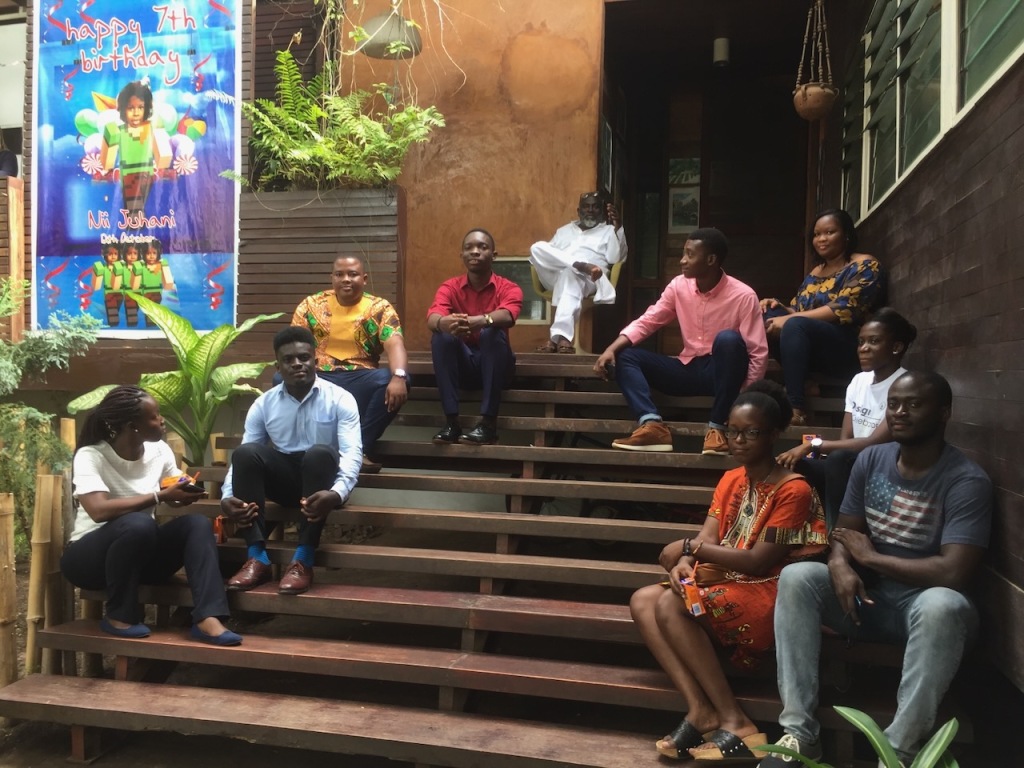
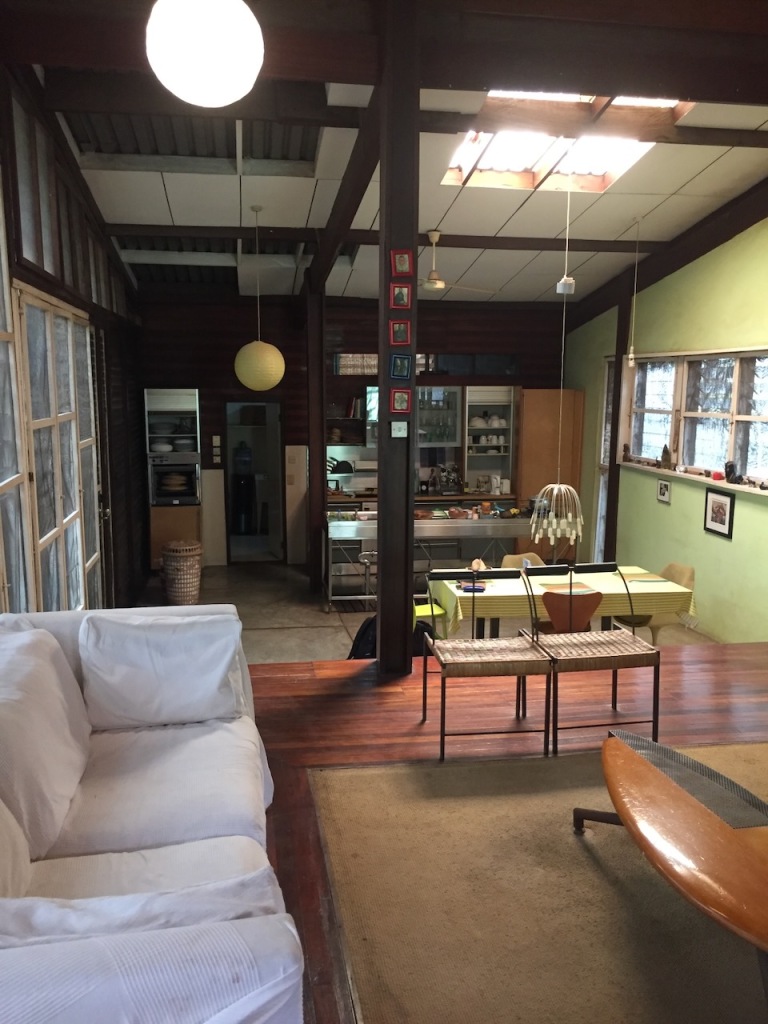
Joe Osae-Addo in 2018 with architecture studentsInterior of Joe Osae-Addo’s house, AccraVerandah Exterior of the house with tree canopy, 2020
Kwabena Appeaning Addo: What inspired your design for the Inno-native House in Accra, Ghana?
Joe Osae-Addo: My first thought was “How do I create a building that responds to the weather better than most,” so that I don’t have to use air conditioning? That was my primary focus. I then began thinking about the landscape, about how trees can be used as the first line of defense against heat, and also about how to position a building so that there is no direct solar gain. I was working in Los Angeles at the time, and I learned that the worst heat comes not from the sun, but through conduction from the earth, through the floor slab. So I thought to raise the building by about a meter, removing all direct contact between the floors and the earth, and insulating the building with a pocket of air. Those were my design parameters.
KAA: What happened when you took those principles onto the building site?
JOA: The site and the climate drove the initial layout of the building. After pouring the raised foundation, the first thing I did was to plant mature trees. I didn’t want to plant seedlings, because I wanted the trees to cover the roof by the time construction was done. So, I took a drive out of Accra to the area between Tema and Shai Hills, where there is a natural forest of trees. I went on a rainy day when the soil was wet, with a truck and laborers, and dug out mature—but not fully grown—trees, approximately three meters tall. We brought them back and planted them immediately. A year later, when the house was done, the trees had fully grown in. The ground also had a high water table, so I planted papyrus plants, knowing that they would suck up water. But even so, the site is very wet. On a rainy day, the concrete walkway in front of the house gets wet both from above and below. For the driveway, I used gravel, not concrete, to allow water to flow through and absorb into the ground when it rains. The landscape was integral to the design from the beginning. It is what allowed me to create a cool building.
KAA: What about in the design of the building itself?
JOA: Glass louvres are typically undervalued in contemporary Ghanaian architecture, but they are fantastic at creating cross-ventilation. Many of the exterior walls include glass louvers, at times from floor to ceiling. The rest are made either of laterite blocks or of timber frame walls joined with a tongue and groove system. The interiors of these wood walls are covered with stucco plaster, which makes it feels like a typical cement block wall, but on the outside it is clearly wood. This construction technique, known as Type V construction, is how most buildings in California are built: a 2×4 timber stud frame, 24 inches on center. In my case, however, since there is no air conditioning, there is no need for insulation. The third type of wall in the house, which I am very proud of, is made of wooden slats with a mosquito net attached. The wooden slats have a half-inch gap between them so that air can come through, but because of the net, insects can’t. The interiors are therefore always aerated.
KAA: So does it work?
JOA: Yes, it works! If we had air conditioning, the timber studs would let out so much cold. But because the diurnal temperature variation in Ghana is not significant, designing for cross ventilation works so much better.
KAA: Can you further explain how the walls were designed?
JOA: At the entrance, for example, there is a wall that looks like it is painted concrete block, but it’s actually just plastered. To do this, we placed half-inch plywood against the timber studs, and then placed chicken-wire mesh over the plywood as the support for the plaster.
KAA: So on the inside, it looks like a normal wall, but on the outside, it has a wooden finish. What is it like to maintain the house?
JOA: Well, I haven’t touched it in twenty years.
KAA: Really?
JOA: Well, there was some damage to the surface of the wood deck in the back, but that was because of poor detailing—I shouldn’t have used galvanized nails, which can rust and rot the wood. I haven’t had to repair any of the vertical surfaces.
KAA: That means that it must have been really well constructed.
JOA: Yes, it was. I built it myself, so I made sure everything was right.
KAA: It also means that the wood was treated very well.
JOA: At that time in Ghana, kiln-dried wood wasn’t available. All of the wood we used had to be air dried, so I picked the hardest wood available, which was called “Odanta,” or iron wood. It’s expensive, but I knew that maintenance would be a big issue if we did not use quality wood.
KAA: Does the fact that it doesn’t touch the ground also help?
JOA: Yes! Termites are often an issue if you use wood in Ghana, but this was solved by elevating the building off the ground.
KAA: At the Presbyterian Boys’ Secondary School I went to, some of the teachers’ bungalows were made of wood and they sat on the ground, so I can attest to this! Can you speak further about the laterite walls?
JOA: The laterite walls are composed of compressed earth blocks. I made the blocks myself with the standard cement block formwork. They are stacked and kept together using cement mortar joints, and then finished with stucco. To make the render, we filtered laterite through a sieve to get the finest particles, and added a bit of cement and water. After it dried, we applied clear masonry sealer to protect it from the rain. This generally works, but direct rain can still create damage. So I placed some vertical and horizontal wooden fins on the balcony, so that water does not hit the building directly.
KAA: Is there any benefit to using laterite blocks over sandcrete, which is more typical in Ghana?
JOA: I don’t know the physics of it, but sandcrete seems to conduct more heat than laterite.
KAA: In the middle of the living and dining space, the roof material changes to a translucent acrylic panel. Why is that?
JOA: I wanted to bring in some light. Most of the roof is made of long span corrugated metal, so it serves as a kind of skylight. I didn’t use Perspex because over time it would melt. This is about twenty-years old, and it’s still in perfect shape. Though it occasionally needs cleaning from above to make sure the light doesn’t get too blocked.
KAA: What about the floors?
JOA: The house has polished concrete floors. But the flooring is actually timber, because the house is raised. At the bottom is the timber frame, then, on top of that, plywood, then roofing felt, then chicken wire, and finally concrete, which is primarily made of quarry dust to get as smooth of a finish as possible.
KAA: I also noticed that the kitchen and dining room are lower than the rest of the spaces.
JOA: Yes, they are lower because I was following the topography of the site, which slopes downward. If they were kept at the same level, it would have been very inefficient. Besides, it makes for a nice transition from living room to dining area.
KAA: What about the spatial organization of the rooms?
JOA: Well, the house has no corridors. So you either move from room to room, or use the wraparound deck to avoid disturbing people in adjacent rooms. The reason for this is that when you have an interior corridor, it is difficult to maximize cross ventilation.
KAA: What were some of the challenges with the project?
JOA: Well, one challenge was finding the right carpenters. In Ghana, we don’t often use wood to construct buildings, so getting workers to understand the details and the drawings was difficult.
KAA: How did you address this?
JOA: I wanted to complete everything in twelve months. Since the laborers and artisans were getting paid a daily rate, the longer the process lasted, the more I would have to pay. But since I was the contractor, I could set up systems to speed construction. After we built two bays of columns, for instance, the carpenters I hired to build the timber frames started prefabricating columns, so that we could erect them whenever we needed them. After a certain point, the process of construction became one of assembly.
KAA: Based on your experience, what advice would you give someone who wanted to create a similar design?
JOA: Designers need to make sure that they’re not putting materials in places where they’re going to be compromised very quickly. And, in general, the use of metal should be avoided. Rust is a big issue, particularly in coastal zones. The marine air is corrosive. I used louvres with plastic frames because the metal would have rusted by now. And if you use wood, after it rains, it should be cleaned. No matter how high quality the wood you use is, keeping it dry is best.
An exhibition that we’ve been very much looking forward to opens this week at the V&A Museum in London. We’ve got a few of our models on display at the exhibition, and have been involved behind the scenes. There’s a large contingent from the Transnational Architecture Group making their way to various opening events this week and you can expect a series of reviews and critiques here shortly.
There’s also an article out today by Oliver Wainwright in The Guardian that discusses the exhibition concept – and some of our favourite buildings.
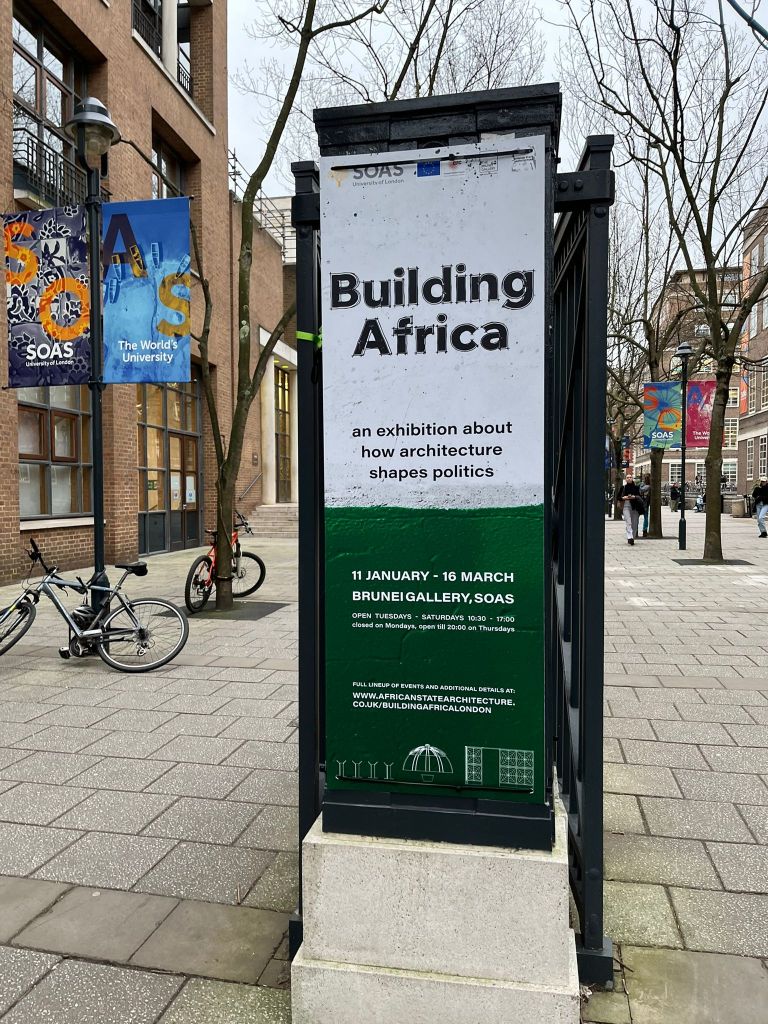
The Building Africa Exhibition curated by Julia Gallagher and Kuukuwa Manful is currently showing at the Brunei Gallery SOAS until 16 March 2024. This is a smaller version of the exhibition which was first shown in Ethiopia as part of the State Architecture Research project at SOAS with Prof Gallagher as its director.
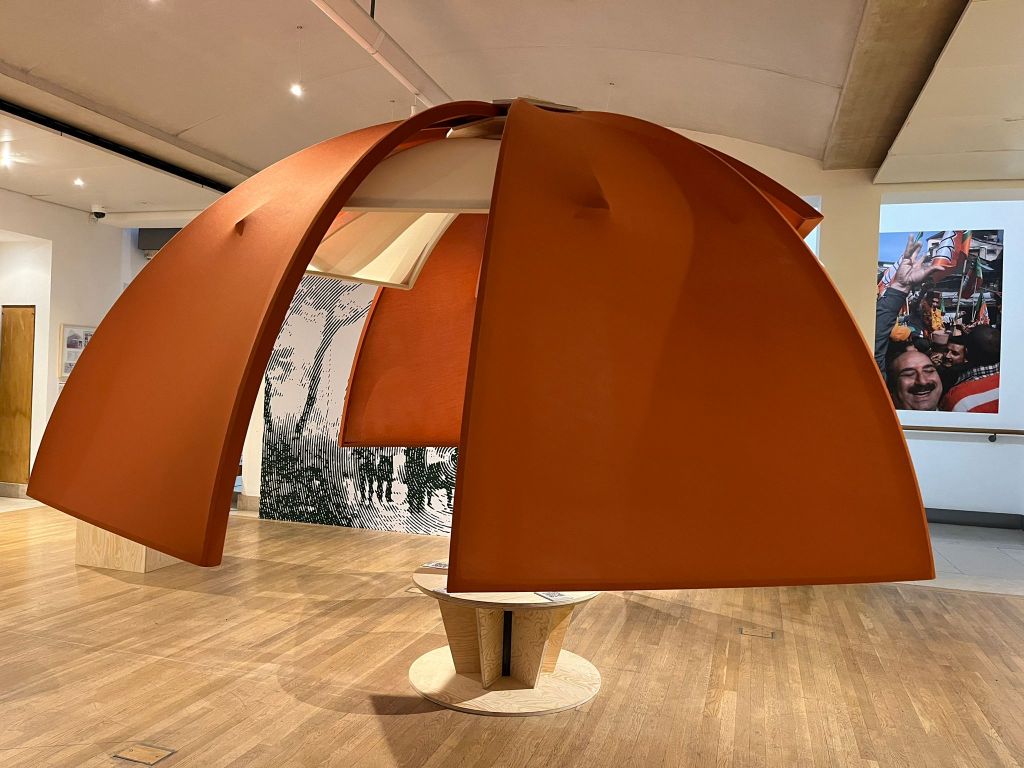
The SOAS exhibition is full of colour featuring, film, photography, a large-scale physical model-installation, publications and school uniforms and memorabilia. Located in the main gallery space, sections deal with the school history of Ghana, ‘state-built architecture in several African countries, highlighted in the exhibition by images of Ghana’s alternating seats of power, (Osu Castle and State House), and the African Unity building constructed in Addis Ababa. A conceptual installation structure evoking African unity has also been produced by the work of a young Ethiopian architect , Nahom Teklu whose umbrella structure enables exhibition visitors view in VR the ‘state’ architecture of different parts of Africa, it also harks back to the idea of pan-African unity where the umbrella unites all states on the continent.
The exhibition’s thesis that buildings shape us, is made clear to viewer and particularly how the state’s involvement is central to this process of power, positioning, and identity, particularly in Africa, from its colonial past to the now post-colonial contemporary situated-ness in Africa’s modern cities to secondary schools in Ghana in which the schools shaped would be future leaders. This was both by the design of the schools within a colonial frame but also school uniforms, motos and other paraphernalia of educational engagement.
State built institutions such as seats of government (state house in the case of Ghana) or stadia (exemplified in the exhibition by the main stadium in Kinshasa) have a more mixed relationship where they both are sites of power, and international events (the Muhammed Ali – Frazier rumble in the jungle, Kinshasa stadium film footage is on show) or symbols of African Unity (shown through AU building in Addis Abeba, which often results in tensions of perceptions and strategic plans for future use as regimes and state actors change.
The exhibition also connects the viewer to the research which has underpinned it. This includes the 2023 book Building African Futures edited by Gallagher and Emmanuel Ofori-Sarpong, and Manful; and Manful’s thesis – and a number of papers members of the State Architecture project have published as reports and in peer reviewed journals.
Building Africa packs a dense amount of African state-built architectural history into a a viewable gallery which audiences are invited to view, engage with and critique, helpful post-it notes are provided for this process. The curators explain that this is an adjusted version of the larger 7 panel exhibition and of the conceptual architectural installation has had to be cut short to fit the gallery space. This does not detract from this well-planned and already publicly pleasing and well- received exhibition.
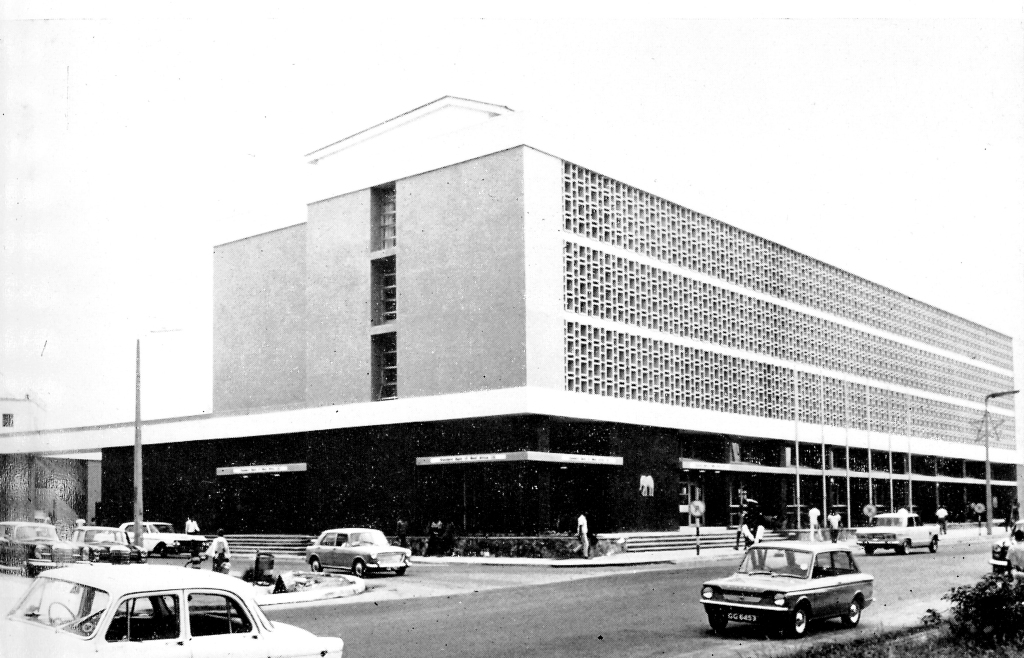
A few years ago we reported on our Keeping Cool project and included a photograph of the Standard Chartered Bank on Accra’s High Street. The bank had been refurbished, radically changing its passively cooled perforated facade to a sealed glass envelope relying on air-conditioning.
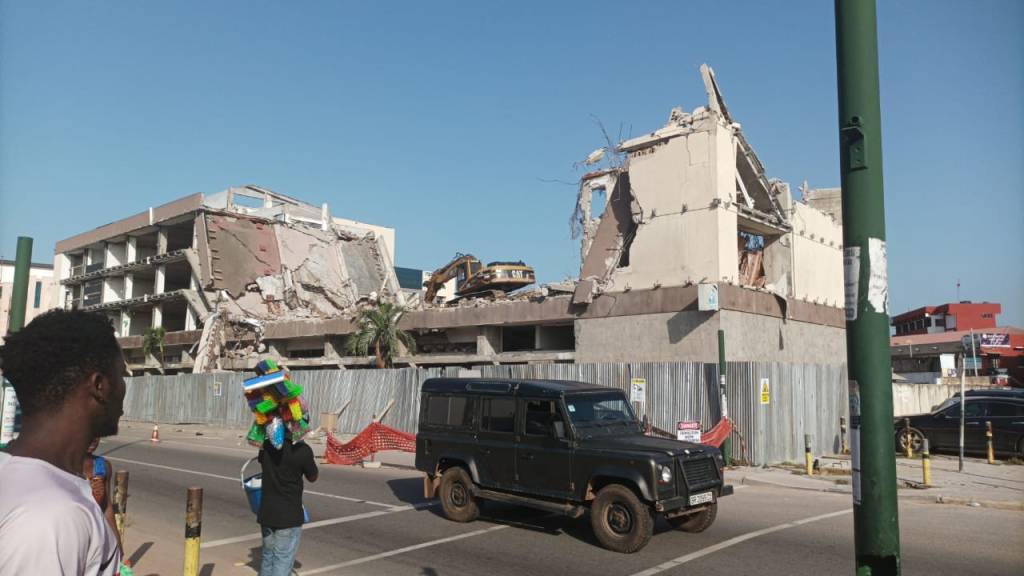
We’ve just received updates from Accra that the bank has now been demolished. No details have been released on what is to replace the bank.
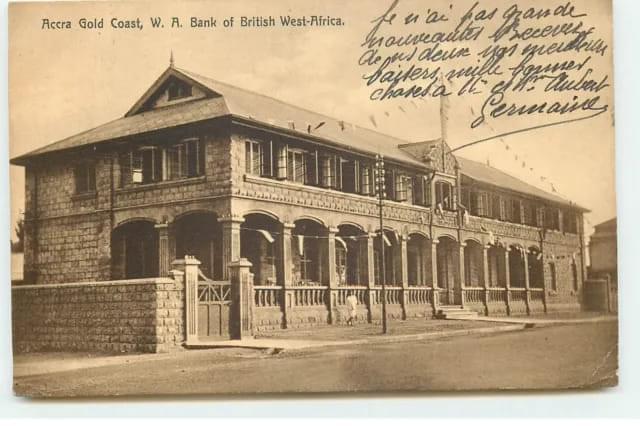
The same site has been used as a banking hall since the late 19th Century. Below are some of the photographs of the site revealing the continuity and change over the last century and the variety of architectural solutions deployed. Joe Addo kindly sent over some photographs of the shock demolition taking place earlier this month.
Accra High Street: Bank of British West Africa shown on the right hand side with the arched loggiaPostcard showing the Bank of British West Africa on the same site of Accra’s High Street, c1900Standard Chartered Bank with passively cooled facade. Architect? unknown, c.late 1950sStandard Chartered with new blue glass facade. Glimpse of Barclays bank on far left.July 2023: Standard Chartered bank being demolished [Courtesy of Joe Addo]
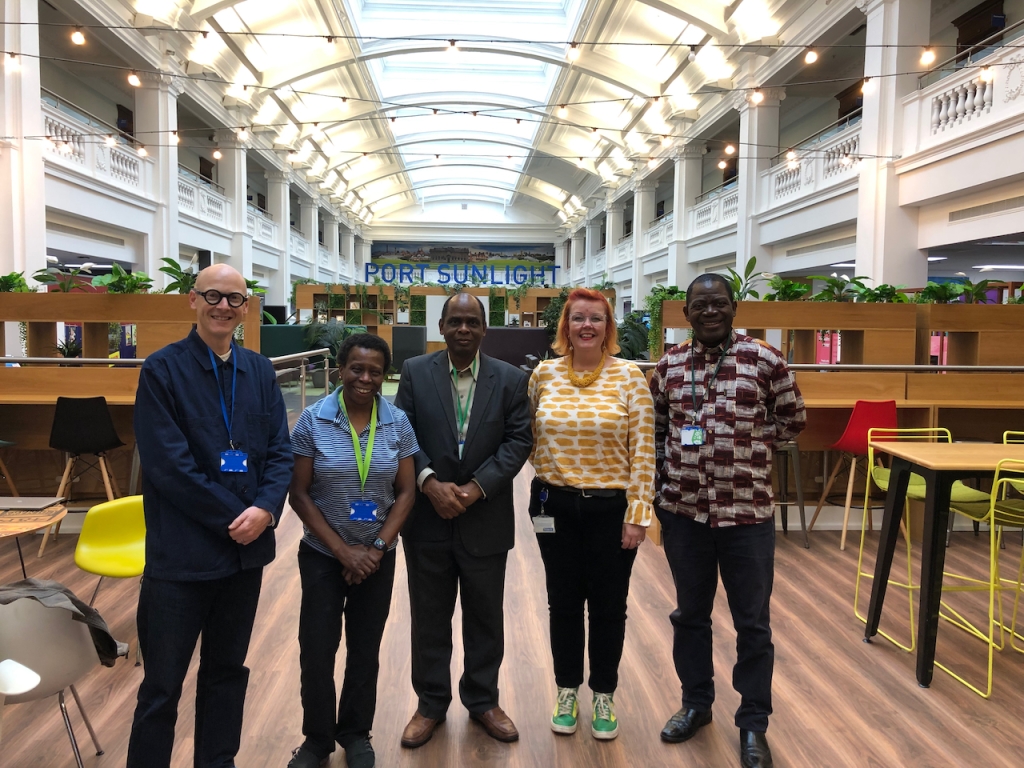
Iain Jackson, Ola Uduku, Ayo Olukoju, Claire Tunstall, Sam Ntewusu at Unilever, Port Sunlight
The objective of the visit was to visit and introduce Profs Olukoju and Ntewusu to the Unilever archive collection at Port Sunlight, particularly its subsidiary the United Africa Company’ (UAC)’s extensive holdings on Western Africa covering its various business interests in the region. The symposium which took place the next day involved presentations by Profs Olukoju and Ntewusu on the state of archives and archival research in West Africa, which was attended by Merseyside researchers and PhD students.
Professors Olukoju and Ntewusu at Unilever, Port Sunlight with bust of William Lever
The two-day visit also enabled discussions to be had about future collaborations at various levels, research, knowledge exchange capacity building at Masters degree level, and forms of impact for institutions in Western Africa and also the the UK and NW England in particular. Our thanks to all who contributed to the symposium. Particularly Claire Tunstall, and her team at the Unilever Archives, Dr Abraham Ng’an’ga of the Andrew Walls Centre, Liverpool Hope University, Alex Buchanan, Archival Studies, University of Liverpool History Department, Suzie Goligher, Afrograph Ltd, and all other individual and institutional contributors to the symposium.
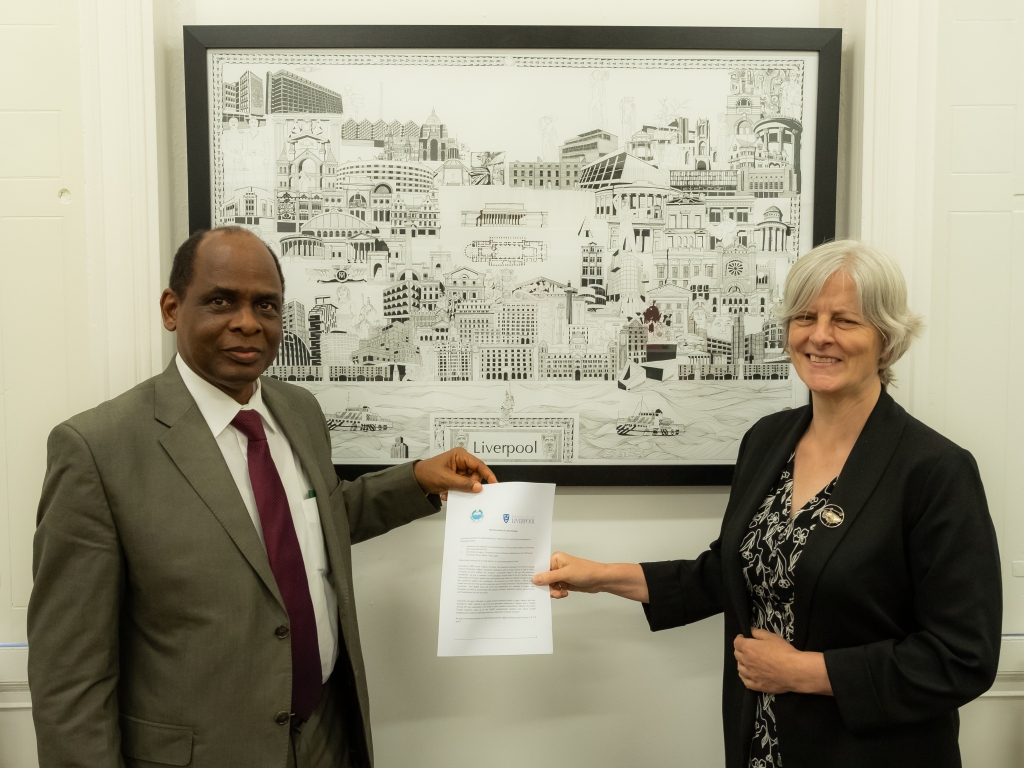
MoU signed by the University of Liverpool’s APVC for the Faculty of Humanities Professor Fiona Beveridge, and received by Professor Olukoju, on behalf of the University of Lagos
The visit also coincided with the finalised signing off of the Memorandum of Understanding which has now been established between the University of Liverpool and the University of Lagos. The formal MoU, was signed by the University of Liverpool’s APVC for the Faculty of Humanities Professor Fiona Beveridge, and received by Professor Olukoju, on behalf of the University of Lagos
We are delighted to be able to host Professor Ayo Olukoju (Institute of African and Diaspora studies, University of Lagos) and Professor Sam Ntewusu (Institute of African Studies University of Ghana) who are visiting the University of Liverpool and also the Unilever Archives to explore the possibilities of future collaborative research and teaching activities across our institutions and others in NW England.
Both Professors are historians who have worked with archival sources in their research in West Africa. They have generously agreed to share, through this seminar, the challenges and issues with working with archival material and sources from a West African perspective and also some of the hopes they have for future collaborations.
Do join us to hear their views and also join the conversation – how do we make the most of archives in the 21st century in different locations and places? Importantly do we need to decolonise the archive, and if so how?
Hosted by the AHUWA Research centre in association with Unilever Archives, School of History and Institutes of African Studies and African Diaspora Studies at the University of Ghana, and the University of Lagos
Dr Christopher Turner co-curator of the exhibition watching film featuring Ola Uduku
Press Cuttings:
“La Biennale di Venezia and the V&A present Tropical Modernism: Architecture and Power in West Africa. Organised in collaboration with the Architectural Association (AA), London, and Kwame Nkrumah University of Science and Technology (KNUST), Kumasi, this presentation at the Biennale Architettura 2023 critically reflects on the imperial history of Tropical Modernism through an analysis of the work of the Department of Tropical Architecture and a dozen key projects. It explores the ways in which this distinctive architectural style was initially developed and employed as a tool to support colonial rule before being adapted by West African architects to promote the excitement and possibilities of the period that followed Ghana becoming the first sub-Saharan African country to gain independence in 1957.
Curated by Dr Christopher Turner (V&A) with Nana Biamah-Ofosu and Bushra Mohamed (AA), the Venice presentation in the Applied Arts Pavilion is centred around a multi-channel film installation featuring interviews with surviving protagonists and footage of remaining buildings. Responding to the theme of the 18th International Architecture Exhibition conceived by Director Lesley Lokko, who writes ‘Africa is the laboratory of the future’ in her curatorial statement for the Biennale Architettura 2023, the presentation also lays the groundwork for a larger exhibition scheduled to take place at the V&A in London in 2024.”
Venice architecture biennale: how pioneering Ghanaian architects reckoned with tropical modernism by Kuukuwa Manful
Owusu Addo Residence by John Owusu Addo.
Kuukuwa Manful, CC BY-NC-NDKuukuwa Manful, SOAS, University of London
But as well as looking at the future of architecture on the continent, visitors will also be able to explore its history, through an exhibition at the Arsenale, entitled Tropical Modernism: Architecture and Power in West Africa.
Early 20th-century modernism in Europe saw architects using large expanses of unshaded glass and flat roofs. Practitioners in warmer, humid climates, such as in Africa and Asia, meanwhile, had to adapt their designs to withstand heavier rainfall and warmer temperatures. In late colonial Africa and during the independence era, this style became known as “tropical modernism” or “tropical architecture”.
In the African context, this is possibly the best researched and well-documented architectural movement. When people discuss it further afield, however, it is mostly through a white lens. The focus is on what European architects practising in these regions were doing – African architects of the same era are largely overlooked.
Putting Europe at the centre of African stories is a choice that echoes the very colonial histories it seeks to elucidate, where European architects operated as though the continent were a blank slate, devoid of pre-existing architecture worthy of note.
My research shows how architects in Ghana in particular aligned with, adapted, or rejected Western colonial ideas. They created modernist buildings that reflected their visions for their nation, their experiences and their global outlook.
Ghanaian expertise
John Owusu Addo, the first black head of department of Ghana’s first architecture school, and Samuel Opare Larbi, another prominent educator and architect, embodied what I term the dominant Ghanaian tropical modernism. Their practice was most similar to, and aligned with, the practice of the white British tropical modernists.
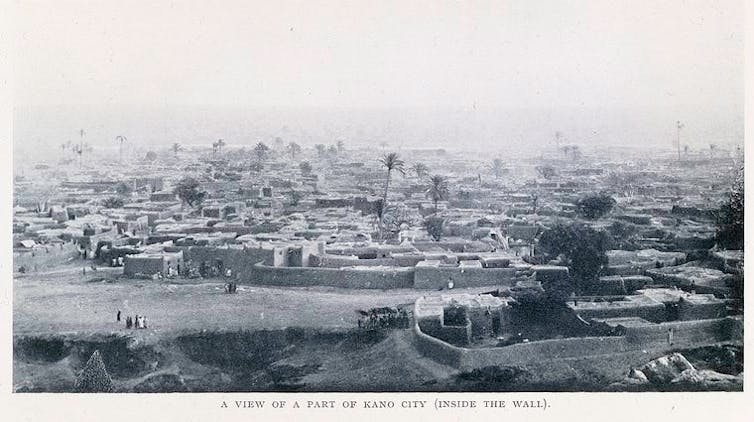
The former Department of Tropical Architecture was established at the Architectural Association (AA) in London in 1954 by the British wife and husband duo Jane Drew and Maxwell Fry, and James Cubbitt. Although Fry described the city of Kano, in present day Nigeria, as a “complete realisation of urban harmony”, he and Drew nonetheless declared having “invented” architecture in West Africa. Their work was coloured by the imperial, racist and sexist notions of the time.
Owusu Addo and Larbi both trained at the AA. They counted among their contemporaries the German architect Otto Koenisberger and the Australian-born British architect Kenneth Mackensie Scott. Although they faced racial discrimination in Europe and back home, their UK education put them in a position of relative privilege in Ghana.
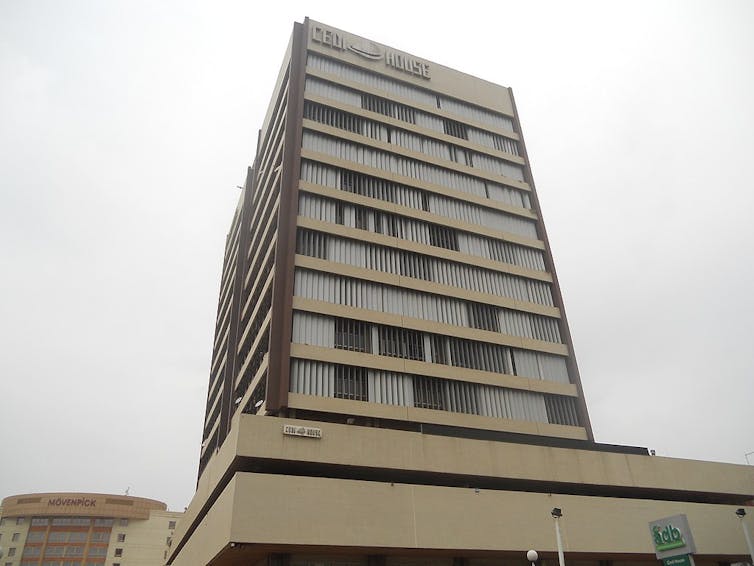
From the outside, many of the institutional and corporate buildings they designed, including Cedi House in Accra (a high-rise tower that now houses the Ghana Stock Exchange) featured elements of tropical modernism: solar shading devices, rhythmic facades, breeze blocks, cross ventilation and east-west orientation.
But it is in the interiors of their domestic architecture that their keen understanding of the people for whom they were designing becomes most apparent. When I interviewed Owusu Addo and Larbi in 2015, they recounted how they took Ghanaian societies into account. And they spoke of the pride they felt at being African architects.
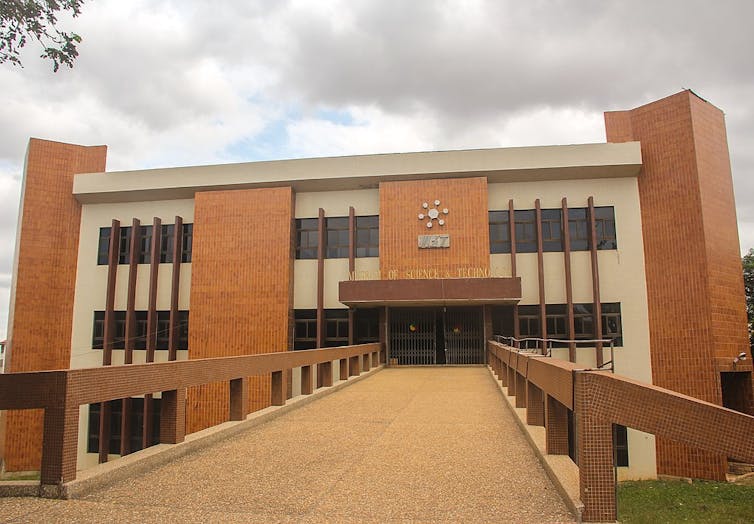
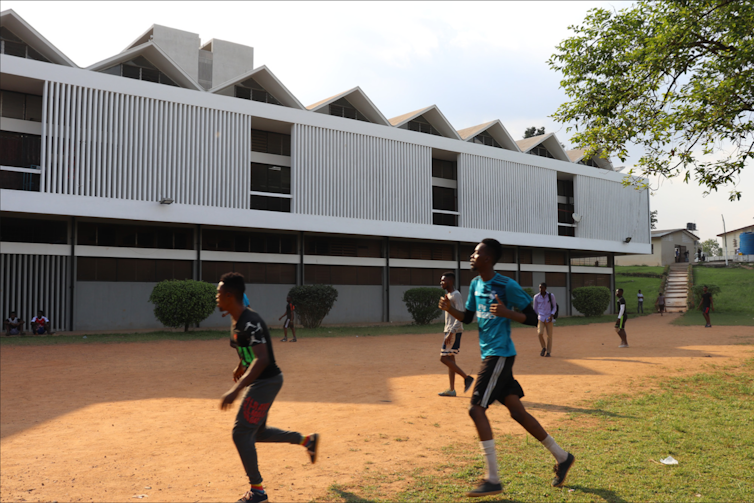
For the Unity Hall student accommodation at the Kwame Nkrumah University of Science and Technology, Owusu Addo created shaded outdoor space, with courtyards and verandas. As he put it: “Rarely do we stay in our rooms in the daytime. If in the daytime anyone was in the room, then he was sick.”
Unity Hall, Kwame Nkrumah University of Science and Technology, Kumasi.Łukasz Stanek, CC BY-NC-ND
Creative dissent
Other architects sought to establish an aesthetic that was visually distinct from European-driven tropical modernism. They accepted the climatic control and other technological and material aspects of the style. However, in the aesthetics they pursued, they were decidedly expressive.
Anyako-born architect Daniel Sydney Kpodo-Tay’s confidence was grounded in his centuries-long family history of building design and construction. Together with his anti-colonial politics and a desire for recognition, this informed an approach that the Ghana Institute of Architects termed “revolutionary”, upon his death in 2018.
Kpodo-Tay was fascinated by symbolism. His designs rejected ornamentation. Instead, he sought to make the buildings themselves sculptural. His projects that were built were often not as bold as his proposals – a compromise he put down to the limited finances and conservatism of clients in Ghana.
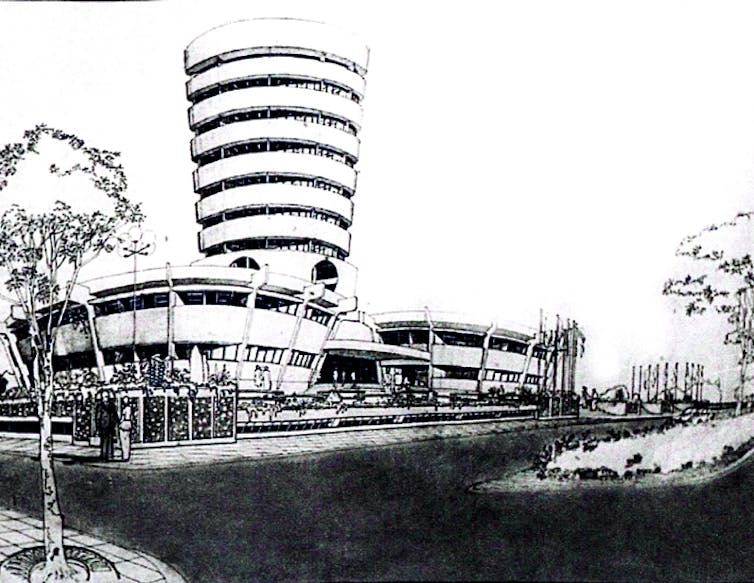
When a competition was held, in the late 1980s and early 1990s, to design the headquarters for the Economic Community of West African States organisation, Kpodo-Tay’s proposal drew on the form of a bowl as symbolic of communality and unity. His design for the complex, which was to house offices, a bank and a conference venue, featured bold inverted conical forms with internal spaces arrayed radially.
Daniel Sydney Kpodo-Tay’s proposal for the ECOWAS headquarters.Kuukuwa Manful, Author provided
Owusu Addo, Kpodo-Tay, and Larbi are not the only Ghanaian architects of their generations whose practice was informed by tropical modernism. Many stories are yet to be brought to light, especially those of the women.
Only a few women were trained at the Kwame Nkrumah University of Science’s architecture school. Sexism in the industry saw some leave. But others, including the late Alero Olympio who designed Accra’s Kokrobitey Institute, struck out in bold new ways. These visionaries challenged the Euro-centric assumptions of what tropical modernism was, in particular through their use of materials.
As scholars, practitioners and visitors from around the world turn to architecture on the African continent, they must be careful not to treat it as a blank slate in the way previous generations did. Africans have been creating, studying, teaching, and documenting architecture in Africa since time immemorial. Their work matters.
The Transnational Architecture Group is 10 year’s old this year. Thank you for supporting the blog and to all of our excellent contributors over the years for enriching the content and generously sharing their work. We’d also like to thank the communities in the places in which we work, the archivists and librarians for making material available to us and sharing their expertise, our respective institutions for supporting our research, and to the research funders who make travel, time, and resources available to us.
The blog started as a means to share our work-in-progress ideas and to promote events – and that is still at the core of what we do. We continue to add updates from our ventures into the archives, travel reports, and to share interesting events and innovative papers. These small reports and updates have compounded into something of a large resource and repository, and we’re delighted so many people have been able to make good use of (and to correct and expand upon) our work and attempts at writing these histories.
To celebrate the 10 year anniversary we held a small gathering at the Liverpool School of Architecture on Wednesday 8th March, curated and organised by Dr Alistair Cartwright. Our speakers were all PhD students, post-doctoral researchers, and research associates at the school. You may watch the proceedings here:
The speakers and titles of the presentations are below, with timings if you’d like to skip to a particular talk:
Rixt Woudstra, “Sapele and Samreboi: Building Company Towns in British West Africa” 5:25
Excy Hansda, “Indigenous Modernities in the Twentieth Century Architecture of Bombay” 20:00
Adefola Toye, “Tropical Modernism in Nigeria’s First Universities: Accessing Sources Beyond the Archives.” 37:00
Ewan Harrison, “Planning for Post/Neo Coloniality: the Paramount Hotel in Freetown” 1:11
Iain Jackson, “Erhabor Emokae and the curious case of the UAC Mural: tropical modernism and decorative arts” 1:31
Daneel Starr, “How and why has the vernacular architecture and intangible cultural heritage of the Akha people changed in the face of globalization: Using the village of A Lu Lao Zhai, Xishuangbanna (sipsongpanna) China, as a case study.” 1:50
Paul Robinson, “Freetown, the UAC and urban design” 2:20
Alistair Cartwright, “Ecologies of Vulnerability: Post-Cyclone Reconstruction in Mauritius, c. 1945” 2:35
We also heard an excellent paper from Razan Simbawa, “The Effects of Demolish-based Urban Regeneration on Displaced Residents in Jeddah, Saudi Arabia” – which cannot be shared on the video recording at the moment.
Thank you again to all of the speakers for their wonderful talks, presentations, and work-in-progress. There was such variety and richness in the topics and methods, and at the same time numerous connections and cross-overs between the work.
Please do get in touch if you’d like to know more, or to share your work on the blog.













 Transnational Architecture Group

