Archive

Tag Archives: Ghana

Building on our Ghana theme I’d like to share an excellent paper recently published by a good friend of the TAG blog, Dr. Lukasz Stanek from Manchester University.

 “When seen from Labadi Road, the buildings of  Accra’s International Trade Fair (ITF) appear among abandoned billboards, scarce trees that offer shade to resting taxi drivers, and tables where coconuts, bottled water, sweets, and telephone cards are sold next to the road.

 The buildings neighbor the La settlement, where streets meander between houses, shops, bars, schools, and shrines,  while on the other sidof Labadi Road, at the seashore, luxurious housing estate is under construction next to upscale hotels that overlook Labadi Beach. Kwame Nkrumah, Ghana’s leader after the country achieved independence (1957), initiated the fair as a prestige project, but it was opened on 1 February 1967 by Joseph Arthur Ankrah the chairman of the National Liberation Council, who led the putsch that toppled Nkrumah in 1966. Once conveying a sense of radical moder-nity, the buildings have suffered from underinvestment and insufficient maintenance, but most of them are still in use, rented for exhibitions that take place every few months, for political rallies, and for religious services.
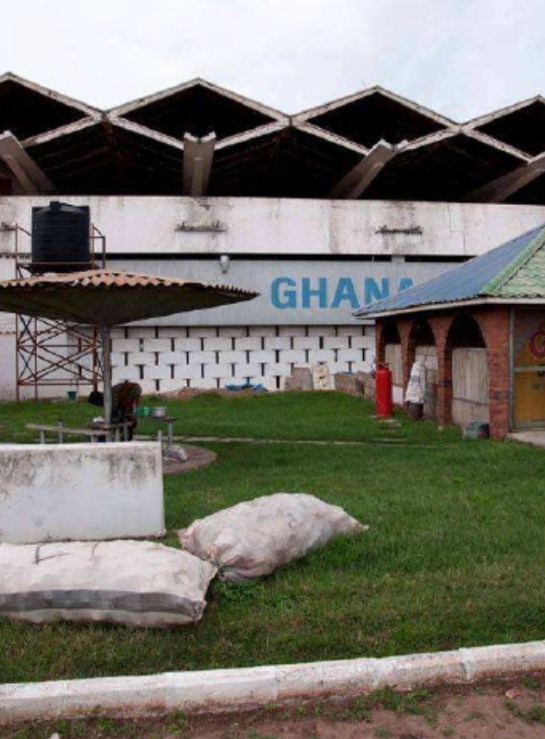
From 1962 to 1967, the Ghana National Construction Corporation (GNCC), the state office charged with design, construction, and maintenance of governmental buildings and infrastructure in Nkrumah’s Ghana, designed and con-structed the ITF. The designers of the fair were two young architects from socialist Poland, Jacek Chyrosz and Stanisław Rymaszewski, who worked with the Ghanaian Victor (Vic)  Adegbite, the chief architect. Chyrosz and Rymaszewski  were employed by the GNCC on a contract with Polservice, the so-called central agency of foreign trade, which mediated the export of labor from socialist Poland.
Ghana copy

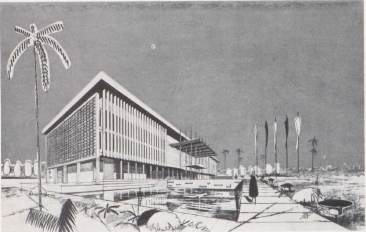
“Made in Ghana Pavilion” 1967, International Trade Fair, designed by Jacek Chyrosz, Stanislaw Rymaszewski and Vic Adegbite


 At the GNCC, they worked together with Ghanaian architects and foreign professionals, many from socialist countries. This collaboration reflected the alliance of Nkrumah’s government with socialist countries, which was demonstrated at the fair by the exhibitions of Czechoslovakia, the German Democratic Republic (GDR), Hungary, and Poland (Figure 3). At the same time, the Ankrah administration used the fair to facilitate Ghana’s reopening toward the West. Hence, the Soviet Union and the People’s Republic of China (PRC), two major allies of Nkrumah, were absent.

 By contrast, the two pavilions not to be overlooked were those of Great Britain, Ghana’s former colonial ruler and its main trade partner, and the United States, which granted Ghana loans for its many infrastructural projects in the 1960s, in particular the Akosombo Dam, financed jointly with the United Kingdom and the World Bank. India was represented as a member of the Commonwealth rather than as a member of the Non-Aligned Movement, since Nkrumah’s attempt to position Ghana among Egypt, India, and Yugoslavia as one of the leading nations of the movement was abandoned after the change of the regime. Collaboration among African countries was particularly favored, not as a way of carrying on Nkrumah’s vision of pan-African union but with a more modest aim, that of the stimulation of trade among African countries. Displays representing African countries were gathered in the round Africa Pavilion at the end of the ramp through which visitors entered the fair, before they moved on to Pavilion A (the “Made in Ghana” pavilion) and the pavilions rented to other countries and Ghanaian state firms.”

Notes from Accra

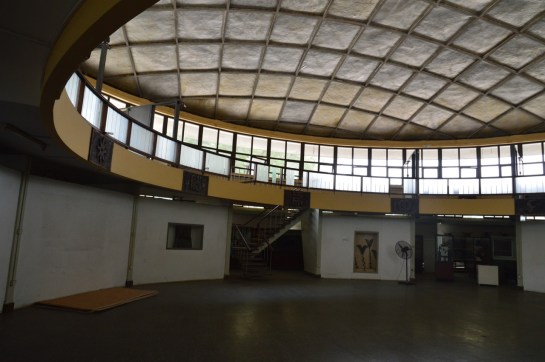
Iain Jackson and Ola Uduku have spent the last two days in Accra catching up with 20th century architecture, and meeting with contacts as part of the British Academy funded ‘From Colonial Gold Coast to Tropical Ghana’ architecture project. Tuesday 23rd February was spent visiting the Ghana National Museum complex, the gem in the crown being Denys Lasdun’s prefabricated dome shaped museum, currently closed for refurbishment. The imagination and vision of the building were still clearly there in our viewing of the stripped down structure ready for conservation.

DSC_0820.jpg

Our next stop took us to Nickson and Borys’ Children’s library building nearer to Central Accra. This had been sympathetically restored, and again was a great demonstration exemplar of ‘West African Modern’ and the developmental vision of the departing colonial government to establish libraries that were open to all citizens. The upper area remained devoid of activity but had potential to be a great multipurpose programme space.

DSC_0801.jpg

Children’s Library

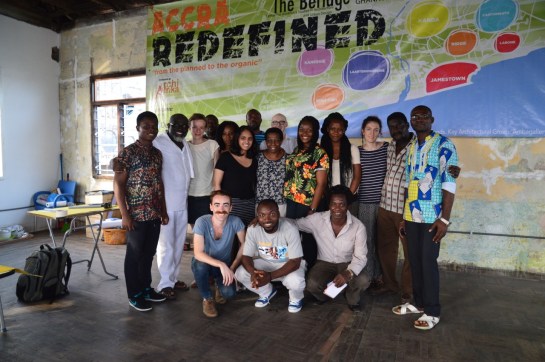
The final visit of the day was to Joe Osae-Addo’s Archi-Africa – TuDelft Berlage Architecture school studio, in Accra’s Jamestown neighbourhood, on the urban fabric of everyday life in Accra. The impromptu crit we were invited to take part in was an enjoyable experience and the schemes were full of promise.

DSC_0832.jpg

TU Delft and Archi-Africa in the newly converted Jamestown Studio

Day two involved visits to Jamestown – as a walking visit this time to take in early 20th century colonial PWD, and also warehouse architecture in the neighbourhood. A visit to Adabraka also yielded a few examples of early PWD worker housing, which was followed by an afternoon visit to Achimota School, which conveyed the height of the colonial education project with architectural symbolism and style. A few later additions to the campus by Nickson and Borys and other’s also fitted well into the College’s narrative of colonial imperialism and privilege. The final visit for the day was to Scott House, which lived up to its deified tropical modernism status, whilst the Western Tessano neighbourhood had transformed into an upper class gated area, that unexpectedly gave us a glimpse of an earlier [likely Cubitt?] designed semi detached housing unit, currently undergoing a further 21st century upgrade..

DSC_0863.jpg

One of the few surviving examples of its type in Adabraka

We will be moving onto Kumasi on Friday and will update from there early next week.

Conserving West African Modernism Workshop and Conference Report

KNUST Kumasi, 2 – 18th July 2015

From the 2nd to 18th July 2015 Ola Uduku spent time at the Kwame Nkrumah University of Science and Technology (KNUST), Kumasi Ghana, working with Dr Rexford Assasie Oppong, to set up and run the inaugural “Conserving West African Modernism” workshop culminating in an international conference held from the 13th – 14th July at KNUST.

There were a number of objectives for the project; firstly the visit provided an initial attempt to explore the possibilities of Edinburgh University’s Scottish Centre for Conservation Studies, (SCCS) and Architecture School becoming involved in research collaboration activities centred on the Modernist heritage of the KNUST campus both in terms of architectural history and also international- tropical conservation practice. Also included in this collaboration was the Liverpool University School of Architecture, (LSA) which has research expertise and archival material on the work of Maxwell Fry and Jane Drew who were involved in the development of Kumasi and Ghana’s post-WW2 architectural heritage.

DSC_0463

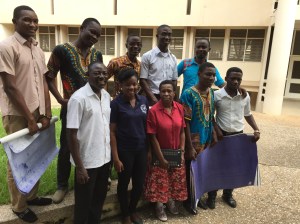
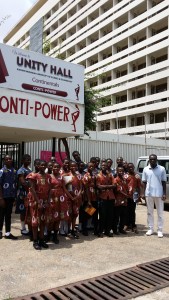
Second, the project sought to make an initial assessment of the modernist heritage site and buildings at KNUST with a view to using these as a basis for documentation, to support the application for Ghana to become a member of the international modernism conservation organisation Docomomo International. This also included a public outreach element in which the project engaged with local university school children in a campus buildings tour and questionnaire session to raise awareness and interest in the buildings on the KNUST campus.

Third, the project sought to explore the possibilities of having the SCCS at Edinburgh University support the development of an MSc. Course in conservation and also contributions to architectural history teaching, initially via online courses, using available media technology at both institutions. In connection with this, linkages to architectural history teaching at the Liverpool School of Architecture and its future research-links with Ghana were also examined.
PG_KNUST2

Also at public and international outreach level, work was undertaken with Junior high school students to raise awareness about the modernist architectural legacy on the Kumasi campus, via a series of tours, discussions and ‘snap-voting’ on buildings judged ‘best’ by the pupils. At the international level the project enlisted PG architecture students to work on listing key campus buildings, using the Docomomo, (the international organisation for conserving modernist buildings and landscapes), fiche listing template. This is with a view to working with KNUST staff and students towards compiling material required to apply for Ghana’s membership of Docomomo in the next biennial conference in 2016.
GROUP_UNITY

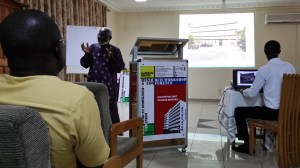
The project culminated with a well-attended two-day conference at KNUST, where keynote speeches were given by; KNUST Professor emeritus H. Wellington, and Professor Miles Glendinning, Director SCCS, University of Edinburgh. Teams of Junior High School and KNUST Architecture PG students also gave presentations, showing the work they had done during the preceding week’s ‘KNUST Modernism’ workshops.

miles_rex_me Prof_Wellington

Providently the conference also heard the views and reminiscences of Profs Wellington, Owuso Addo, and Arc. J Larbi, all eminent Ghanaian architects and educators, who had been historically involved with the development of the campus, since its inception in the mid 1950s to the 1990s, who attended the workshop. Representatives from the Ghana Institute of Architects, the Lands and Survey office at KNUST, associated faculty staff from the College of Architecture, Arts, and Planning, and from the ArchiAfrika organisation, were also in attendance.

The various workshops and final conference was made possible by funding and in–kind support received from a number of bodies including: The African Studies Association UK, ArchiAfrika, The University of Edinburgh, The University of Liverpool and KNUST.

The Communique below was issued at the conclusion of the conference:

Conserving West African Modernism and Urbanism Research Workshop and Conference Communiqué

 At the inaugural workshop / conference, ‘Conserving West African Modernism and Urbanism’, held at KNUST, Kumasi, Ghana on 13-14 July 2015 – an event which involved staff and student participants from the KNUST Junior High School, KNUST Architecture postgraduates, and which was attended by a range of national and international invitees including the Ghanaian architectural luminaries Prof. J. Owusu-Addo, Prof. H. N. A. Wellington, and Arc. S. O. Larbi, along with Prof. Miles Glendinning from the University of Edinburgh, Scotland – it was agreed to pursue the following specific objectives:

  • To continue with the primary objective of the project in supporting and developing an appreciation and culture of conservation in West Africa, in collaboration with DOCOMOMO International – commencing with the task of researching and conserving the heritage modernist movement campus layout and buildings at KNUST, Kumasi, and pursuing the establishment of a Ghanaian national chapter of DOCOMOMO;
  • To work to develop collaborative research links related to KNUST’s building history, with the Edinburgh School of Architecture and Landscape Architecture (University of Edinburgh) and the Liverpool School of Architecture (University of Liverpool), with expected joint academic research outputs.
  • To explore the possibilities of developing a Department of Architecture -KNUST Masters programme in history/ conservation studies with support and collaboration from the Scottish Centre for Conservation Studies (SCCS) at the University of Edinburgh, and the Liverpool School of Architecture (LSA);
  • To seek funding to develop a West African Modernism Archival Project, (WAMAP) which would have the Department of Architecture, KNUST as its centre. Its objective will be to create a digital archive of KNUST’s extant material records of its historical development, comprising plans, models, and oral histories contributed by surviving actors involved in the founding and development of the campus. This project would aim ultimately to evolve into an international centre and nexus for modernist building research in West Africa.

In this communiqué we also acknowledge the desirability of developing full links with cognate research and academic bodies within Ghana, including the Institute of African Studies and the Department of Archaeology and Heritage Studies, at the University of Ghana, Legon, together with other associated educational and professional institutions, including the Ghana Museums and Monuments Board, the Ghana National Archives, the Ghana Institute of Architects, and ArchiAfrika.

  15th July 2015
Dr Rexford Assasie Oppong Dr Ola Uduku
Department of Architecture,

Kwame Nkrumah University of Science and Technology, Kumasi, Ghana

Edinburgh School of Architecture and Landscape Architecture,

University of Edinburgh, Scotland

*** Further news, Iain Jackson, Rexford Assasie Oppong and Ola Uduku will be collaborating on a British Academy Funded International Partnership and Mobility Grant “Architecture and planning in the Tropics; from Imperial Gold Coast to Tropical Ghana“,  starting in November 2015. ***
West African Modernism & Urbanism Research Conference and Workshop, 13-14 July 2015, KNUST, Kumasi, Ghana

You are invited to a workshop and conference which will focus on developing the conservation of modernist buildings and urban landscapes in West Africa.

This development strategy will be tackled at two levels. Firstly, at urban and edifice level, through the development of the KNUST Architecture Department as a Centre for public engagement with, and professional expertise in, contemporary urban conservation training and research; in West Africa, this discipline is currently not taught at institutional level, despite the existence of a network of architecture and planning schools, and architectural institutes for whom this would be beneficial.

Secondly, with support from DOCOMOMO International’s African group and Urbanism-landscape specialist committee, the workshop will develop a physical archive of modernist buildings in West Africa, using digital technology to scan and record building photographs and plans of the postwar modernist era. The data will be made available both to researchers linked to the proposed urban conservation training project, and, equally importantly, to the local public, as a visual resource of contemporary West African Modernist history.

The workshop will feature outreach presentations from junior secondary school pupils and talks from the eminent keynote speakers and research associates involved in the workshop and archive programme.

Keynote Speakers: Prof. Miles Glendinning [University of Edinburgh] and Prof. H. N. A. Wellington [Emeritus and Former Head of KNUST].

Kumasi_Conference_poster

We acknowledge the support of this event by the Universities of Edinburgh, and of Liverpool, and by the Royal Africa Society.

For more details on the event please contact Dr. Rexford Assasie Oppong [assasie2003@yahoo.co.uk] / Dr. Ola Uduku [o.uduku@ed.ac.uk] for more details.

In the laboratory and in the field: hybrid housing design for the African city in late-colonial and decolonising Ghana (1945–57)

Viviana d’Auria, The Journal of Architecture Volume 19, Issue 3, 2014

This paper considers the case of late-colonial and ‘transitional’ Ghana (1945–57) to qualify the way in which ‘native’ dwelling practices were harnessed for housing design. Theories about the ‘colonial modern’ have underpinned the ambivalence of residential schemes and urbanisation strategies developed during decolonisation by modernist architects. Most documented among these is work in North Africa, with projects from Casablanca and Algiers taken as the epitome of how modernism memorably embraced the vernacular to amend its tenets in the early 1950s; however, British involvement in the colonies has more commonly been documented in relation to the tropical architecture canon, with a focus on institutional buildings rather than housing projects, especially in West Africa. Housing design, on the other hand, makes manifest the significance of the social and cultural dimensions as a basis for housing and urbanism during decolonisation in Ghana, downplayed to date because of a focus on climatic and economic factors. Projects by Fry, Drew, Drake and Lasdun, and by Alfred Alcock and Helga Richards, are discussed to gauge the extent of transcultural exchange while socio-economic surveys, experiments in building science and anthropological studies increasingly inspired the design process.

Read the full article here: http://www.tandfonline.com/eprint/feTHdMSVJgz2GHV5Biux/full

Scottish independence. Should there be an independent Scotland, or should Scotland remain an integral part of the United Kingdom? As the clock ticks closer to the proposed referendum on 18 September 2014, the debate rages on. Although the mid-twentieth century independence of West African nations took place under completely different circumstances, this article uses the present independence debate to re-ignite a discussion on Nigeria’s decolonization years, the attainment of independence and the architecture which emerged as a consequence.

aoi

The Governor General of Nigeria Sir James Robertson, and the new Nigerian Prime Minister Sir Abubakar Tafawa Balewa on Oct 1, 1960


The clamour for independence and self-rule in West Africa gradually began after World War II.  This achieved its highpoint in 1957, when Ghana became the first African nation to attain independence and transit from colonial rule to self-governance. One feature which perhaps, became widely synonymous with the country’s drive for independence was the Pan-Africanist movement and the frontline role of Kwame Nkrumah, who later became Ghana’s pioneering president. However, a less referenced but equally important tribute to Ghana’s independence, were the architectural monuments which were constructed to commemorate the event. Chief among these is the Accra independence arch.

aoi2

Independence Arch, Accra, 1957


As with Ghana, self-governance calls had pervaded different levels of Nigerian society before the October 1 1960 independence date. The most prominent perhaps were those propagated through African edited newspapers like the West African Pilot, and which echoed the voices of native elites and politicians. Nigeria’s formal decolonization process however appears to have started with the 1945 promulgation of Richard’s constitution. Not only had this constitution granted greater levels of native participation in the legislative house, it equally paved way for the much sought after regional system of governance. Nigeria was therefore reorganized along political and administrative lines into a Western region with headquarters at Ibadan, a Northern region with headquarters at Kaduna, and, an Eastern region with headquarters at Enugu, while Lagos remained the Federal Headquarters. With this new organizational structure came the formation of regional houses of Assembly and the election of its representative members.

aoi3

Design for Eastern Nigeria parliamentary complex, 1960

Of equal importance were the new parliamentary complexes being built to usher in the emerging era of self-governance, beginning from October 1 1960. The new buildings may therefore be described as some of Nigeria‘s most prominent symbols of transition to self-rule, and were indeed the ‘architecture of independence’.


The planning of late colonial village housing in the tropics: Tema Manhean, Ghana

001

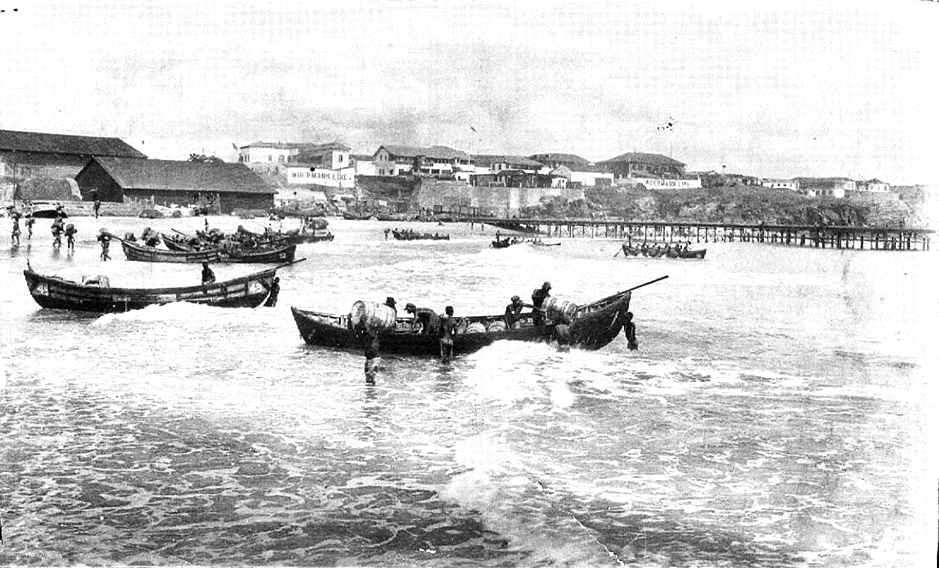
The Surf Boat Harbour at Accra, before the construction of Tema Harbour. Image c. 1920s, courtesy of Wirral Archives

This paper examines the planning, physical development, and housing in Tema New Town, an appendix of the newly created Tema industrial and harbour city, located on the northeastern part of Accra in the Greater Accra Region in Ghana. The city and its appendage were designed and built during the 1950s, as the country was rapidly approaching political independence. Tema, originally an old Ga-fishing village, became a significant part of a much larger and ambitious scheme, known as the Volta River Project proposed as part of Kwame Nkrumah’s domestic policy, embracing multifaceted and multidimensional development projects. These projects were to serve as a symbol of ‘progress’ and were part of Ghana’s desire for modernization as it emerged from a colonial past. The related schemes were largely funded as a result of the British Colonial Development and Welfare Acts, and this paper investigates the implementation of this policy and the effect that it had on physical planning and provision of architectural solutions in Ghana.

007

Maxwell Fry’s sketch of the ‘traditional’ Compound House, from Village Housing in the Tropics

013

One of Fry and Drew’s plans for the fishing village of Tema Manhean, Ghana.

The full paper, published in Planning Perspectives can be read at: http://www.tandfonline.com/eprint/cWc4hRPQWT7yCai5GkjS/full

Workshop and Roundtable discussion: 28th November 2013 Liverpool School of Architecture.

This workshop is concerned with the architecture, design and planning proposals developed by architects/planners from Poland during the mid-late twentieth century. In particular it seeks to address how people and ideas have migrated beyond national borders and with what effect. Without the networks of empire and trade that aided so many British and Western European architects to practice around the world in the twentieth century, how and why did so many Polish architects obtain commissions beyond the immediate reach of Eastern Europe?

One answer to the above question was the placing of a Polish School of architecture within the Liverpool school during World War Two. In 1942 the British Council approached the university with the proposal that was part of a broader plan that saw other academic disciplines placed in other UK universities, such as a veterinary school at Edinburgh.

The Polish School of architecture was inaugurated by the Prime Minister of Poland and Commander-in-Chief, General Wladyslaw Sikorski in November 1942 – although the school had actually been in operation from June 1941. Staff and students worked on theoretical schemes such as for the rebuilding of a specified Polish village, along with designs for hospitals, blocks of flats, factories, town halls and the like. Professor Budden commenting on the Polish School’s tenure in Liverpool noted that although ‘the work…is in the mainstream of contemporary architectural thought and practice, it is yet distinctively expressive and national in character. The forms employed are in the main familiar, but they are given an unmistakably Polish inflection – and the result is the more interesting and vigorous for that…’

What was this inflection that Budden observed and can we begin to discern a specific Polish approach to twentieth century architecture and planning?

The Polish School is but one of the many networks, vectors and agencies that facilitated the export of Polish architecture and architects. What other modes of migration were pursued? What happened after the Polish School and where did its graduates go on to practice?

These are the most basic questions that we hope to discuss and address, but suggestions, other case studies and individual biographies are very welcome.

Papers and work-in-progress are most welcome. 20 minute papers followed by 20 minutes discussion. For further information or to submit abstracts of 200 words please email Iain Jackson ijackson@liv.ac.uk  or Peter Richmond richdrp@hotmail.co.uk.  Deadline for abstracts is 14th October 2013.

‘The Influence of Fry and Drew’ Conference, Abstract 7

Viviana d’Auria, ‘“The most difficult architecture to create”:  Fry, Drew & Partners’ contested legacies and the vicissitudes of low-cost housing design in (post)colonial Ghana’.

As has been well documented, Maxwell Fry and Jane Drew were intensely involved in British West Africa. From their Accra-based office, they designed the cornerstones of late colonial welfare development, ranging from hospitals to universities. Explorations of their West African work however, have neglected housing design, including the ways in which it confronted colonial antecedents and how expatriate practitioners and local professionals confronted its legacy. This disregard is all the more challenging seen the weight it had for Fry and Drew themselves, as well as its overall significance for general post-war technical assistance.

Indeed, in the case of housing conception too, the partnership’s work was envisaged at a time of confidence in the reconciliation of modernism and development within the walls of a low-income dwelling. Freshly-arrived in Chandigarh after several years spent in West Africa, Fry and Drew were important contributors at the United Nations Housing Seminar in New Delhi in 1953. At the event, their efforts not only earned them recognition with the prize-winning conception of House 23, but was also the topic of Fry and Drew’s paper, who underscored how low-cost dwellings were “of all architecture the most difficult to create”.

On such premises, this contribution focuses on pre-Chandigarh housing design in Ghana. By looking at cases from the Accra-Tema Metropolitan Area, it wishes to comment more particularly on how the partnership was concerned with indigenous dwelling cultures. It then reflects on how this centre of attention was (or not) picked up by international technical assistance and local government planning in the following decades. The notion of ‘growing’ and ‘extendable’ housing, in addition to gender-based typologies will be inquired into by means of selected cases such as the Jamestown slum clearance scheme, the work of the Tema Development Corporation and of the International Co-operative Housing Development Association.

..

Viviana d’Auria is Lecturer in Human Settlements in Development at the Department of Architecture, Urbanism and Planning (University of Leuven) and NWO Rubicon fellow at the Department of Geography, Planning and International Development Studies (University of Amsterdam). Her dissertation Developing Urbanism in Development: Five Episodes in the Making of the Volta River Project in (Post-)colonial Ghana 1945-76 (KU Leuven, 2012) explored the contribution of transnational technical assistance projects to the epistemology of (post-)colonial urbanism through the particular case of the Volta River Project. Critical spatial analyses of modern dwelling environments and their lived-in ‘hereafter’ are an integral part of her research within a more general interest in modern urbanism in non-Western contexts. On this note, Viviana’s post-doctoral inquiry is comparatively exploring home space in Greater Accra and Lima by focusing on the socio-spatial history of modern ‘incremental’ neighbourhoods such as Tema Manhean and Villa El Salvador.

­­

‘The Influence of Fry and Drew’ Conference, Abstract 3

Łukasz Stanek, ‘Tropical Architecture as Cold War Discourse in Post-Independence Ghana (1960–1966)’.

While scholars have convincingly linked the genealogy of tropical architecture to the colonial networks of the British Empire within the processes of decolonization, the role of Cold War dynamics in this genealogy has been much less recognized. This paper fills in this gap by discussing the cosmopolitan architectural practices in Ghana during the presidency of Kwame Nkrumah (1960–1966), with the specific focus on the Accra International Trade Fair. This ensemble was designed by architects and engineers from socialist Poland according to the principles of “tropical architecture” as advocated by Maxwell Fry and Jane Drew: the translation of modernist architecture according to local climate, technology, and society. The construction of the Fair was a part of broader debates on “building in the tropics” in the Soviet Union and Poland, in response to the engagements of professionals from socialist countries in Europe in Africa and Asia since the late 1950s. Yet in spite of being one of the most prominent ensembles in Nkrumah’s Accra, the Trade Fair was never included to publications about “tropical architecture” nor was it presented in the journal “Western African Architect and Builder” which promoted “tropical architecture” well into the 1970s. This absence needs to be seen as expressing the “intellectual division of labor” specific for the Cold War that allowed acknowledging the work of architects from socialist countries as technological objects, but not as architectural ones.

Based on archival research and fieldwork in Poland, Hungary, Croatia, and Ghana, this talk will show how the discourse on “tropical architecture” offered a way for expressing ideological and economic antagonisms among architectural practices in mid-1960s Accra. At the same time, this paper will signal points of connection among practitioners from both sides of the Iron Curtain in early post-independence Ghana, including the School of Architecture in Kumasi, where Fry and Drew would discuss the principles of tropical architecture with colleagues from Hungary and Yugoslavia.

..

Łukasz Stanek is the 2011–2013 Mellon Post-Doctoral Fellow at the Center for Advanced Studies in Visual Arts (CASVA), National Gallery in Washington and Lecturer at the Manchester Architecture Research Centre, University of Manchester. Stanek authored Henri Lefebvre on Space: Architecture, Urban Research, and the Production of Theory (University of Minnesota Press, 2011) and he is currently editing Lefebvre’s unpublished book about architecture, Vers une architecture de la jouissance (1973). Stanek’s second field of research is the transfer of architecture from socialist countries to Africa and the Middle East during the Cold War. On this topic, he published ‘Miastoprojekt Goes Abroad. Transfer of Architectural Labour from Socialist Poland to Iraq (1958–1989)’ in The Journal of Architecture (17:3, 2012) and the book Postmodernism Is Almost All Right. Polish Architecture After Socialist Globalization (Fundacja Bęc-Zmiana Warsaw, 2012). He has taught at the ETH Zurich and Harvard Graduate School of Design.