Archive

Tag Archives: Housing

Conference Call for Papers: The Design, Planning and Politics of How and Where we Live

ab0a4cd7-3ec5-4f67-9662-3ddd2272aa94
Place: University of the West of England (UWE), Bristol, UK
Dates: 25-26 January 2018
Organisers: Department of Architecture, UWE, with AMPS. In collaboration with the Public Health Film Society and World Health Organisation Collaborating Centre at UWE.

Abstract Submission (Round 1): 01 June 2017   

http://architecturemps.com/bristol-2018/

The conference welcomes delegates to present in-person, via Skype or pre-recorded video which will be uploaded to the AMPS YouTube channel.

This major international conference considers the sustainability and healthiness of the places we live in – from our houses to our cities. Inspired by the origin of the public health movement in the issues of urban housing, it seeks an interdisciplinary debate on the quality of life in the built environment. It welcomes health professionals, sociologists, community activists, architects, planners, urban designers, and more.

From a health perspective, it continues the work of AMPS over the past three years on public health. From a housing perspective it continues AMPS engagement with the Housing – Critical Futures research programme. In its concern with the ‘politics of housing and health’ it continues collaborations with sociologists and community researchers. From a design point of view, it brings together the work of architects and spatial designers from various disciplines concerned with a better quality living environment affecting wellbeing, health and social sustainability.

Publications:
There will be a conference proceedings publication with its own ISSN.
There are several other publications:
1. A Special Issues of the Architecture_MPS journal
2.  Amps Book Series with UCL Press
3. Amps Book Series with Libri Publishing
4. Amps Book Series with Vernon Press

Other Partners:
The event is coordinated by the UK non-profit research organisation AMPS as part of its engagement with the UN Habitat University Initiative. It is part of a series being organised by an international consortium of universities and publishers including: The University of Derby, La Universidad de Sevilla, University of Cyprus, Swinburne University Australia, London South Bank University Liverpool and John Moores University, UCL Press and Libri Publishing.

This particular event is organised by the University of the West of England, Bristol, UK.
http://architecturemps.com/bristol-2018/

Image: Guy Freeman

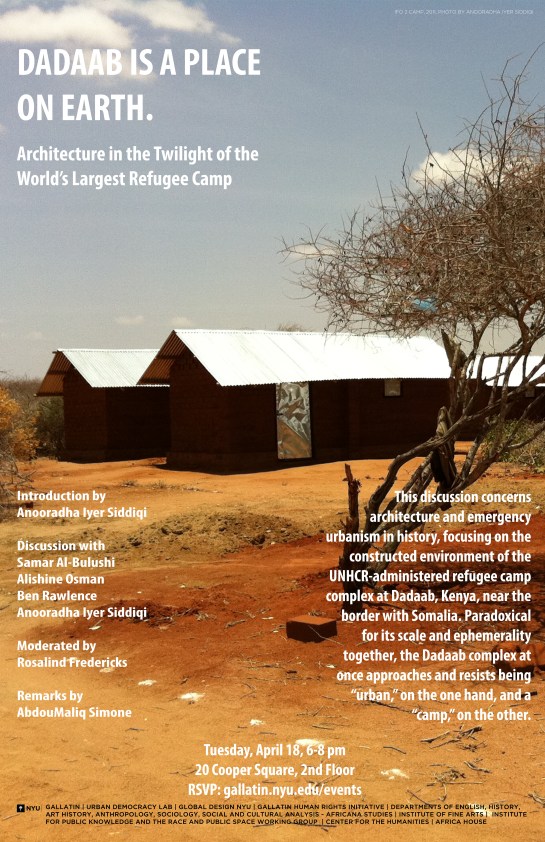
DADAAB IS A PLACE ON EARTH

Architecture in the Twilight of the World’s Largest Refugee Camp

April 18, 2017, 6:00-8:00 P.M., 20 Cooper Square, 2nd Floor, New York University

http://gallatin.nyu.edu/utilities/events/2017/04/DadaabIsAPlaceOnEarth.html

African Cities Week

This moderated discussion concerns architecture and emergency urbanism in history, focusing on the constructed environment of the UNHCR-administered refugee camp complex at Dadaab, Kenya, near the border with Somalia. Paradoxical for its scale and ephemerality together, the Dadaab complex at once approaches and resists being “urban,” on the one hand, and a “camp,” on the other. Established in 1991 to shelter thirty thousand refugees, the Dadaab complex expanded over the course of a quarter century to five settlements with a compound headquartering a centralized structure of humanitarian agencies. According to unofficial counts, it currently houses one half million refugees and asylum seekers, along with humanitarian aid workers in residence. In early 2016, citing security threats, the government of Kenya announced that it would close the complex prior to the next general election, and dismantled the Department of Refugee Affairs as a decisive measure. Through a detailed discussion on design, use, aesthetics, and affect at the Dadaab site, we hope to study the social and political lived realities of an environment constructed to be liminal.

Dadaab-1

Introduction by Anooradha Iyer Siddiqi

Discussion with Samar Al-Bulushi, Alishine Osman, Ben Rawlence, Anooradha Iyer Siddiqi

Moderated by Rosalind Fredericks

Remarks by AbdouMaliq Simone

Organized by Anooradha Iyer Siddiqi, with Rachel Stern. For more information and teaching materials related to this event, please see: http://gallatin.nyu.edu/utilities/events/2017/04/DadaabIsAPlaceOnEarth.html

Adjena Revisited

Ola Uduku writes;

It was a long and dusty journey, we soon understood why the taxi wouldn’t haggle down from the amount he quoted. The road definitely existed, it was just in very poor condition and work was being done near the end of the journey to Adjena to re-grade the laterite. We finally pulled into a gathering of housing on each side and slowed down, I said this looks likes ‘tropical designed housing’.

dsc_0456

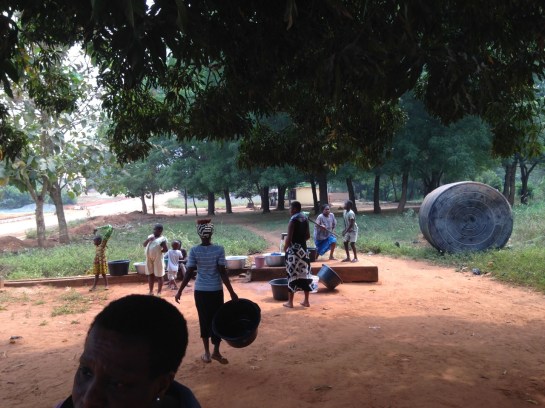
A hand-operated water pump caught our eyes and we watched a small gathering of  women and children pump up their water into buckets and containers and then take them away for use.  We walked to two elderly men dozing under a tree and asked the throng if we could wake one up.

img_0727

‘Is the Adjena resettlement area?’, we asked.

‘yes’ came the reply.

Our first informant was in his eighties and  had arrived when the first set of resettled villagers were moved to the site in 1957. He explained that there was a school further along and more housing.

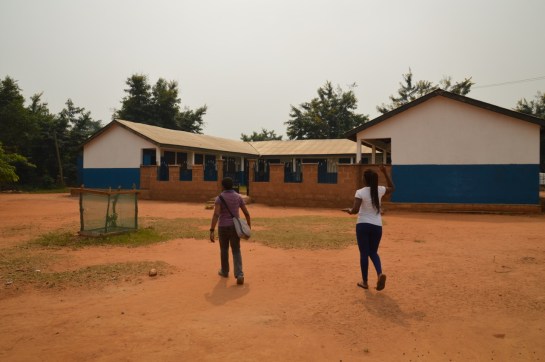
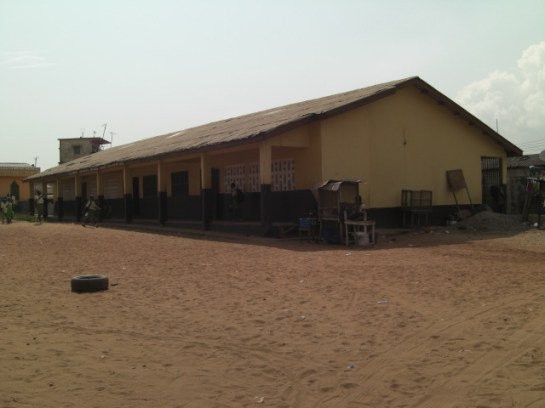
We went further into the clearing and hit gold – a small school designed around a courtyard to specific tropical standards. Windows were deep and allowed light to penetrate through the classrooms, and the verandas were ample to enable their use in teaching.  The school was foregrounded by a number of trees which seem to have been planted to a specific format, unfortunately they seemed to be dying, but they still helped frame the school and looked as if they were very much part of the school grounds.

dsc_0439

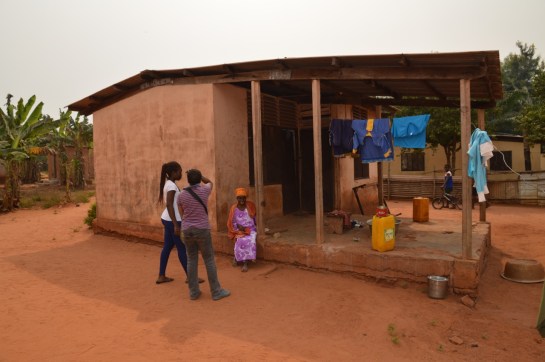
Moving on from the school we came to a clearing with a designed kitchen–cooking area central to a number of small dwellings. We stopped and talked to Agnes, whom we asked about what she remembered about moving to Adjena. She immediately recounted that she had been 27 when the move had taken place and she was 87 now. A quick date check confirmed that these dates tallied with the move of the settlement in the Volta valley to Adjena. As we chatted with her on the step to the kitchen she explained that she preferred the new settlement to the old as the new buildings were  ‘Cortex’, the name given to the company who built the settlement made up a concrete frame with infill breeze block walls.

dsc_0443

We passed a number of small dwellings designed as part of the scheme. All dwellings now had electricity with television sets to prove it, however water was only available via the standpipes that we had seen when we walked into the settlement. The communal WCs did not seem to well used, one supposes that in this very remote rural area this option was unlikely to be popular.

For a resettlement scheme approaching its 6th decade Adjena was in good condition, it now had a junior secondary school and the road carried both the electricity lines and also the mobile phone masts. The road also ran through to the community council offices and there were other settlements which were now part of the greater extended Adjena community.

Developments were coming to Adjena, and we had been made welcome guests to this sleepy, yet thriving community. What would Leo De Syllas and the other designers of the then New Adjena think of their creation more than half a century on? An understated success we’d say as we made our dusty way back to the town.


An Update from Takoradi, Ghana Part 2

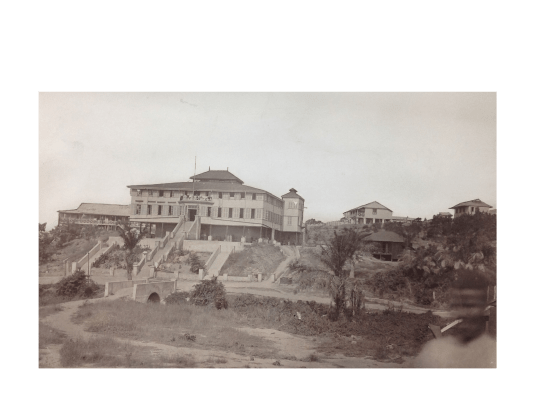
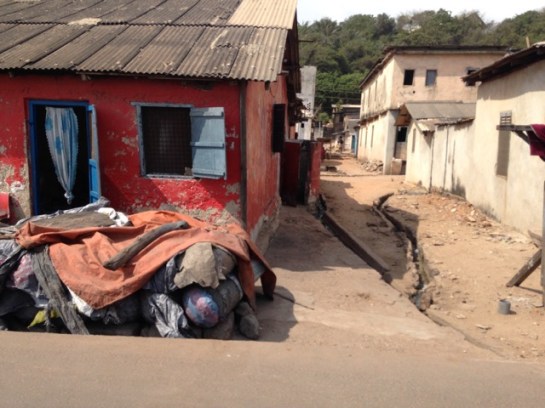
The docks and rail infrastructure of Takoradi was the impetus behind its rapid expansion from a small village to a major town. Construction commenced after WW1, but before this took place, it was neighbouring Sekondi that dominated the area with its grand houses, trading offices and the plush Metropole Hotel. The Dutch established Fort Orange there from 1670 and the natural harbour provided a suitable place for light vessels to shelter whilst the surf boats manned by the Kru people brought goods and people ashore.

evernote-snapshot-20160720-121210-copy

The Metropole Hotel, Sekondi

There is some rich architectural heritage in this town, and clear evidence of a once prospering settlement full of traders and merchants. Those days are clearly gone.

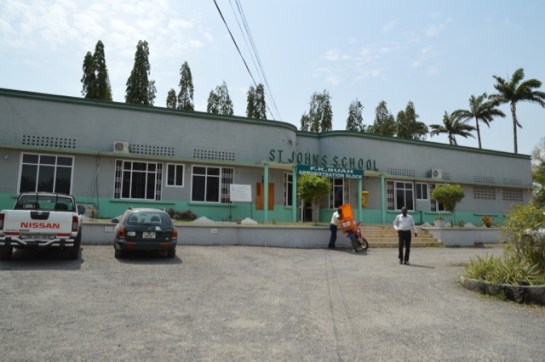
We started with two schools, the first called Fijai, captured here by the UK National Archives Africa through a lens. Then onto St. John’s, again the vintage photo below shows the clean lines of the school, when constructed c. 1955.


dsc_0383

St. John’s School, Sekondi

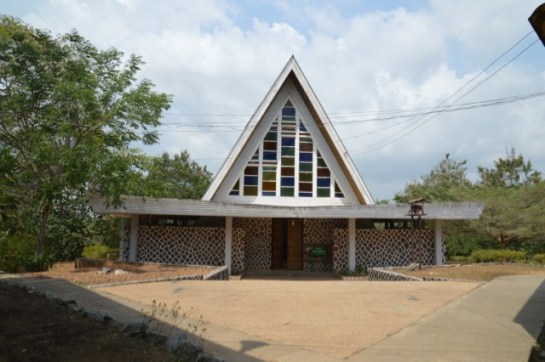
There have been further additions to the school including the striking church, donated by a Wisconsin family , with its large A-line structural frame,  finely detailed concrete casting, wooden ceiling and pre-cast screening. Next to St. John’s is Adiembra housing estate. There were revisions proposed for Adiembra in the 1944 Town Planning report made by Maxwell Fry and Jane Drew, but it is difficult to ascertain what impact this report made on the area, if any. However, we did spot some standpipes and washing stations that resemble those proposed by Fry and Drew in their manual, Village Housing in the Tropics, so perhaps this is evidence of their involvement.

dsc_0376

The Church at St. John’s School

We went onto the main street of Sekondi where the Post Office is located. We discussed this building in our chapter in Bremner’s Architecture and Urbanism in the British Empire, but were now shocked to see how the exquisite timber counter had been painted in bright blue gloss – destroying the previous display of tropical hardwoods. The rest of the street has only gotten worse since our last visit, with many of the former colonial buildings on the brink of collapse. Absent landlords coupled with a shrinking economy has left these structures vulnerable and economically unviable. Further sad news must be reported, as the modernist Sekondi Regional Library has recently been demolished and replaced with a new library.

Our final visit in Sekondi was to the coastal-road village of Ekuasie, laid out in 1912. This was an early attempt at providing worker housing and adopts the familiar grid iron street format, although far more loosely imposed than similar schemes elsewhere (such as Korle Gono). There are some later and grander additions to this village, including a set of houses from the mid 1950s.

img_0663

Ekuasie Housing Estate

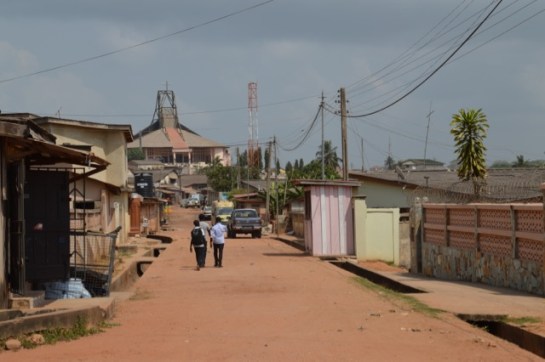
We returned to Takoradi and explored the workers’ estate, mentioned in the PRAAD archives as the ‘labourers housing and school’ at the Zongo area. This is still a thriving area, Hausa was heard being spoken and the tiny streets eventually lead to a playground-cum-village square, overlooked by the Islamic school and Mosque.

cimg5294

Takoradi Zongo School

An Update from Takoradi, Ghana

We started at the Takoradi Train Station, completed by 1928 as part of the coastal rail and docklands development. The train lines were initially constructed to transport cash crops, minerals and metals from the northern agricultural and mining districts to the awaiting ships, sheltered in the newly constructed breakwater and deep water harbour. When we visited in 2012 the train station was completely derelict and not in use. Today we found it carefully restored and new tracks laid. The plan is to reuse it for a local transport network. We walked up the hill to the small commercial district made up of international banks and a post and telegrams office. The mishmash of styles reveals the incremental development, as well as the fierce competition between the banks eager to differentiate themselves from the competition.

The former European hospital clock tower up on the hill overlooks the banks and docklands, as well as benefiting from the cooling sea breeze.

We drove to the 1920s part of Takoradi, a major new town extension that was built to accompany the docks development of that time. This portion of the town was primarily for the African population, although it also contains the Lasdun designed Bank of Ghana [built 1957]. Lasdun was also the architect of the National Museum in Accra. The bank was vacant when we visited in 2012, but now it stands in a state of complete dereliction, its fine materials and fixings being stripped from the building. This is a real tragedy. It was once an outstanding building, recorded in the Architecture journals of the day and surely one of Lasdun’s greatest works from this period.

img_0633

Somewhat downbeat, we bid farewell to the bank, and made our way to the rond-point in the middle of the town. The map was deceiving, as this was built as a major market place – our driver told us it was one of the largest markets in West Africa. It had the feel of Kariakoo market  in Dar es Salaam, and also contains a delightful little PWD post office with its signage graphics still intact.

Adjacent to the market is Amanful Village. Laid out in 1922-3 it is a mixed use area of housing and commercial properties. The basic PWD-type houses and layout remained in place, but more wealthy owners had transformed much of the upper part of the estate to suburban housing.

We then went to the Takoradi Technical Institute, shown above (Left, b+w) in the Africa Through a Lens Collection at the UK National Archives. There is a forcefulness to this scheme that takes the familiar two storey gallery access format, and emboldens into more ‘clunky’ yet determined architectural-structural forms.

dsc_0363

Nearby is the Effiekuma housing and the Effia Nkwanta hospital. The hospital has evolved overtime from a European hospital-cum-sanatorium in the colonial period, to a major health provider today. The careful layering and response to the site contours offers delightful views as well as a most welcome breeze to all the small structures that each have a view of the docks. At the top of the hill is a large brutalist extension that dates from c. late 1960s early 1970s. But who designed it?

Notes from Kumasi Part 2

The KNUST campus continued to delight as we explored its many building types, landscape and wildlife. The staff housing [over twenty different types], is generally low density bungalows generously positioned along the sweeping roads to the west of the campus. The Vice-Chancellor’s lodge is also set amongst the staff housing, its pierced screen providing shading to the verandah-cum-corridor behind.

DSC_0219

Vice-Chancellor’s Lodge

At Unity Hall, the two high-rise accommodation blocks dominate the arrangement, but they also frame the quadrangle that contains badminton courts, refectory and other social spaces. The space is also commandeered for laundry drying and we observed architecture students surveying the landscaped elements with their drawing boards set up under the shade of the loggia. Just a short walk from Unity is the sports track and Paa Joe Stadium. The seating is set within the raked landscape and the grandstand has a graceful concertinaed concrete roof that reduces in depth as it cantilevers over the seating.

DSC_0229

Unity Hall

We were fortunate enough to view the architectural drawings of these buildings – but sadly, the climate has rendered them in a poor state and plans for digitization must be urgently progressed to preserve this important archive of material.

DSC_0264

Paa Joe Stadium

Off campus we visited the Manhyia Palace built in 1925. Upon returning from exile the Ashantehene Nana Prempeh 1 was offered the building by the British (the former palace having been destroyed in the ‘War of the Golden Stool’ in 1900). The palace is now a museum with some excellent artifacts and collections. The palace grounds also contain the Manhyia archives, managed by the West African Studies department of Legon University. The archives contain records dating back to 1926 including many documents on land development, sanitation, state buildings and town planning. We’re looking forward to seeing what this archive holds – an initial inspection revealed many plans and previously untapped material!

DSC_0221

Manhyia Palace Museum

Notes from Accra Part 2

Our journey continued with visits to Tessano ‘East’ which had a few remnants of the original site and service planned estate, best exemplified by the police station and a few administrative blocks, which often defined the colonial housing plan layout. A visit to the University of Ghana, at Legon followed. Designed in the late 1940s by Harrison Barnes and Hubbard, the leafy campus sits upon on a hill, high above Central Accra. The campus architecture has a curious oriental aesthetic which defines the its identity, with a number of significant buildings including the Balme Library and the Main Hall. In the African Studies department we joined our British Academy project associate, Dr Irene Appeaning Addo, for a very productive meeting.

DSC_0905

Tisano East Police Quarters


DSC_0917

The Grand Hall and Tower at Legon University, Accra

A trip to the Korle Gonno Housing Estate followed, using then new drained highway over the Korle Bu inlet and past the University of Ghana Hospital. The Korle Gonno Estate demonstrated a very early example of decant housing as from conversations with an older resident of the estate it was found out that many of the original residents had been moved from the Jamestown area of Accra to Korle Gonnu, a few miles down the coast. The estate was more intact than Tessano, with a number of the original buildings still evident.

DSC_0928

Korle Gono Housing Estate: regulated street patterns and services

Korle-gono

Korle-Gono Model, c.1920? Photograph held in the National Archives, Kew, UK.

A walk around the “Ringway” estate ,where we resided took us to the “Osu” layout and a road which had a pair of suspected James Cubitt-designed residences . A second visit just before departure from Accra confirmed this, although their external facades had been significantly altered. The pair of residences are now in use by the diplomatic corps.

Notes from Accra

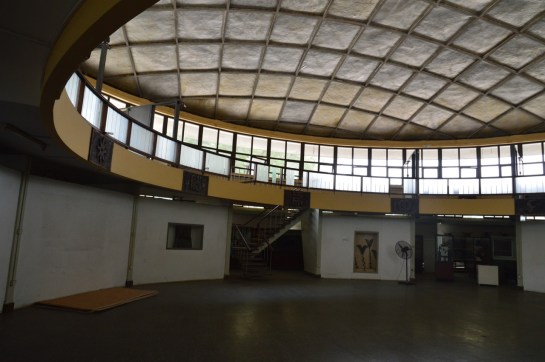
Iain Jackson and Ola Uduku have spent the last two days in Accra catching up with 20th century architecture, and meeting with contacts as part of the British Academy funded ‘From Colonial Gold Coast to Tropical Ghana’ architecture project. Tuesday 23rd February was spent visiting the Ghana National Museum complex, the gem in the crown being Denys Lasdun’s prefabricated dome shaped museum, currently closed for refurbishment. The imagination and vision of the building were still clearly there in our viewing of the stripped down structure ready for conservation.

DSC_0820.jpg

Our next stop took us to Nickson and Borys’ Children’s library building nearer to Central Accra. This had been sympathetically restored, and again was a great demonstration exemplar of ‘West African Modern’ and the developmental vision of the departing colonial government to establish libraries that were open to all citizens. The upper area remained devoid of activity but had potential to be a great multipurpose programme space.

DSC_0801.jpg

Children’s Library

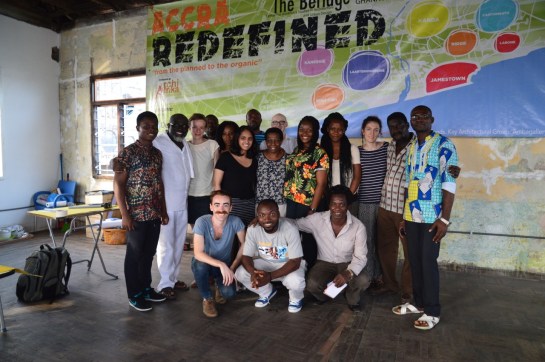
The final visit of the day was to Joe Osae-Addo’s Archi-Africa – TuDelft Berlage Architecture school studio, in Accra’s Jamestown neighbourhood, on the urban fabric of everyday life in Accra. The impromptu crit we were invited to take part in was an enjoyable experience and the schemes were full of promise.

DSC_0832.jpg

TU Delft and Archi-Africa in the newly converted Jamestown Studio

Day two involved visits to Jamestown – as a walking visit this time to take in early 20th century colonial PWD, and also warehouse architecture in the neighbourhood. A visit to Adabraka also yielded a few examples of early PWD worker housing, which was followed by an afternoon visit to Achimota School, which conveyed the height of the colonial education project with architectural symbolism and style. A few later additions to the campus by Nickson and Borys and other’s also fitted well into the College’s narrative of colonial imperialism and privilege. The final visit for the day was to Scott House, which lived up to its deified tropical modernism status, whilst the Western Tessano neighbourhood had transformed into an upper class gated area, that unexpectedly gave us a glimpse of an earlier [likely Cubitt?] designed semi detached housing unit, currently undergoing a further 21st century upgrade..

DSC_0863.jpg

One of the few surviving examples of its type in Adabraka

We will be moving onto Kumasi on Friday and will update from there early next week.

Herbert Rowse Research Project, funded by the RIBA.

Iain Jackson and Peter Richmond have been awarded a research grant from the RIBA to investigate the work of Herbert James Rowse (1887–1963). He was without doubt one of the most outstanding architects of his generation and through his work on a number of high-profile commissions he shaped the inter-war cityscape of Liverpool in a way that no other architect has done since. Whilst the trajectory of the evolution of his stylistic preferences can be clearly traced in the work he undertook in Liverpool, his output was not confined to the city and in the course of his career, he worked on major projects in Britain, Europe, Asia and North America. After local pupillage, in 1905 Rowse entered the school of architecture at Liverpool University, where Charles Reilly had just been appointed Roscoe professor.

DSCF0539

Mersey Tunnel Ventilation Shaft, Liverpool, 1931-

Gaining a first-class certificate in 1907, Rowse was also the joint winner of the Holt travelling scholarship, which took him to Italy and started a lifelong interest in Italian Romanesque and Renaissance architecture. A set of measured drawings arising out of his Italian studies won him an honourable mention in the silver medal competition of the RIBA in 1910. In the same year he became an associate of the RIBA whilst employed as an assistant to Frank Simon, who in 1912 had won the competition for the Manitoba parliament building. Rowse worked in Simon’s Winnipeg office in 1913. He also travelled extensively throughout North America and worked briefly in Chicago and New York. On his returned to Liverpool, Rowse opened his own practice in 1914 and during the First World War he worked for the Admiralty designing ‘purely functional buildings’.

DSCF0534

Woodside Tower for Mersey Tunnel, Birkenhead, 1931-

Following the War, he re-launched his practice with a commission for the Fairrie sugar refinery in Liverpool. Rowse’s competition-winning design for the Liverpool shipping office (the India Buildings) in 1924 was the first among a series of large-scale commercial commissions in the city, often carried out in partnership with other individuals or firms; these included Martins Bank (1927–32), Lloyds Bank (1928–32), and the Bibby Shipping Line offices (1930). The Lloyds Bank branch in Church Street was in Italian Romanesque, while for bigger buildings Rowse used a rich, eclectic classicism, often with a distinct American Beaux-Arts flavour – a style that was simultaneously being promoted by Reilly at the Liverpool School. In 1931 he was appointed consultant to the Mersey tunnel authority, and designed the tunnel approaches, arched entrances, and ventilation towers. The largest tower housed the tunnel authority offices, and was a distinguished addition to the group of tall buildings at Liverpool’s pierhead; whilst the Woodside tower on the Cheshire side of the Mersey won Rowse the 1937 RIBA bronze medal. His tunnel authority schemes featured low-relief sculpture and art deco work, leaning towards the stripped classical style favoured by both European totalitarian regimes and American New Deal designers. At this time Rowse was working closely with Tyson Smith, Liverpool’s leading modern sculptor.

The Philharmonic Concert Hall (1936–9), with its simplified brick massing and its restrained decoration, was much closer to mainstream European modernism, and is apparently inspired by W. M. Dudok. It was this approach which informed his designs for the British pavilion at the Empire Exhibition, Glasgow (1938), the Pharmaceutical Society headquarters in Brunswick Square, London (1937), and the Pilkington Glass Company offices in St Helens, Lancashire (1938–9) all of which displayed similar Dudokian influences combined with American Streamline Moderne styling. War again frustrated Rowse’s professional career just when he was beginning to win substantial commissions outside Liverpool. In 1947 he completed the Pharmaceutical Society building (now London University’s pharmacy school) and secured the Woodchurch cottage housing scheme, in Wirral, upstaging his mentor Charles Reilly with a scheme ‘traditionally English in character … modified to suit contemporary limitations and resources’. Woodchurch was one of the biggest regional projects in the era of post-war austerity, and won Rowse a bronze medal for housing from the Ministry of Health. However, the architect resigned before completion, following a dispute with the client. Rowse designed diplomatic buildings at Delhi and Karachi in 1951. He also advised the Belgians on post-war reconstruction, and was awarded the Order of Leopold II in 1950. However, he took no further recorded part in British practice until he won the competition for the renovation of the ‘Rows’ in Chester (with Thomas Harker) just before his death in 1963.

http://www.architecture.com/RIBA/Becomeanarchitect/Fundingyoureducation/Researchfunding/ResearchTrustAwards/2014Recipients/IainJacksonandPeterRichmond.aspx

In the laboratory and in the field: hybrid housing design for the African city in late-colonial and decolonising Ghana (1945–57)

Viviana d’Auria, The Journal of Architecture Volume 19, Issue 3, 2014

This paper considers the case of late-colonial and ‘transitional’ Ghana (1945–57) to qualify the way in which ‘native’ dwelling practices were harnessed for housing design. Theories about the ‘colonial modern’ have underpinned the ambivalence of residential schemes and urbanisation strategies developed during decolonisation by modernist architects. Most documented among these is work in North Africa, with projects from Casablanca and Algiers taken as the epitome of how modernism memorably embraced the vernacular to amend its tenets in the early 1950s; however, British involvement in the colonies has more commonly been documented in relation to the tropical architecture canon, with a focus on institutional buildings rather than housing projects, especially in West Africa. Housing design, on the other hand, makes manifest the significance of the social and cultural dimensions as a basis for housing and urbanism during decolonisation in Ghana, downplayed to date because of a focus on climatic and economic factors. Projects by Fry, Drew, Drake and Lasdun, and by Alfred Alcock and Helga Richards, are discussed to gauge the extent of transcultural exchange while socio-economic surveys, experiments in building science and anthropological studies increasingly inspired the design process.

Read the full article here: http://www.tandfonline.com/eprint/feTHdMSVJgz2GHV5Biux/full