Archive

Tag Archives: Housing

The planning of late colonial village housing in the tropics: Tema Manhean, Ghana

001

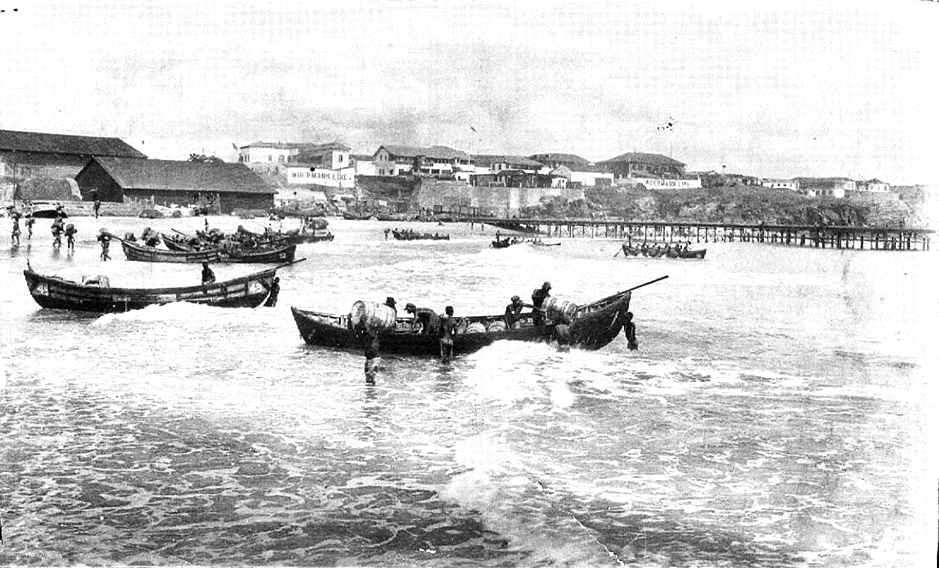
The Surf Boat Harbour at Accra, before the construction of Tema Harbour. Image c. 1920s, courtesy of Wirral Archives

This paper examines the planning, physical development, and housing in Tema New Town, an appendix of the newly created Tema industrial and harbour city, located on the northeastern part of Accra in the Greater Accra Region in Ghana. The city and its appendage were designed and built during the 1950s, as the country was rapidly approaching political independence. Tema, originally an old Ga-fishing village, became a significant part of a much larger and ambitious scheme, known as the Volta River Project proposed as part of Kwame Nkrumah’s domestic policy, embracing multifaceted and multidimensional development projects. These projects were to serve as a symbol of ‘progress’ and were part of Ghana’s desire for modernization as it emerged from a colonial past. The related schemes were largely funded as a result of the British Colonial Development and Welfare Acts, and this paper investigates the implementation of this policy and the effect that it had on physical planning and provision of architectural solutions in Ghana.

007

Maxwell Fry’s sketch of the ‘traditional’ Compound House, from Village Housing in the Tropics

013

One of Fry and Drew’s plans for the fishing village of Tema Manhean, Ghana.

The full paper, published in Planning Perspectives can be read at: http://www.tandfonline.com/eprint/cWc4hRPQWT7yCai5GkjS/full

Village Housing in the Tropics: With Special Reference to West Africa

The seminal book on Tropical Architecture by Jane Drew and Maxwell Fry has been republished by Routledge 66 years after its first edition was bravely produced by Lund Humpries.

villagehousing

The slender volume loaded with Fry’s cartoons and sketches became an instant hit, with its engaging insights and empirical findings.  It was not aimed at the specialist or technician, rather the generalist and interested reader looking for quick tips to solve familiar problems. The book gives pragmatic advice on the siting of villages, housing orientation and matters relating to sanitation and health. Although the content was far from novel or radical, it presented previously dry and mundane material in a manner that was easy to understand, and encouraged greater attention to be given to the everyday housing problems of West Africa.

The book was used by Fry and Drew as a promotional tool,  they included a copy along with their CV’s when applying to be considered for the University of Ibadan project and it almost certainly influenced their consideration for Chandigarh. It set them apart from others working in tropical regions,  and with its emphasis on village housing firmly aligned them with the Colonial Office’s desire to promote ‘Development and Welfare’.

It almost goes without saying, but the publication was a product of its time and formed part of the colonial enterprise. Within the front and back endpapers of the book a map of the world is coloured to highlight Britain’s Colonial territories, highlighting where the book’s advice could be dispensed and treating all ‘tropical’ territories as one and the same irrespective of their specific contexts and climatic variations.

Available to purchase here: Village Housing in the Tropics: With Special Reference to West Africa (Studies in International Planning History)

‘The Influence of Fry and Drew’ Conference, Abstract 7

Viviana d’Auria, ‘“The most difficult architecture to create”:  Fry, Drew & Partners’ contested legacies and the vicissitudes of low-cost housing design in (post)colonial Ghana’.

As has been well documented, Maxwell Fry and Jane Drew were intensely involved in British West Africa. From their Accra-based office, they designed the cornerstones of late colonial welfare development, ranging from hospitals to universities. Explorations of their West African work however, have neglected housing design, including the ways in which it confronted colonial antecedents and how expatriate practitioners and local professionals confronted its legacy. This disregard is all the more challenging seen the weight it had for Fry and Drew themselves, as well as its overall significance for general post-war technical assistance.

Indeed, in the case of housing conception too, the partnership’s work was envisaged at a time of confidence in the reconciliation of modernism and development within the walls of a low-income dwelling. Freshly-arrived in Chandigarh after several years spent in West Africa, Fry and Drew were important contributors at the United Nations Housing Seminar in New Delhi in 1953. At the event, their efforts not only earned them recognition with the prize-winning conception of House 23, but was also the topic of Fry and Drew’s paper, who underscored how low-cost dwellings were “of all architecture the most difficult to create”.

On such premises, this contribution focuses on pre-Chandigarh housing design in Ghana. By looking at cases from the Accra-Tema Metropolitan Area, it wishes to comment more particularly on how the partnership was concerned with indigenous dwelling cultures. It then reflects on how this centre of attention was (or not) picked up by international technical assistance and local government planning in the following decades. The notion of ‘growing’ and ‘extendable’ housing, in addition to gender-based typologies will be inquired into by means of selected cases such as the Jamestown slum clearance scheme, the work of the Tema Development Corporation and of the International Co-operative Housing Development Association.

..

Viviana d’Auria is Lecturer in Human Settlements in Development at the Department of Architecture, Urbanism and Planning (University of Leuven) and NWO Rubicon fellow at the Department of Geography, Planning and International Development Studies (University of Amsterdam). Her dissertation Developing Urbanism in Development: Five Episodes in the Making of the Volta River Project in (Post-)colonial Ghana 1945-76 (KU Leuven, 2012) explored the contribution of transnational technical assistance projects to the epistemology of (post-)colonial urbanism through the particular case of the Volta River Project. Critical spatial analyses of modern dwelling environments and their lived-in ‘hereafter’ are an integral part of her research within a more general interest in modern urbanism in non-Western contexts. On this note, Viviana’s post-doctoral inquiry is comparatively exploring home space in Greater Accra and Lima by focusing on the socio-spatial history of modern ‘incremental’ neighbourhoods such as Tema Manhean and Villa El Salvador.
‘The Influence of Fry and Drew’ Conference, Abstract 1

Christina Papadimitriou, ‘Houses of Chandigarh’.

“Birth is an impingement by an environment which insists on being important… To be born or to relive birth is to experience the feeling of being in the grips of something external.” Donald Winnicott

This paper will narrate the story of the housing schemes of Chandigarh built in a period of anxiety shortly after India’s independence in 1947. Following Nihal Perera’s argument that Chandigarh is a hybrid of imaginations negotiated between multiple agencies rather than a single author’s creation, the narrative will try to give an account of the different voices expressed and the different visions of modernity moving between individuals – as diverse as Otto Koenigsberger, Albert Mayer, Matthew Nowicki, Maxwell Fry, Jane Drew, Le Corbusier and Pierre Jeanneret – and national and institutional platforms.

The main argument will be made in terms of international relationships, with major and minor players, as they manifest themselves in the building of the houses of Chandigarh and not in post-colonial terms since the latter frame of thought has the tendency to reduce the ex-colony to the role of a post-colony. Thus, by focusing on Maxwell Fry and Jane Drew, this paper will compare their housing projects in Chandigarh not only to their work in West Africa or in the Middle East, as is usually the case, but also with their projects in Britain such as the two schemes designed for Harlow, the Tany’s Dell and Chantry housing groups. Since Fry and Drew were also responsible for the bye-laws provisioned for Chandigarh, similarities and differences between them and those of the London County Council will also be drawn. The paper’s aim is to demonstrate a process of modernization that affects everyone but where “effects” on a specific subject depend on the latter’s position in the instance of modernization.

..

Christina Papadimitriou is a Ph.D. Candidate in the Department of Art and Archaeology at Princeton University where she received her M.A. in 2011. She also holds an M.A. (Dist.) in Histories and Theories from the Architectural Association in London, a Diploma (Dist.) in Architecture from the University of Patras and a Diploma in Art and Archaeology (Dist.) from the University of Athens. Her dissertation studies the MARS Group in Britain from 1933 until 1957. Starting as a marginal architectural group, MARS acquired a preeminent position both in England and abroad after the Second World War and played an important role in the way the modern movement was perceived and disseminated globally. The dissertation takes on specific themes of shared interest as indicated by the group’s organized committees and narrates the MARS story through exemplary but formally diverse solutions to the obstacles the group had identified in Britain’s way to modernism.

Contact: cpapadim@princeton.edu