Archive

Tag Archives: India

hall-of-nations-demolished_a3308b4a-2908-11e7-bd89-19cc2c5d765e.jpg

We included an article on these structures exactly one year ago today – and were still hopeful that the Indian Government would see sense and agree to retain these important pieces of architecture. Alas, they made a terrible decision and sent in the wrecking ball.

There was no real justification for this act of cultural vandalism. It is a disgraceful destruction of modern heritage, not to mention the environmental waste.

Next month the AHRC and Indian Council for Historical Research will be sponsoring a workshop on ‘Cultural Heritage and Rapid Urbanisation in India‘ in Delhi. Its too late for the Maidan but let’s hope the workshop can provoke some much needed change.

asia-72-exhibition_0f931730-290e-11e7-bd89-19cc2c5d765e

Read and see more at the Hindustan Times.

Architect-entrepreneurs in post-independence Pune (India)

Sarah Melsens, Priyanka Mangaonkar-Vaiude, Yashoda Joshi
Department of Architectural Engineering, Vrije Universiteit Brussel (VUB), BelgiumDepartment of Architecture, BRICK school of Architecture, Pune, India

Abstract

With the purpose of expanding the built infrastructure in their colonial empire the British imparted technical training to Indians since the mid nineteenth century. These construction related courses initially focussed on assistant, supervisory and executive tasks but evolved into the training of civil engineers. Half a century later, in 1913, a handful of British architects in Bombay took the initiative to develop an existing drafting school for architectural assistants into India’s first school of architecture. Through such schools, and the gradual employment of Indians at higher ranks in Indo-British firms or the Public Works Department (PWD), Indian architects and engineers acquired British methods of working and construction. While construction practice during the British Raj (1858-1947) has gained scholarly attention recently, less is known of how construction was practiced after India’s independence in 1947. Analysis of the profiles of professional firms has shown to be a fruitful means of gaining insight in the workings of the construction field. In order to understand how construction practice was carried forward, this paper will therefore study the first Indian architect-entrepreneurs, who established their firms after Independence.

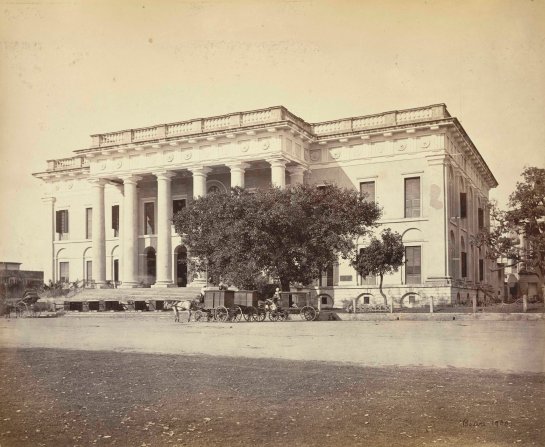
Architecture graduates from JJ School of Art

Architecture Graduates from J. J. School of Art formed the nationwide Indian Institute of Architects in 1929. Top Left: G. B. Mhatre, and Bottom second from Left: C. M. Master with council members of the Indian Institute of Architects, Bombay, 1936-1937

The study is built on data collected from interviews and office archives of three Indian architectural and entrepreneurial offices, which were based in Pune and active in the period 1947-1982. The paper analyses the type of projects these firms were working on, the procedures and organisation of design and construction, and the prevailing construction techniques of the period. As such this contribution will shed light on how, in a post-colonial situation, western models of construction practice were translated into the Indian context.

keywords

Construction practice, architects, post-independence, India, Pune

You may read the rest of this fascinating article here: TNAGblog_architectenterpreneurspune

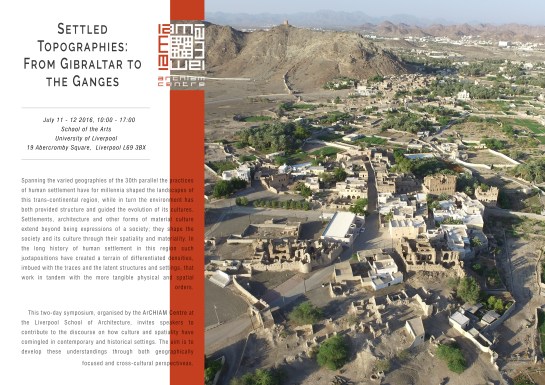
Settled Topographies: From Gibraltar to the Ganges

July 11 – 12, 2016

10:00 – 17:00

School of the Arts Library

19 Abercromby Square, Liverpool
Spanning the varied geographies of the 30th parallel the practices of human settlement have for millennia shaped the landscapes of this trans-continental region, while in turn the environment has both provided structure and guided the evolution of its cultures. Settlements, architecture and other forms of material culture extend beyond being expressions of a society; they shape the society and its culture through their spatiality and materiality. In the long history of human settlement in this region such juxtapositions have created a terrain of differentiated densities, imbued with the traces and the latent structures and settings, that work in tandem with the more tangible physical and spatial orders.

This two-day symposium, organised by the ArCHIAM Centre at the Liverpool School of Architecture, invites speakers and attendants to contribute to the discourse on how culture and spatiality have comingled in contemporary and historical settings. The aim is to develop these understandings through both geographically focused and cross-cultural perspectives.

All welcome to attend and further updates to follow…

2016 UOL_Symposium Flyer.jpg

Are the pleas to save Delhi’s iconic Pragati Maidan falling on deaf ears?

by 

The pleas against the “mindless destruction” have been met with deaf ears.

article-lrjfimhqrw-1459575262

Last year, architect and planner Arun Rewal started a petition on Change.org to appeal to Prime Minister Narendra Modi to save three iconic buildings in Delhi’s Pragati Maidan from demolition. The Hall of Nations, Hall of Industries and Nehru Pavilion, the petition says, are acknowledged the world over as “icons of modernity”. To raze them would be to destroy a part of our heritage.

The Indian Institute of Architects made a similar plea around the same time. “We have learnt that some of the iconic structures… which stood testimony to the nation’s prowess in structural engineering and architecture… are being demolished,” the national body of architects said in a letter to the Indian government. It beseeched against the razing of the structures.

By all signs, the entreaties have swayed nobody.

It was in November 2015 that the demolition of the exhibition halls at Pragati Maidan, under a redevelopment project proposed by Commerce Ministry’s India Trade Promotion Organisation, was confirmed. In their stead, the government plans to construct a state-of-the-art convention centre, a hotel and a parking lot – much to the horror of Indian architects.

In a written reply to the Lok Sabha in 2015, Commerce and Industry Minister Nirmala Sitharaman said, “As per preliminary details of phase-I, it is proposed to develop 100,000 sq. m. of exhibition space and a 7,000 seater convention centre along with support facilities and parking space for 4,800 passenger cars. Other details, such as funding and schedule of completion, are yet to be firmed up.”

The threatened buildings were constructed between 1969 and 1972, the year independent India turned 25. Designed by architect Raj Rewal, Arun Rewal’s uncle, and engineer Mahendra Raj, the three structures were held up as symbols of a progressive India and they have gained iconicity for their modern architecture.

Anyone who has grown up in the national capital knows them intimately. Most Delhiites have visited the buildings during one fair or another at Pragati Maidan, be it a book fair, auto expo (before it shifted to Noida) or trade fair. Just walking through the zig-zag, fenced path leading up to Pragati Maidan’s ticket counter, dragging a tote bag (or four) for books, is enough to inspire nostalgia in many.

gntjoagfmp-1459939680

Raj Rewal in front of the Hall of Nations

The Hall of Nations was designed by Raj Rewal in the traditional jali (mesh) form to serve as a sun breaker. As architect Malini Kochupillai wrote, the buildings “had an effective system of environmental control, thanks to the three-dimensional structure, with solid triangular panels at regular intervals providing sunscreens – a modern equivalent of the traditional jali ubiquitous in Indian architecture ” . The modernist icons were built despite the constraints of time and material.

Raj Rewal was awarded the French Knight of the Legion of Honour, the highest civilian distinction, in March for his outstanding service to the country. It is ironic that the award comes at a time when his best-known creation in India is about to be pulled down.

“It is not just me who wants these buildings left up,” said Raj Rewal. “The entire architectural profession thinks it is an important part of New Delhi and that it will be in everyone’s best interest if these are not demolished. It has been showcased all over the world in exhibitions as a model for 20th century architecture. These need to survive. They are a reflection of what India was in the 1970s. Destroying them would be like destroying any historic building.”

When various bodies representing art and architecture in India and around the world – the Indian Institute of Architects, the Centre national d’art et de culture Georges Pompidou in Paris, and New York’s Museum of Modern Art – got to know about the demolition proposal, they wrote letters to Sitharaman, asking that the architectural sites be preserved.

vtwtgwfsmv-1459939872

The Nehru Pavilion

“The Hall of Nations is known in Europe as in United States as the first large-scale spatial structure in concrete in the world,” writes MoMA in its letter. “Built in a time of great optimism for the future, both structures were seminal in forging a new, modern identity for Indian society and architecture. They are architectural masterpieces and important witnesses of an important chapter of Indian history.”

In another letter, Aurelien Lemonier of Centre Pompidou, which houses the largest museum for modern art in Europe, requests the preservation and maintenance of these structures: “From our understanding, the Hall of Nations and the Nehru Pavilion should be considered as a major heritage of the post-independence architecture and need to be preserved. We want then to express our support and our wish to contribute to the recognition of these two great pieces of architecture and their proper maintenance as part of the architectural heritage.”

There has been no response to the letters from the India Trade Promotion Organisation or from the office of Nirmala Sitharaman.

“It is a part of the city’s memory and people should care because it is a space that belongs to people,” said Arun Rewal. “The importance and potential of the building would be obvious to me even if I wasn’t an architect. The Hall of Nations is a space that can be used in a million different ways. It could be the new Jantar Mantar where the public could stage protests. It could be a new city hall of sorts. It is a little rundown but it’s nothing that can’t be fixed and definitely doesn’t warrant its demolition.”

Arun Rewal stressed that there are very few covered public spaces in Delhi where people can go, sit, and hang out. The Hall of Nations can be adapted for any of these various uses, he says.

According to historian and photographer Ram Rahman, the demolition of the Pragati Maidan structures, especially of the Nehru Pavilion, is ideological in nature. His architect father Habib Rahman is credited with several buildings built under Jawaharlal Nehru’s leadership. “It is a part of a concerted effort to demolish Nehru’s legacy and symbols of Nehru’s modern India,” said Rahman. “It is a part of India’s collective cultural heritage. When these were constructed in 1972, there was no question of the general public not knowing about its existence. The problem is that the public has never been made to think of contemporary architecture as heritage. They need to be educated in the importance of these buildings.”

Architects have noted that there is sufficient space within Pragati Maidan and around the threatened buildings, which take no more than about 3% of the 150 acres of Pragati Maidan, to accommodate new programmes and “adaptive reuses”.

“Efforts should be made to update these spaces with modern facilities and amenities rather than let weak arguments, such as ‘lack of air conditioning’, become reasons for their demolition,” said Arun Rewal. “Just because these buildings are old doesn’t mean they need to be removed. You won’t get rid of your elderly grandmother because she is taking up space, would you?”

Republished from: http://scroll.in/article/806025/are-the-pleas-to-save-pragati-maidan-falling-on-deaf-ears


As part of the Envisioning the Indian City project we have been invited to produce a short set of podcasts for the ‘Realise’ series at Liverpool University. Each podcast is devoted to one of the cities we have been researching [Goa, Pondicherry, Kolkata and Chandigarh] for the past few years in collaboration with Jadavpur University in Kolkata.

india-backing

You may listen to us here: https://www.liverpool.ac.uk/realise-podcast/ and read more about the project here: https://eticproject.wordpress.com

This gallery contains 3 photos.

Originally posted on Envisioning the Indian City:
Standing on the Esplanade crossing, looking down Lenin Sarani with the “Tipu Sultan” mosque on our left, Kawshik Aki pressed his shutter. Bringing his camera down from his eyes he looked at the preview, shook his head, took a step to the left and clicked again.Meanwhile I stood…

Book Review: Jaqueline Tyrwhitt: A Transnational Life in Urban Planning and Design

Ashgate, Farnham, 2013.

By Ellen Shoshkes

ISBN 9781409417781

44 black and white figures

£55.00

9781409417781

What an extraordinary life. This biography carefully chronicles and assembles (in some detail) the life and career of one of the forgotten heroines of the twentieth century planning world. Forgotten is perhaps too strong, as Tyrwhitt is one of those figures that ‘crops up’ rather regularly; aspects of her work are frequently mentioned in conference presentations or cited in journal articles, but she is never the focus of attention despite being, as Shoshkes reveals, a global player. Indeed she is almost omnipresent throughout the planning sphere of the twentieth century when one reads the amount of work she facilitated and the influence she held over publications, translations, lecture courses, planning strategy, international housing and development programmes. Furthermore, she also undertook considerable research into urbanism and planning, yet this is the first volume to draw all these twists and turns together. A good biography is able to not only describe and discuss the person in question, but to also pull in the wider debates and to position the life and works within a broader context – this book manages to effortlessly achieve this feat and is to be commended for it. The narrative adopts a chronological format split over five parts, which neatly track the major episodes of Tyrwhitt’s life. Perhaps one of the reasons for Tyrwhitt’s relative obscurity is because she didn’t have a career in the conventional sense, but rather careered through life bouncing from one project to the next, barely making ends meet. She was also a woman, unmarried, sometimes unkempt, and seemed to care for little beyond friendships and her work. She didn’t establish her own practice or publish provocative tracts, rather operated in a supporting role for the likes of Jose Luis Sert, Sigfried Giedion and Constantinos Doxiadis. As a planner, she left few tangible remains and was not concerned with formulating her legacy as some of her more egotistical collaborators were. She was more focused on getting the job done and took on the important tasks of organising, facilitating and disseminating findings, often with little appreciation from those she made look exceptional. One of her most prolonged and significant roles was translating Giedion’s epic publications, although to label Tyrwhitt’s contribution as a translator somewhat undersells her contribution. She was really a co-author and collaborator, honing Giedion’s ideas and clarifying his arguments – as well as translating them into English. She had a longterm friendship with Giedion which may have strayed into romance, but even this collaboration had its limits and Tyrwhitt stopped working with Giedion long after what most associates would have endured or put up with. Throughout her life there were strong male characters that she supported and encouraged but in the course of time these roles were often inverted and they became dependent on Tyrwhitt.

Although one may know something of Tyrwhitt’s life and work (most planners will be aware of the book she edited on Patrick Geddes in India, for example) this book reveals so much more, and it is very surprising just how far and wide she worked and travelled. One of the more shocking revelations is Tyrwhitt’s involvement with the British Fascists and her decision to experience Hitler’s Germany firsthand in 1937. Very little is said about Tyrwhitt’s political persuasions in later life, but judging from the company she kept it can be safe to assume that she ‘mellowed’ from her early flirtations with the political Right. Her work with the UN in India and Indonesia is another significant aspect of the book and adds new insight into the international agencies that operated in the post-war era. The sources are drawn from numerous archives and the research is detailed and thorough; although very little critical appraisal of Tyrwhitt’s work is made – was any of it implemented, or did any of her students put it into practice? Perhaps an epilogue of influence could have been added as a reprise or conclusion, but this is surely minor criticism of what is a substantial and valuable contribution.

This is a welcome volume to the history of twentieth century architecture and planning; it fills so many gaps, opens up new connections and networks, and goes someway to finally giving Jacky the credit she deserves for a lifetime’s concerted effort to improving and understanding our cities and landscapes.

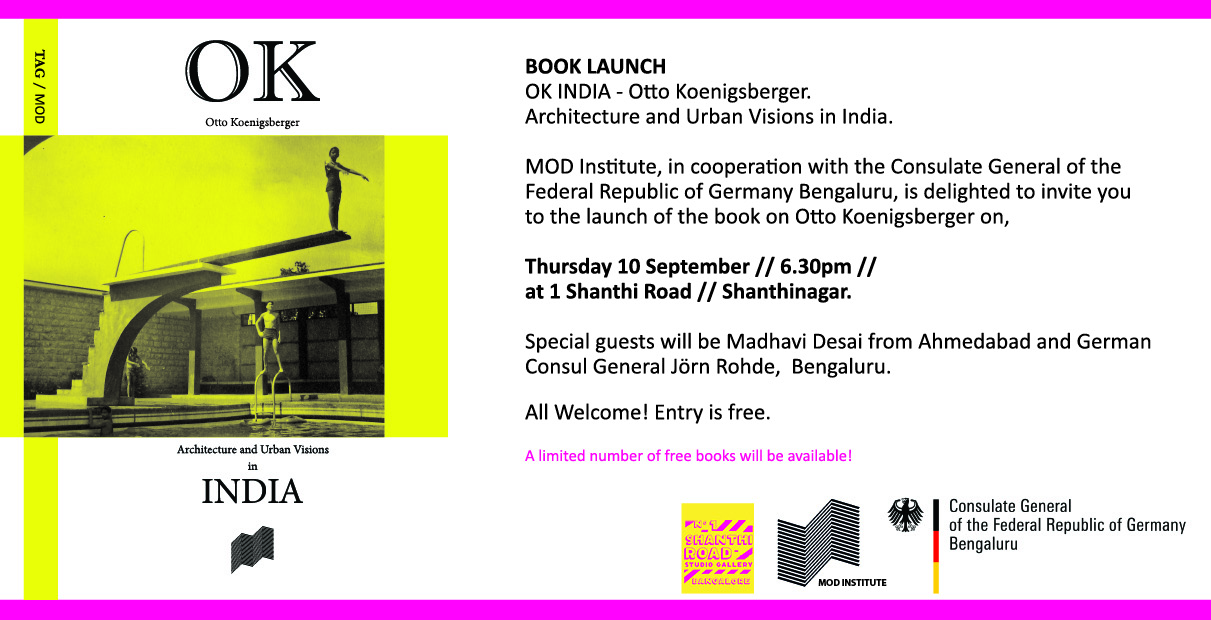
Book Launch OK India – Otto Koenigsberger. Architecture and Urban Visions in India, by Rachel Lee

The much awaited book by Rachel Lee on Otto Koenigsberger is finally with us, and there will be a book launch celebration on 10th September in Bengaluru, see the poster below for more details. We’re delighted that the book has been jointly published by TAG / MOD and we’ll post more details of how you can get a copy in due course…

Book Launch Otto Koenigsberger