Archive

Tag Archives: modernism

British Colonial Architecture in Nigeria, 1900-60.

Yemi Salami’s study explores British colonial architecture in pre-independent Nigeria. Beginning at the turn of the twentieth century and culminating in the year of independence, the investigation traces a significant period of transformation in the country’s history. Notably, it explores the rise of its colonial style buildings, which had come to cater for emerging uses in government, commerce, healthcare, transportation and other contemporary uses of the time.

Previous studies showcase a rich presence of these buildings in pre-independent Nigeria, particularly with reference to the climate responsive “tropical architecture” of the mid-twentieth century. The architectural careers of a few notable professionals are likewise widely explored. However, were these projects and professionals the only modern influences to Nigerian architecture at the time? Who were the other architects and what were they designing? Furthermore, what forms of colonial buildings existed before the mid-twentieth century climate responsive trend?

The aim of this PhD research, therefore, is to obtain a more accurate understanding of the events and circumstances which shaped colonial architectural forms and practice in pre-1960 Nigeria. It will employ a qualitative historical research strategy, by sourcing and investigating materials from previous literature, archival records and existing projects from the period.

‘Memories of African sculpture’

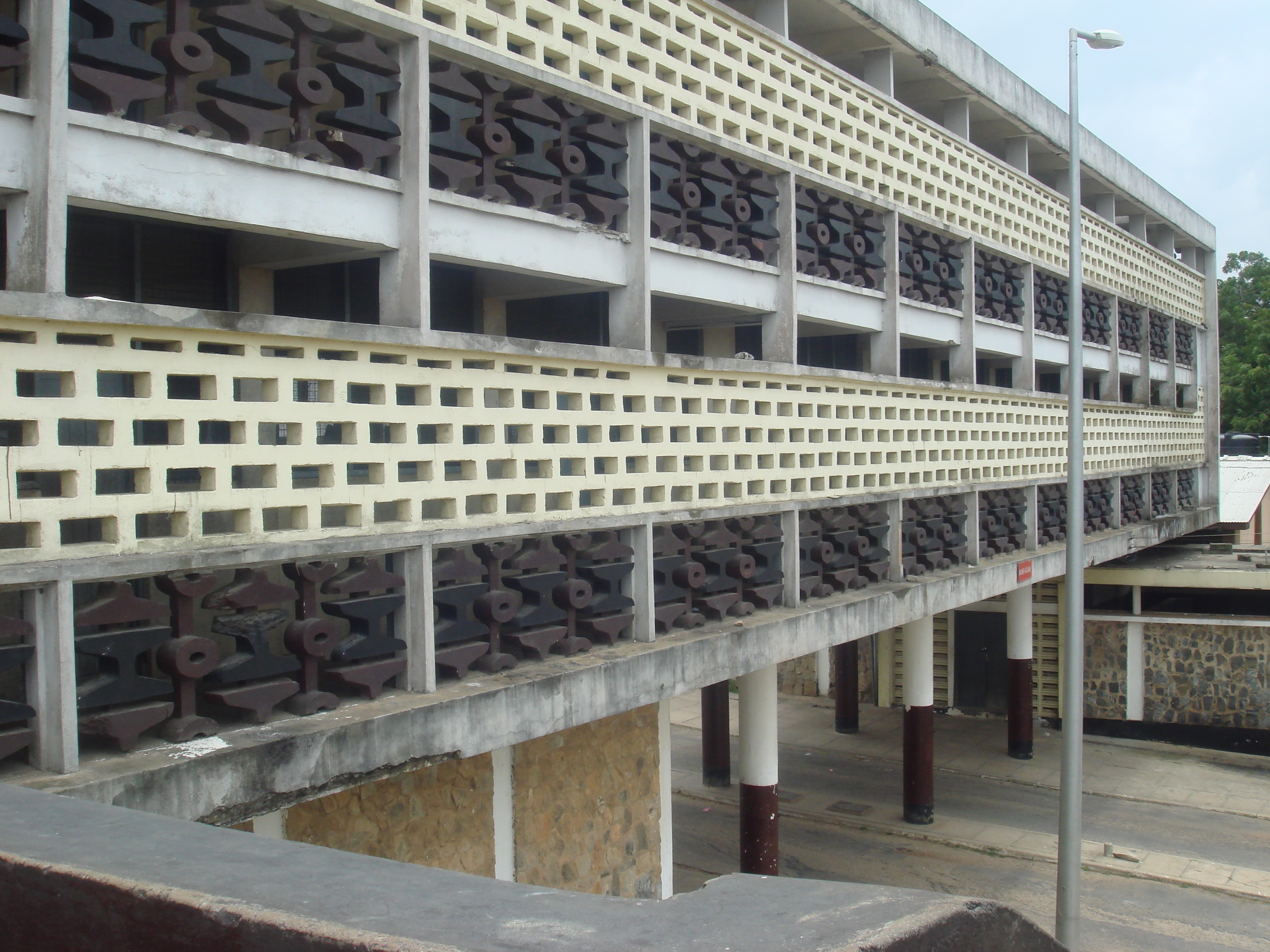
Maxwell Fry and Jane Drew developed the use of perforated screens in their West African ‘tropical architecture’. Designed to provide a sun-break whilst encouraging much-needed cross-ventilation in the hot and humid environment, the brise-soleil also provided an opportunity to add decorative forms to otherwise basic structures.

African influences – described in rather general terms by Fry and Drew as strong forms and colours – were used to bring regionalism to their imported modern ideas. Variants of sculptural ‘African’ forms are used in each of their school, university and hospital projects to provide an instantly recognizable Fry and Drew motif. Over the coming weeks images of these buildings will be posted.

13.2.4 ArchRev

Jane Drew said of their attempts to bring regional character to the modernist buildings:

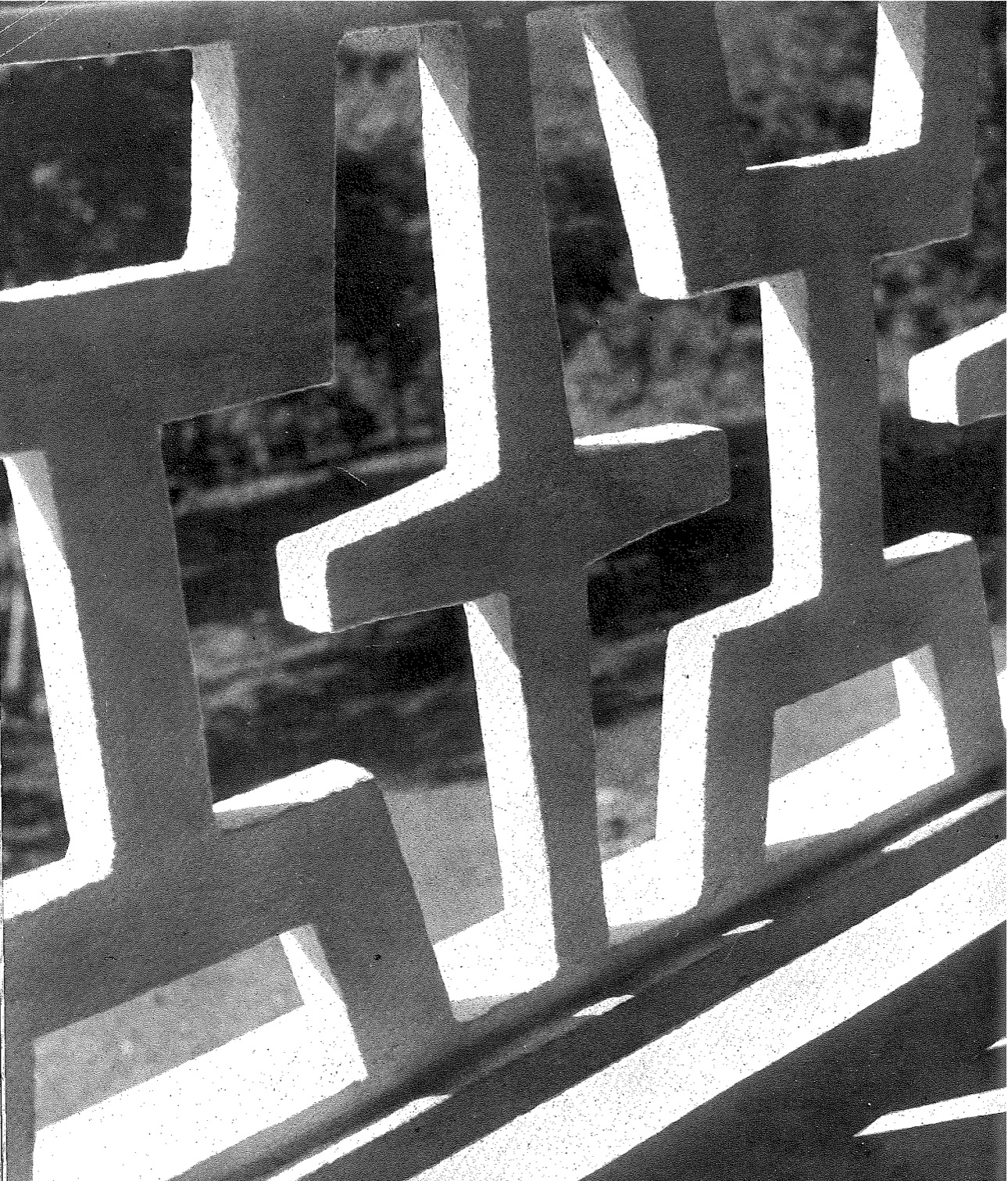
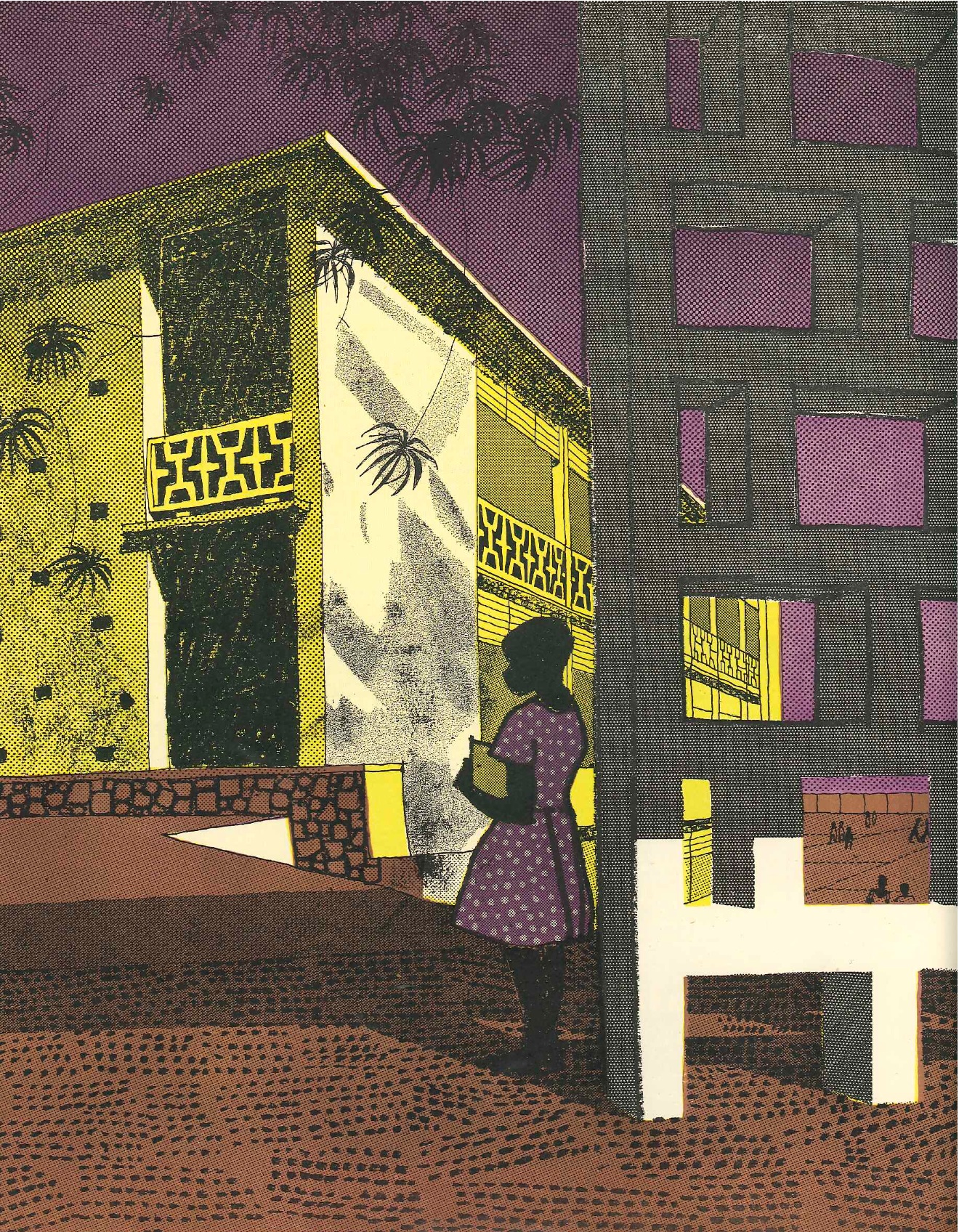
‘The particular architectural character comes not only from the mono-pitch roof and long low blocks … but from the sunbreakers, grilles and other shading but breeze-permitting devices. … the sunshine and moisture and heavy overcast sky and feeling of oppressive lethargy seem to call forth moulded forms which are rhythmical and strong, not spiky and elegant, but bold and sculptural.’

Below, Gordon Cullen’s sketch of bold forms and strong shadows emphasizes Drew’s words. These images are taken from an article on Fry and Drew’s ‘African Experiment’ published by Architectural Review in May 1953 and show the perforated balustrade designed for the Adisadel College extension at Cape Coast, Ghana.

13.2.4 Cullen

A Manual of Modernist Regionalism for Tropical Africa: The cultural environment shaped by Maxwell Fry & Jane Drew.

Edwin Maxwell Fry and his wife Jane Drew, with their West African designs in the 1940s, established a design system that had modernist theories as a starting point and developed ideas of climate responsiveness, development planning and adaptation to the new post-colonial social conditions. This system was promoted in the 1950s within the techno-scientific network of the new British Commonwealth, under the name of Tropical Architecture through publications, conferences and the institution of courses of studies in London and Kumasi.

Jacopo Galli’s PhD research will analyse Tropical Architecture from the factors that influenced its conception: the British medical-engineering tradition, the exportation of modernism and the highly experimental environment. Jacopo intends to analyse the numerous educational institutions built in West Africa by Fry & Drew and several other designers, for instance James Cubbitt & Partners, Godwin & Hopwood and the Architect’s Co-Partnership. These buildings were conceived as experiments to verify the functioning of climate devices and urban solutions. Finally, he will verify how this empire of good practice reached its highest point in the publication of Tropical Architecture in the Dry and Humid Zones in 1956: the textbook approach of the manual seen as the conclusion of the entire experience and its consequences in the history of bioclimatic architecture and planning for development.

Colonial Films Unit at Ibadan University

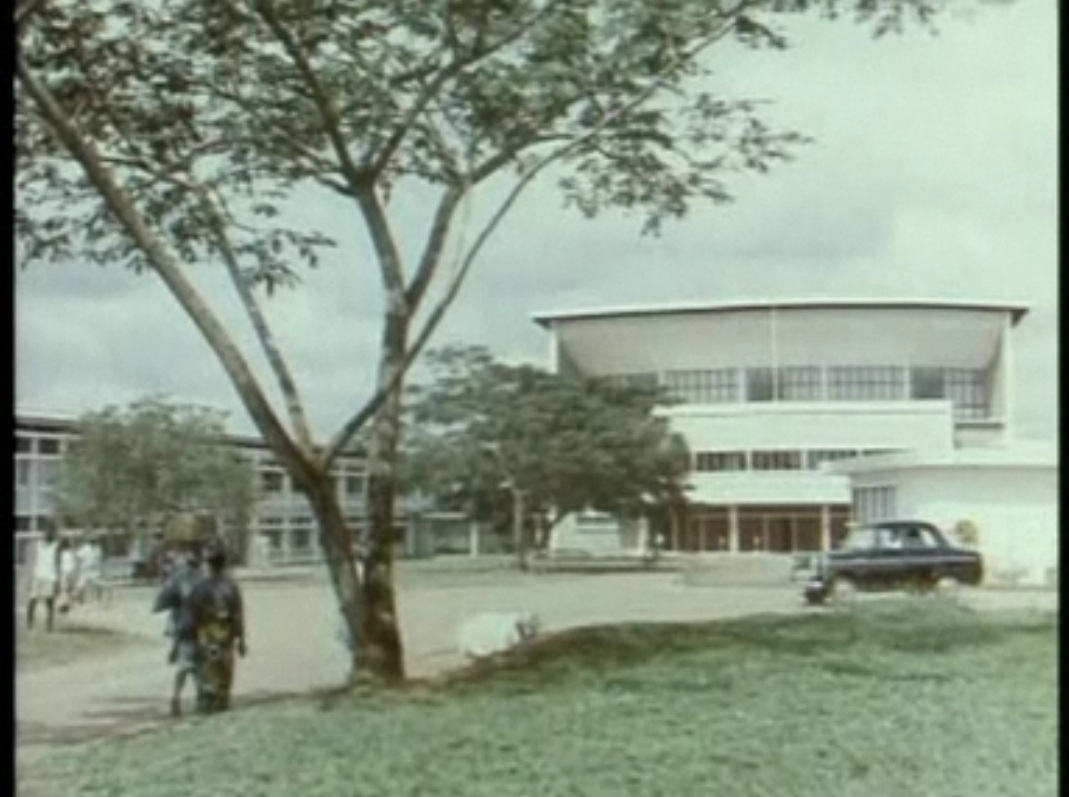
Following on from last week’s post on Ibadan University, here’s a still of Trenchard Hall taken from the 1958 film “Three Roads to Tomorrow”. It tells the story of three students from different parts of Nigeria making their way to university for the first time. Sponsored by BP, the film was made by Greenpark Productions to illustrate the way that ‘modern transport and oil power have changed the lives of all Nigeria’, says the narrator.

13.1.30 ui

The image shows the administrative block to the left of Trenchard Hall and the single-storey bookshop to the right, all designed by Fry and Drew as part of the first phase of development at the university.

The film is available to watch online at the excellent Colonial Film website, a research project intended to ‘allow both colonizers and colonized to understand better the truths of Empire’. The website brings together information on over 6000 films depicting life in Britain and its former colonies, including a fascinating collection of 150 films to view online – such as “Mr English at Home” (1940) and “Farmer Brown Learns Good Dairying” (1951).

A shining example of progress in colonial Nigeria, Ibadan University was the subject of several films, from the early stages of clearing, surveying and planning to the opening ceremony in 1954. Jane Drew featured in early footage; she wrote home to Maxwell Fry of being filmed on-site with the university’s first principal, Kenneth Mellanby:

‘This morning the colonial film unit took films of Mellanby, Jack Hoskins and I talking – a bit bogus but they want a full record’.

Indeed. Read about the Colonial Film Unit here.

University of Ibadan, Nigeria

In August of last year, some of the Transnational Architecture Group visited one of Fry and Drew’s best-known projects in West Africa – Nigeria’s first university, the University of Ibadan (1947-60).

Fry and Drew planned the campus, situated on a site of five square miles of farm and forest land, and designed many of the associated residential and teaching buildings. The campus is approached from a tree-lined avenue leading directly to a central tower, administrative offices and lecture hall. From this administrative centre, residential colleges and teaching buildings are laid out roughly east-west to take advantage of the south-west breeze.

Speaking of building in West Africa, Maxwell Fry summarises their straightforward but considered approach, which is shown so well at Ibadan University:

‘We were fated to make a new architecture out of our love for the place and our obedience to nature, and to make it with cement and steel, asbestos sheets, wood above the termite line, glass, paint and some stone later, and not much else’.

DSC08401

Fry’s words are demonstrated in their design for the central lecture hall, above. Trenchard Hall is constructed of a reinforced concrete frame infilled with concrete block and local stone. The ceiling sweeps up from the stage, over the internal balcony, and finishes at eaves level to the main elevation (shown above). Timber is used freely to the hall’s interior and adds warmth to the concrete columns.

Thanks to the Office of International Programmes, who made us very welcome and showed us around the university.

Map of Fry & Drew Projects

Over the course of our research we have plotted the built and unbuilt projects of the Fry and Drew partnership on an online map, with astonishing results. Although known for their work in West Africa and India, the geographical spread of the partnership’s work is considerable. Projects span Europe, Africa and Asia, tracing a line from The Gambia in the west to Singapore and Malaysia in the east.

The map gives a clear indication of Fry and Drew’s knowledge of Tropical Architecture, which they presented in a series of pioneering books: Village Housing in the Tropics (1947, with Harry L. Ford); Tropical Architecture in the Humid Zone (1956); Tropical Architecture in the Dry and Humid Zones (1964). These publications remain an important source of information – highlighted recently by Routledge’s decision to republish Village Housing in the Tropics later this year (with a new introduction by Iain Jackson).

13.1.21 VHT Sketch

Survey sketch for a new town plan, taken from Village Housing in the Tropics.

The online map is a work in progress and concentrates on work abroad, so not all UK projects are currently shown. If you have any comments or know of any other projects that might be added, please contact us: jholland@liv.ac.uk

Veterinary Building, Liverpool University

The importance of the Fry and Drew research project has been demonstrably underlined with the recent demolition of Maxwell Fry’s School of Veterinary Science (1955-60) at the University of Liverpool. There’s something particularly ironic about the Vet School being situated just a few hundred yards from our offices at the Liverpool School of Architecture – where Fry was a student in the 1920s – or maybe it’s just depressing!

Anyway, over the course of a week last October, it was demolished to make way for new student residences. Here it is, in two pictures: the construction and demolition, just over fifty years later (sigh).

13.1.18 DH Vet

© Sheffield Hallam University. Duncan Horne Collection, c. 1960.

13.1.18 Vet bldg

© Jessica Holland. 24 October 2012.

During the same period Fry also designed the university’s Civil Engineering building. Like the Vet School, it’s a great example of his humanist take on post-war modernism – combining textured and colourful materials, and artwork inside and out, to give a building ‘soul’ (in Fry’s words).

For further reading on these commissions, and for more images of both buildings, see: Iain Jackson, ‘Post-War Modernism: Maxwell Fry’s buildings at the University of Liverpool’, The Journal of Architecture, vol. 16, no. 5, pp. 675-702. Available here.

Graham Bligh on Pilkington Brothers’ Headquarters

Following on from the last post on Fry and Drew’s staff, here’s an excerpt from a recent interview with the Australian architect Graham Bligh, an employee at Fry, Drew & Partners around the same time as Duncan Horne.

Bligh describes his time working on the headquarters for the glassmakers Pilkington Brothers at St. Helens, Lancashire, designed and built from 1955 to 1965. Designed by Maxwell Fry, the project was run by Staff Architect, Peter Bond. As Bligh recalls:

‘I became entirely focused on the canteen building which is next to the lake … I particularly remember doing a detail of the building wall … coming up to the lake with the waterproofing going down … I had a detail which worked but it wasn’t aesthetically suitable, you know, things didn’t really line up and Peter chews my ear about that. But I said, “But Peter, it’s all under the water!” He says, “I don’t care where it is!” … It’s the integrity of the quality of dimensioning and the detail.’

13.1.14 PB Canteen

South façade of the Canteen, Pilkington Brothers’ Headquarters, St. Helens, c. 1965. © Pilkington Brothers

John Macarthur, Robert Riddel and Janina Gosseye interviewed Bligh in connection with the Architectural Practice in Postwar Queensland (1945-75) oral histories project. Visit the project’s website for further interviews with Graham Bligh and other Queensland-based architects.

Do you know these men?!

We are currently compiling a list of architectural and administrative staff employed by the various incarnations of the Fry and Drew partnership, from their pre-marriage work of the 1930s right through to the 1970s. The aim is to include a database in the forthcoming publication.

 13.1.10 GP office

© Sheffield Hallam University. Duncan Horne Collection, c. 1960.

This image is taken from architect Duncan Horne’s collection of photographs held at Sheffield Hallam University and available to view from their excellent online catalogue, Shimmer.

Horne trained at Liverpool School of Architecture and then worked for Fry and Drew at their offices at 63 Gloucester Place in London. His photograph neatly shows what life was like as a Fry and Drew staff architect around 1960, sat at a drawing board with pipe in hand. The smart chap, far left, is Duncan Horne, according to the Shimmer catalogue – can anyone confirm this?

Fry and Drew had lived and worked at the Georgian terrace since the 1940s, which became an open house for the artistic community at the time. As another former employee Trevor Dannatt commented recently at a docomomo-uk lecture, ‘the Fry’s ran a very hospitable house […] it was a place of great ferment.’

We would be very pleased to hear from anyone who worked for Fry and Drew, or knows of any former employees. Leave a comment or contact us at: jholland@liv.ac.uk

E. Maxwell Fry and Jane B. Drew: Modernism, Collaboration and the Tropics.

Iain Jackson and Jessica Holland are currently working on a Leverhulme-funded research project investigating Fry and Drew’s lengthy architectural careers and the wider cultural significance of their work, from the 1920s to the 1970s. The documentation of their work will highlight their significant collaborations with other architects and artists, including Le Corbusier, Walter Gropius, Denys Lasdun, Victor Pasmore, Henry Moore and Barbara Hepworth.

Fry and Drew were pioneers in what is now known as ‘Tropical Architecture’, due to their post-war buildings throughout Africa, from The Gambia to Mauritius, and across Asia, from Iran to Singapore. The project focuses particularly on their extensive work in Ghana, Nigeria and India.

In the UK, Fry and Drew’s often overlooked later projects (1950-70) will also be investigated. While their contemporaries – such as the Smithsons, James Stirling and Denys Lasdun – embraced the changing interpretations of modernism, Fry in particular stuck to the restrained, polite forms that he had promoted in his late ‘thirties work. An examination of Fry and Drew’s increasingly divergent architectural aesthetic will conclude the study.

The project continues through 2013. The findings will be presented in the first monograph of Fry and Drew’s work, published by Ashgate in 2014.