The gallery of everything presents an installation of original sculptures and figures by Nek Chand Saini (1924 – 2015).
Born in 1924, Saini was a village-born child whose family fled to india as refugees. his lifetime project, started in secret in the 1950s, was a maze of narrow walkways and sloping gardens, filled with hand-crafted figurines.
Nek Chand, 2005
Originally titled the kingdom of gods and goddesses, his creative practice was situated somewhere in between land art, landscape architecture and the vast realm of the folkloric vernacular.
Yet even in his lifetime, Saini saw himself neither as an artist, nor as author of his environment. instead, he saw his project as a welcome contrast to Chandigarh’s sharp modernist lines, and a place where everyday people could simply go, discover and be.
In this centenary year of Nek Chand Saini’s birth, The Gallery of Everything honours his profound achievement with an installation of works from the 1960s, 1970s and 1980s, including original ceramic and bangle figures created by Saini and his team of workers.
The Road Less Traveled is the overarching title given to a yearlong series of exhibitions programmed at the Kohler Arts Center to celebrate its 50th Birthday Anniversary – including a major exhibition on Indian artist and visionary environment creator, Nek Chand. The Arts Center has the largest collection of Nek Chand sculptures outside of the Rock Garden in Chandigarh – and they’ve put 200 sculptures on show in an extraordinary exhibition.
Curator Karen Patterson was looking for a more collaborative and creative approach to curating the shows and selected a responder for each exhibition to bring new and unique insights to the work and the final shows.
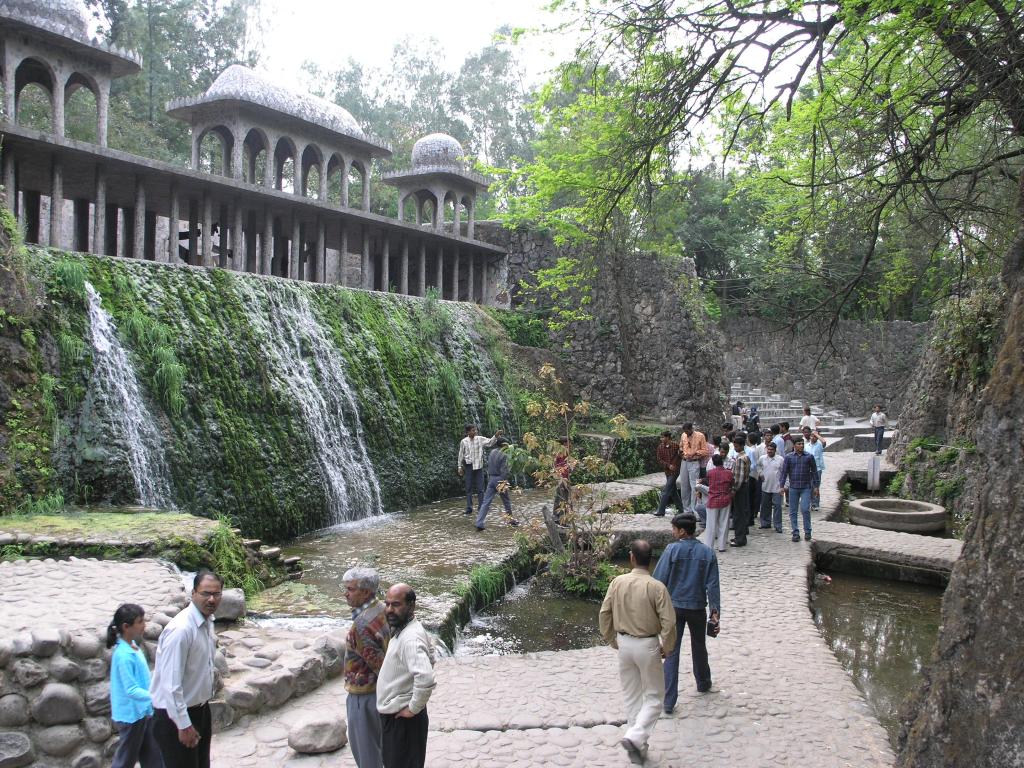
Karen asked me to send her a few ideas on how Nek Chand’s sculptures might be presented and exhibited. We met in Liverpool and discussed a range of concepts, including developing a virtual reality film of the Rock Garden [something I’m really eager to do]. We spoke about the experiential, almost cinematic nature of the Rock Garden – and how it is arranged as a series of distinct ‘outside rooms’ or events. Moving through the space and watching the sculptures being ‘revealed’, hidden, and glimpsed through this process is crucial in Nek Chand’s work.
Sculptures by Nek Chand
Sculptures by Nek Chand
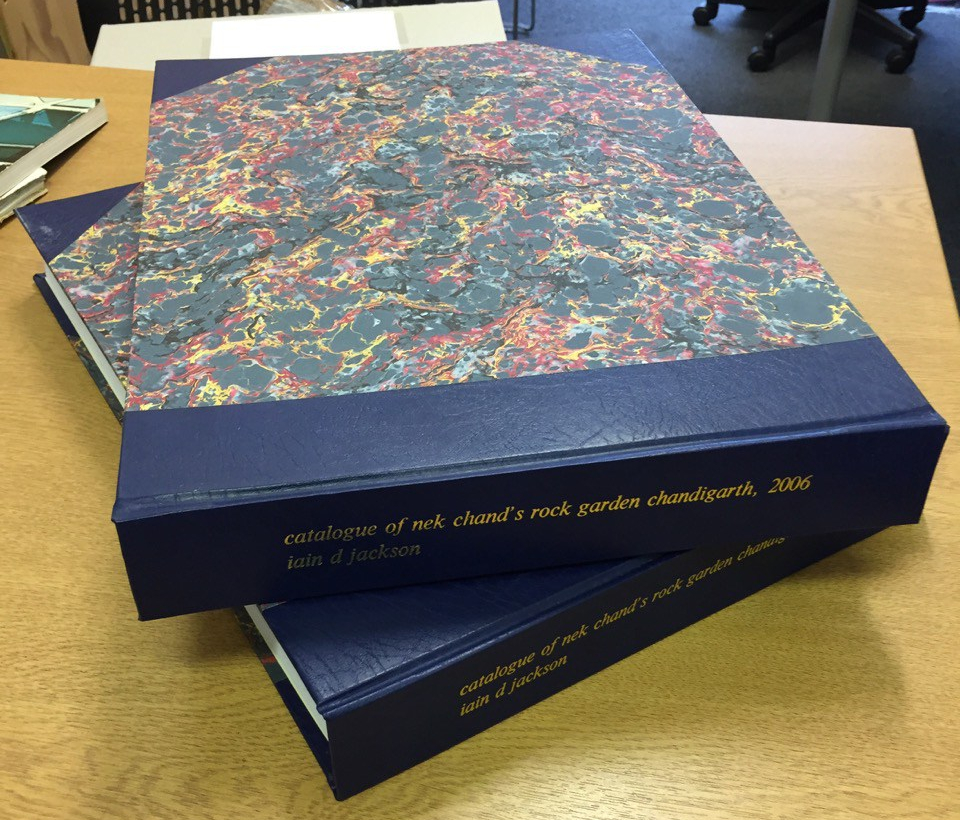
It was also a decade since I completed my PhD research – and I felt it was a good time to revisit my measured drawings and catalogue of the Rock Garden. Karen agreed to exhibit my survey work and I got the catalogue reprinted at A3 size and its 250+ pages hard bound. I really enjoyed ‘re-discovering’ my old work. The survey drawings had been kept rolled up in a plastic tube for ten years, and I carefully extracted the coil of drawings, not knowing in what condition they might be in. Thankfully, they were exactly as I’d left them- tattered at the edges, full of rips, holes and dog-eared corners. I sent them off to the Arts Center, hoping they wouldn’t get lost in the post…
The catalogues of Nek Chand’s work
I arrived at the Arts Centre a few days before the official opening, having seen the CAD drawings of the proposed show, produced by the exhibition designer and co-curator Amy Chaloupka. There’s always a disconnect between an architectural drawing and what it represents – and this was no exception. The scale of the exhibition is vast – and the amount of work required to produce, install and prepare the ‘terrain’ is incredible. One really gets a sense of what it is like to be in the Rock Garden – without there being any sense of pastiche or mimicry. The sculptures are arranged according to type on a series of terraced podiums that sweep through the space, compressing the visitor into a narrow gorge-like passage where the sculptures are densely arranged facing into the walkway. This approach puts the sculptures at eye level and really enables a dialogue to emerge between the viewer and the figures. As well as the concrete sculptures there is a collection of the cloth works – an often overlooked component of Nek Chand’s work – they are again arranged as a group and tightly gathered so that they read as an ensemble of works that need to be walked around, and examined.
An early Nek Chand sculptures, c.1960
Coloured ceramics suggests early edition, but facial features are much later – is it a re-work?
Clinker hair, and brick-dust pigment gives the pinky-brown hue to the skin
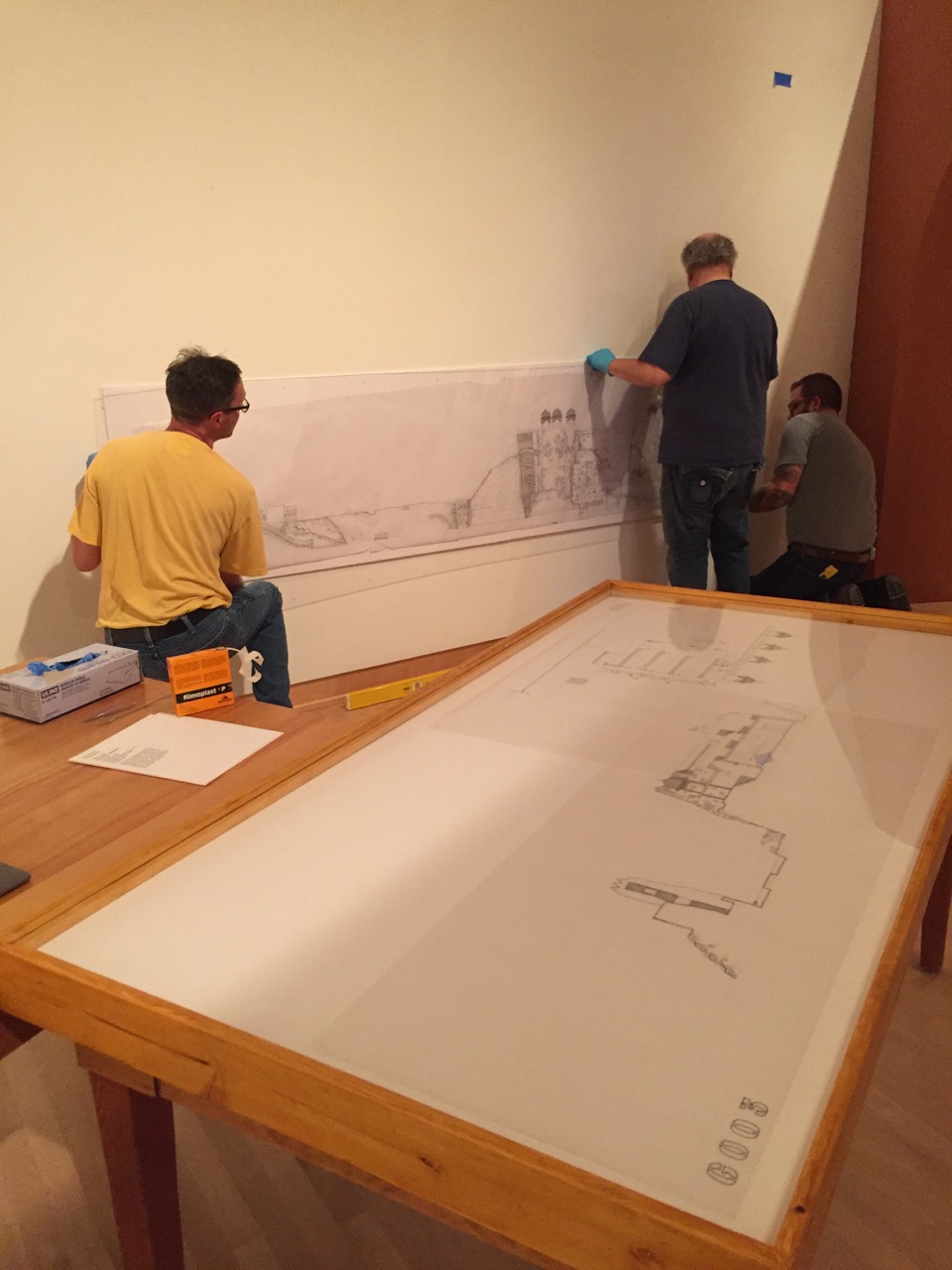
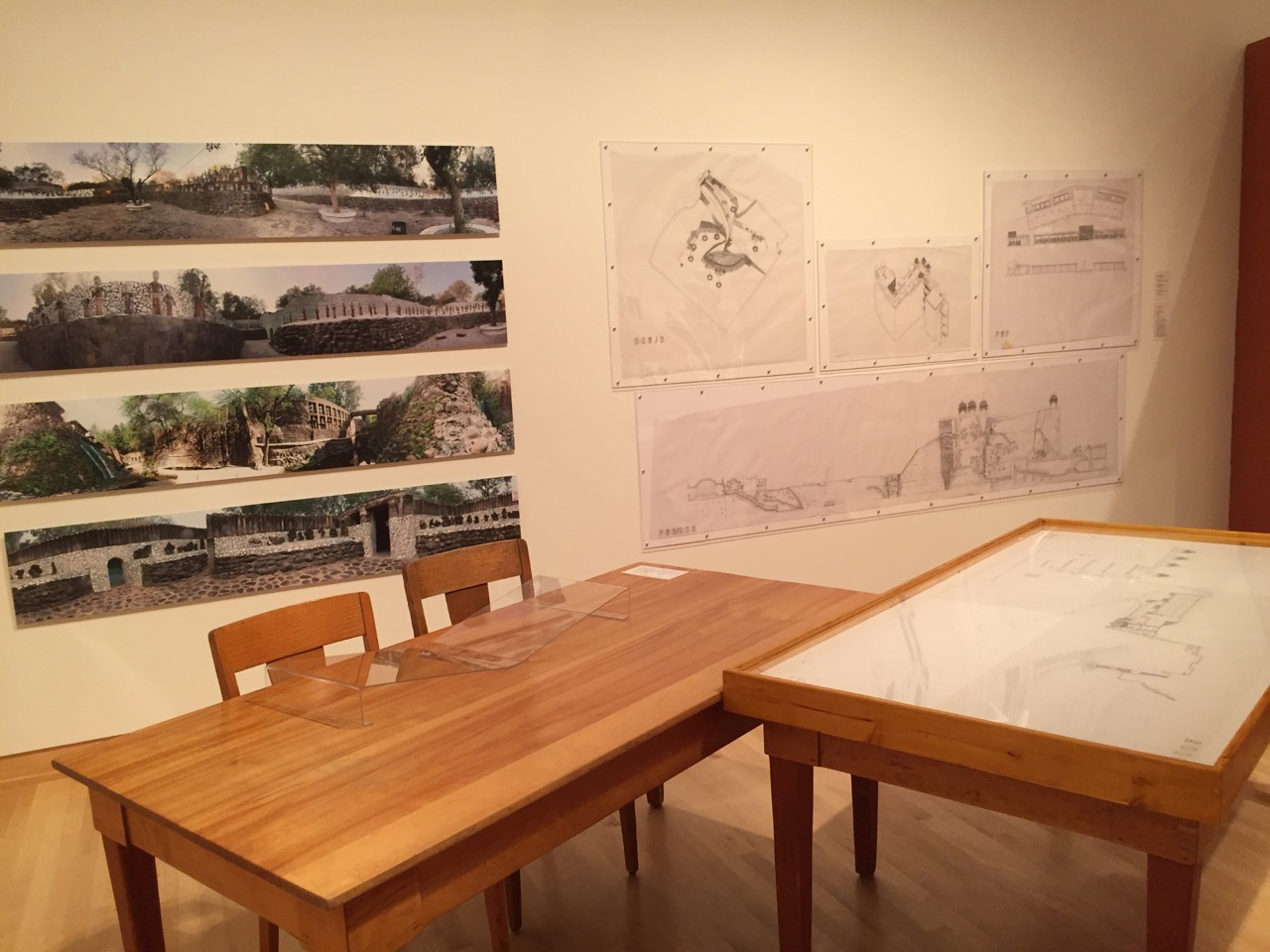
In addition to Nek Chand’s sculptures there is an archway reminiscent of the Phase-3 part of the Rock Garden. Contained within this segment of the exhibition are four panoramic photographs, the catalogue and the survey drawings.
Installing the Drawings…
Panoramic photos and drawings. The catalogue sits on the perspex stand.
Exhibition: Nek Chand at Pallant House Gallery, Chelmsford, until 25th October
This is a rare chance to see Nek Chand’s work in the UK, and in an external setting which is how the sculptures should be seen. Pallant House Gallery has a large group of sculptures on show courtesy of the Nek Chand Foundation.
I re-visited Nek Chand’s Rock Garden, Chandigarh in August, eager to see how it was being treated and maintained following Nek Chand’s passing in June. I was very concerned that at best it would not be managed properly, and my worst fears were theft and destruction of this unique creation. It was such a relief to see it all looking better than ever. The walkways were clean, litter free and everything was running smoothly. Whilst work seems to have ground to a halt in ‘phase 3’ this may not be a bad thing. Perhaps we now need to think of the garden as being complete and any further changes to be made with utmost care and restraint.
Architecture: how public space in India was refined by Charles Correa and Nek Chand Saini
In a single week this June, the world of architecture lost two artists who celebrated modern India through buildings, landscape, sculpture and gardens. Charles Correa, India’s best known architect, died on June 16 in Mumbai. Nek Chand Saini, the creator of the Rock Garden in Chandigarh, died on June 12. A self-taught artist, he created art work out of junk.
My research in India has taken me to some truly wonderful sites, not least the 16th-century city of Fatehpur Sikri, near Agra, commissioned by Mughal emperor Akbar. Well-designed spaces bring pleasure and even improve health and well-being, rather like a good piece of music.
Like those at Fatehpur Sikri, Correa and Nek Chand simply made structures and spaces that feel “better” than others. Despite hailing from opposite ends of the social spectrum, both reached shared conclusions about what makes a space work. But more than this, through their lives and work, they tell us something of the story of India.
Honouring nature and values
Born in 1930 in the colonial town of Secunderabad, Correa studied architecture at MIT in the US before returning to India in 1954. He immediately set out to develop an architecture that responded to climate, rejecting the US euphoria for air-conditioning. Instead, he sought solutions that would exploit cool breeze and shade.
Courtyard cafe of architect Charles Correa’s Jawahar Kala Kendra in Jaipur, built in 1993. Meena Kadri, CC BY-SA
Correa was also pursuing an architecture that would respond to India’s recent independence. He sought to introduce notions of “Indian-ness” into his proposals. His architecture is not overly concerned with elaborate forms, rather it seeks to create a series of flowing spaces often centred around an “open-to-sky” element. The visitor moves through the buildings blurring divisions between inside and outside, taking in carefully incorporated views.
Art out of waste
Nek Chand, creator of the Rock Garden in Chandigarh Iain Jackson, Author provided
Nek Chand took a less conventional approach. Often referred to as an outsider artist, he received no formal training. Born in 1926 in what is now Pakistan, the son of a farmer, he was forced to flee his home in 1947 as a result of India’s Partition.
In 1951, Nek Chand obtained work at the construction site that was Chandigarh – a new city to replace the loss of Lahore – designed by the modernist architect Le Corbusier. He worked as a road inspector by day. By night, he created a secret sculpture park full of figures made from found objects, broken ceramics and the remnants of the villages demolished to make way for Chandigarh.
Nek Chand’s Rock Garden
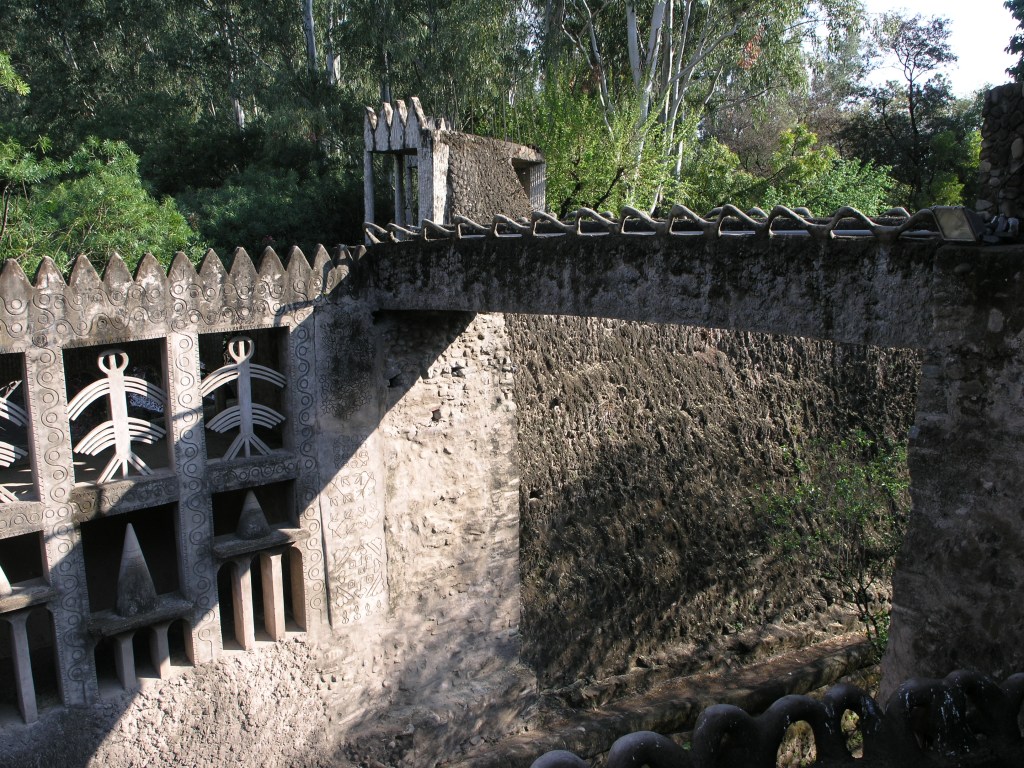
He also crafted the landscape to include waterfalls, courtyards and caverns clad in river rocks and broken sanitary ware fittings. Nek Chand’s Rock Garden, a truly wondrous place invoking playful narratives at every turn, now receives thousands of visitors every day.
Space that evokes and engages
Both Correa and Nek Chand were concerned with the notion of promenade, where the visitor is taken on a journey through a series of enclosed spaces, proceeding spaces hidden from view and revealed suddenly to dramatic effect. Both exploit a site’s natural attributes, responding to contours and always incorporating sculpture and artwork.
Both make a subtle reference to the past, often suggestive of village life, not in a sentimental manner but rather as an integral part of the design. Use of devices such as a space to talk and meet with friends, or a spot to sit quietly with strangers to share a view, have a profound effect. The powerful experience of simply walking through a courtyard clad in a careful selection of materials whilst admiring nature, landscape and artwork, cannot be understated.
Both Correa and Nek Chand were deeply affected by India’s Independence and sought to contemplate this event through their work. For Correa, it was a time to rebuild and rethink the nation, to debate what it meant to be both modern and Indian. At the same time, his use of Mughal-inspired red sandstone demonstrates the idea that India’s pre-colonial past was to be celebrated.
As a migrant to the symbol of India’s political ambition, Nek Chand was also well aware of the changes afoot. In his work there is a sense of loss, a longing to remember the past, as well as a childlike desire to recreate mythological scenes from folk tales and epics.
After their deaths, the works of Charles Correa and Nek Chand will remain wonderful tributes to their passion to improve built urban space in modern India. There can’t be many better legacies than the simple fact that we can learn much about space, light, form and beauty from the spatial experience of joy which their creations have given us.








 Transnational Architecture Group
