Archive

Tag Archives: Nigeria

Exports Only?

Export Architecture. To the casual reader, this phrase may come across as almost self-explanatory, devoid of any further need for clarification. Export, most will reason, literarily connotes the transfer of a product from its source of production to a foreign or external recipient, usually in exchange for a fee, charge or emolument. As for Architecture, the reader might almost think, well, we all know what architecture is! Caution is however advised, as such perceived ‘knowledge’ on architecture could often be very superficial.

In spite of the lack of complexity to the reasoning described above, it does provide a basic insight to export as a means of product transfer. The ‘Product’ here, is however largely limited to a perception of manufactured (or material) goods, but which exportation clearly transcends. Culture, lifestyle, language, and fashion among other things, are immaterial endeavours also exported across borders. Architecture, possibly rated material in terms of the physical building components it employs, and immaterial with regards to construction methods, building forms and functional requirements – has been exported all through history by explorers, adventurers, and new settlers.

Lagos European Quarters

The architecture established in Nigeria during the British colonial era could well be assumed a classic example of export architecture, with features that reflected architectural traits from the heart of empire and were alien to the prevailing indigenous buildings of the time. It may however constitute a very hasty and almost erroneous judgement to assume that all British colonial buildings were export products. Could there perhaps, have been instances where indigenous architectural style and features were adapted, or even wholly copied in colonial building?

Writing on the building works carried out by European builders in Nigeria, Arthur M. Foyle in a 1951 The Builder Journal, had noted the character of early houses for government staff in Nigeria. He observed that while they were built of timber in the south, in the north and in the more inaccessible areas, staff housing were usually constructed of local materials and often by local labour using traditional methods of construction.

Image

Hausa Built form, Northern Nigeria

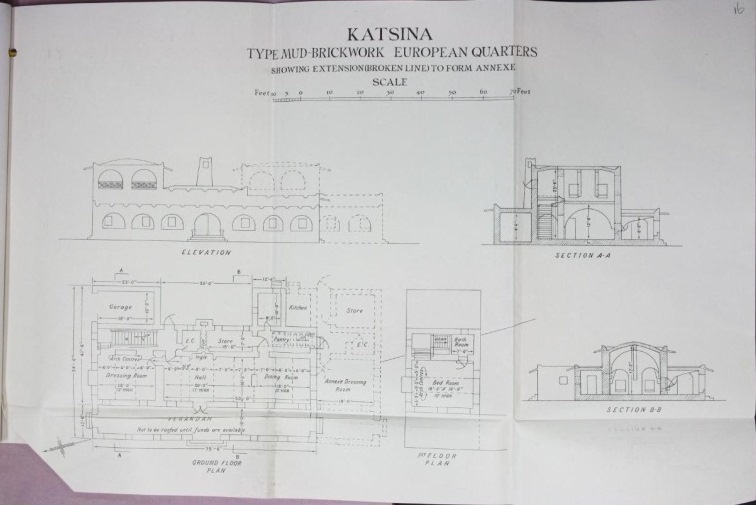
This ‘Type Mud brick European quarters’ designed by Nigeria’s colonial Public Works Department presented here, was sourced from a 1933 technical paper of the department, and rightly corroborates Foyle’s observation. The European quarters’ adapted features may perhaps, be better understood if analyzed on surviving Hausa built form models of Northern Nigeria. Although its plan retains a European model with a garage, hall, pantry, store and dressing room on the ground floor, and features a bedroom and bathroom upstairs, the quarters design largely adapts local form and materials to accommodate the colonial lifestyle.
Image

1933 Drawing of European Quarters at Katsina

BP Headquarters, Lagos, Nigeria

On 1st October 1960, Nigeria gained independence from Great Britain. Jane Drew was in Lagos during this historic period and she wrote home to Maxwell Fry of the carnival atmosphere in the capital: ‘Lagos is electric with excitement.’

Drew was in town to attend the opening of the headquarters for British Petroleum in Lagos, designed by Fry, Drew & Partners. The office block is one of several lucrative projects designed by Fry and Drew for British companies in West Africa – others include the Co-operative Bank, just a few streets away from the BP building, and the Leventis Store in Accra.

13.2.11 BP HQ

Now African Petroleum House, the roof terrace has since been filled in to provide an extra floor of office space and the louvres have been altered – no doubt following the introduction or upgrading of the air conditioning. For images of the building shortly after its opening, see the RIBA online photograph collection.

Colonial Films Unit at Ibadan University

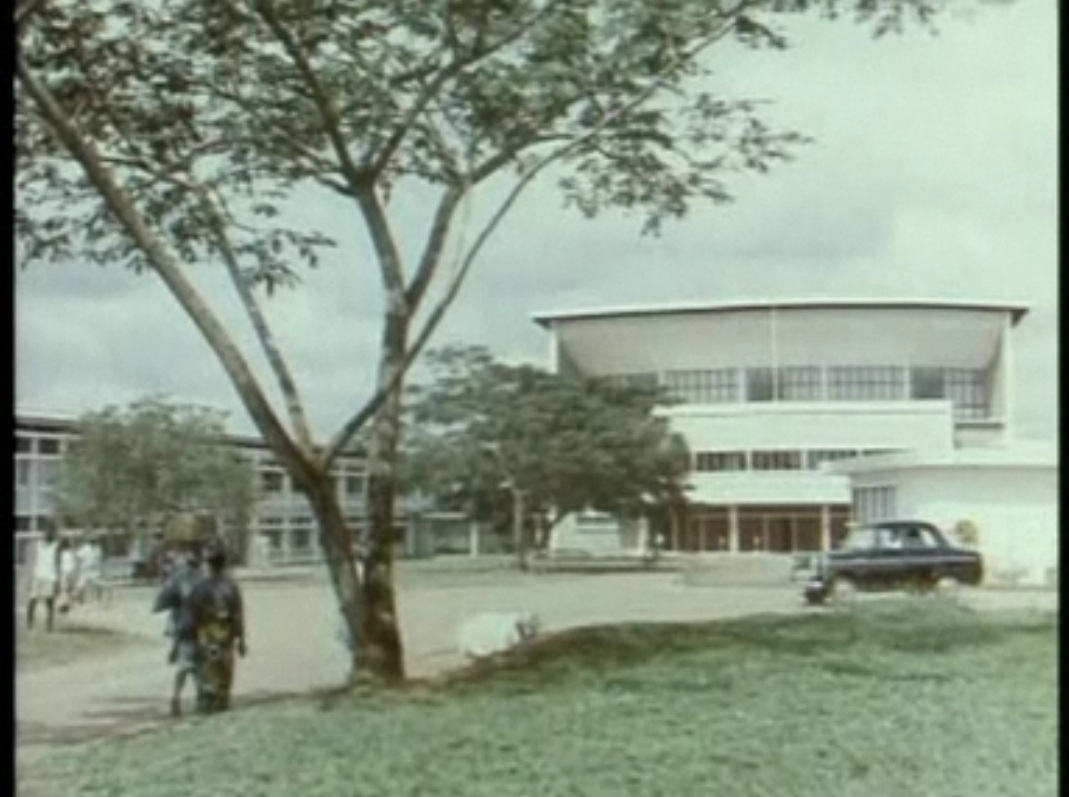
Following on from last week’s post on Ibadan University, here’s a still of Trenchard Hall taken from the 1958 film “Three Roads to Tomorrow”. It tells the story of three students from different parts of Nigeria making their way to university for the first time. Sponsored by BP, the film was made by Greenpark Productions to illustrate the way that ‘modern transport and oil power have changed the lives of all Nigeria’, says the narrator.

13.1.30 ui

The image shows the administrative block to the left of Trenchard Hall and the single-storey bookshop to the right, all designed by Fry and Drew as part of the first phase of development at the university.

The film is available to watch online at the excellent Colonial Film website, a research project intended to ‘allow both colonizers and colonized to understand better the truths of Empire’. The website brings together information on over 6000 films depicting life in Britain and its former colonies, including a fascinating collection of 150 films to view online – such as “Mr English at Home” (1940) and “Farmer Brown Learns Good Dairying” (1951).

A shining example of progress in colonial Nigeria, Ibadan University was the subject of several films, from the early stages of clearing, surveying and planning to the opening ceremony in 1954. Jane Drew featured in early footage; she wrote home to Maxwell Fry of being filmed on-site with the university’s first principal, Kenneth Mellanby:

‘This morning the colonial film unit took films of Mellanby, Jack Hoskins and I talking – a bit bogus but they want a full record’.

Indeed. Read about the Colonial Film Unit here.

University of Ibadan, Nigeria

In August of last year, some of the Transnational Architecture Group visited one of Fry and Drew’s best-known projects in West Africa – Nigeria’s first university, the University of Ibadan (1947-60).

Fry and Drew planned the campus, situated on a site of five square miles of farm and forest land, and designed many of the associated residential and teaching buildings. The campus is approached from a tree-lined avenue leading directly to a central tower, administrative offices and lecture hall. From this administrative centre, residential colleges and teaching buildings are laid out roughly east-west to take advantage of the south-west breeze.

Speaking of building in West Africa, Maxwell Fry summarises their straightforward but considered approach, which is shown so well at Ibadan University:

‘We were fated to make a new architecture out of our love for the place and our obedience to nature, and to make it with cement and steel, asbestos sheets, wood above the termite line, glass, paint and some stone later, and not much else’.

DSC08401

Fry’s words are demonstrated in their design for the central lecture hall, above. Trenchard Hall is constructed of a reinforced concrete frame infilled with concrete block and local stone. The ceiling sweeps up from the stage, over the internal balcony, and finishes at eaves level to the main elevation (shown above). Timber is used freely to the hall’s interior and adds warmth to the concrete columns.

Thanks to the Office of International Programmes, who made us very welcome and showed us around the university.