Archive

Tag Archives: Railway buildings in Africa/West Africa

An Update from Takoradi, Ghana

We started at the Takoradi Train Station, completed by 1928 as part of the coastal rail and docklands development. The train lines were initially constructed to transport cash crops, minerals and metals from the northern agricultural and mining districts to the awaiting ships, sheltered in the newly constructed breakwater and deep water harbour. When we visited in 2012 the train station was completely derelict and not in use. Today we found it carefully restored and new tracks laid. The plan is to reuse it for a local transport network. We walked up the hill to the small commercial district made up of international banks and a post and telegrams office. The mishmash of styles reveals the incremental development, as well as the fierce competition between the banks eager to differentiate themselves from the competition.

The former European hospital clock tower up on the hill overlooks the banks and docklands, as well as benefiting from the cooling sea breeze.

We drove to the 1920s part of Takoradi, a major new town extension that was built to accompany the docks development of that time. This portion of the town was primarily for the African population, although it also contains the Lasdun designed Bank of Ghana [built 1957]. Lasdun was also the architect of the National Museum in Accra. The bank was vacant when we visited in 2012, but now it stands in a state of complete dereliction, its fine materials and fixings being stripped from the building. This is a real tragedy. It was once an outstanding building, recorded in the Architecture journals of the day and surely one of Lasdun’s greatest works from this period.

img_0633

Somewhat downbeat, we bid farewell to the bank, and made our way to the rond-point in the middle of the town. The map was deceiving, as this was built as a major market place – our driver told us it was one of the largest markets in West Africa. It had the feel of Kariakoo market  in Dar es Salaam, and also contains a delightful little PWD post office with its signage graphics still intact.

Adjacent to the market is Amanful Village. Laid out in 1922-3 it is a mixed use area of housing and commercial properties. The basic PWD-type houses and layout remained in place, but more wealthy owners had transformed much of the upper part of the estate to suburban housing.

We then went to the Takoradi Technical Institute, shown above (Left, b+w) in the Africa Through a Lens Collection at the UK National Archives. There is a forcefulness to this scheme that takes the familiar two storey gallery access format, and emboldens into more ‘clunky’ yet determined architectural-structural forms.
dsc_0363

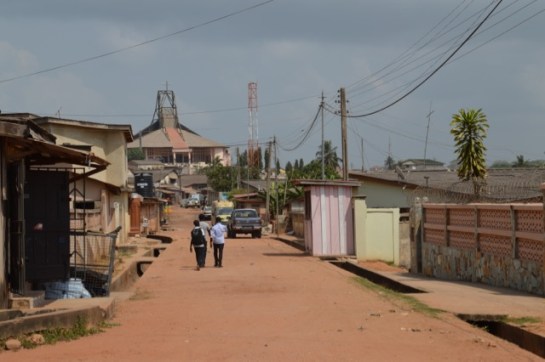
Nearby is the Effiekuma housing and the Effia Nkwanta hospital. The hospital has evolved overtime from a European hospital-cum-sanatorium in the colonial period, to a major health provider today. The careful layering and response to the site contours offers delightful views as well as a most welcome breeze to all the small structures that each have a view of the docks. At the top of the hill is a large brutalist extension that dates from c. late 1960s early 1970s. But who designed it?

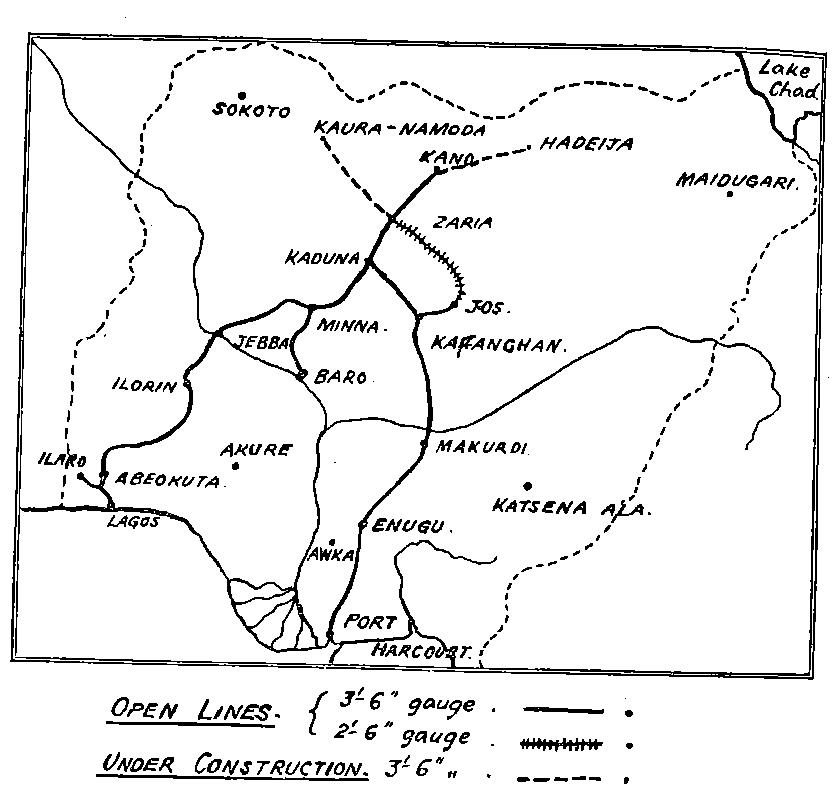
There have been recent debates in the UK media on the need (or not) for the high speed train, HS2, that is being proposed to run from London to the central belt of Scotland. This brought into my remembrance the establishment of the railways in Nigeria beginning from 1895, and its 29 year extension into the hinterlands that concluded in 1926. The establishment of Nigeria’s railway system has often been credited to Sir Thomas Carter, who was the colonial Governor of Lagos from 1891 to1897.

Carter

Sir Gilbert Carter in 1893

Certain events however built up to the coming of the railways. After the annexation of Lagos in 1861, the British initially adopted the policy of non-interference with the Yoruba hinterland. Lagos had therefore being administered from Sierra Leone and later the Gold coast. Around 1886, Lagos was detached from the Gold Coast, became an independent colony and began taking a kin interest in the affairs of Yoruba land, particularly with the looming threat of French intervention in the region. Yoruba inter-ethnic squabbles were not only at their pick within this period, the disputes had also resulted in trade route closures to the interiors. This generated a lot of frustration for Britain’s quest into the interiors, as well as for British and native merchants who desired to trade in the hinterlands. By the third year of his appointment in 1893 therefore, Governor Carter set out on a grand tour of Yoruba land, concluding treaties and agreements with the native Egba and Ibadan chiefs. On the successful completion of the tour, he was able to obtain control over routes and the right to build railways.

rail construction

Construction of rail tracks

The PWD was therefore authorized to conduct a railway survey by the colonial office in 1885 under the then colonial secretary, Joseph Chamberlain. By 1896, construction began from Ebute-Meta on Lagos mainland towards the interior. By April 1899, the line was extended to Abeokuta, and by 1900 the following year, the line was open for traffic to Ibadan, a 120 mile distance from Lagos. The next major construction was the 1909 extension from Ibadan to Jebba, after which several other extensions and new lines were added. By the end of 1926, the total mileage of the system had attained 1,597, with a plan in place for an additional 150 miles of construction every year.

railway map

Railway map of Nigeria, Circa 1928

Though the PWD survey and engineering units undertook the land surveying and rail track constructions in this all new transportation project, its architectural unit had equally designed and constructed the train station buildings. These buildings currently constitute part of Nigeria’s vast colonial architectural heritage, and help raise questions about the PWD’s building programme; For example, were PWD standardized practices employed in the production of these buildings? Was there a ‘type design’ for the larger and busier stations and another for the less patronized? Were these ‘type designs’ strict prototypes enforced country-wide, or were there variants introduced? Where the designs a direct replica of train stations from Empire’s metropolis, or did they reflect local realities? These and other questions of interest could present a basis for further study.

old Ebute-meta

Old Ebute-Meta, Lagos, Platform (Undated)

ebute meta 2

New Ebute-Meta, Lagos Terminus, Circa 1955