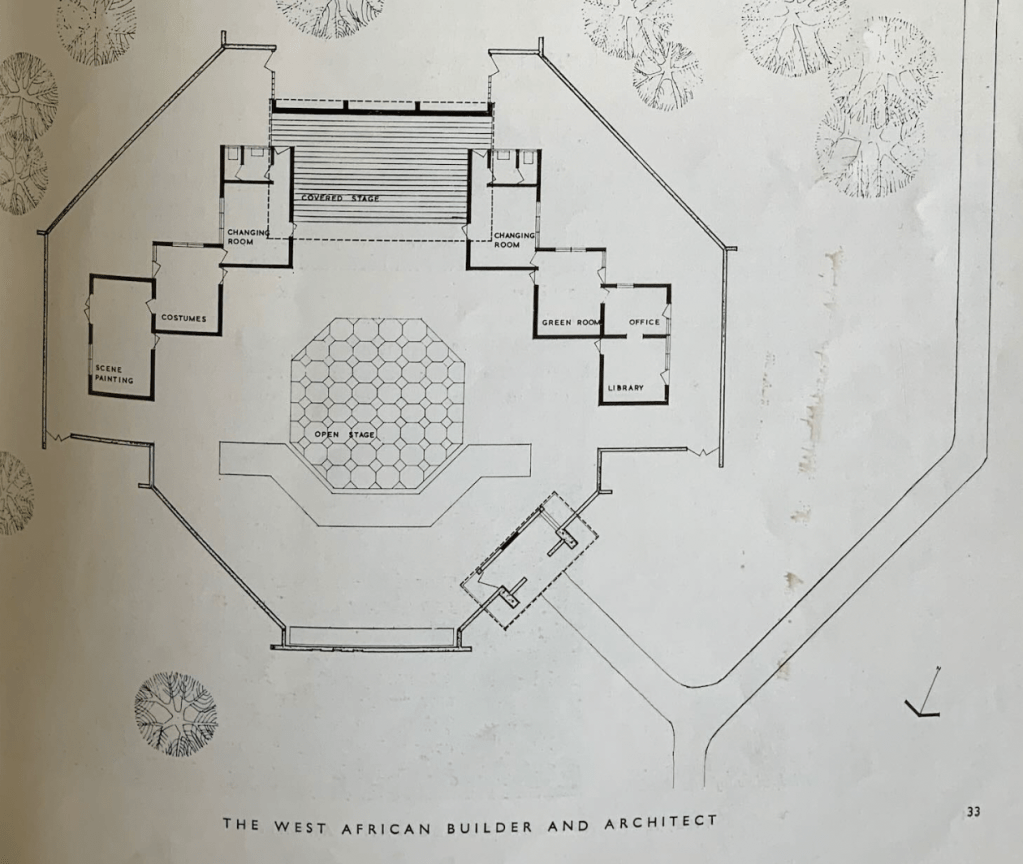
In 1958, the Ghana Arts Council and the Rockefeller Foundation provided the necessary funding to set up ‘the Experimental Theatre Players’ spearheaded by Efua Sutherland and Joe Degraft. Architects Gerlach and Gillies-Reyburn were commissioned to design the structure which was based around two performance stages – one ‘in the round’ and the other a proscenium arch theatre. It was Sutherland who generated the design strategy,
“Conceptualized by Sutherland, the dominance of traditional motifs in the architectural design of this theatre edifice was a statement of cultural renaissance, independence, and nationalism because she believed “political independence suggested cultural autonomy”
(Anku, S. S. (2022). (Post) Colonial Ghanaian Attitudes Towards Ibsen: An Overview of Ibsen Reception in Ghana Between 1930 and 1966. Ibsen Studies, 22(1), 3–30. https://doi.org/10.1080/15021866.2022.2063977).
The stages are enclosed by a series of interlocked rooms built from sandcrete and providing changing, offices, and other ancillary functions. The project received a full write up in the West African Builder and Architect journal in 1962.


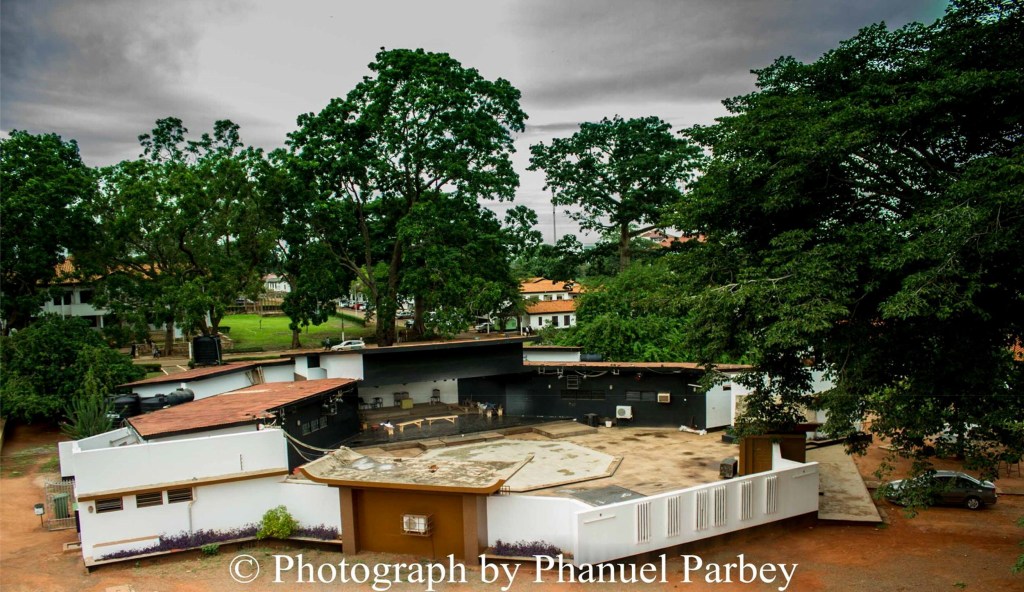
“It was a small structure, unpretentious but handsome, traditional in inspiration yet modern in design. The dazzling whitewashed walls with their dark trim resembled a village compound and were meant to. Inside, at one end, a platform stage was covered by an overhanging roof; but the auditorium, with its seats of carved Ghanaian stools, was open to the night sky. It stood in a rough, weedy place approached by dusty footpaths, its simplicity contrasting sharply with the gaudy grandeur of Accra’s nearby Ambassador Hotel. The crowds were gathering at the entrance that was shaped like a huge traditional stool and flanked by two massive Akuaba dolls, sculpted male and female symbols of fertility”
(Anku, S. S. (2022). (Post) Colonial Ghanaian Attitudes Towards Ibsen: An Overview of Ibsen Reception in Ghana Between 1930 and 1966. Ibsen Studies, 22(1), 3–30. https://doi.org/10.1080/15021866.2022.2063977)
Anku further notes that the theatre was “replicated and relocated to the School of Performing Arts premises at the University of Ghana” – it’s unusual for a building to be entirely remade in a new location. The old site, as Anku notes, was near the Ambassador Hotel – this is now where the Mövenpick Hotel is located. Was the structure physically demolished, moved, and rebuilt? Perhaps the old site is where the National Theatre is located today?
 Transnational Architecture Group