Tag Archives: West Africa
Current Research: West African Modernism & Urbanism Research Conference and Workshop
West African Modernism & Urbanism Research Conference and Workshop, 13-14 July 2015, KNUST, Kumasi, Ghana
You are invited to a workshop and conference which will focus on developing the conservation of modernist buildings and urban landscapes in West Africa.
This development strategy will be tackled at two levels. Firstly, at urban and edifice level, through the development of the KNUST Architecture Department as a Centre for public engagement with, and professional expertise in, contemporary urban conservation training and research; in West Africa, this discipline is currently not taught at institutional level, despite the existence of a network of architecture and planning schools, and architectural institutes for whom this would be beneficial.
Secondly, with support from DOCOMOMO International’s African group and Urbanism-landscape specialist committee, the workshop will develop a physical archive of modernist buildings in West Africa, using digital technology to scan and record building photographs and plans of the postwar modernist era. The data will be made available both to researchers linked to the proposed urban conservation training project, and, equally importantly, to the local public, as a visual resource of contemporary West African Modernist history.
The workshop will feature outreach presentations from junior secondary school pupils and talks from the eminent keynote speakers and research associates involved in the workshop and archive programme.
Keynote Speakers: Prof. Miles Glendinning [University of Edinburgh] and Prof. H. N. A. Wellington [Emeritus and Former Head of KNUST].
We acknowledge the support of this event by the Universities of Edinburgh, and of Liverpool, and by the Royal Africa Society.
For more details on the event please contact Dr. Rexford Assasie Oppong [assasie2003@yahoo.co.uk] / Dr. Ola Uduku [o.uduku@ed.ac.uk] for more details.
TAG Press: Fry and Drew Tropical Source Book
TAG Press Launched
The Transnational Architecture Group has published its first book, on none other than Maxwell Fry and Jane Drew. The aim of TAG press is not to publish lengthy peer-reviewed and ‘academic’ books, but rather to serve as an outlet for photographic material, catalogues, surveys and short essays.
The Fry and Drew Tropical Source Book contains photographic material on Fry and Drew’s projects in India and West Africa; including some previously unpublished letters sent by Fry in the early 1950s whilst he was working in Chandigarh to his site architect, Tony Halliday based in Ibadan, Nigeria.
Available as soft back on the Publications Page above.
Architecture of Independence
Scottish independence. Should there be an independent Scotland, or should Scotland remain an integral part of the United Kingdom? As the clock ticks closer to the proposed referendum on 18 September 2014, the debate rages on. Although the mid-twentieth century independence of West African nations took place under completely different circumstances, this article uses the present independence debate to re-ignite a discussion on Nigeria’s decolonization years, the attainment of independence and the architecture which emerged as a consequence.
The Governor General of Nigeria Sir James Robertson, and the new Nigerian Prime Minister Sir Abubakar Tafawa Balewa on Oct 1, 1960
The clamour for independence and self-rule in West Africa gradually began after World War II. This achieved its highpoint in 1957, when Ghana became the first African nation to attain independence and transit from colonial rule to self-governance. One feature which perhaps, became widely synonymous with the country’s drive for independence was the Pan-Africanist movement and the frontline role of Kwame Nkrumah, who later became Ghana’s pioneering president. However, a less referenced but equally important tribute to Ghana’s independence, were the architectural monuments which were constructed to commemorate the event. Chief among these is the Accra independence arch.
Independence Arch, Accra, 1957
As with Ghana, self-governance calls had pervaded different levels of Nigerian society before the October 1 1960 independence date. The most prominent perhaps were those propagated through African edited newspapers like the West African Pilot, and which echoed the voices of native elites and politicians. Nigeria’s formal decolonization process however appears to have started with the 1945 promulgation of Richard’s constitution. Not only had this constitution granted greater levels of native participation in the legislative house, it equally paved way for the much sought after regional system of governance. Nigeria was therefore reorganized along political and administrative lines into a Western region with headquarters at Ibadan, a Northern region with headquarters at Kaduna, and, an Eastern region with headquarters at Enugu, while Lagos remained the Federal Headquarters. With this new organizational structure came the formation of regional houses of Assembly and the election of its representative members.
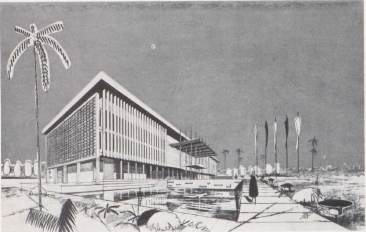
Design for Eastern Nigeria parliamentary complex, 1960
Of equal importance were the new parliamentary complexes being built to usher in the emerging era of self-governance, beginning from October 1 1960. The new buildings may therefore be described as some of Nigeria‘s most prominent symbols of transition to self-rule, and were indeed the ‘architecture of independence’.
Tropical Architecture: Current Research
Village Housing in the Tropics: With Special Reference to West Africa
The seminal book on Tropical Architecture by Jane Drew and Maxwell Fry has been republished by Routledge 66 years after its first edition was bravely produced by Lund Humpries.
The slender volume loaded with Fry’s cartoons and sketches became an instant hit, with its engaging insights and empirical findings. It was not aimed at the specialist or technician, rather the generalist and interested reader looking for quick tips to solve familiar problems. The book gives pragmatic advice on the siting of villages, housing orientation and matters relating to sanitation and health. Although the content was far from novel or radical, it presented previously dry and mundane material in a manner that was easy to understand, and encouraged greater attention to be given to the everyday housing problems of West Africa.
The book was used by Fry and Drew as a promotional tool, they included a copy along with their CV’s when applying to be considered for the University of Ibadan project and it almost certainly influenced their consideration for Chandigarh. It set them apart from others working in tropical regions, and with its emphasis on village housing firmly aligned them with the Colonial Office’s desire to promote ‘Development and Welfare’.
It almost goes without saying, but the publication was a product of its time and formed part of the colonial enterprise. Within the front and back endpapers of the book a map of the world is coloured to highlight Britain’s Colonial territories, highlighting where the book’s advice could be dispensed and treating all ‘tropical’ territories as one and the same irrespective of their specific contexts and climatic variations.
Available to purchase here: Village Housing in the Tropics: With Special Reference to West Africa (Studies in International Planning History)
Fry and Drew: Conference
‘The Influence of Fry and Drew’ Conference, Abstract 7
Viviana d’Auria, ‘“The most difficult architecture to create”: Fry, Drew & Partners’ contested legacies and the vicissitudes of low-cost housing design in (post)colonial Ghana’.
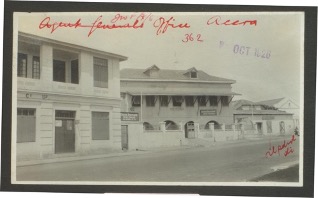
As has been well documented, Maxwell Fry and Jane Drew were intensely involved in British West Africa. From their Accra-based office, they designed the cornerstones of late colonial welfare development, ranging from hospitals to universities. Explorations of their West African work however, have neglected housing design, including the ways in which it confronted colonial antecedents and how expatriate practitioners and local professionals confronted its legacy. This disregard is all the more challenging seen the weight it had for Fry and Drew themselves, as well as its overall significance for general post-war technical assistance.
Indeed, in the case of housing conception too, the partnership’s work was envisaged at a time of confidence in the reconciliation of modernism and development within the walls of a low-income dwelling. Freshly-arrived in Chandigarh after several years spent in West Africa, Fry and Drew were important contributors at the United Nations Housing Seminar in New Delhi in 1953. At the event, their efforts not only earned them recognition with the prize-winning conception of House 23, but was also the topic of Fry and Drew’s paper, who underscored how low-cost dwellings were “of all architecture the most difficult to create”.
On such premises, this contribution focuses on pre-Chandigarh housing design in Ghana. By looking at cases from the Accra-Tema Metropolitan Area, it wishes to comment more particularly on how the partnership was concerned with indigenous dwelling cultures. It then reflects on how this centre of attention was (or not) picked up by international technical assistance and local government planning in the following decades. The notion of ‘growing’ and ‘extendable’ housing, in addition to gender-based typologies will be inquired into by means of selected cases such as the Jamestown slum clearance scheme, the work of the Tema Development Corporation and of the International Co-operative Housing Development Association.
..
Viviana d’Auria is Lecturer in Human Settlements in Development at the Department of Architecture, Urbanism and Planning (University of Leuven) and NWO Rubicon fellow at the Department of Geography, Planning and International Development Studies (University of Amsterdam). Her dissertation Developing Urbanism in Development: Five Episodes in the Making of the Volta River Project in (Post-)colonial Ghana 1945-76 (KU Leuven, 2012) explored the contribution of transnational technical assistance projects to the epistemology of (post-)colonial urbanism through the particular case of the Volta River Project. Critical spatial analyses of modern dwelling environments and their lived-in ‘hereafter’ are an integral part of her research within a more general interest in modern urbanism in non-Western contexts. On this note, Viviana’s post-doctoral inquiry is comparatively exploring home space in Greater Accra and Lima by focusing on the socio-spatial history of modern ‘incremental’ neighbourhoods such as Tema Manhean and Villa El Salvador.
Fry and Drew: Conference
‘The Influence of Fry and Drew’ Conference, Abstract 3
Łukasz Stanek, ‘Tropical Architecture as Cold War Discourse in Post-Independence Ghana (1960–1966)’.
While scholars have convincingly linked the genealogy of tropical architecture to the colonial networks of the British Empire within the processes of decolonization, the role of Cold War dynamics in this genealogy has been much less recognized. This paper fills in this gap by discussing the cosmopolitan architectural practices in Ghana during the presidency of Kwame Nkrumah (1960–1966), with the specific focus on the Accra International Trade Fair. This ensemble was designed by architects and engineers from socialist Poland according to the principles of “tropical architecture” as advocated by Maxwell Fry and Jane Drew: the translation of modernist architecture according to local climate, technology, and society. The construction of the Fair was a part of broader debates on “building in the tropics” in the Soviet Union and Poland, in response to the engagements of professionals from socialist countries in Europe in Africa and Asia since the late 1950s. Yet in spite of being one of the most prominent ensembles in Nkrumah’s Accra, the Trade Fair was never included to publications about “tropical architecture” nor was it presented in the journal “Western African Architect and Builder” which promoted “tropical architecture” well into the 1970s. This absence needs to be seen as expressing the “intellectual division of labor” specific for the Cold War that allowed acknowledging the work of architects from socialist countries as technological objects, but not as architectural ones.
Based on archival research and fieldwork in Poland, Hungary, Croatia, and Ghana, this talk will show how the discourse on “tropical architecture” offered a way for expressing ideological and economic antagonisms among architectural practices in mid-1960s Accra. At the same time, this paper will signal points of connection among practitioners from both sides of the Iron Curtain in early post-independence Ghana, including the School of Architecture in Kumasi, where Fry and Drew would discuss the principles of tropical architecture with colleagues from Hungary and Yugoslavia.
..
Łukasz Stanek is the 2011–2013 Mellon Post-Doctoral Fellow at the Center for Advanced Studies in Visual Arts (CASVA), National Gallery in Washington and Lecturer at the Manchester Architecture Research Centre, University of Manchester. Stanek authored Henri Lefebvre on Space: Architecture, Urban Research, and the Production of Theory (University of Minnesota Press, 2011) and he is currently editing Lefebvre’s unpublished book about architecture, Vers une architecture de la jouissance (1973). Stanek’s second field of research is the transfer of architecture from socialist countries to Africa and the Middle East during the Cold War. On this topic, he published ‘Miastoprojekt Goes Abroad. Transfer of Architectural Labour from Socialist Poland to Iraq (1958–1989)’ in The Journal of Architecture (17:3, 2012) and the book Postmodernism Is Almost All Right. Polish Architecture After Socialist Globalization (Fundacja Bęc-Zmiana Warsaw, 2012). He has taught at the ETH Zurich and Harvard Graduate School of Design.
Tropical Architecture: Current Research
The Alan Vaughan Richards Archive Project
Ola Uduku and Hannah Le Roux
Alan Vaughan-Richards House Main Living Room Interior, photo for Nigerian Interiors Magazine.
The Alan Vaughan Richards archive project seeks to preserve, record and archive the works of the late British-Nigerian Architect, Alan Vaughan-Richards (1925-89). Its ultimate aim is to make available a digital and physical archive of Vaughan-Richards work to the public. This archive, comprising drawings, artefacts, and texts will be made accessible to the public to view online, or by visiting the renovated Alan Vaughan-Richards house in Ikoyi, Lagos. The Vaughan-Richards House, built by the architect in the 1960’s, is acknowledged as a unique example of West Africa tropical modernist architecture.
The archiving project is being funded by the British Academy with a further University of Edinburgh research grant held by Ola Uduku, at the University of Edinburgh, with Hannah Le Roux, at the University of the Witwatersrand, along with financial and logistical support from the Goethe Institute in Lagos and Remi Vaughan-Richards, Alan’s daughter. In 2012 over 300 drawings and other artefacts were brought from Alan Vaughan Richards’ home office in Lagos to be digitized and preserved for archiving. In September 2012 a short exhibition showing the work completed in digitizing the first batch of artefacts, and documenting Alan Vaughan-Richards’ career and life in Lagos was presented at the Matthew Gallery at the University of Edinburgh. This digital archive is held in the name of the Vaughan-Richards family in Edinburgh. The Alan Vaughan Richards blog was created as part of this process.
At the same time as the exhibition, Candice Keeling from Katholieke Universiteit Leuven documented the condition of the existing house in-situ and created as-built drawings. It is hoped in the future to develop the house as an artists’ residence and the home to a physical archive, accessible by appointment to academics and West African architecture enthusiasts. There are ongoing plans for the renovation and redevelopment of the Vaughan-Richards house in Lagos to enable its transformation into the archive and art residency space planned.
The project throws a number of challenges. The harshness of the tropical climate has contributed to considerable decay of materials such as carpeting and textiles. The cost of restoring the structure and aesthetic of the house requires the transformation of use of part of the property in ways that will sustain the conservation of its elements and intentions. These challenges will be addressed by ongoing design and research. On a broader note this project is hoped to generate interest in conservation in West Africa, where many other modernist buildings are in need of maintenance, conservation and reappraisal of use.
The archival work, residency proposals and related information on the Vaughan-Richards family form the material for an exhibition proposed to coincide with the ArchiAfrika conference in Lagos in December 2013.
The project welcomes participation from with researchers and modernist conservation practioners in West Africa, as well as anyone who has further information on the architecture and other work of Alan Vaughan Richards, as a partner in the Architects’ Co-Partnership and later as an architect in Lagos.
Contact email: o.uduku@ed.ac.uk and hannah.leroux@wits.ac.za
..
Permission to publish all images on the blog for educational purposes, has been granted on behalf of the Vaughan-Richards Estate, by his daughter, Remi Vaughan-Richards, a film director, whose feature films and documentaries throw a sharp lens onto contemporary Africa.
Tropical Architecture: Current Research
Three Buildings by the Architects’ Co-Partnership
Iain’s last post mentioned Leo De Syllas, one of the founders of the Architects’ Co-Operative Partnership (ACP) created in London in 1939. The practice originally consisted of 11 members recently graduated from the Architectural Association who wished to work without office hierarchies and on projects of a predominantly social character. They were strongly influenced in their methods by Berthold Lubetkin’s Tecton. The original members other then De Syllas were: Kenneth Capon, Peter Cocke, Michael Cooke-Yarborough, Anthony Cox, Michael Grice, A. W. Nicol, Anthony Pott, Michael Powers, Greville Rhodes and John Wheeler.
De Syllas was the African mastermind of the firm that set up a studio in Lagos in the early 50’s. Their contribution to Tropical Architecture has never been fully studied and is greatly underestimated. De Syllas was one of the most important figures of the second generation of tropical modernists alongside other designers such as James Cubbitt, John Godwin and Gillian Hopwood. Works from Architects Co-Partnership are largely displayed in Fry and Drew’s masterpiece, Tropical Architecture in the Dry and Humid Tropics in 1964. This shows how Tropical Architecture was intended as an innovative design system used by a small group of designers willing to disseminate their design ideas, in an article on Architectural Design in 1959 De Syllas stated: the work shown on the following pages is a record of the adaptation of the principle of tropical architecture to various requirements and some of the lessons learned in the process may be universally useful.
I would like to present three buildings by the Architects Co-Partnership that show their highly experimental attitude. I believe that the appliance of scientific principles and climatic design tools such as solar diagrams and wind charts is highly sophisticated and a perfect example of the tropical design approach. The first building (above) is the Ansar-Ud-Deen School in Lagos, it is a simple design with a concrete structure common to many of the school buildings built in those years. The interesting part of the design is the usage of a single device, simple but yet highly effective. It consist of an horizontally pivoted timber framed shutter that can change position in the different time of the day and become a shading device while assuring cross-ventilation.
The second building is a private house in Kano, in northern Nigeria. I see this building as the direct architectural result of the appliance a periodic heat flow diagram. The materials used, the type of openings and the general concept are all chosen in order to control the diurnal variation of temperature inside the building. The first floor, where the daily life takes place, has 60cm thick stone walls and small openings while the first floor with the bedrooms is a light timber structure with floor-to-ceiling openings. This structure, alongside the use of the double height internal patio, allows to reduce the time lag period in the diagram assuring a longer comfort period. In this case we can assume the whole building as a single climatic device acting towards a specific purpose.
The last building is the Department of Marketing Exports in Ibadan, a t-shaped building with facades facing all four of the cardinal points. A different device was used in each facade: in the east and west facades we find vertical pivoted shades, in the south facade fixed overhead shades and a system of openings assuring cross-ventilation and in the north pivoting storm shutters. The facades reach highly sophisticated solution dealing at the same time with sun-protection, air flow and protection from occasional rainstorms. In the north and south facade in particular we can see the usage of mixed devices: shutters, shades, venetian blinds both movable or steady. The highly experimental will of this building is demonstrated by the fact that it was first built on two floors and then after experiments were made on the function of the different devices increased to three floors.
I’m currently conducting a deeper investigation and a re-drawing of many other Architect Co-Partnership buildings and I would love to be able to get in contact with someone who works or worked in the firm. Have you worked in the office? Have you got any information on this African designs? I’d love to hear from you, feel free to contact me!