Online Modernist University Campus Architecture Writing Workshop: A Ghana-Nigeria-UK collaboration
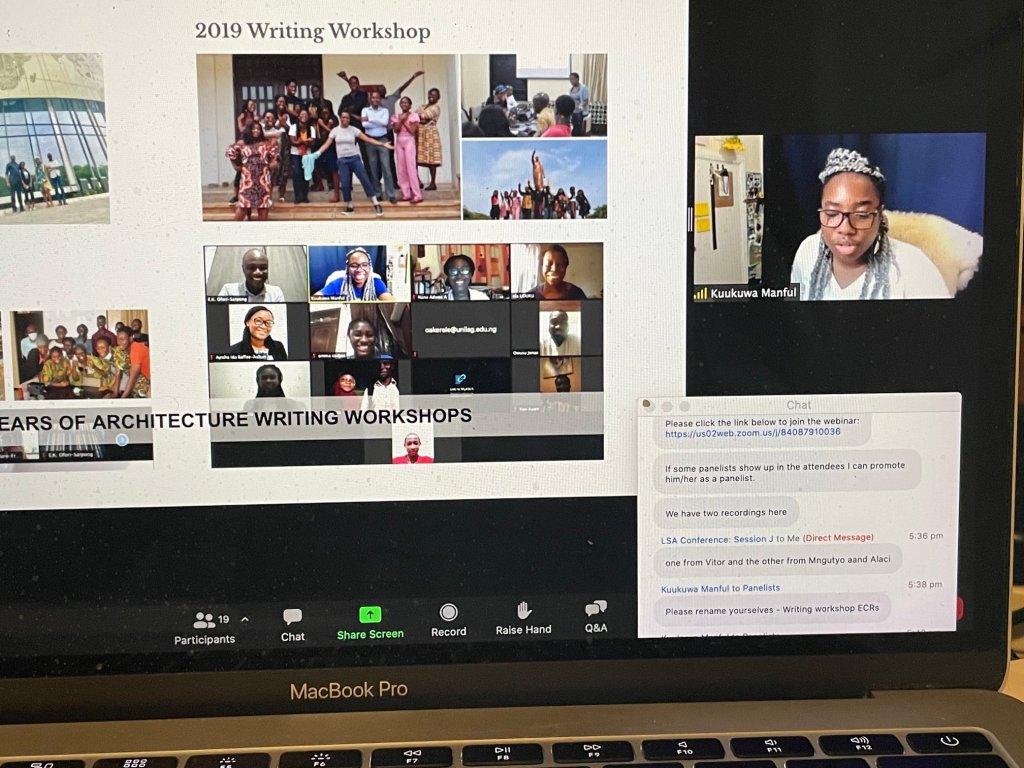
The third iteration of the African Architecture Writing Workshop has involved multi-disciplinary teams of young students and Early Career Researchers (ECRs) from Universities in both Ghana and Nigeria in developing a series short written articles focused on personal views of university campus buildings in Ghana and Nigeria. The ECRs worked directly with the young students as mentors to encourage and develop their writing style.
The ECRs have also been tasked with compiling and editing student work to create a series of gazette entries for the Modernist University Campus Buildings in West Africa project. Aside from the written component the ECRs and students have also taken a set of photographs which will form the basis for a future planned photography workshop to be run in association with the International Documentation of Modern Buildings and Landscapes, (Docomomo) team Germany.
The British Academy-funded workshop took place over two weeks starting at the University of Ghana, Legon led by Co-I Dr Irene Appeaning Addo, with support from ECRs Kuukuwa Manful, Emmanuel Ofori-Sarpong, Dr Ayisha Baffoe-Eshun, and Yaw Asare; as well as guest mentor Dr Joseph Oduro-Frimpong. There was a guest lecture from Professor Lesley Lokko. Students from Kwame Nkrumah University of Science and Technology, University of Ghana, and Central University College took part in the workshop. Arc Ruth Anne Richardson, Arc Tony Asare, Dr Edem Adotey, and Professor Iain Jackson reviewed the students’ final written pieces that were focused on three buildings on the University of Ghana Campus; Commonwealth, Volta and Legon Halls.
After a hand over day the Nigeria team’s workshop was led by Co-I Dr Nnezi Uduma-Olugu, and involved three institutions, the University of Lagos, University of Jos and the University of Nigeria, Enugu Campus. Each institution had a number of ECRs who worked at mentoring the interdisciplinary group of students who had enrolled at each of the workshops. As with the Ghana workshop a number of guest speakers including Prof Bogdana Prucnal-Ogunsote, (University of Jos) Kofo Adeleke (Legacy-92 organisation Lagos) and Dr Onyekiekwe Ijeoma, Nigeria commission for Museums. For the Nigerian final critical reviews attended by Prof Lukasz Stanek (University of Manchester) and Dr Joseph Oduro-Frimpong (Asheshi University Ghana) the ECRs presented their edited summaries of the student-written work and views on campus buildings in the three cities.
ECRs then presented their workshop experience at the Lagos Studies Association International Online Conference at a roundtable panel on conservation challenges in Africa chaired by Profs Uduku and Lawanson, Manchester School of Architecture, Manchester Metropolitan University, and University of Lagos respectively.
Whilst students and ECRs met in covid secure ways at their respective campuses all lectures and reviews took place entirely online, with students and ECRs able to work from ethernet-wifi equipped room spaces at the University of Ghana, and all three Nigerian collaborating Universities.
Currently ECRs are working on the editing and production of the initial phase of the Modernist African University Campus Buildings Gazette, this will be critically reviewed by Prof Miles Glendinning, Docomomo Scotland and Director SCCS University of Edinburgh. Watch this space…
This film documents work songs of a fishing community in Ghana, the West-African roots of the work-song tradition shown in the films “Afro American Worksongs in a Texas Prison” and “Gandy Dancers”. The film shows the community singing as it pulls fish nets onto the shore and men on boats in heavy surf singing to pace their rowing. It was shot 40 miles northeast of Accra, Ghana, January 7th or 8th, 1964.
The film material is part of the Seeger collection at the Library of Congress.
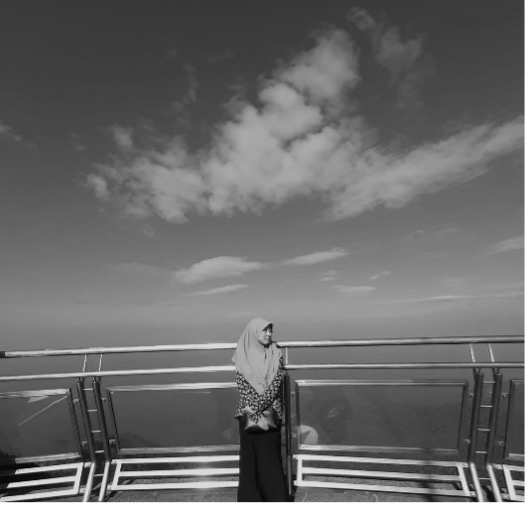
PhD Research Title and Summary: British Malaya: Colonialism and Architecture in Federated Malay States in 1875-1941.
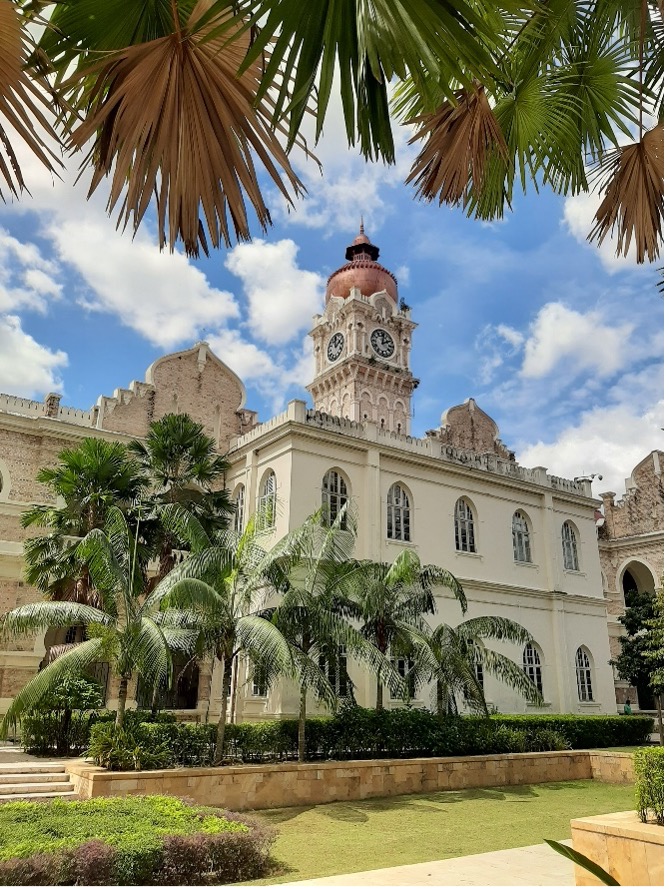
Preserving colonial buildings is difficult in this modern world. In Malaysia, the difficulty can be seen from the news that arises each year regarding the decision to demolish the colonial building in the name of development especially in Kuala Lumpur, the capital city (that never stops developing). However, many non-government organizations and historians are taking action to prevent it once the news appeared. This situation may possibly be a never-ending story. Concerning this issue, I believe that education is important to prevent demolishing and adding value to the colonial buildings. Therefore, to learn the importance of heritage buildings must come from the history itself. So, conducting historical research on colonial buildings will be one of the solutions to this problem.
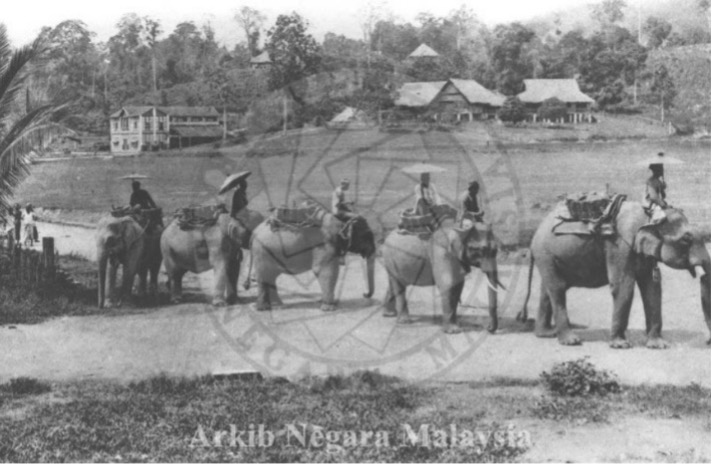
Figure 2 one of the heritage buildings that is no longer exist
Historically, British Malaya consists of three parts of administration systems which are Straits Settlements, Federated Malay States, and Unfederated Malay States. All three parts were later merged to be Malayan Union that leads to the forming of Malaysia this day. Upon researching, I found out that Federated Malay States have less historical research done on their British colonial buildings which leads me to focus on them.
Federated Malay States was the beginning of British establishment in the Malay Peninsula. It is intriguing to see how the British developed the states to become one of the wealthiest among their other settlements. Also, to see how the architecture style is being brought from outside into the Federated Malay States. The architecture was developing through the development of Federated Malay States and each building have their own uniqueness in their design. It is interesting to see how the process of constructing the buildings was in history also what made them choose a certain type of architectural style to apply in this environment and how the architecture was finally developed into a style that comprises the culture of the community.
Figure 4 Credit to National Archives of Malaysia
Archival research is the main data collection method for this study. The research will be conducted in several archives located in Malaysia, Singapore, and United Kingdom. Case studies also are one of the methods to explore their architecture and the development of the capital towns that were formed during the British administration in Federated Malay States. Fieldwork will be performed to observe and mapping the site also photographing the buildings with their environment.
Aims and Objectives:
Constructing a history of Federated Malay States through architectural production lens
Recording the development of colonial architecture in Federated Malay States
Analysing the factors that contribute to the development of their architecture
Recognizing the British Vision through the architecture of Federated Malay States
What did you do before the PhD Research?
I was a practice assistant at an architectural firm in Malaysia before decided to continue my studies for Part 2 in Master of Architecture at The University of Newcastle, Australia. After completing my master’s, due to some family reasons, I was needed to work near our home, so I become a graphic designer while doing part-time architectural work.
Why did you pursue a PhD, and what made you choose the University of Liverpool?
I decided to do PhD because I wanted to step out of my comfort zone. I also want to upgrade my knowledge in a different way than what I was used to in the architectural field. I also got interested in heritage buildings during the time of my degree in architecture when we got to visit various heritage buildings in several countries. So, I decided if I want to do a PhD, I wish to research heritage buildings as they look remarkably unique from my perspective.
For my PhD study, I have decided to study in the UK because I would like to explore a new environment and new system. Besides, the Malaysian government gives a lot of support for their citizen to study in the UK. So, sponsorship is not a problem. While selecting the university, I came across the university website and found an architecture PhD student testimonial on how it was like to study at The University of Liverpool. From there, I started to explore the School of Arts page and seeing that they are very active in architectural heritage research which is my research interest. Therefore, I thought that this university is suitable for me and immediately register the PhD.
What have you found the most fun part of the PhD, and the most challenging?
The fun part of the PhD is the knowledge that you acquire during the process. Besides, getting to know more about history and heritage buildings in my country seems a turning point for me as it increases my knowledge about my own country wherein school the history that we have learned is missing the details. It feels like you to get to learn a new story.
The most challenging part is that sometimes I am not sure of what I am doing and feeling not confident with my own research. I also feel like time is chasing after me because there are so many things to read and if you cannot focus you have to read it again. Not only that, doing a PhD makes you feel like you are in kindergarten because you have to learn everything from the very basic in your research topic. Besides, controlling your emotions and habits without affecting the PhD journey is also very challenging.
Post-Phd? Any ideas of what you’d like to do next?
I do not have anything planned yet for what I want to do next. But the options remain either to be in academia or industry. It will still be a new experience for me if I be in academia or industry. So, I would love to see how my PhD journey ended before deciding anything because I believe that at the end of my PhD, I might know what my strengths are.
Any advice for others interested in doing a PhD?
My first advise is if you do not have any research background, you might want to do some research about it like interviewing PhD students or someone who has already graduated from PhD in order for you to have a clear view of PhD journey. It will be useful as you come prepared for this journey. Secondly, you might want to do lots of reading in a wide scope around your topic and the methodology before registering for your PhD because it will save you lots of your time when you already know the basics. Lastly, you should know how to motivate yourself and enjoy the journey in the long run as this will help you during difficult times.
Following a six month delay due the COVID-19 Pandemic, our latest project to research the Architecture of the United Africa Company has finally started. With generous funding from the Leverhulme Trust, the project will run for two years and result in a series of papers, exhibition, and a monograph.
The Principal Investigator is Iain Jackson (Liverpool School of Architecture), with Co-Investigator Claire Tunstall (Global Head of Art, Archives and Records Management, Unilever Archives and Records Management). This close collaboration will allow the project to have full access to the 1000 linear metre UAC archive held at Port Sunlight, Wirral.
The three research associates for the project are Ewan Harrison, Michele Tenzon, and Rixt Woudstra.
F&A Swanzy Store, Axim, 1903, Unilever Archive
Background
The history of West African cities has often focused on government projects, health, segregation and so on, with far less attention given to the one of the largest contributors to the built environment – the mercantile traders and their endeavours.
This project will investigate the impact of the mercantile developments across former ‘British West Africa’ starting with the late 19thC and ending with the early years of political independence of each nation. The shops, trading centres, high streets, and factories offer an alternative view of these cities, and whilst some of these buildings are ‘everyday’ functional structures, when viewed collectively they form a large and significant assembly across the West African region. Through these buildings and wider town plans that accommodated them, the imperial mission is clearly revealed, as are changing tastes, designs, technologies, and economic positions. The architecture, interior spaces, and streetscape serves as a gauge for wider political development, as well as mapping social shifts as the quest for independence came to fruition.
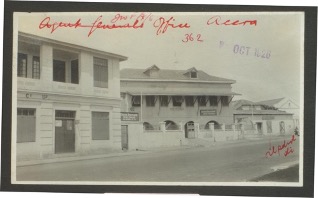
J. Walkden’s Store, Accra,1920, Unilever Archive
One of the largest of these firms operating in West Africa was the United Africa Company (UAC). Whilst formally established in 1929 its constituent firms trace back to the late 18thC and include the Royal Niger Company (operating from the territory that is now Nigeria) and the African and Eastern Trading Company, as well as a whole range of other enterprises. These businesses were effectively operating in a quasi-government capacity and held immense power and influence over what became the colonial occupation of the region. Their contribution to the built environment shaped transport infrastructure, housing, town planning, as well as industrial development of docklands, warehouses, and factories. They also developed more glamorous projects including high-end department stores incorporating the latest design and retail environments; and shaped the fashions and cultural agenda of the towns through facilities such as cinema halls and community centres.
Kingsway Store, Accra, 1950s, Unilever Archive
How did the UAC contribute to the development of the built environment in West Africa, and in what way did it shape the streets, districts, and cities within this region?
Beyond the pragmatic requirements of the business, what type of architecture and planning was it pursuing, and how did this inform the streetscape and experience of the West African city?
Objectives
To develop a new historical study of West African town and cities through the buildings, plans, and infrastructure projects of one of the largest trading conglomerates in the region, the United Africa Company.
Archives
The primary data for this project is held in the UAC Archive, now part of the Unilever Archives, located in Port Sunlight, Wirral. This is a substantial collection and an unapparelled set of material relating to British and post-colonial West Africa. It is a largely ‘untapped’ archive, recently catalogued, and forms a unique set of documents relating to the various businesses ran and acquired by the UAC. In addition to the written sources, the collection includes an exceptional set of photographic records, company films, and recordings of interviews with UAC employees. We’ll also consult various other repositories including the UK National Archives; The Public Records and Archives Department(PRAAD) in Accra, and the National Archives in Sierra Leone (held at Fourah Bay College, Freetown); National Archives of Nigeria (Ibadan Branch).
This congress calls for papers that will examine the movement of people and things around and across the Indian Ocean Rim and reveal instances or patterns of transfer that may complicate assumed centre-periphery dynamics, or correspond more closely to the idea of South-South cooperation. It looks to engage new political framings like the Non-Aligned Movement (NAM) or the Group of 77 (G77) and the resulting New International Economic Order (NIEO) that would reconfigure the transfer of construction materials and labour, and consequently architectural knowledge, across this region. But it also hopes to discuss the potentialities for greater solidarity that emerged from broader philosophical notions of ‘neutralism’ ‘human dignity’ and ‘justice’ and how these have affected the ethics of construction in the Global South. Finally, it is expected that all these considerations will find a place in the discussion of migrant populations and their negotiations with these constructed political and cultural categories, living across and beyond them in a constant state of liminality.
Abstracts (300 words) for proposed papers are invited to be submitted to camea@adelaide.edu.au by 20th June 2021. Congress will meet on 7th-9th November 2021.
Please see the attached Call for Papers for further details:
The 20th anniversary of the Modern Heritage Programme, jointly initiated by UNESCO, ICOMOS, and DOCOMOMO, in 2021 presents a timely and important opportunity to reflect on the transformative cultural experiences and global consequences of the recent past that heralded the dawn of the anthropocene and its many impacts on climate, society, and the planet. Despite these impacts, the ‘modern’ era and its legacies are comparatively undervalued and overlooked, and disproportionately concentrated and interpreted in ‘the west’. MoHoA contends that Africa’s experiences of plural modernities include the positive and negative, colonial and post-colonial, tangible and intangible, urban and rural, culture and nature. This will need greater scholarly attention and can be instructive and transformative in framing modernities and modern heritage globally, as well as addressing the challenges of sustainability continentally. On the one hand, Africa’s contemporary cities, many of which are products of modern encounters, face the highest rates of urbanisation in the world over the next half a century, straining populations and resources, urban landscapes and rural hinterlands, and placing modern heritage at serious risk of alteration or destruction. On the other hand, the unique human settlement patterns in Africa, provides a new dimension, reflected in the cultural landscapes, “combining works of nature and humankind, they express a long and intimate relationship between peoples and their natural environment”.
The African World Heritage Fund has identified modern heritage as amongst the most marginalised heritage categories on the continent, demanding investment in research and documentation to better protect, increase resilience and subsequently Africa’s representation on the UNESCO World Heritage List. Through improved methods of understanding and assessing significance, raising public awareness and promoting inscription on local or global registers, Africa’s modern heritage has a vital role in contributing to rural and urban sustainability in line with the UN’s Sustainable Development Goals (SDGs), the New Urban Agenda (NUA), the African Union’s Agenda 2063, and the Historic Urban Landscapes (HUL) Approach.
MoHoA plans two symposia over two years and a series of supporting thematic workshops. The first symposium, focusing on Africa, will be hosted by the University of Cape Town in September 2021 and titled ‘Modern Heritage of Africa’. The second will be global in scope and hosted by The Bartlett School of Architecture (UCL) in 2022 and titled ‘Modern Heritage in the Anthropocene’. The outcome UCT symposium will lead to proposing a ‘The Cape Town Document on Modern Heritage’ supporting efforts to modify international policy and guidance on modern heritage in line with present and future planetary challenges of ecological, social and economic equity. This will be presented to the World Heritage Committee as part of the reporting exercise and as a side event at the relevant Committee Session. The UCL symposium will discuss the wider implications of the MoHoA globally.
We invite submissions to the International Symposium on the Modern Heritage of Africa and welcome papers and other forms of communication including video, music, performance and literature accompanied with a commentary and interpretation focusing on any of the following themes evolving from the brain storming isivivana last August, highlighting both cultural and natural heritage, the tangible and intangible and their symbiotic relationships:
Considerations of modernities in Africa
Modern Heritage and Sustainable Development in Africa (SDGs)
Infrastructure development, particularly industrialization and transportation systems, as activators of modernism in Africa
Natural heritage and its role in society, linking culture and nature
Public spaces, memorialization and commemoration in postcolonial Africa
Modern Heritage of Africa and the World Heritage Convention
Any other theme not covered by the above
Abstracts: Contributions with African experiences of modernities and the sharing of heritage knowledge and we welcome abstracts of up to 300 words or equivalent format (e.g. film shorts, blog, Instagram story) for other types of digital submissions. For general reference in terms of format – see below. To submit an abstract, email: modernheritageofafrica@gmail.com
The abstracts: Date to be finalised
forming results: Date to be finalised
Publication: Selected papers or presentations will be published as part of the Modern Heritage of Africa Book Series to be published after the conference.
Audience: academia, heritage fields, professionals and practitioners from diverse disciplines addressing the tangible and intangible, culture and nature, documentation, archives and collections. We encourage participation from colleagues and institutions from Africa, particularly from youth and women.
Networking: Institutions of African Studies, Schools of Cultural Studies, Architecture and Planning – African Union and professional bodies.
Languages: Français and English
Dates:22 and 23 September and 24 September, South Africa Heritage Day 2021
Venue: University of Cape Town, South Africa
Participation: online registration will be required and is free; a $50 donation will be welcome.
Format: The MoHoA symposium will be a virtual, hybid, academic event, a dialogical field capable of moving beyond disciplinary boundaries with social and cultural exchanges. To ground its activities and foster dialogue, we invite proposals, ranging from operational practices to speculative and theoretical questionings. These can be presented in written, built, coded, drawn, figured, imagined, filmed, modelled or in any other format (do not hesitate to consult with us for any exotic format or idea!).
Contributions may take the following forms:
Paper presentations that will be shared and discussed through joint working sessions and panel discussions. These might include theoretical work, but also case studies and project reports. To submit your paper proposal, you must submit an abstract of up to 300 words.
Projects, models, images, devices, pieces of coding, hardware and all other kinds of contributions. These must be submitted by sending a 300-word optionally illustrated abstract in the form of a single PDF including text and images (max 5mb).
Contributions can be signed individually or collectively.
Contributors are welcome to submit more than one proposal in one or more formats. If selected, all contributors are responsible for covering the costs of sending their work in time for presentation. The conference is led by the University of Cape Town and planned virtually with a possible physical component on campus; please state if you would able to attend in person.
If selected, contributors might be assigned to a 15-min paper/project presentation session or a debate session to discuss their work. Or both. These might be done in person, by possibly attending one of the conference’s sites, or remotely. The final format and topics of the sessions will be configured once all submissions have been received, so it is possible and desirable that participants will be grouped in thematically coherent yet interdisciplinary sessions.
The University of Liverpool and The National Archives are pleased to announce the availability of a fully funded collaborative doctoral studentship, under the Arts and Humanities Research Council (AHRC) Collaborative Doctoral Partnership (CDP) scheme.
Using The National Archives extensive collections the project will investigate how the West African ‘built environment’ has been shaped to respond to various political, economic, and welfare demands and ambitions. The particular timeframe will cover the transition from colonial rule into independence period. After tracking these broader notions across ‘British West Africa’, the project will pursue a narrower focus on one of the four former British colonies.
How were ideas of ‘self’, identity, freedom, and so on, expressed through new construction and town planning? How did former colonisers, and other foreign groups attempt to shape and influence these developments in the ‘post-colonial’ period. How were notions of identity, nation, and ‘new beginnings’ expressed by the postcolonial nations?
The aim of the project is to investigate how political ideas, and notions surrounding identity, nationhood, and statecraft are expressed or manifest through the built environment.
Infrastructure, prestige projects, and grand architectural schemes are often used to infer power, or suggest modernity, development, and progress. Equally, more (seemingly) mundane developments, such as housing, can be as revealing in terms of power structures and wider ambition. In a problematic and contested political situation these types of projects become highly charged and significant expressions of a nation’s collective (and often contested) identity. This is even more meaningful in a colonial context, and architecture, town planning and infrastructure, in part, become symbolic expressions of the colonial power.
The objective of this project is to examine these notions within the West African context over a period of time that spans the late colonial era and early post-colonial period. This was a particularly volatile moment, charged with excitement and optimism, and a desire to somehow ‘start again’ and rebuild a new nation with a new vision. Architecture and planning would shift from being expressions of colonial dominance and subjugation to being expressions of nationalism, hope, and modernisation.
It is sometimes tempting to see the event of Independence as an abrupt and sudden moment. The clock strikes twelve and everything suddenly changes – and whilst this is true, it is also oversimplifying a complex event that is, to some degree, still being played-out today. There is also a sense of inertia in the built environment and existing city plans, methods of development, and networks of expertise stubbornly persist and outlast political dynasties.
The desire for the newly independent nations to express their hard-fought freedom through physical, often large-scale triumphant (sometimes infrastructure) projects was met with the former colonial power’s aspiration to continue offering technical assistance, expertise, and trade. It resulted in a complex blend of nationalism, reimagining/reinventing identity and Pan-African ambition, further mixed with the additional influences of ‘non-aligned’ socialist assistance and US, World Bank, and UN concerns.
The independence of these nations was not an abrupt severance from the former colonial power, but a feathered, gradual transition coupled with intense global interest eager to retain or cultivate influence and trade advantage.
It makes for a fascinating narrative that reveals the shift from overt imperialism, to one of post-WW2 ‘technical assistance’, ‘development’, and fiscal packages from an array of competing agencies and organisations, met with a desire to express African modernisation, liberation, and success.
Start date 1st October 2021
Applications due 25th May 2021
Interviews planned for 22nd June 2021
For any enquiries please contact: Professor Iain Jackson on: ijackson@liv.ac.uk
How to Apply: To apply for this studentship, please send the following documents to artsrecruit@liverpool.ac.uk:
Full Curriculum Vitae (CV)
Cover Letter expressing motivation for applying and pursuing a PhD on this topic.
Project Plan: This is your chance to set out how you would like to design and plan the research project and should not exceed 1000 words. Please produce a Project Plan that includes the following headings:
Proposed project outline and suggested research questions
Proposed Methodology
The National Archives / other archival sources to be consulted
Selected Bibliography.
The project can be undertaken on a full-time or part-time basis.
CDP doctoral training grants fund full-time studentships for 45 months (3.75 years) or part-time equivalent. The studentship has the possibility of being extended for an additional 3 months to provide professional development opportunities, or up to 3 months of funding may be used to pay for the costs the student might incur in taking up professional development opportunities.
The student is eligible to claim additional travel and research related expenses (worth up to £1000 per year for four years) during the course of the project, courtesy of The National Archives.
· We want to encourage the widest range of potential students to study for a CDP studentship and are committed to welcoming students from different backgrounds to apply. We particularly welcome applications from Black, Asian, Minority Ethnic backgrounds as they are currently underrepresented at this level in this area.
· Applicants should have an undergraduate degree in subjects allied to the Built Environment/Architecture/History/Cultural Geography.
· A Masters level qualification is desirable but not essential. Applicants may be able to demonstrate equivalent experience in a professional setting (e.g. producing and researching written reports, public outreach and liason, working with collections and archives).
· Experience of working in West Africa is desirable but not essential.
· Applicants must be able to demonstrate an interest in the archives sector and potential and enthusiasm for developing skills more widely in related areas.
· As a collaborative award, students will be expected to spend time at both the University and The National Archives.
This is a joint project with AHRC Collaborative Doctoral Partnership programme. The external partner is the National Archive, Kew. See View Website The award pays full maintenance for all students, both home and international students. The National Minimum Doctoral Stipend for 2021/22 is £15,609, plus an allowance of £1000 per year and a CDP maintenance payment of £550 per year.
Here are the recordings from the Crucibles, Vectors, Catalysts: Envisioning The Modern City, event from 2nd and 9th March 2021. Thank you to all of our excellent speakers, and for the interesting questions and discussions.
PROGRAMME: Session 1: Crucibles, 15:00-16:30 (UTC) Building the Modern City: Expressions of Identity, Change and Power, Moderated by Iain Jackson
This panel will explore state-sponsored programmes, planned cities and masterplans in cities such as Lagos, Tehran and Baghdad. It will examine architecture as expressions of nationalism and nationalist political agendas as well as its relationship to big business, corporations and mercantile ventures.
Rupture, Transition and Continuity in Baghdad’s Master Plans: From Minoprio to Miastoprojekt
Session 2: Vectors, 17:00-18:30 (UTC) Connecting the Modern City: Networks, Alliances and Knowledge Production; Moderated by Clara Kim
This panel will explore the practice of modern architecture through colonial-postcolonial networks and geopolitical alliances. It will explore cities in Mozambique within the context of other Lusophone countries, post-Partition East & West Pakistan, as well as the dissemination of knowledge and technical expertise through pedagogy.
Correspondences, Transfers and Memory: Maputo’s “Age of Concrete”
Farhan Karim (University of Kansas)
Archaeology of the Future: Constantinos Doxiaidis in East and West Pakistan
Patrick Zamarian (University of Liverpool)
Global Perspectives and Private Concerns: The AA’s Department of Tropical Architecture
TUESDAY 9 MARCH Session 3: Catalysts, 15:00-16:30
Fragments of the Modern City: Memories, Echoes and Whispers Moderated by Osei Bonsu
This panel will explore the collaborations, connections and entanglements that developed between art and architecture during a dynamic period of building in Morocco, India and Iraq. It will examine the legacy and afterlives of these projects through the investigation of under-recognised figures and narratives in art and architecture.
Speakers:
Lahbib el Moumni & Imad Dahmani (founders of MAMMA, Mémoire des Architectes Modernes Marocain)
Initiatives toward saving modern heritage of Morocco
Ram Rahman (Photographer/Curator)
Building Modern Delhi, The Nehruvian Post-Independence Renaissance
Amin Alsaden (Independent Scholar)
Syntheses Across Disciplines: Rifat Chadirji and Art-Architecture Liaisons in Modern Baghdad
Explore modern cities and architectural production in the blurred era of the independence and postcolonial period
Join us for three sessions which will bring together scholars, researchers and curators to explore architectural production in the blurred era of independence to the post-colonial period of the mid-20th century, focussing on cities in Africa, Middle East and South Asia.
Whether driven by socialist agendas (Nehruvian in India and Nkrumah in Ghana), monarchies (Pahlavis in Iran and Hashemite in Iraq), quasi colonial protectorates, or pan-continental aspirations, architecture (and especially Modernism) was a key apparatus for nation-building, for re-imagining identities and a means to project and invent a new image of the future. The seminar seeks to explore the use of architecture as both physical infrastructure and symbolic expression, as well as its vulnerability to the vicissitudes of changing politics and policies of the times.
The role of cities as crucibles, vectors and catalysts for developing new expressions of identity, change and power is key. Cities in this period saw the emergence of schools of thought, dynasties and collaborations were formed, networks and ideas were shared and publications were disseminated. While the desire of a newly independent nation was often to consolidate a single national collective identity, it was through the urban centres that strands of coherent, yet often multiple identities were formed. The role of figures such as Rifat Chadirji, Mohamed Makiya, Jane Drew and Maxwell Fry were important as they often operated within multiple cities and cross-cultural contexts that spanned the colonial to postcolonial divide.
These urban centres were either newly built, or they were remade and reimagined through city infrastructure, government buildings, universities, cultural institutions and national monuments. Architecture schools, state sponsored projects and external agencies feed into the discussion and warrant further exploration. The seminar explores the transnational connections, diverse political agendas and complex allegiances which informed architectural development in this period.
Seminar convenors:
Iain Jackson, Professor of Architecture and Research Director, Liverpool School of Architecture
Clara Kim, The Daskalopoulos Senior Curator, International Art, Tate Modern
Nabila Abdel Nabi, Curator, International Art, Tate Modern
PROGRAMME TUESDAY 2 MARCH
Session 1: Crucibles, 15:00-16:30 (UTC)
Building the Modern City: Expressions of Identity, Change and Power
Moderated by Iain Jackson
This panel will explore state-sponsored programmes, planned cities and masterplans in cities such as Lagos, Tehran and Baghdad. It will examine architecture as expressions of nationalism and nationalist political agendas as well as its relationship to big business, corporations and mercantile ventures.
Rupture, Transition and Continuity in Baghdad’s Master Plans: From Minoprio to Miastoprojekt
Session 2: Vectors, 17:00-18:30 (UTC)
Connecting the Modern City: Networks, Alliances and Knowledge Production
Moderated by Clara Kim
This panel will explore the practice of modern architecture through colonial-postcolonial networks and geopolitical alliances. It will explore cities in Mozambique within the context of other Lusophone countries, post-Partition East & West Pakistan, as well as the dissemination of knowledge and technical expertise through pedagogy.
Correspondences, Transfers and Memory: Maputo’s “Age of Concrete”
Fahran Karim (University of Kansas)
Archaeology of the Future: Constantinos Doxiaidis in East and West Pakistan
Patrick Zamarian (University of Liverpool)
Global Perspectives and Private Concerns: The AA’s Department of Tropical Architecture
TUESDAY 9 MARCH
Session 3: Catalysts, 15:00-16:30 (UTC)
Fragments of the Modern City: Memories, Echoes and Whispers
Moderated by Nabila Abdel Nabi
This panel will explore the collaborations, connections and entanglements that developed between art and architecture during a dynamic period of building in Morocco, India and Iraq. It will examine the legacy and afterlives of these projects through the investigation of under-recognised figures and narratives in art and architecture.
Speakers:
Lahbib el Moumni & Imad Dahmani (founders of MAMMA, Mémoire des Architectes Modernes Marocain)
Initiatives toward saving modern heritage of Morocco
Ram Rahman (Photographer/Curator)
Building Modern Delhi, The Nehruvian Post-Independence Renaissance
Amin Alsaden (Independent Scholar)
Syntheses Across Disciplines: Rifat Chadirji and Art-Architecture Liaisons in Modern Baghdad
Architectural Training and Research in the Foreign Aid-Funded Knowledge Economy, 1950s-1980s.
Two-day symposium, KTH School of Architecture, Stockholm, 9-10 September 2021.CALL FOR PAPERS / Submission deadline: 1 April 2021.
From the 1950s to the late 1980s, the politics and economies of foreign aid – instigated by both the ‘capitalist West’ as well as the ‘communist East’ – gave rise to a whole infrastructure destined to assist the progress of ‘developing countries’ on their ‘path to development’. The various North-South exchanges that took place in the name of ‘development’ have left a deep imprint on the geopolitical landscape of postcolonial Africa, Asia, and Latin America. Largely instituted through bilateral relations between individual states, these ‘aid’ initiatives involved not only financial and material resources but also various forms of knowledge and expertise; as such, the modalities of this global, foreign aid-funded infrastructure boosted the creation and reinforcement of all sorts of institutional actors to efficiently exchange knowledge – largely through training courses, educational programs and/or research projects. In the light of widespread rural migration and intensive, rapid urbanization processes, expertise on the built environment was a particularly salient form of knowledge to the aims of foreign aid. Hence, architecture, urbanism and planning were no strangers to an emerging foreign aid-funded knowledge economy – a context in which the production and circulation of knowledge were intimately tied to the political-economic value attributed to them by foreign aid diplomacy.
How did architectural knowledge figure in foreign aid-sourced international relations, and what frameworks were set in place to efficiently exchange that knowledge?
For this two-day symposium, we seek scholarly work that critically analyzes, contextualizes, or theorizes the establishment and functioning of such institutional actors, training courses, educational programs, research centers, and other infrastructures for knowledge exchange that emerged under the aegis of development and targeted ‘Third World’ clients. We welcome a wide range of methodological and creative perspectives as well as less empirical (but well-informed) theoretical approaches that interpret this phenomenon from a postcolonial or decolonizing perspective. We also encourage contributions that scrutinize the intersections of these histories with discussions of gender, race, religion and nationalism.
This two-day symposium will be held in Stockholm on 9-10 September 2021. In light of the current pandemic the event will be organized either in a hybrid format, allowing for both in-person and online attendance, or, if health regulations dictate, as a fully online event. The symposium is envisioned as one long, thematically well-focused discussion, without parallel strands, and aims to bring 12 to 15 established as well as young scholars together from every discipline that engages with the topics outlined above. We’re happy to receive anonymized abstracts of up to 300 words and 1 optional image until 1 April 2021, submitted via email to architectureforeignaid@arch.kth.se. Acceptance will be dependent on an anonymous review of the abstract by the scientific committee. If a different format than that of a presentation based on a paper would be more suitable to your work, please contact us (same deadline applies).
Scientific committee: Sebastiaan Loosen (KTH), Erik Sigge (MIT), Helena Mattsson (KTH), Viviana d’Auria (KU Leuven) and Kenny Cupers (University of Basel).
Please find the full CFP attached and visit our website for up-to-date information: architectureforeignaid.arch.kth.se Best regards Sebastiaan Loosen, Erik Sigge & Helena Mattsson