When: 27-28 June 2020
Where: Girton College, University of Cambridge
Submit abstracts of 250 words to architecturesofpower@hist.cam.ac.uk by 21 October 2019.
Historians have long recognised the importance of architecture within the exercising of political power. Yet the interaction between power and place, between human actor and physical location, is a difficult one to quantify. This conference brings together political, social, cultural, and architectural historians to explore this relationship. Architecture could be mobilised to exhibit and to legitimise political power, but it could also have a profound influence on decision-makers at crucial moments of governance. Architecture has played a fundamental role in performances of statecraft. Accounting for this architectural agency, without resulting to crude spatial determinism, is one of the great methodological challenges that this conference will discuss. As architectural historians have established, the meaning of buildings vary from user to user. Often these reflected hierarchies operating within the building: experiences of the Foreign Office, for instance, differed from a Permanent Under-Secretary to a newly arrived clerk. It is this question of the subjective nature of architectural experience that we are particularly interested in exploring.
Taking broad definitions of political power and the state, we will not only consider the architecture of palaces, parliaments, and administration, but also of commercial, financial, legal, and religious sources of political authority. This conference is interested in the physical seats of power from the private residences of statesmen and women, to legislatures, embassies, and banking houses. Importantly, this conference considers how the architecture of political power evolved over time, reflecting changes in structures of government. In the late eighteenth-century, the majority of states were absolute monarchies or governed by elite oligarchs, but by the mid twentieth-century the rise of popular representation entailed very different types of architecture. Where once palaces like Versailles and Blenheim embodied the authority of ruling elites, parliaments and administrative offices soon reflected accountable styles of government.
We welcome papers on any geographical case study from the mid eighteenth-century until the twentieth. We are particularly interested in proposals that consider the role of gender, race, and class as well as questions of architectural science and technology. We are also interested in the role of architecture in the operation of imperial, economic, and religious political power. Please submit abstracts of 250 words to architecturesofpower@hist.cam.ac.uk by 21 October 2019.
On 20th June 2019 Unilever kindly hosted (with additional support from the University of Liverpool) a workshop showcasing the amazing material that can be found within business archives. It was a really great day to learn more about how different researchers are using the collections and the great work by archivist who make all of this accessible to the public.
Keynote by Valerie Johnson, Director of Research, The National Archives
Business archives – a bit of a passion killer?
Valerie Johnson opened her keynote by highlighting that business archives are often seen as dull and uninteresting – to the point she was once told by a conference organizers that he had not expected her research talk about business archives to be so interesting. Nothing could not be further from the truth. For almost any subject of interest to researchers, business archives have materials, as companies were often spearheading new developments (e.g. technology), were embedded in social and cultural trends of the day (e.g. the culture of imperialism), design history (e.g. in the Board of Trade archives) to name but a few.
In a whistle stop tour through a wide range of archives, Johnson illustrated the history of women at work through an architectural map in the ING Barings Archive, and the representations of empire in the textiles archive of John Lewis, and the United Africa Company trademarks at Unilever Historical Archives.
Johnson closed by reiterating that business records offer magnificent materials and insights into society, technology and attitudes of the past, not just the records of business operations in the narrow sense. So she closed with highlighting the importance of:
Putting the passion back into business archives!
Snippets from archival research
The day continued with wide-ranging research presentations. The morning opened with Jeanette Strickland introducing the audience to William Lever, the founder of Lever Brothers (one half of the original Unilever), a formidable businessmen and somewhat of a micro-manager.
This was followed by Frank Thorpe, University of Liverpool, talking about advertising and beyond. His presentation is based on his doctoral thesis that investigates the changing attitudes towards personal hygiene, or “BO”, and how
products like deodorant were gendered and stigmatized at times. At Unilever, he
has researched uncatalogued material, but also used a range of online newspaper
archives to understand the context within which these adverts appeared.
Ronnie Hughes offered a different view on Port Sunlight, the location of the Unilever factory and archives, where the workshop took place, by asking a key question:
What must it have been like to live in someone else’s utopia 100 years after they died?
Walking through Port Sunlight village in the morning before the workshop, this is not unlike the question we asked ourselves – would we actually like to live here,
as beautiful as it is? As a heritage site, it has a very distinct and unique
feel, which is unlike other neighbourhoods. Hughes highlights that he has asked
communities questions about what their perfect place would look like before
starting this research project. He blogs at A Sense of Place.
Prof Matt Reed finished the morning session by outlining his search for the ‘origin story’ of the collaboration between Unilever and the University of Liverpool, which dates back to 1906, which was “multi-faceted and sporadic.”
Lever donated money to a number of departments, including Civic Design and town planning. The Department of Industrial Chemistry was particularly well aligned with Lever’s business interests. Reed finished with a reflection of the value
of searching archives versus the self-taught googling that passes for research
outside of archives.
A fascinating tour of the archives at lunchtime that featured highlights such as Marmite pants.
The afternoon sessions kicked off with Dr Rory Miller’s exploration of why David Fieldhouse’s Unilever Overseas is missing a chapter on Latin America – apparently he fell out with his research assistant. 25 years ago, Miller first visited the Unilever archives to find out what was actually available on Unilever’s business in Argentina and beyond. Perusing the directors’ visiting reports, he outlined how Argentinians rarely bought Lifebuoy soap other than to wash their dogs.
In her talk about the design process, Dr Lee Wright highlighted the potential importance of archives for the design practice and the sourcing of design ideas. In her teaching, students reference the past through images they source from Pinterest, highlighting the significance of social media sites in mediating our visual understanding of the past.
The day closed with two fascinating talks, the first by Prof Iain Jackson about the development of urban architecture in Accra, Ghana in the mid-twentieth century. While the National Archives had more material on the European settlements of Accra, within other archives, such as the United Africa Company collection at Unilever, mercantile areas such as Jamestown are much better documented. Some of his collected images are available in an online book available via issuu.com (search “Accra”) here.
The workshop closed with Claire Tunstall describing their mission and how the archives has to serve many different stakeholders: internal divisions, brands and communications, outreach with schools, partnership with museums and universities and, of course, the Port Sunlight Village Trust, as well as researchers.
Hopefully, more such events, at Unilever or other major archives, will take place in the future. The workshop did not just have great presentations but also offered great opportunities to meet a wide variety of people interested in using and promoting archives.
Conference programme
10 am Registration Tea & coffee
10.20 Welcome, introductory remarks and housekeeping
– Claire Tunstall and Jeannette Strickland
10.30 Keynote Dr Valerie Johnson, Director of Research & Collections, The National Archives “What’s the use? Your research and business archives”
10.50 Q&A
11.00 Refreshments
11.15-12.30 Session 1 Chair: Prof Stephanie Decker, Aston University
11.15 Jeannette Strickland, Department of History, University of Liverpool, “Finding William Lever, the man behind the myth”
11.30 Frank Thorpe, Department of History, University of Liverpool, “Beyond the ad: filling gaps and finding new gaps”
11.45 Ronnie Hughes, Department of Sociology, Social Policy & Criminology, University of Liverpool, “Looking for Utopia”
12.00 Dr Matt Reed, Strategy Director, Materials Innovation Factory, University of Liverpool, “Turn every page”
12.15 Q&A
12.30-2.00 Lunch
Tours of Unilever Archives available at 12.45 and 1.10
2.00-3.00 Session 2 – Chair: Dr Valerie Johnson, The National Archives
2.10 Dr Rory Miller, formerly Reader in the Management School, University of Liverpool, “The Missing Chapter in David Fieldhouse’s Unilever Overseas: Unilever’s Expansion in Latin America in the Mid-Twentieth Century”
2.30 Dr Lee Wright, Senior Lecturer in the History and Theory of Design, Liverpool School of Art and Design, Liverpool John Moores University, “The value of archives and their potential to impact current design practice”
2.50 Q&A
3.05 Refreshments
3.20-4.20 Session 3 – Chair: Jeannette Strickland, University of Liverpool
3.20 Prof Iain Jackson, School of Architecture, University of Liverpool, “Traders, speculators, taste makers: the United Africa Company in Ghana”
3.40 Claire Tunstall, Head of Art, Archives & Records Management, Unilever plc, “The research potential of Unilever Archives”
4.00 Q&A
4.20 Summing up and closing remarks
4.30 Optional post-workshop drink at the Bridge Inn in Port Sunlight
Ng’ambo Atlas. Historic Urban Landscape of Zanzibar Town’s ‘Other Side’
Ng’ambo is the lesser known ‘Other Side’ of Zanzibar Town. During the British Protectorate the area was designated as the ‘Native Quarters’, today it is set to become the new city centre of Zanzibar’s capital. Local and international perceptions of the cultural and historical importance of Ng’ambo have for a long time remained overshadowed by the social and cultural divisions created during colonial times. One thing is certain: despite its limited international fame and lack of recognition of its importance, Ng’ambo has played and continues to play a vital role in shaping the urban environment of Zanzibar Town.
Ng’ambo Atlas. Historic Urban Landscape of Zanzibar Town’s ‘Other Side’ documents the material collected through the heritage-based urban planning project Ng’ambo Tuitakayo! carried out by the Government of Zanzibar in collaboration with African Architecture Matters and City of Amsterdam and under the auspices of UNESCO.
The goal of the project was to prepare a local area plan (structure plan) for the new city centre of Zanzibar’s capital. The planning exercises were from the beginning grounded in the notions of urban culture and heritage, while the principles outlined in the UNESCO Recommendation on Historic Urban Landscape provided a framework for the subsequent stages of the work.
It quickly became clear that the cultural and historic richness of Stone Town’s ‘Other Side’ merited a wider recognition than a technical planning document would allow for. At the same time presenting the outcomes of the project to a wider public through an atlas was a way to promote the history and culture of the area and contribute to the argument that urban heritage should play a central role in sustainable development of cities.
The atlas brings together and presents Ng’ambo’s rich planning history and draws attention to the outcomes of the mapping of the material and immaterial cultural landscape.It presents over hundred years of Ng’ambo’s history and urban development through maps, plans, surveys and images, and provides insights into its present-day cultural landscape through subjects such as architecture, toponymy, cultural activities, public recreation, places for social interaction, handcrafts and urban heritage.
Ng’ambo Atlas was produced by the Department of Urban and Rural Planning, Zanzibar and African Architecture Matters
Livelihoods and culture under threat in Ghana’s historic port of Jamestown
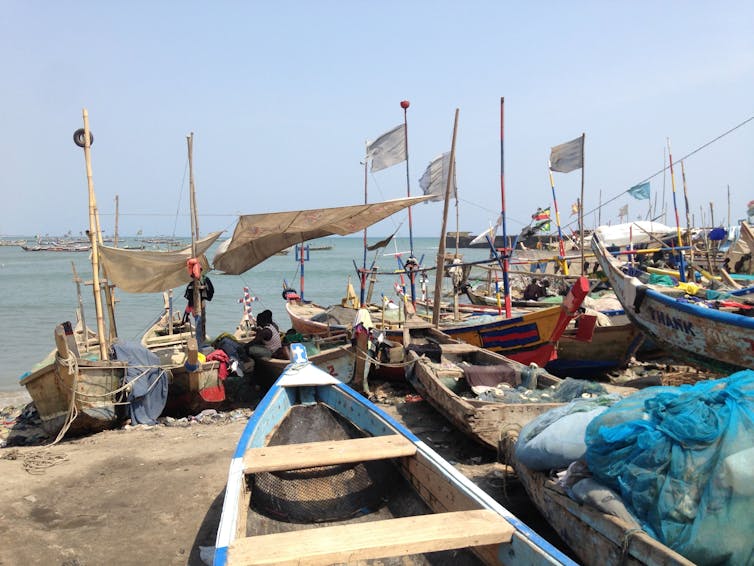
The beachfront of historical Jamestown, Ghana.
Plans are afoot to replace the historic Ghanaian fishing port of Jamestown with a Chinese-backed mechanised factory.
This is a move that will destroy traditional livelihoods, as well as damage the historic built environment. It will drastically change not only the tangible fabric of this historic town, but also impact the fishing methods, market traders and community that’s reliant on the sea.
Since 2011 I have been researching the history of Ghanaian architecture and urbanism, and have been particularly struck by its impressive collection of heritage structures and associated narratives.
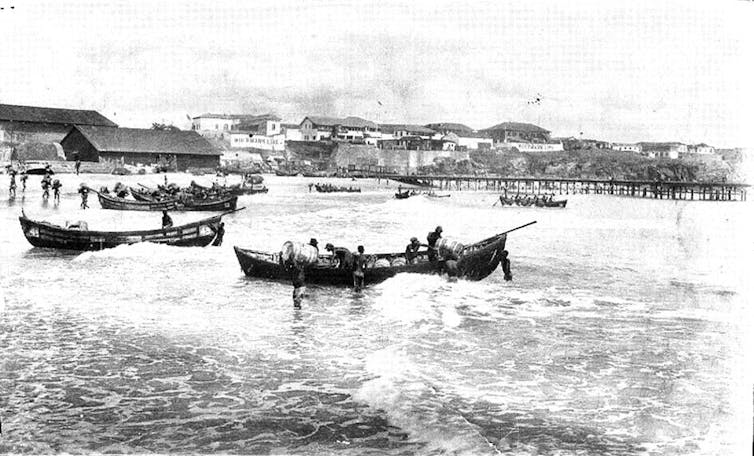
The harbour at Accra’s district of Jamestown was built to provide shelter from the heavy surf that pounds this part of the coast. The breakwater and pier were equipped with railway tracks, gantries and cranes to handle the large produce exports following the cocoa boom of the early 1900s. The wealth created from this trade saw some fine buildings being built. An array of warehouses, stores and villas survive (some very precariously) in Jamestown to this day.
Historical photograph of Jamestown. Courtesy of Wirral Archives
The shallow waters of the harbour utilised smaller surf boats who ferried the goods in and out to the ships anchored in deeper water. The creation of new ports rendered the Jamestown harbour superfluous by the 1950s and it was no longer used for international trade.
While this profoundly affected the livelihoods of the surf boat owners, as well as the economic prosperity of the Jamestown area, it has still remained an active harbour, returning its focus to fishing. New canoes are still built on the beach, nets are made, repaired and dried, and a large, if casual, fishing market trades off the shore.
Although described as a beach, it’s still a working harbour rather than a place for leisure. Businesses, residences, schools, places of worship and bars have all been established on the beach and a large population considers it their home and community. The place has a very different feel to the rest of the city. It has an intimate connection to the sea, dictated by the tides, rituals, songs and danger that accompanies all fishing communities.
It is “informal”, sometimes appears anarchic, and while not suitable in its current format for freight shipping, its potential for commercial development has caught the attention of the municipality and international investors.
New development
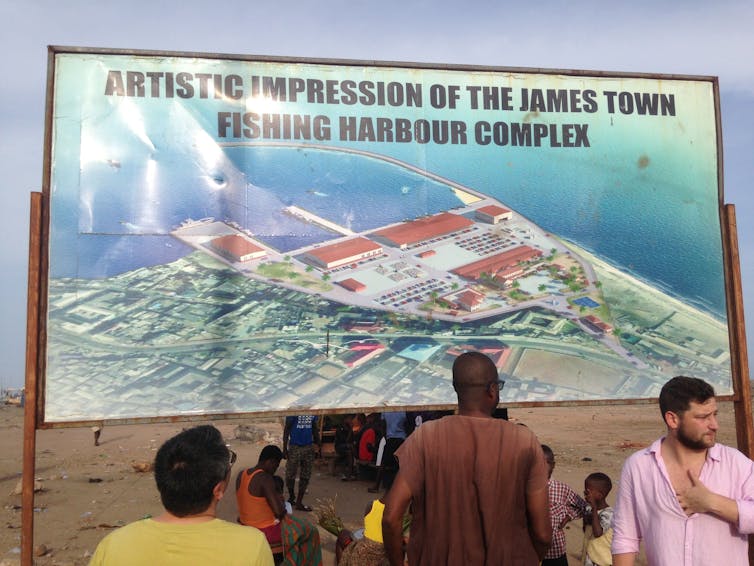
Earlier this year a billboard was suddenly erected on the beach displaying an “artist’s impression” of how the beach is to be developed. It’s a disturbing image in many ways, showing the beach completely cleared of its inhabitants. There’s also a large car park and a series of somewhat bland sheds or factories. There is not one single canoe in sight.
An artist’s impression of the new Jamestown development. Iain Jackson
The proposal (and its backers) see this site as a convenient place to construct a new factory for the mechanised processing of fish. There is nothing inherently wrong with this as an idea. But the current proposal would not only occupy a prime site with historical significance: it would displace a large community along with their heritage, skills and traditions.
There are four main considerations that have not been addressed by the current proposal. And with the beach already being cleared of its residents and traders, time is running short.
Seafront heritage site: A shoreline development with an historic waterfront requires sensitive and appropriate proposals. A failure to deliver this undersells the site’s potential. It is not appropriate for a factory and car park to be placed on this important plot.
It is hard to imagine any other international port city using its most important natural features in this way. The attractive view over the ocean offers lots of possibility for this site. Reducing it to a fish-gutting production line is shortsighted and lacks ambition.
Community discussion and liaison: The settlements and businesses located on the beach are “informal” (like most of Ghana’s economy). But this must not discount or invalidate their contribution to future development. No one is more invested in this place than the current population, part of the minority Gā community, with their own language and traditions, who have lived and traded here for centuries.
Individual fishing boats and their small hauls may not be the most efficient or lucrative methods of extracting the bounty of the sea. But they bring many advantages. The main traders (and controllers) are women affectionately known as “mammies”, who set the prices and manage supply.
This matriarchal system has been largely responsible for ensuring a strong community. Whilst these traders are fiercely competitive, they care for each other and their lives. Memories and stories are inherently bound to this place – the proposed factory would completely undermine and destroy this market and cohesion.
Mechanised production would also result in fewer employment opportunities. The power would be taken from market traders and fewer fishermen would be required.
Fish stock: Environmentally the mechanised processing and trawlers would be disastrous for the fish stock. The existing method marries periods of fallow with festivals, allowing the sea to recuperate and replenish. There is a rhythm to the current fishing method that responds to the seasons and traditions. It is unlikely this approach will be respected by the new process and the factory’s profit driven approach.
Tourist potential: The first place tourists visit when arriving in Ghana is usually Jamestown and the harbour area. Its two former slaving forts and the historic mercantile core of the town, coupled with the array of festivals and events, have so much potential as revenue creators.
They must be treated as rare commodities, not as cheap development plots. If this district is gradually eroded, its natural features, historic charm and engaging community dismissed, then what else is there for visitors to see in Accra?
In the last six months eviction processes have started to clear the beach. This is an earnest plea for this proposal to be rethought – and for this fascinating part of the city to be regenerated in a way that celebrates and respects the history and people of Jamestown.
Thank you to Prof. Ola Uduku of Manchester School of Architecture for reviewing the ‘Sharing Stories from Jamestown’ exhibition. The exhibition has been extended to run until the end of June 2019. Below I’ve uploaded a 360 degree panoramic view – you can ‘click and drag’ the film to have a look around….
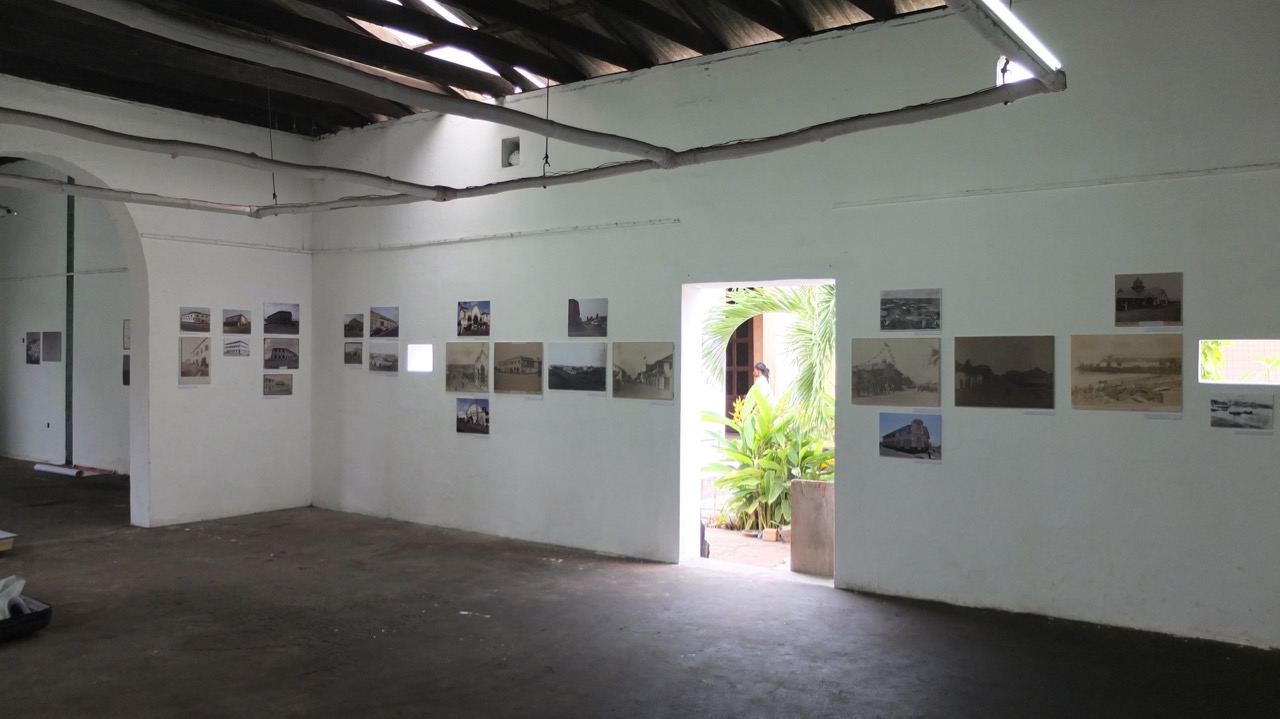
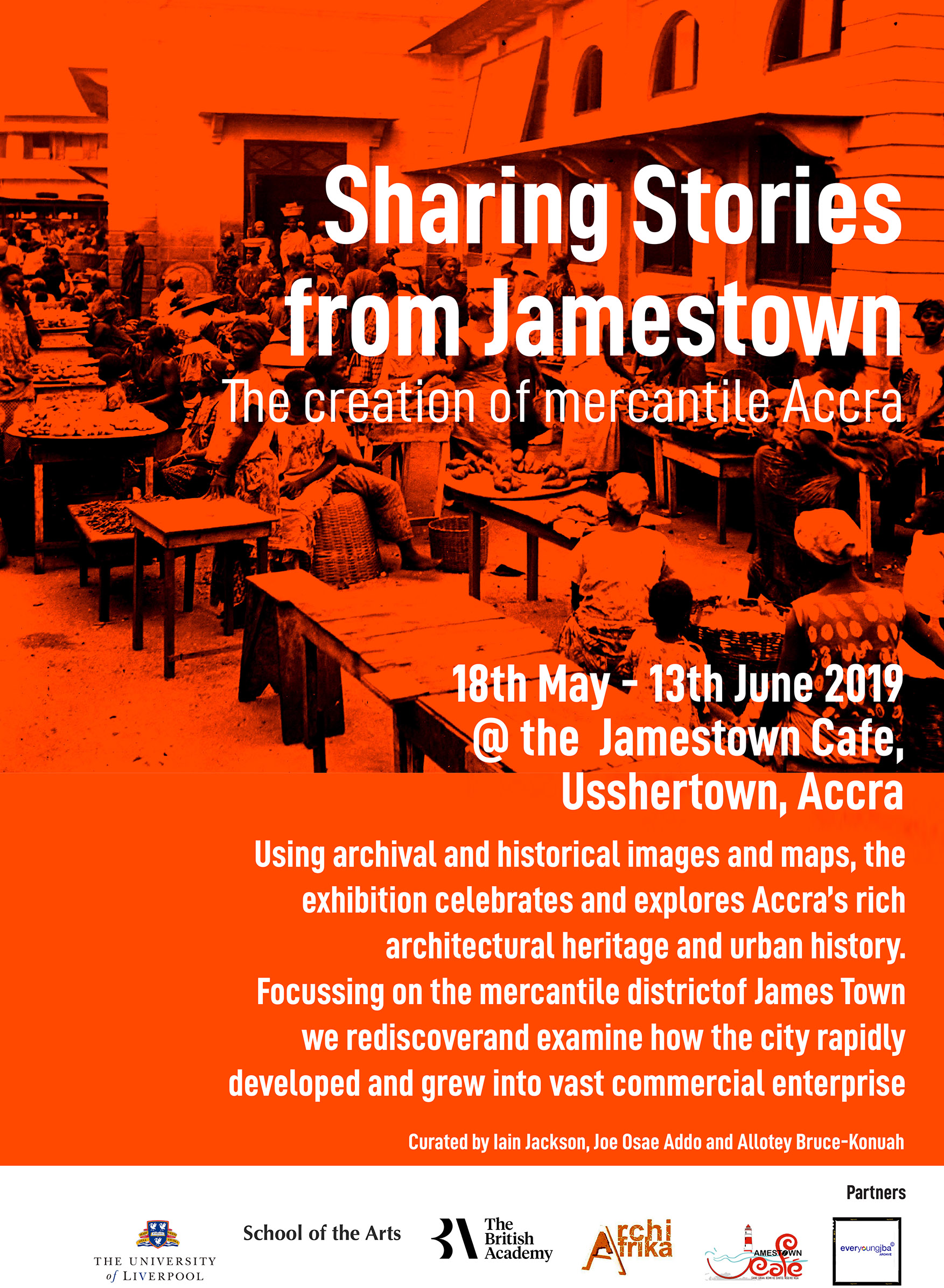
Iain Jackson’s exhibition co-curated by Allotey Konuah-Bruce and Joe Addo opened to great acclaim on Saturday evening at the Jamestown Café, venue, near Ussher Fort. Curiously the café it was confirmed by local elders who attended the opening is accurately in Usshertown; the exhibition launch providing a great forum for these questions to be aired and for detailed discussions to be had.
Historic photographs and maps of ‘old’
Jamestown buildings have been placed next to those which show their age,
condition and use, in ‘contemporary’ Jamestown have been displayed in the lower
gallery of the Jamestown Café, which itself features in the exhibition as Tarquah
house, the dwelling and warehouse of one of Jamestown’s wealthy local
merchants, who had originally had it built. The exhibition represents a true
joint collaboration between Iain Jackson and Allotey Konuah-Bruce who have formed a close and productive working relationship as they have spent the…
You are invited to our Exhibition, ‘Sharing Stories from Jamestown’, opening on the evening of Friday 17th May 2019 at Jamestown Cafe, High Street, Accra. All very Welcome! The exhibition will run until 13th June.
We’ll be exhibiting vintage photographs, plans and drawings from over ten archives and private collections that have been gathered together here for the first time. To accompany the exhibition we’ve also produced a catalogue that attempts to explain and contextualise the images, and to tell the history of Accra’s development, planning and architecture. You can read the digital version below. We’re indebted to Allotey Bruce-Konuah for expertly setting out the catalogue.
This is an excellent opportunity for emerging writers and students. Last year’s gathering produced some excellent work, and this year we will have the exhibition at James Town Cafe as a provocation and stimulus for debate….
We are pleased to announce that we are now accepting applications for the 2019 British Academy – ASAUK funded 2019 African Architecture Writing Workshops. These workshops are offered for postgraduate students looking to develop their academic writing skills in the areas of architecture, urbanism and related disciplines.
This year there are two workshops. The first to be offered will take place in May 2019
FIRST WORKSHOP DETAILS
“Sharing
Stories from Jamestown and the Creation of Mercantile Accra” Writing Workshop
Monday, May 12 – Sunday, May 18, 2019
This workshop explores the colonial
and mercantile architecture of Jamestown, the British settlement area of
colonial Accra and located in Ga Mashie. This writing workshop is linked to the
May 17 exhibition organized by Professor Iain Jackson (University of Liverpool) and Joe Osae-Addo and Allotey Bruce-Konuah (Jamestown Cafe), which will showcase archival and historical images and maps of Accra’s…
A. M. Martin & P. M. Bezemer (2019): The concept and planning of public native housing estates in Nairobi/Kenya, 1918–1948, Planning Perspectives, DOI: 10.1080/02665433.2019.1602785
Estate lay-out Kaloleni, 1943, A.J.S. Hutton. Source: G.W. Ogilvie, The Housing of Africans in the urban areas of Kenya. The Kenya Information Office: Nairobi. 1944
Abstract: Interwar public housing estates for native citizens in Sub-Sahara African cities, represent hybrids of global and local urban concepts, housing typologies and dwelling habits.
The authors explain such hybrids via exploratory research note as a result of transmutation processes, marked by various (non)human actors. To categorize and compare them, Actor Network Theory (ANT) is applied and tested within an architecture historical framework. Nairobi/Kenya functions as pars pro toto with its Kariakor and Kaloleni estates as exemplary cases. Their different network- outcomes underpin the supposition that actor-oriented research can help to unravel a most essential, though neglected part of international town planning history.
Plan and elevation of two one-room dwellings, Kaloleni, 1943, A.J.S. Hutton. Source: G.W. Ogilvie, The Housing of Africans in the urban areas of Kenya. The Kenya Information Office: Nairobi. 1946
(sub) URBAN TROPICALITY: Urban challenges in the tropical zone
International Network of Tropical Architecture (iNTA) Conference at The University of Queensland, Brisbane, Australia, 5 – 8 December 2019
The cities and urban centres of the (sub) tropics are where the greatest challenges facing our collective future can be found. They are where the challenges of global warming, inequality and the migration of people fleeing political unrest or climate change are at their most extreme. The 2019 International Network of Tropical Architecture (iNTA) conference provides a forum to discuss architectural and design solutions for a resilient, smart and just future for urban centres in the tropics.
Founded in Singapore in 2004, the International Network for Tropical Architecture (iNTA) is a networking platform for international researchers and practitioners to collaborate and learn from each other about problems and solutions pertaining to architecture and urban design in the tropical (and sub-tropical) regions and brought together by the shared climatic imperatives and opportunities of these regions. The iNTA permanent secretariat is located at the Department of Architecture, School of Design and Environment at the National University Singapore.
The 2019 iNTA conference is hosted by the School of Architecture at The University of Queensland, located in Brisbane, capital city of the state of Queensland, Australia. Brisbane is proximate to both the fastest growing urban centres in Asia and many Small Island Developing States (SIDS) most at risk from climate change, including Kiribati, Marshall Islands, Federal States of Micronesia, Marshall Islands, Niue and Tuvalu amongst others. Queensland’s most northern extremity, Cape York, sits at the confluence of the Indian and Pacific Oceans, those very same oceans that generate the weather systems that circle the globe and affect the destiny of millions of people.
For those who live in the so-called “global south,” there is a sense of urgency about the challenges arising from rapidly changing climate conditions. Matters are not merely academic, but dynamic and concrete. Before the launch of iNTA, discourse around architecture and urbanism in the tropics was framed by centres of scholarship in Europe and North America. The malingering aftermath of devastating tropical storms such as Maria and Irma (2017) in the Caribbean and Typhoon Haima (2016) in the Philippines challenges such ascendancy. The 2019 iNTA conference in Brisbane brings discourse to a subtropical city at the crossroads of cultures, regions and climate zones. At a time when Australia’s role in the region continues to be questioned, it provides an opportunity to enhance north-south dialogue.
Submission Information & Instructions
Submit abstracts of no more than 300 words in length by email as Word documents to: https://easychair.org/conferences/?conf=inta2019. Please name the email subject ABSTRACT-SURNAME and use this name for your submission file as well.
Abstract deadline: 26 April 2019
Submission of full papers for review: 26 July 2019
Submission of final papers for publication: 18 October 2019
All abstracts will be considered by the conference academic committee; authors will be invited to prepare a full paper (no longer than 4,500 words); authors wishing their papers to be published in conference proceedings should submit their final papers for peer review on or before 26 July 2019. The date for submission of final papers is 18 October 2019. Authors may opt out of publication.
Conference Streams
Tropical Architecture refers to constructed architectural and urban environments relating the climatic and natural conditions of the tropical (and sub- tropical) regions, and interacting with various local specifics of culture, urban fabric and technology. Contributions to the following conference streams are sought.
1. Tropical Urbanism
Stream focussing on challenges to and solutions for enhanced liveability in urban centres of the tropics. Papers might address:
projects or propositions for reversing or healing the degradation and collapse of urban centres under rapid growth;
urban infrastructures at risk: rising sea-levels, increasing storm intensity, expanding torridity and aridity.
urban adaptation responses : design planning policy, governance and codes
urban forms shaped by determinants other than climate alone, such as topography, nature, cultural life.
vegetation in (sub) tropical cities: cultivation in gardens and the peri-urban or neglect in terrain vague.
Stream focussing on individual designs/ architectural, infrastructure, adaptation projects. What is it that makes the contemporary architectural project tropical? Or the tropical project contemporary? Papers might illuminate projects that demonstrate instances of :
building technologies: tropical and subtropical applications including
passive low energy and carbon neutral architecture
climate mitigation strategies
equity in the tropical city
the (sub)tropical tower
contemporary architecture (still) learning from vernacular traditions
reciprocities/dialogue between architecture and tropical environments: between the zeitgeist of a globalized culture and a project’s specific circumstance.
3. Narratives of Disease, Discomfort, Development and Disaster :: Reconsidering Tropical Architecture and Urbanism
The idea of tropical architecture and urbanism initially developed through a particular connection between discourses on disease, spatial practices and optimum architectural typologies, which were believed to circumvent the spread of tropical diseases and to maintain the comfort of the white settler. After the Second World War, the focus shifted from the European settlement of the colonial tropics to the self-development and governance of the world’s tropical regions; a phenomenon necessitated and propelled by post-war decolonization and global regimes of development aid. Accompanying this change was a shift away from the physiological comfort of the colonial settler to a new focus on indigenous cultures, vernacular building traditions, use of local materials, and increasing appreciation for the psychological value of cultural conventions, including superstition and taboo. The aim of this stream is to examine how “triumph” in the tropics was imagined across multiple geographies, by various subjects, through diverse discourses, and at different times and to critically investigate the roles architecture and urban planning played in this process. We particularly welcome papers that offer historical case studies of tropical and subtropical architecture and urbanism examined through one of four lenses:
disease
discomfort
development or disaster.
This stream will be convened by Dr Deborah van der Plaat (The Univerity of Queensland), Dr Vandana Baweja (University of Florida) and Professor Tom Avermaete (ETH Zurich).
4. Historic Urban Landscapes and Tropicality
The Historic Urban Landscape is a new approach recommended by UNESCO that recognises and positions the historic city and its core as a resource for the future and the centre for the urban development process. Papers might address:
operational principles for urban conservation models: respecting values, traditions and environments of different cultural contexts.
historic urban centres and tropical vulnerability
mapping urban heritage values and attributes
planning, design and implementation of development projects in historic urban centres
adaptive use and re-use impacting authenticity and integrity of physical and social fabric in historic urban centres
Small Island Developing States (SIDS) of the Pacific and Caribbean: their vulnerability and resilience