Archive

Author Archives: jacksoniain


The paper focusses on the planning of rural settlements by the Athens-based firm Doxiadis Associates (DA), a key, even if unrealised, project for Zambia’s nation-building and development efforts in the mid-1960s. In line with post-war discourses of modernisation, DA employed Christaller’s 1933-Central Place Theory and its abstract hexagonal geometrical model to organise different-sized settlements within a single spatial system. By introducing a hierarchical rural network over Zambia, the firm aimed to standardise rural settlement patterns and to formulate a strategy to alleviate rural-urban migration. DA’s top-down, large-scale approach even exceeded the State’s aspirations and the firm’s visions eventually faced two challenges: First, DA’s modernist planning was questioned by the social/ecological considerations as formulated by George Kay’s counterproposal on resettlement policy. Secondly, DA’s ‘urbanising’ visions for rural areas were forestalled by some of the country’s realities, which remained out of the planners’ field of control, and eventually called for more cautious responses to the realities on the ground. By exposing the challenges DA’s rural proposal faced, the paper ultimately contemplates the multiple, and even conflicting reactions towards Zambia’s rural settlement projects, and also adds nuances to the wider histories of rural development in Africa.

Full article here: https://doi.org/10.1080/13602365.2018.1458044


‘I need 30 minutes to meditate before giving the lecture’ stated Balkrishna Doshi, ‘and a quiet room in which to do so, and, oh, some tea please’.

I’ve always been somewhat taken by this, my first (and only) meeting of Doshi. This was not the request of an architectural tyrant making petty demands, but an essential aligning of thoughts, removal of distraction, and focusing on how he might respond to the audience. It was a process he mirrored in his architectural work – bring forth a determined idea, eliminate any confusion and put the ‘audience’ or the ‘user’ at the centre. Doshi was in Liverpool to give a lecture to coincide with a Le Corbusier exhibition arranged as part of the European Capital of Culture year. The lecture covered parts of his biography such as his time with Le Corbusier in Paris (and surviving on a meagre subsistence) working on the monuments of Chandigarh, as well as his work with Louis Kahn at the Indian Institute of Management in Ahmadabad. Had his career ended there it would have been remarkable but he would go on to make significant advances in both formal and social aspects of architecture.

OLYMPUS DIGITAL CAMERA

Mill Owners Association Building by Le Corbusier

On 7th March Doshi was awarded the Pritzker Prize, the first Indian to receive the award, and we send our hearty congratulations.

Together with his studio he has designed well over 100 projects in the Gujarati city of Ahmedabad and many more throughout the rest of India. He has chosen to focus on India rather than developing an international portfolio of work, and he has contributed much to low-cost housing provision and town planning.

sangarth

Sangarth

Ahmadabad, with its wealthy merchant class, has proved an eager patron of architecture and the city is astonishing for its quantity of bold design. They readily embraced Corbusier’s work and he received three commissions in the city. Doshi’s own work emerged out of this context. He wasn’t a mimic or somehow bound by Le Corbusier – on the contrary, he developed his ideas further and pursued the playfulness that is rarely discussed in Corb’s later commissions.

Working out of his self-built studios ‘Sangarth’ for the last 40 years, Doshi created a series of half-round concrete parasols clad with ceramic.  These vaulted spaces were quick to construct, eliminate complicated details and components, and offer flexible enclosures that can easily be extended. The vaults offer protection from the intense heat of the Gujarati summer as well as channeling the monsoon rains into a series of pools. The landscaping is equally important with large scale planting, shade trees, and a small amphitheatre carved out of the terrain. The campus is a lesson in how to design with care and beauty whilst minimising materials and maximising spatial impact.

CEPT1

CEPT

Although more sculpted and at a larger scale similar themes were explored at the Centre for Environment, Planning and Technology [CEPT].  Here there is an encouragement of procession and movement through the various structures and landscapes. Gathering spaces open up amongst the strong, yet simple brick masses. The climate here permits few enclosures and the building envelope is perforated and rarely defined. Wandering through the campus exposes the students to the work of others, and one stumbles upon critiques, exhibitions, models being tested, and class discussions. Circulation is no longer a corridor or a staircase. There are elements of Kahn’s IIM, but the CEPT campus is more compact, more urbane and less of a‘set piece’ than IIM – whilst both use the humble brick and deep shadowed reveals to great effect.

CEPT2

Critique at CEPT

There are of course many more projects that we could discuss (see William Curtis or James Steele’s monographs for more on the work), but two that immediately spring to mind are Premabhai Hall (1972) and the Tagore Theatre (1963-65).

premabhai1

Premabhai Theatre

Premabhai was a brave project, situated in the heart of old Ahmadabad’s Badra, a large public square lined with historical works and old city gates. The theatre seems to leap up and cantilever out over the square.  It confidently dominates the space, rewarded for its quirky form, and the blank gables acting as a foil to its ornate neighbours.

th-img-Hall.jpg

Tagore Theatre, Vastu Shilpa Foundation 1967

The Tagore Theatre is a rigid frame, folded plate structure, and achieves an impressive 33m span enabling the interior to remain free of columns (as well as containing all of the services). At first sight it appears too much  – the scale and lack of surrounding context makes for a foreboding approach. But the delicate folds of the concrete and precision casting seems to soften and give the theatre a more starched-fabric feel upon close contact – plus it’s impossible not to smile at the acoustic clouds that line the interior.

Inside the Tagore Theatre

Inside the Tagore Theatre, Vastu Shilpa Foundation, 1967


Two New Buildings in Accra

How are we to build today in Ghana? What is our architectural syntax and how are we to generate form, meaning and qualities that somehow resonate with Ghanaians today? This is of course a difficult question, and not all architecture has to be reflective of the country in which it is built. Indeed, it is very problematic to think of architecture in terms of geo-political territories, especially when the architecture of the West is rarely presented like this. It is unusual to hear of architecture referred to as European, or Luxembourgian for example, but the architectures (and architects) of the global south are frequently labelled according to country or region of origin (Indian, South East Asian, West African for example – see http://blog.nus.edu.sg/seaarc/symposium/), furthermore when ‘modern’ architecture is produced in those countries it is labelled as mimicry, inauthentic, or somehow borrowed, imported, or not belonging.

This is the difficulty architects face when working in places like Ghana. However, architects must take a stance and adopt a position. They should be self-conscious of the designs that they are making, and conceive of a direction, or ambition for their work. There were two recent buildings that we visited in Accra that are attempting to deliver a new response to architecture.

One Airport Square

One Airport Square

One Airport Square  (designed by Mario Cucinella Architects) has gone for the attention-seeking approach. A complex façade composition made up of diagonally arranged structure with horizontal fins. The fins and ‘columns’ project from the building’s envelope by almost 2m, acting as a vast brise soleil they provide much needed shade, as well as absorbing heat externally whilst reflecting sunlight light into the building.

IMG_0838

Atrium of Airport Square One

Internally there is a large atrium space that holds the circulation as well as bringing light into the deep plan and pulling fresh air through the courtyard. This kind of building works well when set amongst other less adventurous forms. It is also helping to create a new context for that part of Accra, and is distinctive enough to become a reference point and landmark. I just hope it doesn’t become part of a silly form-making game with each bank trying to out-do each other in the quest for the next distinctive shape.

IMG_0840

Ecobank, Accra

Another new building that has just reached completion is the vast Ecobank Headquarters located adjacent to the Efua Sutherland Children’s Park. This provocative building was designed by a consortium of Ghanaian and South African architects (http://arc.co.za/project/ecobank-ghana/), the local and site architects being Mobius, lead by KNUST graduate Augustus Richardson. A lightweight metal brise soleil is used to protect the glass façade where the sun strikes, and a perforated metal jali screen offers solar protection at the lower levels, as well as being used to depict a map of the world, and a larger drawing of Africa.

DSC_0549

Augustus Richardson with the model of Ecobank

At ground level the building is clad with limestone firmly rooting it into the earth and forming tactile surfaces. The two forms reflect the public banking space, and the private offices of the bank HQ. The bank is orientated on an axis leading towards the concrete obelisk in Africa Liberation Square, and there is a real declaration of optimism in this building. Mobius are an exciting firm to follow, and Richardson kindly took us on a tour of the bank, giving behind the scenes access. The quality of the finish is exceptional and build quality excellent. Richardson clearly cares about architecture and his city; there is a charged excitement in the way he talks about design (see http://www.design233.com/oldhtml/works/augustus_richardson_the_bridge_mobius.html for more on this).

But what of the building envelope? Is it an appropriate response to design an almost entirely glazed building in Accra?

In 1957 Anthony Chitty gave the opening address to the new school of architecture at KNUST and posed this question,

‘Is a regional architecture, a truly African style, possible for West Africa; for Ghana in Particular? I believe the answer to this question is “yes” : not only possible but desirable, something to be striven for.’

In many ways the Ecobank is the perfect response to the clients wishes – they wanted a modern, international office space to reflect their brand, and clearly Ghanaian architects and engineers can deliver this type of work as well as anyone, but, if we are to be critical, are we guilty of what Chitty spoke about 60 years ago when he demanded,

‘Not just a pallid and mediocre edition of the international style, not just the half considered European solution trotted out to make do here, but a real and living architectural answer to your own local problems, social, technical and political, drawing the maximum from such origins as do exist here, a true Ghana aesthetic.’

I don’t think the Ecobank is at all mediocre, or half-considered, and Chitty was over-playing the Ghana aesthetic idea in light of the nationalist tendencies from the time-  but there must be an approach that can make the architecture of this region specific to this place. Other large projects are rapidly springing up (and unlike the Ecobank) they parade the hackneyed multi-coloured cladding approach that is tormenting every city, whereas Ecobank is clearly searching for something more.

The difficulty is how to scale-up ‘tropical’ design. Tropical architecture stems from the bungalow, barracks, and hospitals – it works well for small-scale low-rise buildings, as the Children’s Library, George Padmore, KNUST Senior Staff Club House demonstrate – it wants to be a ground hugging solution set within leafy gardens and evaporation pools.

A bank today however cannot rely on loggias and verandahs, and rising land values and the ability of buildings to generate substantial rental incomes stimulates the high-rise approach.  This was something that Fry and Drew encountered in West Africa. They worked for the Co-op Bank in Nigeria and placed louvres on the facades of multistory buildings, a technique also used by John Addo at Cedi House in Accra. The library at Ibadan presents another alternative – with its delicate screen and effectively double-façade-cum-circulation zone. Fry found the façade too ‘lace-like’ and pursued something more strapping and formal in later works, such as the library at Girls College in Chandigarh’s Sector-11.

DSC_0553

Cedi House viewed from Ecobank roof garden

Fry also set himself the challenge of using a glazed façade in a hot climate, again in Chandigarh. At the Government Printing Press he used glass on the north facing façade only, and included adjustable louvres on the interior to reduce glare. The south facing façade was protected by the walkways and an external aluminium louvre system based on the traditional jalousie reduces solar gain.

There is perhaps just the germ of historical precedent in the two recent Accra buildings – and both reveal a confidence in the city, as well as an ambition to test this type of architecture. The next step will be to put some data-loggers into these buildings and to see how they perform. Their critics might be pleasantly surprised.


Ghana’s housing – an historical retrospective.
Ola Uduku writes:

Visiting Ghana gives one the chance to step back through time – there is an abundance of housing which has survived the vicissitudes of the temporal, physical and socio economic life of more than fifty years; and in certain cases an entire century of existence in the unforgiving tropical climate which comprises much of Southern Ghana’s landscape. In two weeks we came across these special gems.

 Timber housing: Colonial Ghana, then called the Gold Coast along with Nigeria had significant swathes of forests which were sources of tropical hardwood. The Colonial government established significant agro-forestry concerns in both countries, which resulted in timber research stations. The two houses in this post are examples of experimental worker housing that these research stations were responsible for developing. We think that the Kibi house, near the market town of Koforidua,  is over one hundred years old. The other lapped wood house was found at the Aburi botanic gardens, which had previously been the site of a sanatorium. Interestingly both buildings have substantial elements preserved including; walls, casement windows, wooden flooring and roofing elements. Generally only the non ‘wood’ roofing sheets have had to be replaced.

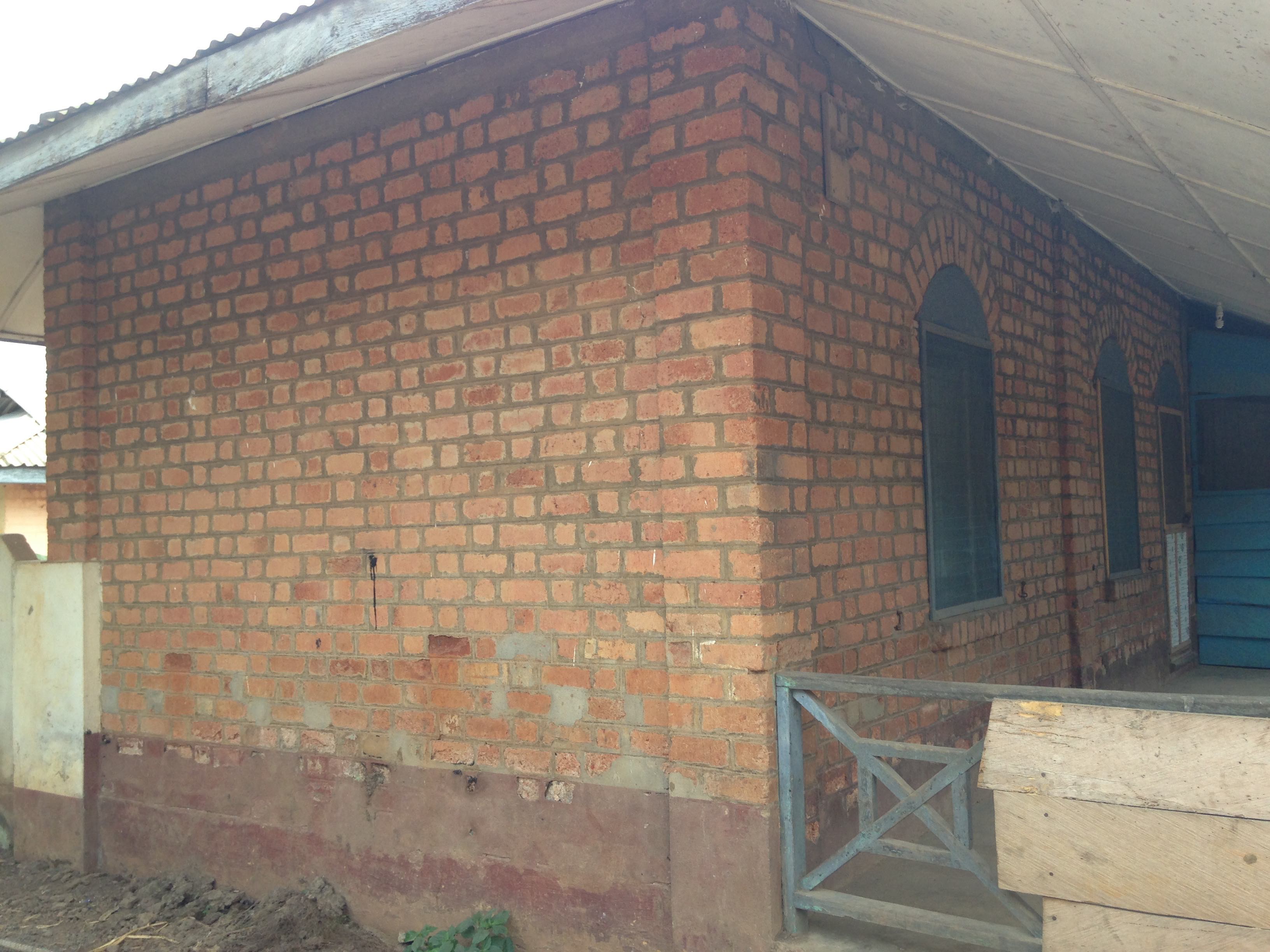
Brick Housing: At Kibi also across the road from the ‘forestry’ house we found an example of a demonstration brick building. This was a semi detached pair of worker quarters set out as a single depth bungalow with a wide verandah and walls one brick thick. The first building retained the balcony format whilst the second had its balcony appropriated to create more space for the larger families who now occupied these buildings.


Experimental Brick Housing in Kibi

Experimental Brick Housing in Kibi

Impregilo Prefabricated Housing
Going to Akosombo Community One  – which was where the elite staff and also the contractor Impregilo had its staff quarters revealed a further rare find.  Built on a higher part of the Community One hill ridge are the original staff quarters for Imregilo staff, we assume these would have been for the Italian foremen and remain in near pristine condition. The original prefabricated lightweight wall-panels can be seen clearly in the neat avenue of houses which looked in some ways like a re-created Italian village scene. A number of the houses had the individually built ‘sit out’ verandah areas with views to the Akosombo landscape and the staff club below.

Impregilo Housing in Akosombo

Prefabricated housing for Italian contractors at Akosombo

View of the Akosombo Dam

View of the Akosombo Dam from Community 1

Today’s domestic architecture in Ghana as in much of West Africa unfortunately seems to have not incorporated much of the ‘environmental design rules’ that these and other residences of this early post independence era were able to employ. The site orientation, use of lightweight materials, utilisation of large areas of operable fenestration, and shading, have all contributed to make these now historic houses exemplars of how domestic buildings could be built to ensure thermal comfort without reliance on today’s ubiquitous air conditioning systems. Surely it is now time to re-evaluate the principles so aptly demonstrated in these houses and use them as a basis for developing a more sustainable response to tropical housing in Africa today.

Notes from James Town, Accra.

Hansen Road, James Town

Hansen Road looking towards the Methodist cathedral

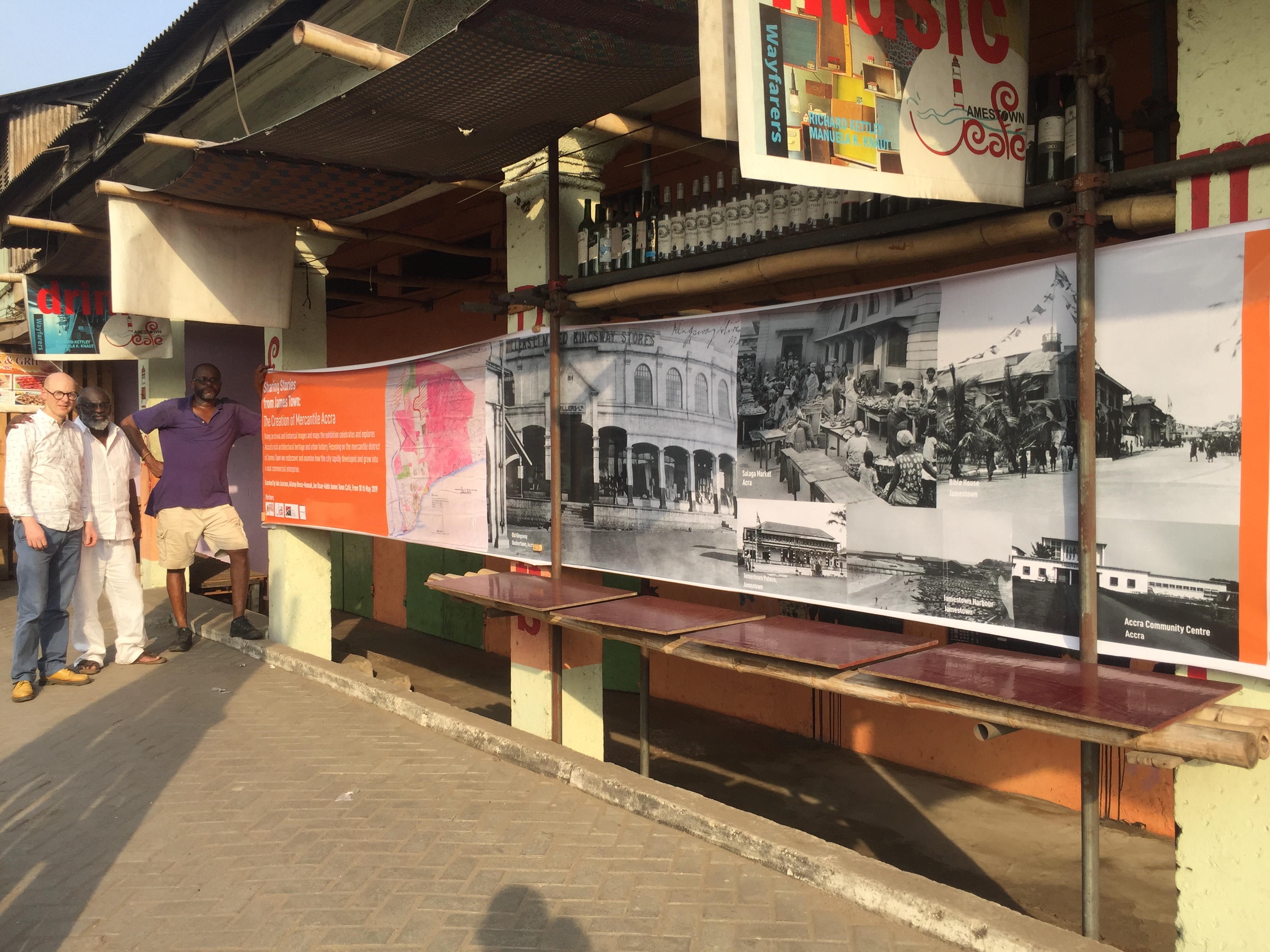
James Town is an old district in Accra running along the coast and associated with the British during the early colonial period – when the Dutch and Danish were also grappling for control of the town. Set behind the Usher Fort are many warehouses, trading posts and residences. A fine array of historical buildings can still be found here, but much of its rich tangible and intangible heritage is at risk through insensitive development, lack of maintenance and the departure of large businesses from the area. Despite this, it remains a vibrant and charming district full of markets, traders and the cultural epicentre that is the James Town Café, recently frequented by Emmanuel Macron during his visit to Accra.

James Town Cafe

James Town Café

Led by the charismatic Allotey Bruce-Konuah we weaved our way through the markets and informal structures that now occupy the gaps and leftover sites, punctuated by a vast collection of colonial-era buildings. Our first stop is a stone obelisk encased within an old market hall. The obelisk was built shortly after 1900 to commemorate the last of the Anglo-Ashanti wars. One of the plaques is in Arabic script, perhaps in recognition of Nigerian-Islamic troops who fought the Ashanti with the British. From here we went to the adjacent market hall. It was used until quite recently – and with some minor repairs could make for a very fine market venue today, perfectly sited on a strong axis and at the centre of the district.

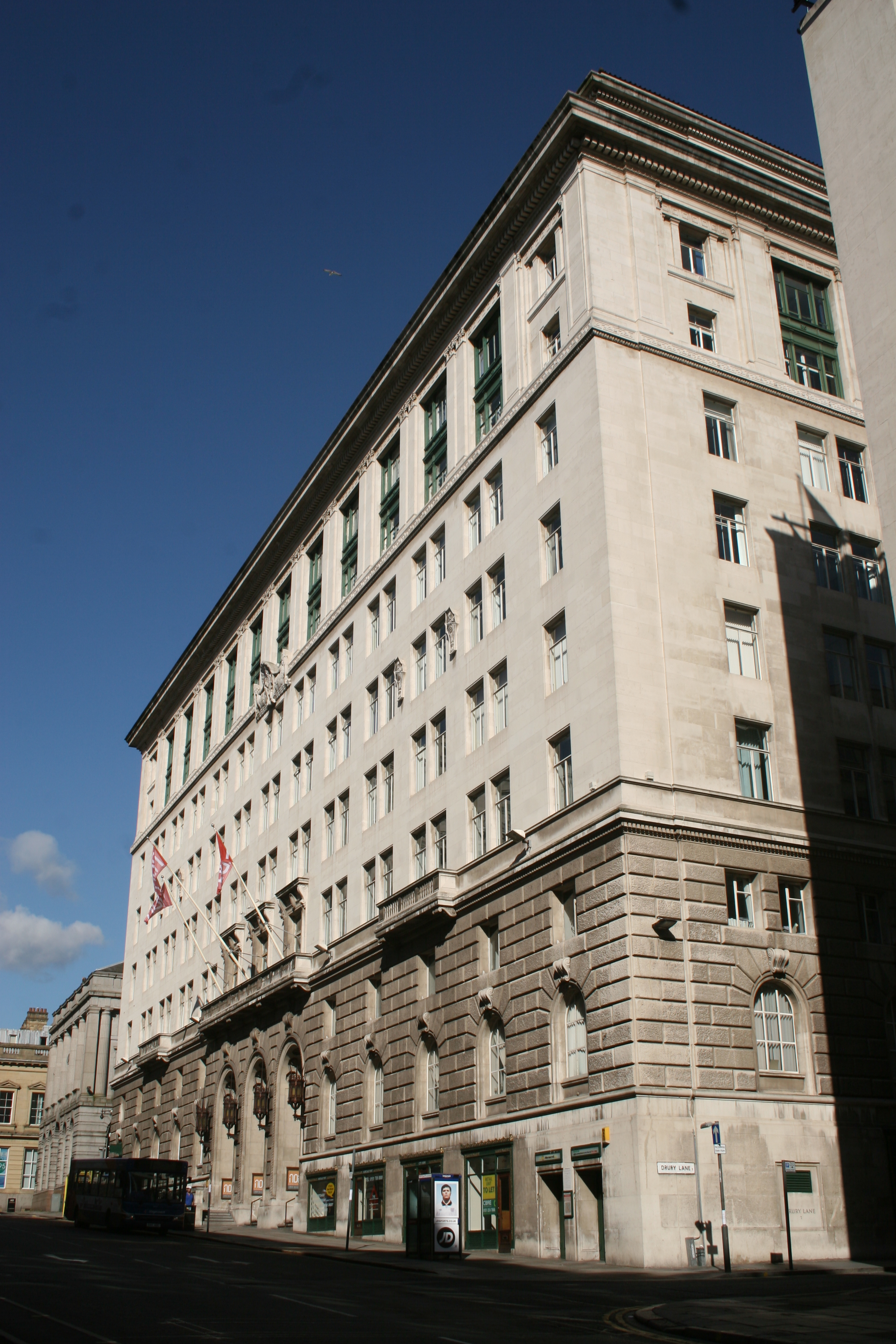
We visited Azumo house, built in 1914 – the original owner’s escapades of shipwrecks and ‘salvaging’ are apparently recorded in the Red Book of West Africa. The quality and number of historical buildings is surprising – a case of preservation by leaving-be. The warehouses of the Compagnie Francaise de L’Afrique Occidentale (based in the Royal Liver Building in Liverpool) occupy a prominent site, and Ellen House built in 1918 boasts a rich history – we will attempt to uncover more.

Our trip concluded with a visit to the studio of Deo Gratias. You may remember some of the photos from this studio featuring in The Guardian (and here) not so long ago. It was extraordinary to see these images printed and in large format. Kate Aku Tamakloe, the granddaughter of the studio’s founder, JK Bruce Vanderpuije, and curator of the collection kindly gave us a tour. Kate told us there are many, many more images to scan, some from glass plates. We look forward to seeing more of this important work.

Deo Gratias Studio

Deo Gratias Studio James Town

Notes from Tema, Ghana

We visited Tema, the new port and town built 10km east of Accra in the 1950s and early 1960s. Planned as part of a suite of infrastructure projects including, an aluminium smelter, docklands, and hydroelectric dam, the town was to provide model housing in a series of self-contained neighbourhoods, called ‘Communities’. Each has its own central market area and Community Building surrounded by a series of residential areas. The houses are set around schools and recreation areas, and grouped according to size and occupant income.

We began at Community 1 and explored the market area, complete with extended community centre, before finding some of the distinctive ‘Type iv’ housing. The housing has been extended and in-filled but the original basic form is just about discernable. Other housing had been supplemented by gardens and painted facades. The low-rise flats with central access staircase have been well-maintained and there is a strong sense of pride in the neighbourhood here.

Michael Hirst designed the Type iv housing. He studied at the Architectural Association in the Department of Tropical Architecture before moving out to Ghana (then known as Gold Coast) in the mid 1950s. He worked for the Tema Development Corporation, and lived in the Denys Lasdun designed flats in Tema. We had a good look for these flats and hoped to track them down – but alas, they eluded us….

Community 2 Housing

Community 2 Housing

At Community 2 we saw some grander properties (surely inspired by Maxwell Fry’s work in Chandigarh), as well as a market with vaulted roof and carefully detailed concrete and guttering system. The structure is, however, badly corroded and in need of urgent repair. The traders informed us that the market is likely to be demolished and replaced shortly.

Community 2 Market

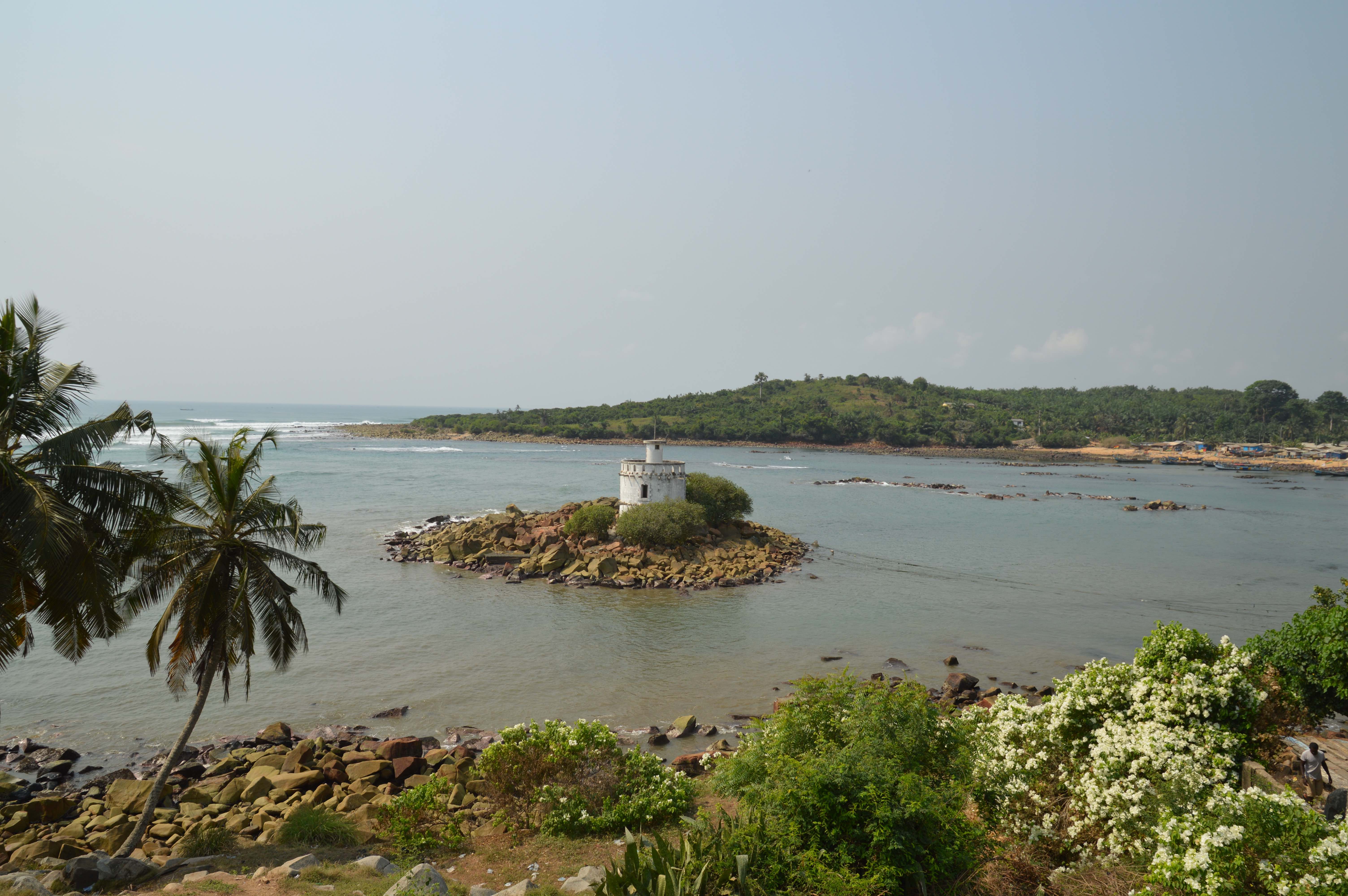
We moved on to Tema Manhean, the ‘replacement fishing village’ built to house the Ga People who were displaced with the building of Tema (see our paper for more detail). The settlement wraps around the light house and is made up of a series of compound houses designed by Maxwell Fry and Jane Drew. We found one compound that was built in 1961 (as noted by the date etched into the concrete during construction) and barely modified since. It was a perfect example of just how successful and adaptable the compound typology can be.


SaveSave

Notes from Accra 2018

Escaping the freezing temperatures of the UK we returned to Ghana for our final trip of the British Academy sponsored project. There were a number of buildings on our list still to be visited in Accra and we were eager to explore…

George Padmore Library, Accra

George Padmore Library, Accra

The first stop was the George Padmore Library designed in 1961, and containing a vast collection of Kwame Nkrumah’s personal books and pamphlets. The building is hidden in the Efua Sutherland Children’s Park and forms an excellent example of tropical modernist architecture with carefully detailed finishes, craftsmanship and landscaping. The cooling reflection pool sits beneath the open-tread staircase that weaves its way up into the reading room. There is no air-conditioning here, just the pleasant breeze enticed through the building by the louvres on each side. Who is the architect of this oft-overlooked gem? The Librarian is eager for the facilities to be expanded and developed – we hope they pursue a sensitive solution, and avoid what has happened the library at Sekondi.

UTC Building

UTC Building

From here we visited the UTC building, a former department store and office block now stripped of its external solar-shades and in the process of demolition. We were lucky to photograph this building, as a few weeks from now it will no longer exist. The building is located in the frantic and exciting market area of town where everything from a tomato to a stadium PA system can be purchased. The market grew up around the train station that brought produce from the north and relayed the imported goods back. Complete with a dainty clocktower and waiting rooms the station structure is made from an imported cast iron kit from either Liverpool or Glasgow. Although there are no trains running any longer the station is as busy ever with squatters and traders making full use of the facilities.

Cedi House

Cedi House

Cedi house, the first podium-base-cum-high-rise to be built in the city in the early 1960s by John Owusu Addo is now, sadly,  looking a little tired, and needs some major investment. Each façade is different to respond to the specific climatic/solar demands. Inside a couple of murals survive and the marble cladding and exposed staircase give a glimpse of the building’s former style.


Biennial Conference, Centre for European Architecture, Kent School of Architecture (UK)

From Building to Continent: How Architecture makes Territories

Cultural landscape refers to landscapes shaped by humans through habitation, cultivation, exploitation and stewardship, and has influenced thinking in other fields, such as architecture. Generally, architecture has been subsumed within cultural landscape itself as a comprehensive spatial continuum. Yet standard architectural histories often analyse buildings as isolated objects, sometimes within the immediate context, but typically with minimal acknowledgement of wider spatial ramifications. However, buildings may become spatial generators, not only in the immediate vicinity, but also at larger geographic scales. ‘Buildings’ in this case include architectural works in the traditional sense, as well as roads, bridges, dams, industrial works, military installations, etc. Such structures have been grouped collectively to represent territories at varying scales.

In the context of this conference, the term ‘territories’ is appealed to rather than ‘landscape’, for the latter is associated with a given area of the earth’s surface, often aestheticized as a type of giant artefact. Territories by contrast are more abstract, and may even overlap. Discussions in this conference may consider varying territorial scale relationships, beginning with the building, moving to the regional, and even to the global. For example, at the level of architectural detailing, buildings may represent large-scale territories, or obscure others, themselves acting as media conveying messages. How tectonic-geographic relationships are represented may also be considered. Various media, primarily maps but also film and digital technologies have created mental images of territories established by buildings, and are all relevant to these discussions. Geopolitical analysis may provide another means towards understanding how architecture makes territories. Governments are often the primary agents, but not always, for religious and special interest groups have played central roles. Mass tourism and heritage management at national and international levels have reinforced, or contradicted, official government messages. Organisations dedicated to international building heritage, such as UNESCO (United Nations Educational, Scientific and Cultural Organization) also are implicated in such processes.

Paper proposals may cover anytime period, continuing into the present. Relevant proposals from all disciplines are welcomed.

Logistics

Conference organisers: Dr. David H. Haney, and Dr. Luciano Cardellichio.

Conference webpage address: Research.kent.ac.uk/frombuildingtocontinent


Paper abstracts: 150-200 words in length.

Paper abstract submission due date: 5th February, 2018.

Paper selection announcement date: 31st of March, 2018.

Please send paper abstracts as a Word doc (without images): frombuildingtocontinent@kent.ac.uk


Conference dates: 28th and 29th of June, 2018

Location: Canterbury, Kent, UK

Venue: The Cathedral Lodge: https://www.canterburycathedrallodge.org/meeting-and-conference-facilities-in-canterbury/

Daily Schedule: to be published

Conference Fee: £140 per person. Includes coffee/tea and refreshments, and buffet lunches on both days.

To pay the registration fee online, please click here: http://store.kent.ac.uk/product-catalogue/faculty-of-humanities/school-of-architecture/events/conference-from-building-to-continent-how-architecture-makes-territories

A conference publication containing selected essays is planned.

Keynote Speaker Lectures:

Professor Lucia Allais, Princeton University (US): ‘Maps of monuments and scales of design: Strategic bombing and the postwar international order’.

Professor Mark Bassin, Södertörn University (Stockholm): ‘Nature as State: Geopolitics and Landscape Monuments’.

Professor Kenny Cupers, University of Basel: ‘The Earth that Modernism Built’.

Professor Tullia Iori, The University of Rome Tor Vergata: ‘Engineering the Italian Landscape: the Autostrada del Sole as Territorial Construct for a New Post-War National Identity’.

The Transnational Architecture Group Blog is 5 Today!

It’s five years since our first tentative blog post. Since that day we’ve posted over 200 articles, calls for papers, and general research updates on all things architecturally transnational.

One of our major research interests has of course been the work of Maxwell Fry and Jane Drew, with the publication of the monograph in 2014 and international conference. But that was just the start. Since then we’ve covered Shama Anbrine and Yemi Salami’s PhD work in Pakistan and Nigeria respectively, as well as Cleo Robert’s PhD work in India. Rachel Lee tested and developed our Timescape App in Bangalore and also published a wonderful monograph (with TAG Press) on Otto Koenigsberger. She was also responsible for a major heritage symposium in Dar es Salam. Ola Uduku has been our most prolific ‘commenter’ as well as providing many research updates on our findings in Ghana and organising numerous workshops on the Architecture of Africa. Our current research project has been sponsored by the British Academy and we’re delighted to be collaborating with Rexford Assasie Oppong (KNUST) and Irene Appeaning Addo (Legon University) on this work.  There is going to be a lot more research stemming from this initial project, not least the cataloguing and archiving of the major drawings collection at KNUST, with Łukasz Stanek from Manchester University.

Other forays have taken us to Thailand and the work of Nat Phothiprasat, as well as to Sri Lanka and the plans of Patrick Abercombie.  We’ve posted abstracts and links to many other papers and projects, not least Johan Lagaes and Kathleen James-Chakraborty’s papers. Killian Doherty and Edward Lawrenson’s film on Yekepa promises to be one of the highlights of 2018.

More recent posts have revealed the rich architecture of the Middle East, including Levin’s paper on Ashkelon, William A. Henderson‘s work at Little Aden,  Ben Tosland’s research into Kuwait, Alsalloum’s moving paper on Damascus and Jackson’s paper on the PWD in Iraq. There’s surely a lot more to investigate here.

It’s been great fun, and here’s to the next five years of exciting research, difficult questions, dusty roads and even dustier archives, and of course new discoveries that make everything worthwhile.

We’d like to thank all of the blog contributors (please do continue to send us your updates, research findings and short articles). Thanks also to our committed readers and for all of your kind comments and emails.

Iain Jackson.


Alfred Roth’s criticism and answer to early schools in Kuwait

Ben A. Tosland, PhD Candidate at Kent School of Architecture, writes:

Recently, my research interests have taken me to Switzerland to the ETH Zurich archives with a focus on Alfred Roth, particularly looking at his work in the Persian Gulf throughout the 1960s and 1970s within the context of early critical regionalism. Roth had once worked in the offices of Le Corbusier, whose influence in form and colour was undeniable through several of his school designs executed in Kuwait in the 1960s and 70s. However, it is his criticism of Khaldiya Girls’ Secondary School designed by Rambald von Steinbüchel-Rheinwall (figure 1) that is particularly scathing and his architectural response is to be the topic of this post.

Picture1

Figure 1Rambald von Steinbrüchel-Rheinwall’s secondary school for girls. This shows the assembly hall that Roth is so scathing about. (ETH Zurich: Alfred Roth Archive no. 131-0764-F-2)

In the excellent compilation of Modern projects in Kuwait from 1949-1989, Roberto Fabbri points out Roth’s scornful thoughts of this school, but only briefly mentions that this is for climatic reasons stating Roth’s thoughts on its environmental inefficiency.[1] In the recently published second volume, he unpacks this further by spelling out the other criticisms Roth had of the school.[2] Roth’s initial criticism is a four-fold affair relating to the excessive use of land, a waste of inner-space causing ‘uneconomic planning’, the neglect of climatic conditions through the widespread layout and ‘enormous glass area’ of the majority of rooms and finally calls the architectural design ‘superficial’ and one of ‘fancifulness.’[3] When Roth talks of ‘gaudiness’, he is referencing the swimming pool buildings and assembly hall, both included in Nelson Garrido’s images printed in Fabbri et al’s Modern Architecture Kuwait’s first volume.[4] Roth’s criticisms are placed in a document that examines the situation of Kuwait’s schools in 1964, within which Roth suggests several alterations to their improvements.[5]

In answer to his criticism of von Steinbüchel-Rheinwall’s school, Roth designed schools that drew from Kuwait and the Gulf’s rich Arab architectural and urban forms. Using his prototypes, he oversaw the construction of many prefabricated schools for a wide range of student ages. Roth aimed to take into account the cultural heritage of Kuwait with his designs noting his quote from Saba George Shiber’s 1964 study The Kuwait Urbanisation:

“contrasting with the simple, humble, dignified, beautiful and organic architecture that is the heritage of Old Kuwait is the complicated, gaudy, undisciplined, ill-mannered and inorganic architecture that has, in “one fell swoop”, replaced or bulldozed away the tranquil and indigenous architecture deriving from the Kuwaiti habitat.”[6]

Picture2

Figure 2 This image shows one of the successfully built schools by Roth with the glazing out of the sunlight owing to the covered walkway on the classroom’s exterior (1970-1) (ETH Zurich: Alfred Roth Archive no. 37-0762-F.Roth-11)

Roth’s architecture in Kuwait, as shown in the images (figures 2, 3 and 4), was contextual to its urban surroundings and respected the organic growth of design within Kuwait and the wider region. His prefabricated low-rise buildings, often introverted facing a courtyard and were built on a significantly smaller scale to the von Steinbüchel-Rheinwall designed school. The designs for all Roth’s schools had covered walkways blocking sunlight from internally glazed areas. The external walls exhibited as little glass as possible (figures 2, 3 and 4) featuring outlets for ventilation punctuating the exterior elevations ensuring climatic credentials (figure 4). The introverted nature was common across Kuwait and the Gulf primarily for cultural and climatic reasons and had been common in the centuries prior to the nation’s modernisation process (figure 3). While they do not look as extravagant as von Steinbüchel-Rheinwall’s school, Roth’s schools functioned successfully.

Picture3

Figure 3 The internal courtyard of the school, showing the walkways on the exterior of the classrooms and how shaded they are from direct sunlight (1970-1) (ETH Zurich: Alfred Roth Archive no. 131-0762-F-Roth-22)

Through Roth’s criticisms of the fanciful designs that preceded him in Kuwait, he created a new form of Modern architecture influenced by research and the oversights of other architects. In terms of development and architecture in Kuwait, this was arguably a turning point towards a more contextual approach to architecture from Western designers. Buildings constructed in the decades after such as Jørn Utzon’s Kuwait National Assembly, Arne Jacobsen’s Central Bank and the unbuilt Mat Building proposals by the Smithsons built for the cultural and climatic conditions of an arid climate and conservative nation trying to find its true built identity. Archival material shows this dialogue between architects and different practices, manifesting itself in better more informed architecture that is not superficial nor fanciful.

Picture4

Figure 4 The external wall of the school without glazing areas allowing for cross-ventilation and no direct sunlight into the rooms (1970-1) (ETH Zurich: Alfred Roth Archive no. 137-0162-F-Roth-4)

[1] Fabbri, R. Saragoça, S. Camacho, R. (2016) Modern Architecture Kuwait, 1949-1989(vol. 1). (Niggli: Zurich), pp. 54-56.

[2] Fabbri, R. Saragoça, S. Camacho, R. (2018) Modern Architecture Kuwait, 1949-1989 (vol. 2). (Niggli: Zurich), p. 213.

[3] Roth, A. (1966) The School Buildings of Kuwait, (Unpublished Report), pp. 10-22. (ETH Zurich: Alfred Roth Archive)

[4] Ibid and Frearson, A. (20.03.2016) Nelson Garrido captures the modern architecture of Kuwait’s Golden Era. Dezeen. (Accessed: 14.12.2017) https://www.dezeen.com/2016/03/20/nelson-garrido-photography-essay-modern-architecture-golden-era-kuwait/

[5] Roth. The School Buildings of Kuwait, pp. 10-22. (ETH Zurich: Alfred Roth Archive)

[6] Shiber, S. G. (1964) The Kuwait Urbanization: Documentation, Analysis, Critique. (Kuwait: Kuwait Government Printing Press), pp. 285-294.