Last year architect Killian Doherty and filmmaker Edward Lawrenson visited Yekepa, a remote new-town in Northern Liberia, designed and built by a mining company prospecting for iron-ore in the late 1950s. Yekepa emerged through the West’s investment in the natural resources of a ‘developing’ Africa to become a built symbol of utopian promise, symbolism that voided local inhabitants claims to ancestral lands and their eventual displacement.
Eventually the iron-ore reserves became depleted and Yekepa fell into disrepair, rendered a ghost town haunted by the memories of past prosperity. Now partly repopulated by workers of another mining firm, Yekepa has returned to life, but its fortunes remain dependent on the global market of iron-ore. Having spoken to past and present residents of Yekepa—both in Liberia and in Sweden—they are making a documentary about the town to chronicle its unusual history and uncertain future.
Doherty and Lawrenson’s research film traces, through the neo-colonial architecture and planning of the town, the complex relationship between land, displacement, and the global extractive industries within, and beyond, Sub-Saharan Africa.
Killian will also give a lecture and film screening in the Autumn 2018 at Liverpool School of Architecture – date to be confirmed soon.
Killian Doherty is a qualified architect who has practiced in Sierra Leone, Liberia, and Rwanda. He runs the collaborative practice Architectural Field Office that has a particular interest in sites of conflict and the dissonance of modernity and development in Africa. He has written for Architectural Review, MAS Context, and VOLUMEmagazine on these themes and is currently is undertaking a PhD by Design at the Bartlett School of Architecture.
Edward Lawrenson is a London-based filmmaker whose films have played at a number of festivals, including Sundance, BFI London Film Festival, True/False, Open City; and cinemas, including the Museum of the Moving Image in New York and London’s ICA. His radio documentaries have played on BBC Radio 4. His 2015 documentary Abandoned Goods (codirected with Pia Borg) won the Golden Leopard for Best International Short at the Locarno Film Festival
William Antony Henderson (1914-1998): Projects in the Middle East with Farmer and Dark
Bill Henderson, c.1980s.
Henderson studied at Liverpool School of Architecture commencing his studies during Prof. Charles Reilly’s final year as Head of School in 1932. He described it as, ‘exciting times for me both in student work and in vacations when, twice with my friend Roger Ward, I travelled by cargo boat on cheap mail fare in Italy, Germany and Scandinavia and worked in the USA [for William Lescaze] and Canada in 1936’. Reilly would often arrange work experience for his students in New York during the summer before their final year and Henderson recorded the sojourn in his sketchbooks.
Bill Henderson Sketch: New York Summer Placement, 1936
Bill Henderson Sketch: Abercromby Square, Liverpool
Bill Henderson Sketch:Boarding the Troop Ship in Liverpool, 1941
He returned to Liverpool and completed his thesis entitled, ‘A Residential group for the University of London’ before being awarded both the prestigious John Rankin Prize and Honan travelling scholarship that funded a research trip to Chile, the findings of which were later published in the Architectural Review. Although professing ‘little experience of nitty gritty’ he worked for Grey Wornum and was about to start work for Shepherd & Partners when war was declared on 1st September 1939. After signing-up to serve, he was posted to Turkey on a troop ship via Sierra Leone, round the Cape through the Suez Canal to Ismailia, with the final stretch by air. He served in the Royal Engineers designing roads and airfields (the illustrated diaries from this period are now housed in the Imperial War Museum).
Returning to the UK in 1945 he worked at Hertfordshire County Architects on their radical school building programmes. He joined the firm of Farmer and Dark in 1951, becoming partner in 1954 until his retirement in 1980. The practice was renowned for handling large complex projects and as their 1955 practice brochure notes, ‘there can be no casual atelier character for a team over a hundred strong’. Many large-scale projects were overseen by Henderson during this period, including the Automobile Association HQ and he was Consultant Architect to Kent University (taking over from Lord Holford), where amongst others he designed the Senate House, Keynes College, the Gulbenkian Theatre, as well as shaping the Master Plan – but what interests us here is the work at Kuwait, Aden and Lebanon.
Kuwait Power Station, 1951
Kuwait Water Tower: perspective by Cyril Farey
Palace for Sheikh Jabir Al Ali, 1960
Henderson set up the Farmer and Dark Middle Eastern Office in Beirut to handle the large number of projects being commissioned in the region, including in Turkey and Cyprus. He first visited Kuwait in 1952, following the commission to design a power station and water distillation plant at Kuwait Town. Prior to the water plant, all fresh water had to be imported from Iraq. Building materials, including bricks, were imported from the UK, but post-war building rations resulted in the steel being sourced from Belgium. The large mass of the power station is dispersed through projecting triangular cornices and sloped vertical fins, that add shadow, texture and rhythm to the substantial volumes.
The Kuwait water towers, as drawn here by Cyril Farey, show a similar concern for using climatic modification to inform the character and formal composition. There is a restrained pragmatic approach to their work, as well as a concern for bold outlines and a clarity in the formal layout and planning. Further work was won including two primary schools, and an Engish Public School in Lebanon (subsequently abandoned following the 1958 Lebanon Crisis).
The Kuwait Team at Farmer and Dark – note the power station photo on the right hand side
L: Bill Henderson, M: Frankland Dark; R: T. A. Eaton
Farmer and Dark also designed a new lavish palace for the Sheikh Jabir Al Ali. There were many references to local patterns and decoration, and bold colours deployed to resist the strong sunlight. A series of hyperbolic arches forms a parasol over the main building, offering some shade to the structure below as well as adding a sense of grandeur and civic stature to the design.
Construction at Little Aden, 1960-1965
Perspective of the proposed town of Little Aden
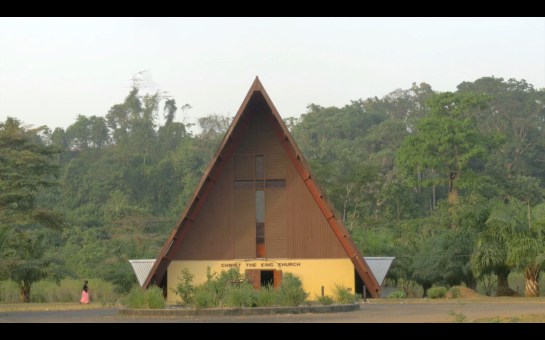
The Church and Clock Tower at Little Aden, 1965
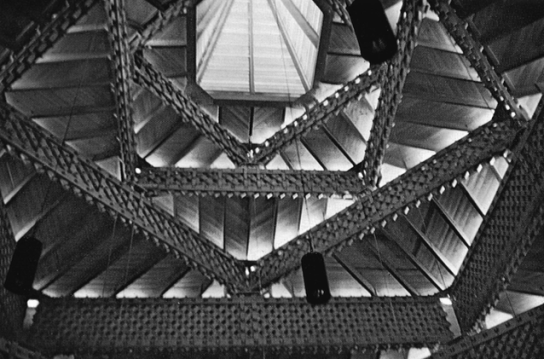
Church Interior, Little Aden, looking up into the lantern, 1965
Perhaps the highlight of this work is the British Army Cantonment at Little Aden designed and built between 1960-65 to house 4500 servicemen and their families. A small town was planned including a variety of different housing types for the various army ranks, as well as a school, sports facilities, cinema, clubhouses and a church. The entire town was designed around a modular system ensuring minimum site work, quick construction and standard details, as well as a progressive approach to data management and standardised drawing processes.
In stark contrast to the earlier reserved work the square timber trusses of the church are alternately stacked at 45° to the layer below to create a dramatic interior, as well as responding to the mountainous backdrop with its external form. It was a roofing technique dating back at least to the time of Vitruvius, who mentioned its use at Colchis. The church was subsequently converted into a mosque after the British were evacuated in November 1967 following attacks from the Front for the Liberation of Occupied South Yemen (FLOSY). The press speculated that the settlement was designed with Arab occupation in mind from the outset – a claim rejected by the architects who designed ‘for the conditions of Arabia and in character with the terrain, so the buildings are bound to be apt for other use, than by the British army’. The arrangement of the church sited on a rocky spur of the Jebel, ‘not only proves to have an affinity with the stone forts of South Arabia but also to the traditional relationship of mosque to minaret.’ Indeed, the architects considered the possibility of the church being converted into a mosque in the event of the British departing.
There’s a lot more to discuss about Farmer and Dark, and the significant contribution made by people such as Bill Henderson to this practice. We hope to post a lot more images and details on the blog in the next few months to bring more of this work to light.
I’m extremely grateful and indebted to Tessa and Kathy Henderson for generously sharing their father’s archive with me.
South African ‘know-how’ and Israeli ‘facts of life’: the planning of Afridar, Ashkelon, 1949–1956, Planning Perspectives by Ayala Levin.
In 1949, in the newly founded state of Israel, South African architects Norman Hanson and Roy Kantorowich planned the city of Ashkelon and, within it, the exclusive neighbourhood unit Afridar. Managed by the South African Jewish Appeal, which initiated and funded the project, Afridar presented a radical exception to Israel’s centralized planning approach during that period.
Figure 6. Arieh Sharon, Plan for Migdal-Gad – Ashkelon, 1951, with added key by the author. Source: Sharon, Arieh. Physical Planning in Israel. Jerusalem: Government Printer, 1951 [in Hebrew].
An early example of a semi-private settlement initiative for an ethnic and class-based enclave reserved for ‘Anglo-Saxon’ Jewish immigrants, it functioned as a ‘model town’ for the immigrant population from the Middle East and North Africa, which was housed by the government in the rest of the city of Ashkelon. Afridar’s enclave reproduced planning practices from South Africa, which had been coloured by race since the 1920s. Despite its exclusive image, it was modelled after progressive experiments in the design of Native Townships. Their main objective of such experiments was to improve the standards of housing of racially discriminated populations yet, in practice, they served as a tool to implement apartheid policies. This paper interrogates this ambivalence of social aspirations and complicity with state segregation practices through examining the translation of apartheid’s planning practices to the Israeli context, and the negotiations and conflicts this translation entailed.
Call for Papers MoMoWo Symposium 2018 International Conference | Women’s Creativity since the Modern Movement (1918-2108): Toward a New Perception and Reception Women’s Creativity since the Modern Movement – MoMoWo is a large-scale cooperation cultural project co-funded by the Creative Culture Programme of the European Union and coordinated by the Polytechnic of Turin launched in 2014. MoMoWo considers an issue of contemporary cultural, social and economic importance, from both a European and an interdisciplinary perspective, women’s achievements in the design professions. After almost four years of successful project activities, and in accordance with the MoMoWo mission, the International Conference | Women’s Creativity since the Modern Movement (1918-2018): Toward a New Perception and Reception continues to increase the visibility of creative women, to foster in Europe and beyond interdisciplinary and multicultural approaches to the study of the built environment “from the spoon to the city”, and to facilitate the exchange of research results and professional practices in the fields of architecture, civil engineering and design.
Topics:
A. Women’s education and training. National and international mappings
B. Women’s legacy and heritage. Protection, restoration and enhancement
C. Women in communication and professional networks
D. Women and cultural tourism
E. Women’s achievements and professional attainments. Moving boundaries
F. Women and sustainability
G. Women ”as subjects”. Documentation, methodology, interpretation and enhancement G.1. Design drawings
‘The Congo must have a presence on Belgian soil.’ The concept of representation in governmental discourses on the architecture of the Ministry of Colonies in Brussels, 1908–1960
Jens van de Maele and Johan Lagae, The Journal of Architecture, Vol 22, Issue 7, p1178-1201.
While parliament buildings and governor‘s palaces have been studied as embodiments of governmental or colonial power, the architecture of the often more mundane state administrative office buildings has only received scant attention from architectural historians.
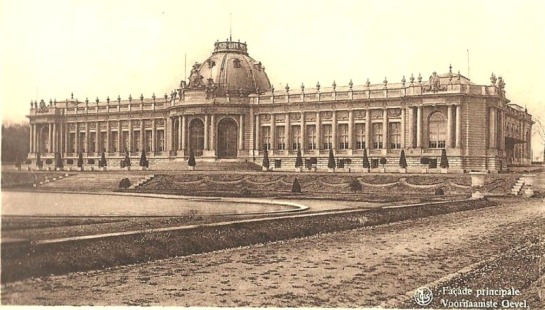
The Museum of the Belgian Congo in Tervuren near Brussels, constructed between 1904 and 1910: undated postcard from around 1910 (personal collection of Johan Lagae).
In this article, we seek to demonstrate that political discourses concerning such buildings can nonetheless reveal important conceptions of colonial power. Rather than focusing on how such power was accommodated in and shaped by state-built architecture overseas, this article draws attention to the representational aspects of colonial governance in a mother country through an analysis of various projects proposed for the Belgian Ministry of Colonies (1908–1960). In the 1930s, when it was still housed in an eighteenth-century neoclassical building in Brussels, the Ministry of Colonies was included in a visionary but unsuccessful civil service reform, which was aimed at a modernisation of the Belgian state bureaucracy and its office buildings.
Presentation drawing of the unrealised headquarters project by Ramon and Aerts, 1953 (City Archives of Brussels: Construction permit request no 63042).
After the Second World War, when colonialism became increasingly criticised in international fora, successive Belgian Ministers of Colonies pleaded for the construction of a new, grandiose ministerial complex, which was supposed to symbolise efficiency, modernity, and—above all —the permanence of the colonial undertaking. Even though important steps were taken to realise this complex, the project was outrun by the global decolonisation process, of which the independence of the Belgian Congo (1960) was an inevitable outcome.
It is with great sadness that the AA has learnt of the death of former AA Principal Professor Michael Lloyd (AADipl 1953). The following obituary, written by Svein Erik Svendsen, Hans Skotte and Patrick Wakely is translated from Norwegian by Desmond McNeill and originally published on the AA website.
Architect and multifarious professor Michael Lloyd was buried in Oslo on 16 June 2017.
With him we have lost one of the foremost architecture educators of our time; not just in Norway – his work and influence were global. He was born in England in 1927 and studied at the Architectural Association (AA) in London. Whilst still a student he took part in the post-war reconstruction of Finnmark, Norway, and after graduating, Alvar Aalto arranged work for him in Helsinki. He then practiced in Oslo and taught at the School of Art & Craft where he met Catharine, who became his wife and lifelong companion.
In 1959 he was appointed first year master at the AA, in charge of all new students to the school. In 1962 Kwami Nkrumah University of Science & Technology, Kumasi, Ghana, approached the AA for assistance in re-organising and running its faculty of architecture that had been established in 1951, but had become moribund. The AA responded to this and gave the job to Michael Lloyd, who was appointed professor and dean of the faculty in 1963. He immediately appointed several new full-time members of teaching staff, several of whom were drawn from the AA Department of Development and Tropical Studies – later to become the Development Planning Unit (DPU) at University College London, and radically reorganised the curriculum and teaching style of the faculty. Over the following five years, Michael brought a number of interesting short-term visiting professors to the faculty, including Buckminster Fuller, Jane Drew, Keith Critchlow, Paul Oliver and Joseph Rykwert. The faculty gained an internationally acclaimed reputation for its innovation and educational and architectural excellence.
In 1966 he was appointed principal of the AA School of Architecture, where he also initiated new and challenging educational and administrative reforms. These were turbulent times for higher education in the United Kingdom and he left the AA after a few years. He then restored the School of Architecture in Kingston-upon-Hull and joined the DPU where he directed a Master’s degree programme in design teaching methods, as part of which he was instrumental in reforming the faculty of architecture at the University of Costa Rica in San José.
On leaving the DPU in the early 1980s, he assisted local efforts in establishing new schools of architecture in Bergen, Norway, where he remained a professor for several years and in Reykjavik, Iceland. Thereafter he was appointed professor at the Oslo School of Architecture and Design, where he, among other things, conducted a project at Makerere University in Uganda, which eventually encompassed the whole of East Africa.
As a teacher, and as the sympathetic man that he was, his work was based on the idea of “the responsible human being” that one learns through taking responsibility for one’s own professional development, and that one’s skills are a personal social responsibility. As an educator Michael was unorthodox, inspiring and very much present as a teacher. He was inquisitive, courageous, and knowledgeable and had highly respected friends all over the world. His international position remains outstanding. To become principal of the AA School of Architecture, which many regard as the world’s best school of architecture, one must possess very special qualifications. Michael had those. As was said during his funeral, “Michael was a truly good man”.
Image: Michael Lloyd at his home in Spain in November 2016, by Mónica Pacheco, Dip. Arch., MA, Ph.D., Department of Architecture and Urbanism, University Institute of Lisbon
I was fortunate to attend two conferences this week that traced the research topics I’ve been investigating during the last 20 years. The first was at the John Michael Kolher Arts Centre and focused on ‘Visionary Environments’ [that is, places and objects built by self-taught and ‘outsider’ artists/builders/architects] and the second was the GAHTC investigating how we might teach a Global Architectural History.
‘The Road Less Travelled’ conference/exhibition at JMKAC celebrated the centre’s 50th Anniversary and brought together many of the contributors, responders, artists and scholars associated with this extraordinary set of 17 exhibitions. It forms a radical set of artwork with equally provocative and experimental curating. I’ve previously reviewed some of their earlier displays in Raw Vision Magazine and on this blog here. Three highlights from the current set of exhibitions include the works of Dr Charles Smith, Eugene von Bruenchenhein and Stella Waitzkin.
Stella Waitzkin resin cast
Eugene von Bruenchenhein bone sculptures
Dr Charles Smith, monument to forgotten slave
Dr Charles Smith exhibition
It was an engaging line-up and full of challenges ranging from conservation, community use, cultural concerns, research methods, and lots on Pasaquan. Prof. Jo Farb Hernandez’s documentation work in Spain really resonated and she’s gathering more material for a follow-up book. I also enjoyed the podcast/lecture on the Forevertron by Benjamin Walker and The Theory of Everything.
There was a strong connection between these two conferences – both held a desire to reexamine and question the way we think about architecture and art, both in terms of its production as well as in its dissemination and history. GAHTC is working from within the canon [with a desire to change it], whereas JMKAC perhaps doesn’t view its collection as architectural, or as something architectural historians might be concerned with. Its collection certainly falls within the ‘architecture without architects’ bracket but not in the way that Bernard Rudofsky presented it. Perhaps the common denominator between these conferences is the visionary environment in LA built by Italian migrant Simon Rodia, and now known as Watts Towers. I paid homage to this staggering creation and highly recommend it.
Watts Towers
Watts Towers detail
JMKAC has recently become the new home for SPACES archive [previously held in California] that contains some wonderful survey drawings, model and photographic documentation of the Towers, currently on display at JMKAC.
Model of Watts Towers from the Spaces Archive
Survey Drawing of Watts Towers from the Spaces archive
The SPACES methodology and detailed survey work sets the standard in this area, and their collection is being digitised. In many ways GAHTC is attempting to build up an equivalent archive of teaching material. To date, there are over 200 lectures held in its repository, and the ambition is for another 200+ lectures. They are also issuing a number of grants for scholars to develop new teaching resources and material. The three plenary speakers, Philip J Ethington, Stella Nair and Greg Castillo stoked considerable debate on cultural appropriation, settlements that existed on the site now occupied by Los Angeles, and the power of mapping this data. I also enjoyed the module proposed by Alicia Imperiale with its three lectures considering various aspects of mobile architecture, (including one by TAG friend Anoo Siddiqi).
New Research: Prof. Robert Home, ‘From cantonments to townships: Lugard’s influence upon British colonial urban governance in Africa’ in Planning Perspectives, Pages 1-22 | Published online: 20 Aug 2017
Abstract: The cantonment has been a neglected topic of planning history, yet is significant for urban landscapes and governance in both India and Africa. Drawing upon scholarship in critical comparative legal geography, path dependency and Foucault’s genealogical method, the article explores the transfer of laws and regulations for urban governance by networks of knowledge and actors, tracing a line of descent from rules for cantonments in British India, through Lugard’s Nigerian period, and his indirect rule policy to townships and local government ordinances. The influence of Lugard’s Political Memoranda and Dual Mandate books is evidenced through the work of various senior officials moving between colonies, specifically South Africa, Kenya, and Northern Rhodesia.
Only 1% of houses around the world were designed by architects. Paul Oliver, who has died aged 90, devoted himself to studying the remainder, architecture that was of the people rather than built for them. His books on vernacular architecture ranged from Dunroamin: The Suburban Semi and Its Enemies (1981, with Ian Davis and Ian Bentley) to a three-volume Encyclopedia of Vernacular Architecture of the World (1997), produced with 780 contributors from 80 countries.
An artist by training who became a distinctive commentator on both architectural history and music, especially the blues, he considered himself a generalist, though writing from an architectural background; when pressed, in 1998, he accepted the term “architectural anthropologist”.
His opportunity to develop this perspective came from taking a part-time job as drawing master at the Architectural Association (AA) in London in 1960. When the leading academics Robert Furneaux Jordanand Sir John Summerson both quit, he was left as the principal lecturer in architectural history.
Oliver’s inspiring teaching took two strands. One was the study of modernism, with its emphasis on simplicity, quality and economy. The other was vernacular architecture.
His interest had been aroused when his parents moved to Symondsbury, near Bridport in Dorset, a village with a strong music tradition, a mummer’s play and a close-knit cottage community. Then six articles in the Architectural Review by EA Gutkind, a planner, in 1953 revealed the diversity of traditional building around the world.
The study of vernacular traditions offered ideas on honest construction and functionalism attractive to modern architects, while also contributing to Britain’s emerging conservation movement. An international dimension took hold when in 1964 Oliver was invited to teach at the School of Architecture in Kumasi, Ghana, where his AA colleague John Lloyd was principal. Oliver and his students studied the ways of managing a humid climate and restricted resources, patterns of use and the buildings’ cultural values. His eyes were opened by the housing of the Gurunsi people, compounds with “the formal beauty and logic of pottery”, as he later wrote, which were being swept away for a reservoir and replaced by rows of prefab dwellings that paid no respect to Gurunsi traditions.
Paul Oliver had a lifelong interest in African-American music
The Ghana trip coincided with Bernard Rudofsky’s exhibition Architecture Without Architects at the Museum of Modern Art, New York. Although it was important in popularising vernacular architecture as a subject, Oliver was enraged by its emphasis on the buildings as art objects, which he considered patronising. Working with colleagues from the AA, including students from its small department of tropical architecture, he offered a broader cultural perspective in his book Shelter and Society (1969). Further books on Africa, Greece and symbolism in buildings followed.
His greatest love was perhaps sub-Saharan Africa where, under Islamic and Christian influences, architecture predominates among the visual arts. His contributors were architects and anthropologists, but the disciplines seemed entirely separate; only archaeologists took a holistic view, and Oliver considered their approach to be as valid for the present as the past.
He advised on conservation issues in French towns and villages for the Patrimoine Historique et Artistique de la France. The British Council supported research and teaching in East Africa and India, and he worked for the Overseas Development Administration in Turkey, the Balkans, Central America and Mexico. Some projects focused on the vulnerability of vernacular buildings to earthquakes and floods, and the failures of post-disaster housing that had not taken account of the lessons of older cultures.
Oliver became head of the AA’s graduate school in 1971, but left two years later to lead the art and design department at Dartington College of Arts, at Dartington Hall, Devon. He became an associate head of the architecture school at Oxford Polytechnic (now Oxford Brookes University) in 1978 and founder of the Shelter and Settlements Unit there. His greatest concern was to safeguard traditions in the face of technological change. He believed that the wisdom, skills and satisfaction of human needs embodied in traditional buildings were fundamental to the housing of millions in the 21st century.
In 1987 Oliver took early retirement, though he continued as a visiting professor, so he could devote himself to his research, stimulated by the suggestion of Alyn Shipton, reference editor at the publisher Blackwell, that he produce an encyclopedia of world architecture. His three-volume study was organised by cultures rather than countries, with the first volume explaining general traits, environments, materials and services. Oliver was particularly proud of sections like that for Ethiopia, which was entirely written by local scholars, while gamely taking on himself areas in which no research existed.
A forked post used in vernacular architectural style to support a beam in Taos, New Mexico
Born in Nottingham, Paul grew up in Pinner, north-west London, the son of W Norman Oliver, an architect, and his wife, the former Dorothy Edmunds. His father was keen that Paul should follow him into the profession, but he lacked any talent for mathematics and turned instead to painting.
At the age of 16, Paul entered Harrow Art School, where he met his future wife, Valerie Coxon (they married in 1950), and began a lifelong interest in African-American music. He trained as an art teacher at Goldsmith’s College, London, and in 1949 returned to his old school, the Harrow county school for boys, as art master. There he established a department teaching crafts as well as art, acted as client for a new building, and introduced an African-American music society after the headmaster refused to allow a jazz club. When he left this post for the AA, the drop in his income forced him to write more music reviews.