Archive

Author Archives: jacksoniain

Call for Papers: Revisiting African Modernism at docomomo 14th International Conference 

6-9 Sep 2016,  Calouste Gulbenkian Foundation,  Lisboa,  Portugal

docomomo International is now accepting abstracts for the 14th International docomomo Conference that will take place in Calouste Gulbenkian Foundation, Lisbon, Portugal, September 6–9, 2016. Please submit abstracts no later than October 18, 2015 (12 pm GMT), for one of the 29 thematic sessions listed here.

One session that will be of specific interest to TAG followers is the ‘Revisiting African Modernism’ session…

“Africa’s history of architectural modernism and modernist landscapes is no longer unknown or obscure.  This session seeks to build on that established foundation by asking contributors to explore the potential contribution of the buildings and infrastructure of this era (c. 1945 – 1970s) to our understanding and engagement with Africa today. Does their original programme make them adaptable for 21st century contemporary urbanism? Are there specific case studies or examples of buildings and landscapes that demonstrate positively (or negatively) adaptive re-use possibilities or experience?

Past docomomo sessions on Africa have (arguably rightly) been occupied with debating Africa’s involvement in docomomo, as both a subject and a participatory region. This session recognizes the increasing inclusion of African nations; South Africa, Egypt, Ghana (proposed) into the docomomo “family”. It also acknowledges contributions from African and Africa-focused researchers in a number of past docomomo publications.

This panel session seeks to expand these contributions into a contemporary discourse, devoted to the investigation of the methods, and means, by which Africa’s modernist past can contribute more than just historical research to the Africans and Africa-focused researchers of the 21st century. We are particularly interested in contributions that consider built “ensembles” within urbanist contexts in African communities or cities, such as university campuses, housing masterplans, and industrial complexes/towns. “

Session Chairs: Ola Uduku, University of Edinburgh, Scotland; Miles Glendinning, University of Edinburgh, Scotland.

Book Review: Jaqueline Tyrwhitt: A Transnational Life in Urban Planning and Design

Ashgate, Farnham, 2013.

By Ellen Shoshkes

ISBN 9781409417781

44 black and white figures

£55.00

9781409417781

What an extraordinary life. This biography carefully chronicles and assembles (in some detail) the life and career of one of the forgotten heroines of the twentieth century planning world. Forgotten is perhaps too strong, as Tyrwhitt is one of those figures that ‘crops up’ rather regularly; aspects of her work are frequently mentioned in conference presentations or cited in journal articles, but she is never the focus of attention despite being, as Shoshkes reveals, a global player. Indeed she is almost omnipresent throughout the planning sphere of the twentieth century when one reads the amount of work she facilitated and the influence she held over publications, translations, lecture courses, planning strategy, international housing and development programmes. Furthermore, she also undertook considerable research into urbanism and planning, yet this is the first volume to draw all these twists and turns together. A good biography is able to not only describe and discuss the person in question, but to also pull in the wider debates and to position the life and works within a broader context – this book manages to effortlessly achieve this feat and is to be commended for it. The narrative adopts a chronological format split over five parts, which neatly track the major episodes of Tyrwhitt’s life. Perhaps one of the reasons for Tyrwhitt’s relative obscurity is because she didn’t have a career in the conventional sense, but rather careered through life bouncing from one project to the next, barely making ends meet. She was also a woman, unmarried, sometimes unkempt, and seemed to care for little beyond friendships and her work. She didn’t establish her own practice or publish provocative tracts, rather operated in a supporting role for the likes of Jose Luis Sert, Sigfried Giedion and Constantinos Doxiadis. As a planner, she left few tangible remains and was not concerned with formulating her legacy as some of her more egotistical collaborators were. She was more focused on getting the job done and took on the important tasks of organising, facilitating and disseminating findings, often with little appreciation from those she made look exceptional. One of her most prolonged and significant roles was translating Giedion’s epic publications, although to label Tyrwhitt’s contribution as a translator somewhat undersells her contribution. She was really a co-author and collaborator, honing Giedion’s ideas and clarifying his arguments – as well as translating them into English. She had a longterm friendship with Giedion which may have strayed into romance, but even this collaboration had its limits and Tyrwhitt stopped working with Giedion long after what most associates would have endured or put up with. Throughout her life there were strong male characters that she supported and encouraged but in the course of time these roles were often inverted and they became dependent on Tyrwhitt.

Although one may know something of Tyrwhitt’s life and work (most planners will be aware of the book she edited on Patrick Geddes in India, for example) this book reveals so much more, and it is very surprising just how far and wide she worked and travelled. One of the more shocking revelations is Tyrwhitt’s involvement with the British Fascists and her decision to experience Hitler’s Germany firsthand in 1937. Very little is said about Tyrwhitt’s political persuasions in later life, but judging from the company she kept it can be safe to assume that she ‘mellowed’ from her early flirtations with the political Right. Her work with the UN in India and Indonesia is another significant aspect of the book and adds new insight into the international agencies that operated in the post-war era. The sources are drawn from numerous archives and the research is detailed and thorough; although very little critical appraisal of Tyrwhitt’s work is made – was any of it implemented, or did any of her students put it into practice? Perhaps an epilogue of influence could have been added as a reprise or conclusion, but this is surely minor criticism of what is a substantial and valuable contribution.

This is a welcome volume to the history of twentieth century architecture and planning; it fills so many gaps, opens up new connections and networks, and goes someway to finally giving Jacky the credit she deserves for a lifetime’s concerted effort to improving and understanding our cities and landscapes.

Exhibition: Nek Chand at Pallant House Gallery, Chelmsford, until 25th October

img_3386_0

This is a rare chance to see Nek Chand’s work in the UK, and in an external setting which is how the sculptures should be seen. Pallant House Gallery has a large group of sculptures on show courtesy of the Nek Chand Foundation.

I re-visited Nek Chand’s Rock Garden, Chandigarh in August, eager to see how it was being treated and maintained following Nek Chand’s passing in June. I was very concerned that at best it would not be managed properly, and my worst fears were theft and destruction of this unique creation. It was such a relief to see it all looking better than ever. The walkways were clean, litter free and everything was running smoothly. Whilst work seems to have ground to a halt in ‘phase 3’ this may not be a bad thing. Perhaps we now need to think of the garden as being complete and any further changes to be made with utmost care and restraint.

Bubonic plague, colonial ideologies, and urban planning policies: Dakar, Lagos, and Kumasi, by Liora Bigon, in Planning PerspectivesDOI:10.1080/02665433.2015.1064779

The Third Plague Pandemic originated in Southwest China in the mid-nineteenth century, reached Africa’s shores around 1900, and spread globally for about a century. This article examines three plague loci in colonial Senegal (Dakar, 1914), Nigeria (Lagos, 1924), and the Gold Coast (today’s Ghana; Kumasi, 1924). A tripartite comparative analysis is made of French and British doctrines of colonial rule, colonial urban planning policies, and anti-plague practices. While some common features are demonstrated in the policies and practices of the colonizing forces such as the implementation of rigorous measures and embracing segregationist solutions, divergent features can also be distinguished. These relate to the methods of implementation of planning and anti-plague policies, in accordance with colonial ideology (assimilation, direct and indirect rule); and to the very nature of autochthonous communities, responses, and levels of agitation. Our both comparative and more nuanced site-related view is also based on a large collection of archival and secondary materials from multilateral channels.

The full article may be viewed here: http://www.tandfonline.com/doi/abs/10.1080/02665433.2015.1064779

Exhibition: Tropicality Revisited: Recent Approaches by Indonesian Architects is currently on show at the Deutsches Architekturmuseum , Frankfurt, Germany.

ImageHandler.ashx-2

29 August 2015 – 3 January 2016, 3rd floor
GUIDED TOURS: Saturday and Sunday, 14:00

ImageHandler.ashx

Architecture in the Tropics was never just about offering shelter from rain and sun. “Tropical architecture” suddenly gained global relevance with the emergence of Modernist Architecture and was adapted to suit all climates and cultures. During the post-War period the science of climatic architectural design became an international success. For many generations of Indonesian architects, the tropics has never been a romantic colony, but a harsh reality with its torrential rains, heat, and high humidity. Today, “tropical architecture” is often easily forgotten by the critics, lost behind the glazed and airconditioned skyscrapers or the celebrated designs for tropical tourist resorts. At times, it seems to be taken for granted – pitched roof and overhangs are the ready-to-use answers – but it is also a challenge for architects to find new solutions. In the days of climate change and energy crises, architecture adapted to the climate is making a triumphal comeback.

ImageHandler.ashx-3
12 ARCHITECTS \ 12 PROJECTS

  • Achmad Tardiyana, Jakarta – Rumah Baca, Bandung
  • Adi Purnomo \ mamostudio, Ciputat – Studi-O Cahaya, West Jakarta
  • djuhara + djuhara, Ciputat – Wisnu Steel House, Bekasi
  • andramatin, Jakarta – Andra Matin House, Jakarta
  • Csutoras & Liando, Jakarta – Kineforum Misbar, Jakarta
  • d-associates, Bandung – Tamarind House, Jakarta
  • EFF Studio, Denpasar \ Bali – Almarik Restaurant, Gili Trawangan \ Lombok
  • Eko Prawoto Architecture Workshop, Yogyakarta – Eko Prawoto House, Yogyakarta
  • Studio Akanoma, Bandung – Ciledug Timber House, Ciledug \ Tangerang
  • LABO, Bandung – House #1 at Labo. the mori, Bandung
  • Studio TonTon, Jakarta – Ize Hotel, Seminyak \ Bali
  • Urbane Indonesia, Jakarta – Baiturrahman Mosque, Kopeng \ Yogyakarta

More information at: http://www.dam-online.de/ 

Congratulations to Zaha Hadid for winning the 2016 RIBA Gold Medal and for being the first women to do so in her own right.

zaha-hadid-interview-united-nude-re-inventing-shoes-milan-design-week-designboom-10-818x523

A very interesting radio interview is transcribed here about the fate of construction workers at the Qatar World Cup Stadium. Don’t call Zaha scary and then attempt a series of poor, under researched questions is the moral here.

Read the interview transcript at: http://www.theguardian.com/artanddesign/ng-interactive/2015/sep/24/zaha-hadid-radio-4-interview-sarah-montague-qatar 

Further info at the RIBA site here: https://www.architecture.com/Awards/RGM/RGM2016/ZahaHadid.aspx

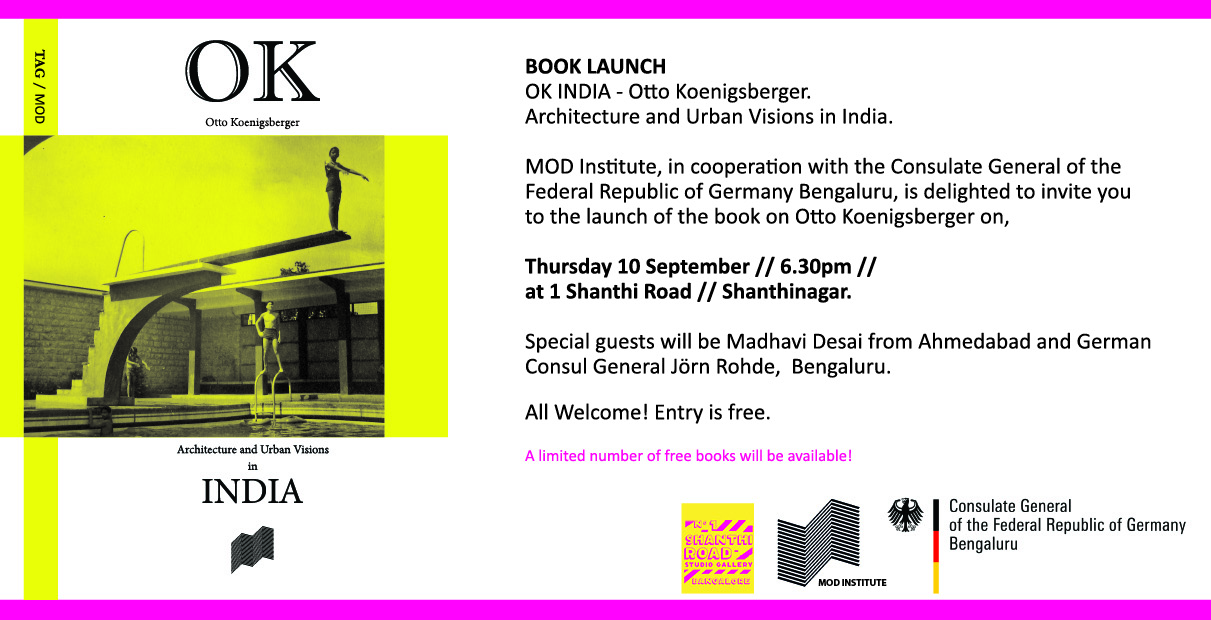
Book Launch OK India – Otto Koenigsberger. Architecture and Urban Visions in India, by Rachel Lee

The much awaited book by Rachel Lee on Otto Koenigsberger is finally with us, and there will be a book launch celebration on 10th September in Bengaluru, see the poster below for more details. We’re delighted that the book has been jointly published by TAG / MOD and we’ll post more details of how you can get a copy in due course…

Book Launch Otto Koenigsberger

Architecture Tour: Otto Koenigsberger: Building Bangalore in the 1940s

Dr Rachel Lee will be leading a tour of Otto Koenigsberger’s buildings in Bangalore on 3rd September – a rare treat to learn more about Koenigsberger’s work in Mysore state. Dr Lee’s PhD was dedicated to Koenigsberger’s work in India and she is about to publish a monograph on her findings very soon- which we are very much looking forward to and will announce further details here…..

Otto Koenigsberger with Nehru, Amrit Kaur and Mountbatten

Thursday, 3 September 2015

Tour Start Point: 1:00 p.m. at the Pavilion in M. N. Krishna Rao Park

Tour End Point: 5:00 p.m. at IISc CCS

To register, contact: +919880347794 OR 080-49000812-ext 836  or email: cph@srishti.ac.in 

Last day for registration: 1 September 2015.

To view the poster and for more details see: Rachel Lee Walk

cleoroberts's avatarEnvisioning the Indian City

Tuesday 18th August 2015

The second day opened with two papers addressing the architectural development and planning of Chandigarh. Iain Jackson (Senior Lecturer, School of Architecture, University of Liverpool) explored the overlooked and quotidian portions of the city in his paper, ‘Chandigarh Dwellings: Ghastly Good Taste or Flamboyant Modernism’. Departing from the over-cited work on the city by Le Corbusier, Pierre Jeanneret, Maxwell Fry and Jane Drew, he detailed his early research into private developments which have avoided similar ossification. 

His documentation of these private dwellings showed idiosyncratic modification contra to the city’s founding vision. Discussing this independence from the Government’s arbitration of taste and aesthetic agenda, Jackson proposed a series of classifications including Punjabi Baroque. He stated that this peacock flamboyancy and non-utilitarian adaptation showed Chandigarh remained open, unresolved and signalled the failure of modernist notions of ‘home’. 

New Chandigarh villa New Chandigarh villa

Melissa Smith (Banduksmith Studio/Visiting Faculty, CEPT…

View original post 1,521 more words