Next Week is Africa Week at the University of Edinburgh. An excellent line-up of talks and events are set to take place – 16h00 on Friday 7th is the TAG blog session of choice.

Next Week is Africa Week at the University of Edinburgh. An excellent line-up of talks and events are set to take place – 16h00 on Friday 7th is the TAG blog session of choice.
As part of our British Academy Internationalisation and Mobility grant Iain Jackson and Ola Uduku visited Rexford Opong at KNUST in March (we included some brief updates here: Notes from Kumasi and Notes from Kumasi: part 2 and also Notes from Kumasi Part 3). We were fortunate enough to visit the Estate Planning Department and drawing offices and photographed some of the original drawings made of the university estate and buildings. Whilst every effort is being made to carefully preserve these drawings they have been subject to the ravages of time, humidity and vermin attack and many are in a poor state of repair. They are unlikely to survive for much longer.
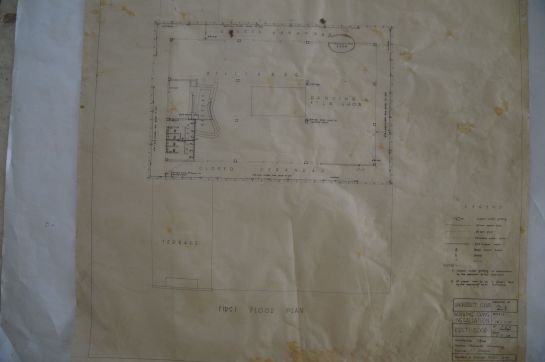
Drawing of the First Floor Senior Staff Club House, KNUST
In an attempt to remedy and counter this we are putting together an ‘Archives in Danger’ grant that, if successful, will enable these important artefacts to be digitally scanned/carefully photographed and then carefully preserved and archived for future scholarship.
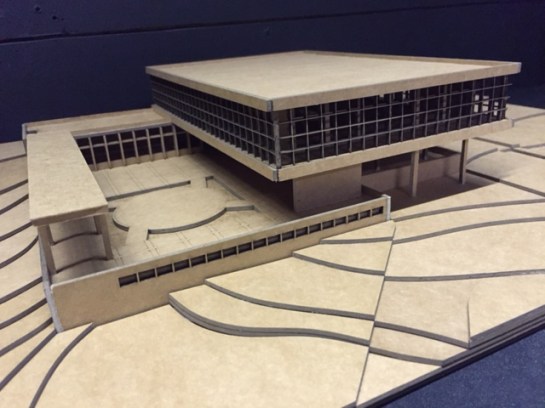
In the meantime we’ve used the photographed drawings to produce a series of new CAD files. Pedro Bittencourt, a student based at Liverpool School of Architecture, has worked dilligently on translating the imperial scales into a metric format and has produced all of the new drawings. He has then used these drawings to construct a beautiful scale model of the Club House, utilising a laser cutter as to form the delicate components.

Pedro with the completed scale model
We’re hoping to produce additional models of other buildings on campus that can be used in exhibitions and as part of our lecture series.

II International Conference on ‘African Urban Planning’
Date:
7 – 8 September 2017
Location:
University of Lisbon, Portugal

Organization:
Institute of Geography and Spatial Planning, University of Lisbon & International Planning History Society (IPHS)
Conference Website:
https://sites.google.com/site/cpcup2017conference/
Conference e-mail:
urbanplanningafrica2017@gmail.com
Important dates:
– Submission deadline for abstracts: 31 January 2017
– Notification of abstract acceptance: 15 March 2017
– Registration and payment: 1 – 15 April 2017
We’re delighted to announce that our Fry and Drew book is to be published in paperback format in a few days time. This should make it a little more affordable and hopefully accessible to a broader audience in West Africa and India…

TAG is delighted that the Getty Foundation has awarded a ‘Keeping it Modern’ heritage grant to the Children’s Library in Accra, Ghana – the first time this prestigious award has been made to a building in Africa. This will fund building research into the material fabric of the library, as well as programme of events to keep the space activated and enjoyed.


The library was designed by Nickson and Borys (see Notes from Accra ) in late 1950s / early 1960s (the building appears in J. M. Richard’s New Buildings of the Commonwealth, 1961) and has already received some sympathetic restoration in more recent times, as well as some less fortunate interventions (such as the aluminium front door).
The latest project will be in safe hands under the leadership of the ArkiAfrica team, http://archiafrika.org/wp-content/uploads/2013/03/march-13-invite.jpg and we will post updates on the project here.
Getty press release and information on the other awards here: http://blogs.getty.edu/iris/2016-grantees-for-conserving-modern-architecture-initiative-announced/
Oxford University Press will publish ‘Architecture and Urbanism in the British Empire’ on 7th October 2016. Below is a brief synopsis from the publishers website.

Throughout today’s postcolonial world, buildings, monuments, parks, streets, avenues, entire cities even, remain as witness to Britain’s once impressive if troubled imperial past. These structures are a conspicuous and near inescapable reminder of that past, and therefore, the built heritage of Britain’s former colonial empire is a fundamental part of how we negotiate our postcolonial identities, often lying at the heart of social tension and debate over how that identity is best represented.
This volume provides an overview of the architectural and urban transformations that took place across the British Empire between the seventeenth and mid-twentieth centuries. Although much research has been carried out on architecture and urban planning in Britain’s empire in recent decades, no single, comprehensive reference source exists. The essays compiled here remedy this deficiency. With its extensive chronological and regional coverage by leading scholars in the field, this volume will quickly become a seminal text for those who study, teach, and research the relationship between empire and the built environment in the British context. It provides an up-to-date account of past and current historiographical approaches toward the study of British imperial and colonial architecture and urbanism, and will prove equally useful to those who study architecture and urbanism in other European imperial and transnational contexts.
The volume is divided in two main sections. The first section deals with overarching thematic issues, including building typologies, major genres and periods of activity, networks of expertise and the transmission of ideas, the intersection between planning and politics, as well as the architectural impact of empire on Britain itself. The second section builds on the first by discussing these themes in relation to specific geographical regions, teasing out the variations and continuities observable in context, both practical and theoretical.
Table of Contents:
Introduction
Architecture, Urbanism, and British Imperial Studies, G. A. Bremner
PART I: Themes in British Imperial and Colonial Architecture and Urbanism
1: Beginnings: Early Colonial Architecture, Daniel Maudlin
2: Urbanism and Master Planning: Configuring the Colonial City, Robert Home and Anthony D. King
3: Stones of Empire: Monuments, Memorials, and Manifest Authority, G. A. Bremner
4: The Metropolis: Imperial Buildings and Landscapes in Britain, G. A. Bremner
5: Propagating Ideas and Institutions: Religious and Educational Architecture, G. A. Bremner and Louis P. Nelson
6: Imperial Modernism, Mark Crinson
Part II Regional Continuity, Divergence, and Variation in the British World
7: British North America and the West Indies, Harold Kalman and Louis P. Nelson
8: South and Southeast Asia, Preeti Chopra
9: The Australian Colonies, Stuart King and Julie Willis
10: New Zealand and the Pacific, Ian Lochhead and Paul Walker
11: Sub-Saharan Africa, Iain Jackson and Ola Uduku
12: Egypt and Mandatory Palestine and Iraq, Samuel D. Albert
Further details here: https://global.oup.com/academic/product/architecture-and-urbanism-in-the-british-empire-9780198713326?cc=ro&lang=en&#
Announcement
Four-year PhD Studentships
Location: University of Westminster
Deadline: 26th August 2016
Two x four-year, full time PhD studentships in the Faculty of Architecture and the Built Environment as part of ERC grant funded project Monsoon Assemblages.
Stipend of £16,000 p.a. and Tuition Fees (Home/EU fees only).
Full article
Two x four-year, full time PhD studentships
Monsoon Assemblages is a five-year long research project funded by the European Research Council (Starting Grant no. 679873) with the ambition of confronting challenges of urban climate change through novel, inter-disciplinary research in three of South Asia’s rapidly growing cities: Chennai, Delhi and Dhaka. It is driven by questions of how these cities might be transformed if no longer thought of as exclusive products of human agency, but as co-designed by the material energies of earth systems.
PhD applications are invited from the spatial design and/or environmental humanities disciplines to engage with these questions. The exact areas of…
View original post 119 more words
Abstract.
“This article examines the socio-spatial history of the central market of a colonial African city. Colonial policies of racial segregation created obstacles to commerce, which in turn generated a local strategy of improvisational planning to placate various urban actors with a host of often contradictory concessions to ameliorate dislocation. These contradictions of colonial governance played out most visibly in the struggles over Kariakoo market, which became the city’s primary market after its construction in 1923.

Kariakoo Market, March 2016
By focusing on contests over the spatial ordering of commerce and residence in a multi-racial city ruled by Europeans, commercially dominated by Indians but overwhelmingly populated by Africans, this article demonstrates how the production of certain types of urban space creates unforeseen leverage for local actors, which simultaneously entrenches wider patterns of obstinate racialization despite the ubiquity of planning concessions. Using deeply researched archival evidence as well as a rich secondary literature, the authors argue that the city market best illustrates the racially contradictory impact of the colonial state on an urban landscape.”
Full article available here: http://www.tandfonline.com/eprint/vGx4RCbCui3cBncBNP8h/full
TAG also included recent posts on Dar es Salam here: A quick tour of Dar es Salam and here: Urban Narratives (Simulizi Mijini) Symposium Report
Annika Seifert kindly took a group from the Urban Narratives (Simulizi Mijini) Symposium on a walking tour of the city. We met at the Old Boma and after a briefing on the history of the city plan we set off taking in the Post Office, and Anthony Almeida’s modernist St. Joseph’s school and the colonial White Fathers’ house.

L: St Joseph’s School. R: White Fathers’ House
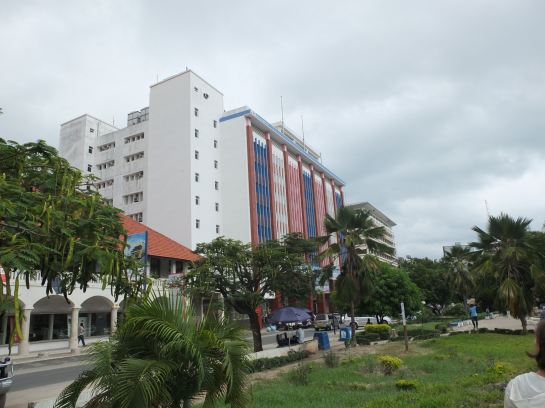
National Bank of Commerce
Further along the dock road is the National Bank of Commerce designed by Charles Alfred Bransgrove (who also designed the British Legion Offices in Dar, 1952). From here we visited Walter Bgoya’s wonderful book shop (picking up a copy of Dar es Salaam. Histories from an Emerging African Metropolis, Mkuki Na Nyota Publishers,2007) and then venturing into the wonderful commercial district that contains outstanding architecture from the inter-war period. Some of the buildings display hints of Indian influence, others definitely deco, sweep around the corner sites with great confidence.
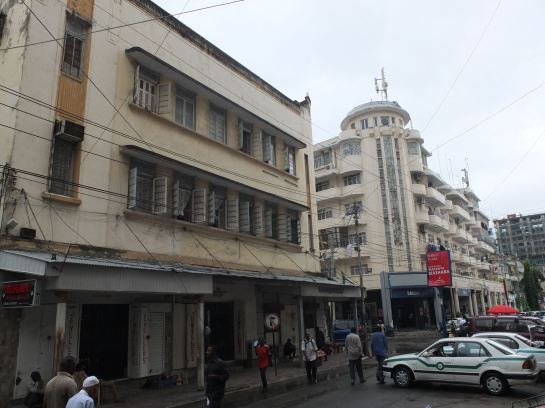

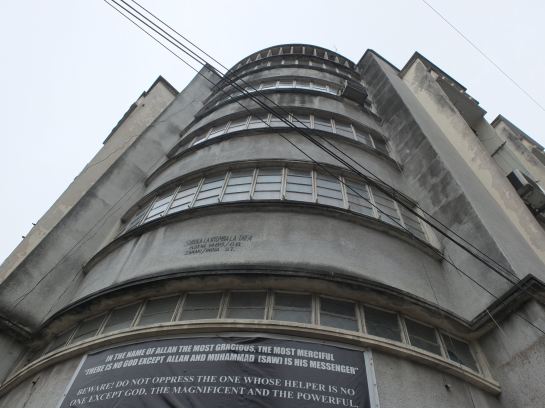
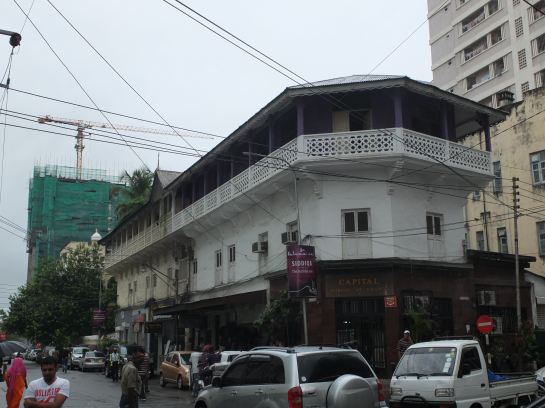
From the city centre we crossed the old colonial cordon sanitaire (now an ‘open space’) to venture into the Kariakoo district to take in the brutalist market designed by Beda Amuli.

Inside Kariakoo Market
Exterior of Kariakoo Market
Many thanks to Rachel Lee and Diane Barbé from The Habitat Unit at TU Berlin for organising this event. Great Job!
Urban Narratives (Simulizi Mijini) Symposium was held at the British Council building in downtown Dar es Salam on 1st April. Accompanying the event was a small exhibition of short stories – compiled by Masters students from TU Berlin and Ardhi University. During the past four weeks the students have been exploring and mapping the city as well as interviewing and recording the everyday and extra-ordinary narratives of life in the city. The result is a very special collection with some insightful, and often deeply moving, recollections. The stories should be on-line soon and we’ll post a link to them.
The symposium was arranged in 15-minute presentation slots, so the pace was fast and varied, starting with the international perspective (Jackson on India and Ghana, Lagae on curating an open air architecture museum in Lumbumbashi, Adanali offering a wonderful but at times disturbing insight into the plight of Istanbul, see http://reclaimistanbul.com).

Yasar Adanali presentation
Part 2 considered the Eastern and Southern African context with Hannah Le Roux considering the notion of movement and heritage in South Africa and Johannesburg in particular. She also shared a wonderful image from the South African Automobile Association revealing the road networks that traversed the continent in the 1950s. Joy Mboya spoke about a festival created by local communities called Nai ni Who http://nainiwho.co.ke. This was followed by a discussion of the neighboring island of Zanzibar by Muhammad Juma, and the problems of preserving and building, in and around the historical context of Stonetown. Zanzibar was explored further after lunch with a project that is seeking to catalogue and document the built fabric of stonetown as well as associated memories and stories.

Colonial Road Networks of Africa
Annika Seifert shared the vision for the new DARCH building and exhibition spaces located in The Old Boma, including how the material was selected and curated (https://www.facebook.com/DARCHTZ/). The new museum located in a historical colonial building, located opposite the Zanzibar ferry terminal, will be a great resource for the city with its roof top café and ‘public space’.

The Old Boma
The session and roundtable was wrapped up by Walter Bgoya, who kept things lively, very entertaining and sharply to the point. It was a very enjoyable day and stoked lots of ideas for future research as well as fuelling the desire to take action. As Muhammad Juma reminded us, it is never too late to start campaigning for heritage and making the case to protect and preserve our built environment.


