Archive

British Colonial Architecture

y

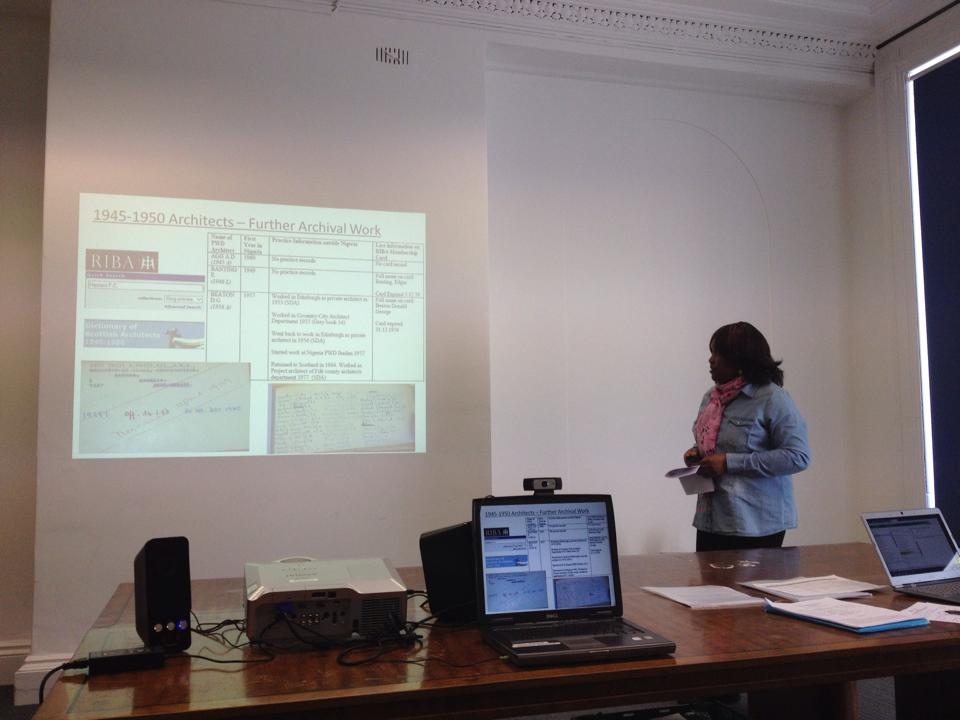
14 May was a PhD research presentation day at the school of architecture. Students were required to describe the progress made in their research; what had been done in the previous year, what the foregoing research plan is, and how they intend to get it done. Going by these guidelines, I outlined how my research had developed from inception to its current stage of findings. I equally provided a Gantt chart to relay the progress made, as well as the projections for ensuing months.

My research has been examining Nigeria’s Public Works Department (PWD), with specific interest in the composition and outputs of its architectural unit between 1900 and 1960. The explorations have largely been conducted along three historiographical strands. First is on the department’s administration and its linkages to the wider colonial system of the day, the second on standardized building production practices it employed, and third on its architects; who they were, why they came to practice in Nigeria and how this relates to the wider notion of empire building. Going by the PWD flourish period also, these architects appear to provide the pioneering legacy in the study of Nigeria’s architectural profession.


‘Charles Correa India’s Greatest Architect’

This review was originally published (without the photographs) in the JSAH Journal, Vol 73, no.1, March 2014.


‘Charles Correa India’s Greatest Architect’ exhibition featured at the RIBA, London, as part of its ‘Out of India’ season, that also included numerous events running throughout the summer. Film screenings, discussions, a symposium with Charles Correa, and a lecture by the great man himself will subject the work to an extended period of interrogation where proper debate can ensue.

India has become something of a hot topic, with recent high profile visits made to the country by Prime Minister David Cameron, coupled with numerous television programmes and radio broadcasts, trade delegations and educational visits; the UK is hungry for all things Indian.

DSCF0426 DSCF0427

The exhibition at the RIBA forms part of this renewed interest, but was largely triggered by Correa’s decision to donate his personal archive of over 6,000 artifacts to the RIBA – the largest single donation to their collection by a non-British architect. This fine array of drawings, models and written ephemera spanning from 1958 to the present, promises to be a most valuable resource to scholars and students, and for those unable to visit London, has been digitized in its entirety (more about this later). Correa is at liberty to give his work to whomever he pleases, but the choice of a British Institution, and a Royal one at that, may raise some eyebrows and probably came as a shock even to the RIBA. Correa was born during the colonial era and his work has consistently looked to develop an architecture that was modern, firmly entrenched as Indian, and certainly not European. Despite this, Correa felt that the RIBA would look after the work and ensure that it is properly catalogued and preserved – a feat that sadly would be difficult to achieve in India (a visit to the Chandigarh City Museum demonstrates how Le Corbusier’s drawings have been treated…)

DSCF0429 DSCF0430

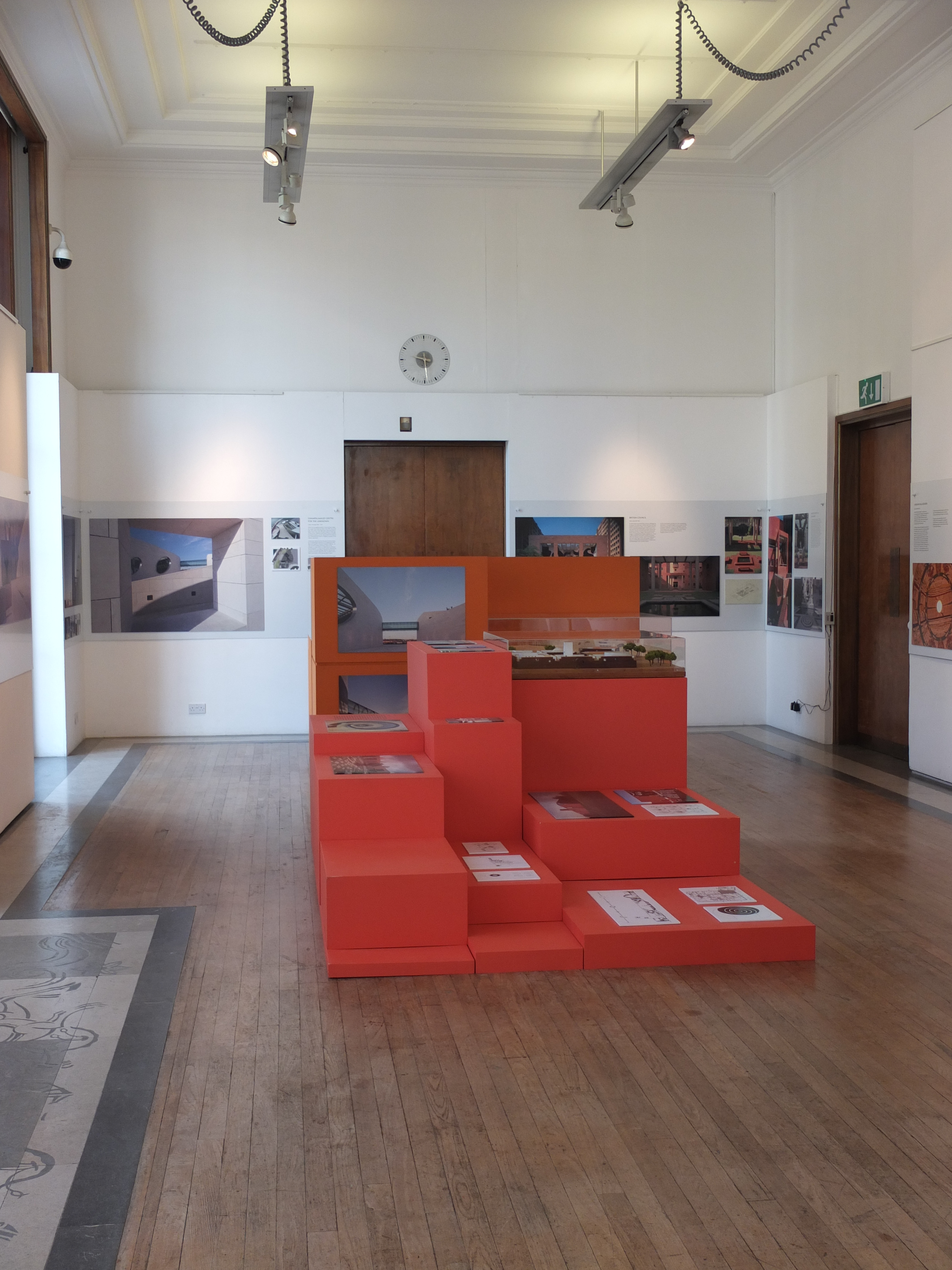
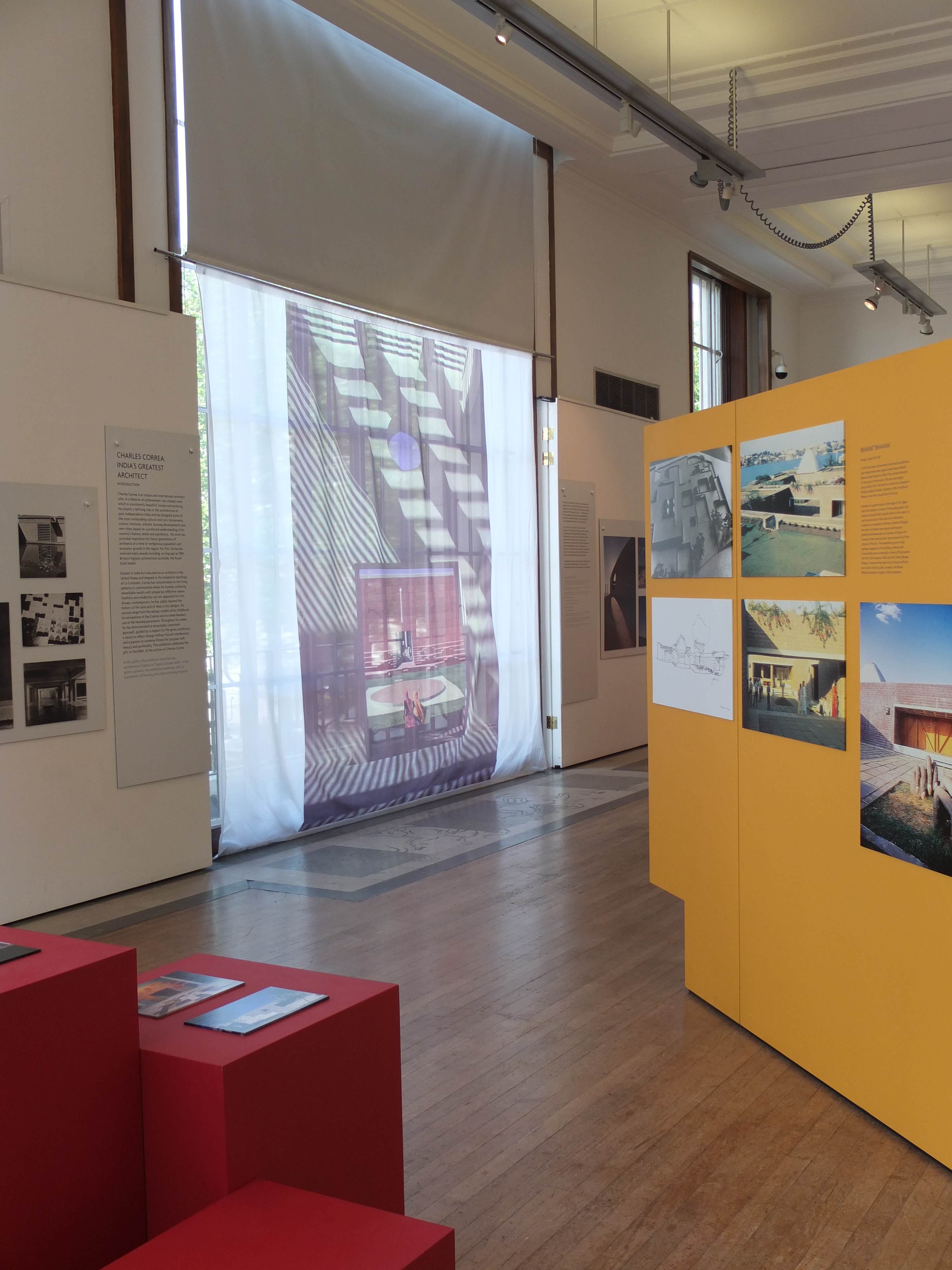
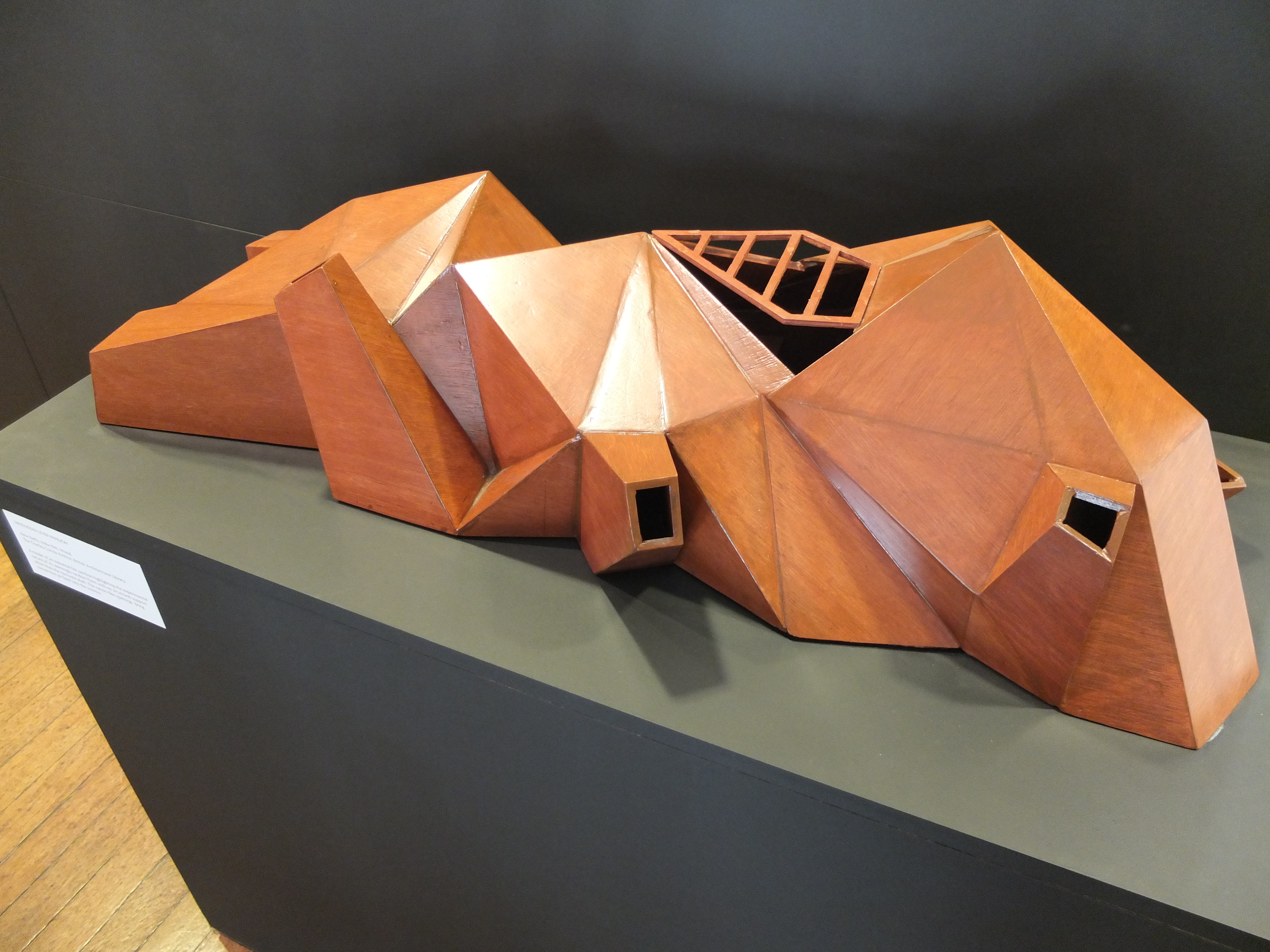
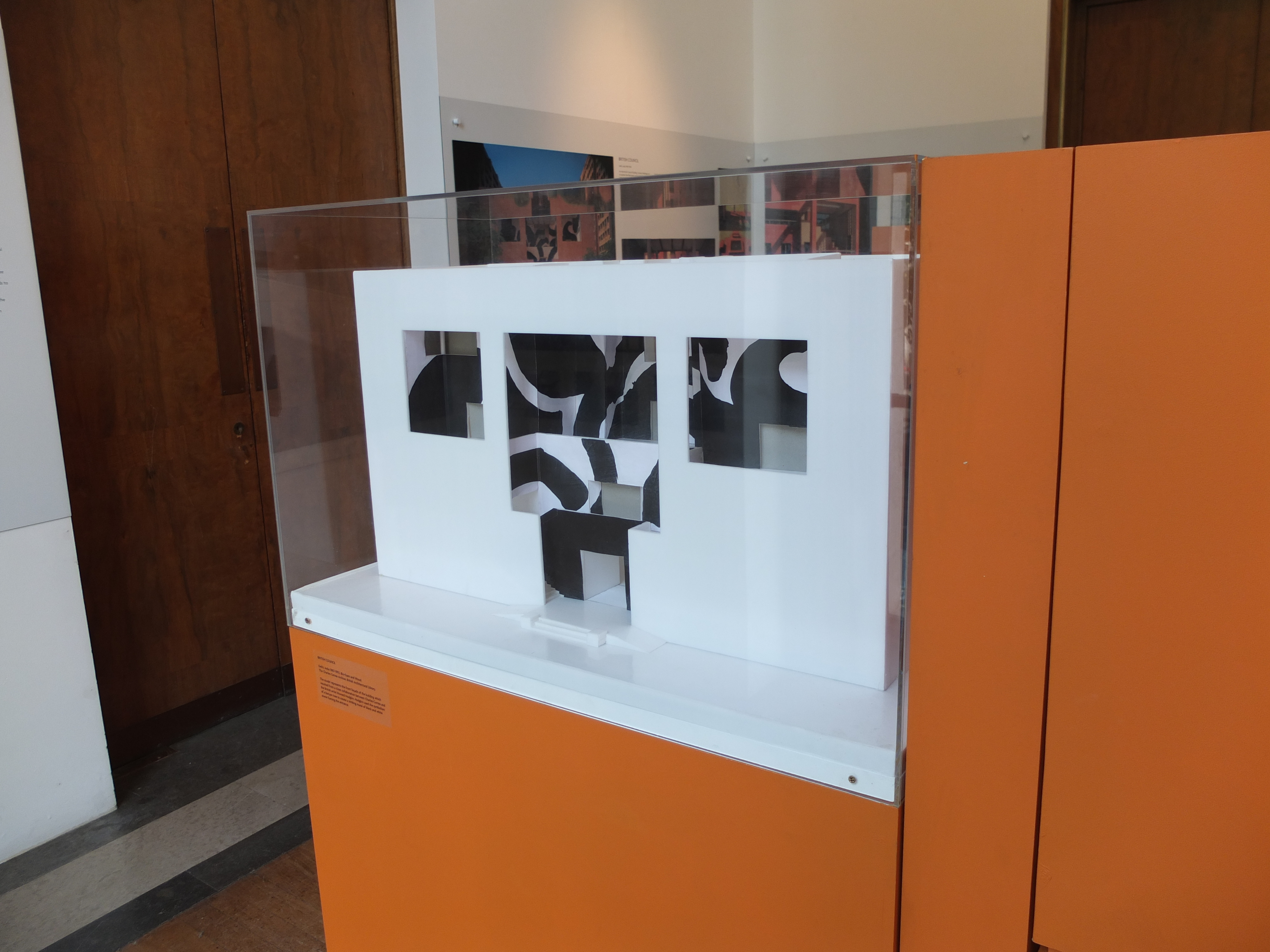
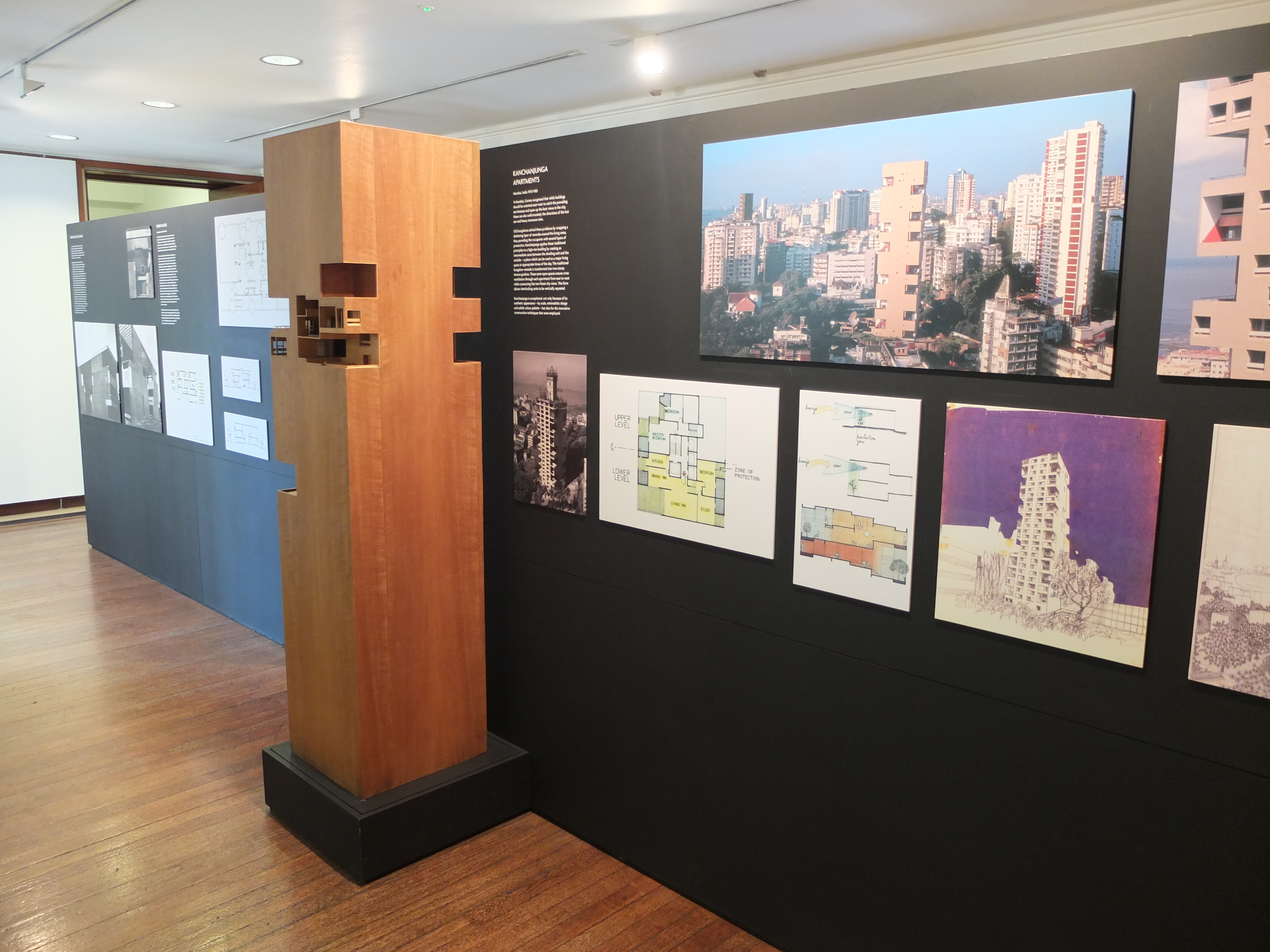
The exhibition, designed by David Adjaye and curated by Irena Murray, is spread over two floors with the lower level including a series of timber plinths painted in the delightful hues of paprika, turmeric and saffron invoking the Jawahar Kala Kendra project. It is a dramatic introduction to the work that leaves one expectant of something really special but sadly the exhibition fails to do justice to this enigmatic architect. Architecture exhibitions are peculiar affairs, not least because the architecture rarely features in architecture exhibitions, instead, we see the machinery created as a result of, or to enable the production of, the artifact in question – what Correa calls the trail left by a snail. The gap between drawing and architecture is especially apparent when viewing Correa’s work; the buildings and spaces (‘the empty centre’ in Correa’s parlance) really need to be moved through, set against an open sky and as Adjaye describes in the catalogue, absorbed through the soles of the feet. His work is not really captured by a rendered elevation or static photograph, nevertheless, considerable pleasure is gained from studying his sketches that go someway in connecting us to the person behind the drawings. Through the pencil lines and coloured crayons we can discern something of the architect who made the marks – but at this exhibition we are not even looking at the actual drawings. Instead, they are scanned reproductions on mountboard. Perhaps this would not matter if they were not so grossly enlarged to the point that they are pixelated. I found this to be most distressing, as when viewed in the catalogue (which is excellent and highly recommended) they look wonderful. As the original drawings could not be displayed due to the lighting at the RIBA it might have been a better idea not to show any at all, or just to reproduce the images as the small drawings that they are, rather than distorting them in this manner. The photographs are more forgiving, but some of them are also pixelated and not really of exhibition quality. Despite these distractions, the models go a long way to make things better. The Hindustan Lever Pavilion model in tropical hardwood is spectacular and still a radical design despite being over fifty years old, and the model of the Kanchanjunga Apartments stands at over 6ft tall putting the apartments at eye-level and immediately showing the vantage points and interiors. The housing section is the real strength of the exhibition, and arguably of Correa’s career – from the ‘Tube House’ and one-off houses in the Ahmedabadian brick and concrete style, through to the courtyard houses of Belapur and the PREVI experimental houses in Peru he has demonstrated how to design dwellings. It is these schemes, along with Correa’s analysis and proposals for Mumbai that put him up there as one of India’s greatest architects (what will the RIBA call the exhibition if Doshi follows suit with his archive? India’s Greatest Architect 2?)

DSCF0432DSCF0436

The rest of the content I found lacking and slightly predictable; I was hoping to see some of the less well-known designs, or greater analysis of some of the larger projects. For example, the confrontational LIC building in Delhi is sadly missing from the exhibition – how does that building fit with Correa’s objective of site and context, for instance? In many ways the designer and curator have played it too safe, and other than the outstanding project in Lisbon, Portugal, and the Po-Mo British Council building in Delhi we are not shown much of the playful later work.

The digital archive interface has been carefully crafted and as well as including the entire collection of drawings contains photographs of the models, buildings and scans of magazine articles and books that discuss the projects in question. The digital archive should have played a central role in the exhibition and broken away, at least in part, from the static mode of exhibiting and the passive role of viewing an exhibition – it was the perfect opportunity to project all of his work in a small space and to use the displays to critically examine the work, and perhaps to further explore why Correa might just be India’s greatest architect.

DSCF0431

The catalogue: Irena Murray, Charles Correa India’s Greatest Architect (London, RIBA Publishing, 2013), price £9.95


Transnational Architecture Group in Sicily

The Transnational Architecture Group (TAG) were participants in the just concluded Cost Action conference, “Rethinking European Architecture Beyond Europe”, from 13 to 16 April 2014. Pictured are the founder of the Group, Dr Iain Jackson on the far right, along with three members; Dr Ola Uduku (2nd Right), Yemi Salami (middle), and Jacopo Galli (far left).

Dr Jackson is a Senior lecturer at the School of Architecture, University of Liverpool, and Yemi Salami is running her PhD in the same department under he’s supervision. Dr Uduku is a Reader at the Edinburgh School of Landscape Architecture (ESALA), and Jacopo Galli a PhD Student at University of Venice Italy, (IUAV) .

At the conference, Dr Jackson and Dr Uduku had co-chaired the session titled ‘Examining tropical architecture in different international contexts’, while Yemi and Jacopo had both presented papers within the same session. Yemi’s paper, titled “British Architects in the colonial PWD: Unravelling Nigeria’s early Government Architecture”, saw her examining Nigeria’s colonial administrative architecture, though a time-line of events that produced a network of architects and specialized building design mechanisms. Jacopo’s Paper is titled “From tropical Medicine to tropical architecture.” In it he examines the generic process by which tropical health parameters had determined climate influenced designs for the tropical regions.

By and Large however, the conference provided an opportunity to deliberate on research trajectories in a varying range of subjects within the conference theme, present current research findings, get useful feedback on on-going research, and of course to savour some Mediterranean cuisine and sunshine!


European Architecture Beyond Europe ; E-Cost Action

The final conference for the ‘Architecture Beyond Europe‘ network has just finished in Palermo, Sicily. We met in the wonderful Scarpa restored Palazzo Chiaramonte Sterri, and as usual it was a very interesting gathering with participants, contributors and audience members hailing from all corners of the world. Six packed sessions covered the Transnational, Development Aid, Tropical Architecture, Identity, Methods and Exile. In addition two keynotes were given by Sibel Zandi-Sayek (William and Mary, Virginia) on the Ottoman-British Networks and Lukasz Stanek (Manchester) on Architects from socialist countries working in Ghana. The full programme is attached here: FC_program_final

DSC_0052 DSC_0120

The network has opened up many new opportunities and collaborative endeavours, as well as a high quality new journal (eager to receive submissions): for more details see:  ABE.

‘Suitable lodgings for students’: modern space, colonial development and decolonization in Nigeria

Tim Livsey has recently published his research into Ibadan University in Urban History Journal. The article argues that development and modernity have had spatial manifestations. It considers understandings of modern space in colonial and post-colonial Nigeria through the study of University College Ibadan, the country’s first university institution founded in 1948. It contends that the university was shaped by existing West African conceptions of modern space and university buildings took on new meanings with the shifting politics of decolonization. The article also suggests that colonial development involved a range of groups and forms of knowledge. It seeks to recognize the strength of colonial institutions and cultures but also the limits to and contingencies in late colonial power.

It also has some great archival images of Ibadan University from Cambridge University and SOAS Archives.

http://dx.doi.org/10.1017/S0963926813001065

The planning of late colonial village housing in the tropics: Tema Manhean, Ghana

001

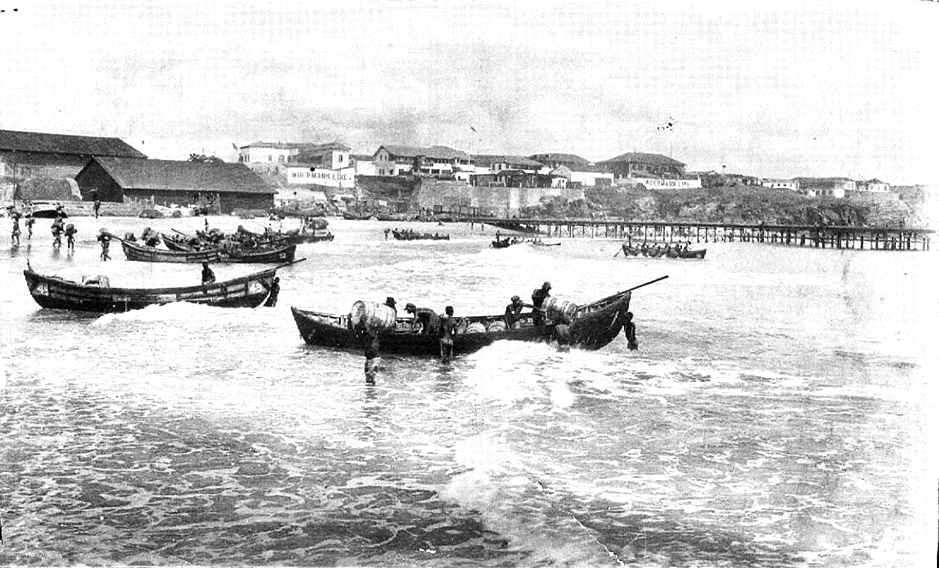
The Surf Boat Harbour at Accra, before the construction of Tema Harbour. Image c. 1920s, courtesy of Wirral Archives

This paper examines the planning, physical development, and housing in Tema New Town, an appendix of the newly created Tema industrial and harbour city, located on the northeastern part of Accra in the Greater Accra Region in Ghana. The city and its appendage were designed and built during the 1950s, as the country was rapidly approaching political independence. Tema, originally an old Ga-fishing village, became a significant part of a much larger and ambitious scheme, known as the Volta River Project proposed as part of Kwame Nkrumah’s domestic policy, embracing multifaceted and multidimensional development projects. These projects were to serve as a symbol of ‘progress’ and were part of Ghana’s desire for modernization as it emerged from a colonial past. The related schemes were largely funded as a result of the British Colonial Development and Welfare Acts, and this paper investigates the implementation of this policy and the effect that it had on physical planning and provision of architectural solutions in Ghana.

007

Maxwell Fry’s sketch of the ‘traditional’ Compound House, from Village Housing in the Tropics

013

One of Fry and Drew’s plans for the fishing village of Tema Manhean, Ghana.

The full paper, published in Planning Perspectives can be read at: http://www.tandfonline.com/eprint/cWc4hRPQWT7yCai5GkjS/full

There have been recent debates in the UK media on the need (or not) for the high speed train, HS2, that is being proposed to run from London to the central belt of Scotland. This brought into my remembrance the establishment of the railways in Nigeria beginning from 1895, and its 29 year extension into the hinterlands that concluded in 1926. The establishment of Nigeria’s railway system has often been credited to Sir Thomas Carter, who was the colonial Governor of Lagos from 1891 to1897.

Carter

Sir Gilbert Carter in 1893

Certain events however built up to the coming of the railways. After the annexation of Lagos in 1861, the British initially adopted the policy of non-interference with the Yoruba hinterland. Lagos had therefore being administered from Sierra Leone and later the Gold coast. Around 1886, Lagos was detached from the Gold Coast, became an independent colony and began taking a kin interest in the affairs of Yoruba land, particularly with the looming threat of French intervention in the region. Yoruba inter-ethnic squabbles were not only at their pick within this period, the disputes had also resulted in trade route closures to the interiors. This generated a lot of frustration for Britain’s quest into the interiors, as well as for British and native merchants who desired to trade in the hinterlands. By the third year of his appointment in 1893 therefore, Governor Carter set out on a grand tour of Yoruba land, concluding treaties and agreements with the native Egba and Ibadan chiefs. On the successful completion of the tour, he was able to obtain control over routes and the right to build railways.

rail construction

Construction of rail tracks

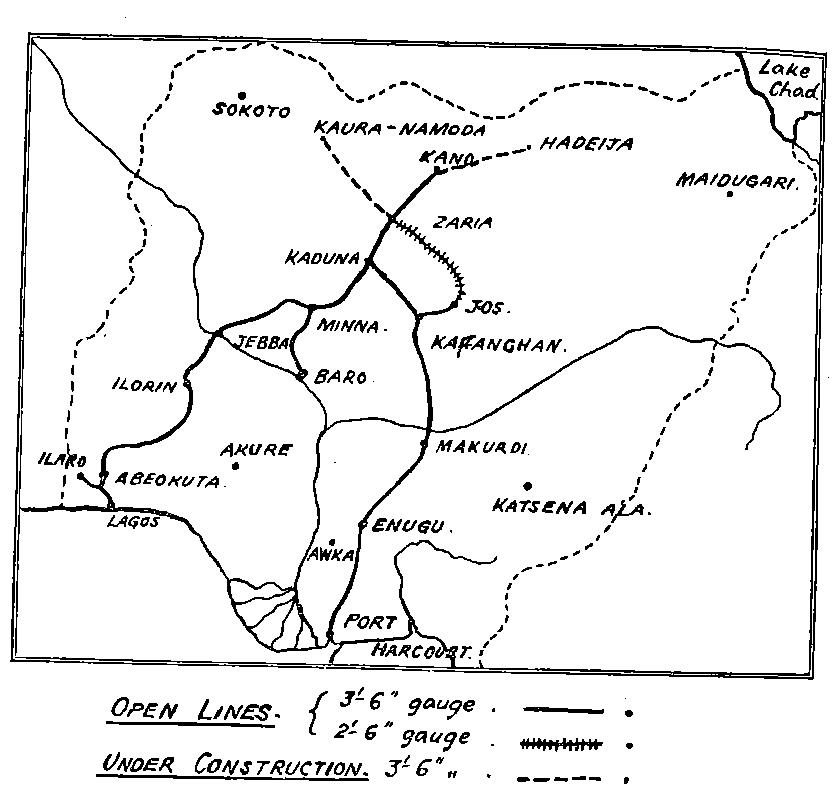
The PWD was therefore authorized to conduct a railway survey by the colonial office in 1885 under the then colonial secretary, Joseph Chamberlain. By 1896, construction began from Ebute-Meta on Lagos mainland towards the interior. By April 1899, the line was extended to Abeokuta, and by 1900 the following year, the line was open for traffic to Ibadan, a 120 mile distance from Lagos. The next major construction was the 1909 extension from Ibadan to Jebba, after which several other extensions and new lines were added. By the end of 1926, the total mileage of the system had attained 1,597, with a plan in place for an additional 150 miles of construction every year.

railway map

Railway map of Nigeria, Circa 1928

Though the PWD survey and engineering units undertook the land surveying and rail track constructions in this all new transportation project, its architectural unit had equally designed and constructed the train station buildings. These buildings currently constitute part of Nigeria’s vast colonial architectural heritage, and help raise questions about the PWD’s building programme; For example, were PWD standardized practices employed in the production of these buildings? Was there a ‘type design’ for the larger and busier stations and another for the less patronized? Were these ‘type designs’ strict prototypes enforced country-wide, or were there variants introduced? Where the designs a direct replica of train stations from Empire’s metropolis, or did they reflect local realities? These and other questions of interest could present a basis for further study.

old Ebute-meta

Old Ebute-Meta, Lagos, Platform (Undated)

ebute meta 2

New Ebute-Meta, Lagos Terminus, Circa 1955

International Conference
Crossing boundaries: Rethinking European architecture beyond Europe
Palermo, 13-16 April 2014

The International network “European Architecture beyond Europe: Sharing Research and Knowledge on Dissemination Processes, Historical Data and Material Legacy (19th-20th centuries)”, chaired by Mercedes Volait and Johan Lagae, and supported by EC funding through the COST Action IS0904 (2010-2014), is holding its final conference in Palermo (Rettorato dell’Università degli Studi di Palermo,  Palazzo Chiaramonte Steri ), 13-16 April, 2014.

 The conference includes a general session presenting the achievements and future prospects of the network, and the following panels:

–        Session 1. Methods and methodologies: Writing the histories of European imperial/colonial architecture, chaired by Alex Bremner (Edinburgh School of Architecture and Landscape Architecture) and JoAnne Mancini (National University of Ireland Maynooth)

–        Session 2. Architectures of exile: Visions and re-Visions of the global modern in the age of the refugee, chaired by Regina Göckede (Brandenburgische Technische Universitaet, Cottbus) and Rachel Lee (Technische Universität Berlin)

–        Session 3. Looking eastward, building identities: The architecture of European diplomacy beyond the Mediterranean in the age of Empire chaired by Paolo Girardelli (Boğaziçi University) and Mercedes Volait (CNRS/INHA)

–        Session 4. Transnational studies and cultural transfers, chaired by Kathleen James-Chakraborty (University College Dublin)

–        Session 5. Architecture as development aid. Actors, networks and mechanisms in the design of institutional buildings in the postcolonial global South, chaired by Kim De Raedt (University of Ghent’s Faculty of Engineering & Architecture) & Tom Avermaete (Delft University of Technology)

–        Session 6. Examining Tropical Architecture: in different international contexts,  chaired by Ola Uduku (Edinburgh School of Architecture and Landscape Architecture) and Iain Jackson (The Liverpool School of Architecture)

The keynote speech will be delivered by Dr. Sibel Zandi-Sayek, The College of William and Mary,
Williamsburg, Virginia, USA, Remapping the Geographies of Industrial Enterprise: Ottoman-British Networks and the Architectural Canon

An invited lecture will be delivered by Dr. Lukasz Stanek, Manchester Architecture Research Centre, School of Environment & Development, University of Manchester, UK, Architects from Socialist Countries in Ghana (1957-1967): Architecture and Mondialization 

The official launch of the new dedicated electronic journal, ABE – European Architecture beyond Europe, will take place at the conference.


For the detailed program of the conference, check www.architecturebeyond.eu


Call for Papers: Crossing boundaries: Rethinking European architecture beyond Europe

13-17 April 2014 Palermo

The International network “European Architecture beyond Europe: : Sharing Research and Knowledge on Dissemination Processes, Historical Data and Material Legacy (19th-20th centuries)”, chaired by Mercedes Volait and Johan Lagae, and supported by EC funding through the COST Action IS0904, is opening calls for papers for its final Conference to take place on 13-17 April 2014 at Palermo (Italy).

The conference will have the 6 following sessions:

Transnational studies and cultural transfers” (chaired by Kathleen James-Chakraborty).

Methods and methodologies: Writing the histories of European imperial/colonial architecture” (chaired by Alex Bremner and JoAnne Mancini). 

“Looking eastward, building identities. The architecture of European diplomacy beyond the Mediterranean in the age of Empire” (chaired by Paolo Girardelli and Mercedes Volait).

Tropical architecture” (chaired by Ola Uduku and Iain Jackson).

Architectures of exile: Visions and re-visions of the global modern in the age of the refugee” (chaired by Regina Göckede and Rachel Lee).

Architecture as development aid: Modernization, technical assistance and the design of institutions” (chaired by Tom Avermaete and Kim de Raedt).

The deadline for proposing a paper (300-word abstract) is 1 December 2013. Submissions to the chairs of the sessions should be accompanied by a short biographical note (max. 150 words). Acceptance decisions will be communicated by mid-December. Please note that invited speakers are expected to submit their complete paper by 15 March, 2014, to be circulated among the conference’s participants. Speakers based in countries participating in the Action (refer to the website http://www.architecturebeyond.eu for the complete list) will be able to claim reimbursement of their expenses. A few grants will be available for speakers based in other countries. For further information, please contact the sessions’ chairs or write to is0904@inha.fr.

Transnational studies and cultural transfers

Chaired by Kathleen James-Chakraborty (University College Dublin)

European architects have worked beyond Europe since the time of the Crusades.  Many architectural historians have documented these practices. In recent years particular attention has been paid to architects who emigrated to escape authoritarian regimes and who are widely credited with having brought modernism with them.  Most of this literature, however, floats independently of social science scholarship on transnationalism, and much of it focuses on the movement of forms and theories, rather than on how people structure their own identity in relationship to their experiences of other places and cultures.  Moreover, relatively little of this writing engages the role of the client, although the role of local building cultures is beginning to receive the attention it deserves.  And finally, very little of it is comparative.  What is the difference between Genoese settlements on the Black Sea, for instance, and Portuguese ones on the African coast?

This session seeks papers that rectify this situation. Particularly welcome are contributions that consider current anthropological investigations of transnationalism and theories of cultural transfer and their applicability to architectural history. What can architectural historians learn from methodologies developed largely to analyze more portable forms of artifacts, not to mention ideas?  Also desired are papers that seek to conceptualize the ways in which transnational architectural practice has changed across time.  What, for instance, distinguishes the German architects that came to the United States following 1933 from those who emigrated after 1848?  Papers might also examine the problem of determining what role biographical experience plays in the designs of any architect.   This is particularly important in the case of a profession that is profoundly collaborative, engaging clients, builders, and users as well as designers.  Other questions that might be addressed include what motivates clients to hire architects from other countries and how do these architects operate once they have such commissions.  Are they employed because of technical or stylistic expertise gained abroad, or are other factors at work?  What types of information and ideas travel with them, and under what circumstances are what local conditions taken into account?

Kathleen James-Chakraborty kathleen.JamesChakraborty@ucd.ie

Methods and methodologies: Writing the histories of European imperial/colonial architecture

Chaired by Alex Bremner (Edinburgh School of Architecture and Landscape Architecture) and JoAnne Mancini (National University of Ireland Maynooth)

This session seeks to explore and debate the ways in which we write (and have written) the history of ‘European architecture abroad’, particularly in the context of European imperial expansion. For some thirty years now the study of European imperial and colonial architecture has largely been refracted through the theoretical lens of post-structuralism—mainly appropriated from philosophy, literary  and cultural studies—in the form of the ‘Orientalist’ critique of Edward Said and other forms of Foucauldian discourse analysis, nominally referred to as ‘post-colonial theory’. As powerful and seductive as these modes of analysis may be, and as useful in their opening new ways of seeing and interpreting forms of cultural production such as architecture, they have become formulaic, predictable, and even orthodox. They have also received trenchant and sustained criticism from the wider scholarly community in historical studies (especially outside art and architecture circles) for their inherent limitations.

This leaves us with the question of where the study of European imperial and colonial architecture might turn next.  On the whole, other scholarly and cognate traditions, such as early modern and modern European history, have developed more diverse and wide-ranging approaches to the study of empire and culture, adapting insights from geography, environmental studies, anthropology, and other disciplines; and have devoted significant attention to integral concepts such as networks and agency. Although not necessarily opposed to discourse analysis, these scholarly frameworks—including regional approaches (‘Atlantic’, ‘Pacific’, ‘Indian Ocean’, and ‘World/Global’ histories), network theory, and ‘connected’ histories—provide new and very different insights than those provided by post-colonial theory.  However, just as architectural historians have not fully engaged with scholars in these fields, early modern historians have also been somewhat reluctant to engage fully with architecture and the built environment as agents and repositories of social practice and social change.

Can, indeed should, architectural history engage more with these alternative scholarly traditions and modes of analysis? What can we learn from them, and how might we apply them?  How might architectural historians interact more productively with colleagues in history and historical social science disciplines to encourage more architecturally-informed analysis in those fields?  Or, ought post-colonial theory remain the key concept and frame of reference that underpins our study of the colonial built environment?  This session welcomes papers that address any aspects of these key questions, either by dealing specifically with methodological approaches that enhance, progress, and/or transform our understanding of European imperial and colonial architecture, or by exploring case studies that allow for these methodological concerns to be elaborated in specific contexts. Put simply: where are we, where are we going, and where do we want to be as scholars of the colonial built environment.

Alex Bremner alex.bremner@ed.ac.uk & JoAnne Mancini JoAnne.Mancini@nuim.ie

Looking eastward, building identities: The architecture of European diplomacy beyond the Mediterranean in the age of Empire

Chaired by Paolo Girardelli (Boğaziçi University) and Mercedes Volait (CNRS/INHA)

Embassies are, by definition, representative institutions, but the share of their architectural shelters in this signifying function is a complex and still understudied issue. By transferring a fragment of the nation beyond its frontiers, embassies, consulates and other officially “foreign” architectures engage in a complex cultural dynamic of encounter, estrangement or integration. Symbolic, identitarian and political meanings may be variously inscribed in their architectural fabric; balances in social topography may be altered – all the more when
such buildings were constructed or adapted by European powers in countries with a remarkable degree of geographical/cultural distance. The stylistic heterogeneity resulting from the interactions and constraints inherent to diplomacy is all the more bewildering in such cases.

This session is meant to develop a critical and comparative reflection on a rather neglected aspect of architectural and urban history that informs the global spread of European forms and aesthetics through an unusual lens. It proposes to do so by concentrating on the geography that lies East of the Mediterranean and on places and structures located outside the direct colonial confrontation. We are interested in contributions looking at buildings related not only to the main Western European players, but indeed to Eastern and Central European agency. Empirical as well as conceptual and theoretical research on European diplomatic structures in the Ottoman, Persian and non-colonial Asian geography, as well as in peripheral cities of the Russian empire, can be presented and discussed in this session.

We invite papers assessing the ways in which European diplomacy, international relations, and changing power balances shaped important parts of the built environment outside Europe, in a space/time framework characterized by expanding European penetration eastward and corresponding roughly to the long 19th century and beyond. We are particularly interested in contributions that address the architectural embodiment of encounters and representational strategies within innovative frameworks, exploring new ground beyond the conventional critique of Orientalism. Preeminence will be given to proposals reflecting on the appropriate methods and sources for this kind of trans-national investigation, and addressing the history of diplomatic buildings as a constant reworking of images, styles, spaces and political messages, affecting each other in unpredictable ways.

Paolo Girardelli girardel@boun.edu.tr & Mercedes Volait mercedes.volait@inha.fr

Tropical architecture

Chaired by Ola Uduku (Edinburgh School of Architecture and Landscape Architecture) and Iain Jackson (The Liverpool School of Architecture)

‘Tropical Architecture’, used as a term here to define a particular strain of construction that seeks to address the hot, humid, and dry climes found between the Tropics of Cancer and Capricorn, is inextricably connected with the colonial endeavours of Europe. Traditional scholarship has sought to historicise the canon and to look to early encounters between travellers, missionaries, military engineers and local populations. This seems like a sensible mode of enquiry from which to begin. Participants are encouraged to present research papers that have examined how ideas have travelled, been interpreted and eventually built, with particular interest on the indigenous perspective. We are also however seeking papers that take us beyond the archive; thus in addition to examining records of the indigenous contribution to tropical architecture, what of those forced to live in tropical dwellings, or to occupy schools, courts, and other such buildings? How did they modify or enhance the tropical capabilities of the buildings they occupied and what recorded or pictorial evidence do we have that shows what they thought of their surroundings? Finally, and importantly we are interested in the domestic setting; what constituted the ‘everyday’ what were the female, (and possibly youth) perspectives, on life in these new tropical dwellings. Also how was environmental comfort and hygiene, evaluated by local residents, as compared with the plans and expectations of the tropical research establishments in the home countries?

Tropical Architecture is a blunt, but useful term. Can we begin to draw out some revealing tributaries? The architecture of Port Cities and ‘sailor towns’, will inevitably vary to that of the hinterland, hill station, administrative centre or desert. What about the island, archipelago, peninsula, and mainland as specific places of exchange, encounter, settlement and isolation- can we begin in a more concerted manner to consider the architecture of these territories and conditions whilst thinking about the tropical? The architecture of trade, railways, stations, warehouses, dock walls and shipping offices all need further investigation.

Tropical architecture ‘at the edges’ is also pertinent; beyond the cosmic boundaries imposed by Cancer and Capricorn, what happens at the edges of the tropical – the subtropics and other such regions that form the imagined boundary. Is the architecture of these almost-tropical places of note, and how does it borrow or contribute to the broader debates. Other boundaries seem to exist at The Americas and Caribbean; they have not featured to the same extent as other geographic areas in recent scholarship. Is there a reason for this? Is the architecture of Rudolph and Polevizky in Florida, or Ossipoff in Hawai’i, or Kurchan and Hardoy in Buenos Aires not the right type of tropical architecture, or is there simply less to say about these, often glamorous, projects or places?

Biography is a contested historiographical method, but can we look more closely at the indigenous architects who have contributed to this canon often working alongside European architects, or should we accept that they should retain their anonymity in light of our concerns about biographical narratives? Equally should we continue to explore the life stories of Europeans who worked in the tropics? Should we be placing them more carefully within a broader narrative? Or indeed when does biography become hagiography – to what purpose and for what audience is it really meant.

Colonies within colonies, or neighbouring territories may offer new insights. For example, was the French Indian colony of Pondicherry culturally isolated from its surroundings, or can were discern ‘knowledge transfers’ and modes of exchange? How did the French differ in their approach to tropical design to the British, or Portuguese in Goa, for example? Taking this premise to its other extreme, what characterises early Indian labour settlements in Durban, or Chinese settlement in areas like San Francisco on America’s Western Seaboard, or West Indian/returnee African settlements in Sierra Leone, Liberia and other countries on the West African coast.

Ola Uduku o.uduku@ed.ac.uk and Iain Jackson Iain.Jackson@liverpool.ac.uk

Architectures of exile: Visions and re-Visions of the global modern in the age of the refugee

Chaired by Regina Göckede (BTU Cottbus) and Rachel Lee (TU Berlin)

The emergence of what is today known as international architecture is to a large extent related to the global impact of exiled European architects, who, scattered throughout the world, contributed decisively to its theoretical debates, institutional formations and built manifestations from the early 1920s onwards.

The historiography of exiled modern architecture has long focused on cases of purportedly successful and unidirectional cultural transfer as represented in the master narratives of prominent US immigrants such as Walter Gropius and Mies van der Rohe. The dominant focus on individual biographies and histories of linear stylistic innovations has all too often overlooked the importance of discrepant discursive contexts (material and non-material alike), marginal geographical destinations, the effects of critical self-reflection, as well as the numerous tragedies of loss, disruption and failure under the conditions of forced dislocation. In the last two decades, there have been, however, several important studies that have contributed to a much more complex understanding and significantly extended knowledge (temporal as well as geographical) of the fragmented dynamics of architects’ and urban planners’ exilic dislocations (including re-migrations and transmigrations) and modern architecture and planning. In addition, new approaches from the fields of post-colonial and cultural studies have stimulated the emergence of conceptually de-centered and ideologically de-nationalized perspectives.

This session focuses on the intersection of exile and architectural practice as a historical phenomenon in an increasingly globalizing world. It seeks to re-examine both the exilic histories of our architectural present and the concept of exile as an analytical tool for interpretively grasping the so-called globalization of modern architecture.

We invite contributions by historians of architecture and art history as well as by scholars from related fields such as literary studies, anthropology, human geography and political history. Papers can address the many individual lives and works of 19th and 20th century exiled European architects with a view to their role in the transformation of international architecture, trace (discursive) modes of production and reception (including non-European resistance to Western cultural hegemony), test specific (historical) experiences for links with and relevance to current, or possibly earlier, exilic modes of planning and building, or investigate the research field’s historiographical overlaps and collusions with related interpretive paradigms like diasporic, (trans-)migrant, (post-)colonial, transnational, cosmopolitan, global, or international architecture. We are particularly interested in comparative perspectives and theoretical-methodological approaches that consider temporal/geographical variants, discrepant political-ideological conditions, and institutional and personal networks. We also invite papers that explore exilic careers of non-European architects within Europe or analyse the architecture produced, commissioned or inhabited by exiles who were not architects.

Regina Göckede goeckede@tu-cottbus.de & Rachel Lee rachel.lee@gmx.net

Architecture as development aid. Actors, networks and mechanisms in the design of institutional buildings in the postcolonial global South.

Chaired by Kim De Raedt (University of Ghent’s Faculty of Engineering & Architecture) & Tom Avermaete (Delft University of Technology)

This session deals with the theoretical and practical architecture expertise which emerged through development aid in the ‘global South’ after decolonisation. By looking specifically at development aid organisations, the aim is to unravel mechanisms of architecture and knowledge production specific to the postcolonial context, characterized by shifting political and economic conditions as a result of the Cold War. Through a particular focus on the design of institutional buildings (schools, universities, hospitals, etcetera), the session seeks to produce a mapping of postcolonial networks of expert(ise)s which substituted former métropole-colony relations.

Questions that could be addressed by the papers are: How did a specific type of ‘global expert’ arise through development aid? What was the role and position of such architect-experts within the highly institutionalized aid bodies they worked for, and to what extent could they operate autonomously within those organisations? What kind of architectural discourse was implicitly or explicitly constructed by development aid bodies? How did this lead to a particular approach to the design of institutional buildings? What was the role of African players in the production of those buildings?

Ultimately the session seeks to understand the specificity of the architecture production realized through development aid, and recognize the particularity of the role of the ‘architect-expert’ within aid organisations. This will allow identifying the continuities and shifts in discourse, mechanisms and architectural language with respect to the production of institutional buildings in the late colonial period, while also tentatively putting the increasing globalisation of the architecture practice today into a historical perspective.

Kim De Raedt kim.deraedt@ugent.be & Tom Avermaete T.L.P.Avermaete@tudelft.nl
 

With the current array of communication media available in today’s world – the electronic or email, the short message service or SMS, voice and video calls, sharing and exchanging of information and ideas through social media – it is becoming increasingly difficult to imagine a world where most of these did not exist. It is also of interest that a good number of the media have only come into use in the last twenty years approximately.

1901 one shilling southern Nigeria postage stamp

1901 one Shilling Southern Nigeria postage stamp

Communication has always been a top priority of the human existence. This is perhaps attested to by the picture writings of archeological findings on ancient cave walls. Postal communications (and the radiotelegraph developed later) were probably the only means of long distance communication in Nigeria during the early and mid-twentieth century period of colonial rule. It may also appear that next in the line of priorities after hospitals, was the development of the colonial Post Office. The provision of hospitals and health care infrastructure were of top priority. The first few years of European presence had resulted in so many deaths for the new settlers, it unfortunately earned the African continent the sobriquet “white man’s grave.”

Post offices were of almost equal importance. They provided an undisrupted flow of communication between the colonial office and the administration in Nigeria, and thereby represented a pivotal tool in the colonial administrative process. Their function was however not limited to providing postal services; the post offices were also often equipped with telephone exchange facilities. Aside from their role in relaying official correspondences, post offices equally helped colonial civil servants, service personnel of the Royal West African frontier force (RWAFF) and other settlers of the time keep constant touch with families back home.

archivexmaspostoffice

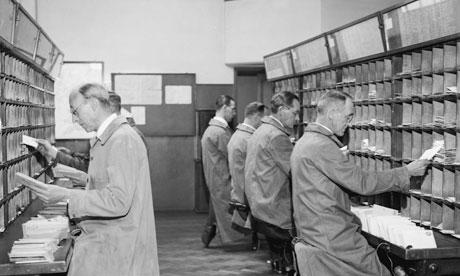
The ‘Sorting’ office

The Public Works Department (PWD) had designed and built these post offices across Nigeria as part of the wider colonial building program. As with most other public buildings of the time, the designs were based on ‘Type’ categories. These categories had perhaps reflected the postal requirements of various settlement types. This ranged from village, to native administration center, division, provincial headquarters and colony. Like the example shown below, the post offices were mostly designed in simple geometric open plan forms. The postage and package sorting office is the focus of activities, and has a larger dimension than the other spaces. The entrance features an open porch, fronted by a classical archway and topped by a parapet. The hipped roof form provides a conical, prism shaped backdrop, that makes the design exude a note of brilliance, simplicity and well-proportioned forms. 

post office

1946 PWD Post Office drawing