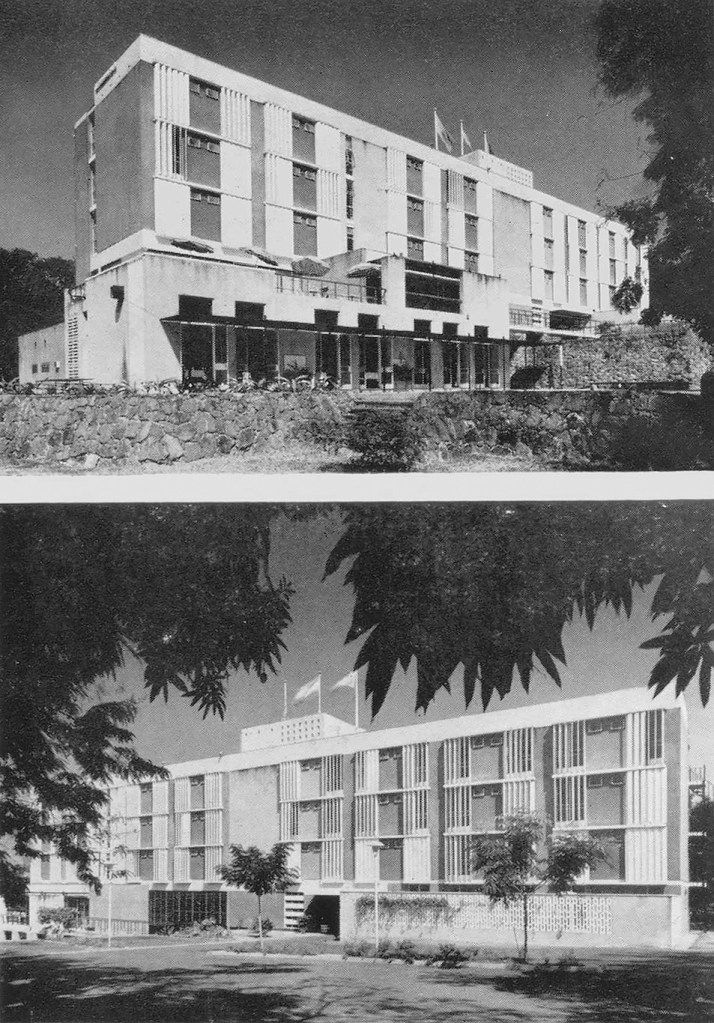
Source: “Paramount Hotel, Freetown,” The West African Builder and Architect, vol. 2, no. 4, July/Augst 1962. Original copyright holder unknown
Abstract:This article examines the planning of the Paramount Hotel in Sierra Leone, completed to the designs of James Cubitt & Partners in 1961, during Sierra Leone’s transition from colonial rule to independence. This paper demonstrates that the hotel was conceived of as a neocolonial instrument planned and funded by the British government’s Colonial Development Corporation to support the continued operation of British capital in a post-imperial world. At the same time, tourist-based development was a central component of economic planning in the immediate post-independence years for Sierra Leone’s political class. This paper therefore reveals that the luxury hotel played a central, if unstable, role in planning for economic futures during the ends of empire in Sierra Leone.
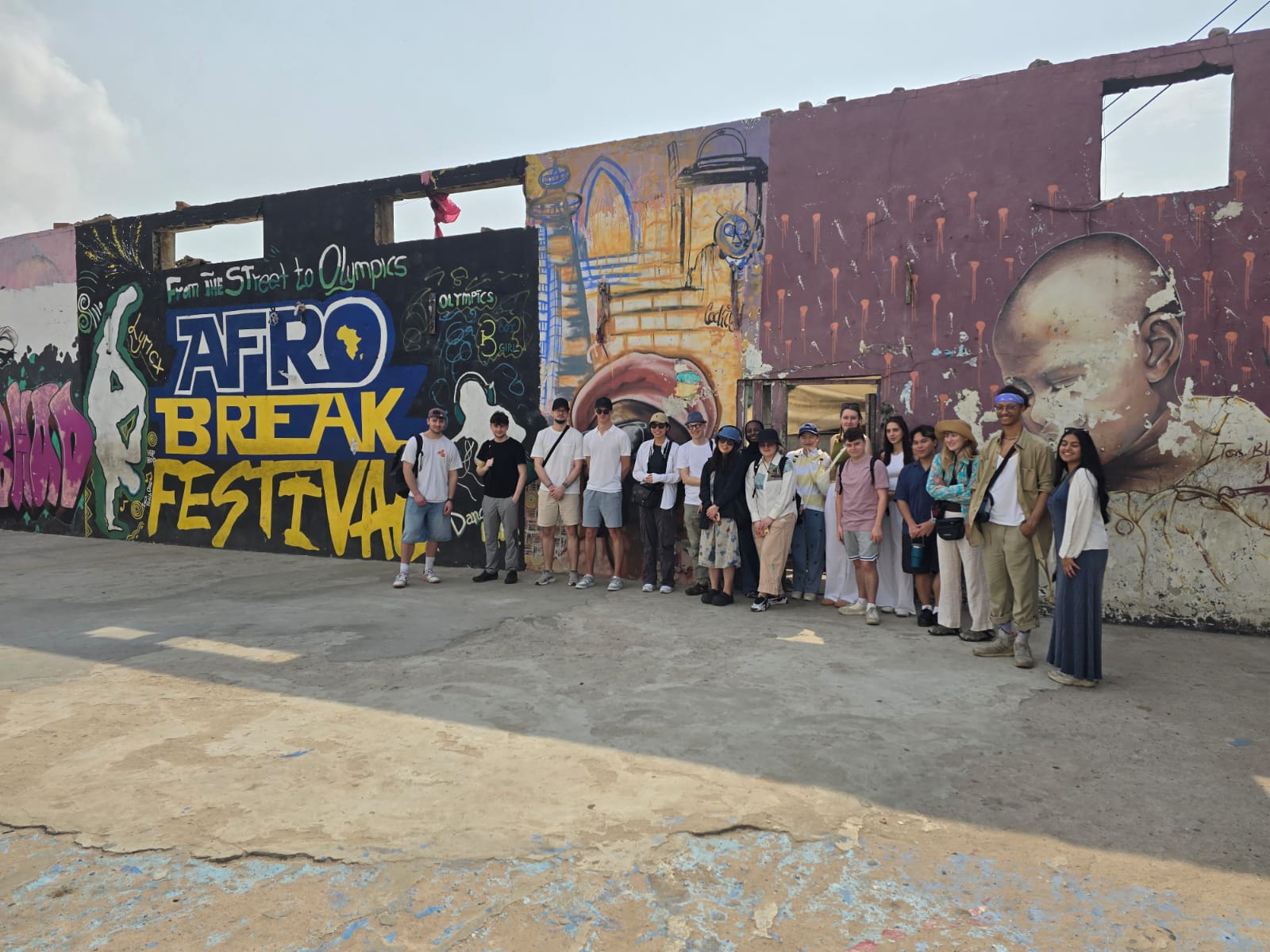
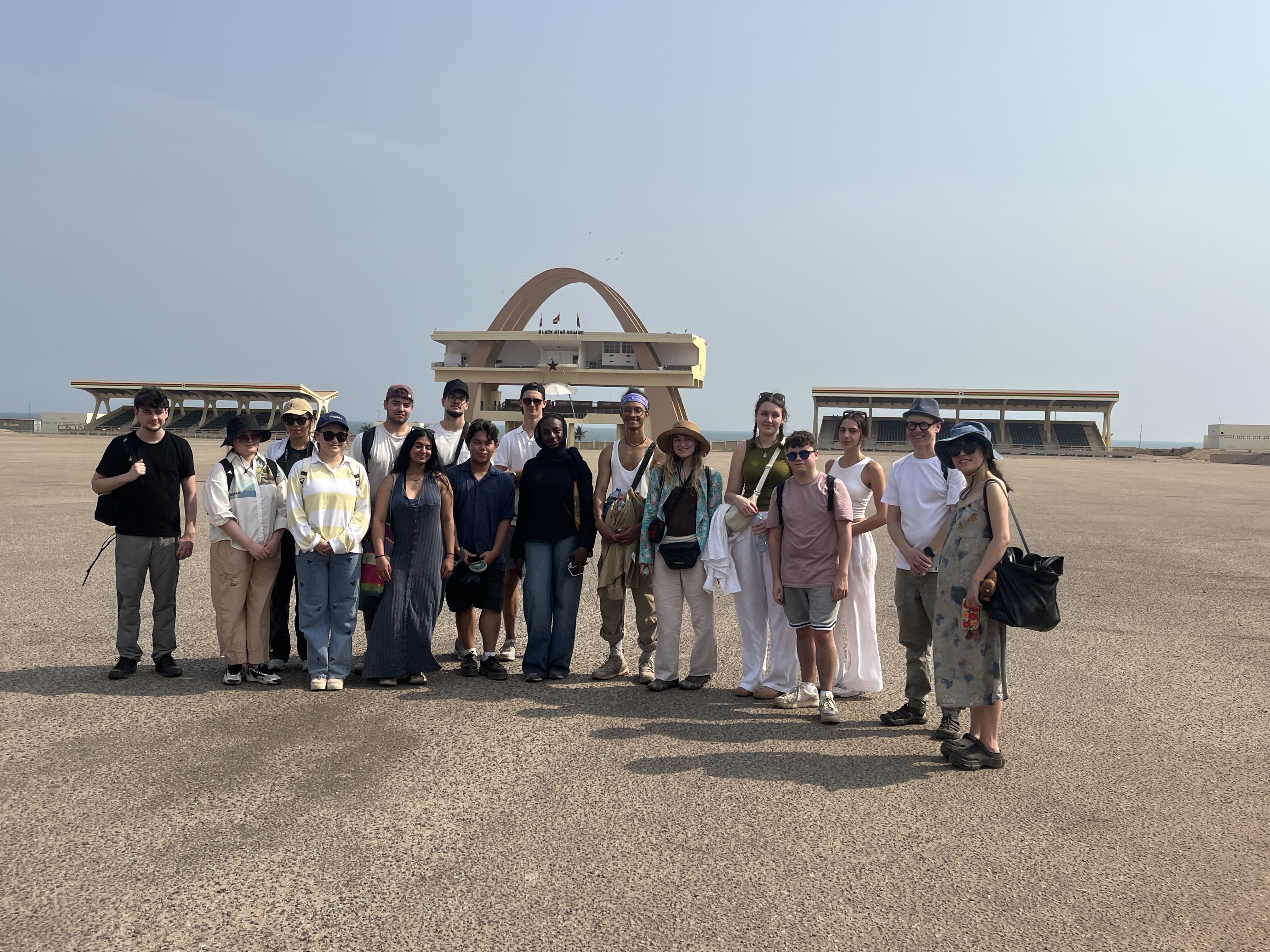
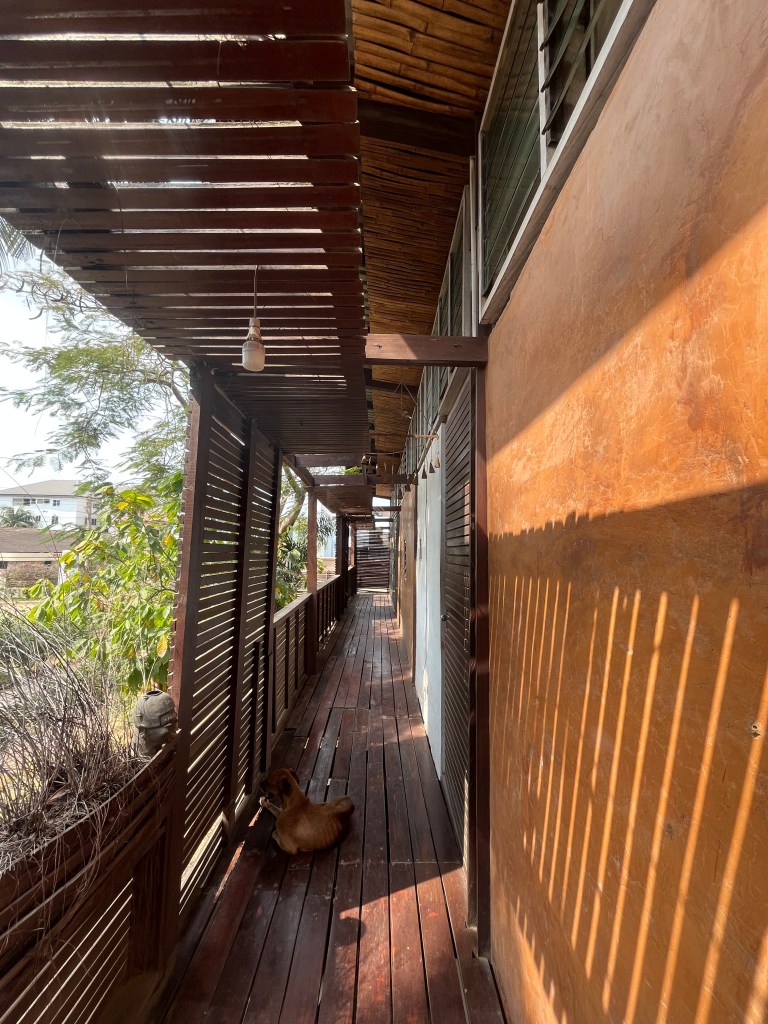
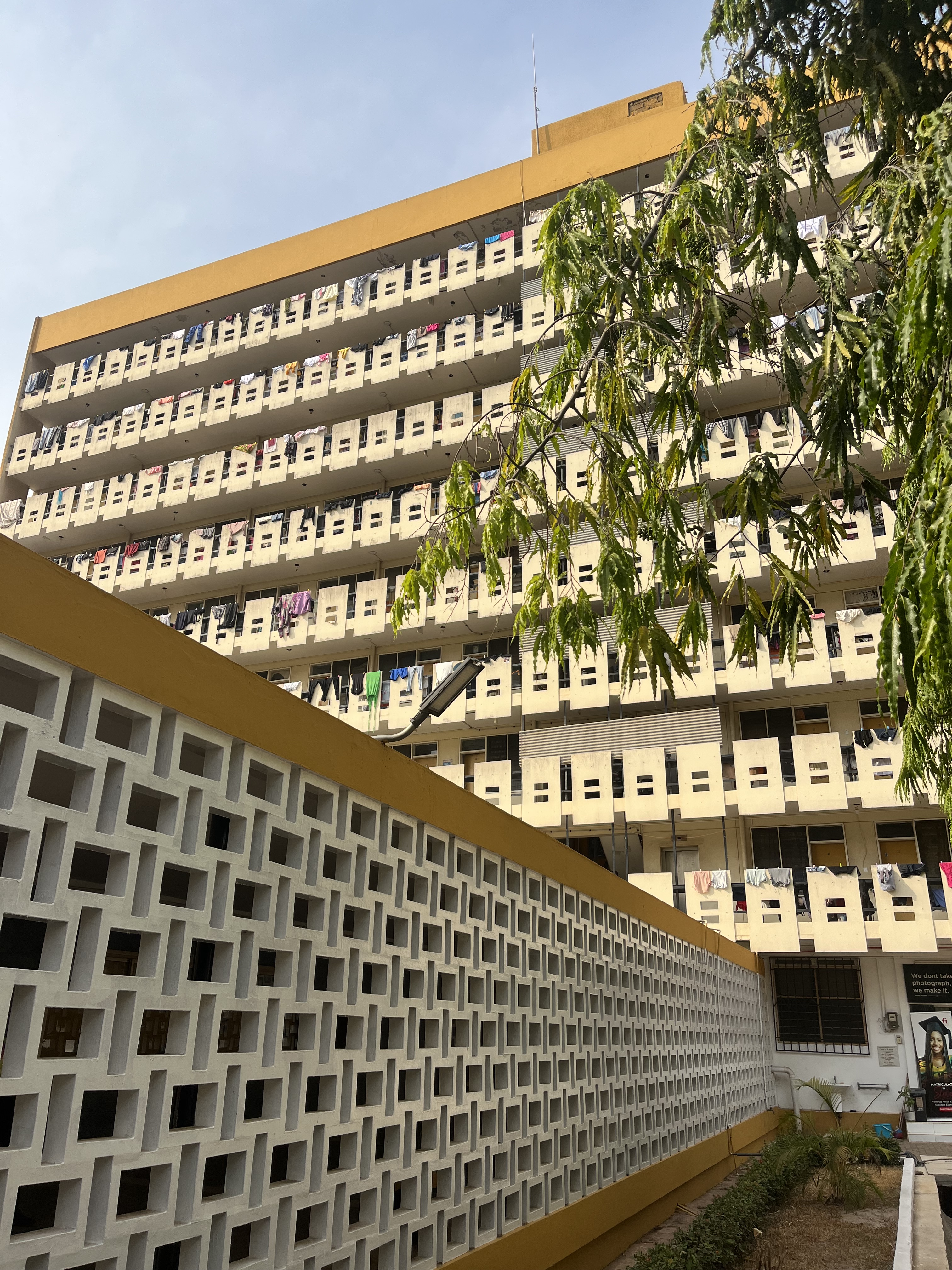
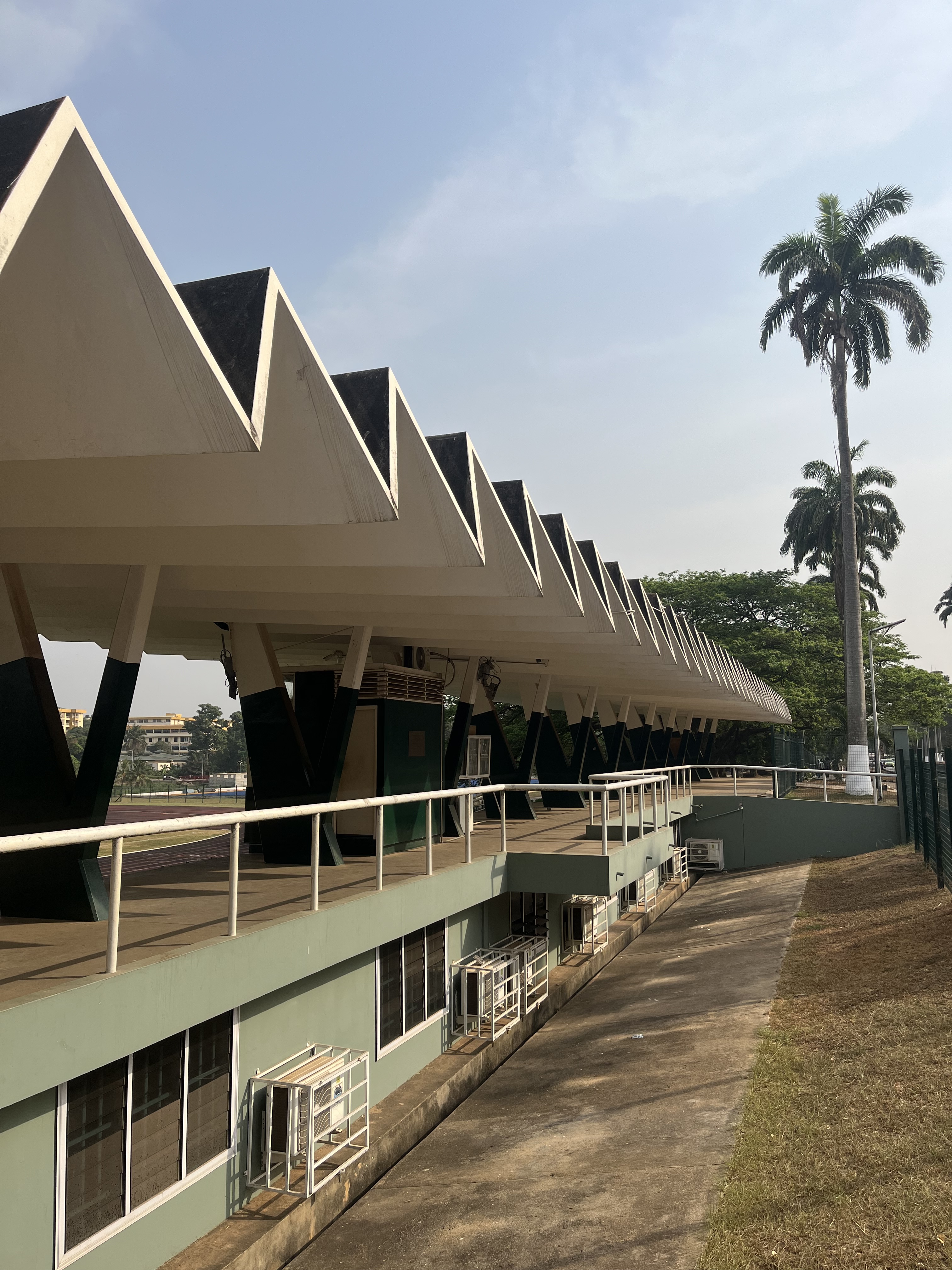
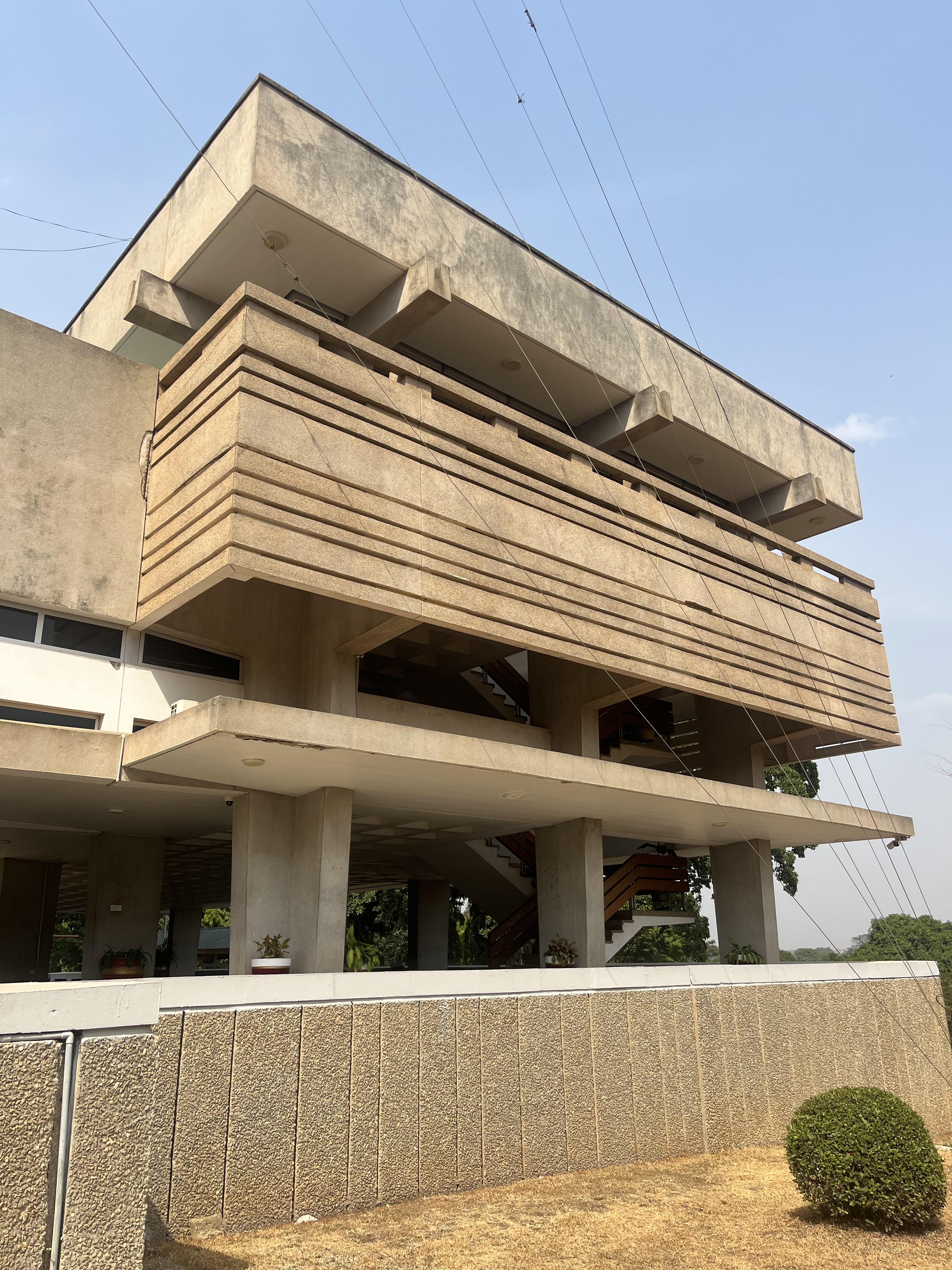
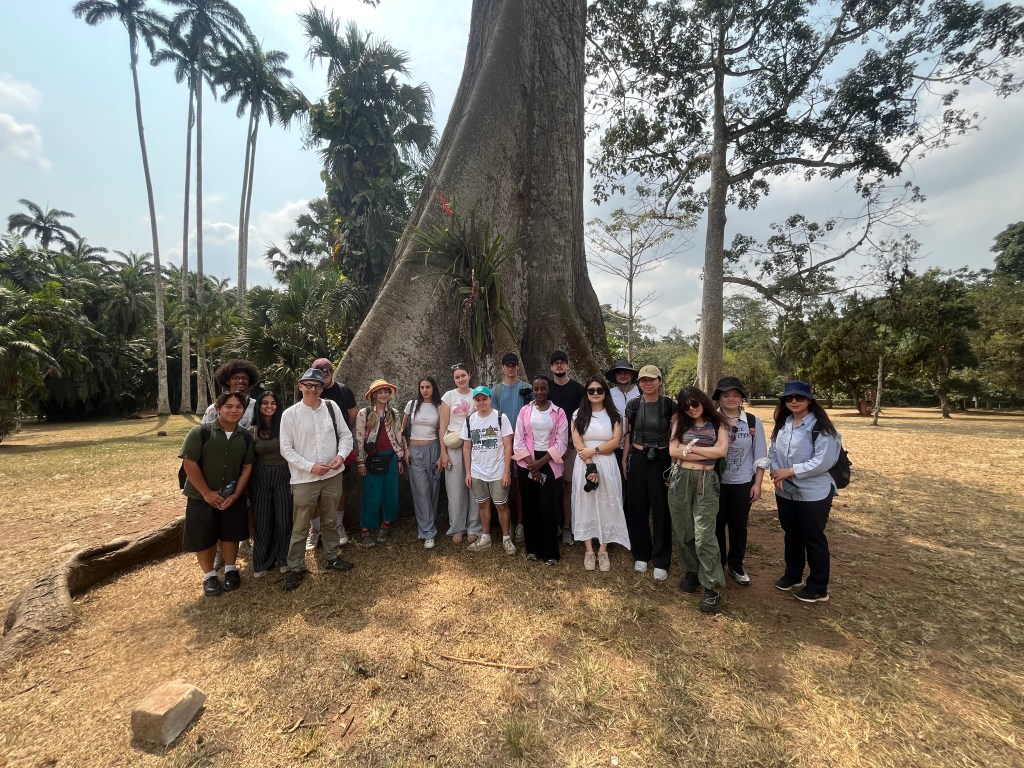
We’ve just returned from a Liverpool School of Architecture BA3 field trip to Ghana. 17 students from the AHUWA studio visited Accra, Kumasi, Cape Coast, and Aburi. We’ll be setting a theoretical design project at the former Kingsway Stores site on Accra’s High Street. Students will be using the site to test climatically appropriate design solutions, naturally cooled interiors, and how a new botanical research station, exhibition, and garden could be reimagined in the historic core of Accra.
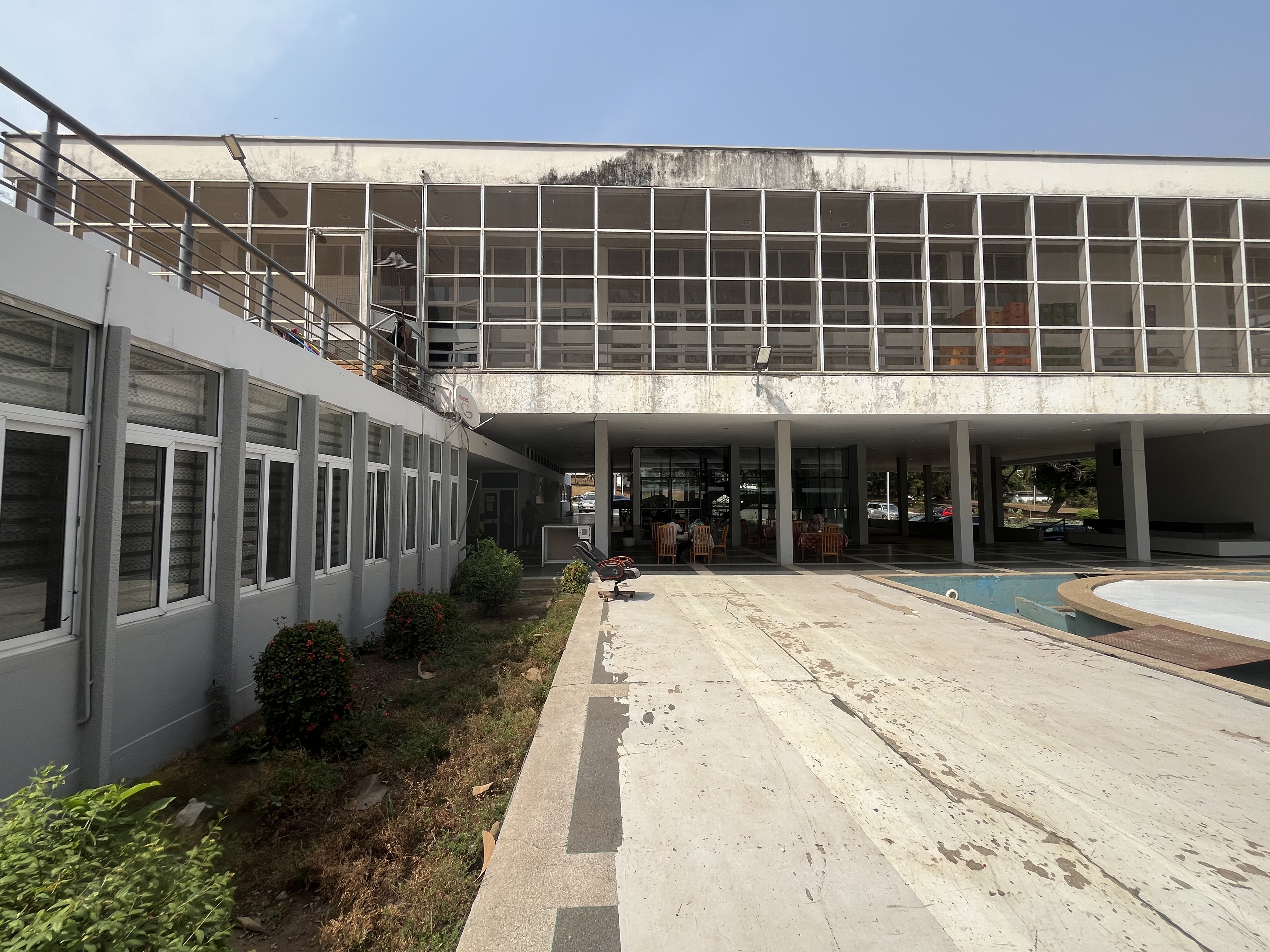
We visited Jamestown, the Padmore Library, Accra Library, Black Star Square and various streets and buildings around central Accra.
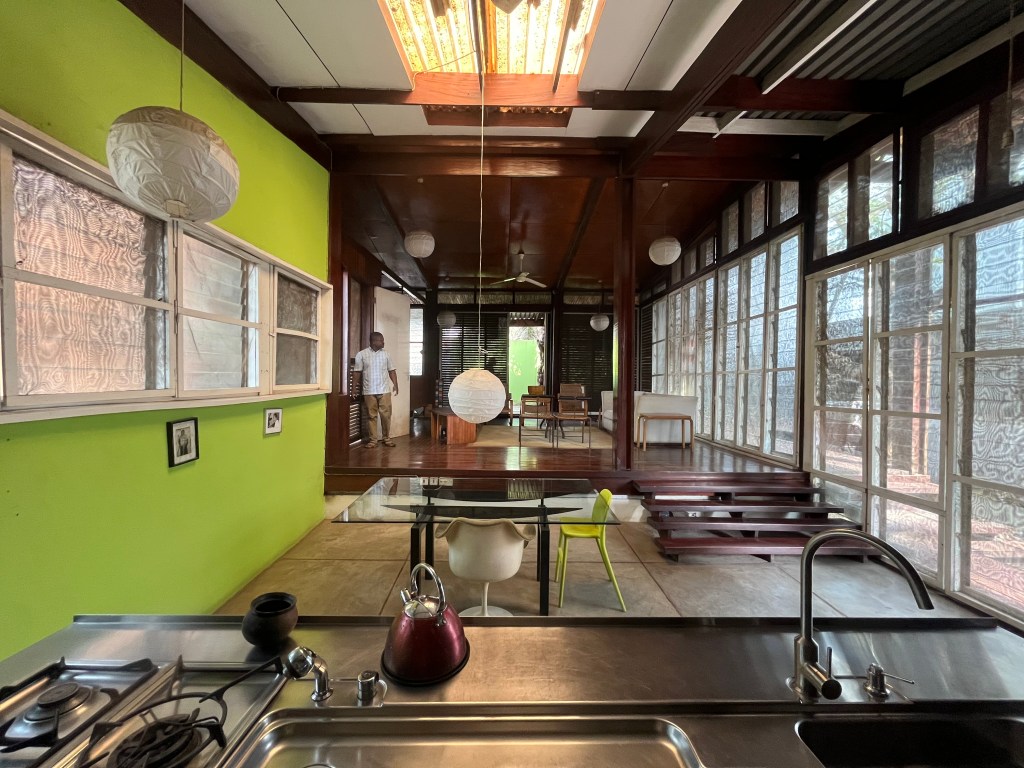
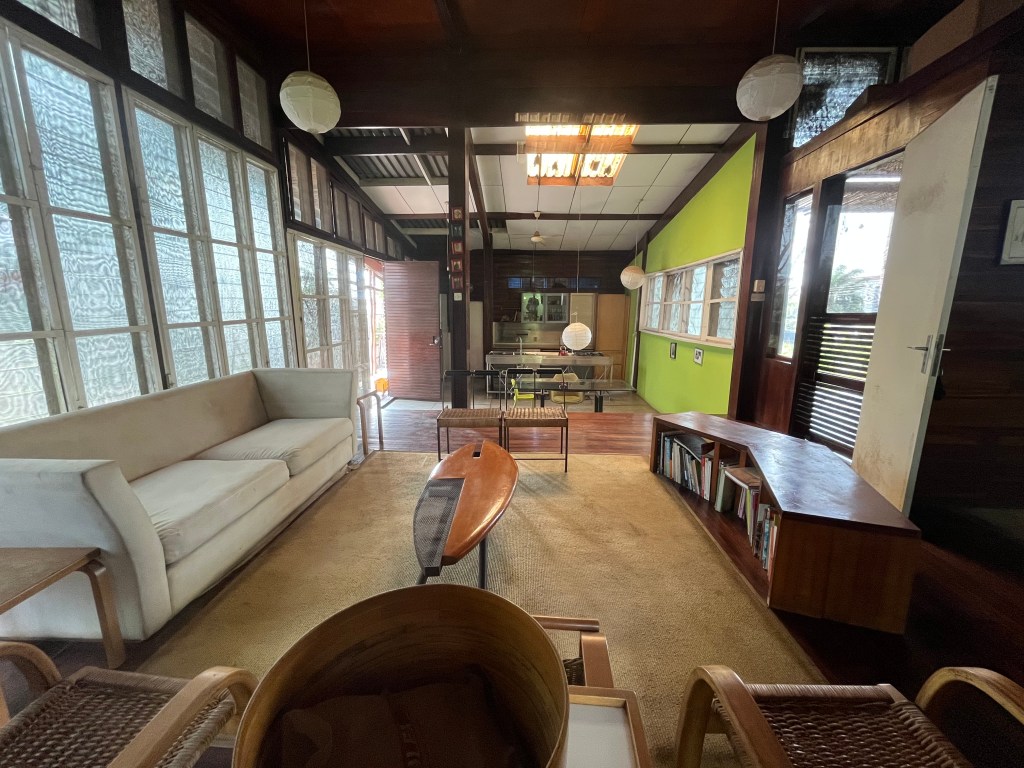
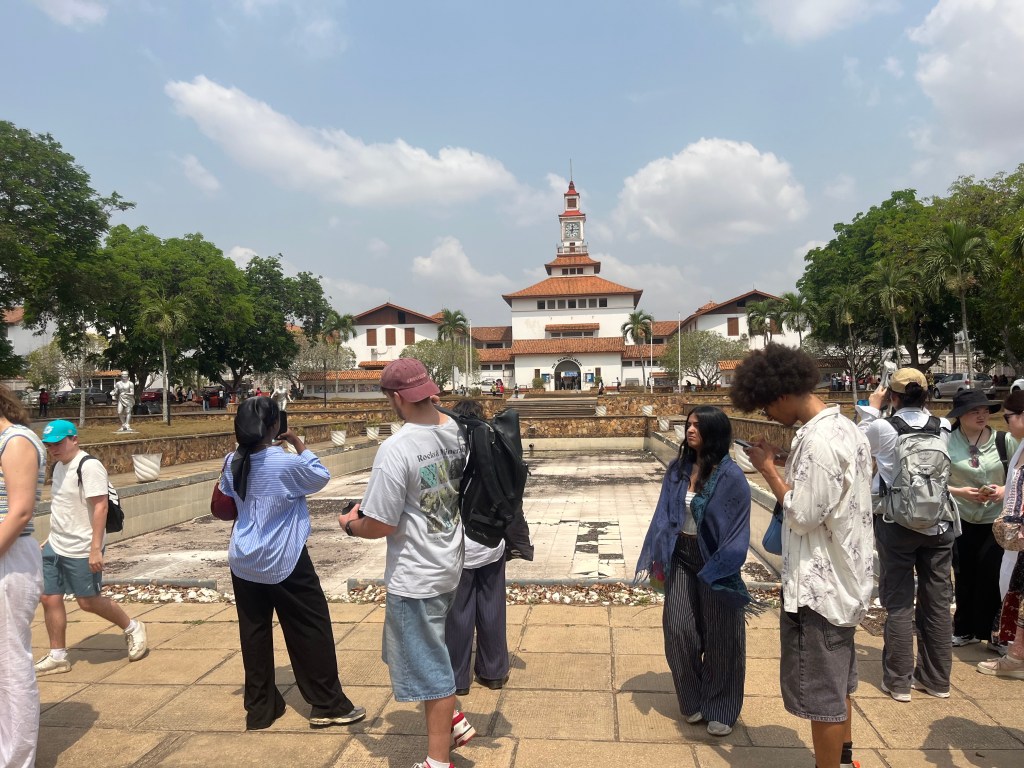
Joe Addo kindly gave us permission to visit his home in Medina, and from there we went to the University of Ghana.
In Kumasi we visited the KNUST campus as well as the Ejisu Besease Shrine – an early 19thC shrine and one of the few surviving Asanti traditional buildings (now all UNESCO heritage sites).
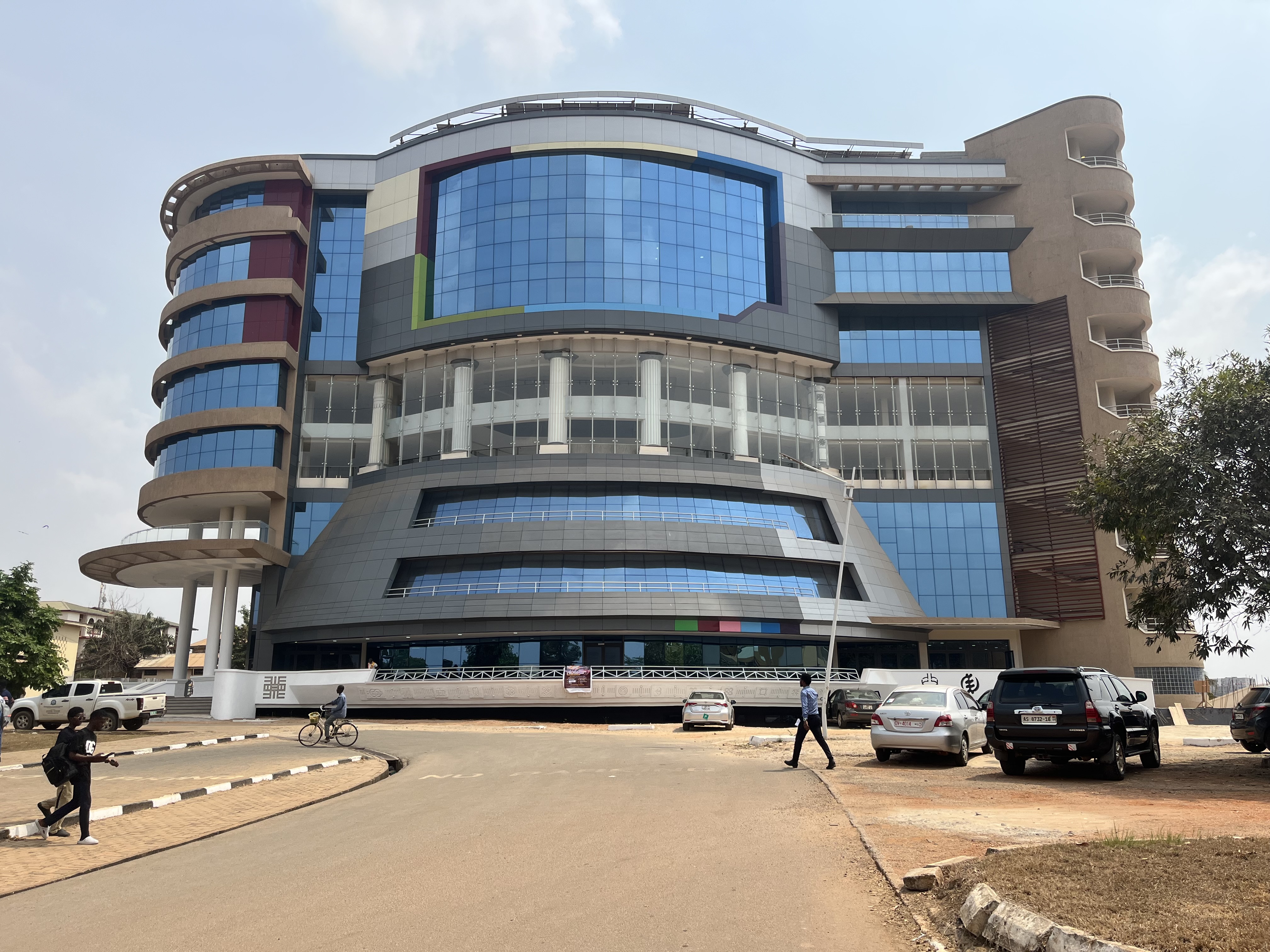
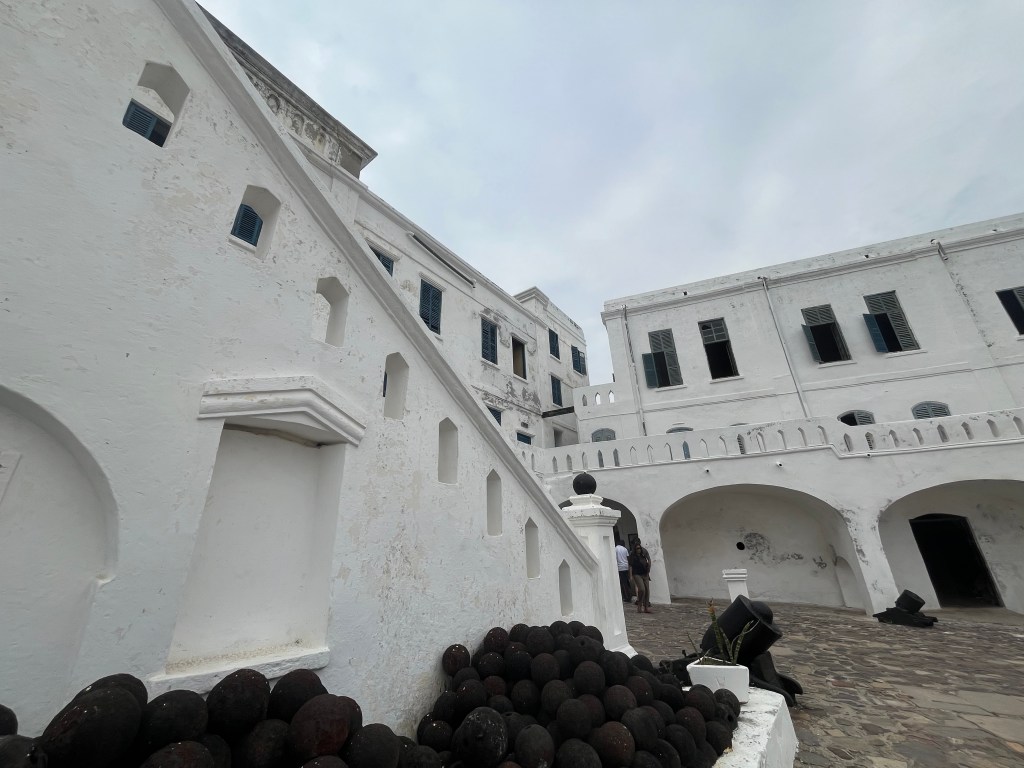
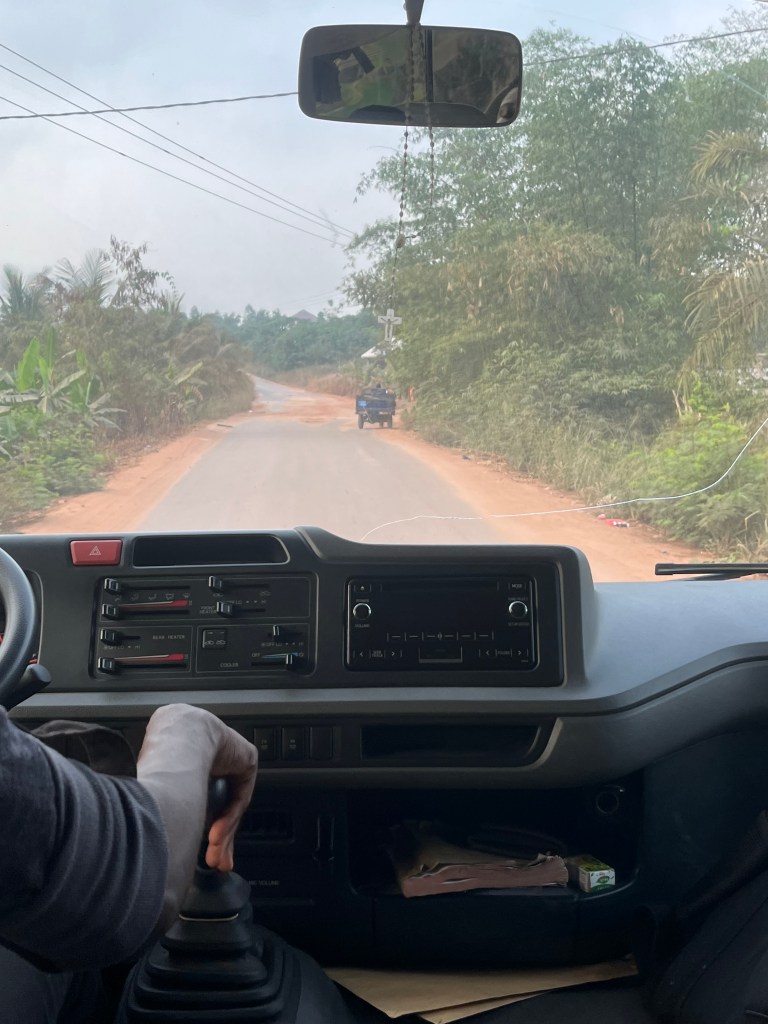
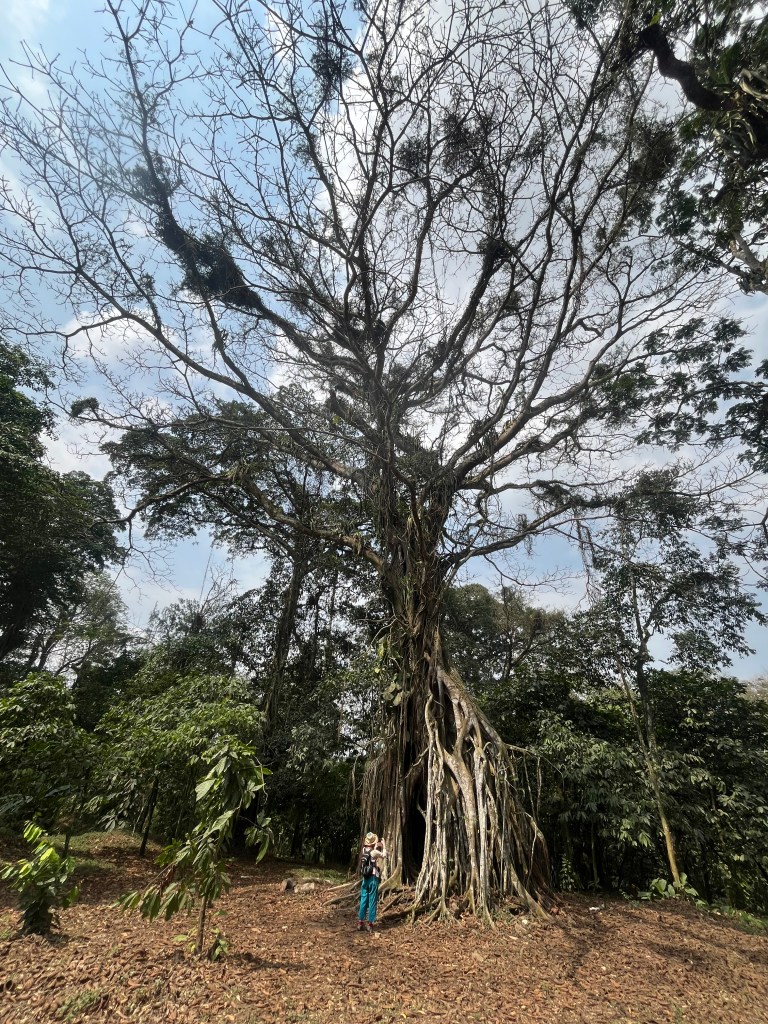
The large new build with the white columns behind the glazing is going to be the new arts and architecture building on campus. It sits at the end of the road axis leading to the library and great hall. It’s not finished yet and we couldn’t visit the interior. From there we went to the Kumasi Cultural Centre to see the Nickson and Borys designed Asanti Regional Library before heading to Adum and central Kumasi. We travelled by bus to from Kumasi to Cape Coast where we visited the Cape Coast castle – with an excellent tour of its disturbing and poignant history. We returned along the coast road back to Accra to continue our buildings visits there and to the Botanical Gardens at Aburi.
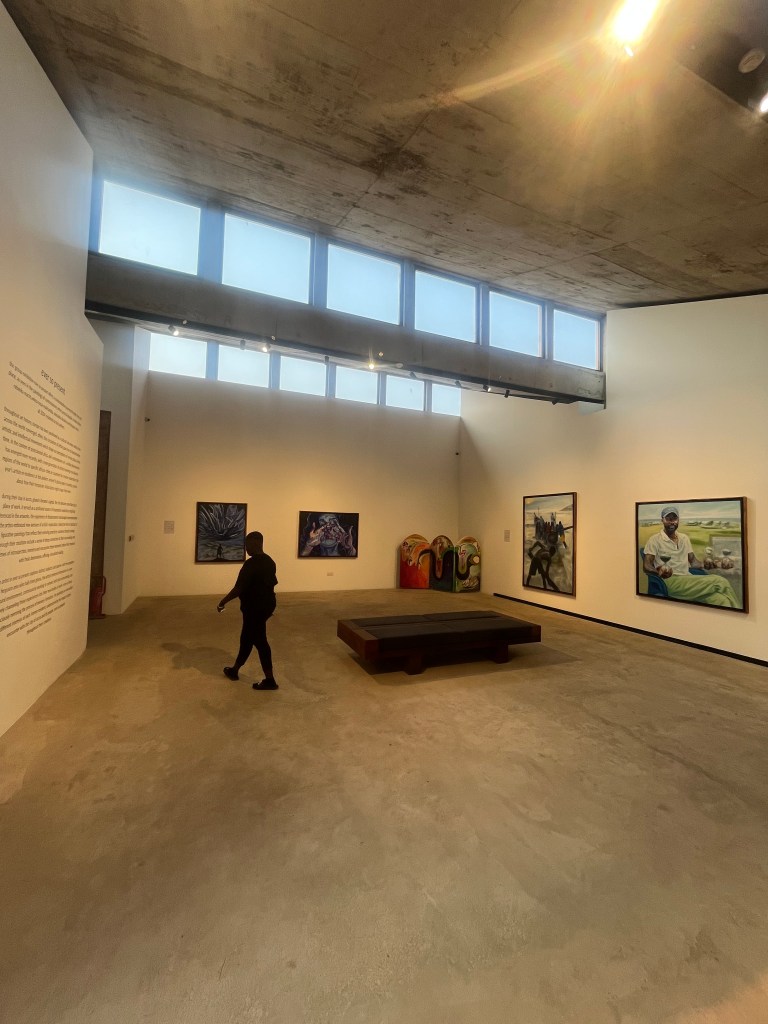
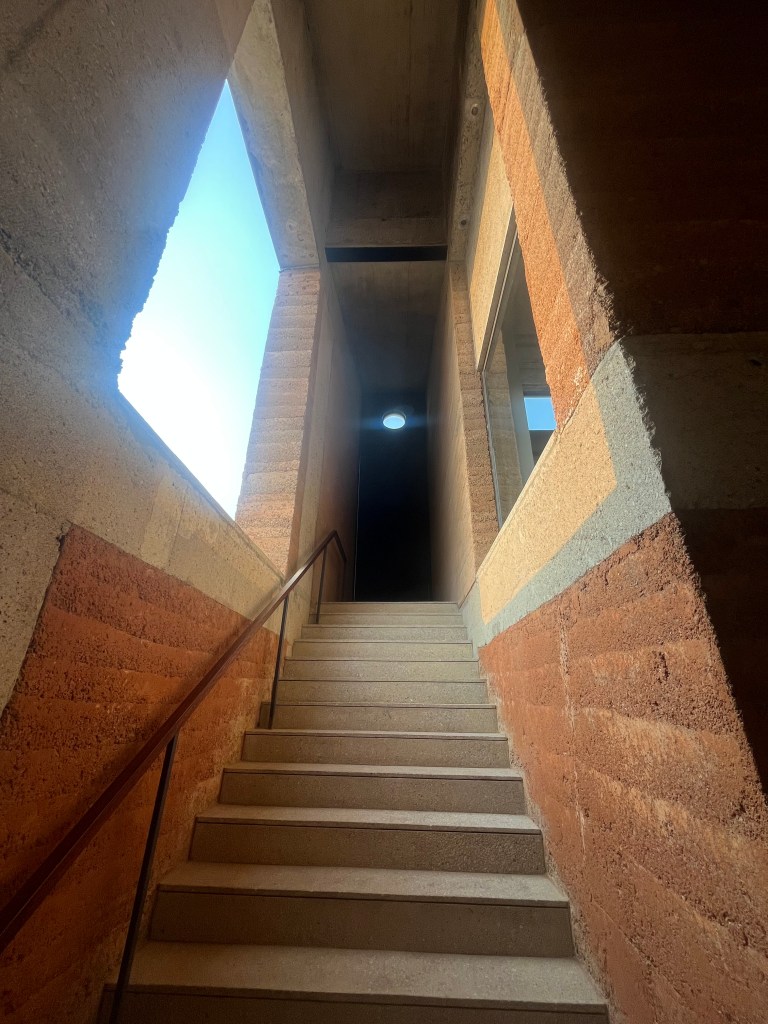
We visited the dot atelier new artist studios and gallery spaces designed by Adjaye Associates too. A 3-storey rammed earth building with concrete frame and distinctive saw-tooth roof above the gallery. The clerestory windows set within the roof are north-facing. The vertical circulation has large openings offering views out over the suburb and allowing the sea-breeze to circulate through the building. A metal flashing detail was being retrofitted below the exposed concrete floor and the pisé – the mud was being eroded at that point and required some additional protection. It’s a fascinating structure and clearly an experimental project that requires fine-tuning and testing.
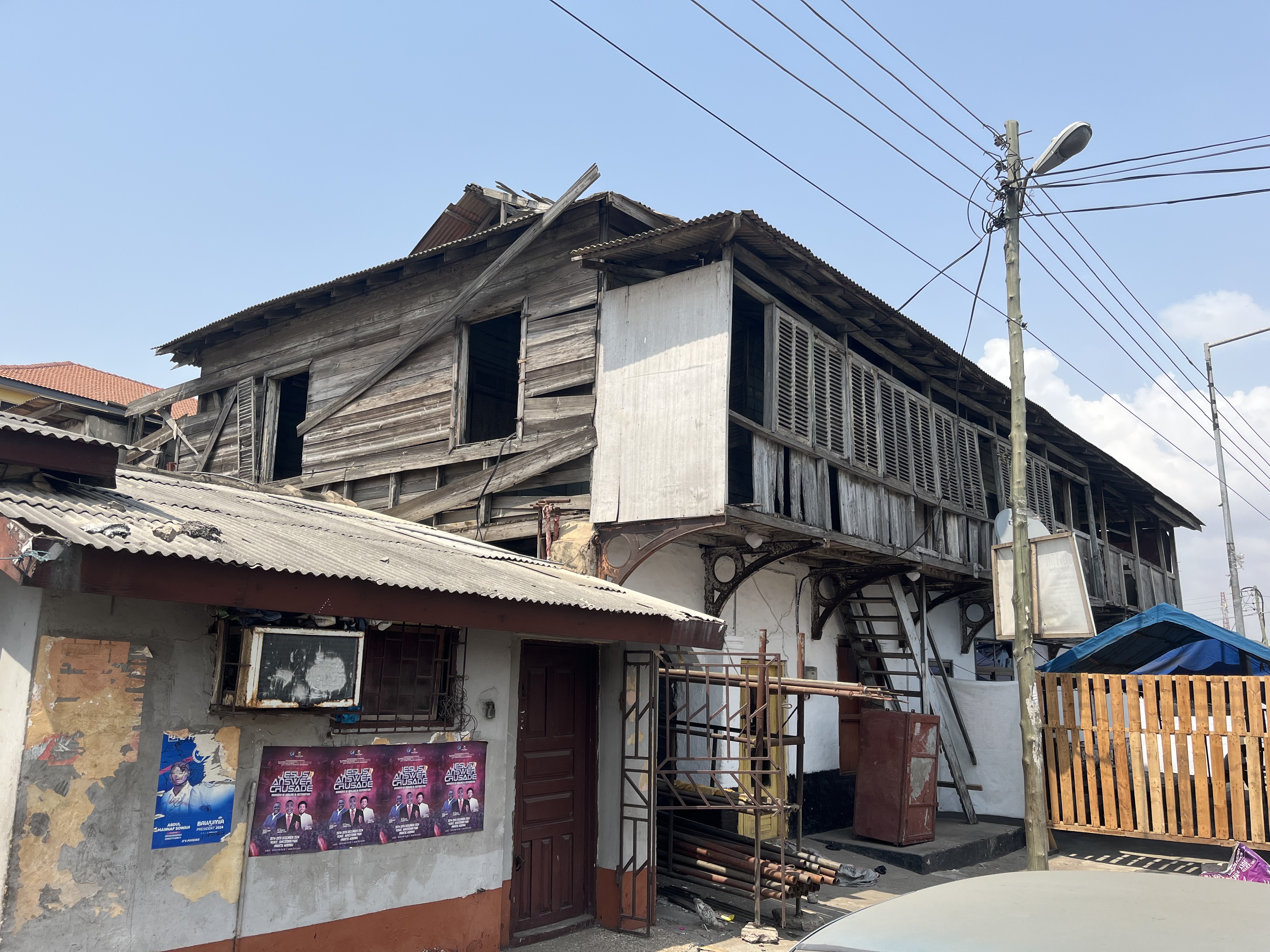
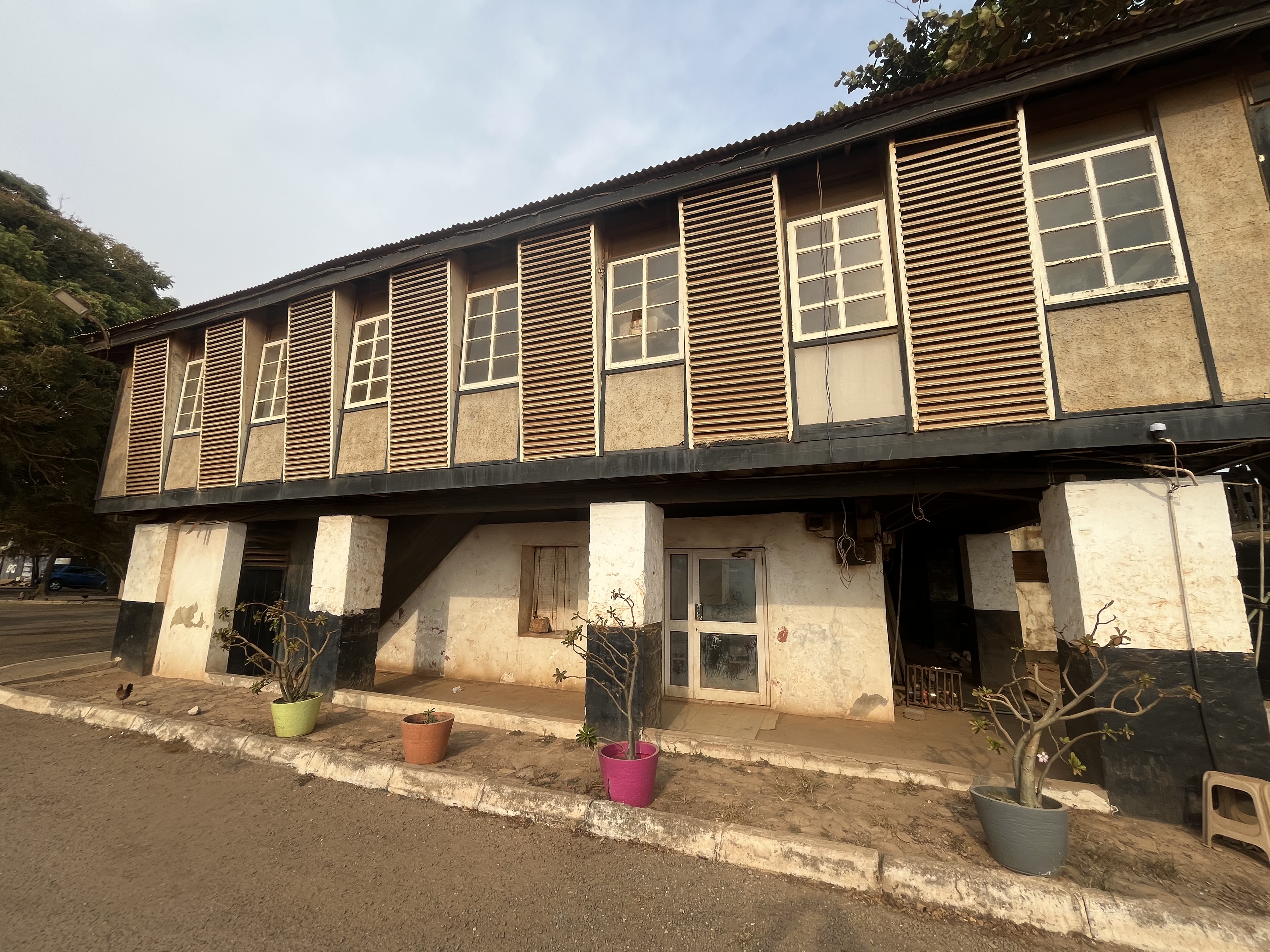
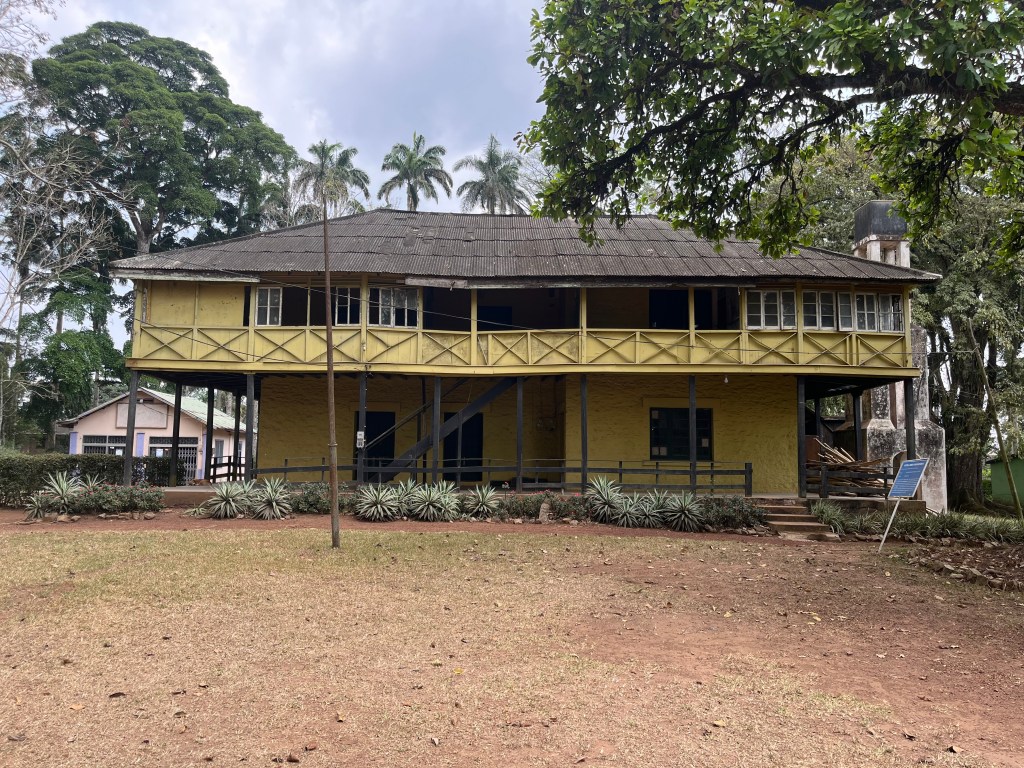
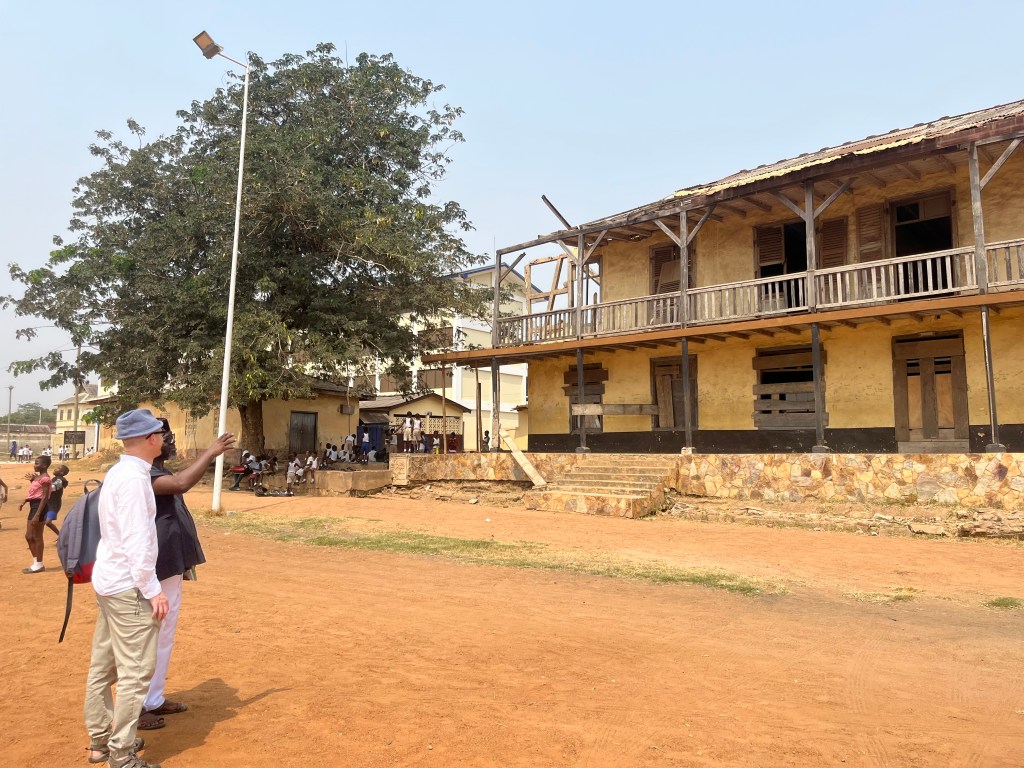
I gave a talk on some of our research and studies of Accra’s heritage structure for the Ghana Institute of Architects and Centre for Architecture and Arts Heritage. Architect David Kojo Derban kindly organised the event – and is pursuing an important mission to preserve, list, and celebrate the heritage structures and spaces within Ghana. David kindly showed us a project he’s been tasked with restoring. It’s the Osu Salem Presbyterian Middle Boys Boarding School – founded by the Basel Mission of Switzerland in 1843. The timber frames, shutters, windows, and verandahs were all pre-fabricated in Germany and then imported. The wattle and daub walls were infilled using local adobe, stones, and plaster. The school is now severely dilapidated and in urgent need of repair. It may not survive the next rain season.
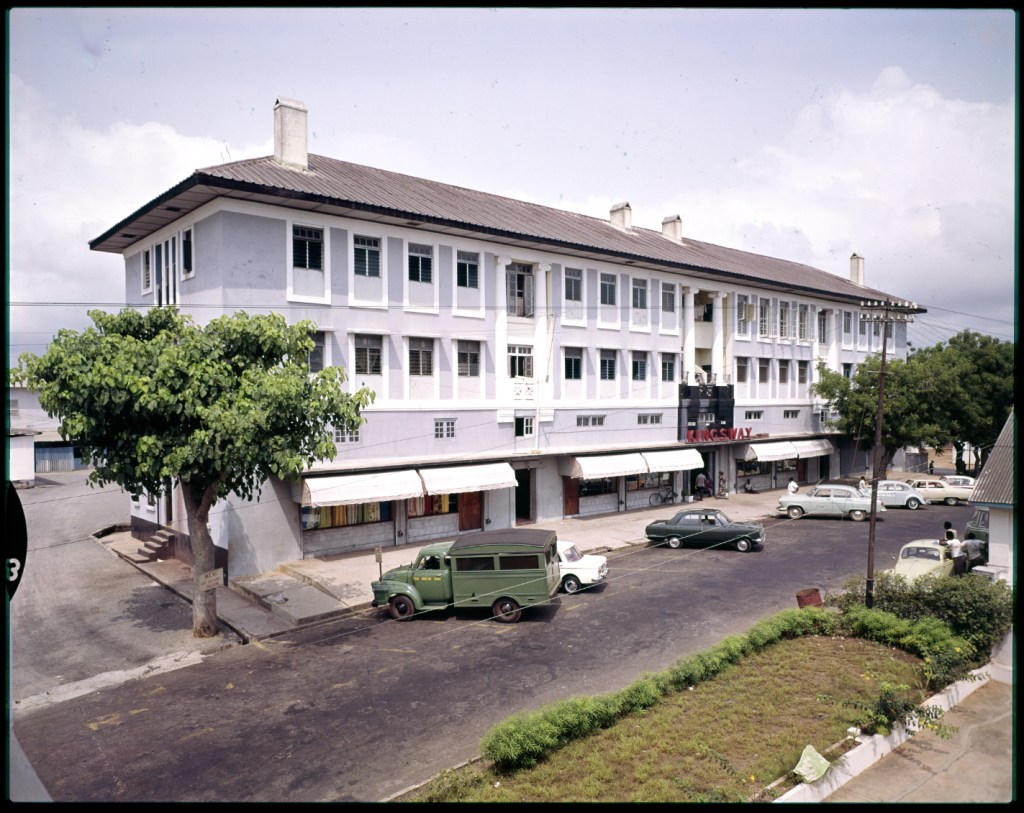
When I was scanning the images for the Kingsway Stores exhibition and recent article, I came across the Takoradi Kingsway in a colour slide. It wasn’t a building I was familiar with and hadn’t seen any other references to it within the wider UAC archive. The design is also different to the other branches – it doesn’t seem to fit with the earlier Millers (old Accra) or F&A Swanzy (Kumasi) stores – nor with the James Lomax-Simpson designs found at neighbouring Sekondi and Cape Coast. The branch at Sekondi complicates things further – why would there be a Kingsway at both Sekondi and Takoradi when they’re so physically close together? The Takoradi branch is also a substantial structure – far larger than might be expected for a town of this scale. Perhaps it was used as a warehouse or depot for the wider enterprise, receiving the imported goods from the neighbouring port that had opened in the 1920s, or was it used as a regional office and retail outlet for the UAC (or one of its predecessors) when the new town and port was set out? The archives include some replanning and refurbishment plans from the 1960s but nothing on the structure’s history and design. The neo-classical facade with ionic columns in antis is also unusual – contrasting with the more moderne 1930s turrets and cantilevered canopies.
Kingsway Takoradi, Ghana: reproduced from an original in the Unilever Archive UAC/1/11/10/1/10, 1958.
I began to look at the maps of Takoradi to try to locate the structure, but couldn’t find anything on this scale – it was only when I reviewed my photos of the town that I found a contemporary image. The building is still standing and largely unaltered. It’s located amongst the other large European trading properties that were built around the customs house, train station and post office. There’s also shipping offices for Palm Line and Elder Dempster, along with a Barclays bank within this commercial cluster.
This article examines the operative uses of modernist design by the Kingsway Stores, an elite department store chain active across West Africa. Kingsway responded to independence by instrumentalizing a particularly modernist domesticity through a series of didactic marketing efforts and the construction of boldly modernist new stores. While it was responding to African demands, this instrumentalization of modernist design was planned and executed as a business survival strategy: modernism is here revealed as complexly imbricated with colonial and neocolonial profit-seeking.
Kingsway Apapa, Lagos, Nigeria, Reproduced from an original image in Unilever Archive, UAC/1/11/10/1/9/1
Harrison, E., Jackson, I., Addo, I. A., & Muraina, O. (2024). “Kingsway leads the way to modern living”: British Profit-seeking and Modernism in Ghana and Nigeria 1920–1970. Journal of Design History, Article epae010. https://doi.org/10.1093/jdh/epae010
Stanek Ł. Hegemony by Adaptation: Decolonizing Ghana’s Construction Industry. Comparative Studies in Society and History. Published online 2024:1-34. Full paper available here: doi:10.1017/S0010417524000185
Soviet Uzbekistan Today (Through the Republican Press Pages). August. (Tashkent: The Uzbek Society of Friendship and Cultural Relations with Foreign Countries, 1963).
This paper discusses competing visions of the decolonization of Ghana’s economy during the first decade of the country’s independence from Britain (1957–1966), and the agency and horizon of choice available to the Ghanaian decision-makers in charge of implementing these visions. It focuses on Ghana’s construction industry, both as an important part of the national economy and as a condition for Ghana’s broader social and economic development in the context of colonial-era path-dependencies and Cold War competition. By taking the vantage point of mid-level administrators and professionals, the paper shows how they negotiated British and Soviet technological offers of construction materials, machinery, and design. In response to Soviet claims about the adaptability of their construction resources to Ghana’s local conditions, the practice of adaptation became for Ghanaian architects and administrators an opportunity to reflect on the needs, means, and objectives of Ghana’s construction industry, and on broader visions of Ghana’s economic and social development. Beyond the specific focus on the construction industry, this paper conceptualizes the centrality of adaptation in enforcing technological hegemony during the period of decolonization, and discusses African agency beyond the registers of extraction and resistance that have dominated scholarship on the global Cold War.
Ewan Harrison, Rixt Woudstra and Iain Jackson, “Accelerating Development: Taylor Woodrow and Arcon’s Prefabricated Steel Structures in Decolonizing West Africa”, ABE Journal [Online], 23 | 2024, Online since 01 October 2024, connection on 01 October 2024. URL: http://journals.openedition.org/abe/16130
Construction of the Sapele Sawmill, Nigeria, 1946. UAC 2/13/b/7/1, reproduced with permission from an original in the Unilever Archives, UAC 2/13/B/7/1.
In 1943, in the middle of World War II, the British architects Edric Neel (1914-1952), Raglan Squire (1912-2004), and Rodney Thomas (1902-1996) created Arcon (short for Architectural Consultants). Focused on applying factory mass production systems to the building industry, Arcon engaged in an unusual, yet close, partnership with the civil engineering contracting company Taylor Woodrow. While their first project became one of Britain’s most popular post-war “prefabs,” it is little known that in the years thereafter a similar structural steel system was widely marketed in Britain’s West African colonies, where it became one of the most frequently used prefabricated building designs. Through the support of Taylor Woodrow, which acted as the agent for Arcon’s worldwide implementation, the prefabrication system was utilized in a range of contexts: to build houses for British companies, to build schools and market halls for colonial governments, and, of most interest here, to build factories and warehouses for the United Africa Company (UAC), as part of the industrialization drive that accompanied decolonization in the 1950s. The UAC was part of Unilever, and one of the largest conglomerates of trading and manufacturing interests active across “British” West Africa. It entered a partnership with Taylor Woodrow to jointly market the Arcon system, thereby profiting from the erection of its own buildings, and the sale of the Arcon system of construction to colonial and subsequently, post-colonial governments across the region. Today, Arcon structures, often sizeable sheds clad with imported metal sheets or locally available timber, can still be found across Ghana, Nigeria, and Sierra Leone.
Exploring Tropical Architecture in the Age of the Climate Crisis by Ben Tosland with a foreward by Ola Uduku
The first comprehensive monograph about the tropical architecture of Godwin and Hopwood in Nigeria.
After studying at the Architectural Association in London, John Godwin and Gillian Hopwood moved to Nigeria, where they significantly shaped the country’s architectural landscape for more than sixty years.
When Nigeria became independent in 1960 following British dominance since the 19th century, the couple worked to create architecture that was site-specific, modern, and adapted to the climate relevant to Nigeria’s aspirational political and economic policies.
In this richly illustrated monograph, organised by typology, Ben Tosland examines Godwin and Hopwood’s form of tropical modernism and illuminates its contemporary meanings and concluding with its relevance in times of the climate crisis.We are delighted to welcome Carey Godwin alongside the author Ben Tosland and contributor Ola Uduku to the AA Bookshop to celebrate the launch of this new publication. The event will be introduced by Head of AA Archives Edward Bottoms.
The book will be sold at the very special price of £50 (RRP £63)
Ghosts, Gifts and The Red Clay Revolution By Iain Jackson and Martin Wallace
Ibrahim Mahama is a man on a mission. An artist whose raison d’etre is both to provoke questions about Ghana’s colonial past and to inspire actions towards a more positive, equitable future. Hot on the heels of his Purple Hibiscus work at the Barbican, ‘Songs about Roses’ opened in Edinburgh’s Fruitmarket on 13th July 2024.
But in some ways, these and his other international shows are just the tip of the iceberg because the main event is on the outskirts of Tamale, northern Ghana, where Mahama was born. In July he showed us around and shared the thinking behind the immense project.
Red Clay: Studio, Archive, Gallery, School: Tamale, Ghana
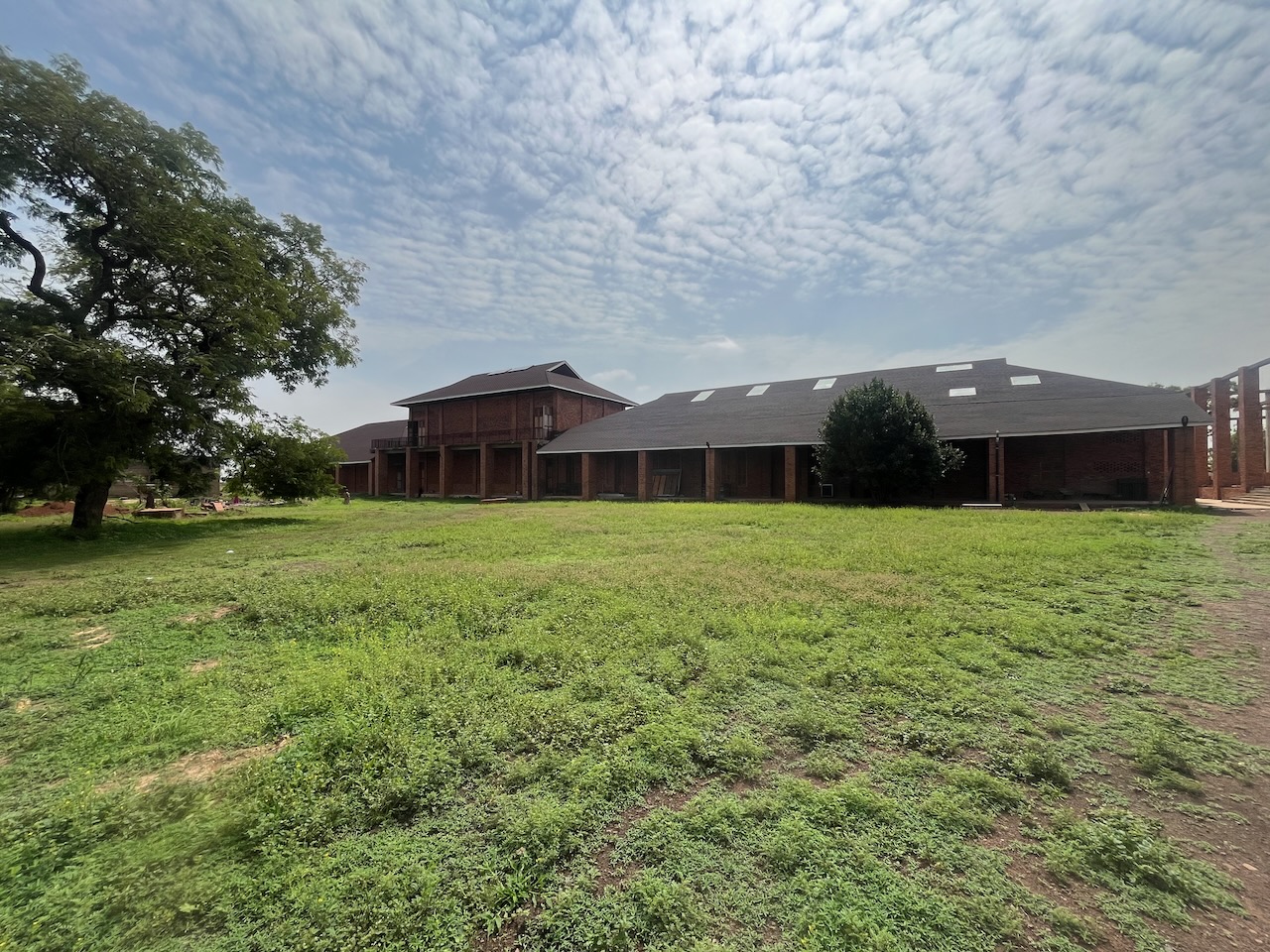
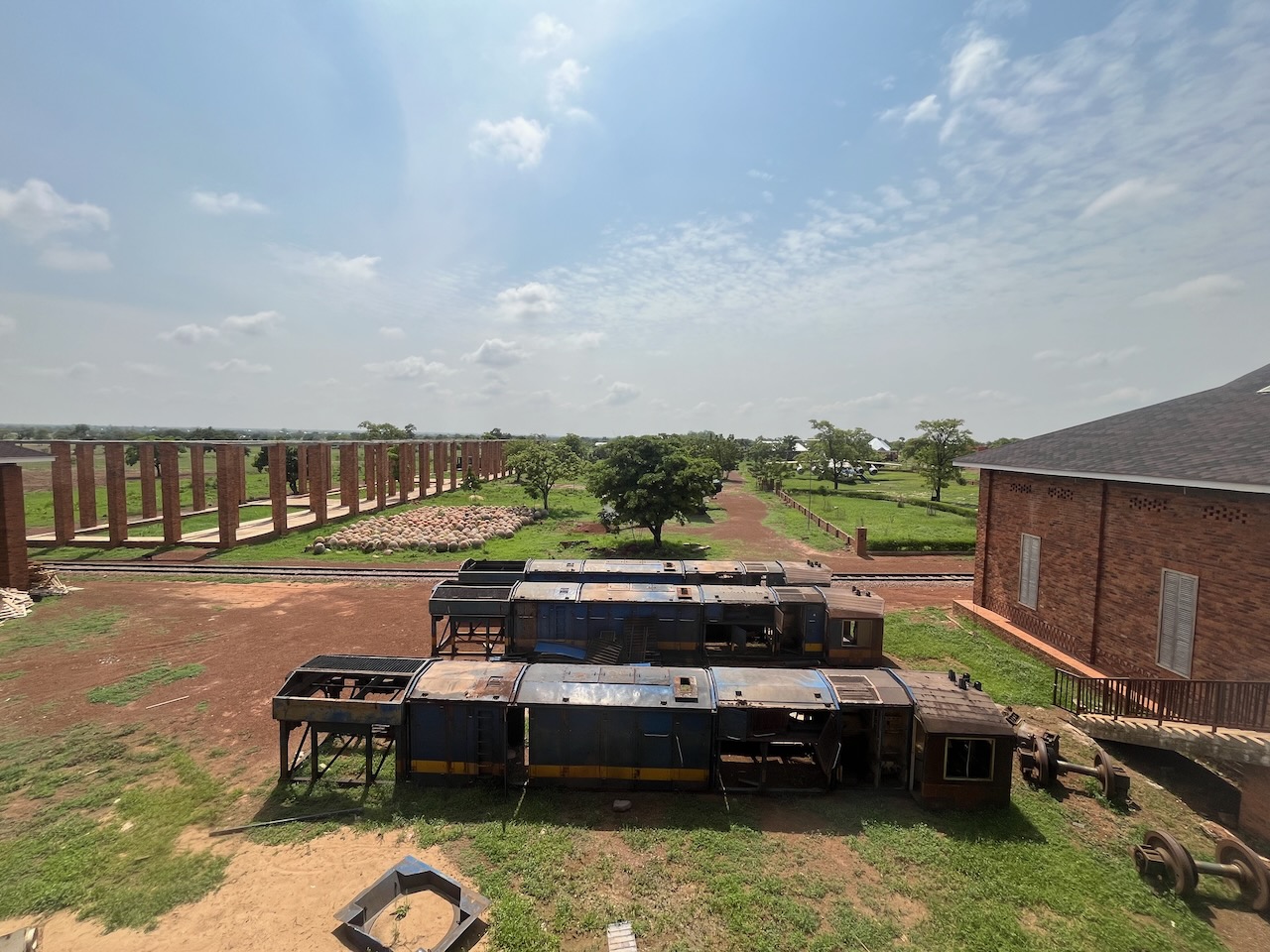
For the past 9 years, Mahama has used the proceeds of his international career to build art ‘infrastructure’ in Tamale from the ground up. He has created a huge studio-gallery-archive complex called Red Clay. It’s here that much of his work returns after it’s been exhibited around the world, put on display in vast colonnaded hand-made brick structures with polished terrazzo floors. When he’s not working elsewhere, he lives on site. This is an artist’s studio with a difference. Open to the public; there is no entrance fee. It is a gift.
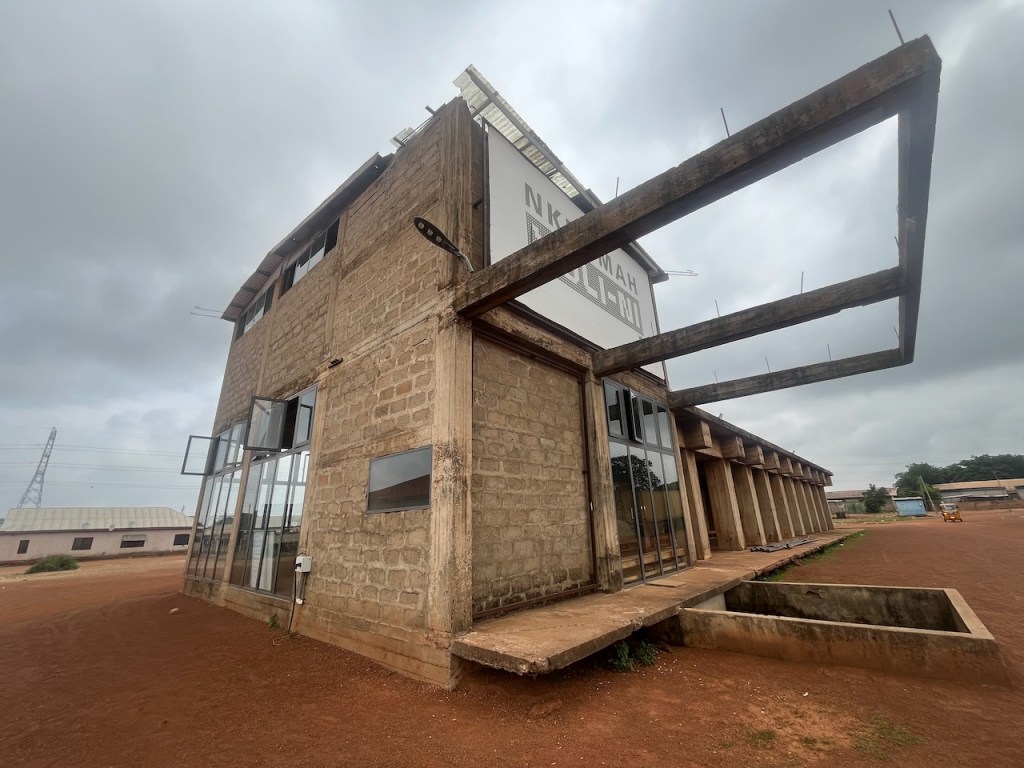
Recognising the economic precarity of the vast majority of Ghanaians, Mahama ‘wants the people of Tamale to be able to experience this art, and the best art made by others too.’ An exhibition on James Barnor’s photography is currently on show. ‘Even if they could’, Mahama asks, ‘why should they have to travel to the Serpentine to experience this art?’ A full retrospective of Barnor’s work is on show in SCCA, a sister institution built by Mahama on the other side of Tamale. It is another, large-scale, free-access space dedicated to platforming under-appreciated Ghanaian artists of the past. A disused concrete silo structure has also been acquired by Mahama in Tamale. Left abandoned and unfinished following the 1966 coup it became a ruin before it was even finished. Mahama has renamed it Nkrumah Volini and uses it to discuss the political shifts in Ghana’s history as well as showing films and installations.
Nkrumah Volini
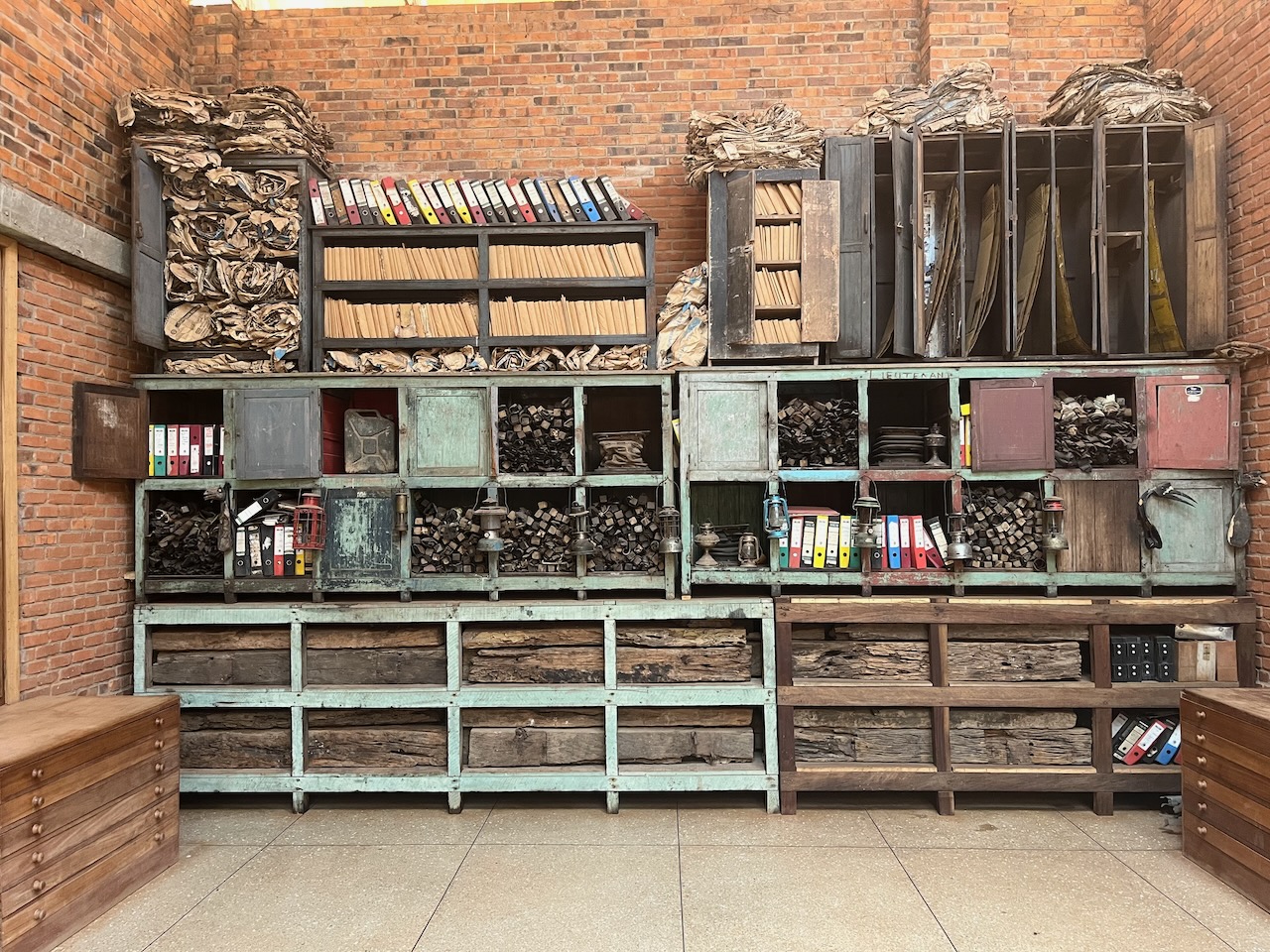
While Red Clay draws international visitors each week, the vast majority of its patrons are local people, some bringing picnics to the only free public space in Tamale. Busloads of children from schools in neighbouring villages are allowed to touch and explore these vast installations. The big idea here isn’t about art per se but to use objects and their material histories (their ‘ghosts’) as an invitation to ask questions and begin to imagine future possibilities. It’s about demystifying technology, sparking curiosity, and encouraging a desire to pursue visions through creative problem solving.
Selom Kudjie giving a tour at Nkrumah Volini
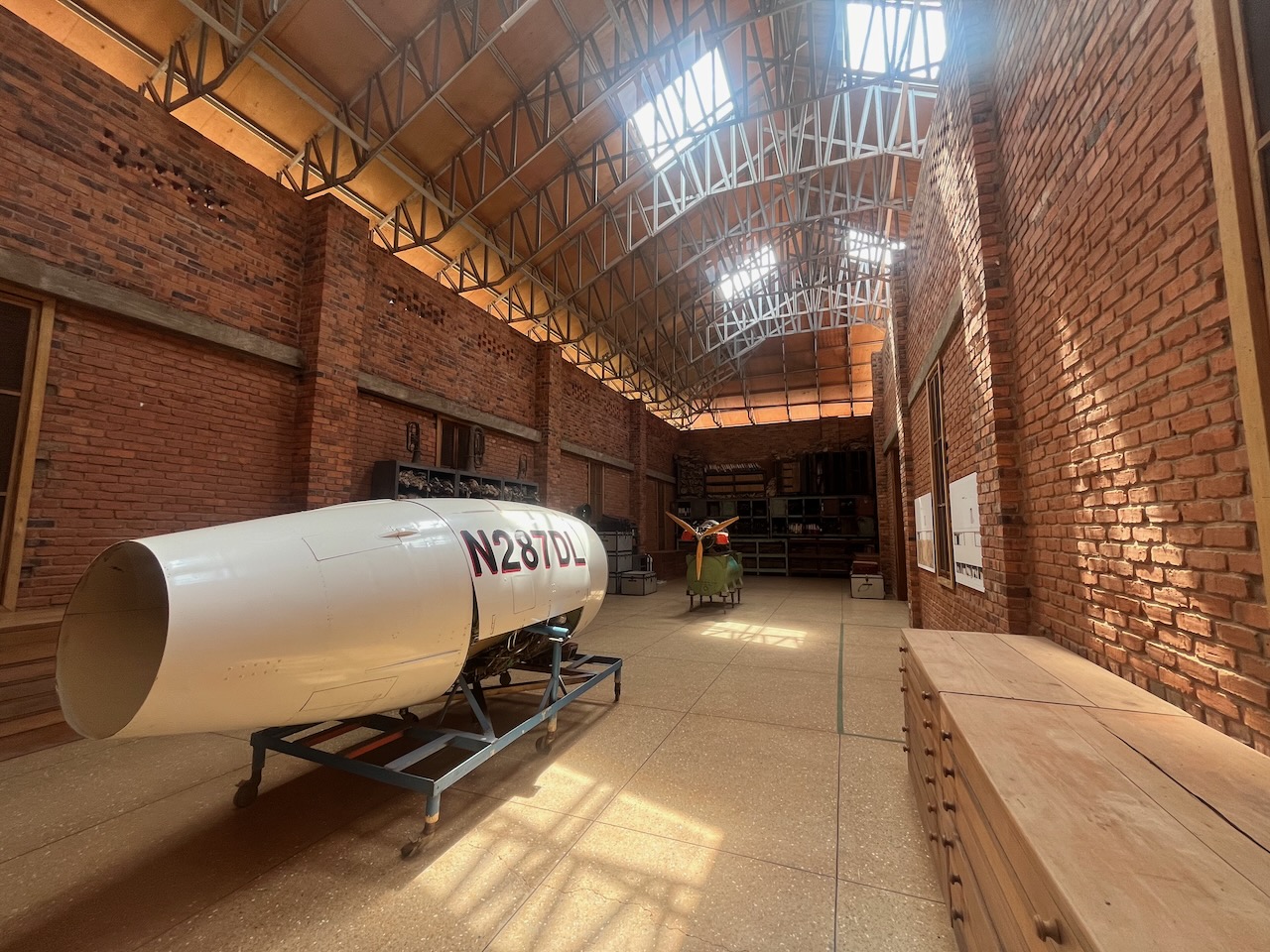
This invitation is backed up by educational opportunities. Classes for building PCs and coding are delivered in one of the seven aeroplanes Mahama has brought to this rural savannah, creating something of a surreal transport hub where the journeys are cerebral rather than physical. He also imported old trains from Germany that are in the process of being converted into accommodation for visiting artists (including the one used by Queen Elizabeth II when she visited Ghana in 1961).
When the railways were built in Ghana they did not extend into the northern territories, and many local visitors have never encountered a train before. Leading us through the now gutted carriages, Mahama reminds us about the immense amount of labour involved in making the colonial railways. He speculates on how many tonnes of resources and produce machines like these helped to extract during the colonial period. His work operates on these differing layers – at once an engaging and accessible spectacle that evokes traces of the histories of industry and technological innovation, whilst also critically examining the deployment and impact of these machines.
Ibrahim Mahama looking at his sketchbook archive
Informal tours of Red Clay are delivered by a series of local ambassadors employed by Mahama. They make the ideas at play accessible to local visitors in their own language, Dagbani. It’s a place where children and families are welcome. Letting people see processes rather than only the finished art pieces is also part of the offer. When the trains and planes were transported across country on flatbed lorries, Mahama documented their conspicuous journeys and the quizzical, joyous public response; bold, large-scale action that provokes excitement and a sense of ambition.
In one of the giant red-brick rooms, preparations for a New York show at White Cube in September are underway. A team of local women dip their brushes into the same black ink sometimes used to create semi-permanent eyeliner. But here they graffiti names and words agreed with Mahama across rough reclaimed leather panels that have been ripped from the floors of the train carriages as part of the refurb. Nothing is wasted. The humdrum is defamiliarized and ghosts within materials are encouraged to tell their tales.
Studio work in progress
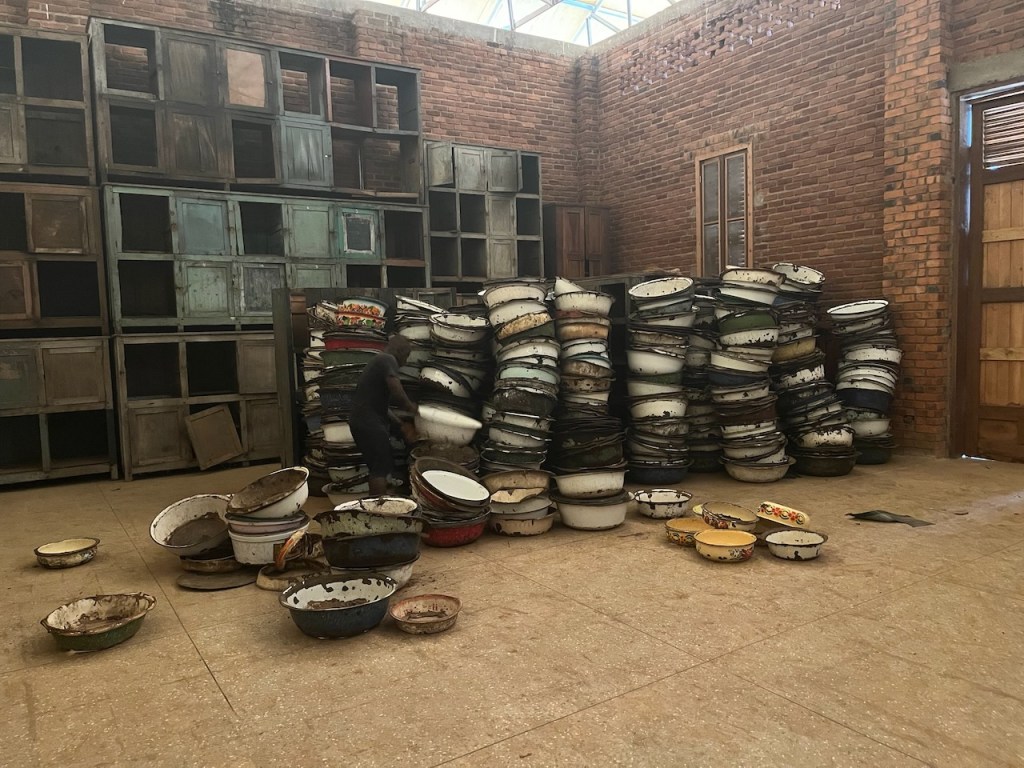
In another brick-built hanger, women have walked from miles around to swap their tired, old enamelled bowls for shiny, new aluminium ones. Mahama wants the old ones as an index of the thousands of hours labour their battered frames represent. He has exchanged about 1500 and plans to balance a diesel locomotive on the old bowls, echoing the usual way in which the bowls are carried on the head to transport all manner of produce around every village and town.
Enamel bowls collected for a new exhibition and exchanged for new aluminium bowlsNew bowls for Old
In one of the huge gallery spaces lit by towering windows is a piece first shown at White Cube Bermondsey 2019-21 entitled, ‘Capital Corpses’. Rows of gnarled desks salvaged from schools are mounted with old sewing machines facing a wall of blackboards replete with chalk lessons. When the machines are started by remote control, the clatter is at first startling and then uncanny; a room full of invisible operators burst into life, summoned to an unknown task. The school desks conjure an idea of children as future factory fodder. Like so much of Mahama’s work, he counterpoints a certain nostalgia and appreciation of familiar historic objects with an acknowledgement of the stark horror that these things, machines and regimes inflicted.
Ibrahim Mahama and ‘Capital Corpses’, Red Clay, Tamale, Ghana
Mahama and his team have achieved a lot in Tamale over the last 9 years but much remains to be done to complete his revolutionary vision and unlock the full emancipatory potential of art. But he’s clearly in this for the long haul, determined to explore Ghana’s complex colonial history and to speculate about its possible futures. Red Clay is a place where these ghosts of past and future mingle in powerful ways and invite us to play.
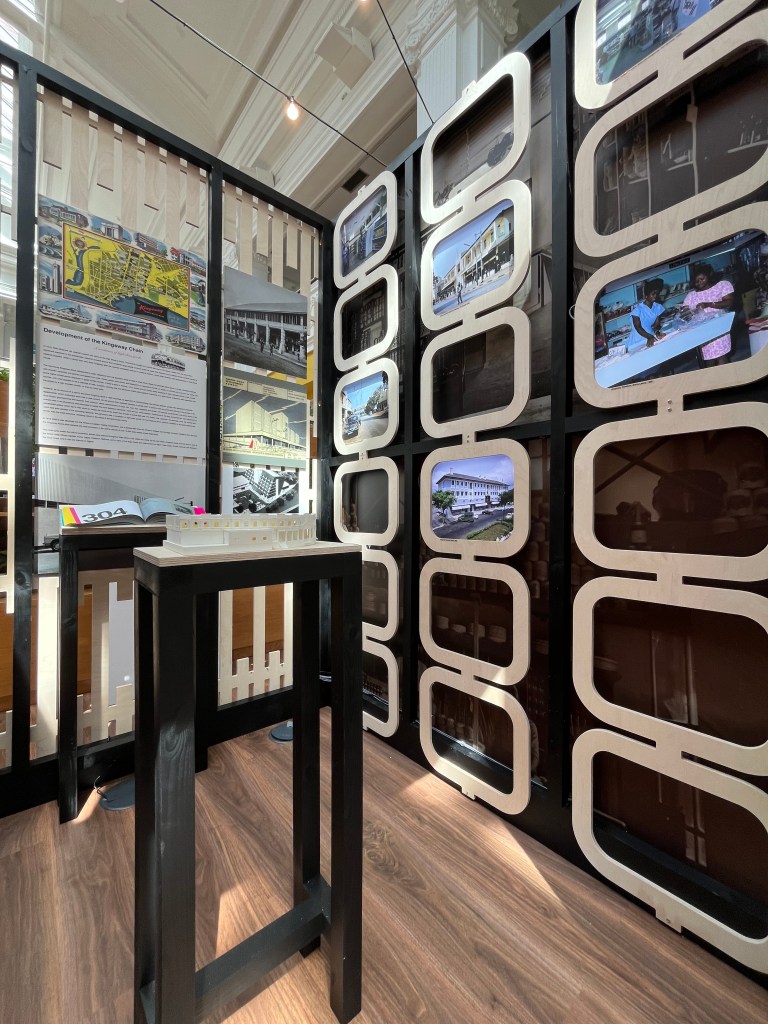
This week we installed our new exhibition: Shopping Emporiums of West Africa: The Kingsway Stores, at Lever House, Port Sunlight.
Following on from our research project into the architecture of the United Africa Company we’ve curated an exhibition that focuses on the department stores and their contribution to design, urban development and retail throughout the 20thC.
The exhibition has been co-curated with archivist Claire Tunstall, and developed from the research undertaken during the last 4 years with Ewan Harrison, Rixt Woudstra, Paul Robinson, and Michele Tenzon.
The exhibition includes images from the Unilever Archive arranged across two freestanding pavilions along with archival films, and a set of newly commissioned 3D printed models beautifully crafted by Liverpool School of Architecture students. The pavilions were fabricated using CNC routers with the expert help of LSA’s technicians.
The catalogue is available here. This is just the start – the next step is to tour the exhibition from their current home in Port Sunlight to Birkenhead, Liverpool, Accra, and Lagos.
There is something intriguing about the term “tropical modernism.” It invokes paradisical lushness, remote islands, and foamy surf, a friendly wilderness with suave luxury and precision detailing. But the “tropical” isn’t a place as such – it’s an imagined geography, an artificial threshold, and constructed territory defined by the tropics of Cancer and Capricorn. Those celestial belts that wrap around the world stretching out from the equatorial waistline about 23.5 degrees north and south. It covers a vast territory, incorporating the Caribbean, Central America, and a large segment of South America, the majority of Africa, parts of the Middle East, three-quarters of India, most of Southeast Asia and the northern segment of Australia.
It’s a problematic term, if not lazy and arbitrary. It effortlessly homogenises people, culture, climates, altitudes, countries, and identities into a convenient catch-all term. The differences between these places far outnumber their commonalities, and yet we seem quite satisfied to lump them together as one – united by a shared humidity and common wet-bulb temperature reading. The tropics is hot and sometimes humid – relative to the temperate zones. It was a means for Europeans to describe those parts of the world that were somehow other, often colonised, different, and exotic. It aligned with late Victorian views of the world – the tropics was there to be tamed, turned into a vast imperial estate ripe for extraction and supplying the raw materials necessary for industrial advances. As Edward Said set out the opposing Orient and Occident, so too can we observe something similar with the Temperate and Tropical and special scientific enquiries were devoted to the tropics. For example, a specialised branch of medicine sought to cure “tropical diseases” and improve health conditions that decimated the colonial population and gave rise to the “white man’s grave” nomenclature of West Africa. Two schools of Tropical Medicine were established in England by 1899 endowed with funds and prizes from West African merchants. Tropical agriculture followed, tasked with creating botanical gardens such as Aburi, in Ghana, manned by a curator from Kew Gardens. There was a vested interest in these “tropical” institutions and their enquiries that would benefit trade, seek out new materials and products, and bolster the imperial vision.
Architecture, too, was part of the medical arsenal that could help fight disease and increase the comfort Europeans faced with these debilitating environs. A solution to the problem of “malarial miasmic gases” was to raise the ground floor of dwellings on stilts. The heat of the sun was mitigated through other design features such as the verandah whilst the jalousie screen increased cross ventilation. A design vocabulary, or as Jiat-Hwee Chang terms it, a “genealogy of tropical architecture” emerged that responded to the climate and saw much greater attention devoted to orientation, wind direction, and “healthy” sites.Footnote1 These designs developed in the Caribbean plantations, West African river stations, and the East Indian bungalows by traders, Royal Engineers, and missionaries. These structures were part of the colonial mission, and as ideas were exchanged and shared, a tropical lexicon emerged that was deemed applicable across all these territories. Just as a priest might be posted to a new mission station or an engineer sent from Georgetown to Jamestown, so too did this design technology and architectural language migrate and become ubiquitous as Anthony King demonstrated in his seminal Bungalow.Footnote2
Tropical architecture existed before the arrival of the “modern,” if anything it offered a syntax that was adopted by Modernist architects and the so-called “five points towards a new architecture” are a derivation of the tropical bungalow. Modernism claimed to reject historical precedent and to be universally applicable – it had a globalist ambition with little regard to context. But if Modernism was international, why did it need to be tempered for the tropical, and in what way? Climate was presented as the chief design generator, as if it was the only functionalist criteria to be addressed, ignoring sociological concerns, imperialism, land ownership, and labour – it was more straightforward to talk about the weather. The result was an architecture that attempted to create an inner sanctum of coolth and cross-ventilation, with the building acting as a veil between interior safety and comfort, and the diseased and overly heated discomfortable exterior – whilst “tropical architecture” replaced the less palatable term “colonial architecture.”
Michael Hirst and images of 1950s TemaSite plan of KNUST campus by James CubittUnity Hall, Kumasi, by John Owusu Addo
It’s at this point that the V&A picks up the story. It’s been an eagerly anticipated exhibition and the opening had a large queue gathered outside, in the rain, 30 minutes before the reveal. Glimpses of what to expect had been shown at the Venice Biennale, which premiered a specially produced film shown on a 12 m long curved screen. Two British architects, E. Maxwell Fry (1899–1987) and Jane B. Drew (1911–1996) are used as a thread or reinforcement bar, to connect the disparate and eclectic set of exhibits, and their projects in Ghana and India act as two poles about which other architects, authors, and artists are introduced. Fry developed some tropical experience following wartime service in “British West Africa,” soon joined by Drew, his wife, businesses partner, and flamboyant force behind the practice. Pre Fry, Drew ran a female-only practice, was a single mother, and possibly worked as an MI6 agent. Fry, more at home at the drawing board, was something of a UK Modernist pioneer and collaborated with Walter Gropius at Impington Village College, which served as a model for the 20 schools he and Drew went on to design in Ghana.
The exhibition includes photographs and drawings of these early projects that utilised local stone and timber, creating a rustic modernism in the remote Amedzofe hills, through to the more urbane Opoku Ware school in Kumasi, with its cast-concrete Asante stool-motif decoration. These schools were part of a post-war United Kingdom funded development drive, aimed to prepare the colony for political independence, but as Mark Crinson reminds us – this wasn’t a “neutral” architecture.Footnote3 Modernism may have imagined itself as a tabula rasa – but it was merely continuing a system that sustained existing material supply chains, contractors, and consultants. Kwame Nkrumah was quick to label this “Neo-Colonialism” as the large multinationals accelerated their grip on market share, continued their cartels, and benefited from development aid in this “Independence Boom.” Footnote4
The politics of architecture, aid, development, and how a former-colonial state is reimagined is a complex exhibition theme – it’s also clouded by the artistic expression and seductive qualities of this architecture. It’s quite possible for these buildings to say one thing through their concrete lace and sweeping cantilevered staircases, and yet to be undermining this vision through its finance, construction, and material supply infrastructure. It was something of a bind for Nkrumah as he sought to demonstrate change through the built environment. For example, he commissioned Tema, a new harbour town, to transition Ghana to a manufacturing and industrial base, but to do so relied almost entirely on former-colonial enterprise, loans, and to an extent control. British planner Alfred Alcock designed the plan, which was executed through the Tema Development Corporation by chief architect, Theodore Shealtiel Clerk (1909–1965) – Ghana’s only qualified African architect at the time. He was joined by a team from London’s Architectural Association’s newly established “Department of Tropical Architecture.”
The exhibition includes photographs taken of Tema by Michael Hirst, who documented the entire process as a 24-year-old, newly qualified architect charged with designing hundreds of new houses there. The inclusion of these private images in the exhibition reveals how little has been documented and preserved in more official collections. It was a difficult task for the curators to source original material – as not much survives if it was ever collated at all. The fragments that have endured, such as the beautiful drawings of Unity Hall, Kumasi, by John Owusu Addo (another graduate from the AA Tropical Department) are particularly fragile, and it’s remarkable that such important documents have not been preserved and exhibited before. Other artefacts were exhumed and restored for the exhibition, such as the Buckminster Fuller geodesic dome, salvaged from a university workshop in Kumasi and now suspended from the ceiling alongside a model of the campus, designed by Australian James Cubitt in 1951. Other than this model, it’s curious that Cubitt is absent – his one-time collaborator Kenneth “Winky” Scott (also from Australia) and designer of perhaps the most “tropical” of all tropical houses in Accra only receives a passing mention. It’s always difficult to decide what and who to include – and if major players in West Africa like Cubitt and Scott are on the margins, how much more the burgeoning West African architects?
John Owusu Addo features as mentioned, but the rest of the early 1950s cohorts struggle to be heard. There are some wonderful photographs of Victor Adegbite, brought back from the US by Nkrumah to design the Black Star Square homage to himself, and Max Bond’s seductive library at Bolgatanga. Others are included – but you’ve got to search for them – there’s an intriguing shot of an architect called John Noah (“an architect from Sierra Leone”) photographed with Fry – but who was he, and what else did he build? There are other questions more important than the biographical focus on individual architects, such as why the narrow focus on Ghana? Neighbouring giant Nigeria is largely absent despite its cache of tropical modernist architecture, not least the idiosyncratic Ibadan Dominican Chapel by 2023 Golden Lion award winner Demas Nwoko. There was scope here for more conversations between the likes of Hirst, Nwoko, and Addo – what we lack in ephemera could have come through lived testimony – and the film does address this, in part, with footage from Henry Wellington, Owusu Addo, and Ola Uduku amongst others.
The other focus of the exhibition is the Indian city of Chandigarh. Commissioned in the wake of India’s partition in 1948, the object was to create a Punjabi capital, but more than this, it was a symbolic vision for Jawaharlal Nehru’s new India. Like Nkrumah, Nehru was attempting to use architecture to forge a tangible manifestation of his political vision. These top-down projects gave the opportunity to produce grand statements as well as provide amenities such as housing, hospitals, schools – “unfettered by the past” as Nehru put it. Le Corbusier was, on Drew’s suggestion, appointed as master planner and architect of the “Capital Complex” a vast esplanade dotted with Corbusian objects, including “the Tower of Shadows” (a model of this delightful folly from the MoMa collection is included in the exhibition) devoted to casting shadows with the movement of the sun.Footnote5 It’s whimsical solar-fetishism. Corbusier’s cousin Pierre Jeanneret, Fry, and Drew were responsible for the rest of the city arranged as a grid of Sectors, with housing allocated to the new residents according to salary and civil service rank. Critics of the town are many, but it’s a place that warrants closer inspection and there is much to commend the Sector interior layouts with their generous parks, schools, local shops, and carefully designed housing. The grid layout is unforgiving, but on a scale that allows, even encourages, deviation and transgression. What the Modernist Masters overlooked (chaiwallahs, bike repairs, laundries, and so on) can now find a comfortable spot. Jeanneret even made the town his home, and set about creating a suite of affordable furniture with local carpenters and weavers – now controversially auctioned off at six-figure sums – there’s a few examples positioned on a podium so no one accidently sits on them.
Alongside photos of Le Corbusier posing with his Modulor Man (a Fibonacci-inspired proportioning device), are ceramic-clad statues by self-taught artist Nek Chand. Chand was employed to help build Chandigarh, but during the nights over the course of 50 years, he created his own illegal version of the city at the edge of Sector-1 using the remnants of villages destroyed to make way for the city. He was eventually discovered by the then Chief Architect Manmohan Nath Sharma, who was part of the original design team and worked with Fry and Drew on Sector-22. Rather than following the city Corbusian edicts, Sharma wisely told Chand to continue his art and his creation is now India’s second largest tourist attraction. Nek Chand’s “visionary environment” filled with waterfalls, palaces, and thousands of sculptures presents an alternative Chandigarh, before Corbusier, with fragments of a pre-modernist era proudly on display and revealing the heavy price that many paid for this vision of the future. Yet despite Nehru’s claims of being unfettered by history, Corbusier’s cosmic-brutalist-palaces invoke a ruined temple complex. They’re curious structures containing Corbusier’s hieroglyphics and a sense of a European overly enamoured by imagined Eastern mysticism. These works are included in the exhibition expressed through the refined timber models of Giani Rattan Singh.
Surprisingly, one of Corbusier’s disciples, Balkrishna Doshi, doesn’t feature in the exhibition – his work at Ahmedabad could have provided a foil to Corbusier’s heft (and opened up further dialogues with Louis Kahn in Ahmedabad and Dhaka; and Albert Mayer, who worked in India and Ghana). A welcome inclusion is a large model of the Pragati Maidan in Delhi, by architect Raj Rewal (sadly demolished in 2017).Footnote6 An example of post-Chandigarh Modernism produced 25 years after independence, the tessellating triangular pyramids show a new expressive (post?) Modernist vocabulary being pursued by the likes of Doshi, Charles Correa, and Rewal. But this is something different, and much later to the exhibition’s core and scope – there’s no real connection between Rewal and the Chandigarh project or design team. Rewal worked for Michel Écochard in the early 1960s and that could have prompted another strand on the Modernism of North and Francophone Africa (as researched by Tom Avermaete in the Casablanca Chandigarh project).Footnote7 It would have been more coherent to have Sri Lankans Geoffrey Bawa and Minnette de Silva in the exhibition – both of whom worked with Drew and like her studied at the AA. Other strands such as Manmohan Nath Sharma planning Nigeria’s new capital, Abuja, could also have helped connect both aspects of the exhibition and discussed the ongoing transnational networks that occurred post Fry and Drew.
Each section of the exhibition opens up these lines of enquires – it’s very much an exhibition that is setting out the premise and introducing the topic. It’s a primer and with such latitude that there’s bound to be an aspect that intrigues or provokes further reading and research by the visitor. It could have been more focused, but like Chandigarh it’s within these spaces and gaps that interesting and unexpected events and possibilities occur.
Notes
1. Jiat-Hwee Chang, A Genealogy of Tropical Architecture: Colonial Networks, Nature and Technoscience (London, New York: Routledge, 2016), https://doi.org/10.4324/9781315712680
2. Anthony D. King, The Bungalow: The Production of a Global Culture (London: Routledge & Kegan Paul, 1984).
3. Mark Crinson, Modern Architecture and the End of Empire (Burlington, VT: Ashgate, 2002).
4. Kwame Nkrumah, Neo-Colonialism: The Last Stage of Imperialism (New York: International Publishers, 1966).
7. Tom Avermaete and Maristella Casciato, Casablanca Chandigarh: A Report on Modernization (Montréal, Québec, Canada: CCA, Canadian Centre for Architecture; Zūrich: Park Books, 2014).
This article was originally published here: Jackson, I. (2024). Tropical Modernism: Architecture and Independence, V&A Museum, South Kensington, London, 2 March – 22 September 2024. Fabrications, 1–6. https://doi.org/10.1080/10331867.2024.2348850


































 Transnational Architecture Group