SAH Conference, Chicago, 2027: The call for papers has been announced – and there are some fascinating and timely panels planned. This one caught our eye….
Session Chairs: Zhijian Sun and Qingyun Lin
Session Title: Cooling the Tropical Built Environment: Discomfort, Decolonization, and
Decarbonization
Session Description:
Tropical climate and building problems related to heat and humidity have long troubled
professionals both within and beyond the tropics, who resorted to various climatic
techniques around (late-)colonial networks to tame the tropics. During the Cold War, the
tropical world became a contested arena in the name of development aid. Despite relying
on a globally circulated climatic knowledge, thermal comfort norms and cooling
technologies, these state and non-state actors from socialist, capitalist and non-aligned
countries who engaged in postcolonial development, often produced discourses of
“tropicality” that deviated from Euro-American templates.
The stakeholders in the Global South were never merely passive recipients of
technological expertise, however. Rather they were often active mediators of multi-
directional global exchanges of “architectural resources”, in Łukasz Stanek’s (2020) term.
We invite papers interrogating global, transnational and local dynamics through
marginalized cases in the long-twentieth centuries across any (sub-)tropical areas,
including Asia-Pacific region, Latin America and the Caribbean, Africa, the Middle East
and elsewhere. We particularly welcome the nuanced perspective of “seeing from the
South,” especially how Southern institutions and individuals negotiated external
interventions around “collaborative” frameworks filled with heterogeneity, competition and
contingency. By examining processes, consequences and legacy of local reimagination
and reinterpretation of climate, built spaces, thermal (dis)comfort, labor and body, this
panel speaks to what Daniel Barber (2019) calls “decarbonization as decolonization.”
Drawing on Nicole Starosielski’s (2021) critical temperature studies, we view tropical built
environment’s (uneven) management of heat and cold as means of “enacting racialized,
classed and gendered forms of power.” We encourage proposals that engage the
interdependence between architecture’s climatic techniques, human body, non-human
actors, and exercise of socio-political power, focusing on the underappreciated roles of
marginalized people, suppressed knowledge, neglected practices, or ignored things.
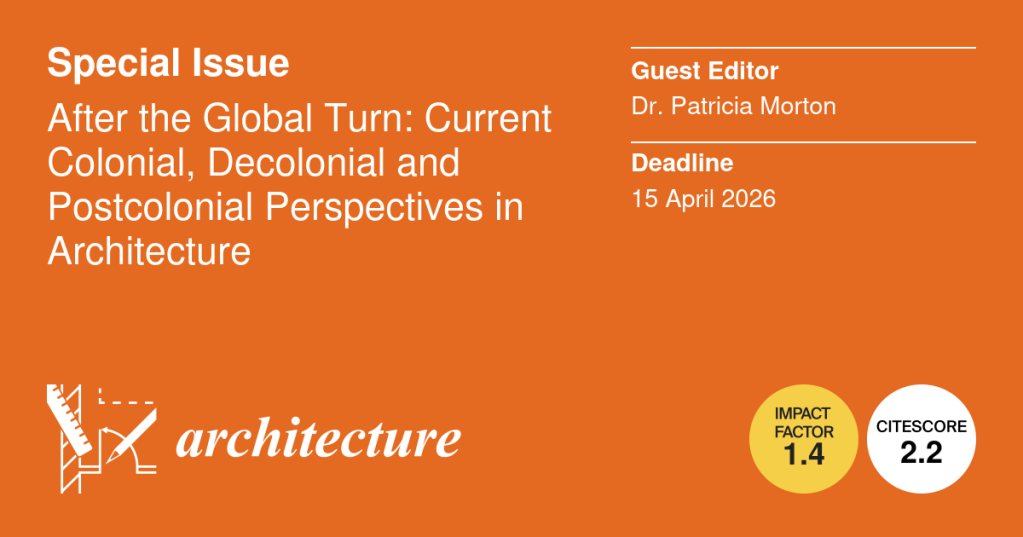
After the Global Turn: Current Colonial, Decolonial and Postcolonial Perspectives in Architecture
What is the status of postcolonial and decolonial discourse in architecture?
How has the “global turn” in architectural discourse evolved from histories of contact, conquest and colonization?
Forty years ago, the influential essays of “‘Race,’ Writing and Difference” appeared in Critical Inquiry (Gates, 1985, 1986). Essays by Edward Said, Homi Bhabha, Gayatri Chakravorty Spivak, Hazel Carby, Jacques Derrida, Abdul R. JanMohamed, and others created new critical models that interrogated how difference had been inscribed as “race” and explored the complex interactions of race, writing and difference, which influenced architectural history and theory for several decades.
That same year, Spiro Kostof’s textbook A History of Architecture (1985) spurred a “global turn” in architecture that has complicated the field’s canon. The new global discourse seeks to understand contemporary globalization as manifested in the built environment, exemplified by the foundation of the Global Architectural History Teaching Collaborative (GAHTC) and the publication of multiple volumes on global architecture.
The global turn has attempted to close the dichotomies of East and West, North and South imposed by earlier colonial and postcolonial theories, such as Edward Said’s formulation of Orientalism as the Occident’s “other” (Said, 1978). Perspectives from the “Global South” have emerged as important correctives to the hegemony of Northern Hemisphere-centered scholarship and practice. What has resulted from this “turn” has been ambiguous, however, as it often focuses on architects from the Global North operating in the Global South or developments modeled after Western architecture and urban design, without a concomitant innovation in truly global approaches and subject matter.
This Special Issue aims to explore the field’s development from colonial, decolonial and postcolonial theory to the global turn and beyond. We encourage papers that take innovative approaches to the colonial, postcolonial, decolonial and global in architecture, including such topics as:
Transnational connections and flows in excess of political boundaries;
Decentered models of global architecture;
Race and architecture;
Feminist, subaltern and minor perspectives on architecture,
Critical Inquiry: Autumn 1985 (vol. 12, no. 1) and Autumn 1986 (vol. 13, no. 1); Henry Louis Gates, ed. “Race,” Writing, and Difference. Chicago: University of Chicago Press, 1986.
“Diplomatic Interiors: Spaces, Practices, and Infrastructures in Historical Perspective” explores historical relationships between interior spaces and diplomacy. We invite researchers from a variety of disciplines to examine how settings such as embassy buildings, permanent chancelleries, and temporary conference venues have been shaped over time by social, technological, and material infrastructures in support of diplomatic representation, negotiation, and collaboration.
The full call and submission guidelines for abstracts are outlined on the CfP page.
Palm leaves loosely thatched create a bushy screen wall. The screen is part of a large building designed to shelter the pieces of other plants and make them dry out quickly. They are tobacco leaves, hanging from the rafters in neat rows swaying in the breeze. Nearby, the dried ones are being plucked and gathered into sorting bags, where they find themselves stacked by quick fingers into piles of like-colored leaves and pressed into baskets woven from the fronds of the pandanus plant. Finally, they are stowed into ships built with trees far from home, hulls of oak and elm, decks of pine. Altogether, they will float back towards Europe. Dry, sort, stack, press, stow, sell.
The plantation system is a term used to describe forms of monocrop agricultural land use, of shaping land after the cultivation of single crops in climates suitable to them. Scholarly discourse in recent years has traced the historical genealogies of extraction and de-diversification of the natural world that the system, with its rapacious claims to territory over four centuries, has come to represent. Because of their low seasonal variation and consistent sunlight, tropical zones—also some of the most biodiverse places in the world—have historically been sites where the most intense forms of plantation agriculture took place. In a broader sense, from at least the seventeenth century on, the plantation system fundamentally altered how people perceived land, property, plants, people, and their environments. Artificial species flows combined with trade and commerce created a disembodied system with disastrous consequences for the ecological complexity of the world and its climate.
The recognition of this system has led to contemporary shifts in perspectives of the environment, that it is interconnected and needs diversity in order to thrive, revealing the extent to which a reimagining of existence outside of plantation logics is necessary. Conceptually, therefore, to understand the history of the plantation is also a method to understand its opposite: biological complexity and inter-species flourishing.
Architecture has had a troubled historical relationship to plantation environments. As an ordering system, dwelling device, and apparatus for synthetic plant growth, one can project a range of examples. In Europe these range from the stately residences in the British countryside of erstwhile plantation owners in the Caribbean to greenhouses for testing banana plant hybrids to tobacco auction houses in Amsterdam. Geographically removed, yet deeply intertwined are the examples in Europe’s elsewheres: coffee processing warehouses under a tropical sun, watchtowers framing their perimeter, rudimentary barracks for workers; and as counterpart, examples of living outside of or in spite of the plantation system, such as maroon communities and so-called slave gardens.
What can plants tell us about these stories, and in what ways do plant histories diversify our understanding of the plantation system and its architectures?
This two-chapter symposium is interested in the entangled histories that the plantation system produced, and each location is chosen for its historical role in specific plantation stories. Singapore Botanic Gardens was founded in 1859 under the auspices of an Agri-Horticultural society for research and experimentation and played host to a series of botanists and plant explorers as a place to grow, experiment, and distribute potentially useful plants (among others, one early success was the cultivation and propagation of Hevea brasiliensis, Para Rubber). Chapter 1, “Plant Histories” takes place in two former colonial bungalows designed by architect Alfred J. Bidwell at the turn of the century that are now part of Singapore Botanic Gardens’ recent Gallop Extension. Chapter 2, “Plantation Architectures” takes place in Villa Maraini, the former home of Emilio Maraini who made his fortune in sugar beet plantations and refineries centered in Terni, Italy. The villa was designed by Maraini’s brother, Otto Maraini in 1905, and stands on an artificial hill (a former dump) in the Ludovisi district of Rome where since 1948 it has played host to the activities of the Swiss Institute.
Plant Histories focuses on the stories that plants tell about the plantation system in monsoon Asia. This first chapter of the symposium invites contributions that explore how people use plants in/as architecture, plants that travel between places, ethnobotanical relationships on and around plantations, and the historical connections that shaped the environment, people, and architecture on plantations. We are also interested in contributions (papers, performances, artworks) that reflect on the methodological challenges and affordances of thinking-with plants and their histories.
Chapter 2: Plantation Architectures Swiss Institute (Rome), 25–27 March, 2026
Plantation Architectures re-centers the plantation as a system not only rooted in colonial geographies but also within Europe itself. In this second chapter of the symposium we welcome contributions that critically engage with the selective remembering of the past, and how Europe’s distance from sites of plantations obscured its role in the system even as it universalized itself globally. How have social, spatial, and architectural modalities informed this obfuscation? How have European claims to cosmopolitanism been grounded in histories of violence and extraction? In what ways do buildings, as architectural objects part of urban landscapes, reflect these underpinnings?
General Information
Interested participants decide which chapter they would like to attend and indicate this in their submission. A travel bursary will be available for a limited number of participants. Please indicate in your proposal if you do not have institutional funding and require travel support. The conference language will be English. All presentations are to be made in person unless urgent circumstances prevent attendance. If participants need childcare or any other accommodations, please let us know so that it can be arranged.
Submission
Please send your abstract (max. 350 words), a short CV (max. 1 page), and preferred location of participation to: voyaging.vapors@usi.ch by 31 August, 2025. Notifications will be sent out in September. The program for each chapter of the symposium will be announced in October.
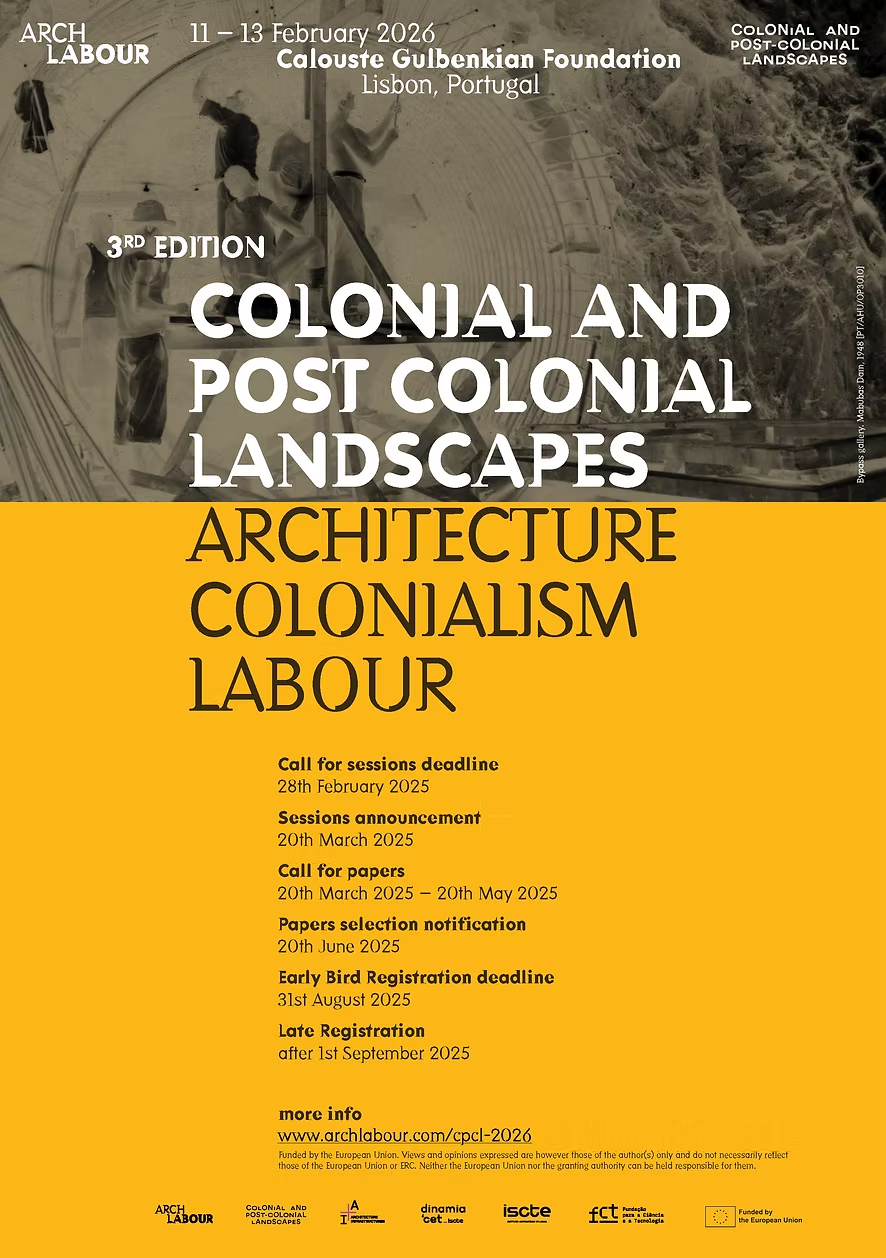
11-13 February 2026 Fundação Calouste Gulbenkian, Lisbon
After questioning Architecture, Cities and Infrastructure (2019) and Architecture, Colonialism and War (2023), the third edition of the Colonial and Post-colonial Landscapes Congress (2026) will intersect the topics of Architecture, Colonialism and Labour.: https://www.archlabour.com/cpcl-2026
Although a common topic in colonial historiography, the influence of large-scale labor on the creation of built environments—including the design, construction, and maintenance of infrastructure, buildings and landscapes—has not been fully explored in the context of colonial architecture. The topic has significant implications not only for the description of past societies, but especially for the comprehension and support of present-day communities with colonial pasts and their relationship to the production of space. Connecting architecture and labor in these contexts offers a promising avenue for addressing some of the challenges encountered by postcolonial societies. These include the relationship with “Western” construction technologies and materials, scarcity of traditional building systems and their undervalued insights on climate adaptation and sustainable solutions, and persistent racial and gender inequalities in public works labor environments.
This congress welcomes contributions from diverse geographical, disciplinary, and chronological backgrounds to promote a wide and tough-provoking debate, crossing the history of colonial architecture, labour and social history and construction technology.
Liverpool School of Architecture, at the University of Liverpool and the Program in the History of Science, Medicine, and Technology of the Johns Hopkins University invite proposals for a hybrid symposium to be held in Liverpool from the 17-18 April 2025.
Pathology Labs, Korle Bu Hospital, Accra, c1958
We welcome presentations that explore various settings for health and healing, such as shrines, sacred healing huts, and herbal ‘apothecaries’ and other spaces for indigenous medicine and healing practices; ‘basic’ health care infrastructure incorporating dispensaries, clinics, and hospitals developed for early missionary and colonial medicine; post-independence medical centres. We are also interested in papers examining the use of healthcare ‘vectors’ such as barefoot doctors, travelling midwives and paramedics and their spread of health care practices such as vaccinations, and childhood nutrition programmes in urban and rural areas.
We are interested in the settings for full range of medical specialisms from paediatrics to psychiatry and also more contemporary physical design responses to contemporary pandemics such as Ebola and Covid. Evidence and records of mixtures of indigenous and western healthcare practices in some community settings and the emergence and involvement of teaching hospitals in healthcare planning is also of interest.
Other possible topics include the role of military hospitals, colonial and modern, and contemporary healthcare infrastructure and provisions for displaced persons and refugees. We encourage interdisciplinary approaches–history of medicine, medical anthropology and sociology, oral history, among others.
Our area of interest is the African continent, from the ‘MEANA’ countries of the maghreb, north of the Sahara, to all countries South of the Kalahari and East and West of the Sahara. Health and healing facilities on islands in proximity to main continental mass such as Zanzibar, Mauritius, Fernando Po and Cape Verde are also of unique interest.
We are seeking to publish selected outputs from the symposium in a volume currently under negotiation with the publisher. We welcome abstracts (500 words max) and short CVs (1page) Please also indicate whether you intend to deliver your paper in person or online. For more information please contact Ola Uduku o.uduku@liverpool.ac.uk or Bill Leslie, swleslie@jhu.edu
Exploring UNESCO and UIA – Histories of Architecture and Bureaucracy in Development Contexts
Organised by Frederike Lausch and Andreas Kalpakci
International organisations had a profound impact on the global architectural culture of the Cold War period. Two of them stood out: UNESCO (the United Nations Educational, Scientific and Cultural Organisation, an intergovernmental organisation) and UIA (the International Union of Architects, an international association of architectural societies). Their respective roles in the institutionalisation of heritage conservation and in the promotion of the architectural profession are well documented. Rather, this workshop places particular emphasis on the relationship between UNESCO and UIA. This relationship began in the formative years of both bodies in the immediate post-war era and continues to this day in areas such as architectural education and international architectural competitions.
As a discipline and discourse, architecture participated in the development regime that sought to restructure societies in the pursuit of socio-economic “progress”, thereby perpetuating colonial power dynamics. Exploring the relationship between UNESCO and UIA builds on recent scholarship that links bureaucracy to architecture’s involvement in development contexts, defining practices, directing information flows, and mediating legitimacy. Both organisations have been engaged in development contexts, from the 1963 UIA congress on “Architecture in Countries in the Process of Development” to the work of UNESCO’s Division for Human Settlements and the Socio-Cultural Environment, established in 1976. How did these organisations interact in terms of cooperation, competition, and interdependence? How did they provide training, knowledge transfer, and technical assistance to so-called “developing countries”? How did they mediate architecture in these contexts, contributing to nation-building and international exchange?
This workshop aims to explore critical histories of the multifaceted relationship between UNESCO and UIA in development contexts. It will address various aspects of their partnership, including environmental initiatives, housing programmes, school buildings, professionalisation efforts, heritage campaigns, international networking, and media strategies. The workshop will also serve as a platform for exchanging research methodologies, archival sources, and historiographical perspectives.
We invite papers that explore the relationship between UNESCO and UIA as development actors during the Cold War in a wide range of geographical contexts. Papers are free to focus either on the relationship between the two organisations or on each organisation individually. Topics may include the situated histories of specific projects (e.g. buildings, publications, exhibitions, and conferences), the agency of lesser-known voices (e.g. international experts, civil servants, and local stakeholders), and the interactions between Paris (the headquarters of both organisations), national professional societies of architects, and the often abstract “target audience”. Contributions are welcome from a variety of disciplines, including architectural history and theory, art history, cultural studies, international relations, cultural sociology, and the history and philosophy of science.
The workshop will take place from 21 November 2024 (half day) to 22 November 2024 (full day) in Zurich, Switzerland and will be available via live streaming. We aim to cover travel and accommodation costs, although the format (in person or hybrid) will depend on the availability of funding. Please submit an abstract of no more than 300 words and a short bio of no more than 100 words to Frederike Lausch (lausch@arch.ethz.ch) and Andreas Kalpakci (andreas.kalpakci@gta.arch.ethz.ch) by 31 July 2024.
Architectures of Informal Empire in Architectural Theory Review
Recent efforts to understand the pervasiveness of empire and its legacies have done little to reorient and expand the geographic or theoretical focus of scholarship, often downplaying the broad range of political, commercial, and cultural relationships that empire was built upon. Yet imperial ambitions were almost always accompanied by multiple economic and civilisational claims that preceded or did not amount to direct colonisation. Aptly named the “Age of Empire” by Eric Hobsbawm, the nineteenth century witnessed unprecedented travel and exchanges made possible by the advances in technology and industry of the century, that served to advance economic and cultural aims simultaneously. A wide range of private and state actors, including missionaries, merchants, explorers, archaeologists, doctors, nurses, and scientists thus helped expand, articulate, and consolidate both the reach of western “civilisation” as a standard and the petrification of indigenous civilisations as backwards and “other.” Neither have all imperial activities been recognised as such. Some empires, like the United States, engaged in similar processes driven wholly by private actors, without the apparatus of a colonial state, while positioning themselves as “anti-imperial.” And some regions, like the Eastern Mediterranean, while never “formally” colonised—depending on our definition of colonialism—were significantly shaped by “informal” foreign interests. But almost three decades since Mark Crinson introduced the history of informal imperialism into architectural history, such areas remain marginal in studies of colonial architecture and urbanism. In these areas that were the site of informal or inter-imperial contestation, or that were subject to what Ann Laura Stoler calls “affective” security regimes, the projects of private actors often led to extensive economic, material, and spatial configurations whose reverberations continue to be felt, even today. Architecture, as an embodiment of territorial, political, economic, and cultural imaginations, was integral both to these processes and to their contemporary endurance.
This issue seeks to explore the boundaries of what can be considered “colonial” in histories of architecture and urbanism, in the past as in the present. It asks how we can define and describe the architectural and urban projects that accompany imperial ambitions, both formal or informal, and their spatial, material, and cultural imprint on the territories in which they are implemented. How can we meaningfully question the legacies of missionary projects, of infrastructural concessions, or developmental aid, to mention only a few examples, especially when such projects came without a colonial state? What do we learn about the entanglement of architecture and political power if we begin from the buildings and sites around which proto-imperial and para-imperial processes took place, rather than from the study of a single or formal imperial state?
We welcome contributions that explore new theoretical questions and methodological approaches to the study of architectures of informal empire—that foreground the affective power of buildings in the past or present; the entanglements of state and non-state actors in informally colonised regions; instances of intra- or inter-imperial contestation or collaboration, including with local elites; or the broader cultural and/or economic relationships inscribed in space that survive after the dismantling of colonial states. We also encourage empirical contributions that focus on geographies and actors that have remained marginal in the scholarship on colonial architecture and urbanism, that can dislodge the primacy of the single colonial state. By expanding our understanding of the “colonial” in architectural history, we hope to gain new insights into the contemporary and enduring manifestations of empire in the built environment—a necessary starting point for any true attempts at future decolonisation.
Call for Papers for Modern Heritage in the Anthropocene Symposium
Modern Heritage in the Anthropocene is part of the MoHoA global collaborative and builds on the Modern Heritage of Africa symposium hosted by the University of Cape Town in September 2021. Coordinated by The Bartlett’s Professor Edward Denison and Head of the University of Liverpool’s School of Architecture, Professor Ola Uduku, along with partners at the University of Cape Town, the Africa World Heritage Fund and around the world, this upcoming hybrid symposium responds to an age of planetary crisis in which a precarious present reflects an inequitable past and a perilous future.
The international railway settlement of Fushun (northeast China), with its modern town planning and the Ryuho Colliery, built by Denang and Siemens, and home to one of the world’s largest open cast mines in the 1930s.
Modern heritage in all its forms and from around the world is the subject of this multidisciplinary symposium, presenting the paradox of being of modernity and yet threatened by its consequences. MoHoA was originally conceived within an African context to interrogate this paradox because the continent encapsulates the historical inequities that characterise the modern and its associated notions of development and progress while also facing the highest rates of urbanisation over the next 30 years, demanding new approaches to the past and present that achieve equitable and sustainable futures on a planetary scale. The outcomes of the two symposia will synthesise in the recognition of the Cape Town Document on Modern Heritage.
Call for papers
Submissions are invited from researchers, academics, and practitioners. The organisers are seeking papers or equivalent submissions that critically engage with reframing, re-evaluating, decentring, and decolonising recent, hidden or marginalised pasts in pursuit of achieving more equitable, just, and sustainable futures. Participants will contribute to the completion of the Cape Town Document on Modern Heritage, supporting policy change at a global level through our partner UNESCO.
Topics can include, but are not limited to:
Practices of coloniality, decentring and decolonising history and historiography
Considerations and conceptualisations of multiple modernities
Modern heritage and Sustainable Development Goals (SDGs)
Planetary futures and the Anthropocene
Infrastructure and (post)-industrial heritage
Combining culture and nature, and the role of natural heritage in society
Public space and memory: memorialisation, commemoration and remembering
Modern heritage and the World Heritage Convention
How to submit
Submissions should be in English or French and should be emailed to mohoa@ucl.ac.uk by 31 May 2022.
Notification of acceptance will be provided by 30 June. Abstracts should be a maximum of 300 words or equivalent format (e.g. film shorts, blog, or Instagram story) for other types of digital submissions.
Selected papers or presentations will be published as part of the MoHoA Book Series after the conference and selected extended papers will appear in a special edition of the journal ‘Curator’.
We are pleased to announce the launch of the 2022 ASAUK biennial conference titled: “Diaspora Remittance Flows: Restitution, Culture and Capital”. This is an innovative conference which seeks to harness the global two-year involvement with online communications with our physical engagement with conferencing which we hope will return in 2022. This conference is conceived to enable our research colleagues in Africa (Ibadan, Nigeria and Nairobi, Kenya) to be part of the research conversation at the 29th ASAUK biennial conference, via the zoom media platform. We also will be running a smaller traditional in-person conference in Liverpool addressing this and other ASAUK member-determined themes.
Running from August 31st – September 4th, 2022, the ASAUK Biennial conference will be a unique two-part conference. With British Academy funding, the first part will take place entirely online and involve ASAUK research colleagues based in Ibadan and Nairobi engaging in the conference themes from Africa based platforms shared across Africa and Liverpool in the UK. This will be followed by a smaller, traditional in-person conference, hosted by the ASAUK at the University of Liverpool.
We invite you to attend the online conference, which is entirely free, and also to come to Liverpool for the ‘in-person’ conference, taking place from Friday 2nd – Sunday 4th September. The Liverpool conference will have a smaller audience, and conference panel requirements planned to pre-empt possible ongoing Covid health advice on conference size and appropriately spaced and ventilated conference facilities. Taking this into account, there will be online access to the physical Liverpool conference for a reduced fee.
THE ONLINE CONFERENCE 31st August – 2nd September
IBADAN-NAIROBI-LIVERPOOL
Restitution, Culture and Capital
This is an entirely free to attend conference (with registration required).
Hosted by ASAUK colleagues at the IFRA Institute, at the University of Ibadan and the BIEA, Nairobi, the online conference has been directly funded by the British Academy, with generous supplementary funding from the BIEA. It will be delivered entirely online from both Ibadan and Nairobi, using the Zoom platform. Working closely with the Institutes in Ibadan and Nairobi, these interactive conferences will be broadcast on two consecutive days, from Ibadan on Wednesday 31st August and Nairobi on Thursday, 1st September. The final part of the online conference will be broadcast from Liverpool on Friday 2nd September, jointly chaired by the ASAUK and RAS presidents.
We expect to curate and edit the key papers, from Ibadan, Nairobi and Liverpool that will be discussed at this unique online conference series. These with support from the British Academy will form the basis of the ASAUK publication Restitution Culture and Capital in Africa and the Diaspora, a trans-national conversation which will elaborate on the themes of the conference through the publication of the keynote papers and also the responses as recorded by participants at the three conference platforms.
The panel session themes and keynotes for the three day online conference are as follows:
HOSTED ONLINE FROM IFRA, UNIVERSITY OF IBADAN
Curated by Vincent Hiribarren, Director IFRA Ibadan
Ibadan Session 1. DIASPORA FLOWS OF CULTURAL ARTEFACTS TO AND FROM AFRICA
Prior to the online sessions keynote speakers will discuss their papers with Africa-based ECRs in workshop format.
THE LIVERPOOL ASAUK 29th BIENNIAL CONFERENCE
FRIDAY 2ND – SUNDAY 4TH September 2022
The ‘in-person’ Liverpool Conference follows the traditional panel theme format. Whilst the panel theme titled: “Diaspora: Restitution, Culture and Capital“, follows on directly from the online conference, we invite proposals for other panel themes.
As this is planned to be a smaller conference we call on panel proposers to ensure all panel proposals are sent in to the ASAUK conference team by 31st March, 2022. All proposals need to have the names of the 3 – 4 paper givers, and their abstracts submitted by the 31st March deadline. This will enable us to plan the conference space and facilities required. It will also mean that we can work to ensure that any documentation required for proposed international participants who might need this will get processed on time. We realise that this is different from the traditional conference format but hope you will join us for this unique, innovative conference in 2022. The 30th April is the later deadline for individual paper proposals. Due to the smaller conference format, space for individual papers will be limited and we encourage paper givers to consider working with emerging panel themes which will announce from February onwards.
The 29th ASAUK biennial conference dinner will be held at Liverpool University’s Victoria Gallery and Museum on Saturday 3rd September. This will also be the venue for announcement and awards ceremony for the Audrey Richards prize, the Fage and Oliver prize and the distinguished Africanist awards ceremony.
For more information about the 29th ASAUK conference. Please contact the conference organisation team via the email address: asaukconference22@gmail.com. Panel proposals, comprising the 3 – 4 papers with abstracts, can also now be sent to this address.
We will be providing further information as the conference details develop on our website and via social media.





 Transnational Architecture Group