Archive

Fry & Drew

Keynote Speakers Announcement

13.3.21Max and Jane

We are delighted to confirm the following invited speakers for the forthcoming conference on ‘The influence of Fry and Drew’, to be held at Liverpool School of Architecture, 10th – 11th October 2013:

  • Hilde Heynen, Head of Architecture, Urbanism and Planning at KU Leuven, Belgium
  • Elizabeth Darling, Senior Lecturer in Art History at Oxford Brookes University, UK
  • Jiat-Hwee Chang, Assistant Professor at the Department of Architecture, University of Singapore

See the conference page for the call for papers.

A.E.S. Alcock and the planning of Asawasi, Kumasi

As part of our research into the architecture and planning in West Africa we have uncovered some important work undertaken by Alfred Edward Savige (“Bunny”) Alcock. He worked as  Town Engineer in Kumasi, 1936-45, and then as Gold Coast Town Planning Advisor from 1945-56. Whilst working in Kumasi, Alcock was a pioneer in developing self-build villages. He set up small scale production lines where the villagers could produce ‘swishcrete’ blocks, prefabricated roof trusses and various sanitation devices such as latrines and communal laundries.

DSCF0073

This work was all carefully documented by Alcock and his hand-made photo album survives in the National Archives, London.  Maxwell Fry and Jane Drew worked with Alcock on this ‘experimental village’ (they were credited in Alcocks album) and went on to plan the larger second phase of the development, known as Asawasi. Fry described how the project grew, ‘from being a little experiment has become a big scheme spawning all over the hillside.’

Alawasi_plan

The plan above shows the complete development arranged into ten compounds (housing groups). The area coloured pink was the original village planned by Alcock with the remaining areas designed by Fry and Drew. Alcock proposed a terraced (row) housing approach to create ‘interior’ courtyards, or ‘open compounds’. Alcock described it as a ‘ a repetitive pattern of garden and service compounds alternating… this pattern is adapted to curving contours in the main estate.’ There was a low-tech thrifty approach to the development as Alcock describes,

‘door and window furniture was made from scrap iron by blacksmiths. It was stronger and cheaper than imported furniture.’ In the kitchen a hood and flue were provided by using ‘old tar drums covering all four fire places shared by eight tennants’
Fry and Drew’s Village Housing in the Tropics is indebted to this early development. Alcock proudly noted that his designs could exceed the current building regulations and reduce costs. The big idea was for the government to supply the materials (and technical knowledge) with the villagers providing the labour. It was a system that became very popular throughout West Africa, although it was not always a fair and equitable solution.

DSCF0075

Alcock took over from Fry as the Town Planning Advisor in Accra and was instrumental in the initial planning of Kwame Nkrumah’s Volta River project, new port and town Tema. He (along with Helga Richards) published his findings in a series of ‘How to’ building guides. Although less commercially successful than Fry and Drew’s acclaimed Village Housing in the Tropics manual, Alcock’s books were far more pragmatic and explanatory. There is also an element of humour in his books. How to Plan your Village for example is all about an educated villager returning to his old village and helping them to restore it – the character is named ‘Kwame’  – an overt reference to Nkrumah and a metaphor for the radical changes he was proposing.

howtovillage

The Influence of Fry and Drew

Jane and Max on beach in N Wales001

CONFERENCE CALL FOR PAPERS

THURSDAY 10TH – FRIDAY 11TH OCTOBER 2013

SCHOOL OF ARCHITECTURE, LIVERPOOL UNIVERSITY, U.K.

For over fifty years, E. Maxwell Fry (1899–1987) and Jane B. Drew (1911–96) were integral members of the English architectural avant-garde. The Fry and Drew partnership – in its various incarnations – was a magnet for architects and architectural students from all over the world, giving the practice a distinctly international outlook. Their built works, from the 1920s to the 1980s, cross the globe from Europe to South-east Asia.

This conference seeks to investigate the themes and movements of twentieth century architecture and town planning that have been influenced by the work of Fry and Drew, and vice versa. What is the context of Fry and Drew’s architecture? Is it possible to identify a FryDrew strand of Modernism or a house style? What is their architectural legacy?

We welcome papers from scholars and practitioners, and encourage proposals from early career researchers and graduate students. Papers might address, but are not limited to:

  • Inter-war Modernism – early influences, the rise of Modernism in England, collaborators and creative networks (such as contractors, engineers, artist, patrons).
  • Post-war Modernism – the Festival of Britain style, the Brutalist movement and younger British modernists, questioning the modernist agenda, the work of Fry and Drew’s former employees.
  • Colonialism – comparisons of colonizers in architectural and theoretical terms, war-time postings, colonial frameworks (for example, the role of the Public Works Departments).
  • Post-colonialism – tradition and modernity, design and identity, cultural colonialism. For example, Fry and Drew’s work at Chandigarh, in West Africa, throughout the Middle East.
  • Tropical Architecture – the use of new technologies and design ideas, its network and legacy, reassessment of the tropical, tropical architecture pedagogies at the Architectural Association and beyond.
  • Town Planning – the Garden City model, the neighbourhood unit, modernist planning schemes, the New Towns and post-war rebuilding, the spread and implementation of CIAM guidelines.
  • Fry & Drew’s wider influence – their patronage of art, Drew’s significance for women (in architecture), influential personal or professional relationships, their published texts, their involvement in architectural design education.

We invite abstracts of up to 300 words for 20-minute papers. Please email Jessica Holland and Iain Jackson at fryanddrew@gmail.com by Sunday 2nd June 2013.

Please check the conference page for regular updates.

Fry and Drew, 2013 Conference Announcement 

13.3.21Max and Jane

We are currently planning an international conference to highlight Maxwell Fry and Jane Drew’s significant contributions to architecture. The conference will be held at Fry’s almer mater, the Liverpool School of Architecture, in the autumn of this year.

The conference seeks to provide students, academics and practitioners with an opportunity to discuss all aspects of Fry and Drew’s work. It will cover their long careers from the 1920s through to the 1980s, and take in their work from North America to South-east Asia.

A call for papers will be published here shortly.

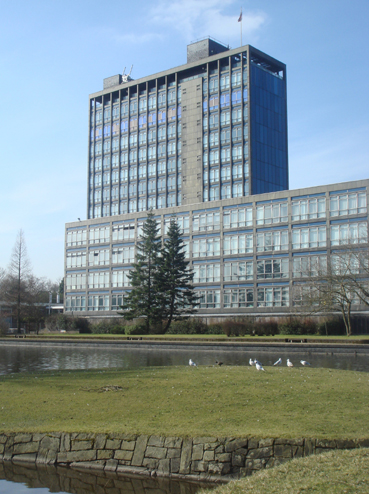
Pilkington Brothers’ Headquarters, St. Helens (1955-65)

Despite a series of important commissions on home soil, Fry and Drew’s post-war work in Britain is often sidelined due to a historical narrative focused on the second generation of MARS (Modern Architectural Research) Group modernists. A forthcoming article examining Maxwell Fry’s scheme for the glass manufacturers Pilkington Brothers’ new headquarters in St. Helens, seeks to shed light on Fry and Drew’s post-war projects.

The Pilkington commission was Fry and Drew’s first ‘prestige’ building for corporate clients in Britain (although they had built several overseas for BP, Shell and the Co-operative Bank). In the wake of the Pilkington project, offices for Gulf Oil Company, Dow Agro Chemicals and Rolls Royce quickly followed, thus enabling Fry, Drew & Partners to establish itself as an expert in modern, corporate architecture.
13.2.27 PB HQ

The project’s sizeable budget and enlightened clients – who saw themselves as patrons to the British art and design scene – allowed Fry to assemble a sixteen-strong collective of artists to design twenty-four artworks. Including work by Victor Pasmore, Edward Bawden, John Hutton, Robert Goodden, Humphrey Spender, and Avinash Chandra, the headquarters house an outstanding collection of post-war applied art – a secular counterpart to Basil Spence’s Coventry Cathedral.

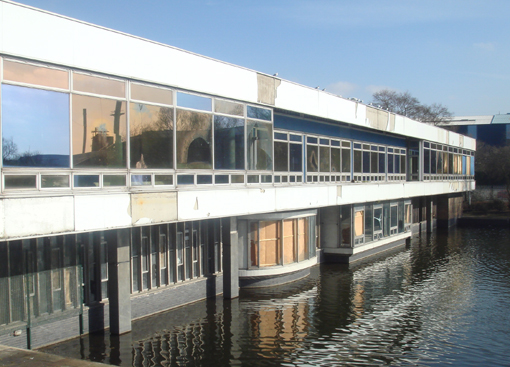
The new headquarters opened for business on 31st  August 1965, providing 1,500 employees with the latest in modern working conditions. Extensive social and welfare facilities for staff included a canteen, a medical centre (including a dentist, an optician and a chiropodist), a hairdresser, a library, and a museum, telling the history of glassmaking. The landscaped grounds with the ‘works water’ reservoir – complete with a pair of swans – was intended for use by both the Pilkington staff and St. Helens community.

13.2.27 PB canteen

The complex was sold off around ten years ago, although some 200 Pilkington staff remain with independent companies leasing the remaining office space. The canteen building (above and shown in this previous post), is currently unoccupied and in a bad state, but is apparently now being stripped of its asbestos linings for future re-use.

Did you work for Pilkington Brothers at the new offices on Prescot Road? Do you remember when the building opened? Did you help build the new headquarters? We’d love to hear from anyone with connections to the company and learn more about its significance for the people of St. Helens.

The article ‘A Monument to Humanism: Pilkington Brothers’ Headquarters (1955-65) by Fry, Drew & Partners’, by Jessica Holland and Iain Jackson, will be published in this year’s Architectural History journal.

‘Fire’, Avinash Chandra

At the Pilkington Brothers’ Headquarters in St. Helens (1955-65), designed by Maxwell Fry, sixteen contemporary artists were commissioned to create artwork that demonstrated the range of traditional and innovative techniques used in glass manufacture.

The Indian artist Avinash Chandra (1931-91) created a representation of fire, ‘which lies at the heart of glassmaking’. Measuring thirty-seven feet by nine feet (11.2m x 2.7m) the mural comprises laminates of coloured, clear and wired glass, and plastic, in fluid circular forms. It is back-lit with over one hundred light-bulbs. ‘Fire’ is surprisingly three-dimensional – you don’t really get a good sense of it in the image here – the crackled spheres burst out of their setting, giving a suggestion of the extreme heat and light of a glass furnace.

13.2.27 Chandra detail

The piece is amongst a series of large-scale, coloured glass murals undertaken by Chandra for corporate clients during the 1960s; he also created a mural for the Indian High Commission in Lagos (1962) and a Fibreglass mural for the Indian Tea Centre, Oxford Street, London (1964).

‘Fire’ still hangs in its original setting, over the main entrance to the Pilkington tower block (more on this later). For an image of a dapper Chandra in front of his work, see the excellent VADS collection.

Chandigarh, India

The city of Chandigarh in India has received considerable interest since its design and construction in the early 1950s, mainly due to the appointment of the French-Swiss architect Le Corbusier as a member of the design team. As one of the Modern Movement’s founding fathers Le Corbusier became the figurehead of the project, despite the involvement of other leading architects – Maxwell Fry, Jane Drew and Pierre Jeanneret – to undertake the bulk of the design work and oversee the city’s construction. Emphasis is traditionally placed on Le Corbusier’s three monumental capitol buildings, rather than the more everyday (yet no less significant) work of the remaining neighbourhood blocks (or ‘sectors’).

DSC07036

The Legislative Assembly, Sector 1 Capitol Complex, Chandigarh. Le Corbusier.

Recent scholarship has begun to critically examine the planning of the city and to introduce the other members of the design team. Iain Jackson has written a paper that attempts to assess the first housing in Chandigarh designed by Fry and Drew for Sector-22.

DSC06938

Sector 22 Housing, Chandigarh. Jane Drew.

The paper considers the influences behind their planning method and housing typologies, with particular focus on the notions of ‘neighbourhood planning’. The paper argues that Fry’s work with Thomas Adams from the 1920s is of particular importance to Sector-22’s layout, which was further informed by Drew’s studies published immediately after the Second World War. Finally, their housing plans are considered, along with the contributions of their Indian colleagues – an important group who have largely been ignored in previous academic studies of the city. The full article is available to view here.

Images taken during a TAG visit, April 2012 © Jessica Holland.

Civil Engineering Building, Liverpool University

This is the Civil Engineering Building (1955-60), designed by Maxwell Fry and photographed last week in a snowy Liverpool.

The tower is decorated with a cast concrete panel of lettering, which lists names of the great and good of the structural and civil engineering world from Archimedes to Brunel. Situated directly over the main entrance, the panel acts as a potent reminder to students of their place in the engineering tradition. Reflecting the function of the building, this is Fry’s Modernist equivalent of a Classical decorative frieze.

13.2.20 engbldg

The following drawing by staff at Fry, Drew and Partners – taken from the Liverpool University Special Collections and Archives – shows the tower-and-podium typology used by Fry. Classroom accommodation is provided to the T-shape tower and large, basement workshops are top-lit via the podium. From the vantage point of the reception area, it is possible to look down into the workshops and see the engineers at work – mirroring the industry portrayed by Peter Lanyon’s mural, which sits adjacent to the viewing screen.

13.2.20 engbldgdwg

For further discussion of the building and Fry’s other work for Liverpool University, see this online article.

‘The Conflict of Man with the Tides and the Sands’, Peter Lanyon

Jane Drew and Maxwell Fry used artwork in their buildings wherever possible. At the University of Liverpool’s Civil Engineering Building (1960), Fry commissioned the Cornish artist Peter Lanyon (1918-64) to design a mural of enamelled tiles. Lanyon created a visualisation of the research into loose-boundary hydraulics, including the movement of rivers, the mechanism of waves and the behaviour of solids suspended in water. He spent months researching hydraulics before attempting to create the image, which is intended to represent the interaction of forces.

13.2.13 lanyon2

Maxwell Fry suggested the use of enamelled tiles as a method of creating a hard-wearing surface that might be applied to a wall of the reception area, immediately opposite the main entrance. The mural consists of 750 standard, 6-inch white tiles that Lanyon painted and then fired in a kiln. This process has ensured that the texture of each brushstroke is discernable on close inspection, giving added movement to the work. In some cases Lanyon adheres to the lines of each tile, while other sweeping strokes break up this rectilinear pattern:

13.2.13 lanyon detail

Much of this information was taken from a write-up on Lanyon’s work situated next to the mural. Visit it if you can – the pictures don’t do it justice!

Images © Jessica Holland.

BP Headquarters, Lagos, Nigeria

On 1st October 1960, Nigeria gained independence from Great Britain. Jane Drew was in Lagos during this historic period and she wrote home to Maxwell Fry of the carnival atmosphere in the capital: ‘Lagos is electric with excitement.’

Drew was in town to attend the opening of the headquarters for British Petroleum in Lagos, designed by Fry, Drew & Partners. The office block is one of several lucrative projects designed by Fry and Drew for British companies in West Africa – others include the Co-operative Bank, just a few streets away from the BP building, and the Leventis Store in Accra.

13.2.11 BP HQ

Now African Petroleum House, the roof terrace has since been filled in to provide an extra floor of office space and the louvres have been altered – no doubt following the introduction or upgrading of the air conditioning. For images of the building shortly after its opening, see the RIBA online photograph collection.