Archive

Ghana

The University of Liverpool and The National Archives are pleased to announce the availability of a fully funded collaborative doctoral studentship, under the Arts and Humanities Research Council (AHRC) Collaborative Doctoral Partnership (CDP) scheme.

Using The National Archives extensive collections the project will investigate how the West African ‘built environment’ has been shaped to respond to various political, economic, and welfare demands and ambitions. The particular timeframe will cover the transition from colonial rule into independence period. After tracking these broader notions across ‘British West Africa’, the project will pursue a narrower focus on one of the four former British colonies.

How were ideas of ‘self’, identity, freedom, and so on, expressed through new construction and town planning? How did former colonisers, and other foreign groups attempt to shape and influence these developments in the ‘post-colonial’ period. How were notions of identity, nation, and ‘new beginnings’ expressed by the postcolonial nations?

The aim of the project is to investigate how political ideas, and notions surrounding identity, nationhood, and statecraft are expressed or manifest through the built environment.

Infrastructure, prestige projects, and grand architectural schemes are often used to infer power, or suggest modernity, development, and progress. Equally, more (seemingly) mundane developments, such as housing, can be as revealing in terms of power structures and wider ambition. In a problematic and contested political situation these types of projects become highly charged and significant expressions of a nation’s collective (and often contested) identity. This is even more meaningful in a colonial context, and architecture, town planning and infrastructure, in part, become symbolic expressions of the colonial power. 

The objective of this project is to examine these notions within the West African context over a period of time that spans the late colonial era and early post-colonial period. This was a particularly volatile moment, charged with excitement and optimism, and a desire to somehow ‘start again’ and rebuild a new nation with a new vision. Architecture and planning would shift from being expressions of colonial dominance and subjugation to being expressions of nationalism, hope, and modernisation. 

It is sometimes tempting to see the event of Independence as an abrupt and sudden moment. The clock strikes twelve and everything suddenly changes – and whilst this is true, it is also oversimplifying a complex event that is, to some degree, still being played-out today. There is also a sense of inertia in the built environment and existing city plans, methods of development, and networks of expertise stubbornly persist and outlast political dynasties.

The desire for the newly independent nations to express their hard-fought freedom through physical, often large-scale triumphant (sometimes infrastructure) projects was met with the former colonial power’s aspiration to continue offering technical assistance, expertise, and trade. It resulted in a complex blend of nationalism, reimagining/reinventing identity and Pan-African ambition, further mixed with the additional influences of ‘non-aligned’ socialist assistance and US, World Bank, and UN concerns. 

The independence of these nations was not an abrupt severance from the former colonial power, but a feathered, gradual transition coupled with intense global interest eager to retain or cultivate influence and trade advantage. 

It makes for a fascinating narrative that reveals the shift from overt imperialism, to one of post-WW2 ‘technical assistance’, ‘development’, and fiscal packages from an array of competing agencies and organisations, met with a desire to express African modernisation, liberation, and success. 

Start date 1st October 2021

Applications due 25th May 2021

Interviews planned for 22nd June 2021

For any enquiries please contact: Professor Iain Jackson on: ijackson@liv.ac.uk

How to Apply:
To apply for this studentship, please send the following documents to artsrecruit@liverpool.ac.uk:

 Full Curriculum Vitae (CV)

Cover Letter expressing motivation for applying and pursuing a PhD on this topic.

Project Plan: This is your chance to set out how you would like to design and plan the research project and should not exceed 1000 words. Please produce a Project Plan that includes the following headings:

  • Proposed project outline and suggested research questions
  • Proposed Methodology
  • The National Archives / other archival sources to be consulted
  • Selected Bibliography.

The project can be undertaken on a full-time or part-time basis.

CDP doctoral training grants fund full-time studentships for 45 months (3.75 years) or part-time equivalent. The studentship has the possibility of being extended for an additional 3 months to provide professional development opportunities, or up to 3 months of funding may be used to pay for the costs the student might incur in taking up professional development opportunities.    

The student is eligible to claim additional travel and research related expenses (worth up to £1000 per year for four years) during the course of the project, courtesy of The National Archives.

·      We want to encourage the widest range of potential students to study for a CDP studentship and are committed to welcoming students from different backgrounds to apply. We particularly welcome applications from Black, Asian, Minority Ethnic backgrounds as they are currently underrepresented at this level in this area. 

·      Applicants should have an undergraduate degree in subjects allied to the Built Environment/Architecture/History/Cultural Geography.

·      A Masters level qualification is desirable but not essential. Applicants may be able to demonstrate equivalent experience in a professional setting (e.g. producing and researching written reports, public outreach and liason, working with collections and archives).

·      Experience of working in West Africa is desirable but not essential.

·      Applicants must be able to demonstrate an interest in the archives sector and potential and enthusiasm for developing skills more widely in related areas.

·      As a collaborative award, students will be expected to spend time at both the University and The National Archives.

·      All applicants must meet the UKRI terms and conditions for funding

Who to contact

Related content

Availability

Open to students worldwideFunding information

Funded studentship

This is a joint project with AHRC Collaborative Doctoral Partnership programme. The external partner is the National Archive, Kew. See View Website
The award pays full maintenance for all students, both home and international students. The National Minimum Doctoral Stipend for 2021/22 is £15,609, plus an allowance of £1000 per year and a CDP maintenance payment of £550 per year.

Supervisors

https://www.liverpool.ac.uk/study/postgraduate-research/studentships/building-the-nation/

Explore modern cities and architectural production in the blurred era of the independence and postcolonial period

Join us for three sessions which will bring together scholars, researchers and curators to explore architectural production in the blurred era of independence to the post-colonial period of the mid-20th century, focussing on cities in Africa, Middle East and South Asia. 

Register here: https://www.eventbrite.co.uk/e/crucibles-vectors-catalysts-envisioning-the-modern-city-tickets-138966892717

Whether driven by socialist agendas (Nehruvian in India and Nkrumah in Ghana), monarchies (Pahlavis in Iran and Hashemite in Iraq), quasi colonial protectorates, or pan-continental aspirations, architecture (and especially Modernism) was a key apparatus for nation-building, for re-imagining identities and a means to project and invent a new image of the future. The seminar seeks to explore the use of architecture as both physical infrastructure and symbolic expression, as well as its vulnerability to the vicissitudes of changing politics and policies of the times.

The role of cities as crucibles, vectors and catalysts for developing new expressions of identity, change and power is key. Cities in this period saw the emergence of schools of thought, dynasties and collaborations were formed, networks and ideas were shared and publications were disseminated. While the desire of a newly independent nation was often to consolidate a single national collective identity, it was through the urban centres that strands of coherent, yet often multiple identities were formed. The role of figures such as Rifat Chadirji, Mohamed Makiya, Jane Drew and Maxwell Fry were important as they often operated within multiple cities and cross-cultural contexts that spanned the colonial to postcolonial divide. 

These urban centres were either newly built, or they were remade and reimagined through city infrastructure, government buildings, universities, cultural institutions and national monuments. Architecture schools, state sponsored projects and external agencies feed into the discussion and warrant further exploration. The seminar explores the transnational connections, diverse political agendas and complex allegiances which informed architectural development in this period. 

Seminar convenors:

  • Iain Jackson, Professor of Architecture and Research Director, Liverpool School of Architecture
  • Clara Kim, The Daskalopoulos Senior Curator, International Art, Tate Modern
  • Nabila Abdel Nabi, Curator, International Art, Tate Modern

PROGRAMME
TUESDAY 2 MARCH

Session 1: Crucibles, 15:00-16:30 (UTC)

  • Building the Modern City: Expressions of Identity, Change and Power
    • Moderated by Iain Jackson

This panel will explore state-sponsored programmes, planned cities and masterplans in cities such as Lagos, Tehran and Baghdad. It will examine architecture as expressions of nationalism and nationalist political agendas as well as its relationship to big business, corporations and mercantile ventures.

Speakers:

  • Talinn Grigor (University of California, Davis)
    • Building a (Cosmopolitan) Modern Iran
  • Ola Uduku (Manchester School of Architecture)
    • Lagos International Metropolis: A city’s adventure in tropical architecture as an expression of dynamic modernism and growth in the mid 20th century
  • Lukasz Stanek (University of Manchester)
    • Rupture, Transition and Continuity in Baghdad’s Master Plans: From Minoprio to Miastoprojekt

Session 2: Vectors, 17:00-18:30 (UTC)

  • Connecting the Modern City: Networks, Alliances and Knowledge Production
    • Moderated by Clara Kim

This panel will explore the practice of modern architecture through colonial-postcolonial networks and geopolitical alliances. It will explore cities in Mozambique within the context of other Lusophone countries, post-Partition East & West Pakistan, as well as the dissemination of knowledge and technical expertise through pedagogy.

Speakers:

  • Ana Tostões (University of Lisbon)
    • Correspondences, Transfers and Memory: Maputo’s “Age of Concrete”
  • Fahran Karim (University of Kansas)
    • Archaeology of the Future: Constantinos Doxiaidis in East and West Pakistan
  • Patrick Zamarian (University of Liverpool)
    • Global Perspectives and Private Concerns: The AA’s Department of Tropical Architecture

TUESDAY 9 MARCH

Session 3: Catalysts, 15:00-16:30 (UTC)

  • Fragments of the Modern City: Memories, Echoes and Whispers
    • Moderated by Nabila Abdel Nabi

This panel will explore the collaborations, connections and entanglements that developed between art and architecture during a dynamic period of building in Morocco, India and Iraq. It will examine the legacy and afterlives of these projects through the investigation of under-recognised figures and narratives in art and architecture.

Speakers:

  • Lahbib el Moumni & Imad Dahmani (founders of MAMMA, Mémoire des Architectes Modernes Marocain)
    • Initiatives toward saving modern heritage of Morocco
  • Ram Rahman (Photographer/Curator)
    • Building Modern Delhi, The Nehruvian Post-Independence Renaissance
  • Amin Alsaden (Independent Scholar)
    • Syntheses Across Disciplines: Rifat Chadirji and Art-Architecture Liaisons in Modern Baghdad

This event is organised by Hyundai Tate Research Centre: Transnational and Liverpool School of Architecture.

Call for Participants: Writing Group on Architecture and Empire
Society of Architectural Historians of Great Britain

https://www.sahgb.org.uk/news/architectureandempire

With a formal existence spanning early modern to contemporary history, the British Empire supported complex networks of trade, war and settlement. It intervened in land-based expansions as well as maritime worlds and prefigured a global architectural history. Yet research that seeks to critically address the empire and its legacy poses complex challenges for the architectural historian: the mental-mapping of bureaucratic systems across multiple continents, finding evidence of buildings and landscapes for which little documentation exists, sitting with a complex past and present of race, gender, religion, nationalism and capitalism.

This writing group is formed as an empathetic structure for scholars writing books and dissertations on imperial and colonial histories. We seek to create a space for researchers to share resources on chapter writing, structuring and revision. Writing is often an isolating activity, particularly for emerging scholars with non-Eurocentric specialisations that are underrepresented in the academy. To this end, we especially encourage applications from early-career researchers and those whose primary field sites are located outside of Great Britain. This project is among the first within the society’s new Race and Ethnicity network, a new effort to foster greater equality, diversity and inclusivity within the Society of Architectural Historians of Great Britain.

The group will meet for two hours every two months, with participants alternating between workshopping their own draft chapters and that of another in the writing group. Participants must commit to reviewing and presenting once every four months. To mitigate time zones and geographies, all events will be held over Zoom.

HOW TO JOIN

To join, please send a one-page cover letter and a brief project abstract to info@sahgb.org.uk with the subject line ‘Application: Writing Group on Architecture and Empire’ by 15 January 2021. The cover letter should state why you would like to be a part of the group and your general meeting availability, and the abstract should address the dissertation or book project you hope to work on as part of the writing group. All interested participants will be notified by 31 January 2021. The group will meet every other month beginning in February 2021. The meeting times, format and specific group expectations will be refined amongst participants during the first meeting and reviewed on a regular basis.

This writing group is convened by Sonali Dhanpal (Newcastle University), Sben Korsh (University of Michigan) and Y.L. Lucy Wang (Columbia University).

The aim of this project is to investigate if, and to what extent do ‘tropical modernist’ structures modify or mitigate climatic conditions to create more ‘comfortable’ interiors. 

Most of these structures were designed to be passively cooled and as such have a permeable façade composed of concrete screens or louvres to facilitate cross ventilation air-flow, and to create shade. A good example is the Children’s Library in Accra, designed by Nickson and Borys in 1957.

Mainly built during the 1930s-70s, these buildings are now at an age when they require refurbishment and rehabilitation – although this is mainly superficial and does not involve structural correction. There are various options pursued, many involving the installation of air-conditioning units. For the AC to be effective it ideally requires a sealed interior volume, rendering the existing permeable façade unsuitable. 

Standard Chartered Bank: as built and passively cooled
Standard Chartered Bank: refurbished, clad in glazed panels and reliant on AC

One solution being increasingly used in Ghana is to externally clad the façades with a glazed screen, as seen on the Standard Chartered Bank on Accra’s High Street. 

The glazing cuts out street and traffic noise and reduces dust infiltration, as well as enabling the interior to be mechanically cooled. But in terms of energy usage (consumption of AC and in the fabrication of the glazed units) it is far from ideal. Furthermore, there is the financial cost of cooling what is now effectively a greenhouse in a hot and humid climate. Architecturally the building has also been dramatically altered. It is now a bland non-descript block, and lacks the patterns, shading effects, and references to the floors behind the façade. I’m not suggesting that this example is a prestigious heritage monument, but rather using it to illustrate what is becoming an increasingly common approach to refurbishment. Fortunately, in this case glazing can be easily removed and the older structure has been preserved inside.

Our project has several objectives, including to:

  1. Recognise and promote the significance of these 20thC modernist structures.
  2. Determine if the passive cooling approach does create sufficiently comfortable interiors.
  3. Investigate what conditions are comfortable for the occupants of these buildings.
  4. Investigate alternatives to AC that provide low cost and low energy comfortable interiors without detrimentally impacting upon the architectural quality.

To test both inland and coastal conditions we’ve selected a case study at KNUST in Kumasi, and another at the University of Ghana, Accra.  Both buildings are university libraries, and as such have a large number of daily visitors that we can consult. The library at KNUST was designed as a louvred screen wall, fully adjustable from the interior, and also has a later brutalist extension with a twin façade arrangement and partially air-conditioned interior. 

KNUST Library: a facade of adjustable louvres

At Accra, the Balme Library takes a more colonial/traditional approach with a series of courtyards, loggias and high ceilings. Some of the rooms have been retro-fitted with air-conditioning, whilst at the same time naturally ventilated. Both libraries are large institutional buildings and have the potential to consume large amounts of energy should they be refurbished with full AC and cooled to ASHRAE recommendations. Furthermore, it is important for the health and education of the staff and students that these buildings are comfortable places to spend time in, and to study. 

Balme Library at University of Ghana

In each building we’ve installed a number of Hobo data-loggers that record the temperature and humidity at regular intervals. Whilst this data allows us to determine whether the internal temperature/humidity is different to the external condition, it does not tell us if the conditions are comfortable to the inhabitants. To establish this, we’ve consulted the library users and staff to enquire how comfortable they feel in the various library spaces. The respondents also recorded their attire, age, sex, and how long they have been in the library prior to completing the survey.  Over 250 people completed the survey at KNUST in January 2020. We will repeat this in the ‘rainy season’, and conduct similar surveys at Accra. When we’ve gathered this data we can correlate the data-logger findings with those of the user surveys. We’re also constructing 3d computer models of the buildings to test various refurbishment scenarios and cooling options.

Our partners in this project are Dr. Haniyeh Mohammadpourkarbasi at University of Liverpool; Dr. Irene Appeaning-Addo and Dr. Dan Nukpezah from University of Ghana; and Prof. Rexford Assasie-Oppong at KNUST. We’re also indebted to the library staff and students at each institution. Funding has been generously provided by the University of Liverpool ODA Seed Fund 2019-2020.

Updates to follow when we have more data and findings to report.

Mojca Smode Cvitanovic, ‘New Paper: Tracing the Non-Aligned Architecture: Environments of Technical Cooperation and the Work of Croatian Architects in Kumasi, Ghana (1961-1970)’ Histories of Postwar Architecture, 3(6), 34-67. Full paper available here: DOI: https://doi.org/10.6092/issn.2611-0075/10450

Unity Hall, KNUST, designed by Miro Marasović and John
Owusu Addo, 1968.

Focusing on the work of a group of Croatian i.e. Yugoslav architects in Ghana, the paper explains the nature of technical cooperation as a model of temporary international contract work in relation to the specificities of the environment built consequently. It focuses on the engagement of Miro Marasović as the head of the Kwame Nkrumah University of Science and Technology Development Office from 1961 to 1964. As its contextual framework, the paper addresses bilateral technical cooperation as a form of international communication and exchange, the practices of the Non-Aligned Movement, and the interrelations of the pre- and post-independence generation of modern architecture in Africa.

[See also KNUST archival drawings here ]

Call for Papers: British Architecture in the World

As part of its long-running series Twentieth Century Architecture, the Twentieth Century Society is planning a journal for publication on the relationship between British architecture and other countries of the world, particularly those beyond Europe.

Pansodan Street, Yangon, including Chartered Bank, Palmer & Turner, 1939–41.

Pansodan Street, Yangon, including Chartered Bank, Palmer & Turner, 1939–41.

The nature of the relationship may take a number of forms, such as British-based practices working overseas, British architects establishing offices in other countries, architects coming to Britain for training before returning home, or more general issues of how the profession in Britain set standards for education and validation elsewhere, in particular through the RIBA. We tend to favour actual buildings as subject matter in Twentieth Century Architecture, but on this occasion the field may be wider, including town planning, cultural responses, climatic adaptation, administrative histories, professional formations, and relationships to the later period of colonialism and its ending. Accounts of the scope of archival resources could be of interest, and we might also include reports on the current state of buildings, including threats and conservation projects.

Jane Drew, housing in Sector-22, Chandigarh, c. 1954.

Jane Drew, housing in Sector-22, Chandigarh, c. 1954.

The scope outlined above is larger than usual for what is a relatively small collection of published pieces – the journal usually contains about ten articles – but it seems preferable not to place limitations until we are aware of what might be available. Recently, research and publication in this area have grown rapidly, and our aim is to bring together articles that complement each other, but with a spread of periods (anything from 1914 to around 2000), styles and locations. The journal will be the sixteenth in the series, and will probably be published in 2023.

In the first instance, please send your ideas by 01 July 2020 in the form of an abstract of up to 300 words, along with a brief CV and list of publications to date, to elain.harwood@HistoricEngland.org.uk, who will also answer any queries. Abstracts will be reviewed by the editorial committee of the journal, drawn from members of the Twentieth Century Society Publications Committee, and selected for full submission. Completed texts will be peer-reviewed.

Following commissioning, delivery would be 1 March 2022, the length of articles should be between 2,000 and 5,000 words, with up to ten images per article. Contributors are expected to provide and pay for images of publishable quality.

New Research Paper: I. Jackson, O. Uduku, I. Appeaning Addo, R. Assasie Opong, “The Volta River Project: planning, housing and resettlement in Ghana, 1950–1965”, Journal of Architecture, vol 24 (4), 512-548.

This paper investigates the housing schemes proposed in connection with the Volta River Project, Ghana, in the mid-1950s to early 1960s. The Volta River Project formed part of Kwame Nkrumah’s vision for Ghana’s modernisation and industrialisation in the wake of political independence. Three associated worker housing schemes demonstrated somewhat contradictory design and construction methods, from high specification, extensive amenities, and comprehensive servicing, through to self-build ‘core’ houses amounting to little more than single-room dwellings.

Figure 16.jpg

Core House at New Ajena, Ghana. Built c.1961, photographed in 2017

The paper traces the complex and controversial history of these schemes, supplemented with findings of several field trips to the settlements in question, to unravel the value of the ‘Core Houses’ approach. The most successful project to incorporate indigenous agency and true collaboration was the semi-formal ‘Combined Area’ housing at Akosombo, a positive model for shared agency and collaboration in planning, housing, and facilities delivery. Sitting alongside the carefully manicured plan of Akosombo, with its regulated market, excellent health care and desire to set high standards of cleanliness, the Combined Area has not only provided homes for the lower-paid and labouring workers of the town, but has developed over time into a settlement where professionals and retired government workers are also now residing, not out of necessity but by choice. By actively developing their own homes, shared spaces and amenities there has developed a strong sense of ownership, community, and identity. The success and level of attachment to this settlement clearly extends beyond its material presence and through the shared experience of helping to cultivate a place of one’s own.

Full Article Available here: https://www.tandfonline.com/doi/full/10.1080/13602365.2019.1643389?scroll=top&needAccess=true


Article by Prof Stephanie Decker, Professor at Aston Business School specializing in organizational history and international strategy. Originally published here: https://orghist.com/2019/06/21/unlocking-archives-unilever-historical-archives/

On 20th June 2019 Unilever kindly hosted (with additional support from the University of Liverpool) a workshop showcasing the amazing material that can be found within business archives. It was a really great day to learn more about how different researchers are using the collections and the great work by archivist who make all of this accessible to the public.

Keynote by Valerie Johnson, Director of Research, The National Archives

Business archives – a bit of a passion killer?

Valerie Johnson opened her keynote by highlighting that business archives are often seen as dull and uninteresting – to the point she was once told by a conference organizers that he had not expected her research talk about business archives to be so interesting. Nothing could not be further from the truth. For almost any subject of interest to researchers, business archives have materials, as companies were often spearheading new developments (e.g. technology), were embedded in social and cultural trends of the day (e.g. the culture of imperialism), design history (e.g. in the Board of Trade archives) to name but a few.

In a whistle stop tour through a wide range of archives, Johnson illustrated the history of women at work through an architectural map in the ING Barings Archive, and the representations of empire in the textiles archive of John Lewis, and the United Africa Company trademarks at Unilever Historical Archives.

To get a better sense of what Unilever Historical Archives do, see their
Instagram site: https://www.instagram.com/unileverarchives/

Johnson closed by reiterating that business records offer magnificent materials and insights into society, technology and attitudes of the past, not just the records of business operations in the narrow sense. So she closed with highlighting the importance of:

Putting the passion back into business archives!

Snippets from archival research

The day continued with wide-ranging research presentations. The morning opened with Jeanette Strickland introducing the audience to William Lever, the founder of Lever Brothers (one half of the original Unilever), a formidable businessmen and somewhat of a micro-manager.

This was followed by Frank Thorpe, University of Liverpool, talking about advertising and beyond. His presentation is based on his doctoral thesis that investigates the changing attitudes towards personal hygiene, or “BO”, and how
products like deodorant were gendered and stigmatized at times. At Unilever, he
has researched uncatalogued material, but also used a range of online newspaper
archives to understand the context within which these adverts appeared.

Ronnie Hughes offered a different view on Port Sunlight, the location of the Unilever factory and archives, where the workshop took place, by asking a key question:

What must it have been like to live in someone else’s utopia 100 years after they died?

Walking through Port Sunlight village in the morning before the workshop, this is not unlike the question we asked ourselves – would we actually like to live here,
as beautiful as it is? As a heritage site, it has a very distinct and unique
feel, which is unlike other neighbourhoods. Hughes highlights that he has asked
communities questions about what their perfect place would look like before
starting this research project. He blogs at A Sense of Place.

Prof Matt Reed finished the morning session by outlining his search for the ‘origin story’ of the collaboration between Unilever and the University of Liverpool, which dates back to 1906, which was “multi-faceted and sporadic.”
Lever donated money to a number of departments, including Civic Design and town planning. The Department of Industrial Chemistry was particularly well aligned with Lever’s business interests. Reed finished with a reflection of the value
of searching archives versus the self-taught googling that passes for research
outside of archives.

A fascinating tour of the archives at lunchtime that featured highlights such as Marmite pants.

The afternoon sessions kicked off with Dr Rory Miller’s exploration of why David Fieldhouse’s Unilever Overseas is missing a chapter on Latin America – apparently he fell out with his research assistant. 25 years ago, Miller first visited the Unilever archives to find out what was actually available on Unilever’s business in Argentina and beyond. Perusing the directors’ visiting reports, he outlined how Argentinians rarely bought Lifebuoy soap other than to wash their dogs.

In her talk about the design process, Dr Lee Wright highlighted the potential importance of archives for the design practice and the sourcing of design ideas. In her teaching, students reference the past through images they source from Pinterest, highlighting the significance of social media sites in mediating our visual understanding of the past.

The day closed with two fascinating talks, the first by Prof Iain Jackson about the development of urban architecture in Accra, Ghana in the mid-twentieth century. While the National Archives had more material on the European settlements of Accra, within other archives, such as the United Africa Company collection at Unilever, mercantile areas such as Jamestown are much better documented. Some of his collected images are available in an online book available via issuu.com (search “Accra”) here.

The workshop closed with Claire Tunstall describing their mission and how the archives has to serve many different stakeholders: internal divisions, brands and communications, outreach with schools, partnership with museums and universities and, of course, the Port Sunlight Village Trust, as well as researchers.

Hopefully, more such events, at Unilever or other major archives, will take place in the future. The workshop did not just have great presentations but also offered great opportunities to meet a wide variety of people interested in using and promoting archives.

Conference programme

10 am Registration Tea & coffee
10.20 Welcome, introductory remarks and housekeeping
– Claire Tunstall and Jeannette Strickland
10.30 Keynote Dr Valerie Johnson, Director of Research & Collections, The National Archives “What’s the use? Your research and business archives”
10.50 Q&A
11.00 Refreshments
11.15-12.30 Session 1 Chair: Prof Stephanie Decker, Aston University
11.15 Jeannette Strickland, Department of History, University of Liverpool, “Finding William Lever, the man behind the myth”
11.30 Frank Thorpe, Department of History, University of Liverpool, “Beyond the ad: filling gaps and finding new gaps”
11.45 Ronnie Hughes, Department of Sociology, Social Policy & Criminology, University of Liverpool, “Looking for Utopia”
12.00 Dr Matt Reed, Strategy Director, Materials Innovation Factory, University of Liverpool, “Turn every page”
12.15 Q&A
12.30-2.00 Lunch
Tours of Unilever Archives available at 12.45 and 1.10
2.00-3.00 Session 2 – Chair: Dr Valerie Johnson, The National Archives
2.10 Dr Rory Miller, formerly Reader in the Management School, University of Liverpool, “The Missing Chapter in David Fieldhouse’s Unilever Overseas: Unilever’s Expansion in Latin America in the Mid-Twentieth Century”
2.30 Dr Lee Wright, Senior Lecturer in the History and Theory of Design, Liverpool School of Art and Design, Liverpool John Moores University, “The value of archives and their potential to impact current design practice”
2.50 Q&A
3.05 Refreshments
3.20-4.20 Session 3 – Chair: Jeannette Strickland, University of Liverpool
3.20 Prof Iain Jackson, School of Architecture, University of Liverpool, “Traders, speculators, taste makers: the United Africa Company in Ghana”
3.40 Claire Tunstall, Head of Art, Archives & Records Management, Unilever plc, “The research potential of Unilever Archives”
4.00 Q&A
4.20 Summing up and closing remarks
4.30 Optional post-workshop drink at the Bridge Inn in Port Sunlight


Livelihoods and culture under threat in Ghana’s historic port of Jamestown

The beachfront of historical Jamestown, Ghana.

Plans are afoot to replace the historic Ghanaian fishing port of Jamestown with a Chinese-backed mechanised factory.

This is a move that will destroy traditional livelihoods, as well as damage the historic built environment. It will drastically change not only the tangible fabric of this historic town, but also impact the fishing methods, market traders and community that’s reliant on the sea.

Since 2011 I have been researching the history of Ghanaian architecture and urbanism, and have been particularly struck by its impressive collection of heritage structures and associated narratives.

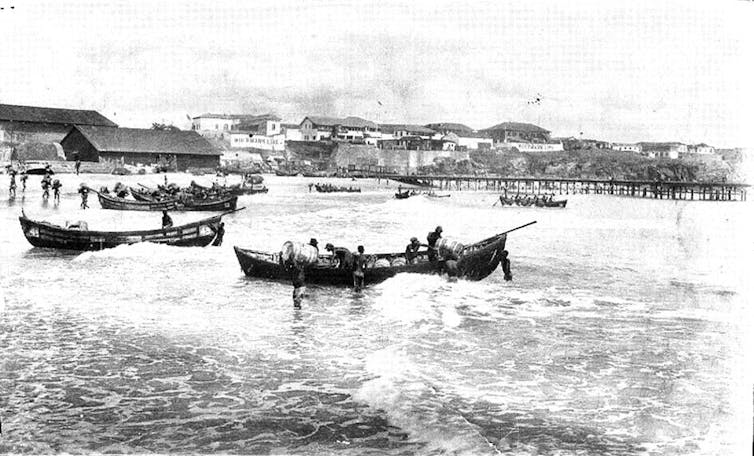
The harbour at Accra’s district of Jamestown was built to provide shelter from the heavy surf that pounds this part of the coast. The breakwater and pier were equipped with railway tracks, gantries and cranes to handle the large produce exports following the cocoa boom of the early 1900s. The wealth created from this trade saw some fine buildings being built. An array of warehouses, stores and villas survive (some very precariously) in Jamestown to this day.

Historical photograph of Jamestown.
Courtesy of Wirral Archives

The shallow waters of the harbour utilised smaller surf boats who ferried the goods in and out to the ships anchored in deeper water. The creation of new ports rendered the Jamestown harbour superfluous by the 1950s and it was no longer used for international trade.

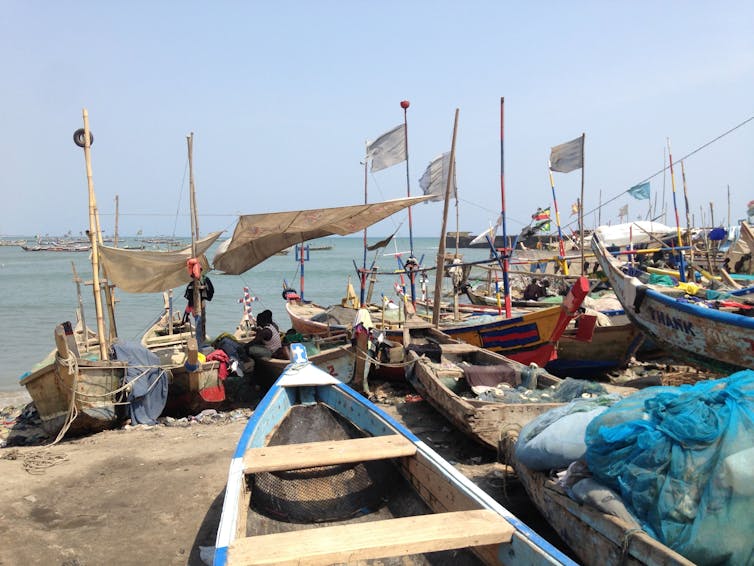
While this profoundly affected the livelihoods of the surf boat owners, as well as the economic prosperity of the Jamestown area, it has still remained an active harbour, returning its focus to fishing. New canoes are still built on the beach, nets are made, repaired and dried, and a large, if casual, fishing market trades off the shore.

Although described as a beach, it’s still a working harbour rather than a place for leisure. Businesses, residences, schools, places of worship and bars have all been established on the beach and a large population considers it their home and community. The place has a very different feel to the rest of the city. It has an intimate connection to the sea, dictated by the tides, rituals, songs and danger that accompanies all fishing communities.

It is “informal”, sometimes appears anarchic, and while not suitable in its current format for freight shipping, its potential for commercial development has caught the attention of the municipality and international investors.

New development

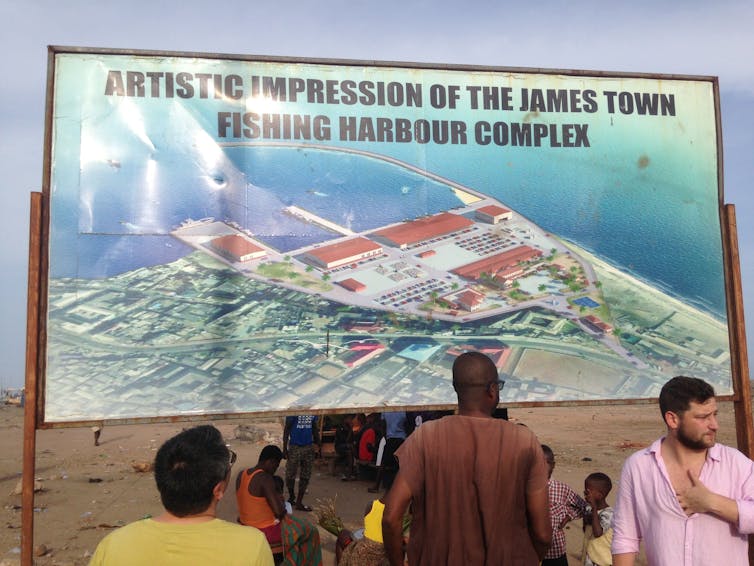
Earlier this year a billboard was suddenly erected on the beach displaying an “artist’s impression” of how the beach is to be developed. It’s a disturbing image in many ways, showing the beach completely cleared of its inhabitants. There’s also a large car park and a series of somewhat bland sheds or factories. There is not one single canoe in sight.

An artist’s impression of the new Jamestown development.
Iain Jackson

The proposal (and its backers) see this site as a convenient place to construct a new factory for the mechanised processing of fish. There is nothing inherently wrong with this as an idea. But the current proposal would not only occupy a prime site with historical significance: it would displace a large community along with their heritage, skills and traditions.

There are four main considerations that have not been addressed by the current proposal. And with the beach already being cleared of its residents and traders, time is running short.

Seafront heritage site: A shoreline development with an historic waterfront requires sensitive and appropriate proposals. A failure to deliver this undersells the site’s potential. It is not appropriate for a factory and car park to be placed on this important plot.

It is hard to imagine any other international port city using its most important natural features in this way. The attractive view over the ocean offers lots of possibility for this site. Reducing it to a fish-gutting production line is shortsighted and lacks ambition.

Community discussion and liaison: The settlements and businesses located on the beach are “informal” (like most of Ghana’s economy). But this must not discount or invalidate their contribution to future development. No one is more invested in this place than the current population, part of the minority Gā community, with their own language and traditions, who have lived and traded here for centuries.

Individual fishing boats and their small hauls may not be the most efficient or lucrative methods of extracting the bounty of the sea. But they bring many advantages. The main traders (and controllers) are women affectionately known as “mammies”, who set the prices and manage supply.

This matriarchal system has been largely responsible for ensuring a strong community. Whilst these traders are fiercely competitive, they care for each other and their lives. Memories and stories are inherently bound to this place – the proposed factory would completely undermine and destroy this market and cohesion.

Mechanised production would also result in fewer employment opportunities. The power would be taken from market traders and fewer fishermen would be required.

Fish stock: Environmentally the mechanised processing and trawlers would be disastrous for the fish stock. The existing method marries periods of fallow with festivals, allowing the sea to recuperate and replenish. There is a rhythm to the current fishing method that responds to the seasons and traditions. It is unlikely this approach will be respected by the new process and the factory’s profit driven approach.

Tourist potential: The first place tourists visit when arriving in Ghana is usually Jamestown and the harbour area. Its two former slaving forts and the historic mercantile core of the town, coupled with the array of festivals and events, have so much potential as revenue creators.


Read more:
Igniting public space at the Chale Wote street art festival in Accra


They must be treated as rare commodities, not as cheap development plots. If this district is gradually eroded, its natural features, historic charm and engaging community dismissed, then what else is there for visitors to see in Accra?

In the last six months eviction processes have started to clear the beach. This is an earnest plea for this proposal to be rethought – and for this fascinating part of the city to be regenerated in a way that celebrates and respects the history and people of Jamestown.

This article is republished from The Conversation under a Creative Commons license. Read the original article.


Thank you to Prof. Ola Uduku of Manchester School of Architecture for reviewing the ‘Sharing Stories from Jamestown’ exhibition. The exhibition has been extended to run until the end of June 2019. Below I’ve uploaded a 360 degree panoramic view – you can ‘click and drag’ the film to have a look around….

ouduku's avatarWARUH: West African Rapid Urbanisation and Heritage Conservation Research Network

Iain Jackson’s exhibition co-curated by Allotey Konuah-Bruce and Joe Addo opened to great acclaim on Saturday evening at the Jamestown Café, venue, near Ussher Fort. Curiously the café it was confirmed by local elders who attended the opening is accurately in Usshertown; the exhibition launch providing a great forum for these questions to be aired and for detailed discussions to be had.

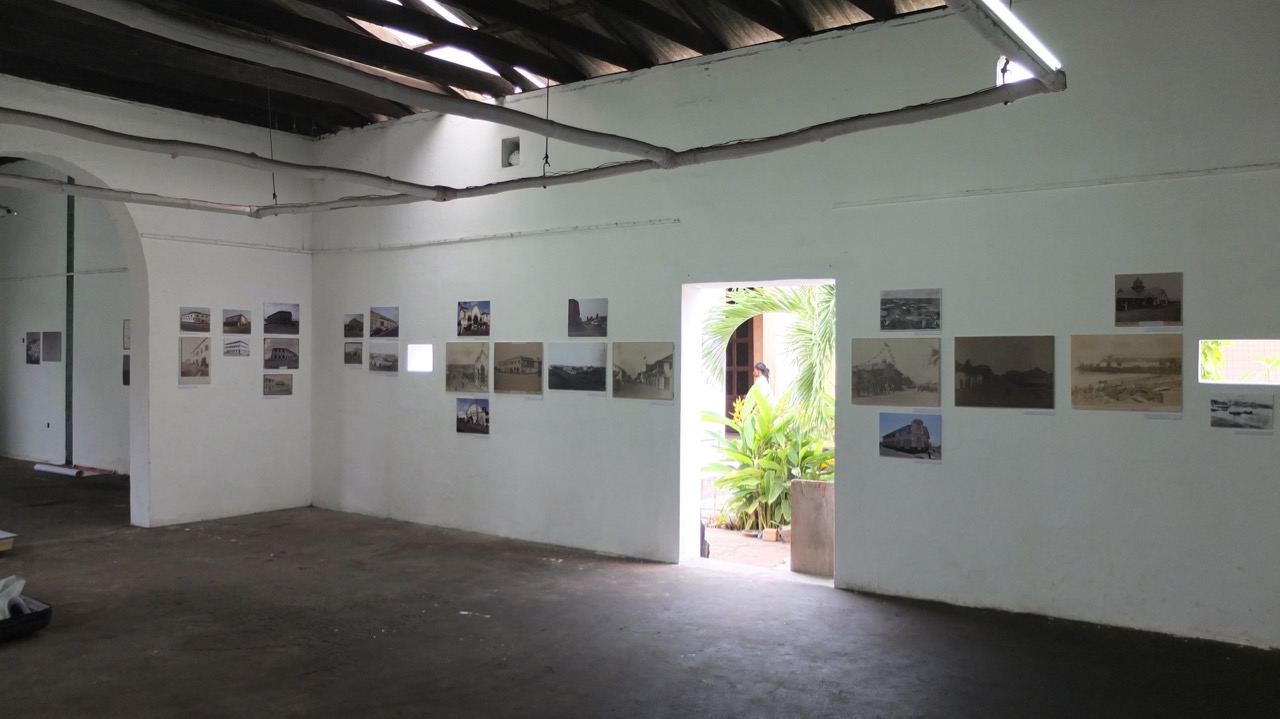
Historic photographs and maps of ‘old’
Jamestown buildings have been placed next to those which show their age,
condition and use, in ‘contemporary’ Jamestown have been displayed in the lower
gallery of the Jamestown Café, which itself features in the exhibition as Tarquah
house, the dwelling and warehouse of one of Jamestown’s wealthy local
merchants, who had originally had it built. The exhibition represents a true
joint collaboration between Iain Jackson and Allotey Konuah-Bruce who have
formed a close and productive working relationship as they have spent the…

View original post 244 more words